Feeling uncertain about what to expect in your upcoming interview? We’ve got you covered! This blog highlights the most important Digital Engagement interview questions and provides actionable advice to help you stand out as the ideal candidate. Let’s pave the way for your success.
Questions Asked in Digital Engagement Interview
Q 1. Explain your experience with different social media platforms and their respective best practices.
My experience spans various social media platforms, each demanding a unique approach. I’ve worked extensively with Facebook, leveraging its robust targeting options and diverse ad formats for lead generation and brand awareness. Instagram, with its visual focus, has been instrumental in crafting compelling storytelling campaigns that resonate with younger demographics. LinkedIn provides a professional networking environment ideal for B2B engagement and thought leadership initiatives. Twitter excels for real-time conversations and crisis communication. For each, understanding the platform’s algorithm and audience is paramount.
Best Practices: These differ slightly per platform but generally include:
- Consistent Posting Schedule: Maintaining a regular presence keeps your audience engaged.
- High-Quality Content: Visual appeal, informative text, and interactive elements are crucial.
- Audience Engagement: Respond promptly to comments and messages; foster a two-way conversation.
- Data-Driven Optimization: Regularly analyze performance metrics to refine your strategy.
- Platform-Specific Strategies: Instagram favors high-quality visuals and short-form video; LinkedIn requires professional tone and industry insights.
For instance, on Facebook, I’ve seen significant success using A/B testing different ad creatives to optimize click-through rates. On Instagram, using relevant hashtags and engaging Stories has boosted brand visibility considerably.
Q 2. Describe your process for developing a digital engagement strategy.
Developing a digital engagement strategy is a multi-step process. It starts with a deep understanding of the business goals and target audience. I typically follow this framework:
- Define Objectives: Clearly articulate what you aim to achieve (e.g., increase brand awareness, generate leads, drive sales).
- Audience Research: Identify your ideal customer profile (ICP), understanding their demographics, psychographics, online behavior, and preferred platforms.
- Platform Selection: Choose the most relevant social media platforms based on your audience’s presence and your objectives.
- Content Planning: Develop a content calendar that aligns with your objectives and audience preferences, encompassing a variety of formats (text, images, videos, infographics).
- Content Creation: Produce high-quality, engaging content that resonates with your target audience and aligns with your brand voice.
- Campaign Execution: Implement the strategy across chosen platforms, using scheduling tools and analytics dashboards.
- Monitoring & Analysis: Track key performance indicators (KPIs) to measure campaign effectiveness and make data-driven adjustments.
- Iteration & Optimization: Continuously refine your strategy based on performance data to maximize results.
For example, for a B2B client, we might focus on LinkedIn and industry-specific blogs, while for a consumer-focused brand, Instagram and TikTok might be more effective.
Q 3. How do you measure the success of a digital engagement campaign?
Measuring the success of a digital engagement campaign requires a multifaceted approach. It goes beyond simply looking at likes and shares. I utilize a combination of quantitative and qualitative metrics:
- Website Traffic: Measuring referral traffic from social media to track engagement effectiveness.
- Conversion Rates: Tracking the percentage of website visitors who complete a desired action (e.g., purchase, sign-up).
- Engagement Rate: Calculating likes, comments, shares, and other interactions relative to the number of followers.
- Brand Mentions: Monitoring mentions of your brand across social media to understand sentiment and reach.
- Social Listening: Using tools to track conversations about your brand or industry to identify emerging trends and customer concerns.
- Customer Feedback: Gathering direct feedback through surveys, comments, and direct messages to understand customer satisfaction and areas for improvement.
For example, a successful campaign might show a significant increase in website traffic, a higher conversion rate, and positive brand sentiment across social media.
Q 4. What key performance indicators (KPIs) are most important for digital engagement?
The most important KPIs for digital engagement are those directly aligned with business objectives. However, some consistently valuable ones include:
- Reach: The number of unique users exposed to your content.
- Engagement Rate: The percentage of your audience interacting with your content (likes, comments, shares).
- Website Traffic: The amount of traffic driven to your website from social media.
- Conversion Rate: The percentage of users completing a desired action (e.g., purchase, sign-up).
- Customer Acquisition Cost (CAC): The cost of acquiring a new customer through your digital engagement efforts.
- Return on Investment (ROI): The overall return on your investment in digital engagement.
- Brand Mentions & Sentiment: Tracking positive and negative brand mentions to gauge public perception.
Prioritizing these KPIs allows for data-driven decision making and continuous optimization of your strategies.
Q 5. How do you identify and target your ideal audience for digital engagement?
Identifying and targeting the ideal audience is crucial for effective digital engagement. I employ a multi-pronged approach:
- In-depth Market Research: Conduct thorough research to understand your target audience’s demographics, psychographics, online behavior, and pain points.
- Competitor Analysis: Analyze your competitors’ audiences to identify potential overlaps and opportunities.
- Social Media Analytics: Utilize platform analytics to gain insights into your current audience’s demographics and interests.
- Persona Development: Create detailed buyer personas representing your ideal customers, including their goals, challenges, and online habits.
- Targeted Advertising: Leverage social media advertising platforms to target specific demographics, interests, and behaviors.
- Content Personalization: Tailor your content to resonate with specific audience segments based on their interests and needs.
For example, we might use Facebook’s detailed targeting options to reach specific age groups, interests, or locations. Understanding your audience is half the battle.
Q 6. What experience do you have with A/B testing and its applications in digital engagement?
A/B testing is a cornerstone of my approach to digital engagement. It involves creating two or more versions of a piece of content (e.g., ad creative, landing page, email subject line) and comparing their performance to determine which version is more effective.
Applications:
- Optimizing Ad Creatives: Testing different images, headlines, and calls to action to improve click-through rates and conversions.
- Improving Website Conversion: Testing different layouts, calls to action, and form fields to increase conversion rates.
- Enhancing Email Marketing: Testing subject lines, email content, and call to actions to improve open rates and click-through rates.
- Social Media Post Optimization: Testing different types of content, posting times, and hashtags to maximize engagement.
I use tools like Google Optimize and other A/B testing platforms. For example, I recently A/B tested two different headlines for a Facebook ad campaign. One headline focused on the features of the product, while the other focused on the benefits. The benefit-driven headline resulted in a significantly higher click-through rate.
Q 7. Describe your experience with content marketing and its role in digital engagement.
Content marketing plays a vital role in digital engagement. It involves creating and distributing valuable, relevant, and consistent content to attract and retain a clearly defined audience — and, ultimately, to drive profitable customer action. It’s about building relationships, not just selling products or services.
Role in Digital Engagement:
- Attracting and Engaging Audiences: High-quality content attracts potential customers and keeps them engaged.
- Building Brand Awareness: Consistent content creation reinforces brand identity and messaging.
- Driving Traffic to Website: Content promotes website visits, leading to potential conversions.
- Establishing Thought Leadership: Providing insightful content positions your brand as an authority in your industry.
- Improving SEO: Well-optimized content improves search engine rankings, increasing visibility.
For example, we might create blog posts, infographics, videos, and webinars to educate our target audience about industry trends and our solutions. This approach helps us build trust and establish ourselves as a thought leader, which translates into improved digital engagement and higher conversions.
Q 8. How familiar are you with SEO and SEM best practices?
SEO (Search Engine Optimization) and SEM (Search Engine Marketing) are fundamental to digital engagement. SEO focuses on organic (unpaid) search results, improving website visibility through techniques like keyword research, on-page optimization (title tags, meta descriptions, content quality), and off-page optimization (backlinks). SEM, on the other hand, involves paid advertising through platforms like Google Ads, allowing for targeted campaigns and immediate results. Best practices involve a holistic approach, combining both SEO and SEM for maximum impact. For example, a well-structured website with high-quality content (SEO) will perform even better when complemented by targeted Google Ads campaigns (SEM) driving traffic to specific pages.
- SEO Best Practices: Keyword research using tools like SEMrush or Ahrefs, creating high-quality, engaging content, building high-authority backlinks from reputable websites, optimizing website speed and mobile-friendliness.
- SEM Best Practices: Precise keyword targeting, compelling ad copy, A/B testing different ad variations, setting a clear budget and monitoring campaign performance, using relevant ad extensions to improve click-through rates.
Effectively combining SEO and SEM creates a synergistic effect, amplifying the reach and impact of your digital engagement strategy. Think of it like this: SEO is building a strong foundation, while SEM is adding a powerful engine to accelerate your growth.
Q 9. Explain your understanding of influencer marketing and its potential impact.
Influencer marketing leverages the reach and credibility of influential individuals (influencers) on social media and other platforms to promote products, services, or brands. The impact can be significant, ranging from increased brand awareness and reach to driving sales and generating leads. The key is selecting the right influencers whose audience aligns with your target market. For instance, a fitness brand might collaborate with fitness influencers on Instagram to showcase their products, reaching a highly engaged and relevant audience.
Potential Impacts:
- Increased Brand Awareness: Influencers introduce your brand to their followers, expanding your reach and building familiarity.
- Improved Brand Trust and Credibility: Consumers are often more receptive to recommendations from trusted influencers.
- Higher Engagement Rates: Influencer posts typically have higher engagement rates than standard brand posts.
- Direct Sales and Lead Generation: Influencers can drive traffic to your website or e-commerce platform, resulting in increased conversions.
Successful influencer marketing requires careful planning, including influencer selection based on audience demographics, engagement rate, and brand alignment. Measurement is also crucial, tracking key metrics such as reach, engagement, website traffic, and sales conversions to assess ROI.
Q 10. How do you manage and respond to negative comments or feedback on social media?
Managing negative comments on social media requires a prompt, professional, and empathetic approach. Ignoring negative feedback is never a good strategy. My approach involves:
- Monitoring: Actively monitoring social media channels for comments and mentions.
- Responding Promptly: Addressing negative comments within a reasonable timeframe (ideally within 24 hours).
- Acknowledging the Feedback: Showing empathy and understanding by acknowledging the user’s concerns. For example, ‘I understand your frustration regarding…’
- Offering a Solution: Where possible, offer a solution or resolution to the problem. This might involve offering a refund, providing customer support, or investigating the issue.
- Moving the Conversation Offline (if necessary): If the issue is complex or requires sensitive information, offer to contact the user privately via email or phone.
- Learning from Feedback: Analyze negative feedback to identify areas for improvement and prevent similar issues from occurring in the future.
Example: If a customer complains about a faulty product, I would respond acknowledging their frustration, apologize for the inconvenience, offer a replacement or refund, and provide contact information for further assistance. This demonstrates proactive customer service and helps to mitigate potential negative impacts.
Q 11. Describe your experience with email marketing and automation tools.
I have extensive experience with email marketing and automation tools. Email marketing remains a powerful tool for nurturing leads, building relationships, and driving conversions. Automation tools allow for efficient management and personalization of email campaigns. I’m proficient in using platforms like Mailchimp, Constant Contact, and HubSpot, leveraging their features for segmentation, automated workflows, A/B testing, and performance tracking.
My experience encompasses:
- Email List Building: Implementing strategies to grow email lists through website forms, lead magnets, and social media promotions.
- Email Segmentation: Dividing email lists into targeted segments based on demographics, behavior, or purchase history to personalize messaging.
- Workflow Automation: Setting up automated email sequences for onboarding new subscribers, nurturing leads, and promoting products or services.
- A/B Testing: Testing different subject lines, email content, and call-to-actions to optimize campaign performance.
- Performance Analysis: Tracking key metrics like open rates, click-through rates, and conversions to measure campaign effectiveness and make data-driven improvements.
I’ve successfully implemented email campaigns resulting in significant increases in lead generation, customer engagement, and sales conversions.
Q 12. What is your experience with analytics platforms like Google Analytics?
Google Analytics is my go-to analytics platform for tracking website traffic, user behavior, and campaign performance. I’m highly proficient in using Google Analytics to gain insights into key metrics and make data-driven decisions for optimizing digital engagement strategies. My experience includes:
- Website Traffic Analysis: Tracking sources of website traffic, bounce rates, and session duration to understand user engagement.
- User Behavior Analysis: Analyzing user flows, pageviews, and conversion paths to identify areas for improvement in website design and user experience.
- Campaign Tracking: Setting up campaign tracking codes to measure the effectiveness of different marketing initiatives.
- Goal Setting and Conversion Tracking: Defining key goals and setting up conversion tracking to monitor progress toward achieving those goals.
- Data Visualization and Reporting: Creating custom reports and dashboards to visualize data and communicate insights to stakeholders.
I use the data from Google Analytics to inform decisions about content creation, SEO optimization, paid advertising, and overall digital strategy. Essentially, Google Analytics provides the crucial data needed to understand what’s working, what’s not, and how to improve digital engagement.
Q 13. How do you stay current with the latest trends in digital engagement?
Staying current with the ever-evolving landscape of digital engagement requires a multi-faceted approach. I actively utilize several methods to remain updated on the latest trends:
- Industry Publications and Blogs: I regularly read industry publications, blogs, and newsletters from reputable sources like Search Engine Journal, Marketing Land, and Neil Patel’s blog.
- Conferences and Webinars: Attending industry conferences and webinars allows me to learn from experts and network with other professionals.
- Social Media: Following key influencers and industry leaders on platforms like Twitter and LinkedIn to stay informed about emerging trends.
- Online Courses and Certifications: Continuously expanding my skillset through online courses and certifications offered by platforms like Coursera, edX, and Google Digital Garage.
- Competitor Analysis: Regularly analyzing the digital strategies of competitors to stay ahead of the curve and identify best practices.
This holistic approach ensures I remain informed and can apply the most up-to-date strategies and best practices to my work.
Q 14. Describe a time you had to overcome a challenge in a digital engagement campaign.
In a recent campaign for a client in the e-commerce sector, we experienced a significant drop in website traffic from a key social media platform. Initial investigations pointed to an algorithm change on the platform, impacting the organic reach of our posts. This presented a significant challenge as a large portion of our traffic originated from this channel.
To overcome this challenge, we implemented a multi-pronged strategy:
- Diversification of Social Media Channels: We shifted some of our resources to other platforms like TikTok and Pinterest, identifying channels with greater organic reach and alignment with our target audience.
- Paid Social Media Advertising: We increased our investment in paid social media advertising to compensate for the loss in organic reach.
- SEO Optimization: We focused on enhancing our SEO strategy to improve organic search engine rankings and drive website traffic from search engines.
- Email Marketing Campaign: We launched a targeted email marketing campaign to re-engage existing customers and acquire new leads.
- Content Strategy Refinement: We adapted our content strategy, creating content formats and topics more relevant to the algorithms of various platforms.
By implementing this comprehensive approach, we successfully mitigated the impact of the algorithm change and maintained a steady flow of traffic to the client’s website, demonstrating adaptability and problem-solving skills in a dynamic digital environment.
Q 15. What is your experience with CRM systems and their role in customer engagement?
CRM systems are the backbone of effective customer engagement. They’re essentially centralized databases that store and manage all customer interactions and data. This includes contact information, purchase history, support tickets, and even social media interactions. My experience encompasses working with several leading CRMs, including Salesforce, HubSpot, and Zoho. I’ve utilized these platforms to segment customers, personalize communications, track campaign performance, and ultimately, improve customer satisfaction and loyalty. For example, in a previous role, we used Salesforce to identify high-value customers who were at risk of churning. By proactively reaching out with personalized offers and support, we successfully reduced churn by 15%. This highlights how a CRM doesn’t just store data; it empowers data-driven decision-making for enhanced engagement.
A crucial aspect of CRM implementation is ensuring seamless integration with other marketing and sales tools. This allows for a holistic view of the customer journey, facilitating a more cohesive and personalized experience. For instance, integrating a CRM with marketing automation software allows for automated email campaigns triggered by specific customer actions within the CRM.
Career Expert Tips:
- Ace those interviews! Prepare effectively by reviewing the Top 50 Most Common Interview Questions on ResumeGemini.
- Navigate your job search with confidence! Explore a wide range of Career Tips on ResumeGemini. Learn about common challenges and recommendations to overcome them.
- Craft the perfect resume! Master the Art of Resume Writing with ResumeGemini’s guide. Showcase your unique qualifications and achievements effectively.
- Don’t miss out on holiday savings! Build your dream resume with ResumeGemini’s ATS optimized templates.
Q 16. How do you integrate digital engagement strategies with overall marketing goals?
Integrating digital engagement strategies with overall marketing goals is paramount for success. It’s not enough to simply have a strong social media presence; it needs to align with broader business objectives. I approach this by first clearly defining the overarching marketing goals – are we aiming to increase brand awareness, drive sales, improve customer retention, or something else? Once these goals are defined, I develop digital engagement strategies that directly contribute to achieving them. This involves setting key performance indicators (KPIs) that are directly tied to the marketing goals, such as website traffic, lead generation, conversion rates, or social media engagement.
For example, if the goal is to increase brand awareness, the digital engagement strategy might focus on creating engaging content for social media, running targeted advertising campaigns, and optimizing website SEO. Each digital initiative should have a clearly defined path that leads back to the overall marketing objective. Regular monitoring and analysis of KPIs are critical to ensure the strategies are on track and make necessary adjustments.
Q 17. Explain your experience with different types of content formats (video, images, text).
My experience spans a wide range of content formats, and I understand that the optimal format depends heavily on the target audience and the message.
- Video: I’ve produced and managed video content for various platforms, from short, attention-grabbing social media clips to longer, more in-depth explainer videos on YouTube. I understand the importance of high-quality production and compelling storytelling to maximize engagement.
- Images: High-quality visuals are essential for capturing attention. I have experience selecting and optimizing images for different channels, ensuring they are visually appealing and consistent with the brand’s identity. This includes using tools like Adobe Photoshop and Canva for image editing and optimization.
- Text: Effective text-based content is crucial for conveying information and building a connection with the audience. My experience includes writing blog posts, website copy, email newsletters, and social media captions. I understand the principles of effective writing, including clarity, conciseness, and SEO optimization.
I often combine these formats to create a more engaging and comprehensive experience for the audience. For example, a blog post might include embedded videos and high-quality images to break up text and make the content more visually appealing.
Q 18. What is your understanding of the customer journey and how it impacts digital engagement?
The customer journey is the path a customer takes from initial awareness of a brand to becoming a loyal advocate. Understanding this journey is critical for effective digital engagement. It involves identifying all the touchpoints a customer has with the brand – from website visits and social media interactions to email communications and customer service interactions.
By mapping out the customer journey, we can identify opportunities to improve the customer experience and tailor our digital engagement strategies to each stage. For example, in the awareness stage, the focus might be on creating engaging content to attract potential customers. In the consideration stage, the focus might shift to providing information and resources to help customers make informed decisions. In the decision stage, the focus might be on providing compelling calls to action and overcoming objections. Finally, in the loyalty stage, the focus might be on nurturing relationships and encouraging repeat business. A well-defined customer journey allows us to personalize the experience and deliver the right message at the right time, thereby increasing engagement and conversion rates.
Q 19. How do you leverage data to inform digital engagement strategies?
Data is the lifeblood of effective digital engagement strategies. I leverage data from various sources, including website analytics (Google Analytics), CRM systems, social media platforms, and marketing automation tools, to understand customer behavior, preferences, and pain points.
This data informs decisions about which content to create, which channels to use, and how to target specific customer segments. For example, analyzing website analytics can reveal which pages are most popular, which keywords are driving traffic, and where users are dropping off in the conversion funnel. This information can be used to optimize website content and improve the user experience. Similarly, social media analytics can provide insights into audience demographics, interests, and engagement levels, allowing us to tailor our content and messaging to resonate with specific audience segments.
I utilize tools like Google Data Studio to create dashboards that visualize key metrics and track the performance of our digital engagement strategies. This allows us to identify what’s working and what’s not, and make data-driven decisions to optimize our campaigns for better results.
Q 20. Describe your experience with budget allocation and ROI in digital engagement.
Budget allocation and ROI are critical considerations in digital engagement. My approach involves a data-driven, phased approach. First, I establish clear objectives and KPIs for each campaign. Then, I carefully research and analyze the costs associated with different channels and strategies. This includes considering factors such as advertising costs, content creation costs, and personnel costs.
I then allocate the budget strategically, prioritizing channels and strategies that have the highest potential for ROI based on past performance data and industry benchmarks. For instance, if email marketing consistently delivers a high ROI, a larger portion of the budget might be allocated to this channel. Throughout the campaign, I consistently monitor KPIs to track progress and identify areas for optimization. Regular reporting and analysis allow me to assess the ROI of different initiatives and make necessary adjustments to the budget allocation to maximize return.
It’s important to remember that ROI in digital engagement is not just about immediate financial returns. Building brand awareness and fostering customer loyalty are also valuable long-term investments that contribute to overall business success. Therefore, a balanced approach that considers both short-term and long-term goals is essential.
Q 21. How do you manage multiple digital engagement campaigns simultaneously?
Managing multiple digital engagement campaigns simultaneously requires a well-structured and organized approach. I rely on project management methodologies, such as Agile, to ensure efficient workflow and coordination. This involves breaking down large campaigns into smaller, manageable tasks and assigning responsibilities to team members.
I use project management tools like Asana or Trello to track progress, deadlines, and deliverables for each campaign. Regular team meetings and communication are crucial for keeping everyone informed and aligned. A key aspect of managing multiple campaigns is effective prioritization. I focus on allocating resources and attention to the campaigns with the highest priority and potential impact. Clear communication and collaboration among team members are essential to avoid conflicts and ensure that all campaigns are executed effectively and on schedule. This is often supported by utilizing centralized content calendars and robust reporting systems that give a clear overview of all active campaigns.
Q 22. What is your experience with social listening and its use in understanding customer sentiment?
Social listening is the process of monitoring online conversations and mentions related to your brand, industry, competitors, or specific topics. It’s crucial for understanding customer sentiment because it provides valuable insights into what people are saying about you, both positive and negative. This allows for proactive issue management and strategic adjustments to improve products, services, and overall customer experience.
In my previous role, we used social listening tools like Brandwatch and Talkwalker to track mentions of our brand across various social media platforms, forums, and news websites. We analyzed the data to identify trending topics, understand customer feedback on new product launches, and gauge the effectiveness of our marketing campaigns. For example, we discovered negative sentiment surrounding a recent software update through social listening. This allowed us to swiftly address customer concerns through targeted communication and a revised update, preventing further damage to our brand reputation.
- Sentiment Analysis: We used automated sentiment analysis to categorize mentions as positive, negative, or neutral. This gave us a quick overview of overall sentiment.
- Topic Clustering: We identified key themes and topics related to our brand, allowing us to focus on the most pressing issues.
- Competitor Analysis: We compared our brand mentions to those of our competitors to identify areas for improvement and opportunities to differentiate ourselves.
Q 23. How do you ensure brand consistency across various digital platforms?
Maintaining brand consistency across various digital platforms is essential for building a strong and recognizable brand identity. This involves creating a unified brand voice, visual style, and messaging across all channels. Inconsistency can lead to confusion and dilute the brand’s message.
My approach involves developing a comprehensive brand style guide that outlines the brand’s personality, voice, logo usage, color palette, typography, and image guidelines. This guide serves as a centralized resource for all teams involved in digital engagement. We then use project management tools to ensure adherence to this guide across all platforms. Regular audits and training sessions for team members reinforce brand consistency. For instance, a brand voice document could dictate using a friendly, informal tone on Instagram while adopting a more professional tone on LinkedIn. Visual consistency involves adhering to the same color schemes and logo variations across all platforms, from website banners to social media posts.
Q 24. Describe your experience with using project management tools for digital campaigns.
I have extensive experience utilizing project management tools like Asana, Trello, and Monday.com for planning, executing, and tracking digital campaigns. These tools are instrumental in managing tasks, deadlines, budgets, and team collaborations. They provide a centralized platform for tracking progress, identifying bottlenecks, and ensuring accountability.
For instance, when launching a large-scale social media campaign, I’d use a project management tool to break down the campaign into smaller, manageable tasks. This includes content creation, scheduling, social media listening, and performance analysis. Each task would be assigned to specific team members with clear deadlines and responsibilities. The tool’s progress tracking feature helps monitor the campaign’s overall progress, allowing for proactive adjustments as needed. We utilize Gantt charts to visualize the project timeline and identify potential conflicts.
Q 25. How do you handle pressure and deadlines in a fast-paced digital environment?
The digital landscape is constantly evolving, demanding adaptability and resilience. Handling pressure and deadlines effectively requires a structured approach.
My strategy involves prioritizing tasks based on urgency and importance using methods like the Eisenhower Matrix. I break down large projects into smaller, manageable tasks, creating a realistic timeline with buffer time for unexpected delays. Effective communication with my team is crucial – transparently sharing updates and potential challenges ensures everyone is aligned and prepared. Proactive problem-solving, seeking help when needed, and practicing stress management techniques like short breaks and mindfulness are also vital.
For example, facing a tight deadline for a product launch campaign, I prioritized the key elements of the campaign, delegating tasks efficiently and monitoring progress closely. Open communication with the team about the urgency ensured everyone was focused and working collaboratively. By using a combination of organization, communication, and stress management, the campaign was successfully launched on time.
Q 26. Explain your approach to building and maintaining a strong online community.
Building and maintaining a strong online community requires a multi-faceted approach that focuses on engagement, trust, and value creation. It’s about fostering a sense of belonging and shared interest among your audience.
My approach starts with identifying the core values and interests of your target audience. This informs the content strategy and the types of interactions you cultivate. We use interactive content like polls, Q&As, and contests to encourage participation. We actively respond to comments and messages, fostering two-way communication. Creating dedicated spaces for community members to connect, such as forums or Facebook groups, is crucial. Moderation is key – establishing clear community guidelines and actively addressing any negativity or inappropriate behavior ensures a positive and welcoming environment. Regularly analyze community engagement metrics to understand what resonates with the audience and adapt the strategy accordingly. Think of it as cultivating a garden – you need to nurture it consistently to see growth.
Q 27. What are your thoughts on the ethical implications of digital engagement strategies?
Ethical considerations are paramount in digital engagement. Transparency, honesty, and respect for user privacy are foundational. Ethical challenges include issues like data privacy, manipulative advertising, and the spread of misinformation.
My approach emphasizes adhering to data privacy regulations like GDPR and CCPA. We ensure transparency in data collection practices and obtain informed consent from users. We avoid manipulative tactics like dark patterns in website design or misleading advertising. We actively combat misinformation by promoting fact-checking and responsible content sharing. Ethical considerations aren’t an afterthought; they should be integrated into the strategy from the outset.
Q 28. How do you adapt your digital engagement approach to different target audiences?
Adapting your digital engagement approach to different target audiences requires a deep understanding of their demographics, psychographics, and online behavior. A one-size-fits-all strategy rarely succeeds.
My approach involves conducting thorough audience research to identify the specific needs, preferences, and pain points of each target group. This informs the choice of platforms, content formats, messaging styles, and the overall tone of communication. For example, a campaign targeting young adults might leverage platforms like TikTok and Instagram, utilizing short-form videos and interactive content. Meanwhile, a campaign targeting professionals might focus on LinkedIn and professional blogs, using more formal and data-driven content. Consistent monitoring and analysis of engagement metrics help in optimizing the approach for each audience segment. Essentially, it’s about speaking the right language to the right people on the right platform.
Key Topics to Learn for Your Digital Engagement Interview
- Digital Strategy & Planning: Understanding the process of developing and implementing comprehensive digital strategies aligned with business objectives. Consider case studies showcasing your ability to define target audiences, set measurable goals (KPIs), and choose appropriate channels.
- Social Media Marketing: Beyond simply posting, delve into audience engagement, community management, content calendar creation, social listening, and analyzing campaign performance using relevant metrics. Think about how you’d handle a crisis on social media.
- Content Marketing & SEO: Explore the synergy between creating engaging content and optimizing it for search engines. Understanding keyword research, on-page and off-page optimization, and content distribution strategies is crucial. How would you measure the success of a content marketing campaign?
- Email Marketing & Automation: Mastering email marketing involves more than just sending newsletters. Understand segmentation, personalization, A/B testing, email deliverability, and automation workflows. How would you design an email campaign to nurture leads?
- Data Analytics & Reporting: Demonstrate your ability to interpret data from various digital platforms (Google Analytics, social media analytics, etc.) to track performance, identify trends, and inform future strategies. Practice explaining complex data in a clear and concise manner.
- Digital Advertising (PPC, Paid Social): Gain a strong understanding of different digital advertising platforms (Google Ads, Facebook Ads, etc.), campaign management, budgeting, targeting, and optimization techniques. Prepare to discuss your experience managing ad campaigns and interpreting their results.
- Website Analytics & UX/UI: Understanding website analytics is vital, but equally important is your understanding of user experience and interface design principles. How would you improve the user experience of a website based on data analysis?
Next Steps
Mastering Digital Engagement is key to unlocking exciting career opportunities in a rapidly evolving field. To maximize your chances of landing your dream role, focus on creating a compelling and ATS-friendly resume that showcases your skills and experience effectively. ResumeGemini is a trusted resource that can help you build a professional resume that stands out from the competition. We provide examples of resumes tailored to Digital Engagement roles to inspire you and guide your process. Take the next step towards your dream job – build a winning resume today!
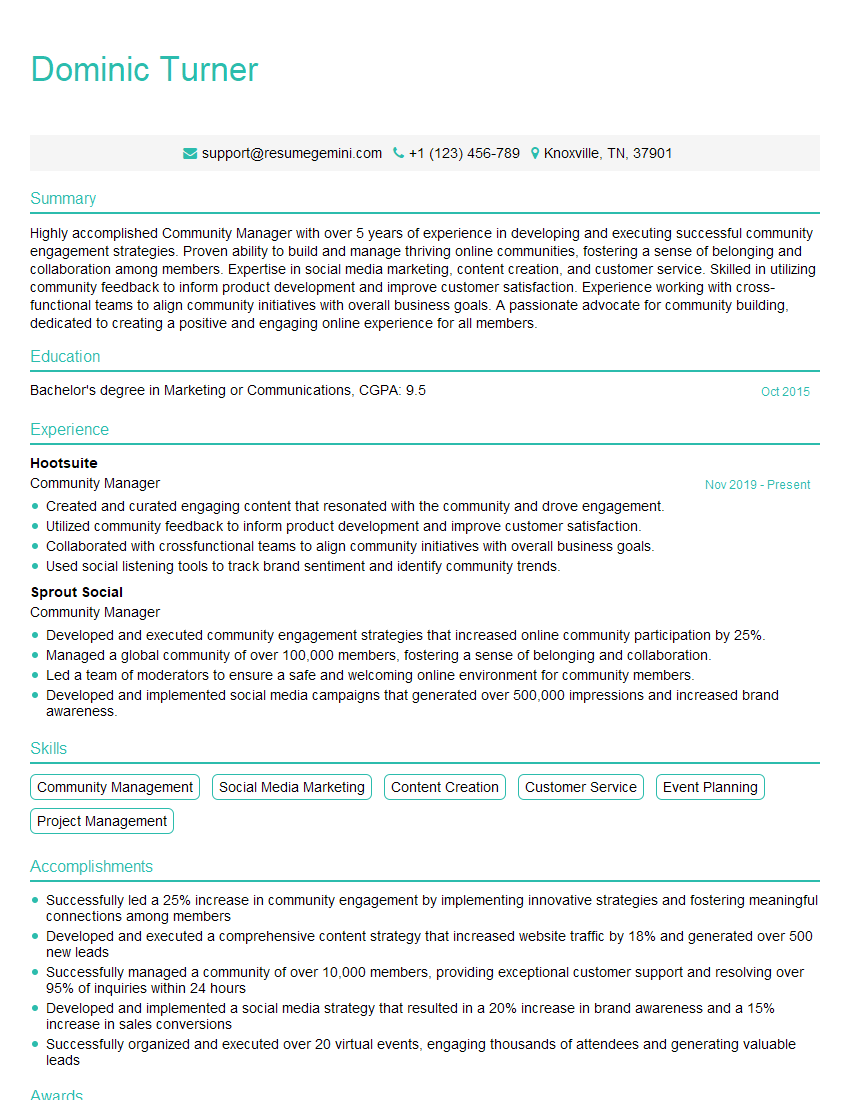
Community Manager Resume Sample

Social Media Manager Resume Sample
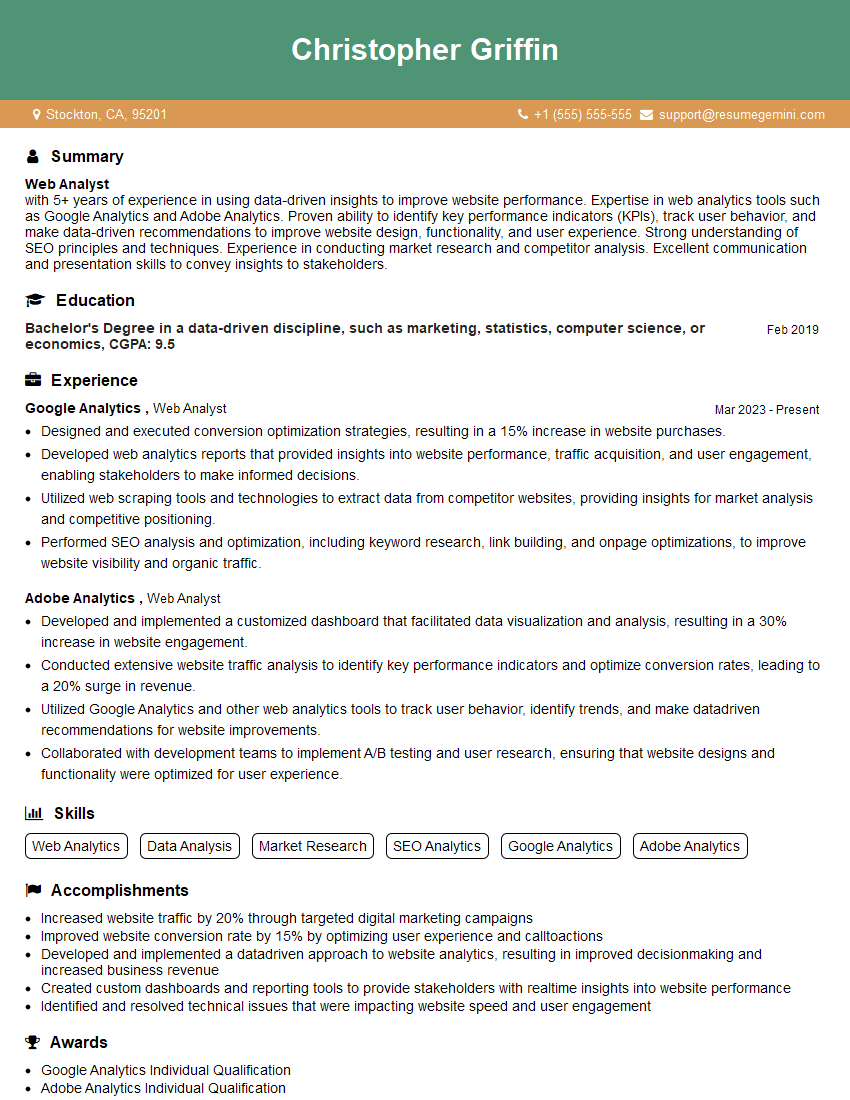
Web Analyst Resume Sample
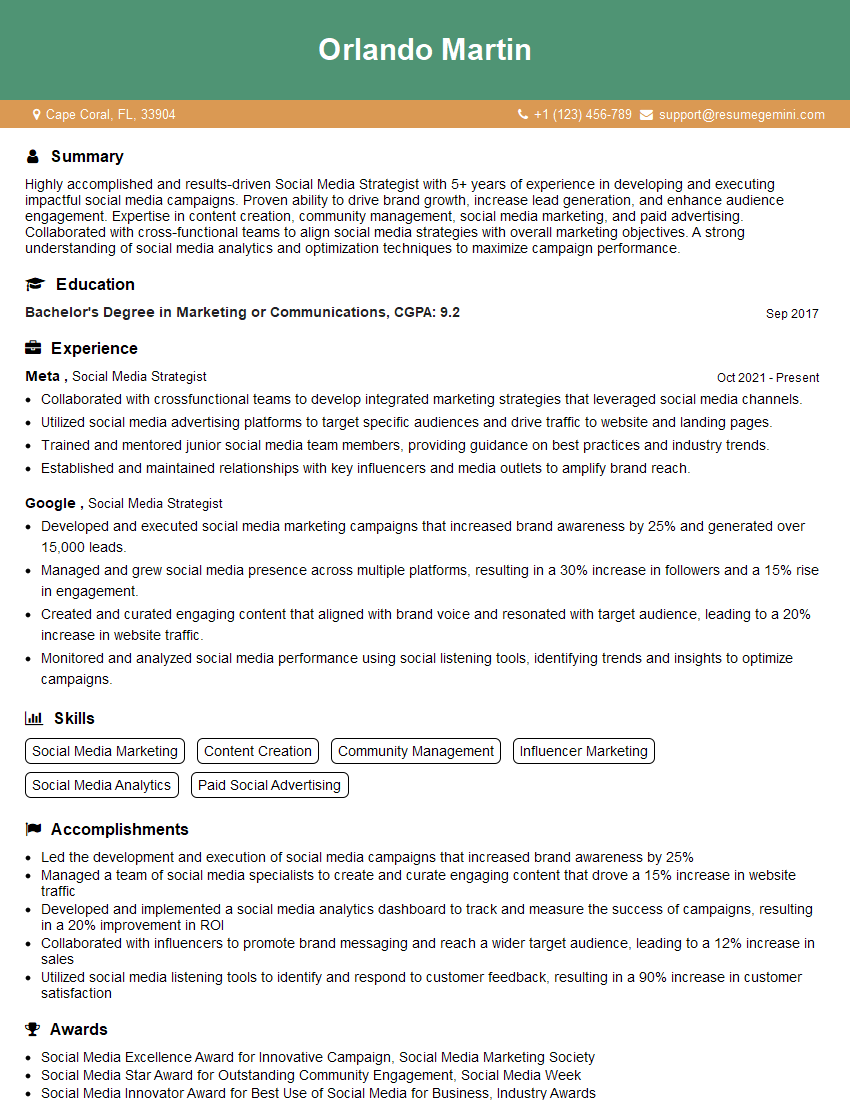
Social Media Strategist Resume Sample

Content Strategist Resume Sample

Growth Hacker Resume Sample
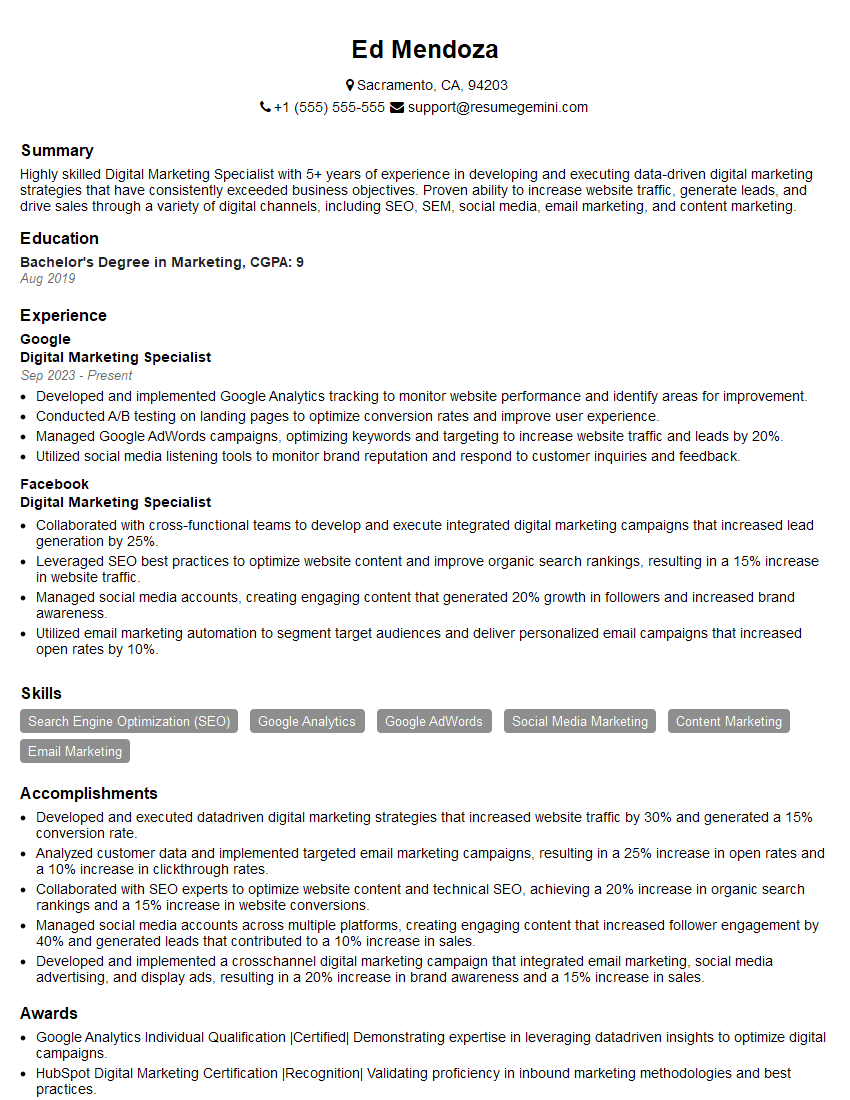
Digital Marketing Specialist Resume Sample
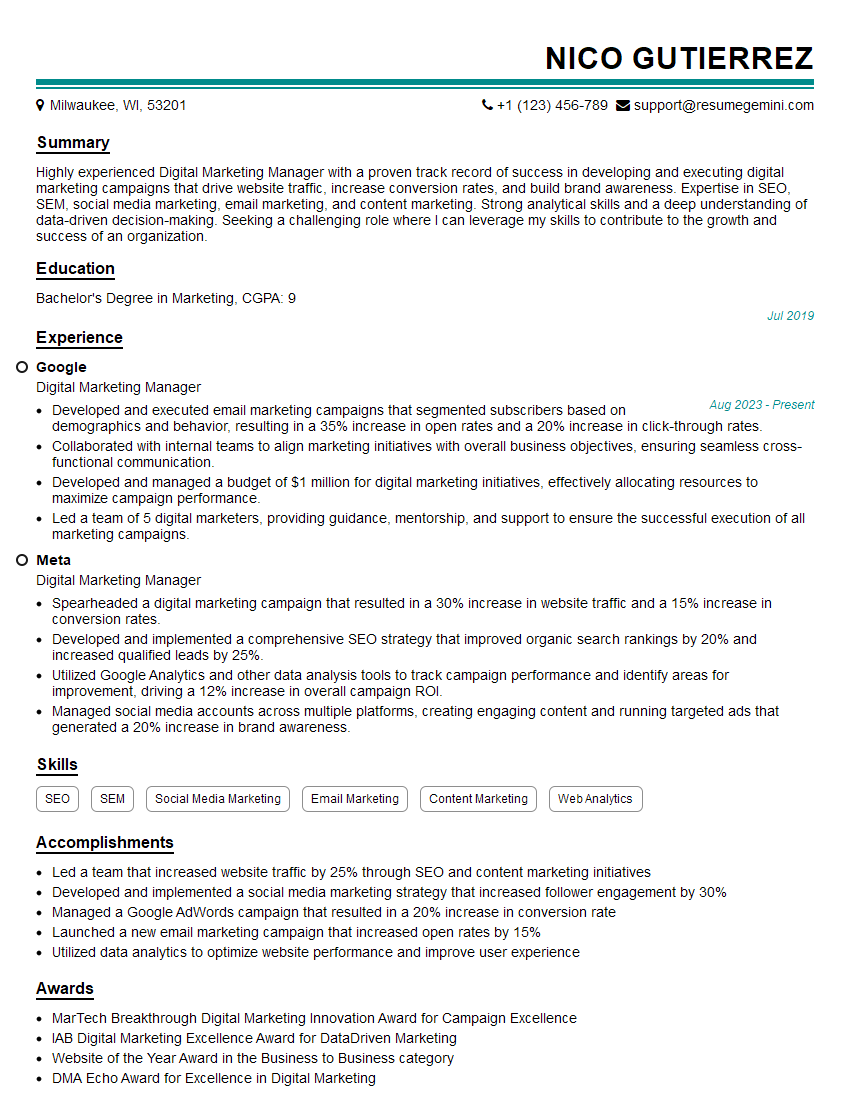
Digital Marketing Manager Resume Sample
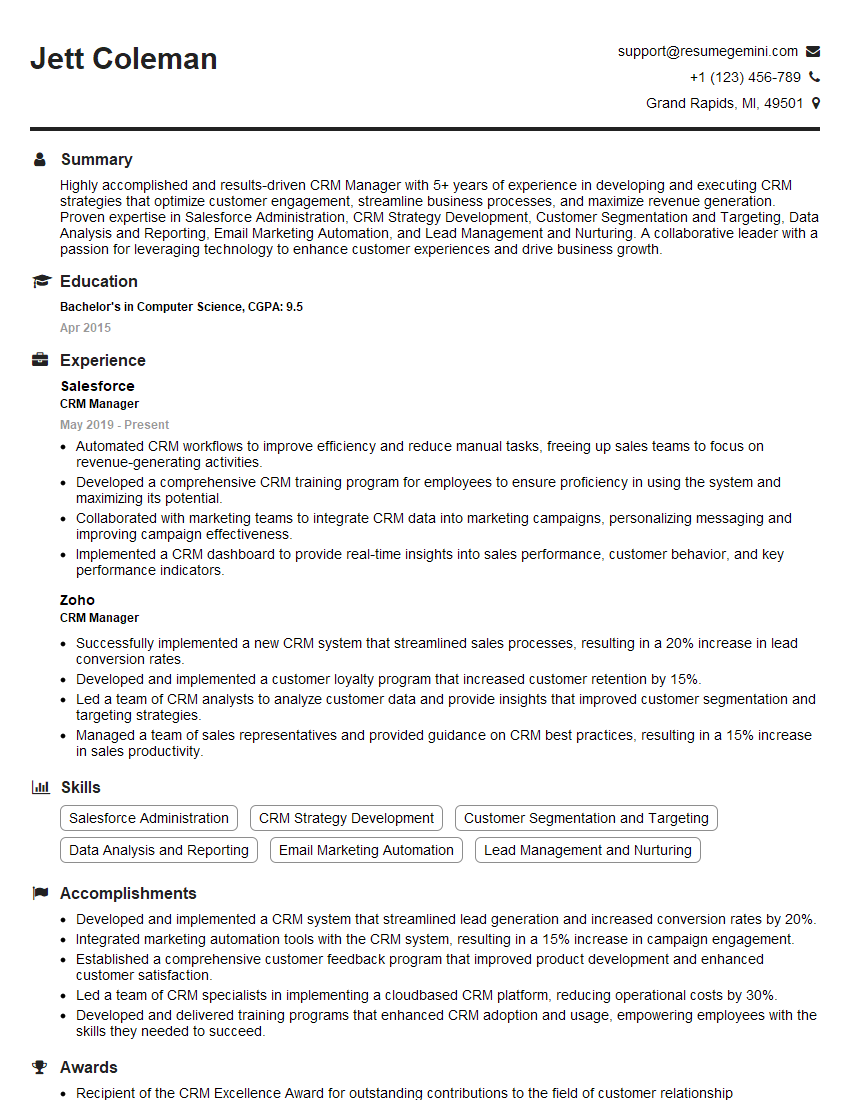
CRM Manager Resume Sample
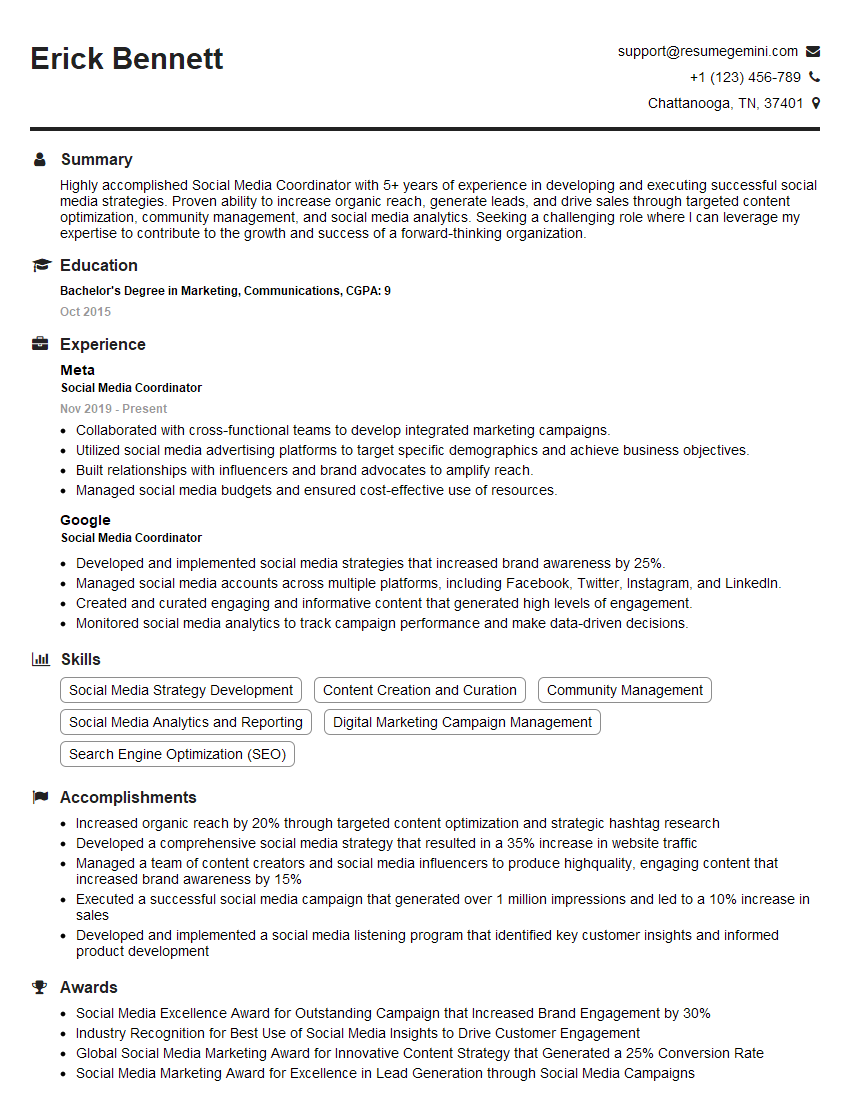
Social Media Coordinator Resume Sample
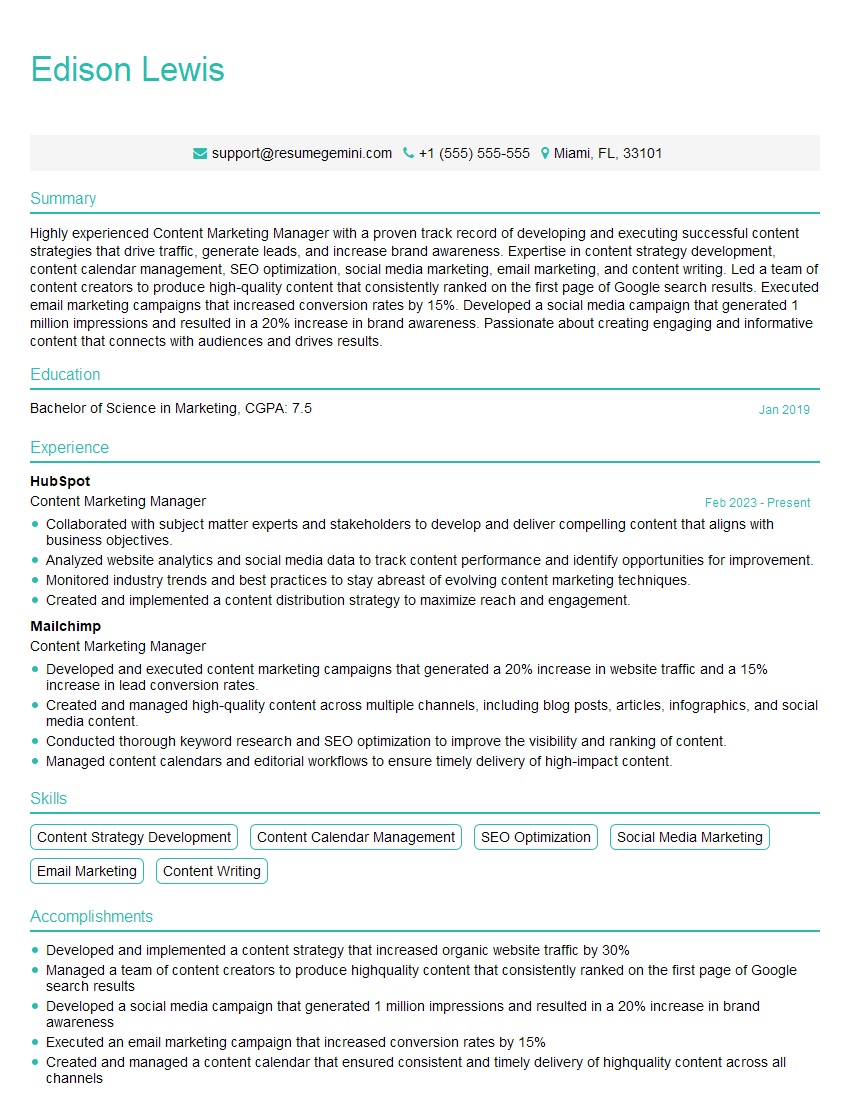
Content Marketing Manager Resume Sample

Influencer Marketing Manager Resume Sample
Explore more articles
Users Rating of Our Blogs
Share Your Experience
We value your feedback! Please rate our content and share your thoughts (optional).
What Readers Say About Our Blog
To the interviewgemini.com Webmaster.
Very helpful and content specific questions to help prepare me for my interview!
Thank you
To the interviewgemini.com Webmaster.
This was kind of a unique content I found around the specialized skills. Very helpful questions and good detailed answers.
Very Helpful blog, thank you Interviewgemini team.