Preparation is the key to success in any interview. In this post, we’ll explore crucial Electrical Inspection and Compliance interview questions and equip you with strategies to craft impactful answers. Whether you’re a beginner or a pro, these tips will elevate your preparation.
Questions Asked in Electrical Inspection and Compliance Interview
Q 1. Explain the NEC (National Electrical Code) and its significance in electrical installations.
The National Electrical Code (NEC) is a widely adopted standard for the safe installation of electrical wiring and equipment in the United States. It’s not a law itself, but it’s often adopted by local governments and enforced through building codes. Think of it as a comprehensive rulebook for electricians, ensuring safety and preventing electrical hazards. The NEC’s significance lies in its role in minimizing fire risks, electrical shocks, and other electrical-related injuries. It covers everything from wiring methods and circuit protection to grounding and bonding requirements for various types of buildings and installations. Regular updates reflect advancements in technology and safety practices, keeping pace with the evolving electrical landscape. Compliance with the NEC is crucial for ensuring safe and functional electrical systems.
For example, the NEC specifies the appropriate wire gauge for different amperage loads, preventing overheating and fire hazards. It also dictates the required types of circuit breakers and ground fault circuit interrupters (GFCIs) for specific applications.
Q 2. Describe your experience with different types of electrical testing equipment.
My experience encompasses a wide range of electrical testing equipment. I’m proficient in using multimeters for measuring voltage, current, and resistance, essential for troubleshooting and verifying circuit integrity. I regularly employ clamp meters to measure current without disconnecting wires, speeding up diagnostics. For more comprehensive testing, I utilize insulation resistance testers (meggers) to check the integrity of insulation on wires and cables, identifying potential weaknesses before they cause problems. Ground resistance testers are crucial for ensuring proper grounding, a key safety feature. In addition, I have experience using various types of specialized testers for specific applications, including arc flash testing equipment for high-voltage systems. Each tool plays a vital role in assessing the safety and performance of electrical systems.
Q 3. How do you identify and report electrical hazards in a workplace?
Identifying electrical hazards requires a systematic approach. I start with a thorough visual inspection, looking for frayed wires, damaged insulation, overloaded circuits, exposed wiring, and improper grounding. I then use testing equipment (as described in the previous answer) to confirm my observations and identify hidden issues. For instance, a seemingly intact wire might have degraded insulation detectable only with a megger. Once hazards are identified, I document them meticulously, including photographs and detailed descriptions of the location, nature, and potential severity of each hazard. This documentation is vital for reporting and remedial action. My reports always include clear recommendations for corrective measures, prioritizing immediate safety concerns. For example, if I find a damaged outlet in a high-traffic area, I will recommend immediate replacement to prevent electric shock.
Q 4. What are the common causes of electrical fires, and how can they be prevented?
Electrical fires are often caused by a combination of factors, but common culprits include overloaded circuits, faulty wiring, damaged insulation, loose connections, and overheating equipment. Overloaded circuits occur when too many appliances draw power from a single circuit, exceeding its capacity. Faulty wiring, such as frayed wires or improper connections, can create sparks that ignite nearby combustible materials. Damaged insulation allows exposed wires to come into contact, causing short circuits and arcing. Loose connections create resistance, generating heat that can ignite surrounding materials. Overheating equipment, such as space heaters or faulty motors, can also cause fires if not properly maintained. Prevention strategies involve regularly inspecting electrical systems, using surge protectors, ensuring proper circuit loading, adhering to the NEC, and employing qualified electricians for installations and repairs. Regular maintenance and timely replacement of worn-out components significantly minimize the risk.
Q 5. Explain the process of grounding and bonding in electrical systems.
Grounding and bonding are crucial safety measures in electrical systems. Grounding connects non-current-carrying metal parts of equipment to the earth, providing a low-resistance path for fault currents to flow. This prevents dangerous voltage buildup on metal enclosures and protects against electric shock. Bonding connects non-current-carrying metal parts within a system to each other, equalizing their electrical potential. This prevents voltage differences that could lead to dangerous arcing. A simple analogy: imagine grounding as a safety valve for excess electricity, directing it harmlessly to the earth, while bonding ensures everything is at the same electrical ‘level,’ preventing dangerous jumps. Proper grounding and bonding are essential for protecting people and equipment from electrical hazards. The NEC provides detailed specifications for grounding and bonding methods depending on the type of installation and the specific equipment involved.
Q 6. How do you ensure compliance with OSHA regulations regarding electrical safety?
Ensuring compliance with OSHA (Occupational Safety and Health Administration) regulations regarding electrical safety is paramount. This involves adhering to OSHA’s standards for electrical safety in the workplace, which often align with and incorporate the NEC. I ensure that all electrical work is performed by qualified personnel, all equipment is properly grounded and inspected regularly, lockout/tagout procedures are meticulously followed during maintenance and repairs, and employees are properly trained in electrical safety practices. I also maintain detailed records of inspections, testing, and training, readily available for audits. Regular safety meetings and training sessions reinforce safe work practices and address potential hazards proactively. My approach centers around a preventative safety culture, minimizing the potential for electrical incidents.
Q 7. Describe your experience with different types of electrical inspections (e.g., residential, commercial, industrial).
My experience spans various types of electrical inspections. Residential inspections focus on verifying the safety of household wiring, outlets, appliances, and lighting fixtures, adhering to local codes and the NEC. Commercial inspections involve more complex systems, including power distribution, lighting, HVAC systems, and specialized equipment, often demanding a deeper understanding of larger electrical loads and safety systems. Industrial inspections present unique challenges due to high-voltage equipment, specialized machinery, and potentially hazardous environments. These inspections require a comprehensive understanding of industrial electrical systems, including motor control centers, transformers, and heavy-duty power distribution. My approach is adaptable to each setting, ensuring a thorough assessment tailored to the specific hazards and complexities of each environment. In each case, detailed reporting and recommendations for corrections are critical for ensuring ongoing safety and compliance.
Q 8. What are the key differences between a GFCI and an AFCI?
Both GFCIs (Ground Fault Circuit Interrupters) and AFCIs (Arc Fault Circuit Interrupters) are safety devices designed to protect against electrical hazards, but they target different types of faults. A GFCI protects against ground faults, which occur when current leaks from the circuit to ground, often through a person or object. This is common in wet areas like bathrooms and kitchens. An AFCI, on the other hand, protects against arc faults, which are dangerous electrical arcs that can ignite fires. These arcs are often silent and difficult to detect, potentially causing significant damage before a traditional circuit breaker trips.
- GFCI: Detects imbalances in current flow between the hot and neutral wires. If a significant imbalance is detected (indicating current flowing to ground), it quickly interrupts the power. Think of it like a sensitive scale – if the weight on one side is significantly less than the other, it trips.
- AFCI: Monitors the electrical waveform for unusual characteristics associated with arc faults, such as high-frequency noise or rapid current fluctuations. If an arc fault is detected, it interrupts the power to prevent a fire. This is like a smoke detector for your electrical system – it senses the presence of something potentially dangerous (an arc) before it causes major damage.
In short: GFCIs protect against shocks, while AFCIs protect against fires.
Q 9. How do you interpret electrical drawings and schematics?
Interpreting electrical drawings and schematics requires a systematic approach and a solid understanding of electrical symbols. I start by identifying the key components, such as power sources, load centers, branch circuits, and grounding systems. I then trace the flow of electricity through the system, paying attention to voltage levels, wire sizes, and protective devices. Symbols are key, and I’m very familiar with the industry standards (like ANSI/IEEE). For example, a circle represents a light fixture, while a rectangle typically signifies a motor. I always cross-reference the drawing with other documentation, including specifications and equipment schedules, to ensure accuracy and completeness. I’m comfortable using both single-line diagrams (simplified representations showing the main components) and more complex, detailed schematics.
I’ll often use a highlighter to trace specific circuits to understand their paths and connections. This helps to identify potential problems, like improper wiring or overloaded circuits, before they become a safety issue. I’m experienced in using software to interpret and review drawings digitally, as well.
Q 10. Explain your understanding of arc flash hazards and mitigation strategies.
Arc flash hazards are a serious concern in electrical systems. An arc flash occurs when an electrical current jumps across an air gap, producing an extremely intense flash of light, heat, and pressure. This can cause severe burns, hearing loss, blindness, and even death. The intensity of the arc flash is related to the available fault current and the system voltage. Higher voltage systems and higher fault currents result in more severe arc flashes.
Mitigation strategies focus on minimizing the risk of an arc flash through a combination of engineering controls, administrative controls, and personal protective equipment (PPE).
- Engineering Controls: These involve modifications to the electrical system, such as installing arc flash relays, which quickly interrupt the fault current and limit the duration of the arc. Proper grounding and bonding techniques are also crucial in minimizing the risk of arc flash incidents. Using equipment with appropriate ratings and ensuring proper clearances are some of the other strategies we implement.
- Administrative Controls: These involve procedures and practices that reduce the likelihood of arc flash incidents, such as lockout/tagout procedures, which are critical before any work is performed on energized equipment. Employee training and proper use of PPE are also essential.
- Personal Protective Equipment (PPE): This includes arc flash suits, face shields, and hearing protection that are designed to protect workers from the thermal and mechanical effects of an arc flash. The selection of PPE is determined by arc flash risk assessments, a crucial step we utilize to evaluate and determine these levels and the needed protection.
Arc flash hazard analysis is a necessary step to correctly determine the level of risk. I’m very familiar with performing these assessments and understanding the results to properly implement protection methods.
Q 11. Describe your experience with lockout/tagout procedures.
Lockout/tagout (LOTO) procedures are critical for ensuring worker safety during electrical maintenance or repair work. My experience with LOTO involves a step-by-step process to isolate and de-energize electrical equipment before anyone can work on it. This involves physically locking and tagging the equipment’s disconnecting means, such as circuit breakers or switches, to prevent accidental energization. I’m meticulous in following the established procedures and always ensure that proper authorization and training are in place before starting any LOTO procedure. I understand the crucial role of verifying the isolation of the equipment to ensure it remains de-energized and safe for workers. Furthermore, I’m very familiar with the documentation procedures required for successful LOTO events, ensuring clear records are kept and that all steps are accurately documented.
A typical procedure would involve verifying the equipment to be de-energized, turning off the breaker, locking it out, and tagging it with information such as the worker’s name and the reason for the lockout. After the work is completed, a thorough verification of re-energization is performed before removing the lock and tag.
Q 12. How do you handle non-compliant electrical systems?
When I encounter non-compliant electrical systems, I follow a structured approach that prioritizes safety and compliance. I start by clearly identifying all non-compliant aspects based on relevant codes and standards (such as the National Electrical Code – NEC). I document these findings meticulously using photographs and detailed descriptions. The next step involves assessing the severity of the non-compliance, differentiating between minor issues (requiring simple corrections) and significant hazards requiring immediate attention. Urgent situations requiring immediate shutdown and rectification will be communicated immediately to the appropriate authority, whereas other issues will be detailed in my report along with recommendations for remediation.
I will clearly outline the potential hazards posed by each non-compliance issue to support the importance of making the necessary corrections. I’ll then collaborate with stakeholders, providing a comprehensive report that includes my findings, recommendations for corrective action, and a suggested timeline for implementation. My approach is collaborative, ensuring that solutions are practical and cost-effective while maintaining a high level of safety.
Q 13. What is your approach to documenting inspection findings?
Accurate and detailed documentation is paramount in electrical inspections. My approach involves using a combination of methods to ensure a complete and easily understandable record. This includes taking clear, high-resolution photographs of any issues or non-compliant equipment. Each photo is labelled and referenced in my report to clearly indicate the location and issue. I utilize standardized forms and templates to document my findings systematically. This ensures consistency and ease of review. Along with the visual documentation, I provide detailed written descriptions of each issue, including its location, type, severity, and potential hazards. The reports clearly outline the applicable codes and standards that are being violated, along with suggested solutions and compliance methods. I believe in providing clear and concise reports that are easily understood by both technical and non-technical audiences.
Q 14. Explain your knowledge of different types of electrical conductors and their applications.
Electrical conductors are the pathways for electrical current to flow. Different types of conductors are selected based on their properties, such as conductivity, flexibility, and resistance to environmental factors. Here are a few examples:
- Copper (Cu): Widely used due to its high conductivity and ductility, making it suitable for various applications, including wiring in buildings and power transmission lines. Its flexibility makes it easy to work with.
- Aluminum (Al): Lighter than copper and less expensive, making it common in large-scale power transmission, but it requires larger wire sizes due to lower conductivity. It’s also susceptible to oxidation and corrosion, which needs to be considered.
- Steel-Reinforced Aluminum Cable (ACSR): Used in high-voltage overhead transmission lines to combine the strength of steel with the conductivity of aluminum. This design allows for spans with minimal sagging.
- Insulated Conductors: Conductors are often covered with insulation materials like PVC or Teflon to provide electrical insulation and protection from environmental factors. The choice of insulation depends on the voltage level and the operating environment.
The selection of the appropriate conductor type depends on several factors, including the current carrying capacity, voltage, installation method, and environmental conditions. For example, in a residential setting, copper conductors with PVC insulation are commonly used for branch circuits, while in high-voltage transmission lines, ACSR conductors are used.
Q 15. How do you determine the appropriate amperage rating for a circuit breaker?
Determining the appropriate amperage rating for a circuit breaker is crucial for safety and preventing overloads. It’s not just about the appliance’s power consumption; it considers the total load on the circuit.
Here’s a step-by-step process:
- Calculate the total load: Add up the wattage of all devices that will be connected to the circuit. For example, a 1500-watt microwave, a 100-watt light, and a 500-watt blender would total 2100 watts.
- Convert watts to amps: Use the formula: Amps = Watts / Volts. In a standard 120-volt household circuit, this would be 2100 watts / 120 volts = 17.5 amps.
- Apply safety factor: It’s best practice to add a safety factor of 25% to account for potential surges or future additions to the circuit. 17.5 amps * 1.25 = 21.875 amps.
- Select the appropriate breaker: Choose a circuit breaker with an amperage rating equal to or greater than the calculated value. In this case, you would need a 20-amp breaker (since 20 amps is the next available standard size that is above 21.875 amps). Never use a breaker with a lower amperage rating than required; this is a fire hazard.
Example: In a commercial kitchen, where multiple high-power appliances are used simultaneously, a careful calculation is vital. Underestimating the amperage can lead to frequent tripping, while overestimating can mask potential wiring issues.
Career Expert Tips:
- Ace those interviews! Prepare effectively by reviewing the Top 50 Most Common Interview Questions on ResumeGemini.
- Navigate your job search with confidence! Explore a wide range of Career Tips on ResumeGemini. Learn about common challenges and recommendations to overcome them.
- Craft the perfect resume! Master the Art of Resume Writing with ResumeGemini’s guide. Showcase your unique qualifications and achievements effectively.
- Don’t miss out on holiday savings! Build your dream resume with ResumeGemini’s ATS optimized templates.
Q 16. Describe your experience with thermal imaging and its use in electrical inspections.
Thermal imaging is an invaluable tool in electrical inspections. It allows us to detect overheating components that might not be apparent through visual inspection alone. This is particularly helpful in identifying potential fire hazards before they escalate.
My experience includes using thermal cameras to inspect electrical panels, wiring in walls (through access points), and even large industrial equipment. I’ve found hot spots in overloaded circuits, loose connections, failing capacitors, and even early signs of insulation breakdown, all of which are significant safety concerns. The images generated provide clear visual evidence of the problem areas, which is crucial for documentation and reporting.
For example, I once used thermal imaging to identify a loose connection in a panel that was causing significant resistive heating. It was barely visible to the naked eye, but the thermal image clearly showed a hotspot. Fixing this small issue prevented a potentially disastrous fire.
Q 17. Explain the importance of regular electrical maintenance and inspection.
Regular electrical maintenance and inspection are paramount for safety, efficiency, and longevity of electrical systems. Neglecting maintenance can lead to significant risks, including fire, electrical shock, and equipment failure.
- Safety: Prevents electrical shock and fire hazards by identifying and correcting faulty wiring, overloaded circuits, and other electrical problems.
- Efficiency: Regular inspections can pinpoint inefficient components, reducing energy waste and lowering electricity bills. For instance, a failing motor might draw significantly more current than needed, causing both safety and energy-consumption problems.
- Longevity: Early detection of problems allows for proactive repairs, preventing costly major repairs or replacements down the line. Think of it like a medical checkup – catching problems early is far better than waiting until a major crisis occurs.
- Compliance: Regular inspections help ensure compliance with relevant safety regulations and building codes, which are essential for avoiding legal repercussions and liabilities.
Consider a scenario where a building’s electrical system is not inspected for years. A small issue, like a corroded connection, could silently worsen, eventually causing a catastrophic fire.
Q 18. What software or tools do you use to manage inspection data?
To manage inspection data effectively, I utilize a combination of software and tools. This includes specialized electrical inspection software, cloud-based storage for image and report management, and mobile apps for on-site data collection.
The software allows me to create detailed inspection reports, generate customized templates, and automatically generate compliance reports. Cloud storage provides secure backup and easy access to data from any location. Mobile apps make data entry quick and efficient, directly in the field. I also utilize spreadsheets for data analysis and reporting if needed.
An example would be using a mobile app to record observations during an inspection, upload images of identified hazards directly into the cloud storage and automatically generate a report with these images and observations at the end of the inspection.
Q 19. How do you communicate inspection results to clients or management?
Communicating inspection results effectively is vital. I tailor my communication approach to the audience – whether it’s a client or management.
For clients: I provide clear and concise reports that highlight key findings, using plain language that avoids technical jargon. I explain the significance of any identified issues, outlining potential risks and recommended solutions. I focus on the safety implications and cost savings associated with addressing the problems. I use visual aids like photos and thermal images to make my points more easily understandable.
For management: I prepare more detailed reports including technical information, cost estimates, and prioritization of repairs based on safety and regulatory compliance. I might also include data analytics showing trends and areas for improvement in maintenance programs.
Regardless of the audience, I ensure the communication is prompt, accurate, and professional.
Q 20. Describe your experience with electrical panel inspections.
Electrical panel inspections are a cornerstone of my work. I meticulously examine the panel’s components, looking for a wide range of potential hazards.
My inspection process includes:
- Visual inspection: Checking for loose wires, damaged components, corrosion, overheating signs, and proper labeling.
- Tightness checks: Ensuring all connections are secure.
- Amperage testing: Verifying that circuit breakers are appropriately sized for the loads they serve and functionality.
- Grounding verification: Confirming effective grounding to prevent electrical shocks.
- Overcurrent protection check: Checking circuit breaker and fuse ratings and functionality.
During a recent inspection, I found a panel with several loose wires and signs of overheating. This highlighted the need for a complete panel upgrade for the client to prevent a fire hazard.
Q 21. What are the key elements of a safe electrical work permit?
A safe electrical work permit is crucial for ensuring workplace safety. It outlines the scope of work, hazards involved, and necessary precautions.
Key elements include:
- Job description: A detailed description of the electrical work to be performed.
- Location: The specific location where the work will be carried out.
- Hazards identified: A list of potential electrical hazards, such as high voltage, energized equipment, arc flash, and confined spaces.
- Precautions: Specific safety measures that must be implemented to mitigate the identified hazards, such as lock-out/tag-out procedures, personal protective equipment (PPE) required, and emergency procedures.
- Permits to work: Authorizations from relevant parties, ensuring that only authorized personnel can commence work. This might involve signatures from authorized personnel, supervision verification, and even the specific permits needed according to regulations and the location.
- Completion sign-off: Verification that the work has been completed safely and that all hazards have been eliminated.
A poorly documented or incomplete permit is a recipe for accidents. A thorough permit acts as a checklist, ensuring all necessary steps are taken before work begins and throughout its duration.
Q 22. Explain your understanding of voltage drop calculations.
Voltage drop calculations are crucial for ensuring that electrical equipment receives sufficient voltage to operate correctly. A significant voltage drop can lead to malfunctioning equipment, overheating, and even fire hazards. The calculation determines the voltage lost in the conductors between the power source and the load.
The basic formula is: Voltage Drop = 2 * I * L * R / 1000, where:
Iis the current (in amps)Lis the length of the conductor (in meters) – remember to consider the total length of the circuit (there and back)Ris the resistance of the conductor (in ohms per 1000 meters)
The ‘2’ accounts for both the outgoing and return conductors in a circuit. The division by 1000 converts the resistance from ohms per 1000 meters to ohms per meter. We use this calculation to ensure the voltage drop remains within acceptable limits (typically less than 3% for lighting and less than 5% for power circuits, although specific regulations can vary).
For example, consider a 100-meter run of 2.5mm² copper cable carrying a 20-amp current. If the resistance of 2.5mm² copper cable is approximately 7.41 ohms per 1000 meters, the voltage drop would be: 2 * 20A * 100m * 7.41Ω/1000m / 1000 = 2.964V. This needs to be checked against the supply voltage to assess if it is within acceptable limits.
Different cable types, sizes, and currents will require different calculations, and software tools often simplify this process by allowing the input of cable specifications and current to directly output voltage drop.
Q 23. How do you ensure the accuracy and reliability of your inspection findings?
Accuracy and reliability in electrical inspections are paramount. I ensure this through a multi-pronged approach:
- Calibration of Instruments: All my testing equipment (multimeters, clamp meters, insulation testers etc.) are regularly calibrated to certified standards by a reputable lab. This guarantees the accuracy of the readings I take.
- Systematic Inspection Procedures: I follow a standardized, documented inspection process, meticulously checking each aspect of the electrical system against relevant codes and standards. This checklist approach reduces the likelihood of overlooking critical issues.
- Detailed Record Keeping: I maintain comprehensive records of all inspections, including photos, diagrams, test results, and observations. This documentation allows for easy review, traceability, and helps support my findings.
- Peer Review (where applicable): In complex or high-stakes projects, I often engage in peer review with other qualified inspectors. This provides an additional layer of quality control and ensures that all aspects of the inspection are thoroughly examined.
- Continuous Professional Development: Staying current with the latest codes, standards, and best practices is essential. I regularly participate in continuing education courses and workshops to maintain my proficiency and knowledge.
Essentially, it’s about combining the precision of calibrated tools with rigorous methodology and meticulous documentation to ensure the integrity of my findings.
Q 24. Describe your experience working with different electrical systems (e.g., DC, AC, low-voltage, high-voltage).
My experience encompasses a wide range of electrical systems. I’ve worked on:
- AC Systems: These are the most common systems, using alternating current for power distribution in homes, businesses, and industries. I’m proficient in inspecting single-phase and three-phase systems, understanding the nuances of voltage, current, and power factor.
- DC Systems: Less prevalent in general power distribution but crucial in specific applications like battery systems, industrial control circuits, and specialized equipment. My experience includes inspecting DC power supplies, ensuring correct polarity and voltage levels.
- Low-Voltage Systems: These systems operate at voltages below 50V and are common in building automation, security systems, and data networks. I’m experienced in inspecting these systems for compliance with safety standards and proper grounding.
- High-Voltage Systems: I have experience with high-voltage systems (typically above 1kV), requiring specialized training, safety precautions, and equipment. This includes inspections of substations, high-voltage switchgear, and industrial power distribution systems, working in close cooperation with specialized contractors.
Across all these systems, I understand the unique safety considerations, testing procedures, and regulatory requirements.
Q 25. How do you prioritize inspection tasks based on risk assessment?
Prioritizing inspection tasks involves a risk-based approach. I employ a system that considers several factors:
- Potential Hazards: Systems with high-voltage, large currents, or hazardous locations are prioritized. For example, an inspection of a high-voltage switchgear would take precedence over a lighting circuit in a low-risk area.
- Criticality of Systems: Essential systems like emergency lighting, fire alarm systems, or critical power supplies receive higher priority due to their importance for safety and building operations.
- Age and Condition of Equipment: Older or visibly damaged equipment poses a higher risk of failure and needs more attention.
- Past Inspection Reports: Previous inspection findings and any identified recurring issues are taken into account.
- Regulatory Requirements: Inspections needed to meet legal compliance deadlines or insurance requirements are prioritized.
I often use a risk matrix to visually represent these factors and rank inspection tasks accordingly. This ensures the most critical safety and compliance issues are addressed first.
Q 26. What are some common electrical code violations you’ve encountered?
Common electrical code violations I’ve encountered include:
- Improper Grounding: This is a major safety concern, often found in older buildings or poorly executed installations. It can lead to electric shocks and equipment damage.
- Overloaded Circuits: Using circuits beyond their ampacity rating can cause overheating, wire fires, and potential equipment failures.
- Lack of GFCI Protection: Ground Fault Circuit Interrupters are essential safety devices in wet areas (bathrooms, kitchens) to prevent electric shocks. Their absence is a significant violation.
- Improper Wiring Methods: Incorrect wire splices, damaged insulation, and unauthorized modifications are frequent violations that pose safety risks.
- Missing or Damaged Arc Fault Circuit Interrupters (AFCIs): AFCIs protect against arc-fault fires in branch circuits supplying bedrooms and other areas where fires can start easily. Missing or damaged AFCIs are a significant code violation.
- Improper use of extension cords: Permanent installations using extension cords are hazardous and often discovered during inspection.
Each violation’s severity depends on its potential impact on safety and compliance. I always document these findings meticulously and recommend corrective actions to ensure compliance.
Q 27. Describe your experience with electrical inspections in various types of construction projects (e.g., residential, commercial, industrial).
My experience spans various construction project types:
- Residential: I’ve inspected numerous residential projects, from new constructions to renovations, focusing on compliance with local and national electrical codes, ensuring safety measures are in place for lighting, appliances, and other electrical systems.
- Commercial: I have experience inspecting commercial buildings, including offices, retail spaces, and restaurants. These often involve more complex electrical systems, including larger power distributions, specialized lighting, and fire alarm systems. Compliance with stringent commercial codes is critical.
- Industrial: Industrial settings present unique challenges, with high-voltage equipment, specialized machinery, and hazardous areas. My experience includes inspecting industrial facilities ensuring the safety of workers and compliance with relevant industrial electrical codes and standards.
Each project type requires a different level of detail and focus, adapting my approach to the specific needs and risks involved. I am familiar with the unique code requirements and safety protocols of each sector.
Q 28. How do you stay updated with the latest changes and updates in electrical codes and regulations?
Staying updated is crucial in the ever-evolving field of electrical codes and regulations. I achieve this through:
- Subscription to Professional Organizations: Membership in professional organizations such as IEEE and other relevant bodies provides access to updated standards, publications, and continuing education opportunities.
- Regular Review of Code Updates: I actively monitor updates to the National Electrical Code (NEC) and any relevant local or regional electrical codes. I ensure that my knowledge and practices reflect the latest changes.
- Participation in Industry Conferences and Workshops: These events offer insights into the latest advancements, best practices, and emerging technologies in electrical safety and compliance.
- Online Resources and Training Platforms: I utilize online resources, training courses, and webinars to supplement my knowledge and stay informed about the latest industry trends and regulatory updates.
Continuous learning ensures that my inspections are performed accurately and in accordance with the most up-to-date regulations, maintaining the highest level of professionalism and expertise.
Key Topics to Learn for Electrical Inspection and Compliance Interview
- National Electrical Code (NEC) Knowledge: Demonstrate a thorough understanding of the NEC, including relevant articles and their practical application in various settings. Be prepared to discuss code changes and updates.
- Inspection Techniques and Procedures: Explain your familiarity with different inspection methods, including visual inspections, testing procedures (e.g., using multimeters, insulation resistance testers), and documentation requirements. Be ready to discuss practical scenarios and how you’d approach them.
- Safety Regulations and Practices: Highlight your understanding of OSHA regulations and safe work practices related to electrical inspections. This includes lockout/tagout procedures, personal protective equipment (PPE) usage, and hazard identification.
- Electrical System Analysis: Show your ability to analyze electrical systems, identify potential hazards, and understand the principles of grounding, bonding, and overcurrent protection. Be prepared to discuss troubleshooting scenarios.
- Report Writing and Documentation: Explain your experience in creating clear, concise, and accurate inspection reports, including detailed descriptions of findings, recommendations, and photographic evidence.
- Specific Codes and Standards: Depending on your target role, be ready to discuss specific codes and standards relevant to the industry (e.g., NFPA 70E, IEEE standards).
- Problem-solving and Critical Thinking: Prepare examples showcasing your ability to identify and solve complex electrical problems efficiently and safely. Be ready to discuss your approach to troubleshooting and decision-making in high-pressure situations.
Next Steps
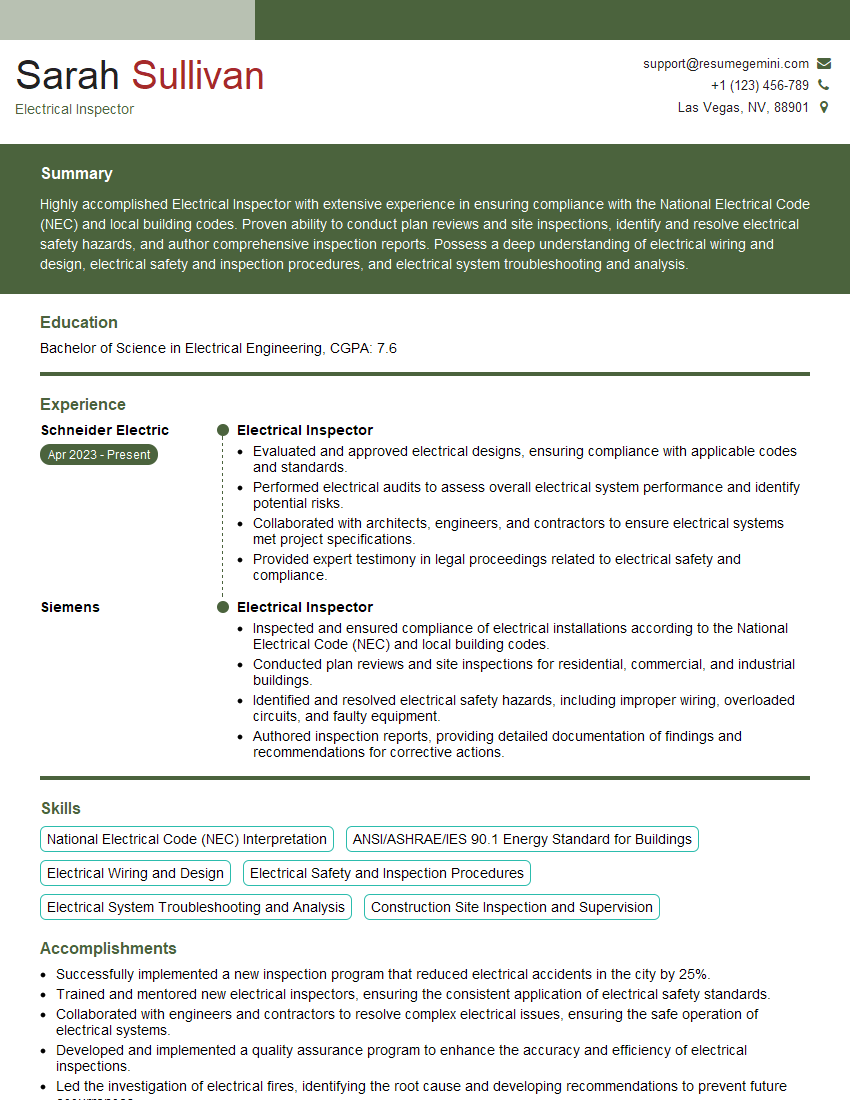
Mastering Electrical Inspection and Compliance opens doors to a rewarding career with excellent growth potential. A strong understanding of these principles is highly sought after in today’s job market. To maximize your chances of landing your dream role, focus on building an ATS-friendly resume that effectively highlights your skills and experience. ResumeGemini is a trusted resource that can significantly enhance your resume-building experience, ensuring your qualifications shine. We provide examples of resumes tailored to Electrical Inspection and Compliance to help guide you through the process. Invest time in creating a compelling resume – it’s your first impression with potential employers.
Explore more articles
Users Rating of Our Blogs
Share Your Experience
We value your feedback! Please rate our content and share your thoughts (optional).
What Readers Say About Our Blog
To the interviewgemini.com Webmaster.
Very helpful and content specific questions to help prepare me for my interview!
Thank you
To the interviewgemini.com Webmaster.
This was kind of a unique content I found around the specialized skills. Very helpful questions and good detailed answers.
Very Helpful blog, thank you Interviewgemini team.