Interviews are opportunities to demonstrate your expertise, and this guide is here to help you shine. Explore the essential Equipment Pre-Planning interview questions that employers frequently ask, paired with strategies for crafting responses that set you apart from the competition.
Questions Asked in Equipment Pre-Planning Interview
Q 1. Describe your experience with different equipment pre-planning methodologies.
My experience encompasses a range of equipment pre-planning methodologies, adapting my approach to the specific project needs. I’ve extensively used Last Planner Systems (LPS) for its focus on collaborative short-term planning, ensuring equipment is available when needed. This is particularly effective on complex projects where coordination is crucial. For larger, more linear projects, I’ve successfully employed Critical Path Method (CPM) scheduling, integrating equipment availability as a constraint within the critical path analysis. This helps pinpoint potential bottlenecks and optimize resource allocation. Finally, I also utilize Lean construction principles, focusing on eliminating waste and streamlining equipment usage through careful planning and just-in-time delivery.
For example, on a recent high-rise construction project using LPS, we held weekly planning meetings with subcontractors and equipment suppliers to ensure seamless coordination. This resulted in a significant reduction in equipment idle time and improved overall project efficiency. In contrast, a highway project benefited from CPM’s ability to highlight potential delays due to equipment availability constraints, allowing for proactive mitigation strategies.
Q 2. How do you identify potential equipment conflicts during the pre-planning phase?
Identifying potential equipment conflicts is a proactive process that starts with a thorough review of the project schedule and equipment list. I utilize several strategies. Firstly, I develop a detailed equipment register, listing each piece of equipment, its specifications, required maintenance, and planned usage. Secondly, I create a resource histogram showing the daily or weekly demand for each equipment type. This visual representation quickly highlights potential overlaps and conflicts. Thirdly, I conduct what-if scenario analysis – for instance, simulating delays to assess their ripple effects on equipment availability. Finally, I engage in regular communication with all stakeholders, including subcontractors, to ensure everyone’s aware of potential scheduling clashes.
For instance, during a large-scale renovation project, the resource histogram clearly showed a conflict between two teams needing the same crane on the same day. By proactively identifying this conflict, we were able to adjust the schedule, mitigating a potential delay of several days.
Q 3. Explain your process for estimating equipment needs for a project.
Estimating equipment needs involves a multi-step process. I begin by carefully reviewing the project specifications, blueprints, and scope of work. This provides a foundational understanding of the tasks and materials involved. Next, I develop a detailed work breakdown structure (WBS), breaking down the project into smaller, manageable tasks. For each task, I identify the specific equipment required, its operating capacity, and the estimated duration of its use. I then consolidate this information to generate a comprehensive equipment list, including quantities and rental periods. Finally, I incorporate contingency buffers to account for unforeseen circumstances such as equipment breakdowns or delays.
Consider a road construction project. The WBS might break down the project into excavation, paving, and finishing. Based on the volume of earth to be moved, we can estimate the number of excavators and dump trucks needed, their operating hours, and rental duration. Similarly, paving requirements inform the selection and duration of pavers and rollers.
Q 4. What software or tools are you proficient in for equipment pre-planning?
My proficiency extends to several software and tools crucial for effective equipment pre-planning. I’m experienced with Primavera P6 for scheduling and resource allocation, enabling detailed planning and tracking of equipment usage. I also utilize Microsoft Project for smaller projects, leveraging its scheduling and resource management capabilities. For visualizing resource allocation and identifying potential conflicts, I frequently employ Microsoft Excel and specialized construction management software offering resource histograms and similar tools. Finally, I’m familiar with various cloud-based platforms for equipment rental and procurement, streamlining communication and management.
Q 5. How do you manage equipment lead times and potential delays?
Managing equipment lead times and potential delays is crucial for project success. I start by obtaining detailed lead time information from equipment suppliers at the beginning of the pre-planning phase. This data is incorporated into the project schedule, explicitly marking equipment delivery dates as milestones. To mitigate potential delays, I build buffer time into the schedule, creating flexibility to accommodate unexpected setbacks. I also maintain close communication with suppliers, actively monitoring order status and proactively addressing any potential issues. Furthermore, I explore alternative sourcing options or consider renting backup equipment as a contingency plan.
For example, on a recent project, a critical piece of equipment was delayed. Because we’d already factored in a buffer and had identified a backup supplier, we were able to minimize the impact on the overall schedule.
Q 6. Describe your approach to optimizing equipment utilization.
Optimizing equipment utilization focuses on maximizing efficiency and minimizing idle time. This starts with careful equipment selection, choosing the right tools for each task. Next, I optimize the sequencing of tasks to minimize equipment movements and transitions. I also employ techniques such as equipment sharing between subcontractors, if feasible and safe, to avoid unnecessary duplication of resources. Real-time monitoring of equipment usage, using technology when available, helps identify bottlenecks and areas for improvement. Regular maintenance schedules also prevent downtime due to equipment failure.
For instance, by carefully sequencing tasks and leveraging shared use of certain tools, we reduced idle time for a fleet of excavators by 15% on a recent earthworks project, resulting in cost savings and faster project completion.
Q 7. How do you handle changes in project scope that impact equipment requirements?
Handling changes in project scope that impact equipment requirements demands a flexible and adaptable approach. First, I carefully assess the nature and extent of the scope change, identifying its implications on the equipment needs. Next, I update the equipment register and resource histogram to reflect the revised requirements. This might involve adding new equipment, adjusting rental periods, or modifying task sequencing. I then re-evaluate the project schedule, considering potential impacts on the critical path and overall project duration. Finally, I communicate these changes to all stakeholders, ensuring everyone is informed and aligned with the updated plan. This proactive approach minimizes disruptions and ensures smooth project execution.
For example, if a scope change requires additional excavation work, I’d immediately adjust the equipment register, adding extra excavators and dump trucks to the schedule and communicating the revised needs to the suppliers and relevant teams. A transparent and timely update to the schedule prevents conflicts and keeps the project on track.
Q 8. Explain your experience with creating equipment procurement plans.
Creating a robust equipment procurement plan is crucial for project success. It involves a systematic approach, starting with a thorough understanding of project requirements. This includes identifying all necessary equipment, specifying technical requirements (e.g., capacity, power source, safety features), and determining the quantity needed. I typically use a phased approach:
- Needs Assessment: A detailed breakdown of all equipment required, considering factors like project scope, timeline, and potential risks.
- Market Research: Identifying potential vendors, comparing prices, and assessing equipment availability. This often includes contacting multiple suppliers for competitive quotes.
- Specification Development: Creating detailed specifications for each piece of equipment, including technical parameters, safety standards, and performance metrics. This prevents ambiguity and ensures compatibility.
- Vendor Selection: Evaluating bids, considering factors like price, reputation, warranty, and service support. This could involve a weighted scoring system to rank vendors objectively.
- Procurement Process: Managing the actual purchase, including negotiating contracts, arranging for delivery and installation, and ensuring proper documentation.
For example, in a recent construction project, we needed to procure several heavy-duty excavators. My team meticulously analyzed soil conditions, project timelines, and contractor capabilities to determine the optimal excavator models and quantities. We then compared bids from three major vendors, focusing not only on price but also on their service history and warranty offerings. This resulted in securing the right equipment at a competitive price and minimized downtime.
Q 9. How do you ensure compliance with safety regulations during equipment pre-planning?
Safety is paramount in equipment pre-planning. Compliance with safety regulations is achieved through a multi-layered approach. I start by incorporating safety considerations into every stage of the process:
- Risk Assessment: Identifying potential hazards associated with each piece of equipment, including operation, maintenance, and transportation.
- Standard Compliance: Specifying equipment that meets or exceeds all relevant safety standards and regulations (e.g., OSHA, ANSI). This might involve checking certifications and compliance documentation from manufacturers.
- Safety Features: Prioritizing equipment with built-in safety features like emergency shut-offs, alarms, and guarding mechanisms. We also consider ergonomic design to reduce operator fatigue and strain.
- Training & Procedures: Ensuring operators receive adequate training on safe operating procedures, including pre-operational checks, lockout/tagout procedures, and emergency response plans.
- Regular Inspections: Implementing a schedule for regular inspections and maintenance to identify and address potential safety issues before they escalate. This often involves checklists and documented findings.
For instance, during a large-scale industrial project, we mandated the use of excavators with advanced safety systems, including load monitoring and stability control. Operators underwent extensive training on safe operating procedures, and regular safety inspections were conducted to ensure compliance with all relevant regulations. This proactive approach resulted in a zero-incident record throughout the project.
Q 10. Describe your process for tracking equipment costs and budgets.
Tracking equipment costs and budgets is essential for maintaining financial control. I utilize a combination of spreadsheets and project management software to meticulously monitor expenses. This involves:
- Budget Allocation: Initially, I allocate budget lines for each category of equipment, considering purchase price, delivery, installation, maintenance, and potential repairs.
- Cost Tracking: Throughout the procurement process, I meticulously track all costs associated with each piece of equipment, updating the budget regularly to reflect actual expenses.
- Variance Analysis: I perform regular variance analysis to identify any discrepancies between the budgeted and actual costs. This helps to highlight potential overruns and allows for timely corrective action.
- Reporting & Forecasting: I provide regular reports to stakeholders, including detailed cost breakdowns and future cost projections. This ensures transparency and facilitates informed decision-making.
- Contingency Planning: I always include a contingency budget to account for unforeseen expenses or price increases. This reduces the risk of budget overruns.
In a recent project, we used a dedicated project management software to track equipment costs. The software automatically generated reports, allowing us to quickly identify cost overruns. Early identification of a potential problem with a specific vendor allowed us to renegotiate the contract and avoid a significant budget overrun.
Q 11. How do you communicate equipment needs and plans to project stakeholders?
Effective communication is crucial in equipment pre-planning. I ensure clear and consistent communication with all stakeholders through multiple channels:
- Project Meetings: Regularly scheduled meetings with project managers, engineers, and other relevant personnel to discuss equipment needs, procurement progress, and any potential issues.
- Regular Updates: Providing regular written updates (emails, reports) to stakeholders on the progress of equipment procurement. These reports include key milestones, budget status, and potential risks.
- Visual Aids: Using visual aids like charts, diagrams, and presentations to effectively communicate complex information and progress updates.
- Collaboration Tools: Leveraging collaboration tools (e.g., shared spreadsheets, project management software) to facilitate communication and information sharing amongst project team members.
- Formal Documentation: Maintaining detailed documentation of all communication, decisions, and agreements regarding equipment. This ensures transparency and accountability.
For instance, in a large-scale infrastructure project, we used a centralized project management platform to track equipment procurement. This platform allowed stakeholders to monitor progress, access documentation, and communicate with the team in real-time. This transparent approach ensured everyone was informed and aligned.
Q 12. What is your experience with risk assessment related to equipment availability?
Risk assessment related to equipment availability is critical for successful project delivery. I approach this by identifying potential disruptions and developing mitigation strategies. My process involves:
- Identifying Risks: This includes factors such as lead times for equipment procurement, potential supply chain disruptions, equipment breakdowns, and the availability of skilled operators.
- Assessing Likelihood and Impact: Each identified risk is assessed in terms of its likelihood of occurrence and its potential impact on the project schedule and budget.
- Mitigation Strategies: For each high-risk scenario, I develop and implement mitigation strategies. This could involve sourcing equipment from multiple vendors, having backup equipment on standby, or establishing robust maintenance schedules.
- Contingency Planning: This includes creating detailed contingency plans to address potential equipment failures or delays. This often involves having alternative equipment or solutions readily available.
- Monitoring and Review: Regularly monitoring the identified risks and reviewing the effectiveness of mitigation strategies throughout the project lifecycle.
For example, during a construction project in a remote area, we anticipated potential delays in equipment delivery due to logistical challenges. We mitigated this by securing a backup source for critical equipment and creating a flexible schedule that allowed for potential delays.
Q 13. How do you prioritize equipment needs in a multi-project environment?
Prioritizing equipment needs in a multi-project environment requires a structured approach. I typically use a prioritization matrix that considers several factors:
- Project Criticality: Ranking projects based on their overall importance and strategic significance to the organization.
- Equipment Urgency: Assessing the urgency of equipment needs for each project based on timelines and deadlines.
- Resource Availability: Considering the availability of resources (budget, personnel, time) for procuring equipment for each project.
- Risk Assessment: Evaluating the potential risks associated with delays in obtaining equipment for each project.
- Interdependencies: Identifying any interdependencies between projects that might influence equipment prioritization decisions.
I often use a scoring system to quantitatively assess these factors for each project. Projects with higher scores receive higher priority in terms of equipment procurement. For example, a project with critical deadlines and high potential risks would likely receive higher priority than a project with less stringent timelines and lower risk.
Q 14. Explain your understanding of equipment maintenance and its impact on pre-planning.
Equipment maintenance is intrinsically linked to pre-planning and significantly impacts project success. Neglecting maintenance can lead to costly downtime, safety hazards, and project delays. My understanding incorporates:
- Preventive Maintenance: Planning for regular preventive maintenance throughout the equipment’s lifecycle, including scheduled inspections, lubrication, and component replacements. This is crucial for extending equipment life and preventing unexpected failures.
- Maintenance Schedules: Creating detailed maintenance schedules that align with project timelines and ensure that equipment is maintained at optimal performance levels.
- Maintenance Budgeting: Allocating sufficient budget for maintenance activities, including parts, labor, and specialized services.
- Spare Parts Management: Planning for the acquisition and storage of essential spare parts to minimize downtime in case of equipment failures. This includes considering lead times and potential supply chain issues.
- Maintenance Personnel: Ensuring availability of trained personnel to conduct routine maintenance or coordinating with external service providers.
A well-defined maintenance plan, integrated into the pre-planning phase, not only minimizes downtime but also extends the equipment’s lifespan, ultimately saving costs and contributing to a successful project delivery. Failing to account for maintenance can lead to significant cost overruns and project delays, especially with heavy machinery or complex equipment.
Q 15. How do you handle equipment failures or unexpected downtime?
Equipment failures are inevitable, but minimizing their impact requires a proactive approach. My strategy hinges on a robust preventative maintenance program, coupled with swift and effective response mechanisms. This starts with meticulous record-keeping – tracking equipment hours, service history, and any observed anomalies. We use a computerized maintenance management system (CMMS) to schedule preventative maintenance, predicting potential issues before they arise. For example, if a piece of heavy machinery consistently shows elevated vibration readings, we’ll schedule a thorough inspection and potentially a preventative repair before a complete breakdown occurs.
When failures do happen, a well-defined emergency response plan is crucial. This involves a clear chain of command, readily available spare parts, and a network of reliable repair technicians. A recent example saw a critical pump fail on a large-scale pipeline project. Our pre-planned response saw a backup pump installed within four hours, minimizing project downtime to under a day. Post-incident analysis helps us refine our processes and prevent future occurrences.
Furthermore, we leverage predictive maintenance technologies where applicable. This involves using sensors to monitor equipment performance in real-time, alerting us to potential problems before they impact productivity. This proactive approach significantly reduces downtime and associated costs.
Career Expert Tips:
- Ace those interviews! Prepare effectively by reviewing the Top 50 Most Common Interview Questions on ResumeGemini.
- Navigate your job search with confidence! Explore a wide range of Career Tips on ResumeGemini. Learn about common challenges and recommendations to overcome them.
- Craft the perfect resume! Master the Art of Resume Writing with ResumeGemini’s guide. Showcase your unique qualifications and achievements effectively.
- Don’t miss out on holiday savings! Build your dream resume with ResumeGemini’s ATS optimized templates.
Q 16. What are your strategies for managing equipment transportation and logistics?
Managing equipment transportation and logistics is paramount. It involves meticulous planning, starting with the selection of appropriate transportation modes based on equipment size, weight, and project location. For example, oversized or heavy equipment might require specialized lowboy trailers and escort vehicles, while smaller tools and materials can be transported in standard trucks. We always prioritize safety, ensuring that all transportation complies with local regulations and industry best practices.
Effective logistics also require detailed route planning, taking into account road conditions, weight restrictions, and potential permits. We frequently utilize route optimization software to identify the most efficient and cost-effective routes. Real-time tracking systems are employed to monitor shipments and ensure timely delivery to the project site. Clear communication with all parties involved – from the transportation company to the project team – is vital to maintaining smooth operations. A well-defined delivery schedule, including designated arrival times and offloading procedures, minimizes delays and potential disruptions.
Q 17. How do you ensure equipment is properly stored and maintained during downtimes?
Proper equipment storage and maintenance during downtimes are critical to preserving its lifespan and operational readiness. Our approach involves a multi-pronged strategy. Firstly, we select appropriate storage locations, ensuring that equipment is protected from the elements – rain, sun, and extreme temperatures. This often involves using covered storage areas or employing protective covers and tarps. For outdoor storage, proper ground preparation is key to prevent rust and corrosion.
Secondly, we implement regular cleaning and lubrication schedules. This minimizes wear and tear and prevents premature degradation. Regular inspections, checking for signs of damage or corrosion, are also key. For more sophisticated machinery, periodic checks on battery levels, fluid levels, and other critical components are carried out. Finally, we adhere strictly to manufacturer-recommended storage practices. This may include specific instructions for battery charging, fuel storage, or other preventative measures. This attention to detail significantly extends equipment lifespan and ensures it’s ready for immediate deployment when needed.
Q 18. Describe your experience with evaluating different equipment options.
Evaluating equipment options requires a systematic approach. I begin by clearly defining project needs, specifying the tasks the equipment needs to perform, and the required capacity. Next, I research available options, considering factors such as cost, efficiency, maintenance requirements, and reliability. I also examine manufacturer reputation and track records. This research often involves soliciting quotes from multiple vendors and comparing specifications across different models.
A crucial aspect is conducting a thorough cost-benefit analysis. This considers factors such as initial purchase price, operating costs, fuel consumption, and maintenance expenses. The lifecycle cost of each option is calculated to make an informed decision. We also involve key personnel in the evaluation process – operators, mechanics, and project managers – to obtain diverse perspectives. For instance, we recently evaluated two excavators for a large earthmoving project. While one had a slightly lower initial price, the other offered better fuel efficiency and lower maintenance costs, making it the more cost-effective option over its lifespan.
Q 19. How familiar are you with different types of construction equipment?
My familiarity with various types of construction equipment is extensive, encompassing earthmoving equipment (excavators, bulldozers, graders), lifting equipment (cranes, forklifts), material handling equipment (conveyors, loaders), and specialized equipment like paving machines and compaction rollers. I understand the operating principles, capabilities, and limitations of each category, including their appropriate applications and safety protocols. This knowledge is vital for efficient equipment selection, deployment, and operation. For example, I know that choosing the right excavator size for a particular excavation task is critical for productivity and prevents potential damage to the machine or the surrounding area.
Beyond this, I’m familiar with the technology behind various equipment, such as GPS guidance systems, telematics, and automated controls, and their applications in enhancing efficiency and precision. I understand the technical specifications, including engine capacity, lifting capacity, and other performance parameters, enabling effective equipment selection and optimization of project workflows.
Q 20. How do you build and maintain relationships with equipment vendors?
Building and maintaining strong relationships with equipment vendors is essential for success. This involves establishing clear communication channels, regular meetings, and fostering mutual trust. I strive to build long-term partnerships rather than transactional relationships. We engage in open dialogue, discussing project needs, equipment availability, and potential challenges proactively. Fair and timely payment practices are crucial in maintaining positive relationships. We also value vendor input and expertise during equipment selection and maintenance.
Regular performance reviews help identify areas for improvement and foster stronger collaborations. For example, we recently collaborated with a vendor to develop a customized maintenance program for a fleet of excavators, resulting in significantly reduced downtime and improved overall efficiency. Building strong relationships not only ensures reliable equipment supply but also enables us to leverage vendor expertise for better project outcomes.
Q 21. Describe your experience with developing equipment mobilization and demobilization plans.
Developing robust equipment mobilization and demobilization plans is a critical aspect of project management. This process involves a detailed sequence of steps, from the initial planning phase to the final equipment removal. It begins with a thorough assessment of site conditions, accessibility, and potential constraints. This often includes analyzing site topography, load-bearing capacities, and identifying any potential hazards. Then, we create a detailed schedule, outlining transportation logistics, equipment arrival times, and site preparation requirements.
The plan specifies the sequence of equipment arrival and deployment, ensuring a smooth and efficient setup. Safety protocols are carefully integrated into the plan, addressing risks associated with equipment transport, handling, and operation. Clear communication is crucial throughout the process, coordinating with transportation companies, on-site personnel, and relevant authorities. A demobilization plan mirrors the mobilization plan, ensuring a safe and systematic removal of equipment, minimizing potential damage and environmental impact. Post-project reviews help refine our mobilization and demobilization strategies, leading to improved efficiency and reduced risk in future projects. For example, in our last large-scale project, our well-defined mobilization and demobilization plan resulted in minimal disruption to the project timeline and no equipment damage during transportation.
Q 22. How do you use historical data to improve future equipment pre-planning efforts?
Historical data is crucial for refining future equipment pre-planning. We analyze past project data – including equipment utilization rates, downtime, maintenance costs, and even weather patterns affecting project schedules – to identify trends and patterns. For instance, if historical data shows a specific piece of equipment consistently experiences high downtime during peak summer months due to overheating, we can proactively schedule preventative maintenance or explore alternative equipment better suited for those conditions. This data-driven approach allows us to optimize resource allocation, minimize unforeseen delays, and improve overall project efficiency.
We use various techniques like regression analysis to predict future demand and Monte Carlo simulations to assess the risk associated with different equipment choices. For example, if we are planning a large construction project, historical data on similar projects will help us estimate the number and type of excavators, cranes, and other heavy machinery needed, allowing for accurate budgeting and procurement.
Q 23. How do you incorporate sustainability considerations into equipment planning?
Sustainability is paramount in modern equipment pre-planning. We consider the entire lifecycle of equipment, from manufacturing to disposal. This involves evaluating the carbon footprint of different equipment options, prioritizing energy-efficient models, and exploring equipment sharing or rental strategies to reduce overall consumption. For example, we might choose electric or hybrid excavators over their diesel counterparts, reducing emissions on-site. We also factor in the recyclability of the equipment at the end of its life, aiming to minimize waste sent to landfills.
Furthermore, we consider the transportation aspect. Optimizing equipment delivery routes to minimize fuel consumption is a key consideration. We might even explore the feasibility of using sustainable fuels or alternative transportation methods such as rail or barge where applicable.
Q 24. Explain your experience with equipment rental versus purchase decisions.
The decision to rent or purchase equipment hinges on a cost-benefit analysis considering the project’s duration, frequency of use, and budget. For short-term projects or infrequent needs, renting is often more economical. The upfront costs are lower, and the rental company handles maintenance and repairs. However, for long-term, high-frequency use, purchasing can be more cost-effective in the long run, offering greater control and predictability over costs.
For example, for a short-term construction project lasting a few months, renting specialized equipment like a crane makes sense. However, for a large manufacturing plant with continuous production, purchasing key machinery is more beneficial, allowing for customized modifications and better integration into existing processes. We develop detailed financial models comparing the total cost of ownership for both scenarios to make informed decisions.
Q 25. How do you quantify the success of your equipment pre-planning efforts?
We measure the success of equipment pre-planning through several key performance indicators (KPIs). These include on-time project completion rates, equipment utilization rates (maximizing usage while minimizing idle time), cost savings achieved through optimized resource allocation, reduction in equipment downtime, and minimizing safety incidents related to equipment malfunction or improper usage.
We track these metrics throughout the project lifecycle and compare them against established benchmarks. For instance, if our goal is to improve equipment utilization by 10%, we monitor the actual utilization rate and compare it against the target to assess our progress and identify areas for improvement. This data-driven approach helps us demonstrate the tangible benefits of effective equipment pre-planning.
Q 26. Describe a time when you had to make a difficult decision regarding equipment allocation.
In a recent project involving the construction of a large wind farm, we faced a critical decision regarding the allocation of specialized cranes. A significant storm threatened to delay the project, and we only had a limited number of cranes capable of handling the specific wind turbine components. We had to prioritize which turbines to install first based on their proximity to the storm and the risk of delays.
To make the decision, we used a risk assessment matrix, weighing the likelihood of project delays against the potential cost overruns. We ultimately prioritized the turbines most susceptible to weather damage, minimizing overall project risk, even if it meant slightly altering the original schedule. This decision required careful coordination with the weather forecast team and the construction crew, and ultimately resulted in successfully completing the project despite the challenging conditions.
Q 27. How do you stay updated on new technologies and advancements in equipment pre-planning?
Staying abreast of technological advancements is essential in this field. I actively participate in industry conferences, workshops, and webinars, networking with peers and learning about new equipment and software solutions. I subscribe to relevant industry publications and follow key players in the manufacturing and technology sectors. I also utilize online learning platforms to gain proficiency in new software related to equipment management and predictive maintenance.
Moreover, I am a strong advocate for continuous learning. Regularly researching new trends in equipment efficiency, sustainability, and data-driven decision-making enables me to make informed decisions, resulting in better pre-planning and project execution.
Q 28. What are your salary expectations for this role?
My salary expectations are commensurate with my experience and the responsibilities of this role. Considering my expertise in equipment pre-planning, my proven track record of success, and my commitment to continuous learning, I am seeking a competitive salary package within the industry standard for similar positions. I am open to discussing the specifics further based on the complete compensation and benefits package.
Key Topics to Learn for Equipment Pre-Planning Interview
- Needs Assessment & Requirements Gathering: Understanding project scope, identifying necessary equipment, and defining specifications for optimal performance.
- Budgeting and Cost Analysis: Developing realistic equipment budgets, considering factors like acquisition costs, maintenance, and disposal.
- Vendor Selection and Negotiation: Researching and selecting suitable vendors, negotiating contracts, and managing vendor relationships effectively.
- Logistics and Procurement: Planning for equipment delivery, storage, and handling, ensuring timely arrival and minimizing disruptions.
- Risk Assessment and Mitigation: Identifying potential risks associated with equipment selection and deployment, and developing strategies to mitigate them.
- Equipment Maintenance and Lifecycle Management: Developing a plan for regular maintenance, repairs, and eventual replacement, maximizing equipment lifespan and minimizing downtime.
- Safety and Compliance: Ensuring equipment meets all relevant safety regulations and industry standards.
- Technological Advancements and Innovation: Staying up-to-date on the latest equipment technologies and their potential applications within the field.
- Data Analysis and Reporting: Tracking key performance indicators (KPIs) related to equipment usage, costs, and efficiency, and presenting findings to stakeholders.
- Problem-Solving and Decision-Making: Applying critical thinking skills to address unexpected challenges and make informed decisions under pressure.
Next Steps
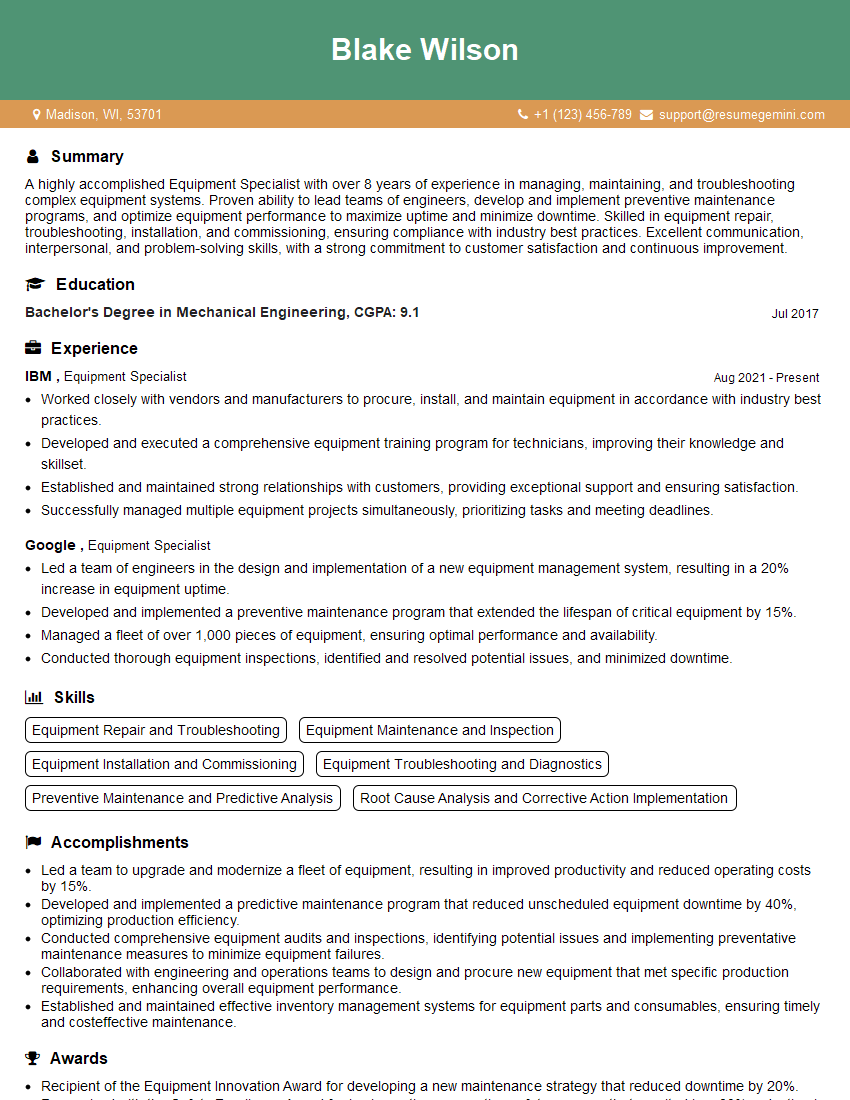
Mastering Equipment Pre-Planning is crucial for career advancement in project management and related fields. It demonstrates your ability to think strategically, manage resources effectively, and contribute to successful project outcomes. To significantly boost your job prospects, create an ATS-friendly resume that highlights your relevant skills and experience. ResumeGemini is a trusted resource that can help you build a compelling and professional resume tailored to the Equipment Pre-Planning field. Examples of resumes specifically designed for this area are available to further guide your preparation. Take the time to craft a strong resume – it’s your first impression on potential employers!
Explore more articles
Users Rating of Our Blogs
Share Your Experience
We value your feedback! Please rate our content and share your thoughts (optional).
What Readers Say About Our Blog
To the interviewgemini.com Webmaster.
Very helpful and content specific questions to help prepare me for my interview!
Thank you
To the interviewgemini.com Webmaster.
This was kind of a unique content I found around the specialized skills. Very helpful questions and good detailed answers.
Very Helpful blog, thank you Interviewgemini team.