Every successful interview starts with knowing what to expect. In this blog, we’ll take you through the top Fault Current Calculations interview questions, breaking them down with expert tips to help you deliver impactful answers. Step into your next interview fully prepared and ready to succeed.
Questions Asked in Fault Current Calculations Interview
Q 1. Explain the difference between symmetrical and asymmetrical fault currents.
The key difference between symmetrical and asymmetrical fault currents lies in the presence of DC offset. Symmetrical fault currents are purely alternating current (AC) waveforms, representing a balanced three-phase fault. Think of it as a perfectly sinusoidal wave. Asymmetrical fault currents, on the other hand, occur in unbalanced faults (like a single line-to-ground fault) and contain a decaying DC component superimposed on the AC waveform. This DC component is a result of the sudden disruption of the system’s magnetic field. It typically decays to zero within a few cycles, but significantly impacts the initial peak current, which is crucial for equipment protection. Imagine it as a sinusoidal wave with a large spike added at the beginning.
In short: Symmetrical – pure AC; Asymmetrical – AC with decaying DC offset.
Q 2. Describe the methods used to calculate fault currents in power systems.
Calculating fault currents involves several methods, depending on the complexity of the power system and the desired accuracy. These methods range from simplified hand calculations to sophisticated software simulations.
- The Short-Circuit Calculation Method: This is a simplified approach using impedance values, suitable for smaller systems. It uses Ohm’s law (I = V/Z) to calculate fault current, where Z is the total impedance of the system at the fault point. It’s useful for quick estimations but doesn’t capture all system complexities.
- Per-Unit System Method: This method simplifies calculations by normalizing system parameters to a base value. It’s particularly useful for large, complex systems and facilitates calculations involving transformers. It’s more accurate than simple calculations but requires understanding of base values.
- Software-Based Simulation: Specialized software packages like ETAP, EasyPower, and SKM PowerTools employ advanced algorithms to model complex power systems accurately. These tools consider all network components, including generators, transformers, transmission lines, and loads, providing detailed fault current calculations and time-domain simulations for various fault types.
The choice of method depends heavily on the size and complexity of the system, time constraints, and required accuracy.
Q 3. What are the different types of faults in a power system?
Power systems are vulnerable to several types of faults, each with different characteristics impacting fault current magnitude and phase relationships.
- Three-Phase Fault (3Φ): This is the most severe type, involving a short circuit between all three phases. It generally results in the highest fault current.
- Line-to-Line Fault (LL): A short circuit between two phases. The fault current is lower than a three-phase fault but still significant.
- Line-to-Ground Fault (LG): A short circuit between one phase and ground. This is a common fault type, and its severity depends on the system grounding configuration (e.g., solidly grounded, impedance grounded).
- Double Line-to-Ground Fault (LLG): A short circuit between two phases and ground. This fault type falls between LLG and 3Φ faults in severity.
Understanding these fault types is essential for proper protection coordination and equipment selection.
Q 4. How do you determine the fault current contribution from different sources?
Determining the fault current contribution from different sources is critical for accurate fault current calculations. We use the principle of superposition: the total fault current is the sum of contributions from all sources. Each source’s contribution depends on its internal impedance and the impedance of the path between it and the fault point.
For example, in a system with multiple generators, each generator will contribute fault current proportional to its short-circuit capacity and inversely proportional to the impedance of the path from the generator to the fault location. Transformers’ impedance plays a key role in reducing the contribution of remote generators. This calculation usually involves considering the network impedance, represented by impedance matrices or symmetrical component analysis techniques. Specialized software greatly assists in handling the complexities of this analysis.
Q 5. Explain the concept of fault current limiting.
Fault current limiting aims to reduce the magnitude of fault currents to levels that equipment can safely withstand. Excessive fault currents can damage equipment, disrupt operations, and even cause fires. Several methods achieve this:
- Current-Limiting Circuit Breakers: These breakers detect faults and interrupt the current flow exceptionally quickly, limiting the energy delivered during a fault.
- Reactors: These devices are added to the power system to increase the impedance, reducing the magnitude of the fault current.
- Fuses: Fuses act as sacrificial elements, melting and opening the circuit to prevent damage to the equipment.
- Protective Relays: These devices rapidly detect and isolate faults, minimizing the duration and impact of the fault current.
Proper fault current limiting is vital for system reliability and safety.
Q 6. What are the factors affecting fault current magnitude?
Several factors influence the magnitude of fault currents. Understanding these is crucial for accurate calculations and system design.
- System Voltage: Higher system voltages naturally lead to higher fault currents.
- System Impedance: Lower system impedance results in higher fault currents. This includes the impedance of generators, transformers, transmission lines, and other equipment.
- Source Impedance: The impedance of generators and other sources significantly impacts fault current contributions. Stronger sources contribute more.
- Fault Type: Different fault types (3Φ, LL, LG, LLG) produce different levels of fault currents. 3Φ faults usually produce the highest.
- Transformer Impedance: Transformers significantly impact fault currents by adding impedance to the network. High-impedance transformers limit fault current.
- Grounding System: The grounding system influences the magnitude of ground faults. Solid grounding usually results in higher fault currents compared to impedance grounding.
Q 7. How do you calculate the short-circuit current using the per-unit system?
The per-unit system simplifies fault current calculations by normalizing parameters to a base value. To calculate short-circuit current using this system, follow these steps:
- Define Base Values: Select base values for voltage (Vbase) and apparent power (Sbase). These are typically chosen based on the system’s nominal values.
- Determine Per-Unit Impedances: Convert all impedances in the system (generators, transformers, lines) into their per-unit values using the formula: Zpu = Zactual * (Sbase / Vbase2).
- Build the Impedance Network: Represent the system’s impedance as a network diagram, reflecting connections and per-unit impedances.
- Calculate Thevenin Impedance: Determine the Thevenin equivalent impedance (Zth) at the fault location. This involves simplifying the network by combining impedances in series and parallel.
- Calculate Short-Circuit Current: Finally, calculate the per-unit short-circuit current (Isc_pu) using: Isc_pu = Vbase_pu / Zth_pu. Remember Vbase_pu is always 1.
- Convert to Actual Value: Convert the per-unit short-circuit current to its actual value using: Isc_actual = Isc_pu * Ibase, where Ibase = Sbase / Vbase.
This method simplifies calculations even in complex systems, allowing for efficient analysis and design.
Q 8. Describe the importance of fault current calculations in power system design.
Fault current calculations are absolutely crucial in power system design because they determine the magnitude of current that flows during a short circuit. This information is paramount for selecting equipment with sufficient interrupting capacity. Imagine building a bridge without knowing its load-bearing capacity – it’s equally risky to design a power system without understanding fault currents. Incorrect calculations can lead to catastrophic equipment failures, fires, and even injuries.
These calculations guide the selection of protective devices like circuit breakers and fuses, which must be rated to interrupt the maximum fault current. They also influence the design of busbars, cables, and other components, ensuring they can withstand the immense thermal and mechanical stresses of a fault. Without accurate fault current calculations, the entire system’s safety and reliability are jeopardized.
Q 9. What are the safety considerations related to fault currents?
Safety is paramount when dealing with fault currents, which are incredibly high and dangerous. The immense heat generated during a fault can cause fires, melting of conductors, and explosions. The resulting arc flash can cause severe burns and even fatalities to personnel working nearby.
- Arc Flash Hazards: The intense light and heat generated by an arc flash pose a significant threat. Proper personal protective equipment (PPE) and safe working practices are essential.
- Thermal Effects: Excessive heat can damage equipment and infrastructure, potentially leading to cascading failures and widespread outages.
- Mechanical Stress: The electromagnetic forces generated by high fault currents can cause physical damage to equipment, leading to mechanical failures.
Therefore, safety measures such as proper grounding, protective relays, arc flash mitigation techniques, and comprehensive safety procedures are absolutely crucial. Regular maintenance and inspections are also vital for ensuring the continued safety of the power system.
Q 10. How do you account for motor contributions to fault current?
Motors significantly contribute to fault currents, acting as substantial sources of fault current during the initial stages of a fault. They don’t simply act as loads; their internal impedance characteristics dictate how much current they inject into the fault. Ignoring motor contributions leads to underestimating the actual fault current, jeopardizing the safety and reliability of the power system.
We account for motor contributions using their subtransient reactance (X”), which represents the motor’s impedance during the initial moments of a fault. This reactance is considerably lower than the synchronous reactance (Xs) used for steady-state analysis. Motor contribution is typically determined using manufacturer’s data or industry standards. Software tools and calculation methods often incorporate the subtransient reactance to accurately model motor contributions to fault current.
For example, a 1000 HP motor might contribute significantly more current during a fault than a simple resistive load of the same power rating. Failing to account for this could lead to selecting insufficiently rated protective devices.
Q 11. Explain the significance of X/R ratio in fault current calculations.
The X/R ratio, the ratio of the reactance (X) to the resistance (R) of a circuit, significantly impacts fault current calculations and the transient behavior of the fault current waveform. It determines the rate of decay of the asymmetrical current component and influences the magnitude of the initial peak current.
A high X/R ratio (typically found in long transmission lines) results in a slowly decaying DC offset in the fault current waveform, leading to a higher peak current. This is because the inductance dominates the impedance, leading to a slower decay of the DC offset. Conversely, a low X/R ratio (typical in short distribution lines) leads to a faster decay of the DC component, resulting in a lower peak current. The higher peak current with a high X/R ratio needs to be considered during equipment selection to prevent damage.
In essence, understanding the X/R ratio is crucial for accurately predicting the severity and duration of fault currents, which directly affects the design and selection of protective devices and equipment.
Q 12. What are the limitations of using simplified methods for fault current calculations?
Simplified methods for fault current calculations, while convenient, come with limitations. These methods often make assumptions that might not hold true in real-world scenarios, leading to inaccuracies in the results.
- Neglect of System Impedance Details: Simplified methods often ignore detailed system impedances, resulting in underestimated or overestimated fault current values.
- Ignoring Motor Contributions: As previously discussed, neglecting motor contributions significantly impacts accuracy.
- Assumption of Symmetrical Faults: Simplified methods might assume symmetrical faults (all three phases involved), which isn’t always the case. Unsymmetrical faults are far more common.
- Linearity Assumptions: Some simplified methods assume linear behavior, neglecting non-linear elements like saturation in transformers.
These inaccuracies can lead to inadequate protection, equipment damage, and safety risks. For critical applications or complex systems, detailed analysis using sophisticated software is necessary to compensate for these limitations.
Q 13. How do you model transformers in fault current calculations?
Transformers are modeled in fault current calculations using their equivalent impedance referred to either the high-voltage or low-voltage side. This impedance accounts for the transformer’s winding resistance and leakage reactance. The per-unit impedance system simplifies the process. The transformer’s impedance is usually expressed in per-unit values which allow easier combination with other system components. The per unit value is typically provided by the manufacturer.
Accurate modeling is vital because transformers significantly influence the fault current magnitude. A transformer with a high impedance will limit the fault current flowing into a network. Conversely, a low-impedance transformer will allow higher fault currents to flow. The method of short-circuit calculation will use the appropriate equivalent circuit and impedance to correctly model the impact of the transformer on the system fault current.
Q 14. How do you handle fault calculations involving parallel feeders?
Parallel feeders significantly complicate fault current calculations. When a fault occurs on one feeder, the fault current is supplied by both feeders. To accurately calculate the fault current, we need to consider the impedance of each feeder and how they contribute to the total current.
The method involves calculating the equivalent impedance of the parallel combination of feeders. This involves determining the individual impedances of each feeder and using parallel impedance formulas to find the combined impedance. Once the equivalent impedance is obtained, we can then calculate the fault current using standard fault current calculation techniques. Software tools readily handle such parallel path calculations.
For instance, if we have two feeders with impedances Z1 and Z2, their combined impedance (Zeq) is calculated as: Zeq = (Z1 * Z2) / (Z1 + Z2). The total fault current is then inversely proportional to this equivalent impedance.
Q 15. What software packages are commonly used for fault current calculations?
Several software packages are widely used for fault current calculations, each offering varying levels of sophistication and features. The choice often depends on the complexity of the system being analyzed and the user’s experience. Popular options include:
- ETAP (Electrical Transient Analyzer Program): A comprehensive software suite used for power system analysis, including detailed fault current calculations, protection coordination studies, and more. It’s known for its powerful capabilities and user-friendly interface, making it suitable for large and complex systems.
- SKM PowerTools for Windows: Another robust software package providing similar functionalities to ETAP. It’s often favored for its ease of use and extensive library of components, simplifying the modeling process.
- EasyPower: This software focuses on power system analysis and design, incorporating fault current calculations as a key feature. It’s known for its strong reporting capabilities and integration with other engineering tools.
- MATLAB with specialized toolboxes: While not exclusively dedicated to power system analysis, MATLAB with its Power System Blockset or other relevant toolboxes can be used for advanced fault current calculations and simulations, particularly for research or specialized applications.
Many other specialized software packages exist, often catering to specific needs or industry standards. The best choice will always depend on the project requirements and available resources.
Career Expert Tips:
- Ace those interviews! Prepare effectively by reviewing the Top 50 Most Common Interview Questions on ResumeGemini.
- Navigate your job search with confidence! Explore a wide range of Career Tips on ResumeGemini. Learn about common challenges and recommendations to overcome them.
- Craft the perfect resume! Master the Art of Resume Writing with ResumeGemini’s guide. Showcase your unique qualifications and achievements effectively.
- Don’t miss out on holiday savings! Build your dream resume with ResumeGemini’s ATS optimized templates.
Q 16. Explain the concept of impedance and its role in fault current calculations.
Impedance is the opposition to the flow of current in an electrical circuit. It’s a crucial concept in fault current calculations because it determines how much current will flow during a fault. Think of it like friction in a pipe – higher friction (impedance) means less water (current) can flow. In electrical systems, impedance is a complex number, encompassing both resistance (R) and reactance (X). Resistance represents the energy dissipated as heat, while reactance represents the energy stored in magnetic and electric fields.
The total impedance (Z) of a circuit influences the fault current (If) according to Ohm’s Law: If = V / Z, where V is the system voltage. A lower impedance leads to a higher fault current, and vice-versa. For example, a short circuit (very low impedance) will result in a very high fault current, potentially damaging equipment.
Calculating impedance involves considering various components in the system, including transmission lines, transformers, generators, and loads. Each component contributes its own impedance, and these are combined using series and parallel impedance calculations to determine the total impedance seen by the fault.
Q 17. Describe the impact of different grounding methods on fault currents.
Grounding methods significantly impact fault current levels. The way a system is grounded determines the path the fault current takes, influencing the magnitude of the current and its distribution throughout the system. Let’s compare a few common methods:
- Solid Grounding: Provides a low-impedance path for fault currents to flow directly to ground. This leads to high fault currents but helps clear faults quickly. This is often preferred for systems requiring fast fault clearing and where high fault currents can be handled by protective devices.
- Resistance Grounding: Introduces a resistor in the ground path, limiting the fault current. This reduces stress on equipment but may allow faults to persist longer, requiring more sophisticated protection schemes.
- Reactance Grounding: Similar to resistance grounding, but uses a reactor instead of a resistor to limit fault current. This method offers a compromise between limiting the fault current and providing a faster fault clearing time than resistance grounding.
- Ungrounded (Isolated) Systems: These systems don’t have a direct ground connection, leading to potentially higher voltages during ground faults. While minimizing fault currents, they often use specialized protection techniques like ground fault detectors to detect and isolate the fault.
The choice of grounding method depends on factors such as system voltage, fault tolerance requirements, and equipment capabilities. A proper grounding scheme is essential for both personnel safety and reliable system operation.
Q 18. How do you calculate the fault current in a system with multiple generators?
Calculating fault current in a system with multiple generators requires considering the contribution of each generator to the fault. It’s not simply adding the individual generator fault currents. Instead, we need to account for the internal impedance of each generator and the impedance of the network connecting them to the fault point.
The process generally involves:
- Determining the internal impedance of each generator: This information is usually available from the generator’s nameplate or manufacturer’s data.
- Modeling the network: Creating a one-line diagram that accurately represents the system’s topology, including impedances of all components (transformers, lines, cables, etc.).
- Applying Thevenin’s Theorem: This theorem simplifies the network by representing it as a single equivalent voltage source (Thevenin voltage) and a single equivalent impedance (Thevenin impedance) as seen from the fault point. This equivalent circuit is then used to calculate the fault current. The Thevenin equivalent voltage will be dependent on the voltage of each generator and the impedance of the network, incorporating the contributions of each generator.
- Calculating the fault current: Using Ohm’s Law (
If = Vth / Zth), whereVthis the Thevenin equivalent voltage andZthis the Thevenin equivalent impedance, calculate the total fault current. The calculation is repeated for different fault locations to obtain the fault currents at various points.
Software packages are typically employed to perform these calculations efficiently, handling the complexities of network modeling and impedance calculations.
Q 19. What is the role of protective relays in fault current mitigation?
Protective relays are crucial for fault current mitigation. They act as the ‘first responders’ in the event of a fault, rapidly detecting abnormal conditions and initiating actions to isolate the faulted section of the system. This limits the duration of the fault, minimizing damage to equipment and preventing cascading failures.
Relays accomplish this by monitoring various system parameters such as current, voltage, and impedance. When a fault is detected (e.g., exceeding pre-set thresholds), the relay sends a trip signal to the circuit breaker, causing it to open and interrupt the fault current. Different types of relays are used for different types of faults (phase-to-phase, phase-to-ground, etc.), and they are strategically placed throughout the system to provide comprehensive protection.
By isolating the fault quickly, protective relays not only prevent equipment damage but also enhance system reliability and safety. They are an essential part of power system protection and significantly contribute to fault current mitigation.
Q 20. Explain the application of arc flash calculations.
Arc flash calculations determine the potential energy released during an electrical arc fault. This is crucial for worker safety, as arc flashes can cause severe burns, hearing loss, and even fatalities. Arc flash hazard analysis aims to quantify the risk associated with such events and ensure appropriate safety measures are in place.
The calculations involve determining the incident energy (in cal/cm²) at various points in the electrical system. Incident energy is the amount of thermal energy that would reach a person’s body during an arc flash. Higher incident energy levels indicate a greater risk. Factors influencing incident energy include available fault current, working distance from the equipment, and the clearing time of the protective devices.
The results of arc flash calculations are used to determine the appropriate personal protective equipment (PPE) required for workers, such as arc flash suits and face shields. Proper arc flash risk assessment helps establish safety procedures, warning labels, and training programs to protect electrical workers from the devastating effects of arc flash hazards.
Q 21. How do you verify the accuracy of your fault current calculations?
Verifying the accuracy of fault current calculations is critical to ensure system safety and reliable operation. Several methods can be employed:
- Cross-checking with software: Using multiple software packages to perform the calculations provides a valuable check on the results. Discrepancies can highlight potential errors in data input or model assumptions.
- Comparing to measured data: If available, measured fault current data from previous fault events can be compared to the calculated values. Significant discrepancies could suggest errors in the model or data used for the calculations. This is especially useful for verifying the accuracy of your model and its applicability to your specific system.
- Peer review: Having another engineer review the calculations and the underlying assumptions is crucial to identifying potential errors or omissions. A second pair of eyes can offer valuable insight.
- Sensitivity analysis: Examining how changes in input parameters (e.g., impedance values) affect the calculated fault current can help assess the sensitivity of the results and identify areas where more precise data is needed.
- Checking for consistency: Ensuring that the calculated fault currents are consistent with the system’s protection scheme is essential. If the calculated fault current exceeds the interrupting capacity of the circuit breaker, it indicates a potential problem requiring attention.
A thorough verification process significantly enhances confidence in the accuracy of the fault current calculations and contributes to a safer and more reliable electrical system.
Q 22. What are the consequences of inaccurate fault current calculations?
Inaccurate fault current calculations can have severe consequences, ranging from equipment damage and safety hazards to significant financial losses and system downtime. Underestimating fault currents can lead to the selection of circuit breakers with insufficient interrupting capacity, resulting in catastrophic failures during a fault. Conversely, overestimating fault currents can lead to unnecessary costs associated with purchasing oversized equipment.
For example, if a circuit breaker rated for 10kA is installed in a system where the actual fault current is 15kA, the breaker will likely fail to interrupt the fault, potentially causing fire, extensive damage to connected equipment, and possibly injury. Conversely, specifying a 50kA breaker where only 10kA is expected represents a significant waste of resources.
Accurate fault current calculations are crucial for ensuring the safety and reliable operation of electrical systems.
Q 23. Describe your experience with different fault calculation methods (e.g., symmetrical components).
My experience encompasses various fault calculation methods, with a strong emphasis on the symmetrical components method. This method is particularly effective for analyzing unbalanced fault conditions in three-phase systems. It involves transforming the unbalanced fault currents into symmetrical components (positive, negative, and zero sequence), which simplifies the calculation process.
I’ve also used other methods, such as the per-unit system, which normalizes the values of impedances and currents, making calculations more manageable, especially in complex systems with multiple transformers and generators. I’m proficient in using specialized software packages like ETAP and SKM PowerTools for performing these calculations, incorporating detailed system models. These tools automate much of the complex calculations, allowing for rapid analysis and design.
In addition to these methods, I’m familiar with simplified methods used for preliminary assessments, however, I always prioritize the accuracy provided by sophisticated methods for critical applications.
Q 24. How do you account for the impact of cable impedance in fault calculations?
Cable impedance plays a significant role in fault current calculations, especially in longer cable runs. Ignoring cable impedance can lead to significant errors in fault current estimations. The impedance of a cable is frequency-dependent and increases with both length and frequency. The impedance is usually modeled as a series combination of resistance and inductive reactance.
To account for cable impedance, detailed cable data, including its material, cross-sectional area, and length, is needed. This data is typically obtained from the manufacturer’s specifications or through measurements. Software packages used for fault current calculations incorporate impedance calculation modules where cable parameters are input to determine impedance values at the fault frequency (typically 50Hz or 60Hz). These impedance values are then incorporated into the overall system impedance matrix, ensuring the impact of cable impedance is accurately reflected in the results.
For example, a long cable run with high impedance can significantly reduce the fault current magnitude compared to a shorter cable with low impedance. Failing to account for this impedance could lead to underestimation of fault current, potentially resulting in the selection of undersized protective equipment.
Q 25. Explain the difference between bolted and arcing faults.
A bolted fault is a direct short circuit between two or more conductors, offering a low-impedance path for fault current to flow. Imagine this as a solid connection, bypassing the normal circuit path. The current flow is limited only by the system impedance.
In contrast, an arcing fault is characterized by a high-impedance path created by an arc between conductors. This arc is intermittent, and its impedance varies due to factors such as the arc length, voltage, and surrounding medium. The current flow is lower than in a bolted fault, though it can still be high enough to cause significant damage. Arcing faults can be more challenging to detect and protect against because of their dynamic and intermittent nature.
The distinction is crucial because bolted faults are modeled with low impedance resulting in maximum fault current, while arcing faults require more complex modeling which considers the impedance and transient characteristics of the arc.
Q 26. How do you interpret the results of a fault current calculation?
Interpreting fault current calculations involves a multi-step process. First, the results provide the magnitude of the fault current (in amperes) for different types of faults (e.g., three-phase, line-to-ground, line-to-line). This is the peak fault current that must be interrupted by protective devices.
Next, the analysis needs to consider the duration of the fault current. Protective devices, such as circuit breakers, have a limited interrupting capacity and interrupting time. The fault current’s magnitude and duration must be within the protective device’s capabilities. Results should identify potential issues such as overcurrent and voltage dips.
Finally, the calculations are used to verify the system’s protective devices, such as fuses and circuit breakers, can handle the calculated fault current. This includes checking for proper coordination between devices to ensure selectivity in fault clearing.
Q 27. How do you determine the required interrupting capacity of circuit breakers?
The required interrupting capacity of circuit breakers is determined directly from the fault current calculations. The breaker’s interrupting rating (in kA) must be equal to or greater than the highest fault current that can occur at its location in the system. This ensures the breaker can safely interrupt the fault without failing.
Safety factors are often incorporated to account for uncertainties in the system’s modeling and potential changes in the system over time. Industry standards and codes (e.g., IEEE, IEC) provide guidance on these safety factors. For instance, a system might be designed with a safety factor of 1.1 or 1.2.
Therefore, the calculation process involves determining the maximum fault current at each breaker location, adding the safety factor, and selecting a breaker with a higher or equal interrupting capacity to this final value.
Q 28. Describe a situation where you had to troubleshoot a problem related to fault currents.
In a previous project, we experienced unexpectedly high fault currents in a newly commissioned industrial plant. The initial calculations had underestimated the fault current by approximately 30%. This discrepancy was causing nuisance tripping of the circuit breakers, leading to significant production downtime.
Our troubleshooting involved a thorough review of the system model, including cable impedances, transformer ratings, and generator capabilities. We discovered that the initial model had underestimated the contribution of a newly installed generator and had not accurately accounted for the cable impedance in one section of the plant. This led to more accurate calculations of the fault currents using updated software and more precise system parameters.
Once the errors in the initial model were corrected, we could accurately determine the necessary breaker ratings and coordination settings, resolving the problem of nuisance tripping. The experience underscored the importance of meticulous system modeling and verification in fault current calculations.
Key Topics to Learn for Fault Current Calculations Interview
- Ohm’s Law and Kirchhoff’s Laws: Understanding the fundamental principles governing electrical circuits is crucial for fault current calculations. Practice applying these laws in various circuit configurations.
- Symmetrical Components: Master the application of symmetrical components (positive, negative, and zero sequence) to analyze unbalanced fault conditions, a cornerstone of accurate fault current calculations.
- Per-Unit Systems: Become proficient in using per-unit systems to simplify complex power system calculations and improve computational efficiency. Understand the advantages and limitations of this approach.
- Fault Calculations Methods: Familiarize yourself with various methods for calculating fault currents, including using impedance diagrams, short circuit studies software, and applying different fault types (three-phase, line-to-ground, line-to-line).
- Transformer Modeling: Understand how transformers are modeled in fault current calculations, including their impedance and impact on fault current magnitudes.
- Protective Relaying Principles: Develop a working knowledge of how protective relays operate and their relationship to fault current calculations. Understand the role of protective relays in system protection.
- Software Applications: Gain experience using industry-standard software packages for power system analysis, such as ETAP, SKM, or EasyPower. Practice modeling power systems and running fault current studies.
- Practical Applications: Be prepared to discuss real-world applications of fault current calculations, such as breaker sizing, protective device coordination, and system design considerations.
- Interpreting Results: Beyond calculation, be prepared to explain and interpret the results of your calculations. Understand the implications of different fault levels and their effects on the power system.
Next Steps
Mastering fault current calculations is vital for career advancement in power systems engineering. A strong understanding of these principles opens doors to exciting opportunities and showcases your technical expertise. To maximize your job prospects, it’s crucial to present your skills effectively. Creating an ATS-friendly resume is key to getting your application noticed. ResumeGemini is a trusted resource that can help you build a professional resume tailored to the specific requirements of the jobs you’re applying for. We provide examples of resumes tailored to Fault Current Calculations to help you get started. Invest the time to craft a compelling resume – it’s your first impression with potential employers.

Reliability Engineer Resume Sample

Automation Engineer Resume Sample

Field Service Engineer Resume Sample

Commissioning Engineer Resume Sample

Electrical Designer Resume Sample

Electrical Engineer Resume Sample

Power Systems Engineer Resume Sample

Protection Engineer Resume Sample

Control Systems Engineer Resume Sample

Electrical Inspector Resume Sample
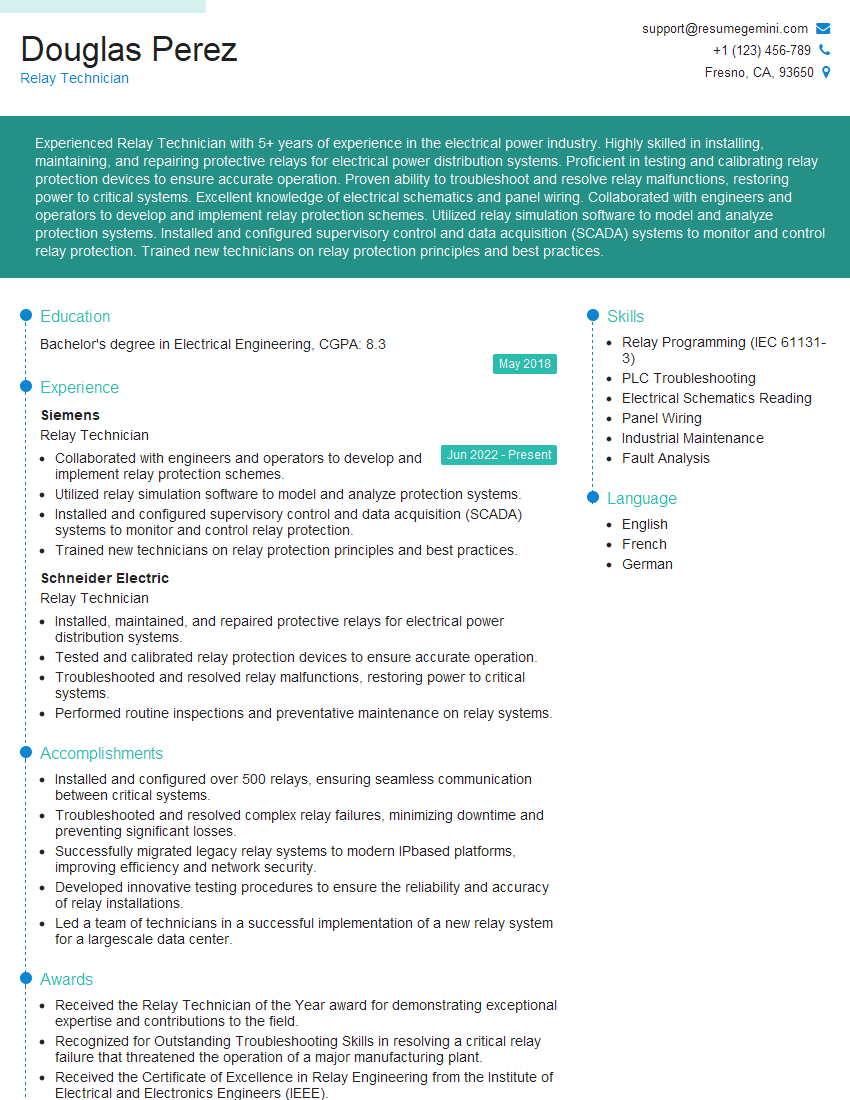
Relay Technician Resume Sample
Explore more articles
Users Rating of Our Blogs
Share Your Experience
We value your feedback! Please rate our content and share your thoughts (optional).
What Readers Say About Our Blog
To the interviewgemini.com Webmaster.
Very helpful and content specific questions to help prepare me for my interview!
Thank you
To the interviewgemini.com Webmaster.
This was kind of a unique content I found around the specialized skills. Very helpful questions and good detailed answers.
Very Helpful blog, thank you Interviewgemini team.