The thought of an interview can be nerve-wracking, but the right preparation can make all the difference. Explore this comprehensive guide to Solar Resource Analysis interview questions and gain the confidence you need to showcase your abilities and secure the role.
Questions Asked in Solar Resource Analysis Interview
Q 1. Explain the difference between direct, diffuse, and global solar irradiance.
Solar irradiance refers to the power of solar radiation received per unit area. It’s broken down into three components: direct, diffuse, and global.
- Direct irradiance: This is the beam radiation that reaches the surface directly from the sun. Imagine a sunny day with no clouds; the bright sunlight you feel is primarily direct irradiance. It’s the most predictable component and is crucial for designing solar power systems.
- Diffuse irradiance: This is the solar radiation that reaches the surface after being scattered by atmospheric particles like clouds, dust, and water vapor. Think of a cloudy day – the sunlight is soft and less intense because it’s been scattered. Diffuse radiation is less predictable than direct irradiance.
- Global irradiance: This is the sum of direct and diffuse irradiance. It represents the total solar radiation received at a given location. This is the most important value for solar energy applications, as it dictates the overall energy production of a solar panel.
For example, in a perfectly clear sky, direct irradiance might be high, while diffuse irradiance is low. On an overcast day, direct irradiance is minimal, and diffuse irradiance becomes the dominant component. Global irradiance considers both, giving the total amount of available solar energy.
Q 2. Describe the various methods used for measuring solar radiation.
Solar radiation is measured using various instruments, each with its strengths and weaknesses:
- Pyranometers: These are the most common instruments for measuring global horizontal irradiance. They are essentially wide-band sensors that measure the total solar radiation received on a horizontal surface. They’re like a sophisticated light meter, but for solar radiation.
- Pyrheliometers: These instruments measure direct normal irradiance – the radiation directly from the sun, perpendicular to its rays. They’re highly accurate and more specialized, often used in research or calibration of other sensors.
- Shading rings and pyrheliometers: By using a shading ring to block the diffuse irradiance, it’s possible to indirectly determine the diffuse component of radiation. This method requires both a global horizontal irradiance measurement and direct normal irradiance measurements.
- Satellite-based measurements: Satellites provide data over large geographical areas. They’re crucial for creating solar resource maps and providing long-term data records. However, spatial and temporal resolution can vary between different satellite sensors. They act like a giant eye in the sky monitoring solar irradiance.
The choice of measurement method depends on factors like accuracy requirements, budget, and the specific application. For instance, a large-scale solar farm development would likely use a combination of ground-based measurements and satellite data for a comprehensive assessment.
Q 3. What are the key factors affecting solar resource assessment?
Several factors significantly impact solar resource assessment. Understanding these is key to accurate predictions:
- Geographic location (latitude, longitude, altitude): Solar irradiance varies greatly with location due to differences in solar angle, atmospheric conditions, and cloud cover.
- Time of year and day: Solar irradiance is highest during summer and midday due to the sun’s higher angle in the sky.
- Atmospheric conditions (cloud cover, aerosols, water vapor): Clouds significantly reduce solar irradiance, while aerosols and water vapor can both absorb and scatter radiation.
- Terrain effects (topography, shading): Mountains and buildings can cast shadows, reducing the amount of solar radiation reaching a particular site. This is particularly important for site selection in complex terrains.
- Albedo (surface reflectivity): The reflectivity of the surface (snow, vegetation, etc.) affects the amount of solar radiation reflected back into the atmosphere.
For example, a site in a high-altitude desert will receive significantly higher solar irradiance than a site in a cloudy, coastal region. Accurate resource assessment must take all these factors into account.
Q 4. How do you account for shading effects in solar resource analysis?
Shading effects are a critical aspect of solar resource analysis because they significantly reduce solar energy output. There are several ways to account for them:
- Site surveys and shadow analysis: This involves conducting detailed surveys of the site to identify potential shading sources such as trees, buildings, and hills. Software tools can then be used to simulate shadow patterns throughout the year.
- GIS-based modeling: Geographic Information Systems (GIS) are incredibly powerful for analyzing terrain and shading effects. They allow for the incorporation of high-resolution elevation data and building footprints to accurately model shadow patterns.
- 3D modeling: Advanced 3D modeling software can generate accurate simulations of solar irradiance, taking into account the complex geometry of the site and the shading from surrounding objects.
- Sun path diagrams: These diagrams show the sun’s position throughout the day and year. They can help visually identify potential shading issues and determine the duration and severity of shadows.
Let’s say you are analyzing a potential solar farm location. Failure to accurately account for shading from neighboring buildings could result in a significant underestimation of the site’s energy production potential, leading to poor investment decisions.
Q 5. Explain the concept of solar irradiance modeling.
Solar irradiance modeling involves using mathematical models and algorithms to estimate the amount of solar radiation received at a particular location. These models simulate the complex interaction between solar radiation, the atmosphere, and the Earth’s surface. Think of it as a sophisticated weather forecast, but specifically for solar energy.
It is crucial for:
- Site assessment and selection for solar energy projects.
- Estimating energy production from solar PV systems.
- Designing solar tracking systems to maximize energy yield.
- Developing solar resource maps for a given area.
Accurate solar irradiance modeling allows for better planning, optimized system design, and realistic energy production forecasts.
Q 6. What are the different types of solar irradiance models?
Many types of solar irradiance models exist, ranging from simple to very complex. They can be broadly categorized as:
- Clear-sky models: These models estimate the solar irradiance under ideal conditions (no clouds). They are based on established equations that consider solar geometry, atmospheric parameters, and the effect of the Earth’s atmosphere.
- Statistical models: These models utilize historical solar irradiance data to predict future radiation levels. They often use statistical methods to analyze trends and patterns, accounting for variations in weather conditions.
- Physical models: These models consider the complex interactions between solar radiation and the atmosphere. They take into account factors such as cloud cover, aerosols, and other atmospheric effects in a more physically accurate way than statistical models. These are generally more complex but are more effective for modelling a specific location and capturing local effects.
- Hybrid models: These models combine aspects of both clear-sky and statistical models, leveraging the strengths of each.
The choice of model depends on factors like data availability, accuracy requirements, and computational resources. Simple models are suitable for quick assessments, while more complex models are needed for high-accuracy predictions.
Q 7. Discuss the advantages and disadvantages of different solar resource datasets.
Solar resource datasets come from various sources, each with its own advantages and disadvantages:
- Ground-based measurements: These provide highly accurate data for a specific location but are limited in spatial coverage and often lack long-term records.
- Satellite data: These provide broad spatial coverage and long-term records but have lower accuracy than ground measurements due to limitations in spatial resolution and atmospheric corrections. Data from different satellites also varies in quality.
- Reanalysis data: These datasets combine ground and satellite measurements with atmospheric models to produce high-resolution solar irradiance estimates over large areas, but may be less accurate in regions with limited ground measurements.
The ideal approach often involves combining different datasets. For example, ground-based measurements can be used to validate and calibrate satellite data, improving its accuracy. The choice of dataset depends on the specific application and the trade-off between spatial coverage, temporal resolution, and accuracy. For example, a national-scale solar resource assessment would benefit from the broad coverage of satellite data, while a smaller site-specific study would need the accuracy provided by ground-based measurements.
Q 8. How do you validate the accuracy of solar resource data?
Validating solar resource data accuracy is crucial for reliable solar project planning. We employ a multi-pronged approach, comparing data from multiple sources and using various quality control checks. This involves:
Comparing against multiple datasets: We cross-reference data from different sources such as ground-based weather stations, satellite imagery (e.g., from NASA’s MERRA-2 or NOAA’s GOES), and reanalysis products. Discrepancies highlight potential errors and allow us to identify the most reliable source for a specific location.
Statistical analysis: We perform statistical tests to assess the consistency and plausibility of the data. This might include checking for outliers, examining the distribution of data points, and comparing against known climatological norms for the region. For example, we might look for unexpectedly high or low values that deviate significantly from the expected patterns.
Spatial consistency checks: We analyze the spatial consistency of the data. Data should show a smooth transition across neighbouring locations, with gradual changes in solar irradiance reflecting geographic features like elevation or cloud cover patterns. Sudden jumps or discontinuities may indicate data errors.
Temporal consistency checks: We ensure that the data adheres to expected diurnal (daily) and seasonal variations. For example, solar irradiance should peak around solar noon and be higher in summer than in winter. Deviations from these patterns might signal issues with the data’s quality or integrity.
Independent validation: Where possible, we compare model-based predictions with actual measurements from operational solar power plants in the region. This ground-truthing helps confirm the accuracy of our resource assessments.
By combining these validation techniques, we can build confidence in the accuracy of our solar resource data and reduce the risk of errors in project planning and design.
Q 9. Explain the role of GIS in solar resource assessment.
Geographic Information Systems (GIS) are indispensable tools for solar resource assessment. They provide a powerful platform to integrate, analyze, and visualize diverse datasets relevant to solar energy potential. Essentially, GIS acts as a central hub for all the data related to a solar project.
Data integration: GIS allows us to integrate solar resource data (irradiance, solar angles), topographic data (elevation, slope), land use data (zoning, land cover), and infrastructure data (transmission lines, roads) into a single, unified platform.
Spatial analysis: GIS enables us to perform various spatial analyses, such as identifying areas with high solar irradiance, assessing the suitability of terrain for solar installations, and analyzing proximity to existing infrastructure.
Visualization: GIS offers powerful visualization capabilities, allowing us to create maps showing the spatial distribution of solar resources, potential project locations, and the impact of environmental factors.
Modeling and simulation: GIS can be integrated with solar energy modeling software to simulate the performance of solar power plants under different scenarios, taking into account factors like shading and atmospheric conditions.
For example, we can use GIS to overlay solar irradiance maps with land use maps to identify suitable sites that are both sunny and zoned for solar development. This significantly streamlines the site selection process.
Q 10. How do you use GIS to identify suitable locations for solar projects?
GIS plays a vital role in identifying suitable locations for solar projects. It’s not just about finding the sunniest spot; it’s about optimizing a complex set of criteria.
Identifying areas with high solar irradiance: We start by overlaying solar irradiance maps (obtained from satellite data or modeling) onto the GIS platform. This helps identify regions with consistently high solar energy potential.
Analyzing terrain suitability: We use digital elevation models (DEMs) to assess slope, aspect, and elevation. Steep slopes can increase installation costs and complexity, while the aspect (direction the slope faces) influences the amount of solar radiation received. Optimal locations typically have relatively flat terrain and favorable aspect.
Assessing land use and zoning: Land use data is crucial. We overlay land use maps to identify areas zoned for solar development, avoiding conflicts with residential, agricultural, or environmentally sensitive areas. This compliance check is critical for project approvals.
Evaluating proximity to infrastructure: Proximity to existing transmission lines is crucial for efficient energy evacuation. We use GIS to analyze distances to substations and transmission networks, minimizing the costs associated with new infrastructure development.
Considering environmental factors: GIS allows us to integrate environmental data such as protected areas, water bodies, and wildlife habitats. This helps us to avoid environmentally sensitive sites and minimize the project’s ecological footprint.
Multi-criteria analysis: Finally, we employ multi-criteria decision analysis (MCDA) techniques within GIS to weigh the relative importance of different factors (solar irradiance, slope, proximity to grid, environmental constraints) and identify the optimal sites for solar development. This combines all the above factors to rank potential sites.
Through a systematic GIS-based approach, we can significantly reduce site selection time and costs while ensuring environmental compatibility and economic viability.
Q 11. Describe your experience with solar resource assessment software.
I have extensive experience with various solar resource assessment software packages, including PVsyst, Helioscope, SAM (System Advisor Model), and ArcGIS Spatial Analyst. Each software has its own strengths and weaknesses, and my choice depends on the specific project requirements.
PVsyst: I frequently utilize PVsyst for detailed performance modeling of photovoltaic (PV) systems. It excels at simulating the energy production of specific PV systems, considering factors such as panel tilt, azimuth, shading, and module characteristics. It’s invaluable for optimizing system design and predicting long-term energy output.
Helioscope: Helioscope provides user-friendly interface for rapid solar resource assessment and system design. It’s helpful for quickly assessing the potential of a site and generating preliminary design concepts. I find it particularly useful in the early stages of project development.
SAM (System Advisor Model): SAM is a comprehensive software package for simulating various renewable energy technologies, including solar PV and thermal systems. I use SAM for detailed financial and performance analyses, exploring various system configurations and economic scenarios. It helps in evaluating the financial viability of a project.
ArcGIS Spatial Analyst: I leverage ArcGIS for spatial analysis and data integration. It’s critical for pre-processing and managing diverse datasets (topography, land use, solar irradiance) in preparation for more detailed solar energy modeling software.
My proficiency in these tools allows me to perform comprehensive solar resource assessments, from initial site screening to detailed system design and financial analysis, tailoring my approach to the specifics of each project.
Q 12. Explain the concept of solar power forecasting.
Solar power forecasting predicts the amount of electricity a solar power plant will generate over a specific time horizon. This prediction is crucial for grid operators to manage electricity supply and demand efficiently, optimizing grid stability and reliability.
Forecasting techniques range from simple persistence models (assuming current power output will continue) to complex numerical weather prediction (NWP) models coupled with PV system simulations. These models consider various factors, including:
Solar irradiance: The most important factor, predicted using satellite imagery, ground-based measurements, and numerical weather models.
Temperature: Affects the efficiency of solar panels; higher temperatures typically reduce output.
Cloud cover: Clouds significantly reduce solar irradiance, impacting power generation.
Other meteorological factors: Wind speed, humidity, and precipitation can also play a role.
PV system characteristics: The specific design of the PV system, including panel type, tilt, azimuth, and shading, significantly influences its power output.
Forecasts are typically provided at different timescales, including:
Nowcasting: Short-term forecasts (minutes to hours) providing very precise predictions of imminent changes in solar power generation.
Day-ahead forecasting: 24-hour forecasts providing a detailed prediction of daily energy generation.
Medium-term forecasting: Forecasts of several days or weeks, generally less accurate but still valuable for planning purposes.
Accurate forecasting is essential for efficient integration of solar power into the electricity grid.
Q 13. What are the challenges in accurate solar power forecasting?
Accurate solar power forecasting presents many challenges:
Variability of weather patterns: Weather is inherently unpredictable, especially cloud cover, which can drastically alter solar irradiance in short periods.
Limitations of meteorological models: Numerical weather prediction models, though advanced, have inherent limitations in accurately predicting localized weather conditions, especially at fine spatial resolutions.
Data scarcity and quality: Obtaining reliable and high-quality solar irradiance and meteorological data, particularly in remote areas or developing countries, can be challenging.
Shading effects: Predicting the impact of shading from trees, buildings, or other obstacles can be complex and requires detailed 3D modeling.
Uncertainty in PV system performance: Factors like soiling (dust accumulation) or degradation of PV panels can introduce uncertainty into power output predictions.
Computational cost: Running high-resolution, sophisticated forecasting models can be computationally expensive, particularly for large solar power plants or extensive geographical areas.
Addressing these challenges requires a combination of advanced modeling techniques, high-quality data, and robust validation processes.
Q 14. How do you account for weather variability in solar power forecasting?
Accounting for weather variability is paramount in solar power forecasting. We address this challenge through a combination of strategies:
High-resolution weather data: Using high-resolution numerical weather prediction (NWP) models and integrating data from multiple sources (satellite imagery, ground stations, radar) improves the accuracy of weather predictions at the specific location of the solar plant.
Ensemble forecasting: Running multiple NWP models with slightly different initial conditions and parameterizations produces an ensemble of forecasts. Analyzing the spread and mean of this ensemble helps quantify forecast uncertainty and improve prediction reliability.
Statistical post-processing: Applying statistical techniques (e.g., Kalman filtering, machine learning) to raw NWP outputs can improve forecast accuracy by correcting model biases and incorporating information from historical data.
Cloud detection and tracking: Sophisticated algorithms that analyze satellite imagery can effectively detect and track clouds, providing crucial input for short-term (nowcasting) solar power forecasts.
Data assimilation: Combining model forecasts with real-time measurements from nearby weather stations and the solar power plant itself helps to refine the forecasts and reduce the impact of model errors. This feedback loop improves forecast accuracy over time.
By combining these techniques, we can generate solar power forecasts that are more robust and less sensitive to weather variability, leading to improved grid management and operational efficiency.
Q 15. What are the different techniques for solar power forecasting?
Solar power forecasting involves predicting future solar irradiance levels, crucial for optimizing grid operations and energy production. Several techniques exist, each with its strengths and weaknesses:
- Persistence Forecasting: This simplest method assumes future irradiance will be similar to the present. It’s useful for very short-term predictions but highly inaccurate for longer periods.
- Statistical Forecasting: These methods employ statistical models, like ARIMA (Autoregressive Integrated Moving Average) or machine learning algorithms, to analyze historical irradiance data and predict future values. They are relatively simple to implement but require substantial historical data.
- Numerical Weather Prediction (NWP) Models: These sophisticated models simulate atmospheric conditions to forecast cloud cover, which directly impacts solar irradiance. They offer higher accuracy, particularly for longer-term predictions, but require significant computational resources and expertise.
- Hybrid Models: These combine the strengths of multiple approaches, often using NWP data to improve the accuracy of statistical models. For example, a hybrid model might use NWP data to adjust a persistence forecast for expected changes in cloud cover.
- Satellite-Based Forecasting: Utilizing satellite imagery provides real-time observation of cloud cover and other atmospheric conditions, enhancing forecasting accuracy, particularly for geographically distributed power plants.
The choice of technique depends on factors like the desired prediction horizon, data availability, computational resources, and the required accuracy.
Career Expert Tips:
- Ace those interviews! Prepare effectively by reviewing the Top 50 Most Common Interview Questions on ResumeGemini.
- Navigate your job search with confidence! Explore a wide range of Career Tips on ResumeGemini. Learn about common challenges and recommendations to overcome them.
- Craft the perfect resume! Master the Art of Resume Writing with ResumeGemini’s guide. Showcase your unique qualifications and achievements effectively.
- Don’t miss out on holiday savings! Build your dream resume with ResumeGemini’s ATS optimized templates.
Q 16. Explain the role of meteorological data in solar resource analysis.
Meteorological data plays a pivotal role in solar resource analysis as it provides the essential inputs for understanding and quantifying solar irradiance. Solar irradiance, the amount of solar energy received per unit area, is highly dependent on atmospheric conditions.
Key meteorological parameters include:
- Global Horizontal Irradiance (GHI): Total solar radiation received on a horizontal surface.
- Direct Normal Irradiance (DNI): Solar radiation received on a surface perpendicular to the sun’s rays.
- Diffuse Horizontal Irradiance (DHI): Solar radiation scattered by the atmosphere, received on a horizontal surface.
- Temperature: Affects the efficiency of solar panels.
- Cloud Cover: Significantly impacts the amount of solar radiation reaching the earth’s surface.
- Humidity: Influences the amount of atmospheric absorption.
- Wind Speed: Impacts panel cooling and dust accumulation.
By analyzing these parameters, we can accurately assess the solar resource potential of a specific location and design efficient solar energy systems.
Q 17. How do you analyze meteorological data for solar resource assessment?
Analyzing meteorological data for solar resource assessment involves several steps:
- Data Acquisition: Obtain relevant data from reliable sources like meteorological stations, weather satellites, or reanalysis datasets. Ensure data quality and consistency is checked carefully.
- Data Preprocessing: This crucial step involves cleaning the data, handling missing values (using interpolation or removal), and converting data into a usable format. Quality control is paramount to avoid erroneous results.
- Statistical Analysis: Calculate key statistical parameters such as mean, standard deviation, and percentiles for GHI, DNI, and DHI. This provides an understanding of the solar resource’s variability.
- Solar Radiation Modeling: Employ solar radiation models to estimate solar irradiance on tilted surfaces, considering factors like solar angles and surface albedo. Software packages like PVsyst or SAM are commonly used.
- Data Visualization: Create graphs and charts to visualize the data and gain insights. This can include time series plots, probability distributions, and spatial maps.
- Resource Assessment: Combine the results of the analysis to determine the annual solar energy potential of the location and evaluate its suitability for solar energy projects.
Example: A common analysis involves calculating the average daily GHI over a year to estimate the annual energy yield. Missing data might be filled using linear interpolation. We would then use this average to assess the suitability of the site for solar panel installation.
Q 18. What is the significance of the clearness index in solar resource analysis?
The clearness index (Kt) is a dimensionless ratio that quantifies the ratio of global horizontal irradiance (GHI) to the extraterrestrial irradiance (Eo) – the solar radiation that would reach the earth’s surface if there were no atmosphere.
Kt = GHI / Eo
Its significance lies in its ability to characterize atmospheric clarity and the amount of solar radiation reaching the earth’s surface. A higher Kt value (closer to 1) indicates clearer skies and higher solar radiation, while a lower value indicates greater cloud cover and atmospheric attenuation. It is invaluable in:
- Solar resource assessment: Helps to quantify the available solar energy at a location.
- Solar energy system design: Influences the choice of system components and sizing.
- Performance evaluation: Used to compare the performance of different solar energy systems or locations.
For example, a location with a consistently high Kt value suggests great potential for solar energy generation. Conversely, a low Kt value indicates a need for a more robust system to compensate for lower irradiance levels.
Q 19. Explain the concept of solar angle calculations.
Solar angle calculations determine the position of the sun in the sky at a given time and location. These calculations are crucial for solar energy applications because they directly influence the amount of solar radiation received by a solar panel.
Key angles include:
- Solar Altitude Angle (α): The angle of the sun above the horizon.
- Solar Azimuth Angle (γ): The angle of the sun measured clockwise from due south.
- Hour Angle (ω): The angular displacement of the sun east or west of the local meridian (due south).
These angles are calculated using astronomical equations that consider the date, time, location (latitude and longitude), and equation of time (corrections for earth’s elliptical orbit). Various algorithms and software are available to perform these calculations, often incorporated within solar resource assessment software. Accurate solar angle calculations are critical for determining optimal tilt and azimuth angles for solar panels, maximizing energy capture.
Q 20. How do you determine the optimal tilt angle for a solar panel?
Determining the optimal tilt angle for a solar panel aims to maximize energy production throughout the year. The ideal tilt angle depends on the latitude of the location and the desired balance between maximizing winter and summer energy production.
Several approaches exist:
- Latitude Rule: A simple method where the tilt angle is set equal to the latitude of the location. This is a good starting point, but it might not be optimal in all cases.
- Fixed Tilt Angle Optimization: Using solar resource data, simulations, or optimization algorithms (e.g., genetic algorithms), one can find the tilt angle that maximizes annual energy production. This approach accounts for the variation in solar radiation throughout the year.
- Seasonal Tilt Adjustment: This approach uses a fixed tilt angle for part of the year, then adjusts the tilt angle seasonally to optimize for peak solar radiation. It is more complex but can significantly improve energy production.
- Tracking Systems: These dynamically adjust the panel’s tilt and azimuth angles to follow the sun throughout the day. While they offer maximum energy capture, they are more expensive than fixed-tilt systems.
The best approach often depends on cost considerations, climate variability and specific goals of the solar energy project. For example, in a location with high winter irradiance, optimizing for winter performance might be desired, resulting in a tilt angle slightly steeper than the latitude.
Q 21. Describe the importance of solar resource maps in project development.
Solar resource maps are essential tools in solar project development, providing a visual representation of the solar energy potential across a geographical area. They are generated using meteorological data, satellite imagery, and solar radiation models.
Their importance stems from:
- Site Selection: Identifying locations with high solar irradiance levels for optimal energy production.
- Project Planning: Assessing the feasibility of solar projects based on the available solar resource.
- System Design: Determining appropriate system size and configuration based on the local solar resource.
- Financial Modeling: Estimating the expected energy production and return on investment for solar projects.
- Resource Assessment: Comparing the solar resource potential of different locations for effective decision making.
For instance, a developer might use a solar resource map to identify regions with high average annual GHI, then use more detailed analysis at potential sites to refine the system design and obtain financing. These maps are an indispensable tool for effective planning and execution in the renewable energy sector.
Q 22. What are the key performance indicators (KPIs) used to evaluate solar projects?
Key Performance Indicators (KPIs) in solar projects are crucial for evaluating success and return on investment. They fall broadly into categories of energy production, financial performance, and system reliability.
- Energy Yield: This includes Annual Energy Production (AEP) in kWh, Capacity Factor (the ratio of actual energy produced to the maximum possible energy production), and Performance Ratio (a measure of system efficiency considering various losses).
- Financial Performance: Key metrics here include the Levelized Cost of Energy (LCOE), representing the average cost of electricity over the system’s lifetime; the Return on Investment (ROI); and the Net Present Value (NPV), which reflects the profitability after accounting for the time value of money.
- System Reliability: This involves tracking system downtime, mean time between failures (MTBF), and overall system availability. A high MTBF indicates a robust and reliable system.
For example, a project might target an AEP of 1,500,000 kWh annually, an LCOE below $0.10/kWh, and a system availability exceeding 98%. These targets are set based on project specifics, location, and market conditions.
Q 23. How do you estimate the energy yield of a solar PV system?
Estimating the energy yield of a solar PV system requires a multi-step process involving solar resource assessment, system design, and performance modeling.
- Solar Resource Assessment: This involves determining the amount of solar irradiance (solar energy) available at the project location. This is typically done using historical solar irradiance data from meteorological stations or satellite imagery, often processed using specialized software.
- System Design: The system’s capacity (kWp), panel type, tilt angle, azimuth (orientation), and shading factors are determined based on the site characteristics and energy demand.
- Performance Modeling: Software tools, such as PVsyst, SAM, or Helioscope, are used to simulate the system’s performance under various weather conditions and account for losses due to temperature, soiling, and other factors. These models take as input the solar resource data, system design specifications, and performance parameters to provide an estimate of the annual energy production (AEP).
For instance, we might use PVsyst to model a 1 MWp system in Arizona, inputting historical solar irradiance data, and the system’s specific characteristics (panel type, tilt, etc.). The software would then output an estimated AEP, along with the system’s capacity factor. The accuracy of the estimation depends on the quality of input data and the sophistication of the model.
Q 24. How do you analyze the economic feasibility of a solar project?
Analyzing the economic feasibility of a solar project involves a thorough assessment of costs and revenues over the project’s lifespan.
A Discounted Cash Flow (DCF) analysis is typically used, incorporating factors such as:
- Capital Costs: These include land acquisition, equipment purchase, installation, and permitting fees.
- Operational Costs: These encompass maintenance, insurance, and cleaning expenses.
- Revenue Streams: This involves projected electricity sales (often based on the estimated AEP and electricity pricing), potential government incentives, and carbon credits.
- Financing Costs: This includes interest rates and loan repayment schedules.
- Salvage Value: This accounts for the potential resale value of components at the end of the project’s life.
The NPV, IRR (Internal Rate of Return), and payback period are key indicators derived from the DCF analysis. A positive NPV and an IRR exceeding the discount rate suggest the project is economically viable. Sensitivity analysis is crucial to understand the impact of variations in key parameters like electricity prices and equipment costs on the project’s profitability.
For example, a sensitivity analysis might show that while the project is viable under base-case assumptions, a significant drop in electricity prices could render it unprofitable. This informs decision-making on risk mitigation strategies.
Q 25. What are the potential risks and uncertainties associated with solar resource assessments?
Solar resource assessments are subject to several risks and uncertainties.
- Data Accuracy and Availability: Historical solar irradiance data may be limited, especially in remote areas or for long periods. Data quality can vary significantly depending on the source (ground-based stations, satellites).
- Future Climate Change: Climate change can alter future solar resource patterns, making projections uncertain. Models need to account for potential changes in cloud cover, temperature, and precipitation.
- Shading and Obstructions: Unexpected shading from vegetation growth or new buildings can reduce energy yield. Accurate shading analysis is crucial but can be challenging.
- Measurement Errors: Instruments used for solar irradiance measurements can have errors. Calibration and quality control are essential to minimize these inaccuracies.
These uncertainties can significantly impact the accuracy of energy yield estimations and subsequent project financing decisions. For example, an underestimation of shading could lead to a significant reduction in actual energy production compared to projected yields.
Q 26. How do you mitigate risks and uncertainties in solar resource assessment?
Mitigating risks and uncertainties in solar resource assessments requires a multi-pronged approach.
- Data Validation and Quality Control: Thoroughly validate data from various sources and use quality control measures to identify and correct errors. This might involve comparing data from multiple stations or using data validation tools.
- Uncertainty Quantification: Quantify uncertainties in the solar resource data using statistical methods. This involves creating probability distributions representing the range of possible future scenarios.
- Advanced Modeling Techniques: Employ sophisticated solar resource models that consider climate change projections and incorporate detailed site-specific information (e.g., topography, albedo).
- Site Surveys and Inspections: Conduct thorough site surveys to identify potential shading issues and other site-specific factors affecting energy production.
- Conservative Estimations: Use conservative estimates of solar resource availability and consider the worst-case scenarios when developing project plans and financial models.
For example, instead of relying solely on a single-point estimate of AEP, we would present a range of possible outcomes considering uncertainty in the input data. This provides a more realistic and transparent assessment of the project’s risks.
Q 27. Describe your experience working with solar resource datasets and their limitations.
I have extensive experience working with various solar resource datasets, including those from NASA’s Surface Meteorology and Solar Energy (SSE) database, the National Renewable Energy Laboratory (NREL), and various commercial providers. These datasets typically provide hourly or daily values of global horizontal irradiance (GHI), direct normal irradiance (DNI), and diffuse horizontal irradiance (DHI).
Limitations of these datasets include:
- Spatial Resolution: The spatial resolution might be insufficient for detailed site-specific assessments. Data from a nearby meteorological station might not fully represent the actual conditions at the project location.
- Temporal Resolution: Data might not be available at the desired temporal resolution (e.g., sub-hourly data). Interpolation methods need to be applied to generate data at finer resolutions.
- Data Gaps: Datasets might have gaps in data due to equipment malfunctions or other reasons. Data imputation or gap-filling techniques are crucial to address this issue.
- Data Quality: Data quality can vary significantly depending on the instrument type, calibration methods, and data processing techniques used.
To overcome these limitations, I often combine data from multiple sources, employ interpolation and gap-filling methods, and conduct site-specific measurements whenever possible. Understanding these limitations is essential for accurate and reliable solar resource assessments.
Q 28. What are some emerging trends in solar resource analysis and technology?
Several emerging trends are shaping the field of solar resource analysis and technology:
- AI and Machine Learning: AI and ML techniques are being used to improve solar resource forecasting, optimize system design, and enhance the accuracy of energy yield estimations. These methods can analyze large datasets to identify patterns and make predictions that are more accurate than traditional methods.
- Advanced Sensor Technologies: New sensor technologies, such as LiDAR and hyperspectral imaging, are providing higher-resolution and more accurate data on solar resource availability, enabling more precise site assessments.
- Integration with GIS and Remote Sensing: Integration of solar resource data with Geographic Information Systems (GIS) and remote sensing data allows for detailed visualization and analysis of solar potential across large areas. This aids in site selection and project planning.
- High-Resolution Solar Forecasting: Improved forecasting methods are crucial for optimizing grid integration of solar energy. Short-term (minute to hour) forecasts are becoming increasingly important for grid stability.
- Climate Change Impact Assessments: Sophisticated climate models and downscaling techniques are being developed to account for the impact of climate change on future solar resource availability and help improve long-term project planning.
These trends are leading to more accurate, reliable, and efficient solar energy systems, and more effective utilization of this critical renewable resource.
Key Topics to Learn for Your Solar Resource Analysis Interview
Ace your next interview by mastering these fundamental areas of Solar Resource Analysis. We’ve broken down the key concepts to help you build a strong foundation and showcase your expertise.
- Solar Geometry and Irradiance Models: Understand the sun’s position throughout the day and year, and how various models (e.g., isotropic, anisotropic) predict solar irradiance on different surfaces. Consider exploring the limitations and applicability of each model.
- Data Acquisition and Processing: Familiarize yourself with methods for collecting solar resource data (satellite imagery, ground-based measurements). Understand data cleaning, quality control, and processing techniques to prepare data for analysis.
- Solar Resource Mapping and GIS: Learn how to use Geographic Information Systems (GIS) to create maps of solar irradiance potential across different regions. Practice interpreting these maps and their implications for solar energy project siting.
- Uncertainty and Error Analysis: Understand the sources of uncertainty in solar resource data and models. Learn how to quantify and propagate uncertainties in your analyses to provide realistic estimates of solar energy potential.
- Advanced Techniques: Explore advanced techniques like statistical downscaling, machine learning applications for solar forecasting, and the integration of solar resource data with energy system models.
- Practical Application: Site Assessment and Project Development: Be prepared to discuss how solar resource analysis informs the design and development of solar energy projects, from initial feasibility studies to detailed system design.
Next Steps: Unlock Your Solar Career Potential
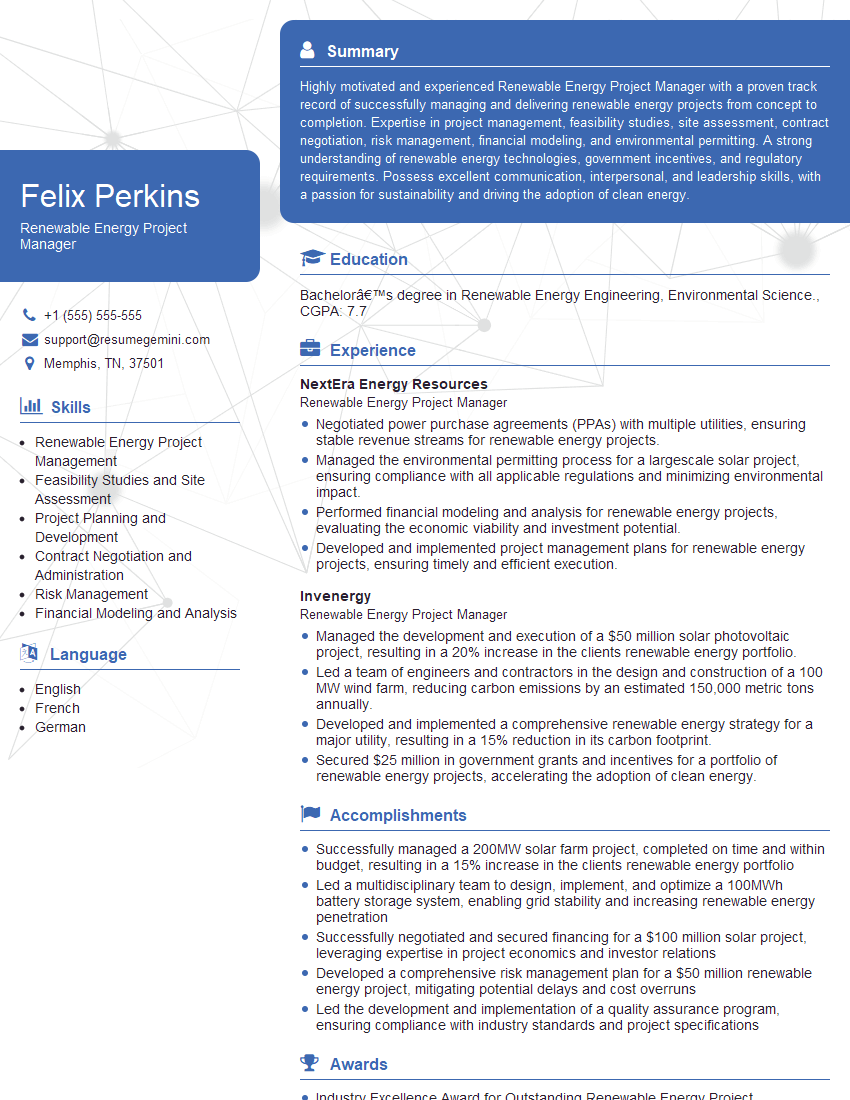
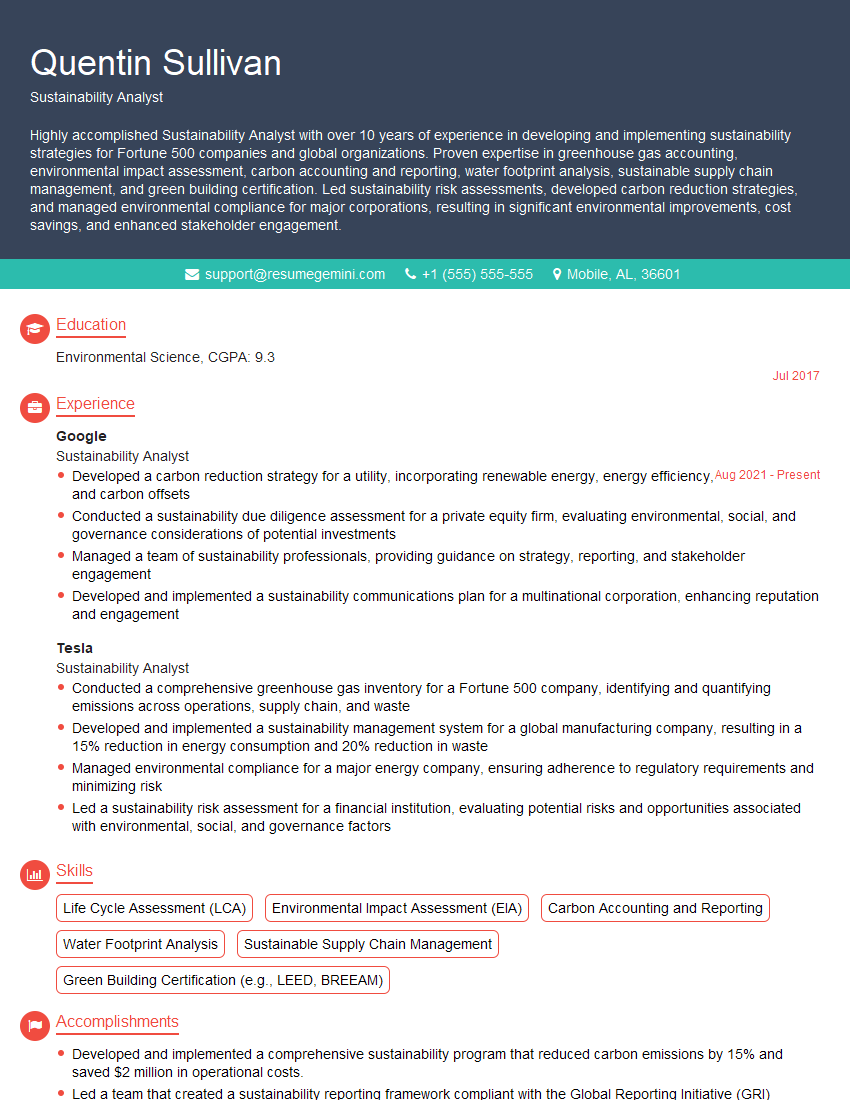
Mastering Solar Resource Analysis is crucial for career advancement in the renewable energy sector. It opens doors to exciting roles and allows you to contribute significantly to a sustainable future. To maximize your job prospects, focus on crafting a compelling and ATS-friendly resume that highlights your skills and experience effectively.
We recommend using ResumeGemini to build a professional and impactful resume. ResumeGemini simplifies the process and helps you create a document that gets noticed. They provide examples of resumes specifically tailored for Solar Resource Analysis professionals, allowing you to see best practices in action and tailor your own resume accordingly.


Explore more articles
Users Rating of Our Blogs
Share Your Experience
We value your feedback! Please rate our content and share your thoughts (optional).
What Readers Say About Our Blog
To the interviewgemini.com Webmaster.
Very helpful and content specific questions to help prepare me for my interview!
Thank you
To the interviewgemini.com Webmaster.
This was kind of a unique content I found around the specialized skills. Very helpful questions and good detailed answers.
Very Helpful blog, thank you Interviewgemini team.