The right preparation can turn an interview into an opportunity to showcase your expertise. This guide to Transportation Modeling (VISSIM, COMPAS) interview questions is your ultimate resource, providing key insights and tips to help you ace your responses and stand out as a top candidate.
Questions Asked in Transportation Modeling (VISSIM, COMPAS) Interview
Q 1. Explain the difference between macroscopic and microscopic traffic simulation.
Macroscopic and microscopic traffic simulation models differ fundamentally in their approach to representing traffic flow. Think of it like looking at a city: macroscopic models view the overall traffic flow as a continuous stream, similar to a river, while microscopic models look at each individual car, like observing each person walking along a street.
Microscopic simulation, used in programs like VISSIM, models individual vehicles and their interactions. Each vehicle follows specific rules, reacting to its surroundings – other vehicles, traffic signals, and road geometry. This approach provides a highly detailed representation of traffic behavior but can be computationally intensive, especially for large networks.
Macroscopic simulation, like some aspects of COMPAS, simplifies traffic flow by aggregating vehicles into groups. It focuses on aggregate measures like flow, density, and speed. It’s faster and less computationally demanding but sacrifices the level of detail seen in microscopic simulation. For example, a macroscopic model might predict overall delay on a freeway section, whereas a microscopic model would show the delay experienced by each individual vehicle.
In essence, the choice depends on the project’s scope and required level of detail. Microscopic models are better suited for detailed analysis of specific intersections or complex scenarios, while macroscopic models are ideal for large-scale network planning or quick assessments.
Q 2. What are the key advantages and disadvantages of using VISSIM and COMPAS?
VISSIM and COMPAS, while both used in transportation modeling, cater to different needs and have their own strengths and weaknesses.
- VISSIM: Advantages – Highly detailed microscopic simulation, excellent visualization capabilities, wide range of vehicle types and behaviors, robust calibration and validation tools. Disadvantages – Computationally expensive, steeper learning curve, can be resource-intensive for very large networks.
- COMPAS: Advantages – Often used for strategic planning, handles large networks efficiently, incorporates various travel demand models. Disadvantages – Less detail compared to VISSIM, may not be suitable for detailed intersection analysis, visualization capabilities can be less intuitive.
Choosing between them relies heavily on the project’s goals. For example, analyzing the impact of a new roundabout on pedestrian safety would benefit from VISSIM’s microscopic detail, whereas assessing the impact of a new highway on regional travel times might be better handled by COMPAS’s ability to handle larger networks efficiently. In some cases, both might be used in a complementary fashion, with COMPAS used for high-level strategic planning and VISSIM used for more detailed microsimulation of specific areas of interest.
Q 3. Describe your experience calibrating a traffic simulation model.
Calibrating a traffic simulation model is crucial to ensure its accuracy. It’s like tuning a musical instrument – you need to adjust parameters until the model’s output matches real-world observations. My approach typically involves these steps:
- Data Collection: Gathering real-world traffic data, including traffic counts, speeds, and queue lengths, from various sources (e.g., loop detectors, video cameras).
- Parameter Estimation: Identifying key model parameters, such as car-following models (e.g., Gipps, Intelligent Driver Model), lane-changing models, and turning movement proportions. Initial values are assigned based on literature and experience.
- Model Calibration: Iteratively adjusting parameters to minimize the differences between simulated and observed traffic data. Statistical measures like RMSE (Root Mean Squared Error) are used to quantify the goodness of fit. This step usually involves sensitivity analysis to identify which parameters have the most significant impact.
- Validation: Assessing the calibrated model’s performance using a separate dataset not used during calibration. This ensures that the model generalizes well beyond the calibration data.
For instance, in a recent project simulating a highway section, I used VISSIM and adjusted parameters related to car-following and lane-changing behavior until simulated speed profiles closely matched those observed by loop detectors. The process involved numerous iterations, careful analysis of the results, and documentation of each parameter adjustment.
Q 4. How do you validate a traffic simulation model?
Validating a traffic simulation model is critical to ensure its predictions are reliable. It’s like testing a new recipe – you need to ensure it produces the expected results. Validation uses data independent from the calibration process and involves comparing the model’s output against real-world observations. Different validation techniques can be employed, depending on the model and available data.
- Qualitative Validation: Comparing simulated patterns (e.g., traffic flow patterns, queue behavior) visually with real-world observations (e.g., video footage). This is subjective but offers insights into the model’s overall behavior.
- Quantitative Validation: Using statistical measures to compare key performance indicators (KPIs) from the simulation with real-world data. Examples include comparing average speeds, travel times, and queue lengths.
- Scenario Validation: Testing the model’s ability to reproduce observed traffic responses under different conditions, like incidents or special events.
In a project involving a city center, I used video footage to qualitatively validate the pedestrian behavior in my VISSIM model, while simultaneously comparing simulated traffic counts at key intersections with real-world data collected from loop detectors for quantitative validation. A good validation confirms that the model is producing realistic and reliable results and can be used to support decision-making.
Q 5. What are the different types of traffic demand models?
Traffic demand models estimate how many vehicles will travel between different origins and destinations within a transportation network. They are crucial inputs for traffic simulation models. Different types exist, each with its strengths and weaknesses:
- Trip Generation Models: Predict the total number of trips originating and ending in a specific zone, based on factors like population, employment, and land use.
- Trip Distribution Models: Allocate the generated trips between different zones, often using gravity models or other spatial interaction models.
- Modal Split Models: Determine the proportion of trips using different modes of transport (e.g., car, bus, train).
- Traffic Assignment Models: Assign the trips to the network links, considering factors like travel time and cost. These can be static or dynamic.
For example, in a study of a suburban area, we used a trip generation model based on household characteristics to predict the number of car trips. A gravity model then distributed these trips across different zones, considering factors like distance and job opportunities. Finally, a modal split model estimated the proportion of trips made by car versus public transport.
Q 6. Explain the concept of network assignment in transportation modeling.
Network assignment is the process of distributing traffic demand (trips) onto a transportation network. It’s like allocating customers to different routes in a delivery service. The goal is to assign trips to links in a way that reflects how travelers choose their routes. This choice is influenced by factors like travel time, cost, distance, and perceived level of service.
Different assignment methods exist, ranging from simple deterministic methods (all users choose the shortest path) to more sophisticated stochastic methods (users make route choices probabilistically, considering factors like risk aversion).
- All-or-Nothing Assignment: Simplest method; all trips between an origin and destination use the shortest path.
- Incremental Assignment: Iteratively assigns trips, updating link costs after each iteration.
- Stochastic User Equilibrium (SUE): More realistic; accounts for uncertainty in route choice.
The choice of assignment method affects the accuracy and realism of the simulation. SUE assignment, for example, more realistically models route choice behavior compared to the simpler all-or-nothing assignment.
Q 7. How do you handle dynamic traffic assignment in your models?
Dynamic Traffic Assignment (DTA) simulates how traffic flow changes over time, unlike static assignment which assumes a constant traffic condition. It’s like showing a movie of traffic flow rather than a snapshot. DTA accounts for time-dependent travel times and route choices, making it more realistic for simulating congested networks.
Implementing DTA in a simulation model involves several considerations:
- Time Discretization: Dividing the simulation time into small intervals to capture the dynamic changes in traffic flow.
- Route Choice Models: Employing models that capture the dynamic behavior of drivers, who may adjust their routes based on real-time traffic conditions (e.g., using information from navigation systems).
In VISSIM, for instance, DTA can be implemented by utilizing the dynamic user equilibrium (DUE) assignment approach. This requires careful consideration of the time step size and the choice of route choice model. The simulation of a major highway during peak hours would greatly benefit from DTA to accurately capture congestion patterns and route choice dynamics.
Q 8. What are the limitations of using a four-step transportation model?
The four-step transportation model (Trip Generation, Distribution, Mode Choice, Assignment) is a classic approach, but it has limitations. Its primary weakness is its inherent sequential nature and the independence assumptions made between steps. This means that changes in one step don’t directly affect the previous steps, leading to inaccuracies. For example, the trip generation step might underestimate the number of trips due to a specific land use change, and this error propagates through the entire model.
- Sequential Nature: Feedback loops between steps are ignored. Changes in network conditions (e.g., congestion) due to the assigned trips don’t influence the earlier trip generation or mode choice decisions.
- Independence Assumption: The model assumes that choices made in each step are independent of each other. In reality, a traveler’s mode choice might heavily influence their trip distribution, and vice-versa.
- Simplified Representation: The model simplifies complex behavioral aspects of travel choices. It struggles to capture factors like behavioral reactions to congestion, route learning, and the influence of real-time information.
- Aggregated Data: The model relies on aggregated data, potentially masking important spatial variations in travel behavior.
More sophisticated models, like activity-based models, address many of these limitations by simulating individual traveler behavior and incorporating dynamic interactions between the four steps. They provide a more accurate representation of reality, but they are also significantly more complex to build and calibrate.
Q 9. How do you incorporate public transit into your traffic simulation models?
Incorporating public transit into traffic simulation models requires a multi-faceted approach. We need to represent transit networks, schedules, and passenger behavior. In VISSIM, for instance, this involves:
- Creating transit routes: Defining bus, train, or subway routes with their respective stops and schedules. This usually involves importing GTFS (General Transit Feed Specification) data.
- Modeling vehicle behavior: Defining transit vehicle characteristics (speed, acceleration, headway) and their movements along the network. We might use dedicated transit vehicle types with specific properties (e.g., larger turning radii for buses).
- Simulating passenger behavior: This is crucial and involves modeling passenger boarding and alighting at stops, waiting times, and transfers between lines. This often necessitates the use of advanced features in the software, possibly including agent-based modeling to simulate individual passenger decisions.
- Integrating with other modes: We ensure seamless interaction between transit and other modes (cars, bikes) at intersections and interchanges. This involves carefully setting up priorities and traffic rules to accurately represent real-world behavior.
COMPAS, while not as visually rich as VISSIM, allows a comparable level of detail in modeling transit through its network loading and assignment routines. The key here is accurate representation of schedules, headways, and passenger demand to obtain reliable results. For both VISSIM and COMPAS, validation is particularly important when modeling transit due to the complexity involved.
Q 10. Describe your experience with VISSIM’s calibration and validation tools.
My experience with VISSIM’s calibration and validation tools is extensive. Calibration involves adjusting model parameters to match observed traffic data, while validation checks how well the calibrated model predicts real-world performance. In VISSIM, I’ve used several tools and techniques:
- Calibration Wizard: This is VISSIM’s built-in tool for initial calibration, facilitating the adjustment of parameters based on collected data (e.g., speeds, flow, densities).
- Manual Calibration: For more detailed adjustments and specific scenarios, manual calibration is often necessary. This involves systematically adjusting parameters like car-following models and lane-changing behavior to reproduce observed traffic patterns.
- Performance Measures: VISSIM offers various metrics to evaluate the model’s performance, such as speed, delay, queue length, and density. These are compared with observed data to assess the calibration’s accuracy.
- Visualization Tools: VISSIM’s visualization tools are invaluable for visualizing results and identifying areas where the model does not align with observations, guiding further refinement of model parameters.
- Validation Datasets: A separate dataset (unseen during calibration) is crucial for validation. This independent dataset checks the model’s ability to predict traffic conditions under various scenarios, ensuring generalizability.
For instance, during a recent project modeling a highway interchange, we used observed loop detector data for calibration and then a separate dataset from video analysis for validation. This rigorous approach ensures that our simulations reflect reality, providing reliable results for decision-making.
Q 11. How do you deal with missing or incomplete data in transportation modeling?
Missing or incomplete data are common challenges in transportation modeling. Strategies to handle them depend on the type and extent of missing data, as well as the modeling objectives. Approaches include:
- Data Imputation: This involves estimating missing values based on available data. Methods range from simple mean/median substitution to more sophisticated techniques like regression imputation or multiple imputation. The choice depends on data characteristics and the risk of introducing bias.
- Sensitivity Analysis: If missing data are substantial, we use sensitivity analysis to assess the impact of different imputation methods on model results. This helps understand the uncertainty associated with missing data.
- Data Collection: The most reliable way is to supplement existing data with new data collection efforts, if resources allow. This might involve traffic counts, surveys, or GPS data.
- Model Simplification: In some cases, if data are severely limited, we might simplify the model scope, focusing on aspects with sufficient data. For instance, we might limit the geographical area or exclude specific modes.
- Data Aggregation: Combining data from different sources or aggregating data to a coarser spatial or temporal resolution can reduce the impact of missing data, but it might result in a loss of detail.
For example, if we lack detailed origin-destination (OD) matrices, we might use existing data to build a reasonable estimate, using methods like gravity models. We’d then perform sensitivity analysis to assess the effect of this estimation on overall model results. It is essential to be transparent about data limitations and uncertainties in the final report.
Q 12. Explain the concept of trip generation, distribution, mode choice, and assignment.
The four steps of the traditional transportation model represent the sequential process of modeling travel demand:
- Trip Generation: This step estimates the number of trips originating from and terminating at different zones within the study area. It considers factors such as population, employment, land use, and income. Examples include using regression models (linear or log-linear) to predict trips based on these factors.
- Trip Distribution: This step models how trips generated in one zone are distributed to other zones in the study area. Gravity models, Fratar models, and other spatial interaction models are commonly used, taking into account distance, travel time, and other impedance factors between zones.
- Mode Choice: This step determines the mode of transportation (car, bus, rail, bike, etc.) for each trip. Discrete choice models (logit models, for instance) are employed to predict mode choice probabilities based on factors like travel time, cost, comfort, and convenience.
- Trip Assignment: This step assigns the trips to the transportation network, determining the routes taken by vehicles. Algorithms like all-or-nothing, incremental, or equilibrium assignment are used. The equilibrium assignment considers the interaction of traffic flow and congestion on route choices.
These four steps, though sequential, interact dynamically in a real-world scenario. Advanced modeling techniques aim to account for these interactions more realistically.
Q 13. What are some common errors to avoid when building a transportation model?
Several common errors can compromise the accuracy and reliability of a transportation model. Some key errors to avoid include:
- Incorrect Data Input: Using inaccurate or outdated data can severely affect model outcomes. Data quality control is paramount. Inconsistent units, wrong zone definitions, or biased survey data can lead to erroneous predictions.
- Inappropriate Model Selection: Using a model that is not suitable for the problem or data is a common mistake. For instance, applying a simple gravity model to a complex network might lead to inaccurate trip distributions.
- Ignoring Network Dynamics: Ignoring dynamic traffic flow effects such as congestion or incident management can significantly underestimate travel times and other key performance indicators.
- Oversimplification of Behavior: Oversimplified assumptions about traveler behavior (e.g., assuming all travelers always select the shortest path) can lead to unrealistic results.
- Poor Calibration and Validation: Insufficient calibration or lack of proper validation can result in models that don’t accurately reflect reality.
- Ignoring Uncertainty: Failing to acknowledge and quantify the uncertainty associated with input data and model parameters can lead to overconfidence in results. Sensitivity analyses are critical here.
For example, I once encountered a model that used outdated population data, leading to a significant overestimation of traffic volume. Always double-check your data and carefully evaluate the applicability of your modeling techniques.
Q 14. How do you use sensitivity analysis in transportation modeling?
Sensitivity analysis is a crucial component of transportation modeling, allowing us to assess the impact of changes in input parameters on model outputs. It helps us understand the uncertainty associated with the model and its predictions. In transportation modeling, we apply sensitivity analysis by systematically varying key model parameters and observing their effects on performance measures like travel time, delay, or emissions.
- One-at-a-Time (OAT) Method: This is a simple approach where we vary one parameter at a time, holding others constant, and observe the change in the output.
- Scenario Analysis: Here, we define different scenarios with varying combinations of parameters to understand their combined effects on the model.
- Variance-Based Methods (e.g., Sobol Method): These are more sophisticated techniques for quantifying the individual and combined contributions of various input parameters to the variance in model outputs.
- Monte Carlo Simulation: We use this to assess uncertainty related to random variables in the model, such as demand fluctuations. We run multiple simulations using various random samples of these variables and analyze the distribution of results.
For instance, in a highway expansion project, sensitivity analysis would assess how changes in projected traffic growth rates, capacity increases, and traffic assignment parameters influence the overall effectiveness of the project, assisting in informed decision-making by highlighting the most impactful factors. The results would help quantify the uncertainty around the predicted improvements due to the expansion.
Q 15. Explain the concept of queuing theory and its application in traffic simulation.
Queuing theory is a mathematical study of waiting lines, or queues. In the context of traffic simulation, it helps us understand and model the delays experienced by vehicles at intersections, bottlenecks, or any point where capacity is limited. Imagine a highway merging point – queuing theory allows us to predict the length of the queue, the waiting time for vehicles, and the overall impact on traffic flow based on factors like arrival rates and service rates (the speed of merging). We use queuing models like M/M/1 (Markovian arrival process, Markovian service process, 1 server) or more complex models in VISSIM and COMPAS to simulate these situations. For instance, in VISSIM, we might define the arrival rate of vehicles at a signalized intersection using a Poisson distribution (a common model for random arrivals), and the service rate would be determined by the green light time and saturation flow rate. The simulation then predicts queue lengths and delays under various scenarios (e.g., different signal timings).
Career Expert Tips:
- Ace those interviews! Prepare effectively by reviewing the Top 50 Most Common Interview Questions on ResumeGemini.
- Navigate your job search with confidence! Explore a wide range of Career Tips on ResumeGemini. Learn about common challenges and recommendations to overcome them.
- Craft the perfect resume! Master the Art of Resume Writing with ResumeGemini’s guide. Showcase your unique qualifications and achievements effectively.
- Don’t miss out on holiday savings! Build your dream resume with ResumeGemini’s ATS optimized templates.
Q 16. How do you handle different levels of detail in traffic simulation models?
Handling different levels of detail is crucial in traffic simulation. We can range from microscopic models (VISSIM), simulating individual vehicles and their interactions, to macroscopic models (COMPAS, sometimes within VISSIM’s network-level capabilities), focusing on aggregated traffic flow. The choice depends on the project goals and available resources. For a detailed analysis of a complex intersection with pedestrian interactions, a microscopic model is essential. However, if you’re studying the overall traffic flow across a large city, a macroscopic approach using a network model might be more efficient. In practice, I often use a hierarchical approach: a macroscopic model for initial network-wide analysis, followed by a microscopic model focusing on areas of interest identified in the initial stage. We can also adjust the level of detail within the microscopic simulation itself: a simpler car-following model might suffice for a preliminary analysis, while a more complex model incorporating driver behavior and lane changing maneuvers is used for higher fidelity results.
Q 17. What are your experiences with different input data types for transportation modeling?
My experience encompasses various input data types. This includes:
- Traffic Counts: Hourly, daily, or even peak-hour volume data from loop detectors or video analysis are crucial for calibrating the model’s traffic demand.
- Geometric Data: Detailed road network data (GIS), including lane configurations, intersection types, turning movements, and speed limits. This usually comes from GIS shapefiles or specialized road network databases.
- Driver Behavior Data: Data on driver reaction times, car-following behavior, and lane-changing probabilities can be collected through field observations or driving simulators, contributing to model realism.
- Public Transportation Data: Schedules, routes, and passenger volumes for buses and trains are incorporated if public transport is significant in the study area.
- Land Use Data: Information on land use zoning and trip generation rates helps in predicting traffic demand. This can come from census data or land use planning documents.
Often, data cleaning and processing are crucial steps. I use scripting languages like Python to handle large datasets, ensure data consistency and format conversion, necessary for importing data into the simulation software.
Q 18. Describe your approach to model visualization and presentation of results.
Model visualization and result presentation are vital for effective communication. I typically use the built-in visualization tools within VISSIM and COMPAS, creating animations of traffic flow, queue lengths, and speed distributions. These animations clearly demonstrate the impacts of different scenarios. For static visuals, I create graphs and charts using software like Excel or specialized data analysis tools to depict key performance indicators (KPIs). For example, I would generate graphs showing travel time distributions, speed profiles along links, and delay experienced at intersections. These graphics are presented in comprehensive reports, supplemented by clear, concise explanations avoiding overwhelming the audience with technical details. In my presentations, I often combine these static graphs with the dynamic animations to enhance engagement and understanding. Interactive dashboards can also be a very effective tool for showcasing the results.
Q 19. How do you incorporate stochasticity and randomness into your models?
Stochasticity and randomness are essential for creating realistic models. In VISSIM, we incorporate randomness through various features: random car-following behavior (through the selection of various car-following models), random lane-changing maneuvers, and using probability distributions for input parameters like vehicle arrival rates (e.g., Poisson distribution). In COMPAS, we utilize stochastic traffic assignment models where routes are chosen probabilistically based on factors like travel time and route choice preferences. The use of Monte Carlo simulations, running the model many times with different random seeds, allows us to assess the variability of results and obtain confidence intervals around key metrics like average travel time, which makes the results more robust and informative. This accounts for the inherent uncertainty in real-world traffic conditions.
Q 20. What are some common metrics used to evaluate traffic simulation results?
Common metrics for evaluating traffic simulation results include:
- Average Travel Time: The average time vehicles take to traverse a specific link or the entire network.
- Average Speed: The average speed of vehicles on a link or the network.
- Queue Lengths: The length of queues at intersections or bottlenecks.
- Delay: The total time vehicles spend waiting, either at signalized intersections or due to congestion.
- Level of Service (LOS): A qualitative measure of traffic flow conditions, often based on speed and density.
- Vehicle Kilometers Traveled (VKT): A measure of the total distance traveled by all vehicles in the network.
- Emissions: Models can predict pollutant emissions based on vehicle types and traffic conditions.
The choice of metrics depends on the objectives of the study. For instance, a study focused on improving intersection efficiency would prioritize queue lengths and delay, while a network-wide analysis might focus on average travel time and overall network performance.
Q 21. Explain the concept of traffic flow theory and its relevance to modeling.
Traffic flow theory provides the foundation for many traffic simulation models. It deals with the fundamental relationships between traffic flow parameters such as density, speed, and flow rate. Key concepts include the fundamental diagram, which illustrates the relationship between flow and density, and various traffic flow models (e.g., Greenshields model, Underwood model, and others) that describe the dynamics of traffic movement. In simulation models, these theories are incorporated to determine how vehicles interact and move within the network, including acceleration, deceleration, and lane changing. They inform the algorithms that govern vehicle movement within the simulation. Understanding the principles of traffic flow theory is crucial for proper model calibration, validation, and interpretation of results. For example, the fundamental diagram helps in identifying the points of congestion in a network by identifying the density levels that lead to significant drop in speed and traffic flow.
Q 22. How do you use different types of data sources for calibration and validation (e.g., loop detectors, GPS)?
Calibration and validation of transportation models rely heavily on diverse data sources. Think of it like building a model car – you need accurate measurements (data) from different parts to ensure it functions correctly. Loop detectors, embedded in roadways, provide real-time traffic volume and speed data, crucial for validating model outputs at specific locations. GPS data from vehicles, either taxis or personal vehicles, offers a more comprehensive view of travel patterns and speeds across a wider network. The richness of these data sources allows for a more robust validation process, where we assess how closely the model’s predictions match reality.
Combining Data Sources: I typically integrate these data sources using a multi-step approach:
- Data Cleaning and Preprocessing: This involves handling missing data, outliers, and inconsistencies. For example, we might filter out GPS data from vehicles that are stationary or moving at unusually high speeds.
- Data Aggregation: Loop detector data might be aggregated to hourly or daily averages, aligning with the time resolution of the model. GPS data is often aggregated into flow patterns by road segment or zone.
- Statistical Comparison: We then use statistical methods (e.g., regression analysis) to compare model outputs with the observed data from both sources. Discrepancies help identify areas for model refinement.
- Model Adjustment: Based on comparisons, the model parameters (e.g., car-following models, driver behavior parameters) are adjusted iteratively. This iterative process continues until a satisfactory level of agreement is achieved between the simulated and observed data.
Example: In a recent project, we used loop detector data to calibrate the base parameters of the VISSIM model for a downtown area, then refined these parameters with GPS trajectory data to capture more accurately the turning movements and route choices.
Q 23. What experience do you have with scenario planning and forecasting using transportation models?
Scenario planning and forecasting are core components of my transportation modeling work. It’s like predicting the future of a city’s transportation system based on different possible developments. Imagine we’re planning a new highway – we wouldn’t just build it without considering what happens if there’s increased population growth, shifts in public transit usage, or even new technological developments like autonomous vehicles.
My approach typically involves:
- Developing Baseline Scenarios: We first create a baseline scenario reflecting current conditions and projected growth based on existing trends.
- Defining Alternative Scenarios: This involves creating various “what-if” scenarios. For example, a “high-growth” scenario might simulate significantly increased traffic volume. Conversely, a “transit-oriented” scenario might assess the impact of significant public transit investments.
- Model Implementation and Simulation: Each scenario is implemented in the chosen model (VISSIM or COMPAS), simulating traffic flow and performance under the defined conditions.
- Output Analysis and Interpretation: The model outputs (e.g., travel times, congestion levels, emissions) for each scenario are analyzed and compared to identify the best approach or to assess the potential risks and benefits of different strategies.
- Sensitivity Analysis: We often perform sensitivity analysis to assess the impact of uncertainty in input parameters (e.g., future population growth rates) on the results.
Example: In a recent project forecasting traffic demand for a new airport, we modeled several scenarios incorporating different levels of public transit access and ride-sharing penetration to understand the airport’s impact on the surrounding transportation network.
Q 24. Explain how you would approach modeling a specific transportation problem (e.g., roundabouts, intersections).
Modeling roundabouts and intersections requires a detailed understanding of driver behavior and geometric design. Let’s consider a roundabout as an example. We’ll go step by step.
- Data Collection: We would begin by collecting data on traffic volumes, turning movements, speeds, and geometric dimensions (radii, lanes, entry and exit angles) of the roundabout. We’d use video cameras, loop detectors or even on-site observations to get this data.
- Model Selection: VISSIM or COMPAS are both well-suited for this task. The choice would depend on the project’s specific requirements and data availability.
- Model Building: We would create a detailed geometric model of the roundabout within the chosen software, accurately representing the number of lanes, entry and exit points and other relevant features.
- Calibration and Validation: We calibrate the model by adjusting parameters to match the collected traffic data, paying close attention to the driver behavior rules—for example, yielding behavior at entries or gap acceptance at exits.
- Scenario Analysis: Once calibrated, we can simulate different scenarios, such as changes in traffic volume, addition of pedestrian crossings or changes in geometric design. This helps evaluate the effectiveness of various design alternatives.
- Performance Measures: We’d analyze key performance indicators such as average delay, queue length, level of service, and safety metrics (e.g., collision rates) to evaluate the roundabout’s performance under different conditions.
The approach for modeling intersections is similar but involves a more careful consideration of signal timings, pedestrian movements, and the interaction between different traffic streams. We may use more advanced techniques like microscopic simulation to capture these interactions in detail.
Q 25. How do you handle large datasets and complex networks in your modeling efforts?
Working with large datasets and complex networks is a routine part of my work. The key is to use efficient data management techniques and leverage the capabilities of the chosen software. Think of it like building a huge Lego castle – you wouldn’t try to assemble it piece by piece; you’d use techniques to make it efficient.
Strategies I Employ:
- Data Partitioning: For extremely large datasets, we often partition the data into smaller, manageable chunks. This allows us to process the data more efficiently.
- Network Simplification: For highly complex networks, we may simplify the network while retaining its key characteristics. This involves aggregating minor roads or representing certain areas as a single zone, simplifying the model without significantly impacting its accuracy.
- Parallel Processing: Software like VISSIM allows parallel processing, enabling multiple simulations to be run concurrently, significantly reducing computation time.
- High-Performance Computing (HPC): For computationally intensive projects, I utilize HPC clusters to significantly speed up simulations.
- Database Management: I leverage relational databases (e.g., PostgreSQL, MySQL) to efficiently manage and query large datasets.
- Efficient Data Structures: Choosing appropriate data structures (e.g., spatial indexes) is critical for fast data retrieval and processing.
Example: In a recent project modeling the entire metropolitan area of a major city, we utilized a combination of these techniques, including network simplification and HPC, to perform complex simulations and achieve the results within a reasonable timeframe.
Q 26. What software packages and programming languages are you proficient in for transportation modeling?
My proficiency spans several software packages and programming languages essential for transportation modeling:
- VISSIM: Expertise in building, calibrating, and validating microscopic traffic simulation models.
- COMPAS: Extensive experience with macroscopic modeling, network assignment, and strategic planning.
- Python: Proficiency in data processing, statistical analysis (using libraries like Pandas, NumPy, and SciPy), and creating custom scripts for model automation and post-processing.
- R: Experience using R for statistical analysis, data visualization, and creating custom reports.
- GIS software (ArcGIS, QGIS): Competent in spatial data handling, network analysis, and visualization.
This combination of skills allows me to approach projects from various angles, selecting the most appropriate tools for the specific task. For example, I might use Python to preprocess GPS data, then use that data to calibrate a VISSIM model, and finally use R to create visualizations and reports summarizing the results.
Q 27. Describe your experience working with stakeholders and clients on transportation projects.
Effective stakeholder engagement is vital for successful transportation projects. It’s not just about building a good model; it’s about communicating findings and using the results to guide decision-making. I approach this through collaborative and transparent communication.
My Approach:
- Initial Consultation and Needs Assessment: I begin with thorough discussions to understand stakeholder needs and expectations, ensuring the model addresses the specific questions and issues that matter to them.
- Regular Updates and Feedback Sessions: I provide regular progress updates and actively solicit feedback, demonstrating responsiveness to their input and concerns.
- Clear and Concise Communication: I present model results in a clear, concise manner, avoiding technical jargon and using visuals to aid understanding. This ensures the results are easily accessible to diverse stakeholder audiences.
- Scenario Exploration and Sensitivity Analysis: I often use scenario planning to demonstrate the effects of various design choices or policy changes and incorporate sensitivity analyses to showcase the robustness and limitations of the model.
- Collaborative Decision Support: I work collaboratively with stakeholders throughout the process, treating them not merely as recipients of information but as active partners in shaping the project and its outcome.
Example: In a recent project involving a major highway expansion, we held multiple public forums and workshops to engage the community and incorporate their feedback into the model and subsequent design recommendations.
Q 28. How do you stay updated on the latest advancements in transportation modeling techniques and software?
Staying current in the rapidly evolving field of transportation modeling is crucial. It’s a dynamic area, constantly adapting to new technologies and evolving challenges.
My strategies include:
- Attending Conferences and Workshops: I actively participate in conferences like the Transportation Research Board (TRB) annual meeting, keeping abreast of new research and software advancements.
- Reading Research Papers: I regularly read peer-reviewed journals and publications in transportation engineering and modeling, ensuring my understanding of the latest methodological developments.
- Professional Development Courses: I frequently partake in short courses and training programs to upgrade my skills and learn about new software features and modeling techniques.
- Networking with Colleagues: Engaging with fellow professionals through online forums, communities, and professional organizations facilitates knowledge sharing and helps identify cutting-edge practices.
- Exploring Online Resources: I leverage reputable online resources such as transportation agencies’ websites and academic repositories to stay updated on the latest advancements.
This multi-faceted approach ensures I am always learning and adapting my skills to remain at the forefront of this field.
Key Topics to Learn for Transportation Modeling (VISSIM, COMPAS) Interview
- Network Modeling: Understanding how to build and calibrate networks in VISSIM and COMPAS, including node types, link attributes, and data import/export methods. Practical application: Designing and simulating a new highway interchange.
- Traffic Flow Theory: Grasping fundamental concepts like capacity, density, speed-flow relationships, and traffic wave propagation. Practical application: Analyzing bottlenecks and optimizing signal timings.
- Microsimulation Modeling: Understanding the strengths and limitations of microsimulation, particularly the differences between VISSIM and COMPAS. Practical application: Evaluating the impact of different traffic management strategies.
- Calibration and Validation: Mastering techniques for calibrating models using real-world data and validating model outputs against observed traffic patterns. Practical application: Ensuring the accuracy and reliability of your simulation results.
- Data Analysis and Interpretation: Proficiency in analyzing simulation outputs, identifying key performance indicators (KPIs), and drawing meaningful conclusions. Practical application: Presenting your findings to stakeholders in a clear and concise manner.
- Scenario Planning and Sensitivity Analysis: Ability to design and conduct various “what-if” scenarios and assess the sensitivity of model results to changes in input parameters. Practical application: Evaluating the impact of different infrastructure improvements.
- Advanced Modeling Techniques (optional): Explore areas like pedestrian and public transit modeling, adaptive traffic control systems, and agent-based modeling within VISSIM or COMPAS capabilities. Practical application: Modeling complex transportation systems involving diverse modes of transport.
Next Steps
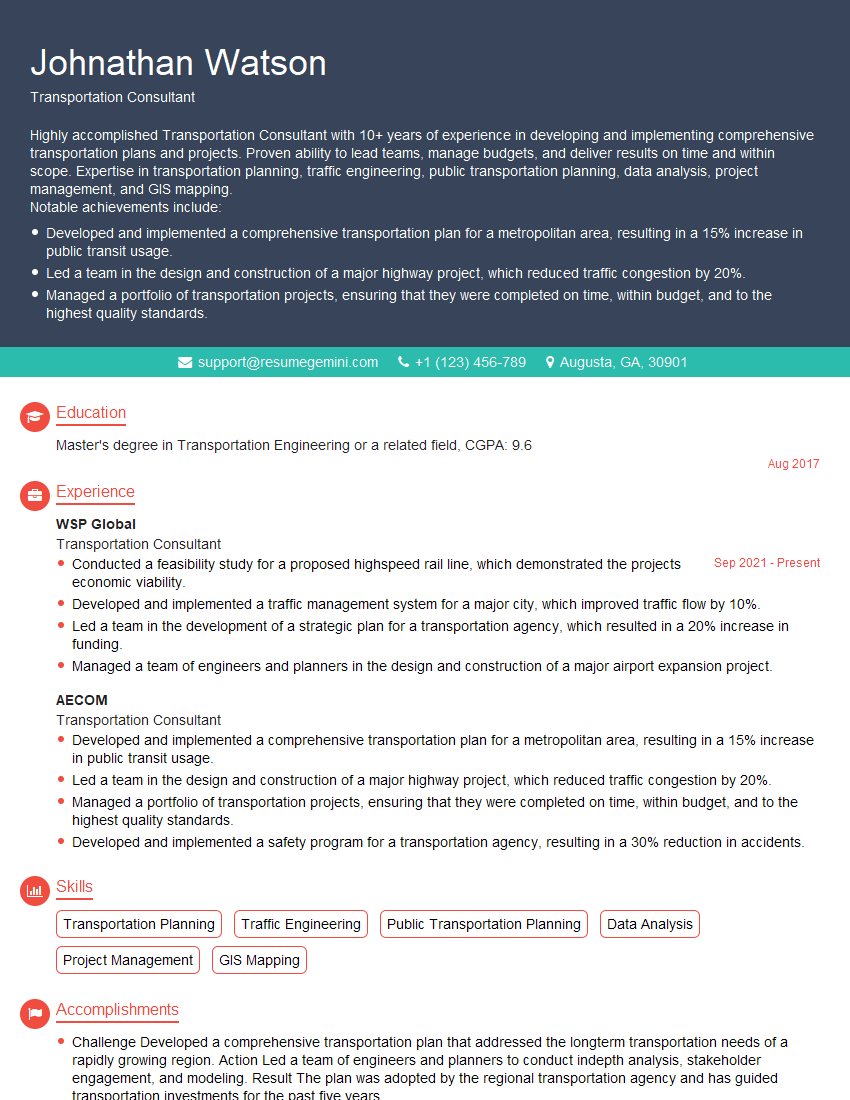
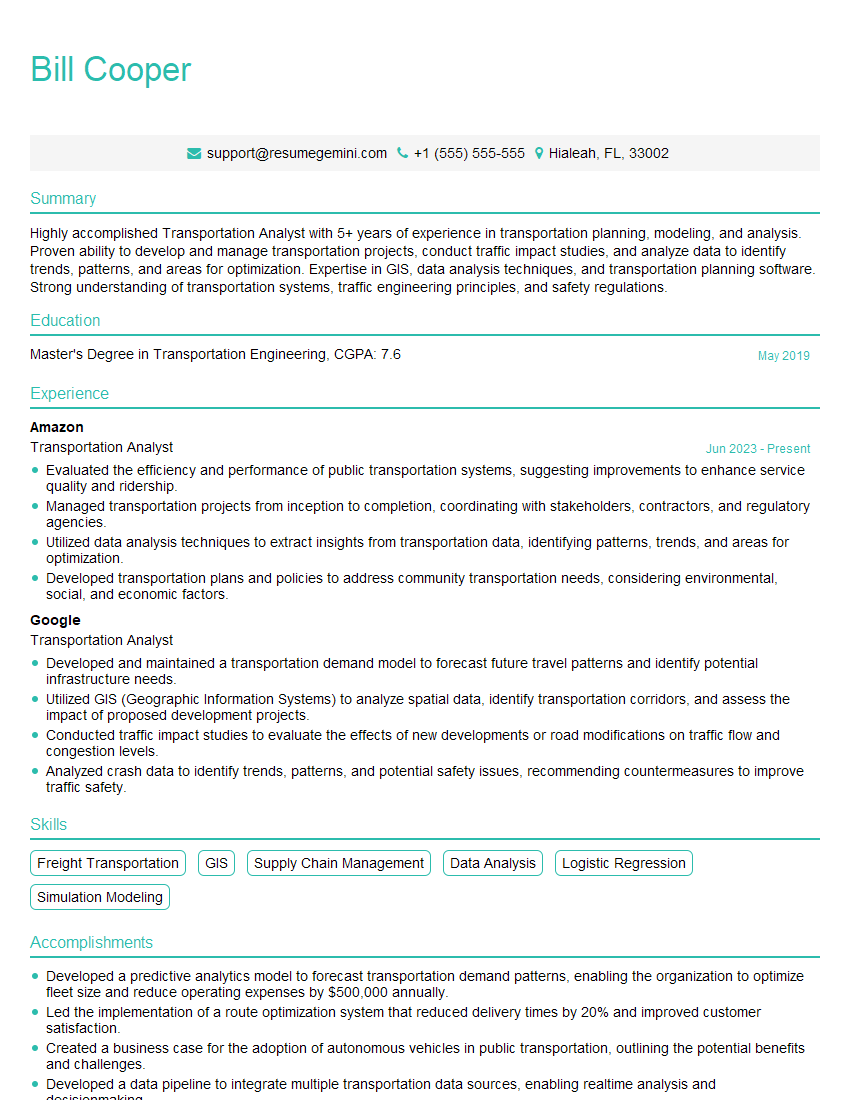
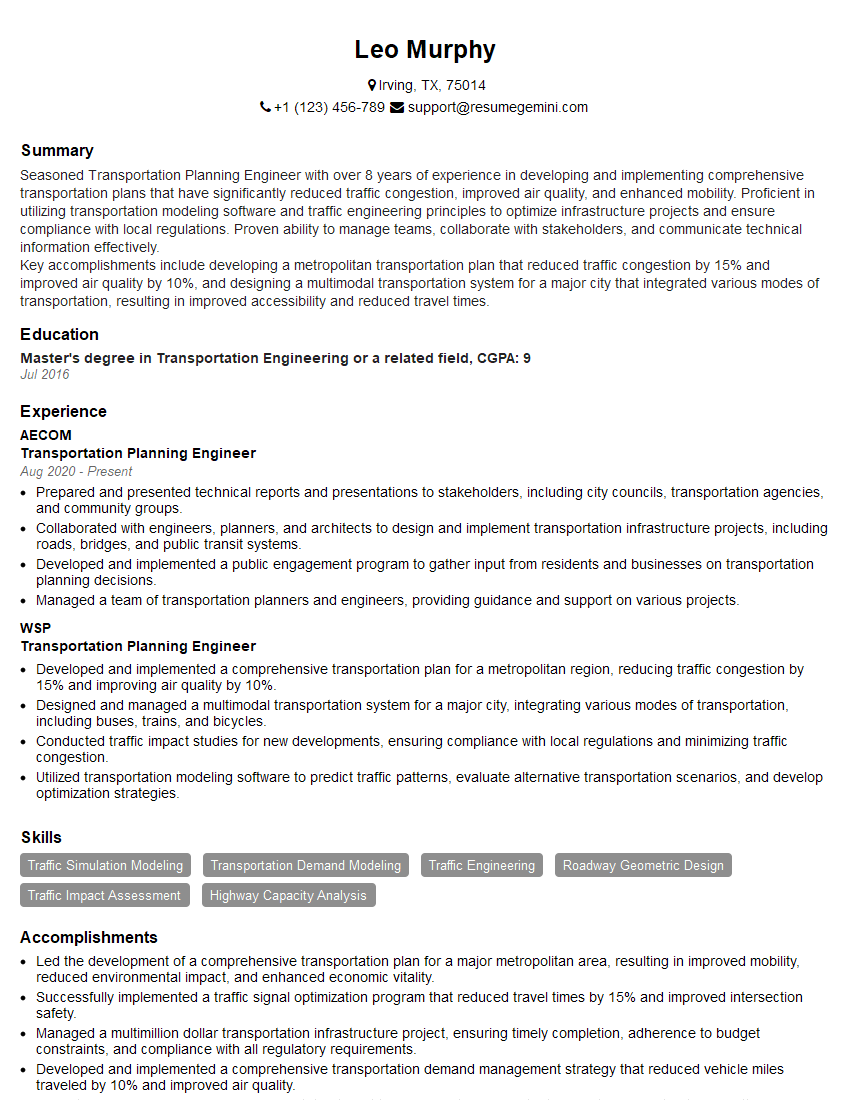
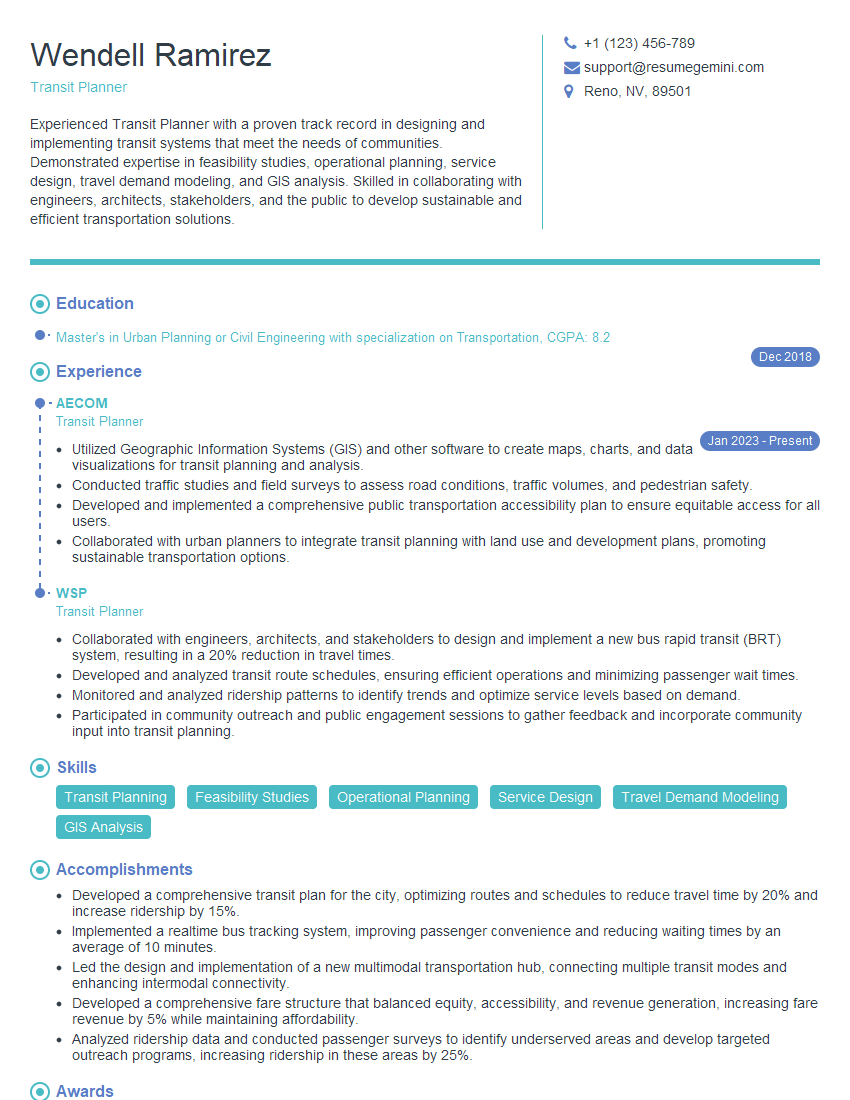
Mastering transportation modeling with VISSIM and COMPAS opens doors to exciting and impactful careers in transportation planning, engineering, and research. To maximize your job prospects, creating a strong, ATS-friendly resume is crucial. ResumeGemini is a trusted resource that can help you craft a compelling resume tailored to showcase your skills and experience effectively. Examples of resumes tailored to Transportation Modeling (VISSIM, COMPAS) are available to guide you. Invest the time to build a resume that reflects your expertise and helps you land your dream job.

Explore more articles
Users Rating of Our Blogs
Share Your Experience
We value your feedback! Please rate our content and share your thoughts (optional).
What Readers Say About Our Blog
To the interviewgemini.com Webmaster.
Very helpful and content specific questions to help prepare me for my interview!
Thank you
To the interviewgemini.com Webmaster.
This was kind of a unique content I found around the specialized skills. Very helpful questions and good detailed answers.
Very Helpful blog, thank you Interviewgemini team.