Are you ready to stand out in your next interview? Understanding and preparing for Troubleshooting and repair of PV systems interview questions is a game-changer. In this blog, we’ve compiled key questions and expert advice to help you showcase your skills with confidence and precision. Let’s get started on your journey to acing the interview.
Questions Asked in Troubleshooting and repair of PV systems Interview
Q 1. Explain the process of diagnosing a faulty solar panel.
Diagnosing a faulty solar panel involves a systematic approach combining visual inspection with electrical testing. First, I visually inspect the panel for any obvious damage like cracks, hotspots (discolored areas indicating cell failure), or debris shading the surface. These are often easily spotted. Then, I move to electrical testing. I’d use a multimeter to measure the open-circuit voltage (Voc) and short-circuit current (Isc) of the individual panel. These values should fall within the manufacturer’s specifications. A significantly lower Voc or Isc compared to other panels in the string or the manufacturer’s data sheet indicates a problem with the panel. For a more in-depth analysis, I might use an I-V curve tracer, which provides a detailed performance profile of the panel, revealing subtle issues not detectable with simple voltage and current measurements. If a specific cell within the panel is faulty, the I-V curve will show a distinct dip in performance. Comparing the results to other panels within the string allows for a precise diagnosis. Remember, safety is paramount! Always disconnect the panel from the system before any testing.
Q 2. How do you identify the cause of low power output in a PV system?
Low power output in a PV system can stem from several sources. My diagnostic process starts with the easiest checks and progresses to more complex investigations. First, I check the weather – cloud cover significantly reduces output. Then, I look at the system’s monitoring data. This data gives insights into individual panel, string, and inverter performance. It immediately highlights underperforming components. If the monitoring reveals a problem, I’ll focus on that area. A common issue is shading – even partial shading of one panel can greatly reduce the entire string’s output due to the series connection. Next, I’d check the connections; loose or corroded wiring at panels, combiner boxes, or the inverter can severely limit power. Faulty components are another common culprit. This could involve a failed panel (as discussed earlier), a malfunctioning inverter, or issues with the system’s ground. Finally, I’d investigate the DC and AC wiring for voltage drops using a multimeter. Significant voltage drops indicate resistance in the wiring, potentially due to long runs, improper sizing, or damage. This methodical approach, combining visual inspection, data analysis, and electrical testing, allows for efficient identification of the cause of low power output.
Q 3. Describe your experience troubleshooting solar inverters.
Troubleshooting solar inverters requires a blend of technical expertise and safety awareness. I begin by carefully inspecting the inverter for any visible signs of damage such as burnt components or loose connections. A simple initial step is to check the inverter’s display and/or communication port (if applicable) for error codes. Most inverters provide informative error codes pointing toward the source of the problem. For instance, an overtemperature error might signal insufficient cooling, while a ground fault error indicates a safety issue that requires immediate attention. Using a multimeter, I’d check the AC output voltage and current to confirm whether the inverter is producing power. If there’s no output, I’d check the DC input voltage to see if the inverter is receiving power from the PV array. A lack of DC input could indicate a problem with the PV array or the DC wiring. Advanced troubleshooting might involve checking internal components (after turning off and disconnecting power) only if I have the necessary experience and manufacturer specifications. If a problem is beyond my expertise, I would always consult the inverter’s manual and/or contact the manufacturer’s technical support. Safety precautions are crucial here—always work with the system disconnected and de-energized to avoid electrical shock.
Q 4. What are the common causes of ground faults in PV systems?
Ground faults in PV systems, a serious safety hazard, commonly arise from several causes. A major factor is damage to the insulation of wiring, allowing the current to leak to ground. This can occur due to rodent damage, physical damage from weather or installation, or degradation of insulation over time. Another common cause is inadequate grounding of the system itself. Poor grounding connections, either at the array, combiner box, or inverter, create pathways for fault currents to flow to ground. Water ingress can also be a significant contributor, especially in wet climates or after storms. Water can compromise the insulation of wiring or penetrate enclosures, creating conductive pathways to ground. Finally, faulty components like damaged panels, connectors, or inverters with internal insulation issues may create pathways for current to bypass the intended circuit and flow to ground. Regular system inspection and testing, along with proper installation and maintenance, significantly reduce the risk of ground faults.
Q 5. How do you test the integrity of solar panel wiring?
Testing the integrity of solar panel wiring involves both visual inspection and electrical testing. Visual inspection checks for obvious damage like cuts, abrasions, or exposed conductors. I’d also look for signs of overheating, such as discoloration or melting of the insulation. For electrical testing, I use a multimeter to check for continuity in the wires. A low resistance reading confirms a good connection; a high resistance or open circuit suggests a break in the wire. I test both the positive and negative wires. I also check for insulation resistance using a megohmmeter, verifying that the insulation prevents current leakage to ground. A low insulation resistance indicates a damaged insulation requiring repair or replacement of the cable section. Furthermore, I’d measure voltage drop along the wiring, ensuring it doesn’t exceed acceptable limits. Excessive voltage drop indicates resistance in the wiring, possibly due to corrosion, poor connections, or insufficient wire gauge. All these tests ensure the safety and reliable operation of the system. During testing, always ensure the system is de-energized to prevent electric shock.
Q 6. Explain the steps involved in replacing a damaged solar panel.
Replacing a damaged solar panel is a relatively straightforward procedure, but safety is paramount. First, I switch off the DC isolator for that specific string. This is to prevent any accidental energization during the replacement process. Then, I carefully disconnect the wires leading to the damaged panel, taking note of their connections (photographing is helpful). I use appropriate tools like insulated screwdrivers and wire cutters and double-check the disconnections to ensure complete power isolation. Next, I carefully remove the damaged panel, paying attention to its mounting system (e.g., rails, clamps). The new panel should be the same model and specifications as the original one to maintain system compatibility. Before installing the new panel, I carefully inspect its terminals and connections for any damages. Finally, I securely mount the replacement panel and carefully reconnect the wires to the matching terminals exactly as they were before. A final check of the connections ensures tightness and correct polarity. After the replacement, I would switch the DC isolator back on and monitor the system’s performance to ensure that the replacement panel is functioning correctly.
Q 7. How do you interpret data from a solar monitoring system?
Interpreting data from a solar monitoring system provides crucial insights into the system’s health and performance. These systems often display real-time and historical data on various parameters, like PV array voltage and current, inverter power output, energy production, and system efficiency. I look for trends and anomalies in the data. A consistent drop in energy production over time, for example, could suggest gradual degradation of the panels or other system components. Similarly, sudden dips in power output might point toward shading, loose connections, or inverter issues. Comparing performance against historical data allows me to identify deviations from normal operating levels. Most systems highlight alerts or warnings when parameters fall outside predefined ranges, drawing immediate attention to potential problems. Data on individual panels or strings identifies specific locations of problems, facilitating targeted troubleshooting. The data provides a clear picture of overall system health, energy generation patterns, and the impact of various factors on system performance, helping to implement preventative maintenance and optimize system efficiency.
Q 8. What safety precautions do you take when working on a PV system?
Safety is paramount when working with PV systems, which operate at high voltages and can pose significant risks. Before even approaching a system, I always ensure the system is properly de-energized. This involves physically disconnecting the array from the inverter and charge controller, using appropriate lockout/tagout procedures. I never rely solely on a switch; I verify the absence of voltage with a non-contact voltage tester. Furthermore, I always wear appropriate Personal Protective Equipment (PPE), including insulated gloves, safety glasses, and arc flash clothing where necessary, depending on the system’s voltage and size. I also adhere to all relevant safety standards and regulations, consulting the system’s operational manual and any existing site-specific safety plans.
Working at heights is common in PV installations, so I utilize proper fall protection equipment like harnesses and safety lines. Finally, I maintain situational awareness, ensuring a clear workspace and avoiding any hazards that could lead to injury. A good pre-job safety briefing is essential to communicate all risks and mitigations to the team.
Q 9. What are the common causes of overheating in solar panels?
Overheating in solar panels can significantly reduce efficiency and even cause damage. Several factors contribute to this problem. Shading is a major culprit; even a small amount of shade on a single cell can cause a significant temperature rise in that cell and impact the whole panel’s performance. This is due to the series connection of cells within a panel. Poor ventilation, such as panels installed too close together or facing unfavorable wind patterns, traps heat and prevents effective cooling. Soiled panels, covered with dust, bird droppings, or other debris, restrict solar radiation absorption and heat dissipation. Defective bypass diodes, essential for preventing hot spots, can lead to localized overheating and potential fire hazards. Finally, high ambient temperatures, especially in hot climates, naturally increase panel temperatures. Addressing these issues, such as regular cleaning, proper panel spacing, and ensuring correct bypass diode functionality, is crucial for maintaining optimal panel temperature and performance.
Q 10. How do you troubleshoot problems with solar charge controllers?
Troubleshooting solar charge controllers requires a systematic approach. I typically start with a visual inspection, checking for any obvious signs of damage, loose connections, or tripped breakers. Then, I check the controller’s display or LED indicators for any error codes or warning messages which often pinpoint the problem. Next, I measure the voltage and current at various points in the circuit, including the solar array, battery bank, and load, using a multimeter. This allows me to identify if the voltage is too high or low, or if there is a current imbalance. I also check the battery voltage to ensure it’s within the acceptable range for the controller. Common problems include faulty sensors, wiring issues, or internal controller malfunctions. If the problem persists after checking connections and voltages, further diagnostics might involve checking for internal faults within the controller (this usually requires specialized equipment). In some cases, replacing the controller might be the most efficient solution. Always consult the manufacturer’s specifications and troubleshooting guide before undertaking any repairs.
Q 11. Describe your experience with different types of solar batteries.
My experience encompasses various solar battery technologies, each with its strengths and weaknesses. I’ve worked extensively with flooded lead-acid (FLA) batteries, which are cost-effective but require regular maintenance and have a shorter lifespan compared to other options. I’ve also worked with Absorbent Glass Mat (AGM) and Gel Cell batteries, which are sealed, maintenance-free, and offer better performance and longevity. More recently, I’ve gained experience with Lithium-ion (Li-ion) batteries, which offer superior energy density, longer lifespan, and faster charging times. However, they typically have a higher initial cost and require a compatible charge controller. The selection of the right battery type depends on factors such as budget, application requirements, environmental conditions, and system design. Understanding the characteristics and limitations of each type allows me to optimize system performance and reliability.
Q 12. How do you test the functionality of a solar combiner box?
Testing a solar combiner box involves several steps. Firstly, I visually inspect the box for any signs of damage, corrosion, or loose connections. I then use a non-contact voltage tester to ensure the box is de-energized before proceeding. Next, I carefully check all wiring connections inside the box, ensuring they are secure and properly tightened. I use a multimeter to measure the voltage at the input and output terminals of each circuit breaker within the box. This will determine whether each string of panels is functioning correctly and identify any inconsistencies. I also check the continuity of each fuse, ensuring it is not blown. If there are any irregularities during voltage and continuity measurements, I would then investigate each string of panels individually to pinpoint the problem. This involves checking connectors, cables, and panels for any faults or damages. It is crucial to follow proper safety procedures and use appropriate PPE throughout this process.
Q 13. Explain how to perform a visual inspection of a PV system.
A thorough visual inspection of a PV system is a crucial first step in troubleshooting. I start by assessing the overall condition of the system, checking for obvious signs of damage like cracked panels, loose wiring, corrosion, or bird nests. I then examine each component individually, starting with the solar panels. I inspect the panel’s surface for any discoloration, debris buildup, or physical damage. I check the mounting hardware for any signs of looseness or deterioration. Next, I inspect the wiring, checking for any cuts, abrasions, or exposed wires. I pay close attention to the connectors, ensuring they’re clean, secure, and free of corrosion. I also visually inspect the inverter, charge controller, and battery bank for any visible issues. Finally, I check the grounding system, ensuring its integrity and proper connection. This visual inspection often reveals many problems, preventing more time-consuming investigations later on.
Q 14. What tools and equipment are essential for PV system troubleshooting?
Effective PV system troubleshooting requires a range of tools and equipment. A high-quality multimeter is essential for measuring voltage, current, and resistance. A non-contact voltage tester is vital for ensuring safety by confirming the absence of voltage before working on any part of the system. A clamp meter is useful for measuring current without interrupting the circuit. A thermal imager allows for the detection of hot spots in panels or other components, which are often an indicator of problems. Appropriate PPE, including insulated gloves and safety glasses, is crucial for personal safety. For working at heights, fall protection equipment might be necessary. In some cases, specialized tools might be needed for working on specific components of the system, and a ladder or lift equipment might also be needed depending on the system’s height and access requirements. A good set of screwdrivers and wire strippers are also essential for any repair work.
Q 15. How do you address shading issues in a PV array?
Shading on even a single PV module can significantly reduce the overall power output of an entire string. Think of it like a traffic jam – one slow car (shaded module) holds up the entire line. To address shading, we need to understand its cause and severity.
Solutions vary depending on the scale and nature of the shading:
- Partial Shading: For minor, intermittent shading (e.g., a tree branch occasionally casting shadow), trimming the branch might suffice. If that’s not feasible, microinverters or power optimizers are excellent solutions, as they allow each module to operate independently of others in the string, bypassing the effect of the shaded module.
- Significant Shading: More extensive shading often necessitates a redesign. This could involve relocating the array to a sunnier location, installing additional arrays in less shaded areas, or using specialized modules designed to tolerate shading better.
- Module-Level Power Electronics (MLPE): Microinverters and power optimizers are MLPE technologies. Microinverters convert DC power from a single module to AC power, while power optimizers maximize power from individual modules and then feed the DC to a central inverter. These technologies are highly effective against shading, but come at a higher initial cost.
- Array Optimization: We might need to reconfigure the PV array’s orientation. Sometimes a simple adjustment can make a huge difference. Analyzing shading patterns using specialized software can inform this.
In one project, a client experienced significant shading due to a nearby building. We analyzed the shading using solar modeling software and proposed a combination of array reorientation and the addition of a smaller supplementary array, greatly improving the system’s performance.
Career Expert Tips:
- Ace those interviews! Prepare effectively by reviewing the Top 50 Most Common Interview Questions on ResumeGemini.
- Navigate your job search with confidence! Explore a wide range of Career Tips on ResumeGemini. Learn about common challenges and recommendations to overcome them.
- Craft the perfect resume! Master the Art of Resume Writing with ResumeGemini’s guide. Showcase your unique qualifications and achievements effectively.
- Don’t miss out on holiday savings! Build your dream resume with ResumeGemini’s ATS optimized templates.
Q 16. Describe your experience with microinverters and power optimizers.
I have extensive experience with both microinverters and power optimizers. They’re both valuable tools for maximizing energy production and improving the reliability of PV systems, particularly in situations with partial shading or module mismatch.
- Microinverters: These convert DC power from a single module to AC power. They offer excellent performance in shaded conditions because each module operates independently. The downside is that they increase the system’s overall cost and can be more difficult to troubleshoot individually.
- Power Optimizers: These devices sit between the modules and the central inverter. They maximize the power output of each module and communicate with the central inverter. They are generally less expensive than microinverters but may not offer the same level of performance in heavily shaded conditions.
In practice, the choice between microinverters and power optimizers often comes down to cost versus performance requirements. I’ve successfully implemented both in various projects, tailoring the solution to the specific needs of the client and the characteristics of the site.
Q 17. What are the common causes of arc faults in PV systems?
Arc faults are dangerous electrical discharges that can lead to fires and equipment damage. In PV systems, they are often caused by:
- Damaged or corroded wiring: Deterioration of insulation, especially in outdoor environments exposed to moisture and UV radiation, creates pathways for current leakage and arcing.
- Loose connections: Poorly tightened connectors create high resistance points, leading to localized heat buildup and potential arcing.
- Faulty components: Defective inverters, modules, or other system components can be sources of arcing. This is why regular preventative maintenance and quality components are critical.
- Environmental factors: Animals, debris, or moisture intrusion can compromise system integrity and trigger arc faults.
Detecting arc faults requires specialized equipment like arc fault circuit interrupters (AFCIs). These devices monitor the electrical current for unusual patterns indicative of arcing and shut down the system to prevent further damage.
Q 18. How do you determine the cause of a system shutdown?
Troubleshooting a system shutdown involves a systematic approach. It’s like detective work – gathering clues to pinpoint the problem’s root cause.
- Inspect the system visually: Look for obvious issues like blown fuses, tripped breakers, loose connections, or signs of damage.
- Check the inverter: Most inverters provide diagnostic codes or error messages that can pinpoint the problem area.
- Monitor string voltages: Use a multimeter to measure the voltage and current at different points in the PV array. This can help identify a problem string.
- Test individual modules: If a problematic string is identified, test individual modules using an IR thermometer to detect hotspots (indicative of module faults) or a multimeter to check their voltage and current output.
- Review system logs: Modern inverters and monitoring systems record operational data and error logs that can provide valuable information.
In a recent case, a system shutdown was initially attributed to a faulty inverter. However, after systematically checking the entire system, I discovered a damaged module hidden under snow, causing a short circuit.
Q 19. Describe your experience working with different types of PV modules.
My experience encompasses various PV module types, including monocrystalline, polycrystalline, and thin-film technologies. Each has its own characteristics and strengths:
- Monocrystalline Silicon: High efficiency, but typically more expensive. Ideal for limited space applications.
- Polycrystalline Silicon: Lower cost than monocrystalline but with slightly lower efficiency. A good balance between cost and performance.
- Thin-film (Amorphous Silicon, CIGS, CdTe): Flexible, lightweight, and suitable for integration into building materials. Generally lower efficiency than crystalline silicon.
Understanding the specific characteristics of each module type is crucial for effective troubleshooting and system design. For instance, thin-film modules might be more tolerant of partial shading, while crystalline silicon modules might benefit more from optimized string configurations.
I’ve worked with various manufacturers’ modules, gaining a comprehensive understanding of their differences in terms of performance, durability, and failure modes. This diverse experience enables me to adapt to various project requirements.
Q 20. How do you ensure the safety of yourself and others while working on a rooftop PV system?
Safety is paramount when working on rooftop PV systems. It’s not just about me, it’s about protecting the entire team and the surrounding environment. We meticulously follow safety protocols which include:
- Proper fall protection: Using harnesses, lanyards, and anchor points is mandatory.
- Lockout/Tagout procedures: Disconnecting and securing all electrical components before working on the system prevents accidental energization.
- Insulation testing: Verifying that all circuits are de-energized is a critical step.
- Arc flash protection: Appropriate PPE (personal protective equipment) including arc flash suits is essential for high voltage systems.
- Weather conditions: Work should only be undertaken during safe weather conditions.
- Communication: Maintaining constant communication with the ground crew ensures safety and coordination.
I never compromise on safety. It’s an integral part of every project. We conduct thorough pre-job briefings and regularly review safety procedures to maintain a safe working environment.
Q 21. What are the different types of fault finding techniques you use?
Fault finding involves a combination of techniques tailored to the specific situation. My approach is systematic and involves:
- Visual inspection: A thorough visual check often reveals obvious issues like damaged wires, loose connections, or faulty components.
- Electrical measurements: Using multimeters to measure voltage, current, and resistance helps identify circuit problems.
- IR thermography: Infrared cameras detect hotspots indicative of overheating components or faulty connections, even before they cause a complete failure.
- Data analysis: Reviewing inverter logs, performance data, and monitoring system information often provides clues to intermittent issues.
- Process of elimination: Starting with the most likely causes and systematically checking each component helps isolate the problem.
I frequently utilize a combination of these techniques, moving from the simple (visual inspection) to the more advanced (data analysis), to efficiently locate and resolve system faults.
Q 22. How do you use a multimeter to test a PV system?
A multimeter is an essential tool for diagnosing PV system issues. It allows us to measure voltage, current, and resistance, crucial parameters for identifying problems within the system. Safety is paramount; always ensure the system is switched off and locked out before commencing any testing.
Testing Procedures:
- Voltage Measurement (DC): Use the multimeter’s DC voltage setting to check the voltage at various points in the system, such as at the solar panel terminals, string combiner box, and inverter input. A lower-than-expected voltage often indicates a problem with the panel itself, cabling, or connectors. For example, a 60-cell panel might produce around 36V under standard test conditions; significantly less points to an issue.
- Current Measurement (DC): Measuring current requires breaking the circuit and inserting the multimeter in series. This is where a proper disconnect and lockout is crucial for safety. Check the current flowing from the panels to the inverter. Low current could indicate shading, faulty wiring, or a problem with the panel or inverter itself.
- Resistance Measurement: Measure the resistance of individual components like the wiring and bypass diodes. High resistance could signal damaged or corroded wiring or a faulty diode. For example, a significant increase in resistance between two points in a string compared to a similar section might indicate a break in the wire.
Example: Imagine measuring 0V at the output of a panel, but other panels in the string are producing voltage. This immediately points to a fault in that specific panel, such as a cracked cell or damaged wiring.
Q 23. What are the different types of bypass diodes and their function?
Bypass diodes are crucial components within a photovoltaic (PV) module. Their primary function is to allow current to continue flowing around a shaded or faulty solar cell, preventing a significant drop in the overall output of the module. Without them, even a single shaded cell would drastically reduce the current generated by the entire string.
Types of Bypass Diodes:
- Standard Silicon Diodes: These are the most common type, offering a good balance of performance and cost. They’re generally reliable but can degrade over time and temperature.
- Schottky Diodes: These offer lower forward voltage drop compared to standard silicon diodes, leading to slightly increased efficiency. They are often used in high-efficiency modules.
Function: When a solar cell within a module is shaded or faulty, its voltage drops. The bypass diode connected to that cell becomes active, shunting current around the affected cell, thereby maintaining the current flow through the rest of the module. This is vital as shaded cells can act like a significant load, reducing the current that the entire module can generate.
Example: In a module with three strings of cells and three bypass diodes, if one string is shaded, the associated bypass diode will allow current to flow through the other two unshaded strings, minimizing power loss.
Q 24. Explain the process of troubleshooting a string of solar panels with a single faulty panel.
Troubleshooting a faulty panel within a string involves systematic checks and measurements to isolate the problem. First, ensure safety by disconnecting the system from the grid and performing lockout/tagout.
Troubleshooting Steps:
- Visual Inspection: Begin with a visual inspection of the string. Look for physical damage to the panels, wiring, connectors, or the combiner box. Cracked cells, broken wiring, or loose connections are often easily spotted.
- Voltage Measurement: Use a multimeter to measure the voltage at the terminals of each individual panel in the string. A significantly lower voltage at one panel’s terminals compared to others strongly suggests a fault within that panel.
- Current Measurement: Measure the current flowing through each panel in series. Note that this often requires a break in the circuit for accurate measurements, requiring a temporary disconnection. A panel producing significantly lower current than others also points towards its failure.
- Bypass Diode Check: While more advanced, if you have the equipment, using an IR thermal imager to detect overheating caused by a non-functional bypass diode can help pinpoint the panel failure.
- Panel Replacement: Once the faulty panel is identified, it needs to be safely replaced with a matching panel from the same manufacturer and model to maintain optimal system performance.
Example: Let’s say you discover a panel with significantly lower voltage than others. Replacing that single panel usually restores the string’s output to its expected level.
Q 25. Describe your experience with different types of racking systems and their potential failure points.
My experience encompasses various racking systems, including ground-mounted, rooftop, and pole-mounted systems. Each has its own unique design and potential failure points.
Types and Failure Points:
- Ground-Mounted: These systems often use driven piles, concrete foundations, or ground screws. Potential failure points include corrosion of metal components, settling of the ground, and damage from extreme weather.
- Rooftop: Roof-mounted systems employ rails, clamps, and mounting hardware attached to the roof structure. Potential failure points include roof penetrations leading to leaks, corrosion, fatigue of mounting hardware, and wind damage.
- Pole-Mounted: These systems use vertical poles to support the solar panels. Potential failure points include pole instability due to inadequate grounding or foundation, wind loads, and corrosion at the base of the pole.
Failure Prevention: Regular inspections are key. Checking for corrosion, loose connections, and signs of structural damage can prevent catastrophic failures. Proper grounding and the use of high-quality materials are also crucial.
Example: I once encountered a ground-mounted system where settling of the ground had caused misalignment of the panels, leading to shading and reduced output. Re-leveling the system resolved the issue.
Q 26. How do you identify and resolve issues related to ground potential rise?
Ground potential rise (GPR) is a dangerous condition that occurs when a significant current flows through the ground during a fault, raising the ground voltage to dangerous levels. This poses a severe risk of electric shock.
Identification: GPR is typically identified through careful voltage measurements using a multimeter. A significant voltage difference between the ground at the PV array and a remote ground point indicates GPR. The use of a clamp meter to measure the current flowing in the grounding electrode is also necessary.
Resolution:
- Proper Grounding: Ensuring adequate grounding is the primary preventative measure. This involves using low-resistance grounding electrodes and connecting them properly to the system’s grounding points. The grounding system needs to be designed and installed according to the relevant electrical codes.
- Grounding Enhancement: If GPR is already present, adding more grounding electrodes or improving the existing ones can help reduce the ground potential.
- Ground Fault Detection: Installing ground fault detection devices can help quickly identify a ground fault and shut down the system, preventing the buildup of GPR.
Example: In one case, a faulty connection led to a GPR exceeding 50V, creating a dangerous situation. Repairing the connection and verifying the ground system eliminated the GPR.
Q 27. What are the common signs of a faulty solar inverter?
Faulty solar inverters manifest in various ways. A comprehensive diagnostic approach is essential to pinpoint the exact issue.
Common Signs:
- No Power Output: The most obvious sign. Check the inverter’s display for error codes or indications of fault.
- Reduced Power Output: The inverter might be producing less power than expected for the given sunlight conditions. This could suggest partial failure or overheating.
- Inverter Alarms/Error Codes: Most inverters have built-in diagnostic features, displaying error codes that provide clues to the problem. Consulting the inverter’s manual is essential for interpreting these codes.
- Overheating: Excessive heat from the inverter can indicate internal faults, often accompanied by a loud humming or buzzing sound.
- Inconsistent Power Output: Sporadic fluctuations or power outages from the inverter point towards intermittent faults.
Example: An inverter displaying an ‘overtemperature’ code usually indicates a cooling fan failure or excessive heat build-up, requiring maintenance or replacement.
Q 28. How do you communicate technical information effectively to non-technical personnel?
Communicating technical information to non-technical personnel requires a clear, concise, and relatable approach. Avoiding jargon is critical. Instead of using technical terms, it’s better to explain concepts in simple, everyday language.
Effective Communication Strategies:
- Use Analogies and Visual Aids: Comparing technical concepts to familiar things (e.g., comparing electricity flow to water flow in pipes) can make them easier to understand. Visual aids like diagrams and charts can also be very helpful.
- Focus on the Impact: Explain the consequences of a problem, and how fixing it will improve the system’s performance or safety.
- Active Listening: Make sure they understand by asking questions and paying attention to their reactions. Be patient and answer their questions clearly.
- Simple Language: Avoid technical jargon. Use plain English and keep sentences short and to the point.
Example: Instead of saying, ‘The DC-DC converter is malfunctioning due to a faulty gate driver,’ I might explain, ‘A part inside the inverter that controls the flow of electricity is broken, and as a result, the system is producing less power.’
Key Topics to Learn for Troubleshooting and Repair of PV Systems Interview
- PV System Architecture: Understanding the components (panels, inverters, racking, wiring, etc.) and their interconnections. This includes different system topologies (series, parallel, etc.).
- Electrical Fundamentals: Solid grasp of DC and AC circuits, Ohm’s Law, Kirchhoff’s Laws, and their application to diagnosing PV system faults. Practical application: Troubleshooting voltage drops and short circuits.
- Troubleshooting Techniques: Mastering systematic approaches to fault finding, including visual inspection, multimeter usage, and interpreting system performance data (e.g., from monitoring systems).
- Inverter Operation and Troubleshooting: Understanding inverter types, communication protocols (e.g., Modbus), fault codes, and common inverter failures. Practical application: Diagnosing and resolving inverter communication issues.
- Safety Procedures: Deep knowledge of relevant safety standards and procedures for working with high voltage DC and AC systems. This includes lockout/tagout procedures and personal protective equipment (PPE).
- Performance Measurement and Analysis: Understanding key performance indicators (KPIs) like power output, efficiency, and energy yield. Using data loggers and monitoring software to identify performance issues.
- Common PV System Faults: Familiarity with typical problems such as shading, faulty modules, connector issues, grounding faults, and environmental impacts.
- Repair and Maintenance Procedures: Understanding the processes for replacing faulty components, performing preventative maintenance, and documenting repairs.
- Solar Panel Testing and Diagnostics: Methods for testing individual solar panels (IV curves, electroluminescence imaging) to identify damaged or underperforming cells.
Next Steps
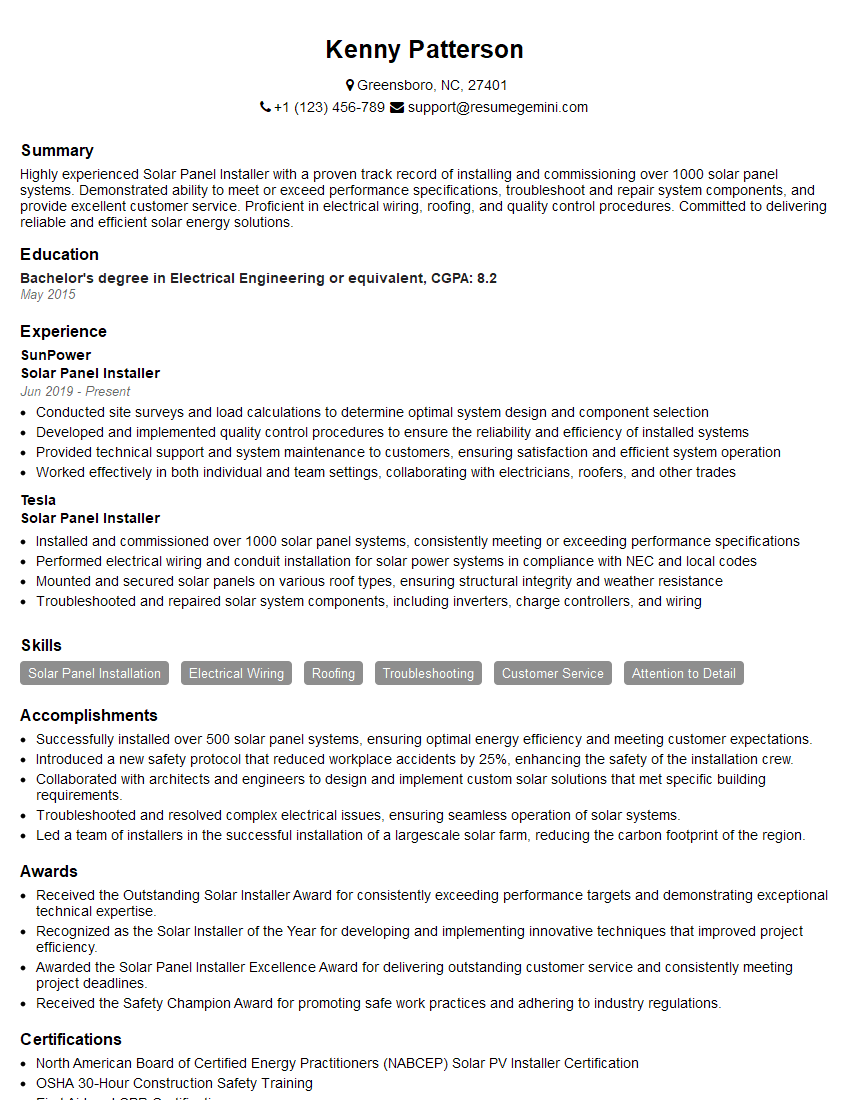
Mastering troubleshooting and repair of PV systems is crucial for career advancement in the rapidly growing renewable energy sector. It positions you as a valuable asset, opening doors to higher-paying roles and greater responsibility. To maximize your job prospects, creating a compelling and ATS-friendly resume is essential. ResumeGemini is a trusted resource to help you build a professional and effective resume that highlights your skills and experience. Examples of resumes tailored to Troubleshooting and repair of PV systems are available, showcasing the best practices for presenting your qualifications to potential employers. Invest in your future – craft a resume that reflects your expertise and lands you the perfect job.

Explore more articles
Users Rating of Our Blogs
Share Your Experience
We value your feedback! Please rate our content and share your thoughts (optional).
What Readers Say About Our Blog
To the interviewgemini.com Webmaster.
Very helpful and content specific questions to help prepare me for my interview!
Thank you
To the interviewgemini.com Webmaster.
This was kind of a unique content I found around the specialized skills. Very helpful questions and good detailed answers.
Very Helpful blog, thank you Interviewgemini team.