Cracking a skill-specific interview, like one for Ureteral Surgery, requires understanding the nuances of the role. In this blog, we present the questions you’re most likely to encounter, along with insights into how to answer them effectively. Let’s ensure you’re ready to make a strong impression.
Questions Asked in Ureteral Surgery Interview
Q 1. Describe the different types of ureteral stones and their management.
Ureteral stones, or nephrolithiasis, are classified by their composition, size, and location within the ureter. Common compositions include calcium oxalate (most frequent), uric acid, struvite, and cystine. Management depends on several factors including stone size, location, patient symptoms, and overall health.
- Small stones (<4mm): Often pass spontaneously with increased fluid intake and analgesics. We may monitor with imaging.
- Medium stones (4-10mm): Medical expulsive therapy (alpha-blockers like tamsulosin) can be used to facilitate passage. Ureteroscopy with laser lithotripsy or basket retrieval may be necessary if spontaneous passage fails.
- Large stones (>10mm): These usually require more aggressive intervention. Options include extracorporeal shock wave lithotripsy (ESWL), percutaneous nephrolithotomy (PCNL), or ureteroscopic lithotripsy. The choice depends on stone location, size, and number.
For example, a patient presenting with excruciating flank pain and a 7mm stone obstructing the distal ureter would likely benefit from ureteroscopic intervention to relieve obstruction quickly. A patient with a single, 15mm stone in the mid-ureter might be a better candidate for ESWL.
Q 2. Explain the surgical techniques used in ureteral reimplantation.
Ureteral reimplantation is a surgical procedure performed to correct vesicoureteral reflux (VUR), where urine flows backward from the bladder to the ureter, potentially leading to kidney infections. Several techniques exist:
- Cohen Technique: This is a widely used technique involving a submucosal tunnel created in the bladder wall. The ureter is passed through this tunnel before being reimplanted into the bladder, reducing the risk of reflux.
- Lich-Gregoir Technique: A more technically demanding technique involving a slightly different tunnel configuration and often used in children.
- Paquin-Leadbetter Technique: Involves a longer submucosal tunnel and is often used for high-grade VUR or when previous reimplantation attempts have failed.
The choice of technique depends on factors like the patient’s age, the degree of reflux, and surgeon expertise. All techniques aim to create a valve-like mechanism at the ureterovesical junction to prevent reflux. Laparoscopic approaches are increasingly common, minimizing incision size and recovery time.
Q 3. Discuss the indications and contraindications for ureteroscopic surgery.
Ureteroscopy is a minimally invasive procedure involving inserting a thin, flexible endoscope into the ureter to visualize and treat conditions.
- Indications: Ureteroscopic surgery is indicated for the management of ureteral stones, strictures, tumors, and foreign bodies. It’s particularly useful for stones located in the distal ureter or those that are difficult to treat with ESWL.
- Contraindications: Relative contraindications include severe bleeding disorders, inability to tolerate anesthesia, severe infection, and significant underlying comorbidities that increase surgical risk. Absolute contraindications are rare but might include severe inflammation or anatomical anomalies that prevent safe scope insertion.
For instance, a patient with multiple small stones in the distal ureter who is otherwise healthy is an ideal candidate for ureteroscopic lithotripsy. A patient with uncontrolled bleeding issues might be contraindicated, needing alternative management strategies for their ureteral stone.
Q 4. What are the complications associated with ureteral stent placement?
Ureteral stent placement, while generally a safe procedure, carries potential complications:
- Infection: Urinary tract infections (UTIs) are a common complication, requiring prompt treatment with antibiotics.
- Bleeding: Minor bleeding is possible during stent placement, but major bleeding is rare.
- Stent encrustation: Mineral deposits can form on the stent, leading to blockage and pain. This can often be mitigated through appropriate fluid intake.
- Stent migration: The stent may move out of place, requiring repositioning or removal.
- Discomfort: Patients often experience urinary frequency, urgency, dysuria (painful urination), and flank pain after stent placement, usually managed with analgesics.
Careful patient selection, meticulous stent placement technique, and post-operative monitoring are crucial to minimize these complications. Regular follow-up is vital.
Q 5. How do you manage ureteral strictures?
Ureteral strictures, or narrowing of the ureter, are managed depending on the severity, length, and location of the stricture.
- Endoscopic Dilation: For short, benign strictures, balloon dilation or stent placement can provide relief. Repeated dilations may be necessary.
- Ureteroscopy with incision or resection: For more complex or resistant strictures, a ureteroscope can be used to incise or resect the strictured segment.
- Ureteroplasty: This involves surgical reconstruction of the ureter, either using a ureteroureterostomy (connecting the healthy ureteral segments) or an interposition graft (using a segment of bowel or other tissue).
The choice of management depends on various factors, and a multidisciplinary approach is often needed. For example, a short, localized stricture following a previous ureteral stone procedure may be managed with endoscopic dilation, while a long stricture following pelvic radiation may require ureteroplasty.
Q 6. Describe your experience with laparoscopic ureteral surgery.
My experience with laparoscopic ureteral surgery has been extensive. I’ve performed numerous laparoscopic ureterolithotomies (removal of ureteral stones), ureteroplasties, and reimplantations. Laparoscopic techniques offer several advantages over open surgery, including smaller incisions, reduced pain, shorter hospital stays, and faster recovery times. However, it demands higher surgical skill and specialized equipment. The use of magnified, high-definition visualization and specialized laparoscopic instruments is essential for accurate dissection and meticulous surgical technique. Careful planning and precise surgical execution are critical to minimize complications.
One memorable case involved a patient with a complex ureteropelvic junction (UPJ) obstruction. The laparoscopic approach allowed us to identify and correct the anomaly with minimal tissue trauma, resulting in a successful outcome and a significantly improved quality of life for the patient compared to open surgery.
Q 7. Explain the use of different types of ureteral stents.
Various ureteral stents are available, each with its own characteristics and applications. The choice depends on factors like the duration of stent placement, patient anatomy, and the indication for stenting.
- Double-J stents: These are the most commonly used stents. They have a ‘J’ shape at each end, anchoring them in place in the renal pelvis and bladder. They’re typically used for short-term drainage after surgery or to relieve obstruction.
- Internal-external stents: These stents exit the body through the urethra or skin, providing external drainage. Useful for long-term management or situations requiring continuous drainage.
- Covered stents: These stents are coated to reduce encrustation. Beneficial in patients with a history of stent encrustation or those at higher risk.
- Biodegradable stents: These stents are designed to dissolve over time, eliminating the need for a second procedure for removal. The technology is still evolving, and the ideal application remains under investigation.
For instance, a double-J stent is typically used for a few weeks post-ureteroscopy to maintain patency, while an internal-external stent might be used for long-term drainage due to a malignant obstruction. The choice is always carefully considered based on the individual clinical scenario.
Q 8. Discuss the role of imaging in the diagnosis and management of ureteral injuries.
Imaging plays a crucial role in both diagnosing and managing ureteral injuries. It allows us to visualize the ureter’s anatomy, identify the location and extent of injury, and assess the success of any interventions.
Diagnosis: Intravenous pyelography (IVP) remains a valuable initial imaging modality, showing the presence and location of any leaks or obstructions. However, CT urography (CTU) is increasingly preferred as it provides superior anatomical detail, allowing for precise localization of injuries, even subtle ones. It’s particularly useful in identifying complex injuries or those involving surrounding structures. MRI urography can also be helpful, especially when evaluating for ureteral strictures or assessing the extent of fibrosis.
Management: Post-operatively, imaging helps to monitor for complications like leaks, strictures, or the presence of a stent. A delayed-phase CTU or an MRI can help assess the success of a repair or the need for further intervention. For example, if a patient develops a post-operative leak, imaging will guide us in determining whether conservative management or surgical intervention is appropriate.
Q 9. How do you manage ureteral trauma during pelvic surgery?
Managing ureteral trauma during pelvic surgery requires a calm, systematic approach. Immediate recognition is key. If a ureteral injury is suspected during a procedure, the first step is to carefully control bleeding and protect the injured area. The surgeon needs to have a thorough understanding of the pelvic anatomy and identify the precise location and type of injury.
Management Strategies: The approach depends on several factors including the type and severity of the injury, the patient’s overall condition, and the surgeon’s expertise. Simple lacerations can often be repaired primarily during the index procedure, using fine absorbable sutures. More complex injuries, such as complete transections or significant avulsions, might necessitate more complex reconstruction techniques. These may involve stenting (placing a tube into the ureter to maintain patency), a ureteroureterostomy (connecting the two ends of the ureter), or even a more extensive procedure like a Boari flap (using a segment of bladder to replace the damaged portion of the ureter). A decision to repair immediately or delay the repair will be made based on the situation and the patient’s condition.
Prevention is paramount: Careful surgical technique, using sharp dissection and avoiding excessive traction on the ureters, is critical for preventing these injuries. The use of ureteral stents during complex pelvic surgeries can also help to protect the ureters.
Q 10. What are the different types of ureteral reconstruction procedures?
Ureteral reconstruction procedures are tailored to the specific injury. Several techniques exist, each with its own advantages and disadvantages:
- Ureteroureterostomy: This involves end-to-end anastomosis of the severed ureteral ends. It’s suitable for relatively short defects.
- Psoas hitch: This involves mobilizing the ureter and attaching it to the psoas muscle to improve tension-free ureteral alignment; useful for distal ureteral defects.
- Boari flap: A segment of the bladder is used to replace the damaged ureteral segment. It’s ideal for extensive injuries or those involving the lower ureter.
- Transplantation of ureter into bowel: Used as a last resort for very extensive injuries where other options aren’t feasible. It carries a higher risk of complications like infection.
- Ureteropyeloplasty: Reconstruction of the ureteropelvic junction for strictures or obstructions at this location.
The choice depends on factors such as the location, size, and type of injury, patient’s overall health, and the surgeon’s experience.
Q 11. Describe the principles of ureteroscopy.
Ureteroscopy is a minimally invasive procedure using a flexible or rigid endoscope (a thin, lighted tube) inserted through the urethra and bladder to visualize and treat ureteral conditions. It allows for direct visualization of the ureteral lumen, enabling precise diagnosis and treatment.
Principles: The procedure involves inserting the ureteroscope into the ureter. A variety of instruments can be passed through the working channel of the ureteroscope, such as lasers, baskets, or graspers, depending on the intervention required. The process allows for the removal of ureteral stones, the treatment of strictures via laser incision or balloon dilation, and the placement of stents. Fluoroscopy or intraoperative imaging is often used to guide the instrument placement and ensure proper positioning within the ureter.
Applications: Ureteroscopy is commonly used for the treatment of ureteral stones, strictures, and tumors.
Q 12. Discuss the management of ureteral fistulas.
Ureteral fistulas, abnormal connections between the ureter and other structures (often the skin, vagina, or bowel), usually result from trauma, surgery, infection, or malignancy. Their management is challenging and depends on several factors, such as the location, size, and cause of the fistula, as well as the patient’s overall health.
Management: Initial management may involve conservative measures, like placement of a ureteral stent or nephrostomy tube (a tube placed directly into the kidney to drain urine), to divert urine and allow the fistula to heal spontaneously. However, many fistulas require surgical repair. Surgical options include excision of the fistula tract and reconstruction of the ureter using techniques mentioned earlier (e.g., ureteroureterostomy, Boari flap). The choice of surgical approach depends on the individual case and the surgeon’s judgment.
Example: A patient with a vesicovaginal fistula (a connection between the bladder and vagina) following a pelvic surgery might initially be managed with a stent, but if this fails, surgical repair might be necessary.
Q 13. What are the advantages and disadvantages of open versus minimally invasive ureteral surgery?
The choice between open and minimally invasive surgery for ureteral conditions depends on various factors, each approach having its own advantages and disadvantages.
Open Surgery: Provides excellent visualization and allows for direct repair, particularly beneficial in complex cases. However, it’s associated with longer hospital stays, larger incisions, greater post-operative pain, and a higher risk of complications.
Minimally Invasive Surgery (MIS): Includes laparoscopy and robotic-assisted surgery. It offers benefits such as smaller incisions, less post-operative pain, shorter hospital stays, and reduced risk of infection. However, it requires specialized training and equipment and may not be suitable for all cases, particularly complex reconstructions.
Example: A simple ureteral stone might be effectively managed using ureteroscopy (a minimally invasive approach), while a complex ureteral transection may require open surgery for optimal repair.
Q 14. How do you choose the appropriate surgical approach for a given ureteral condition?
Selecting the appropriate surgical approach requires careful consideration of multiple factors:
- Location and type of injury: A distal ureteral injury might be suitable for a laparoscopic approach, while a complex proximal injury might require open surgery.
- Severity of injury: Simple lacerations can often be repaired minimally invasively, whereas extensive defects might necessitate open surgery for optimal reconstruction.
- Patient factors: Patient’s overall health, comorbidities, and preferences all influence the decision-making process.
- Surgeon’s expertise: The surgeon’s experience and comfort level with different techniques are critical.
- Availability of resources: Access to specialized equipment and skilled personnel influences the feasibility of minimally invasive options.
Often, a multidisciplinary approach involving urologists, radiologists, and other specialists is required to ensure optimal management.
Q 15. Describe your experience with robotic-assisted ureteral surgery.
My experience with robotic-assisted ureteral surgery is extensive. I’ve performed numerous procedures using the da Vinci surgical system, and I find it offers significant advantages over traditional open surgery. The magnified, three-dimensional vision provided by the robot allows for greater precision, particularly in complex cases involving delicate ureteral reconstruction or the removal of small stones. The minimally invasive nature of robotic surgery translates to smaller incisions, reduced pain, shorter hospital stays, and faster recovery times for patients. For example, I recently used robotic assistance to successfully repair a ureteral stricture in a patient with a history of pelvic radiation, where the precision of the robotic instruments was crucial to avoid further damage to surrounding tissues. In comparison to open surgery, robotic surgery helped minimize the risk of complications and ensured a better cosmetic outcome.
Furthermore, the dexterity and range of motion provided by the robotic arms allow for easier access to challenging anatomical locations, which is particularly beneficial in cases of retroperitoneal tumors impacting the ureter. However, it’s important to acknowledge that robotic surgery requires specialized training and a significant investment in technology.
Career Expert Tips:
- Ace those interviews! Prepare effectively by reviewing the Top 50 Most Common Interview Questions on ResumeGemini.
- Navigate your job search with confidence! Explore a wide range of Career Tips on ResumeGemini. Learn about common challenges and recommendations to overcome them.
- Craft the perfect resume! Master the Art of Resume Writing with ResumeGemini’s guide. Showcase your unique qualifications and achievements effectively.
- Don’t miss out on holiday savings! Build your dream resume with ResumeGemini’s ATS optimized templates.
Q 16. What are the common complications of ureteral surgery?
Common complications of ureteral surgery can be broadly categorized as early and late complications. Early complications, occurring within the first few weeks post-surgery, include bleeding, infection (urosepsis), and ureteral obstruction (often related to edema or stent malfunction). Late complications can manifest months or even years later and include stricture formation (narrowing of the ureter), fistula formation (abnormal connection between the ureter and other organs, like the vagina or bowel), and hydronephrosis (swelling of the kidney due to urine backup). The risk of these complications varies depending on the complexity of the surgery and the patient’s overall health.
For instance, a complex ureteral reconstruction after trauma carries a higher risk of complications compared to a simple stone removal. A thorough understanding of these potential problems informs the surgical plan and the implementation of preventative measures. We routinely use imaging techniques like CT scans and ultrasounds to monitor for complications post-surgery.
Q 17. How do you manage postoperative complications after ureteral surgery?
Management of postoperative complications following ureteral surgery depends heavily on the specific complication and its severity. For example, a urinary tract infection (UTI) is typically treated with intravenous antibiotics. Ureteral obstruction, often presenting with flank pain and decreased urine output, frequently requires intervention such as stent manipulation or replacement. A ureteral stricture may be managed initially with dilation or stenting, but often requires surgical revision. A ureterovaginal fistula, where urine leaks into the vagina, usually needs surgical repair, sometimes involving bowel interposition or tissue grafting. The approach always involves a multidisciplinary team including urologists, radiologists, and potentially other specialists.
Early identification of complications through close monitoring of the patient’s clinical condition and imaging studies is paramount. Prompt and appropriate management can often prevent significant morbidity and improve long-term outcomes. We often employ a combination of conservative management and interventional strategies tailoring the approach to the individual patient’s needs.
Q 18. Discuss the role of ureteral stents in preventing postoperative complications.
Ureteral stents play a crucial role in preventing postoperative complications after ureteral surgery. They act as a splint, keeping the ureter patent and allowing urine to drain freely, reducing the risk of obstruction and infection. This is especially important after procedures that involve suturing or manipulation of the ureteral wall. The presence of a stent minimizes edema and scar tissue formation, thereby helping to maintain ureteral patency. Stents are typically temporary, removed several weeks after surgery, once healing is sufficient. The choice of stent type—double-J, single-J, or others—depends on the specifics of the surgery and patient factors.
However, it is important to note that while stents are protective, they themselves can cause complications such as stent migration, encrustation, pain, and urinary tract infections. We carefully discuss the benefits and risks of stent placement with every patient to make an informed decision. Regular follow-up is crucial to monitor stent function and address any potential issues.
Q 19. What are the long-term outcomes of ureteral surgery?
Long-term outcomes after ureteral surgery depend significantly on the underlying condition, the type of surgery performed, and the presence or absence of postoperative complications. Successful surgeries generally result in the resolution of symptoms, such as pain or urinary tract infections, and the restoration of normal kidney function. However, patients should be aware that late complications, such as strictures, can occur even after successful surgery. Regular follow-up appointments, including imaging studies, are crucial for early detection and timely management of any potential long-term issues.
For example, a patient undergoing ureteral reimplantation for vesicoureteral reflux might experience long-term success with normal renal function. However, another patient with a complex ureteral injury from trauma might have a higher risk of stricture formation necessitating further interventions. Longitudinal studies are essential to better understand the long-term effects of different surgical techniques and approaches.
Q 20. How do you counsel patients about the risks and benefits of ureteral surgery?
Counseling patients about the risks and benefits of ureteral surgery is a crucial part of my practice. I always begin by explaining the patient’s condition clearly and understandably, ensuring they comprehend the reasons for surgery. I then thoroughly discuss the surgical procedure, including the potential benefits—resolution of symptoms, improved kidney function—and the potential risks, ranging from minor complications like discomfort to more serious ones such as stricture formation, infection, or even kidney damage.
I provide detailed information on alternative treatments, if any exist, and compare the risks and benefits of surgery versus non-surgical options. I encourage patients to ask questions and address their concerns, making sure they feel comfortable and empowered to make an informed decision. The conversation always involves a discussion about the postoperative recovery process, pain management, and the possibility of long-term follow-up. Ultimately, shared decision-making is at the heart of this process.
Q 21. Describe your experience with the management of ureteral calculi.
My experience with the management of ureteral calculi (kidney stones that have traveled to the ureter) is extensive. Management strategies depend on several factors, including stone size, location, and the presence or absence of symptoms. Small stones that are not causing obstruction are often managed conservatively with increased fluid intake, pain medication, and close monitoring.
Larger or obstructing stones usually require intervention. Techniques include ureteroscopy, a minimally invasive procedure where a thin telescope is inserted through the urethra to locate and fragment the stone using laser lithotripsy or mechanical methods. Extracorporeal shock wave lithotripsy (ESWL) is another option which uses sound waves to break the stones from outside the body. Percutaneous nephrolithotomy involves making a small incision in the back to access and remove stones directly. The selection of the most appropriate approach is based on the individual patient’s characteristics and the stone’s properties, aiming for the least invasive technique while ensuring effective stone removal.
Q 22. Explain your approach to diagnosing ureteropelvic junction obstruction.
Diagnosing ureteropelvic junction obstruction (UPJO), a blockage at the point where the kidney’s ureter meets the renal pelvis, requires a multi-faceted approach. It begins with a thorough patient history focusing on symptoms like flank pain, intermittent or persistent hydronephrosis (swelling of the kidney), and recurrent urinary tract infections.
Next, imaging plays a crucial role. We typically start with an ultrasound, which can often reveal hydronephrosis. A more detailed assessment comes from an intravenous pyelogram (IVP), which uses contrast dye to visualize the urinary tract, revealing any narrowing or obstruction. However, the gold standard remains a renal scan (e.g., MAG3 or DTPA scan), which provides quantitative information on kidney function and the degree of obstruction. In selected cases, we may also utilize CT urography or MRI urography for a comprehensive anatomical evaluation.
The diagnosis isn’t solely based on imaging; we also consider the patient’s clinical presentation and the results of diuretic renography. This nuclear medicine study assesses the drainage of urine from the kidney after the administration of a diuretic, which helps differentiate between true obstruction and other causes of hydronephrosis. A combination of these tests provides the most accurate and complete picture to guide treatment decisions.
Q 23. Discuss your experience with the management of malignant ureteral tumors.
Managing malignant ureteral tumors is complex and depends on several factors, including tumor location, stage, grade, and the patient’s overall health. Early-stage tumors are typically managed surgically with a nephroureterectomy, involving removal of the kidney, ureter, and a portion of the bladder. The extent of bladder removal depends on the tumor’s location. For tumors near the bladder, a partial cystectomy may be sufficient.
For locally advanced or metastatic disease, surgery may be combined with chemotherapy, radiation therapy, or both. Chemotherapy protocols vary depending on the specific tumor characteristics. Radiation therapy might be used pre-operatively to shrink large tumors or post-operatively to reduce the risk of recurrence.
In cases of advanced disease where surgical resection isn’t feasible, palliative treatment focusing on symptom management and improving quality of life becomes the primary focus. This might include stenting to relieve urinary obstruction or other interventions to address pain or infection.
The management strategy is highly individualized and requires a multidisciplinary approach involving urologists, oncologists, and radiologists, utilizing the latest advancements in imaging, staging, and treatment techniques. Regular follow-up is crucial to monitor for recurrence and provide timely intervention.
Q 24. How do you manage post-operative pain in patients undergoing ureteral surgery?
Post-operative pain management after ureteral surgery is a critical aspect of patient care. We utilize a multimodal approach that combines different analgesic strategies to optimize pain control while minimizing side effects. This typically includes pre-emptive analgesia with a combination of NSAIDs and opioids started before the surgery.
In the post-operative period, we often use patient-controlled analgesia (PCA) pumps allowing patients to self-administer opioids as needed, providing better control over pain levels. Regional anesthesia techniques, like ureteral catheters or epidural analgesia, may also be employed to reduce pain and opioid requirements.
Non-pharmacological approaches, such as regular assessment of pain levels using validated scales, ice packs, and proper positioning, are also important parts of our strategy. We closely monitor patients for adverse effects of analgesics and adjust the treatment plan accordingly. We also emphasize the importance of early mobilization and physical therapy to facilitate recovery and minimize complications. A thorough discharge plan with clear instructions and follow-up appointments ensures optimal pain management and recovery for our patients.
Q 25. What are the latest advancements in ureteral surgery?
Ureteral surgery has seen significant advancements in recent years. Minimally invasive techniques like laparoscopy and robotics are increasingly used, leading to smaller incisions, reduced pain, shorter hospital stays, and faster recovery times. These techniques offer improved visualization and dexterity, allowing for complex procedures with greater precision.
Advances in imaging, particularly advanced three-dimensional imaging and intraoperative imaging, aid in improved surgical planning and execution. New materials and technologies for ureteral stents and other devices are continually being developed, offering better patient comfort and functionality. The development of minimally invasive access techniques, including flexible ureteroscopy and percutaneous techniques, is another major advancement.
Moreover, advancements in understanding of the anatomy and physiology of the ureter are leading to improved surgical strategies and techniques which improve long-term outcomes. Research focuses on identifying and addressing the root causes of various ureteral conditions, leading to more targeted and effective therapies.
Q 26. Describe your experience with the use of advanced imaging modalities in ureteral surgery.
Advanced imaging plays a vital role in both pre-operative planning and intra-operative guidance in ureteral surgery. Pre-operatively, we routinely use CT urography and MRI urography to precisely delineate the location, extent, and characteristics of the ureteral pathology. This enables accurate surgical planning and helps us choose the best approach for the procedure.
During the procedure, fluoroscopy provides real-time imaging, guiding the placement of stents, catheters, and instruments. Intraoperative ultrasound can also be used to assess the anatomical relationship between the ureter and surrounding structures, ensuring minimal damage to adjacent organs. These advanced imaging modalities greatly enhance the accuracy and safety of ureteral procedures, reducing complications and improving outcomes.
For instance, in cases of complex ureteral injuries, intraoperative fluoroscopy allows for precise identification and repair of the damaged ureter under real-time visualization, significantly improving the success rate of the repair.
Q 27. How do you stay current with the latest advances in the field of urology?
Staying current in the rapidly evolving field of urology necessitates a multifaceted approach. Active participation in professional organizations like the American Urological Association (AUA) is essential, providing access to the latest research findings and guidelines through meetings, publications, and online resources. Regularly reviewing peer-reviewed journals and attending national and international conferences keeps me abreast of innovative techniques and breakthroughs.
Collaboration with colleagues through case discussions and attending departmental morbidity and mortality meetings enhances my knowledge and exposure to diverse clinical scenarios and treatment strategies. Moreover, continuous participation in educational courses and workshops related to specific areas of interest further refines my skills and knowledge. I also actively engage with online learning platforms and utilize reputable online medical resources for continuous learning.
Q 28. Describe a challenging case involving ureteral surgery and how you managed it.
One particularly challenging case involved a patient who presented with severe hydronephrosis and an impacted ureteral stone extending into the distal ureter. The stone was unusually large and impacted in a difficult location near the ureterovesical junction, making traditional endoscopic approaches extremely challenging and risky.
Considering the patient’s clinical condition and the risks involved with traditional stone removal techniques, a multidisciplinary team was convened. We decided to use a combination of percutaneous nephrolithotomy (PCNL) and ureteroscopic techniques. Initially, a percutaneous approach was used to fragment the stone using ultrasonic lithotripsy and remove larger fragments, decreasing the size of the stone to allow for successful ureteroscopic retrieval. After careful pre-operative planning and intra-operative fluoroscopic guidance, the remaining smaller fragments were successfully removed using a ureteroscope. Post-operative recovery was uneventful.
This case highlighted the importance of a flexible and adaptable approach to complex ureteral problems, emphasizing the need for a multidisciplinary approach that considers the benefits and risks of different techniques before making a treatment plan.
Key Topics to Learn for Ureteral Surgery Interview
- Ureteroscopy and its variations: Understand the different types of ureteroscopes, their indications, and limitations. Consider the nuances of flexible vs. rigid ureteroscopy.
- Stone management techniques: Master the principles of pneumatic lithotripsy, laser lithotripsy, and basket extraction. Be prepared to discuss case selection for each technique.
- Ureteral stricture management: Explore various approaches to ureteral stricture repair, including endoscopic techniques and open surgical options. Discuss the advantages and disadvantages of each.
- Ureteral trauma and repair: Understand the causes and management of iatrogenic and traumatic ureteral injuries. Be familiar with different surgical approaches to repair.
- Ureteropelvic junction (UPJ) obstruction: Discuss the diagnosis and management of UPJ obstruction, including minimally invasive and open surgical techniques. Consider long-term outcomes and complications.
- Ureteral stents: Be knowledgeable about different types of ureteral stents, their placement, and management of complications such as encrustation and migration.
- Preoperative planning and imaging: Understand the role of various imaging modalities (e.g., CT urography, retrograde pyelography) in the assessment and planning of ureteral surgery.
- Postoperative care and complications: Be familiar with potential postoperative complications, such as infection, bleeding, and stent-related issues, and their management.
- Minimally invasive approaches: Discuss the advantages and disadvantages of minimally invasive techniques (e.g., laparoscopy, robotics) in ureteral surgery.
- Advanced techniques and emerging technologies: Stay updated on the latest advancements in ureteral surgery, such as new laser technologies and materials for stent fabrication.
Next Steps
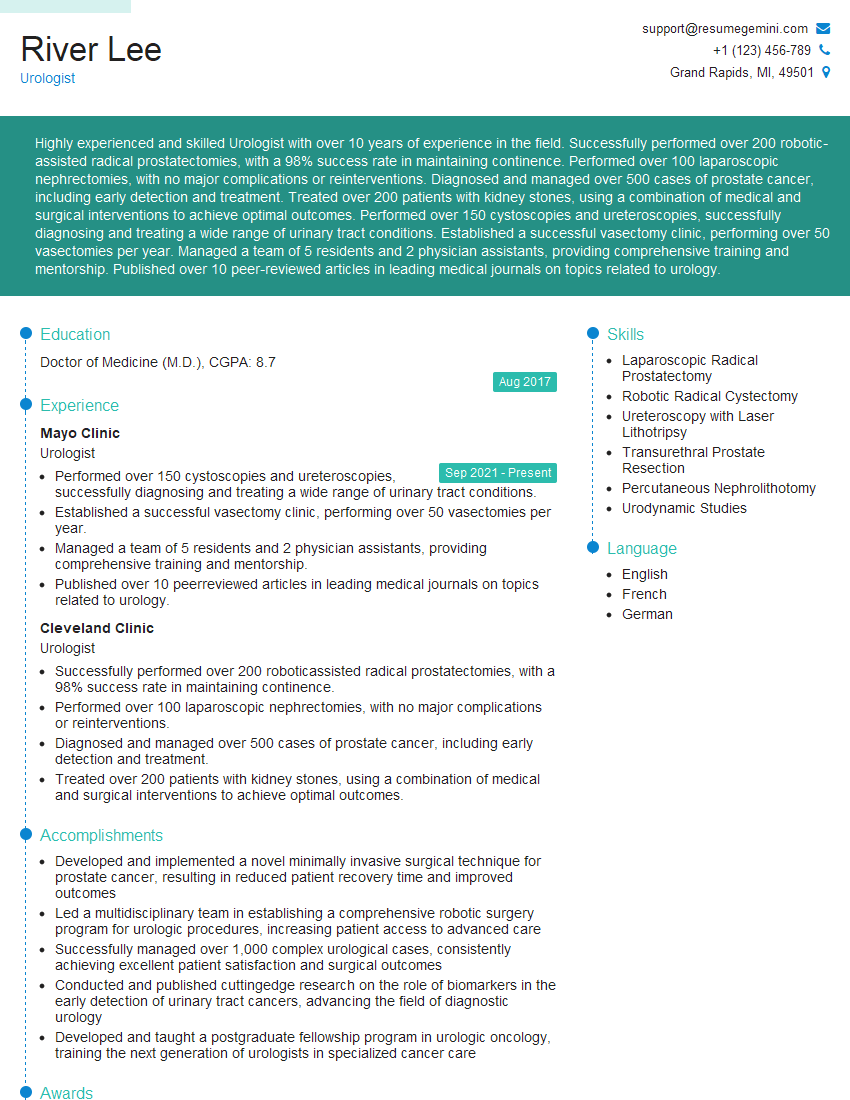
Mastering Ureteral Surgery opens doors to specialized roles and leadership opportunities within urology. A strong foundation in this area significantly enhances your career prospects. To maximize your chances of landing your dream position, create an ATS-friendly resume that highlights your skills and experience effectively. ResumeGemini is a trusted resource to help you build a professional and impactful resume that stands out. They provide examples of resumes tailored to Ureteral Surgery to guide you through the process. Invest time in crafting a compelling resume – it’s your first impression on potential employers.


Explore more articles
Users Rating of Our Blogs
Share Your Experience
We value your feedback! Please rate our content and share your thoughts (optional).
What Readers Say About Our Blog
To the interviewgemini.com Webmaster.
Very helpful and content specific questions to help prepare me for my interview!
Thank you
To the interviewgemini.com Webmaster.
This was kind of a unique content I found around the specialized skills. Very helpful questions and good detailed answers.
Very Helpful blog, thank you Interviewgemini team.