Interviews are more than just a Q&A session—they’re a chance to prove your worth. This blog dives into essential Patent Preparation and Filing interview questions and expert tips to help you align your answers with what hiring managers are looking for. Start preparing to shine!
Questions Asked in Patent Preparation and Filing Interview
Q 1. Explain the difference between a utility patent, design patent, and plant patent.
There are three main types of patents in the United States, each protecting different aspects of an invention:
- Utility Patent: This is the most common type, protecting the way an invention works, its functionality, or its processes. Think of the internal workings of a new smartphone or a novel method for manufacturing a product. It protects the functionality of the invention.
- Design Patent: This protects the ornamental design of an invention. It’s about the aesthetics, the look and feel of a product, not its functionality. Consider the unique shape of a chair, a bottle, or even the user interface of a software application. It protects the appearance of the invention.
- Plant Patent: This protects newly invented or discovered asexually reproduced plants. This could include new varieties of flowers, trees, or other plants that are propagated through methods such as cuttings or grafting, not through seeds. It protects new plant varieties.
For example, a new type of self-driving car would be protected by a utility patent (the technology), the sleek design of the car body would be covered by a design patent, and a new disease-resistant rose variety would be protected by a plant patent. The same invention can be protected by multiple patents, if appropriate.
Q 2. Describe the process of conducting a prior art search.
A prior art search is crucial before filing a patent application. It’s a comprehensive investigation to determine whether your invention is truly novel and non-obvious. This involves searching existing patents, publications, and other publicly available information to identify any similar inventions or technologies. Think of it as a detective investigation to see if your invention has already been ‘discovered’ or ‘disclosed’ before your application date.
The process generally involves:
- Identifying keywords: Based on your invention, determine the relevant keywords and search terms.
- Using patent databases: Accessing databases like USPTO’s (United States Patent and Trademark Office) and other international patent offices’ databases (e.g., Espacenet, Google Patents).
- Searching scientific literature: Reviewing academic journals, conference proceedings, and technical publications.
- Analyzing search results: Carefully evaluating the identified documents to determine their relevance and potential impact on patentability.
- Documenting the search: Maintaining detailed records of the search process and the results found. This is vital for demonstrating due diligence to the patent office.
A thorough prior art search significantly improves the chances of obtaining a valid and enforceable patent by helping to identify potential obstacles and informing claim drafting strategies.
Q 3. What are the key elements of a patent application?
A complete patent application includes several key elements, all meticulously structured and presented to meet the requirements of the patent office:
- Specification: This section describes the invention in detail, including its background, function, and how to make and use it. It should be clear, concise, and enable a person skilled in the art to make and use the invention.
- Claims: These define the scope of the protection sought. They are the most crucial part of the patent application, precisely defining the boundaries of what is protected by the patent. Claims are legal statements defining the invention.
- Drawings: Where applicable, drawings illustrate the invention. They are particularly important for mechanical or electromechanical inventions.
- Abstract: A brief summary of the invention.
- Oath or Declaration: A sworn statement by the inventor(s) affirming their inventorship and other relevant information.
Imagine a recipe for a cake. The specification is the detailed recipe itself, explaining all the ingredients and the steps. The claims are the statements saying, “This cake is specifically protected because of its unique combination of ingredients X, Y, and Z,” or “This cake is protected due to the specific baking method.” The drawings could be pictures of the finished cake, showcasing its appearance.
Q 4. Explain the significance of claim drafting in a patent application.
Claim drafting is arguably the most critical aspect of patent prosecution. The claims define the metes and bounds of the patent’s protection. They are the legal fences around your invention. Poorly drafted claims can render a patent essentially useless, while well-drafted claims ensure broad and robust protection.
Effective claim drafting requires:
- Precision: Claims must be specific and unambiguous, clearly defining the invention’s features and functions. This requires careful consideration of terminology and structure.
- Breadth vs. Specificity: A balance needs to be found between claiming broadly (covering a wider range of embodiments) and narrowly (avoiding prior art but possibly limiting future applications).
- Prior Art Consideration: Claims must be drafted to avoid infringing on existing patents and publications. The prior art search is essential in this process.
- Clarity and Readability: Claims must be easily understood by the patent examiner and, subsequently, by the courts.
For example, a poorly drafted claim might be overly broad and easily challenged due to prior art, while a well-drafted claim will precisely encompass the invention’s novel aspects and stand up to scrutiny.
Q 5. How do you handle amendments during patent prosecution?
Amendments are common during patent prosecution. The patent examiner may raise objections regarding patentability, novelty, or clarity. Addressing these objections requires carefully crafted amendments to the application. This is an iterative process involving dialogue with the patent examiner.
Handling amendments involves:
- Analyzing the Office Action: Carefully reviewing the examiner’s objections and understanding the reasons behind them.
- Developing a Response Strategy: Deciding how to address each objection – amending claims, arguments, and/or submitting evidence.
- Drafting Amendment Documents: Preparing clear and concise amendment documents that respond to each specific objection.
- Strategic Decision-Making: Weighing the pros and cons of different amendments, considering the impact on the claim scope and the overall patentability.
- Filing the Response: Submitting the amended application within the specified timeframe.
Think of it as a negotiation – you’re trying to convince the examiner that your invention is worthy of patent protection by clarifying and strengthening your application’s claims and arguments.
Q 6. What is the role of an independent claim versus a dependent claim?
Independent and dependent claims play distinct roles in defining the scope of patent protection. An independent claim stands alone, defining a complete invention without referencing other claims. A dependent claim is narrower, relying on and adding limitations to a previously defined independent claim. Think of them as building blocks.
- Independent Claim: This claim defines the broadest scope of the invention. It sets the foundation for the dependent claims.
- Dependent Claim: This claim narrows the scope by adding limitations to a preceding independent claim, creating more specific aspects of the invention protected by the patent.
For example:
- Independent Claim: “A method for improving the efficiency of a car engine comprising steps A, B, and C.”
- Dependent Claim: “The method of claim 1, wherein step C further comprises…”
The independent claim establishes the basic protection, while the dependent claim adds additional features for even more specific protection. This layered approach allows for a balance of broad and specific protection, increasing the likelihood of covering different potential infringing implementations.
Q 7. Explain the concept of patent enforceability.
Patent enforceability refers to the ability of a patent holder to successfully assert their patent rights in court and prevent infringement. A patent isn’t just a piece of paper; it’s a legal right to exclude others from making, using, or selling the invention. However, this right isn’t absolute and its enforceability depends on several factors.
- Validity: A patent must be valid to be enforceable. Validity means the patent office correctly granted the patent, and the invention meets all the legal requirements for patentability (novelty, non-obviousness, utility).
- Claim Construction: The interpretation of the claims is crucial. A court’s interpretation of the claims determines their scope and affects whether an accused product or process infringes.
- Infringement: The patent holder must prove that the accused infringer’s product or process literally or equivalently infringes one or more claims of the patent.
- Defenses: Infringers can raise various defenses, such as invalidity, non-infringement, or unenforceability due to inequitable conduct during the patent prosecution process.
A patent’s enforceability is not guaranteed. It is essential to have strong claims and a well-documented prior art search during prosecution. Furthermore, solid legal representation is vital in asserting and defending a patent in court. A patent with broad, well-defined claims, supported by strong evidence, has higher chances of being enforceable.
Q 8. Describe your experience with PCT applications.
My experience with PCT (Patent Cooperation Treaty) applications is extensive. PCT applications provide a cost-effective way to seek patent protection in multiple countries simultaneously. I’ve handled numerous PCT filings, from drafting the international application based on the requirements of the PCT, including the claims, specification, and drawings, to managing the subsequent national phase entry in various jurisdictions. This involves navigating the complexities of different national patent laws, paying fees on time, and responding to any office actions raised by the various national patent offices. For example, I recently guided a client through a PCT application covering a novel medical device, successfully securing protection in the US, Europe, and Japan. This required careful consideration of the differences in examination standards and claim drafting requirements across these regions.
I’m also adept at managing the international search report and written opinion, using them to strategically guide the client’s next steps. I understand the importance of the priority date and the limitations of a PCT application, such as its eventual requirement for national-phase entry. This ensures my clients receive the most efficient and comprehensive patent protection possible.
Q 9. How do you determine patentability?
Determining patentability is a multifaceted process requiring a deep understanding of patent law and the specific technological field. Essentially, we need to assess whether an invention is novel, non-obvious, and useful.
- Novelty: The invention must be new and not previously disclosed anywhere in the world. This includes prior publications, public use, or sale. We carefully search patent databases and other relevant literature to identify any prior art that might anticipate the invention.
- Non-Obviousness: Even if an invention is new, it must not be obvious to a person of ordinary skill in the art. This involves considering the differences between the invention and the prior art, and whether those differences would have been obvious to someone skilled in the field. This analysis requires a deep understanding of the technology involved.
- Utility: The invention must have a practical use. It must work as described and provide a tangible benefit.
I use a combination of legal research, technical expertise, and strategic thinking to determine patentability. This often includes formulating alternative claim strategies to overcome potential rejections based on the prior art. For example, I recently helped a client overcome a rejection by re-framing their claims to emphasize a novel aspect of their software algorithm that hadn’t been previously disclosed.
Q 10. What is the difference between a provisional and non-provisional patent application?
A provisional patent application and a non-provisional patent application are both ways to begin the patent process, but they differ significantly in their scope and effect.
- Provisional Application: This is a low-cost, short-term application that establishes an early filing date. It requires a minimal amount of documentation and does not undergo examination. It’s essentially a placeholder, allowing you to claim a priority date for a later, more complete non-provisional application.
- Non-Provisional Application: This is a complete patent application that must meet all the formal requirements of the patent office. It includes a detailed specification, claims, and drawings and is subject to examination by the patent examiner. It’s the application that, if successful, leads to the issuance of a patent.
Think of it like this: a provisional application is like staking a claim on a piece of land, while a non-provisional application is like building a house on that land. You need the claim (provisional) to establish your rights, but the house (non-provisional) is where you will actually live. A non-provisional application typically claims priority from an earlier filed provisional application, extending the patent term to the priority date of the provisional application.
Q 11. Explain the concept of ‘best mode’ in patent applications.
The ‘best mode’ requirement in patent applications mandates that the inventor disclose the best way they know to practice their invention at the time of filing. This doesn’t necessarily mean the absolute best mode possible, but rather the best mode known to the inventor. This obligation ensures that the public benefits from the full scope of the invention’s functionality after the patent expires. It also prevents inventors from concealing superior embodiments to gain an unfair competitive advantage during the patent term. Failure to disclose the best mode can lead to patent invalidation.
For example, if an inventor discovers two methods to achieve the same result, and one is demonstrably superior in terms of efficiency or cost, then both methods must be disclosed, but the superior method should be clearly highlighted as the ‘best mode’ at the time of filing. It’s crucial to thoroughly document all embodiments and clearly identify the best mode to ensure compliance with this requirement.
Q 12. How do you handle rejections from the patent office?
Handling rejections from the patent office requires a strategic and methodical approach. My process typically involves the following steps:
- Careful Review: I meticulously review the rejection, identifying the specific grounds for the rejection and the cited prior art. Understanding the examiner’s reasoning is paramount.
- Prior Art Analysis: I conduct further research to identify any additional relevant prior art, assessing its impact on the claims and the patentability of the invention.
- Amendment Strategy: Based on the analysis, I develop a strategy for amending the application. This may involve narrowing the claims to overcome the cited prior art, arguing why the prior art does not anticipate or render obvious the claimed invention, or providing additional evidence of non-obviousness.
- Response Preparation: I draft a detailed response to the office action, addressing each ground of rejection point-by-point. This requires precise legal arguments supported by evidence and clear, concise language.
- Interview (if necessary): In some cases, a telephone or video interview with the examiner can be helpful to clarify the issues and facilitate a faster resolution.
Successful handling of rejections often requires a combination of technical and legal skills. I have a strong track record of overcoming rejections through thoughtful claim amendments and compelling arguments, ultimately securing patents for my clients.
Q 13. What is your experience with different patent classification systems?
I am familiar with several patent classification systems, most notably the Cooperative Patent Classification (CPC) system used by the USPTO and the European Patent Office, and the International Patent Classification (IPC) system used internationally. These systems are crucial for organizing and searching patent databases efficiently. My expertise extends to using these classifications strategically during the patent prosecution process.
For instance, understanding the nuances of CPC and IPC classifications is vital when searching for prior art. A precise classification can lead to a more targeted and effective search, potentially identifying relevant prior art that might otherwise be missed. This knowledge is also important when selecting appropriate keywords for patent searches and when responding to office actions. The correct classification of a patent application ensures that it is indexed accurately within the patent databases, increasing its discoverability.
Q 14. Describe your experience with patent litigation support.
My experience in patent litigation support encompasses various aspects, from assisting in the preparation of patent infringement and validity opinions to preparing exhibits for trial. I have supported attorneys in several successful litigation cases involving complex technologies.
For example, in one case I helped analyze the prior art to identify differences between the asserted patents and the accused products, which was crucial in demonstrating infringement. In another instance, I assisted in the preparation of technical expert reports, helping the experts articulate complex technical concepts in a clear and concise manner for the court. This work involves carefully reviewing the patent claims, the accused product, and any relevant expert reports or depositions. I also have experience in preparing chronologies, timelines, and other types of exhibits for use in court or discovery. My attention to detail and ability to explain complex technical information clearly are significant assets in this area.
Q 15. Explain the concept of patent licensing.
Patent licensing is essentially a contractual agreement where a patent holder (the licensor) grants another party (the licensee) the right to use their patented invention under specific terms and conditions. Think of it like renting out the rights to your invention, rather than selling it outright. This allows the licensee to manufacture, use, or sell the invention without infringing on the patent holder’s rights.
There are different types of patent licenses, each with varying levels of exclusivity and control. For example, an exclusive license grants the licensee the sole right to use the invention within a defined scope, while a non-exclusive license allows the licensor to grant the same rights to multiple licensees. The license agreement will specify the royalty payments, geographical limitations, duration of the license, and permitted uses of the invention.
For instance, a pharmaceutical company might license a patented drug formulation from a research university, paying royalties for each unit sold. The agreement would clearly outline the territory where the licensee has the right to sell, the duration of the license, and any restrictions on further licensing or modifications to the patented drug.
Career Expert Tips:
- Ace those interviews! Prepare effectively by reviewing the Top 50 Most Common Interview Questions on ResumeGemini.
- Navigate your job search with confidence! Explore a wide range of Career Tips on ResumeGemini. Learn about common challenges and recommendations to overcome them.
- Craft the perfect resume! Master the Art of Resume Writing with ResumeGemini’s guide. Showcase your unique qualifications and achievements effectively.
- Don’t miss out on holiday savings! Build your dream resume with ResumeGemini’s ATS optimized templates.
Q 16. What is your experience with international patent filings?
I have extensive experience with international patent filings, having successfully secured patents in various countries across North America, Europe, and Asia. My expertise encompasses navigating the complexities of the Patent Cooperation Treaty (PCT) system, preparing and filing national phase applications, and understanding the nuances of foreign patent laws and regulations. I’ve handled applications involving various technologies, including software, medical devices, and chemical processes.
For example, I recently assisted a client in securing a patent in Japan for a novel semiconductor design. This involved meticulously preparing the application to comply with Japanese patent office requirements, which differ significantly from those in the US. This included detailed translations, specific claim drafting according to Japanese practice, and close collaboration with a Japanese patent agent to ensure smooth prosecution.
Q 17. How do you stay current with changes in patent law?
Staying current with changes in patent law is crucial. I achieve this through a multifaceted approach. I subscribe to leading legal journals specializing in intellectual property, such as the Journal of Intellectual Property Law & Practice and the AIPLA Quarterly Journal. I actively participate in industry conferences and workshops organized by professional organizations like the AIPLA (American Intellectual Property Law Association) and USPTO (United States Patent and Trademark Office) to stay abreast of recent case law and legislative changes.
Furthermore, I maintain a network of colleagues and experts in the field, exchanging information and insights. Finally, I utilize online resources, such as the USPTO website and legal databases like Westlaw and LexisNexis, to access updated regulations, rulings, and case precedents.
Q 18. What software or tools are you proficient in for patent preparation?
My proficiency extends across several software and tools vital for patent preparation. I am expert in using professional patent drafting software such as PatBase, which helps in searching prior art and managing patent applications efficiently. I am also well-versed in using Microsoft Office Suite (Word, Excel, PowerPoint) for creating and formatting documents, and Adobe Acrobat for handling PDFs.
Moreover, I’m adept at using specialized image editing software for preparing clear and accurate figures and diagrams which are essential for illustrating complex technical details in patent applications. The ability to seamlessly integrate various tools allows me to create highly professional and comprehensive patent applications.
Q 19. Describe your experience working with clients or inventors.
Working with clients and inventors is a significant aspect of my role. I have a proven track record of building strong client relationships based on trust and effective communication. I understand that many inventors are not patent law experts, therefore I prioritize explaining complex concepts clearly and patiently, ensuring they fully grasp the process and its implications. My approach is collaborative; I work closely with clients to understand their invention’s technical details, business goals, and overall objectives.
For example, I recently worked with a team of researchers who developed a groundbreaking new medical device. Through numerous meetings and discussions, I helped them refine their invention disclosure, draft compelling claims, and navigate the complexities of the patent application process. The patent was subsequently granted, securing their intellectual property rights and opening up significant market opportunities.
Q 20. How do you manage multiple patent applications simultaneously?
Managing multiple patent applications concurrently requires meticulous organization and effective time management. I utilize project management tools and software to track deadlines, milestones, and the status of each application. This ensures that crucial deadlines are never missed and that each case receives the attention it deserves. I often break down large projects into smaller, manageable tasks, assigning priorities based on urgency and complexity. Regular review meetings with clients keep them informed of progress.
Furthermore, I employ a system of detailed documentation and file management to keep track of all correspondence, amendments, and office actions. This allows for seamless handover between team members if necessary and ensures a clear audit trail of all actions taken in each application.
Q 21. How do you ensure the accuracy and completeness of patent applications?
Ensuring accuracy and completeness in patent applications is paramount. My approach involves a multi-step process. Initially, I conduct a thorough prior art search to identify existing patents and publications relevant to the invention. This helps in crafting claims that are both novel and non-obvious. Secondly, I carefully review the application’s technical content, ensuring that all descriptions, claims, and drawings are accurate, consistent, and unambiguous. A thorough internal review, often involving a second opinion, is crucial in identifying and resolving potential issues before filing.
Finally, I meticulously check compliance with all formal requirements of the relevant patent office before submission. This includes ensuring the correct forms are used, fees are paid, and all necessary documentation is included. This proactive approach minimizes the risk of rejection or delays due to formal errors.
Q 22. Describe a challenging patent application you worked on and how you overcame the challenges.
One particularly challenging application involved a novel medical device with complex interactions between its mechanical and software components. The initial claim drafting struggled to capture the inventive concept while maintaining patentability. The challenge stemmed from the novelty residing in the synergistic interplay of hardware and software, which is often difficult to articulate clearly and concisely in patent claims.
To overcome this, we employed a multi-pronged approach. First, we meticulously analyzed the prior art to identify the precise point of novelty. This involved not only reviewing patents but also scientific literature and even product manuals to understand the state of the art. Second, we developed a detailed flow chart illustrating the interaction between the hardware and software components, allowing us to pinpoint the specific steps and interactions that defined the invention. This visual representation was instrumental in structuring our claims. Finally, we drafted a series of claims of varying scope, starting with broad claims to capture the core inventive concept and then narrowing them down to ensure they were not anticipated by the prior art. We also carefully crafted the specification to clearly describe the invention and its advantages, providing solid support for our claims. Through this iterative process of analysis, visualization, and claim drafting, we successfully secured a strong patent application.
Q 23. What is your understanding of the USPTO’s procedures?
My understanding of the USPTO’s procedures encompasses the entire patent application process, from initial filing to allowance or rejection. This includes familiarity with various forms (e.g., the utility patent application, provisional application), the requirements for each section of the application (specification, claims, drawings), and the examination process.
I understand the importance of adhering to deadlines, responding effectively to Office Actions (which include rejections, objections, and requirements), and utilizing available tools like the USPTO’s PAIR (Patent Application Information Retrieval) system for tracking application status. I’m also aware of the various appeal procedures should an application be rejected. The USPTO’s rules and regulations are constantly evolving, and I make it a point to stay updated on any changes through official publications, professional development courses, and industry resources. This ensures I maintain compliance and provide the best possible service to my clients.
Q 24. How do you prioritize tasks when dealing with tight deadlines?
Prioritizing tasks under tight deadlines requires a structured approach. I typically use a combination of techniques, including:
- Task Prioritization Matrix: I categorize tasks based on urgency and importance (using a simple matrix: Urgent/Important, Important/Not Urgent, Urgent/Not Important, Not Urgent/Not Important). This helps me focus on the most critical tasks first.
- Time Blocking: I allocate specific time blocks for particular tasks, ensuring dedicated focus and preventing distractions.
- Break Down Complex Tasks: Large projects are broken down into smaller, manageable sub-tasks, making them less overwhelming and easier to track progress on. This also allows for more flexible scheduling and quicker adaptation to unforeseen delays.
- Regular Progress Checks: I set aside time for reviewing progress and readjusting priorities as needed. Flexibility is key under pressure.
Think of it like building a house – you wouldn’t start painting before laying the foundation. Similarly, I focus on completing critical foundational steps before moving on to other aspects of the patent application.
Q 25. Explain your understanding of the Doctrine of Equivalents.
The Doctrine of Equivalents is a crucial legal principle in patent law that broadens the scope of patent protection beyond the literal language of the claims. Essentially, it prevents others from circumventing a patent by making insignificant changes to the claimed invention while retaining its core functionality.
For example, if a patent claims a “red widget,” the Doctrine of Equivalents might prevent someone from making a “blue widget” if the color is functionally irrelevant and the blue widget performs the same essential function as the red widget. However, it’s not a carte blanche expansion. Courts consider several factors, including the prosecution history, the scope of the claims, and the differences between the accused device and the patented invention. The test often involves whether the accused device performs substantially the same function in substantially the same way to achieve substantially the same result. Understanding the nuances of the Doctrine of Equivalents is vital in both drafting robust patent claims and assessing the validity and infringement of existing patents. A poorly drafted claim can be easily circumvented, leading to the loss of valuable patent protection.
Q 26. Describe your experience with responding to office actions.
Responding to Office Actions is a routine but crucial aspect of patent prosecution. My experience involves thoroughly analyzing the examiner’s objections and rejections, identifying the issues raised, and formulating a comprehensive response. This involves:
- Careful Review: I meticulously review each point raised in the Office Action, ensuring I fully understand the examiner’s reasoning.
- Argumentation and Amendment: I prepare a well-supported response addressing each objection, providing arguments and evidence (such as prior art references or amendments to the claims) to overcome the rejections. This often includes citing relevant case law.
- Clarity and Conciseness: I strive to present our arguments clearly and concisely, avoiding ambiguity and ensuring the examiner understands our position.
- Professional Communication: Maintaining a professional and respectful tone in all communications with the examiner is crucial for positive interaction.
Successful responses often require a deep understanding of patent law, the specific technology, and effective communication skills to convince the examiner of the patentability of the invention. I often iterate through several drafts of the response, refining it to ensure it effectively addresses all concerns raised by the examiner.
Q 27. What are some common pitfalls to avoid when preparing a patent application?
Several common pitfalls can significantly weaken a patent application. Some of the most prevalent include:
- Insufficient Disclosure: Failing to adequately describe the invention and its advantages in the specification. The description must be clear, concise, and enable one skilled in the art to make and use the invention.
- Overly Broad Claims: Claims that are too broad can be easily rejected for lack of novelty or obviousness. It’s crucial to carefully tailor claims to encompass only the specific inventive aspects of the invention.
- Poorly Defined Claims: Ambiguous or unclear claims can lead to rejection or difficulty in enforcing the patent. Claims should be specific and unambiguous.
- Ignoring Prior Art: Failure to thoroughly search and analyze prior art can result in a patent application being rejected for anticipation or obviousness.
- Missed Deadlines: Failing to meet USPTO deadlines can lead to abandonment of the application.
Avoiding these pitfalls requires careful planning, meticulous attention to detail, and a thorough understanding of patent law and procedure. A well-prepared application significantly increases the chances of securing a strong, enforceable patent.
Q 28. How would you handle a conflict between a client’s wishes and your professional judgment?
Handling conflicts between a client’s wishes and professional judgment requires a delicate balance of advocacy and ethical responsibility. My approach involves:
- Open and Honest Communication: I begin by clearly explaining my professional concerns and the potential consequences of pursuing the client’s preferred course of action. I explain the relevant legal principles and their application to the situation.
- Exploring Alternatives: I work with the client to explore alternative solutions that address their goals while mitigating the risks identified. This often involves creative problem-solving to find a path that aligns with both their desires and best practices.
- Documentation: I meticulously document all communications and decisions, including any instances where my professional judgment differed from the client’s wishes. This documentation protects both the client and me.
- Ethical Considerations: If the conflict is irreconcilable and the client insists on a course of action that violates my ethical obligations, I would need to consider withdrawing from the engagement to maintain my professional integrity.
The goal is to reach a mutually agreeable solution that maximizes the client’s chances of success while adhering to ethical standards. Open communication, collaboration, and a strong understanding of patent law are essential in navigating these challenging situations.
Key Topics to Learn for Patent Preparation and Filing Interview
- Patent Searching and Prior Art Analysis: Understanding the process of identifying existing patents and publications relevant to an invention, and assessing their impact on patentability. This includes practical application of search strategies using various databases like USPTO and Google Patents.
- Patent Drafting Fundamentals: Mastering the art of writing clear, concise, and legally sound patent applications. This includes understanding claim drafting techniques, specification writing, and the importance of precise language to define the invention’s scope.
- Patent Prosecution: Familiarizing yourself with the procedures involved in interacting with patent offices (e.g., USPTO, EPO). This includes understanding office actions, responses, and amendments to applications.
- Intellectual Property (IP) Law Basics: Grasping the fundamental principles of IP law, including patent types (utility, design, plant), patentability criteria (novelty, non-obviousness, utility), and IP rights protection.
- Understanding different claim types (independent, dependent, etc.): Knowing how to strategically draft claims to maximize protection while minimizing limitations.
- PCT (Patent Cooperation Treaty) Applications: Understanding the international aspects of patent applications and the process of filing internationally through the PCT system. This includes practical considerations for foreign filings.
- Practical Application: Case Studies: Analyze real-world examples of successful and unsuccessful patent applications to understand best practices and common pitfalls. This strengthens problem-solving skills crucial for interviews.
Next Steps
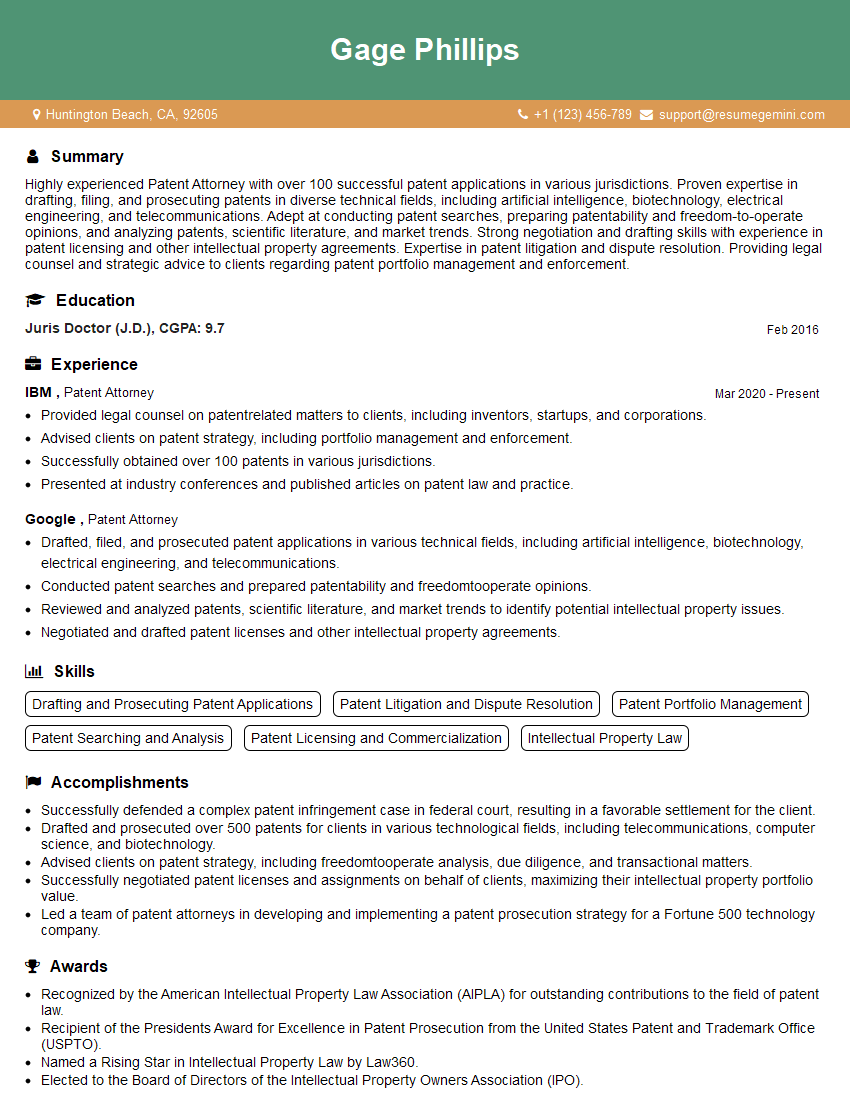
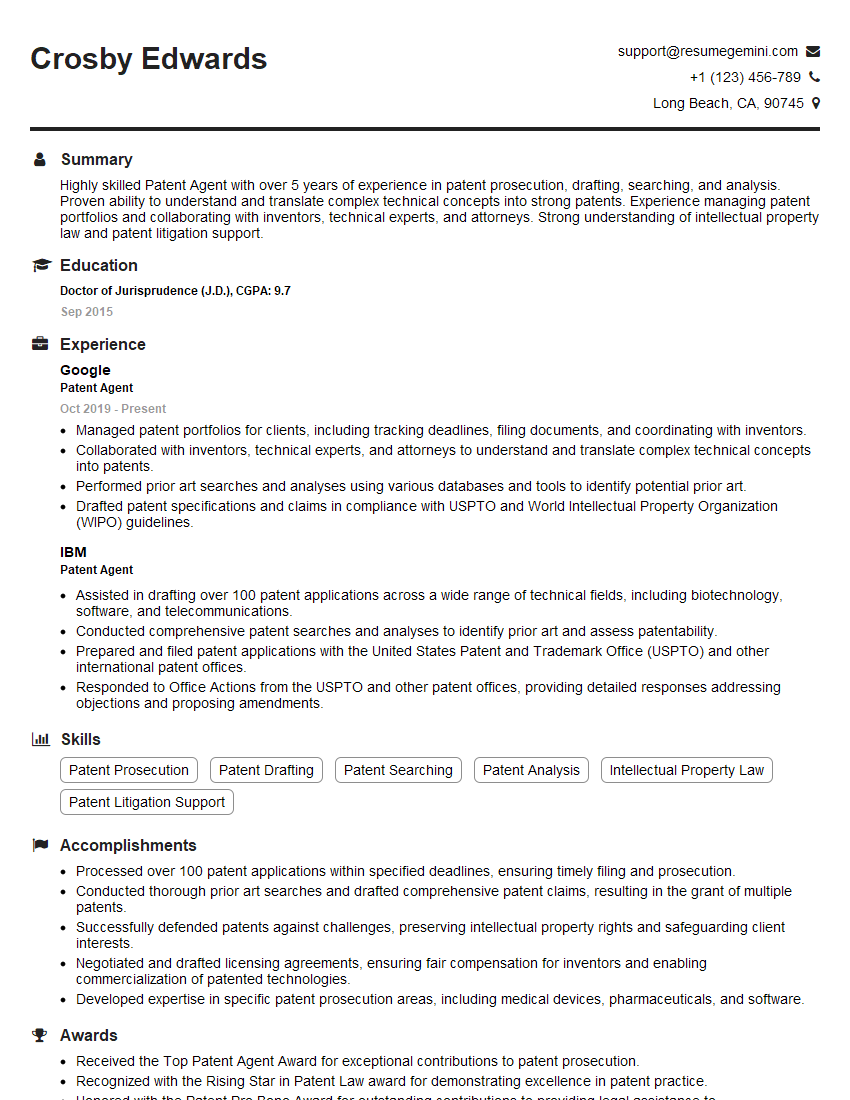
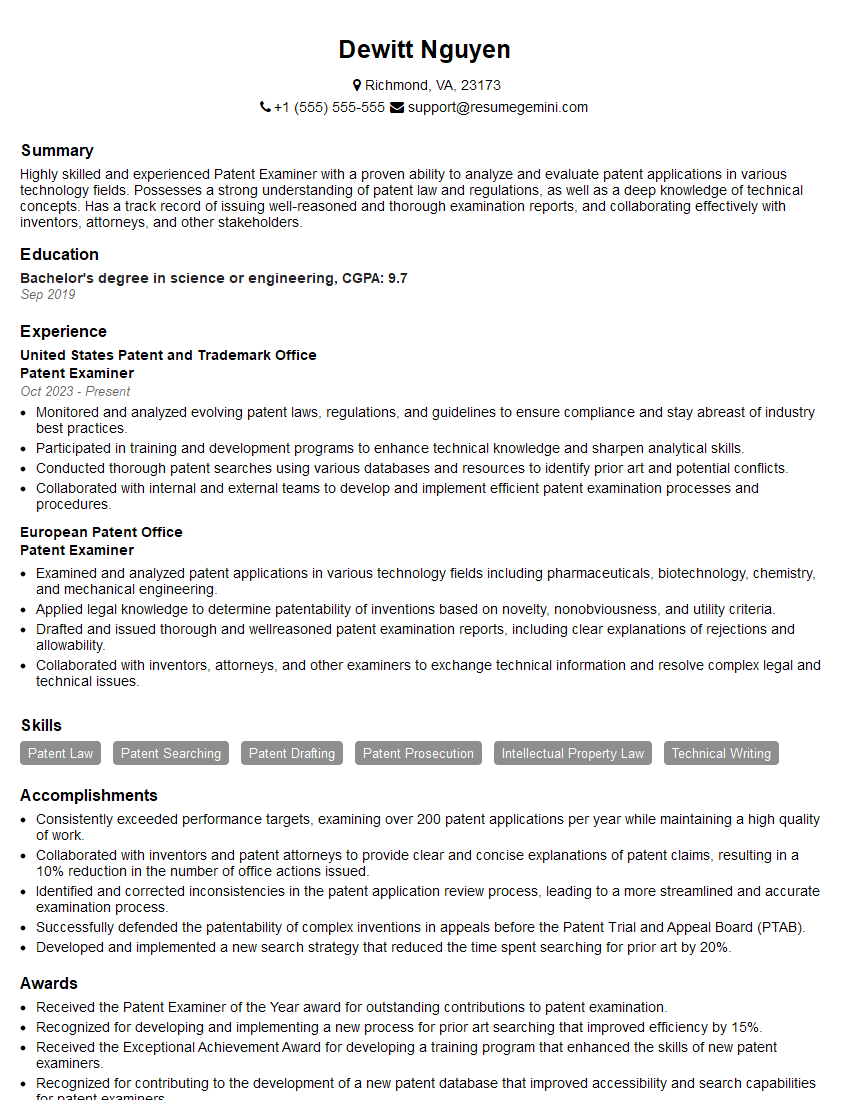
Mastering Patent Preparation and Filing opens doors to exciting and rewarding careers in intellectual property law, technology companies, and research institutions. A strong foundation in these skills significantly boosts your career prospects. To enhance your job search, create an ATS-friendly resume that highlights your relevant skills and experience. ResumeGemini is a trusted resource to help you build a professional and impactful resume. They provide examples of resumes tailored to Patent Preparation and Filing to guide you through the process. Invest time in crafting a compelling resume – it’s your first impression on potential employers.
Explore more articles
Users Rating of Our Blogs
Share Your Experience
We value your feedback! Please rate our content and share your thoughts (optional).
What Readers Say About Our Blog
To the interviewgemini.com Webmaster.
Very helpful and content specific questions to help prepare me for my interview!
Thank you
To the interviewgemini.com Webmaster.
This was kind of a unique content I found around the specialized skills. Very helpful questions and good detailed answers.
Very Helpful blog, thank you Interviewgemini team.