Feeling uncertain about what to expect in your upcoming interview? We’ve got you covered! This blog highlights the most important Millwright Maintenance interview questions and provides actionable advice to help you stand out as the ideal candidate. Let’s pave the way for your success.
Questions Asked in Millwright Maintenance Interview
Q 1. Describe your experience with different types of bearings and their maintenance.
My experience encompasses a wide range of bearings, from simple ball bearings to complex tapered roller and spherical roller bearings. Maintenance involves regular inspections for wear, lubrication, and proper seating. For instance, I’ve worked extensively with ball bearings in high-speed applications, where the focus is on minimizing friction and preventing premature failure due to high RPMs. This often involves using specialized greases and ensuring proper shaft alignment. With tapered roller bearings, common in heavy-duty machinery like crushers, the emphasis is on proper preload adjustment to maintain stability under significant radial and axial loads. Neglecting this can lead to premature wear and potential catastrophic failure. I’ve also dealt with spherical roller bearings, which handle misalignment better than other types but still require regular inspection for signs of wear or damage in the raceways or rollers. A key aspect is understanding the specific bearing’s operating conditions and selecting the appropriate lubricant and maintenance schedule.
- Inspection: Checking for excessive play, noise, or signs of overheating.
- Lubrication: Using the correct type and amount of lubricant, according to the manufacturer’s specifications. Over-lubrication is just as damaging as under-lubrication.
- Cleaning: Removing contaminants such as dust and debris that can accelerate wear.
- Replacement: Knowing when a bearing needs to be replaced and selecting the right replacement.
For example, I once diagnosed a faulty ball bearing in a conveyor system by listening for unusual noises, noticing slightly increased vibration and checking for excessive play. Replacing it prevented a major production disruption.
Q 2. Explain the process of aligning a motor and a pump.
Aligning a motor and pump is crucial for efficient operation and to prevent premature bearing failure. Improper alignment causes vibration, excessive wear, and potential damage to the equipment. I typically use a combination of techniques, including laser alignment and dial indicators. The process involves several steps:
- Preparation: Ensuring both the motor and pump are securely mounted and accessible.
- Laser Alignment (preferred method): Using a laser alignment tool, we establish a baseline and adjust the motor’s feet until the laser readings indicate perfect alignment.
- Dial Indicator Alignment: If laser alignment isn’t available, we use dial indicators to measure the shaft misalignment in both vertical and horizontal planes. Adjustments are made to the motor’s base until the readings are within acceptable tolerances. This is a more time consuming process and requires more experience to assure accuracy.
- Verification: After making adjustments, we re-check the alignment using the chosen method to ensure it’s within acceptable limits. This ensures minimal vibration and optimal performance.
- Torque Check: Once alignment is completed, we check the torque of the mounting bolts to make sure the machine is secured properly.
Think of it like stacking two perfectly round coins; they need to be exactly centered on each other to run smoothly. Any offset will cause friction and instability.
Q 3. How do you troubleshoot a vibrating machine?
Troubleshooting a vibrating machine is a systematic process. I start by identifying the source of the vibration and its frequency. My approach involves:
- Visual Inspection: Checking for obvious problems, such as loose bolts, misalignment, or damaged components.
- Vibration Measurement: Using a vibration analyzer to measure the amplitude and frequency of the vibration. This helps pinpoint the source. High frequency vibrations often point to bearing problems while low frequency vibrations are more likely associated with misalignment or imbalance.
- Frequency Analysis: Analyzing the frequency spectrum of the vibration to identify the specific frequencies associated with the vibration. This allows us to associate the frequency with a likely root cause.
- Component Checks: Examining specific components, such as bearings, belts, couplings, and the foundation, for signs of wear, damage, or looseness, depending on the frequency analysis results.
- Operating Condition Review: Reviewing the machine’s operating conditions and comparing current operating parameters to historical data if available to identify any anomalies.
For example, if the vibration analysis reveals a high frequency at the bearing’s natural frequency, it strongly suggests a bearing problem. Conversely, a low frequency may point to a misalignment issue. Then you can follow up with a visual inspection and potentially dial indicator or laser alignment checks.
Q 4. What are the common causes of bearing failure?
Bearing failure is a common problem, and its causes are multifaceted. Some of the most frequent include:
- Lubrication Issues: Insufficient lubrication, improper lubricant type, or contaminated lubricant lead to increased friction and premature wear.
- Contamination: Dust, debris, and other contaminants can introduce abrasive wear and damage the bearing surfaces.
- Misalignment: Improper shaft alignment creates increased loads on the bearings, leading to premature failure. The forces are not evenly distributed on the bearing.
- Overload: Excessive loads beyond the bearing’s design capacity cause excessive stress and damage.
- Corrosion: Exposure to moisture or corrosive environments can degrade bearing components.
- Improper Installation: Incorrect installation, such as improper seating or damage during installation, can compromise bearing life.
- Fatigue: Repeated loading and unloading of the bearing over time, causes microscopic damage that accumulate and can ultimately lead to catastrophic failure.
Identifying the root cause is essential for implementing effective preventative maintenance strategies.
Q 5. Describe your experience with shaft alignment techniques.
My experience with shaft alignment includes both traditional methods using dial indicators and more advanced laser alignment techniques. Traditional methods are labor-intensive but effective for simpler alignments. Laser alignment systems provide faster, more accurate results, especially for complex setups. The principles involved remain consistent: minimizing the angular and parallel misalignment between connected shafts. Both methods involve measuring offset and angularity between the shafts and making adjustments until optimal alignment is achieved. Precision is key to preventing vibrations and premature wear.
For example, aligning a large centrifugal pump required meticulous measurements using a dial indicator system to minimize the parallel and angular misalignments. Any slight deviation can impact the pump’s operation and efficiency. Laser alignment systems were used for quick and efficient alignment in a production line consisting of various interconnected rotating machinery.
Q 6. How do you perform a vibration analysis on rotating equipment?
Vibration analysis on rotating equipment is a critical aspect of preventative maintenance. I use a handheld vibration analyzer to measure the amplitude and frequency of vibrations at various points on the equipment. The data is then analyzed to identify potential problems. The process typically involves:
- Data Acquisition: Using a vibration analyzer, I measure the vibration levels at different locations on the equipment. I measure both the amplitude and frequency using an accelerometer.
- Spectrum Analysis: The collected data is analyzed to produce a frequency spectrum showing the amplitude of vibrations at different frequencies. This helps identify the source of the vibration.
- Trend Analysis: Tracking vibration data over time helps to identify trends and predict potential failures. A rise in vibration amplitude might indicate impending bearing failure or misalignment.
- Root Cause Identification: By comparing the measured frequencies to known frequencies of common problems (e.g., bearing resonance, imbalance, misalignment), I can identify the root cause of the vibration.
- Reporting: Creating a report to document the findings and recommendations for corrective action. The report can include graphs, charts and other visual representations of the data.
A consistent vibration analysis program is a powerful predictive maintenance tool.
Q 7. Explain the different types of couplings and their applications.
Couplings are crucial for transmitting torque between rotating shafts while accommodating minor misalignment. Different types serve varying purposes:
- Rigid Couplings: These provide a direct connection between shafts and are suitable only when precise alignment is maintained. They are simple and efficient but offer no misalignment compensation. An example would be a flange coupling connecting two shafts of a precisely aligned system.
- Flexible Couplings: These accommodate minor misalignment, protecting connected equipment. They are generally more forgiving and widely used in applications with potential misalignment. Types include:
- Jaw Couplings: Simple, durable, and handle moderate misalignment.
- Elastomeric Couplings: Use elastomers to absorb vibrations and accommodate misalignment. These are ideal for applications where vibration damping is important, such as a pump driving a centrifugal fan.
- Gear Couplings: Durable and handle larger misalignments, but are more complex and expensive.
- Fluid Couplings: Transmit torque hydraulically, absorbing shocks and vibrations. They are suitable for high torque applications and where smooth acceleration is required.
Selecting the correct coupling type depends on the specific application requirements, including the level of misalignment expected, the torque to be transmitted, and the operating environment.
Q 8. How do you diagnose and repair a leaking seal?
Diagnosing and repairing a leaking seal starts with identifying the type of seal and the location of the leak. Think of a seal like a gasket – it’s there to prevent fluids from escaping. A leak indicates a failure in this crucial barrier. The process is methodical:
- Inspection: Visually inspect the seal and surrounding area for obvious signs of damage like cracks, wear, or deformation. Note the type of fluid leaking (oil, water, grease) and its pressure. This will narrow down the likely causes.
- Leak Source Pinpointing: Use a leak detection dye or other methods (e.g., listening for hissing sounds) to pinpoint the exact location of the leak within the seal.
- Root Cause Analysis: Determine the *why* behind the leak. Is it due to seal degradation (age, wear and tear, chemical attack), misalignment of the shaft or housing, excessive pressure, or improper installation? Consider the operating conditions of the equipment.
- Repair/Replacement: Once the cause is identified, the appropriate action can be taken. Minor leaks might be addressed by tightening bolts or replacing a worn O-ring. Major leaks require complete seal replacement. This typically involves dismantling the associated equipment, carefully removing the old seal, cleaning the area thoroughly, and installing a new seal, ensuring proper alignment and lubrication.
- Testing: After repair or replacement, thoroughly test the system to confirm the leak is resolved and the equipment is functioning correctly. This might involve running the equipment under pressure and checking for further leaks.
For example, I once encountered a leaking shaft seal on a large industrial pump. Through careful inspection, I determined the seal was damaged due to misalignment of the pump shaft. Correcting the alignment and replacing the seal resolved the problem permanently.
Q 9. What safety precautions do you take when working with rotating equipment?
Safety is paramount when working with rotating equipment. My approach always follows a strict protocol:
- Lockout/Tagout (LOTO): Before commencing any work on rotating equipment, I always perform a thorough LOTO procedure to ensure the equipment is completely de-energized and incapable of unexpected startup. This includes disconnecting power sources, securing rotating shafts, and verifying the lockout is effective.
- Personal Protective Equipment (PPE): I use appropriate PPE such as safety glasses, hearing protection, gloves, and steel-toe boots, and I always tailor PPE to the specific task (e.g., flame-resistant clothing when working with welding).
- Clearance and Access: I ensure sufficient clearance around the equipment to prevent accidental contact or injury. I will use barriers or warning signs to prevent unauthorized access.
- Risk Assessment: I always perform a thorough risk assessment prior to starting any work, identifying potential hazards and implementing appropriate control measures. This assessment involves considering the specific equipment, task complexity, and environmental factors.
- Proper Tools and Procedures: I utilize only appropriate tools and follow established procedures for maintenance and repair, minimizing any risk of accidental activation.
Ignoring these safety protocols could lead to serious injury or fatality. Remember, safety isn’t just a procedure; it’s a mindset.
Q 10. Describe your experience with preventative maintenance programs.
I have extensive experience with preventative maintenance (PM) programs. These programs are crucial for extending the life of equipment and reducing downtime. A well-structured PM program involves:
- Scheduled Inspections: Regularly scheduled inspections at defined intervals to identify potential problems *before* they become major issues. The frequency depends on the equipment’s criticality and operating conditions.
- Lubrication Schedules: Implementing a lubrication schedule to ensure proper lubrication of all moving parts, extending their lifespan and reducing wear.
- Component Replacement: Proactive replacement of components that are nearing the end of their lifespan before failure occurs.
- Data Tracking: Detailed records of all inspections, maintenance activities, and component replacements allow us to identify trends and adjust the program as needed. This data-driven approach optimizes PM schedules and prevents unnecessary interventions.
- CMMS Systems: Utilization of Computerized Maintenance Management Systems (CMMS) to schedule maintenance, track inventory, and manage the program more effectively.
In my previous role, I implemented a PM program for a large conveyor system. This resulted in a significant reduction in unplanned downtime and a substantial improvement in overall system efficiency.
Q 11. How do you handle emergency repairs?
Emergency repairs require a rapid, effective, and safe response. My approach prioritizes:
- Assessment: First, I thoroughly assess the nature and extent of the damage, ensuring the safety of personnel and the equipment. This often involves isolating the affected area to prevent further damage or injury.
- Immediate Actions: I take immediate action to mitigate the emergency and prevent further damage. This might involve temporary repairs to restore essential functionality or shutting down affected parts of the system.
- Diagnosis: Once the immediate threat is addressed, I conduct a thorough diagnosis to determine the root cause of the failure.
- Repair: I perform the necessary repairs, prioritizing speed and efficiency while maintaining safety standards. This may involve using temporary fixes until permanent repairs can be completed.
- Documentation: Thorough documentation of the emergency, including causes, repairs made, and lessons learned, aids in preventing similar situations in the future.
For instance, I once responded to a sudden failure of a critical pump in a production line. I quickly isolated the pump, implemented a temporary bypass, and diagnosed the problem as a bearing failure. After sourcing a replacement bearing, I completed the repair minimizing downtime.
Q 12. What is your experience with hydraulic and pneumatic systems?
I possess extensive experience with both hydraulic and pneumatic systems. My knowledge covers:
- Hydraulic Systems: I’m proficient in troubleshooting hydraulic pumps, valves, actuators, and cylinders. I understand hydraulic schematics, pressure readings, and flow rates. I am familiar with various hydraulic fluids and their properties.
- Pneumatic Systems: I am experienced with pneumatic components such as compressors, valves, cylinders, and air treatment equipment. I understand the principles of air pressure and flow control in pneumatic systems. Troubleshooting and repair includes identifying leaks, checking pressure regulators, and replacing worn components.
A recent project involved repairing a faulty hydraulic press. By systematically checking the pressure gauges, identifying a leak in the hydraulic line, and replacing a faulty valve, I successfully restored the press to full operational capacity.
Q 13. Explain your experience with different types of welding and cutting.
My welding and cutting experience encompasses various techniques:
- Shielded Metal Arc Welding (SMAW): Proficient in SMAW (stick welding), including the selection of appropriate electrodes for different materials and applications.
- Gas Metal Arc Welding (GMAW): Skilled in GMAW (MIG welding), understanding the importance of gas shielding, wire feed speed, and voltage settings.
- Gas Tungsten Arc Welding (GTAW): Experienced in GTAW (TIG welding), known for its precision and ability to produce high-quality welds.
- Oxy-Fuel Cutting: Proficient in oxy-fuel cutting, safely utilizing this technique for various materials.
I always prioritize safety when using these methods, ensuring proper ventilation, PPE, and adherence to safety regulations.
Q 14. How do you read and interpret blueprints and schematics?
Reading and interpreting blueprints and schematics is fundamental to my work. My approach involves:
- Understanding Symbols and Conventions: I have a thorough understanding of standard symbols, notations, and conventions used in mechanical drawings and schematics.
- Isometric and Orthographic Views: I can easily interpret different views – isometric (3D) and orthographic (2D) – to understand the spatial relationships of components.
- Dimensions and Tolerances: I can accurately read and interpret dimensions, tolerances, and specifications to ensure proper component fit and functionality.
- Bill of Materials (BOM): I can effectively utilize the BOM to identify all components and parts necessary for assembly or repair.
- Cross-Referencing: I can effectively cross-reference between different drawings or sections to gain a complete understanding of the system.
For example, when repairing a complex piece of machinery, I use the blueprints to understand the arrangement of components, identify specific part numbers, and ensure the repair is performed accurately and safely.
Q 15. What is your experience with troubleshooting PLC controlled machinery?
Troubleshooting PLC-controlled machinery requires a systematic approach. My experience involves understanding ladder logic programming, using diagnostic tools, and interpreting fault codes. I start by carefully reviewing the PLC’s alarm history and error logs. This often points to the source of the problem. For instance, a repeated error code indicating a sensor failure would direct me to check the sensor’s wiring, power supply, and the sensor itself. I’m proficient in using handheld programming devices to monitor I/O signals, force inputs/outputs to test circuits, and even make temporary program modifications to isolate issues. I’ve successfully troubleshooted issues ranging from simple sensor malfunctions to complex control algorithm problems in automated packaging lines and CNC machining centers. One memorable case involved a bottling plant where a PLC failure was causing incorrect bottle filling. By systematically checking the input signals from the level sensors and output commands to the filling valves, I isolated the faulty input module within the PLC, replacing it and restoring production quickly.
Career Expert Tips:
- Ace those interviews! Prepare effectively by reviewing the Top 50 Most Common Interview Questions on ResumeGemini.
- Navigate your job search with confidence! Explore a wide range of Career Tips on ResumeGemini. Learn about common challenges and recommendations to overcome them.
- Craft the perfect resume! Master the Art of Resume Writing with ResumeGemini’s guide. Showcase your unique qualifications and achievements effectively.
- Don’t miss out on holiday savings! Build your dream resume with ResumeGemini’s ATS optimized templates.
Q 16. Describe your experience with different types of lubrication systems.
My experience encompasses various lubrication systems, from simple grease fittings to complex centralized automated systems. I’m familiar with different types of lubricants, including grease, oil (mineral, synthetic), and specialized fluids for specific applications like high-temperature environments or food-grade processing. I understand the importance of proper lubrication for extending equipment lifespan and preventing catastrophic failures. I’ve worked with manual lubrication systems, where I regularly inspect and apply grease to bearings and other moving parts. I’ve also worked with automated systems using pumps, filters, and reservoirs to distribute lubricants throughout a machine. These systems require regular monitoring of oil levels, pressure, and filtration efficiency. In one project, we switched from a manual system to a centralized lubrication system for a large-scale conveyor system. This greatly reduced lubrication time and improved consistency, leading to a significant reduction in equipment downtime.
I am also experienced with different lubrication methods, including grease guns, oil cups, wick-feed oilers, and automated lubrication systems. The choice of system depends on factors like machine complexity, operating environment, and lubricant type.
Q 17. How do you maintain and repair gearboxes?
Gearbox maintenance and repair are critical for ensuring smooth operation and preventing costly downtime. My approach begins with a thorough inspection, checking for leaks, unusual noises, and excessive vibration. I’m adept at disassembling gearboxes, inspecting gears, bearings, and seals for wear or damage. This often involves specialized tools like gear pullers and bearing separators. I carefully assess the extent of damage and determine the necessary repairs, which can range from replacing worn seals and bearings to repairing or replacing damaged gears. The process includes cleaning all components thoroughly before reassembly, ensuring proper alignment and lubrication. I’m also familiar with different types of gearboxes, including helical, bevel, and planetary gearboxes, and understand the unique maintenance needs of each type. For example, helical gearboxes require specific alignment to minimize wear, while planetary gearboxes necessitate careful handling during disassembly and reassembly.
Accurate alignment is crucial after any repair or maintenance. Using dial indicators or laser alignment tools ensures proper meshing of gears, reducing friction and prolonging the gearbox’s life. I always document the maintenance performed, including parts replaced and any observations.
Q 18. Explain your experience with different types of conveyor systems.
My experience includes a range of conveyor systems: belt conveyors, roller conveyors, chain conveyors, and screw conveyors. Each type presents unique maintenance challenges. For belt conveyors, this involves inspecting belts for wear and tear, ensuring proper tracking, and lubricating rollers and bearings. Roller conveyors require checks for roller alignment, bearing lubrication, and the condition of the rollers themselves. Chain conveyors need regular lubrication of chains and sprockets, as well as inspection for chain wear and sprocket alignment. Screw conveyors necessitate regular inspections of the screw itself, bearings, and the drive system. I’m also familiar with different conveyor control systems, including PLC-based systems and simpler mechanical systems. In one project, we optimized a large-scale roller conveyor system in a warehouse. This involved replacing worn rollers, adjusting alignment, and implementing a preventative maintenance schedule, resulting in a significant reduction in downtime and improved product flow. Troubleshooting issues like jams, misalignment, and belt slippage is part of my daily routine.
Q 19. How do you handle a situation where a critical machine breaks down?
Handling critical machine breakdowns requires a calm and systematic approach. My priority is always safety – ensuring the machine is secured and the area is safe before commencing any work. The first step is a thorough assessment of the situation, identifying the problem and its potential impact on production. I immediately attempt to isolate the problem, determining whether it’s an electrical, mechanical, or software issue. If possible, I will attempt to implement a temporary fix to get the machine running again, even if it means operating at reduced capacity. Then, I initiate our established emergency procedures, contacting supervisors and other relevant personnel as necessary. I thoroughly document the incident, including the time of failure, the nature of the problem, and the steps taken to resolve it. This information is crucial for improving our preventative maintenance strategies and minimizing future downtime. I believe that timely and thorough documentation is as critical to effective maintenance as the technical skills themselves.
Q 20. Describe your experience with predictive maintenance techniques.
Predictive maintenance is crucial for minimizing unexpected downtime. My experience with predictive maintenance techniques includes vibration analysis, oil analysis, infrared thermography, and ultrasonic testing. Vibration analysis allows for the early detection of bearing wear or imbalance. Oil analysis helps identify contaminants and wear particles, indicating potential problems within the lubrication system. Infrared thermography reveals overheating components that may be failing. Ultrasonic testing can detect leaks and wear in components such as bearings and seals before they lead to more significant damage. I use the data collected from these techniques to prioritize maintenance tasks and prevent catastrophic failures. For example, by regularly performing vibration analysis on critical machinery, we were able to identify a bearing nearing failure on a large pump well before it completely failed, avoiding significant production losses.
Q 21. What software programs are you familiar with for maintenance planning and tracking?
I’m familiar with several software programs for maintenance planning and tracking, including CMMS (Computerized Maintenance Management System) software like [Mention specific examples of CMMS software that you are familiar with, e.g., UpKeep, Fiix, or similar]. These programs allow for scheduling preventative maintenance, tracking work orders, managing spare parts inventory, and generating reports on maintenance activities and costs. I’m comfortable using these systems to create and manage work orders, schedule preventative maintenance, track inventory, and analyze maintenance data to identify areas for improvement. I understand the importance of accurate data entry for effective maintenance management, and I’m experienced with using these systems to optimize maintenance schedules and reduce downtime.
Q 22. Explain your experience working with different types of pumps.
Throughout my career, I’ve worked extensively with various pump types, including centrifugal pumps, positive displacement pumps (like piston, gear, and screw pumps), and diaphragm pumps. Understanding the nuances of each type is crucial for effective maintenance. For instance, centrifugal pumps rely on impeller speed to generate pressure; therefore, maintenance focuses on bearing condition, impeller wear, and seal integrity. Conversely, positive displacement pumps, known for their high pressure capabilities, require attention to internal clearances, valve timing, and lubrication. I’ve troubleshooted issues ranging from cavitation in centrifugal pumps (identified by unusual noise and reduced flow) to seal leaks in positive displacement pumps (often indicated by fluid leakage and decreased efficiency). I’ve also worked with submersible pumps, which often require specialized handling and maintenance procedures due to their operating environment.
One memorable experience involved a malfunctioning gear pump in a chemical processing plant. The initial diagnosis pointed to a bearing failure, but a deeper investigation revealed significant wear on the pump gears, causing reduced efficiency and increased vibrations. Replacing the gears resolved the issue and prevented potential costly downtime.
Q 23. How do you perform a belt alignment?
Proper belt alignment is essential for optimal performance and longevity of any belt-driven system. Misalignment leads to premature wear, increased slippage, and potential component damage. I typically use a combination of methods for alignment, starting with a visual inspection. I then employ tools like a straight edge or laser alignment tool for precision. The process involves ensuring the pulleys are correctly aligned both horizontally and vertically.
The steps involved are as follows:
- Visual Inspection: Check for obvious misalignment.
- Straight Edge Method: Place a straight edge across the pulley faces. Check for equal gaps between the straight edge and each pulley.
- Laser Alignment Tool: These tools provide a more accurate and precise alignment, especially for longer distances between pulleys. The laser beam is projected onto the face of the driven pulley and adjustments made until it is centered.
- Adjustment: Once misalignment is detected, adjust the motor mounts or pulley positions to correct the problem.
- Verification: After adjustments, always re-check alignment to ensure accuracy.
For example, in a recent project involving a conveyor system, a slight misalignment was causing excessive belt wear. Using a laser alignment tool, I quickly identified and corrected the issue, significantly extending the belt’s lifespan and preventing costly replacements.
Q 24. What safety procedures do you follow when working at heights?
Safety is paramount when working at heights. My adherence to safety procedures is unwavering and includes a multi-layered approach. Before commencing any work, a thorough risk assessment is conducted, identifying potential hazards and outlining mitigation strategies. This assessment informs the selection of appropriate personal protective equipment (PPE), such as harnesses, fall arrest systems, and safety helmets. I always ensure proper fall protection is in place, often using anchor points, lifelines, and safety nets.
Furthermore, I strictly adhere to the following:
- Proper Training and Certification: I hold necessary certifications for working at heights.
- Inspection of Equipment: All equipment, including harnesses, ropes, and anchor points, is meticulously inspected before each use.
- Buddy System: When feasible, I work with a partner, providing mutual support and supervision.
- Communication: Clear and consistent communication with ground personnel is crucial.
- Emergency Procedures: We are familiar with emergency procedures and have clearly defined communication protocols in place.
A recent instance involved installing new lighting fixtures on a high ceiling. We implemented a comprehensive fall protection system, including a secured lifeline and harnessed workers, ensuring a safe and efficient job completion.
Q 25. Describe your experience with lockout/tagout procedures.
Lockout/Tagout (LOTO) procedures are critical for preventing accidental energy release during maintenance. I’m thoroughly trained in and rigorously follow all LOTO procedures. This includes identifying all energy sources (electrical, hydraulic, pneumatic, etc.), isolating them, applying appropriate lockout devices, verifying the isolation, and then tagging the equipment to indicate that it’s under maintenance. Once work is complete, I follow the reverse process, verifying the removal of lockout devices and the safe restoration of power.
The procedure ensures that no one can accidentally energize equipment while maintenance is in progress, preventing serious accidents and injuries. I maintain detailed records of each LOTO process, including date, time, personnel involved, and equipment details. I’ve encountered situations where a failure to follow LOTO procedures could have resulted in a catastrophic accident; my diligence in this area is always a top priority.
Q 26. What is your experience with different types of machine guarding?
My experience encompasses various machine guarding types, including fixed guards (like fences or barriers), interlocked guards (that prevent operation when open), and light curtains (non-contact sensors to stop the machine if an object or person enters the danger zone). The type of guard used depends heavily on the specific hazard and the machine’s function.
I’ve worked on systems with various guarding solutions, from simple fixed guards protecting pinch points on presses to sophisticated light curtains safeguarding robotic welding cells. I also assess the effectiveness of existing guards, making recommendations for upgrades or replacements as needed to meet relevant safety standards. Inspecting and maintaining guards is just as important as the initial installation, ensuring that they function correctly and consistently, and provide the appropriate level of protection.
For example, I recently upgraded the guarding on an older lathe, replacing outdated fixed guards with interlocked guards, significantly improving worker safety.
Q 27. How do you ensure compliance with safety regulations?
Ensuring compliance with safety regulations is an ongoing process that involves several steps. First, I stay updated on all relevant regulations and standards, such as OSHA guidelines (or equivalent for other regions). I participate in regular safety training sessions to refresh my knowledge and skills. I regularly inspect equipment and work areas for hazards, conducting thorough risk assessments and implementing corrective actions as needed. I meticulously document all inspections, maintenance activities, and safety incidents.
Furthermore, I actively participate in safety meetings, contributing my expertise to identify and address potential risks. I ensure all work permits and safety procedures are properly followed. Non-compliance is immediately addressed and reported through the appropriate channels to ensure prompt corrective actions. Proactive safety measures are a crucial part of my work ethic. My goal is to maintain a safe working environment for everyone.
Q 28. Explain your experience with root cause analysis for machine failures.
Root cause analysis is vital for preventing recurring machine failures. My approach involves a structured investigation to identify the underlying causes, rather than just addressing surface-level symptoms. I often utilize techniques like the ‘5 Whys’ method, asking ‘why’ repeatedly to drill down to the root cause. Other methods I employ include fault tree analysis and fishbone diagrams to visualize potential causes and their relationships. I also consider factors like operator error, environmental conditions, and component wear.
For example, a recurring bearing failure on a pump was initially attributed to poor lubrication. However, through root cause analysis, we discovered that the pump’s misalignment was causing uneven load distribution, leading to premature bearing failure. Addressing the misalignment effectively solved the problem permanently. Detailed documentation of the findings and corrective actions is crucial to prevent future occurrences. This prevents repetitive maintenance and costly downtime, making the operation far more efficient and safer.
Key Topics to Learn for Your Millwright Maintenance Interview
- Mechanical Systems & Components: Understanding the operation and maintenance of various mechanical systems, including pumps, compressors, conveyors, and gearboxes. This includes preventative maintenance procedures and troubleshooting common malfunctions.
- Precision Alignment & Measurement: Practical application of laser alignment techniques for shafts, couplings, and other critical machinery components. Demonstrate knowledge of different measurement tools and their accuracy.
- Hydraulic & Pneumatic Systems: Knowledge of hydraulic and pneumatic circuits, including troubleshooting leaks, identifying component failures, and understanding pressure regulation. Experience with repairing and maintaining pneumatic and hydraulic actuators is beneficial.
- Blueprint Reading & Technical Drawings: Ability to interpret and understand technical drawings, schematics, and blueprints to diagnose problems and plan repairs. This includes understanding symbols, dimensions, and tolerances.
- Welding & Fabrication: Practical experience with different welding techniques (MIG, TIG, stick) and basic fabrication skills, such as cutting, grinding, and fitting parts. Be prepared to discuss safety procedures related to welding.
- Preventive Maintenance (PM) Programs: Understanding the importance of preventative maintenance, creating and implementing PM schedules, and using CMMS (Computerized Maintenance Management Systems) software.
- Troubleshooting & Problem-Solving: Demonstrate your ability to approach maintenance challenges systematically, using logical reasoning and diagnostic skills to identify the root cause of problems and implement effective solutions.
- Safety Regulations & Practices: Comprehensive understanding of relevant safety regulations, lockout/tagout procedures, and hazard identification and risk assessment.
- Machinery Lubrication: Knowledge of different types of lubricants, lubrication schedules, and the importance of proper lubrication for equipment longevity and performance.
Next Steps
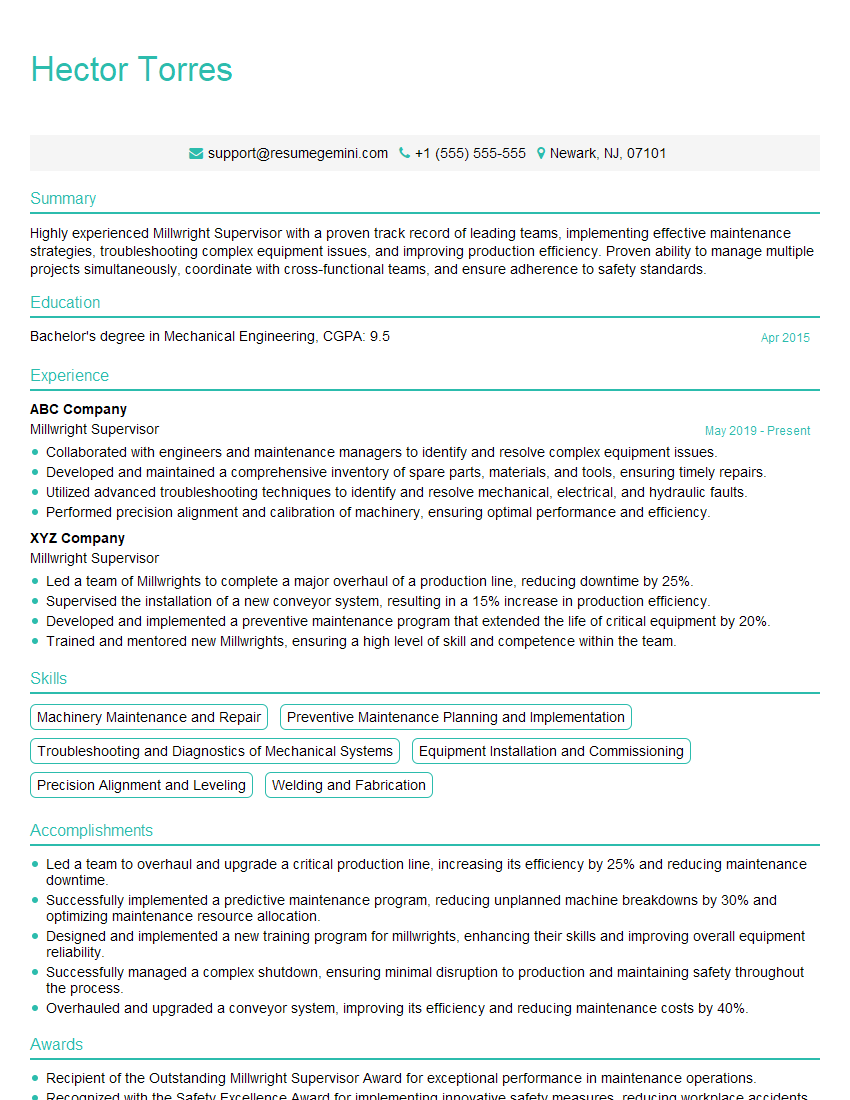
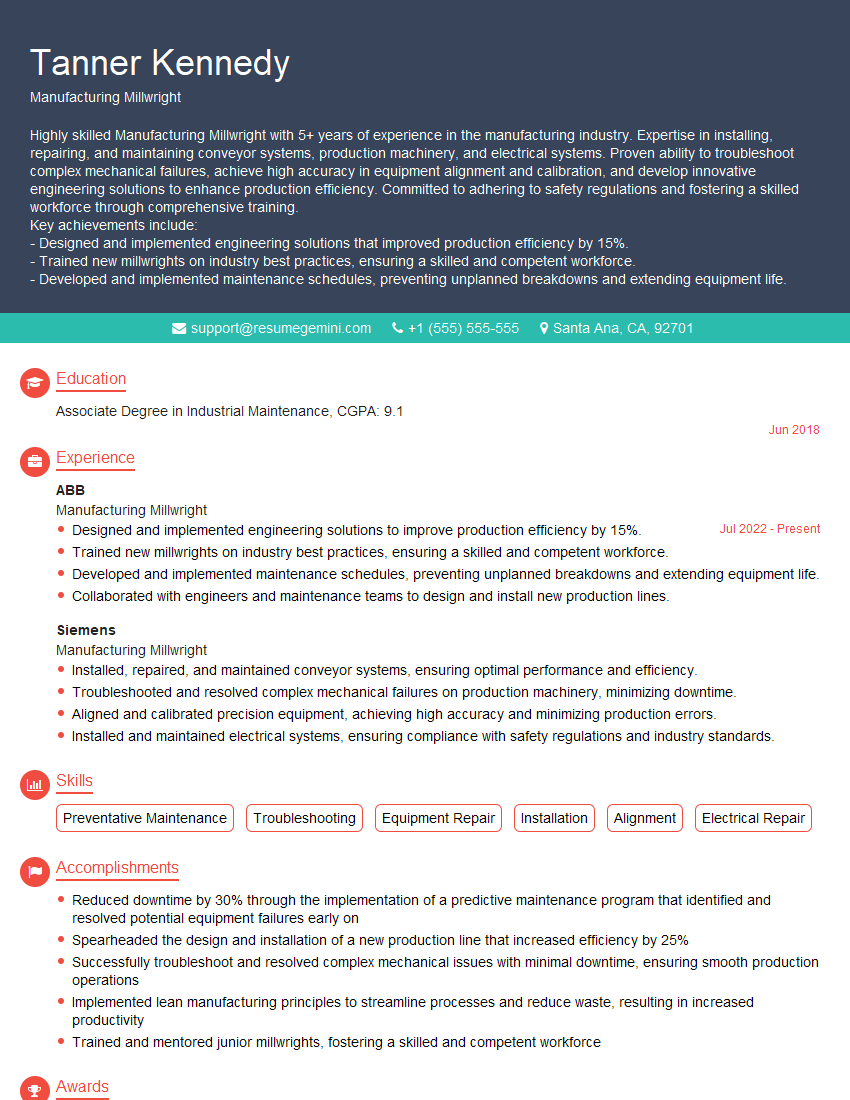
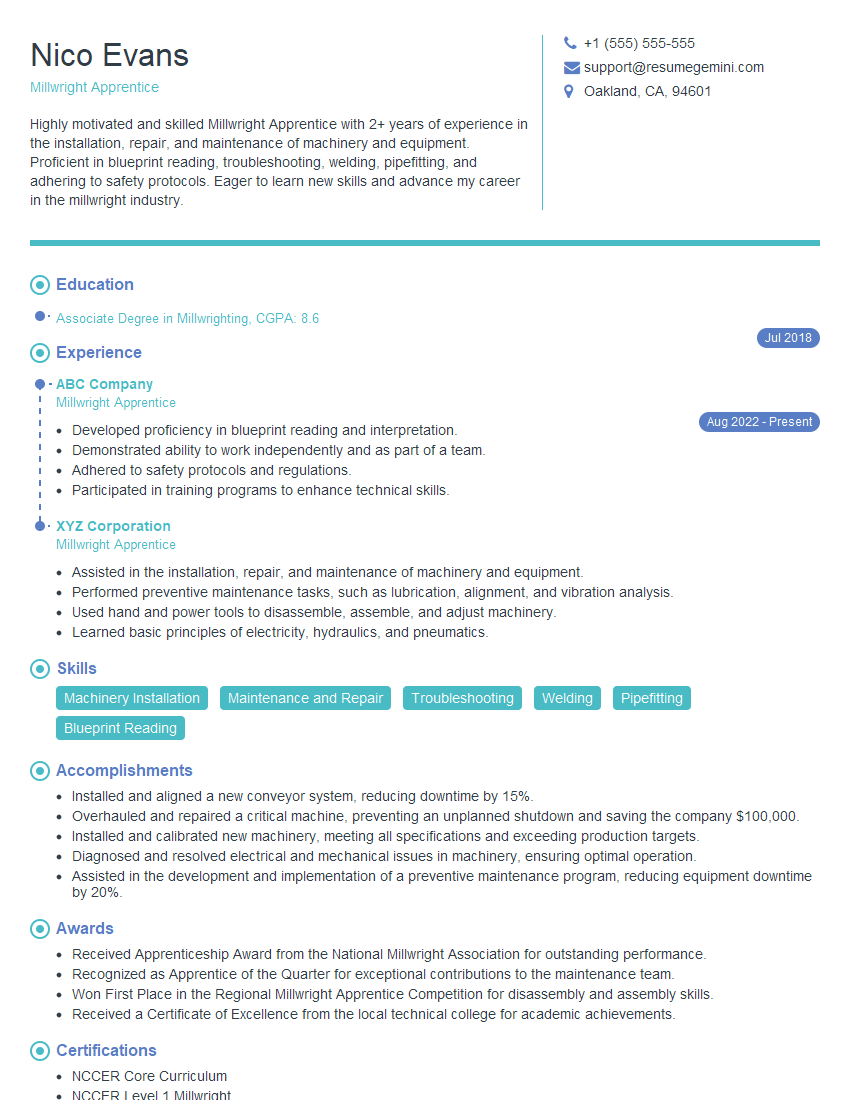
Mastering Millwright Maintenance opens doors to a rewarding career with excellent growth potential. Demand for skilled Millwrights is consistently high, offering opportunities for advancement and specialization. To maximize your chances of landing your dream role, it’s crucial to present yourself effectively. Building an ATS-friendly resume is key to getting your application noticed by recruiters and hiring managers. ResumeGemini is a trusted resource that can help you craft a professional and impactful resume tailored to the Millwright Maintenance field. We provide examples of resumes specifically designed for this industry to help you get started. Take the next step towards your career success today!




Explore more articles
Users Rating of Our Blogs
Share Your Experience
We value your feedback! Please rate our content and share your thoughts (optional).
What Readers Say About Our Blog
To the interviewgemini.com Webmaster.
Very helpful and content specific questions to help prepare me for my interview!
Thank you
To the interviewgemini.com Webmaster.
This was kind of a unique content I found around the specialized skills. Very helpful questions and good detailed answers.
Very Helpful blog, thank you Interviewgemini team.