The thought of an interview can be nerve-wracking, but the right preparation can make all the difference. Explore this comprehensive guide to Vehicle Polishing interview questions and gain the confidence you need to showcase your abilities and secure the role.
Questions Asked in Vehicle Polishing Interview
Q 1. What types of polishing compounds are you familiar with?
Polishing compounds are abrasive materials used to remove imperfections from a vehicle’s paint. They vary in abrasiveness, dictating their use in different stages of the polishing process. I’m familiar with a wide range, including:
- Cutting compounds: These are the most aggressive, designed to remove heavy scratches, swirl marks, and other significant paint imperfections. They contain coarser abrasives.
- Polishing compounds: Less abrasive than cutting compounds, they refine the surface after cutting, removing finer imperfections and leaving a smoother finish. They often contain finer abrasives and polishing agents.
- Glazing compounds: These are the least abrasive, primarily used to enhance gloss and clarity. They contain very fine abrasives or even no abrasives at all, focusing on filling in minor imperfections and improving the overall shine. Think of them as the finishing touch.
- Compound/polish combos: Some manufacturers offer all-in-one products that combine cutting and polishing capabilities in a single compound. These are convenient but often don’t achieve the same level of correction as separate products.
The choice of compound depends entirely on the condition of the paint. Heavily damaged paint requires a cutting compound, followed by polishing and glazing, while lightly scratched paint may only need polishing and glazing.
Q 2. Explain the difference between cutting, polishing, and glazing compounds.
The difference between cutting, polishing, and glazing compounds lies primarily in their abrasiveness and intended purpose. Imagine sanding wood: cutting is like using coarse sandpaper to remove a significant amount of material, polishing is like using medium sandpaper to smooth the surface, and glazing is like using fine sandpaper or a polishing cloth to achieve a mirror-like finish.
- Cutting compounds aggressively remove imperfections, leaving behind a slightly hazy surface. They’re ideal for removing deep scratches, swirl marks, and oxidation.
- Polishing compounds refine the surface left by cutting compounds, removing finer scratches and haze. They leave a smoother, more reflective surface.
- Glazing compounds primarily enhance gloss and clarity, filling in extremely fine imperfections and imparting a deep, wet look. They don’t remove much material.
The process is usually sequential: cutting, then polishing, then glazing, ensuring each step prepares the surface for the next, ultimately achieving a flawless finish.
Q 3. How do you choose the right polishing pad for a specific job?
Choosing the right polishing pad is crucial for achieving optimal results. Pads vary in density, firmness, and material, each impacting the aggressiveness and finish. I select pads based on the compound used and the condition of the paint.
- Cutting pads: These are usually stiffer and more aggressive, made from materials like foam or wool. They’re used with cutting compounds to remove deeper imperfections.
- Polishing pads: These are less aggressive than cutting pads, often softer foam or microfiber. They’re paired with polishing compounds for refinement.
- Glazing pads: These are the softest, often made from microfiber or foam. They’re used with glazing compounds for final shine and clarity.
For example, a heavily swirled car might require a wool pad with cutting compound, followed by a foam pad with polishing compound, and finally a microfiber pad with glazing compound. Choosing the wrong pad can lead to uneven correction, holograms (fine scratches), or insufficient correction.
Q 4. Describe your process for preparing a vehicle for polishing.
Thorough preparation is essential for successful polishing. This involves several key steps:
- Washing: The vehicle must be meticulously washed to remove dirt, grime, and loose contaminants that could scratch the paint during polishing. I use two-bucket method to prevent cross-contamination.
- Decontamination: This step removes embedded contaminants that washing alone can’t address. Techniques include clay barring to remove bonded contaminants and iron remover to dissolve iron particles.
- Drying: The vehicle must be thoroughly dried, ideally with a high-quality microfiber drying towel, to prevent water spots.
- Inspection: A careful inspection under various lighting conditions helps identify the extent of paint damage and guide the choice of compounds and pads. This is where I identify areas needing more attention.
Proper preparation minimizes the risk of introducing further scratches and ensures that the polishing process is effective and efficient.
Q 5. What are the signs of swirl marks and how do you correct them?
Swirl marks, also known as buffer trails, are fine scratches in the paint that appear as spiderweb-like patterns. They’re often caused by improper washing, drying, or previous polishing techniques. You can identify them by looking at the car’s surface under direct sunlight or a bright light. Swirl marks will appear as tiny, circular scratches, reflecting light differently than the surrounding areas.
Correcting swirl marks involves using appropriate polishing compounds and techniques. Typically, I start with a polishing compound and a polishing pad on a dual-action polisher. The goal is to remove the imperfections without removing too much clear coat. This process involves working in small sections and using multiple passes with light pressure. The amount of pressure and the type of compound depends on the depth of the swirl marks; deeper marks might require a cutting compound first, followed by polishing.
Careful observation is crucial during the correction process. Regularly inspect the surface to ensure that the swirls are being removed without creating new defects.
Q 6. How do you handle different paint types (e.g., clear coat, single stage)?
Different paint types require slightly different approaches. Clear coat paints are more forgiving and can generally handle more aggressive polishing, whereas single-stage paints require more care to avoid removing too much paint.
- Clear coat paints: These paints have a separate clear coat layer on top of the base coat, providing more protection and allowing for more aggressive correction. I can use cutting compounds and more aggressive pads without worrying about damaging the base coat.
- Single-stage paints: These paints combine the color and clear coat into one layer. This requires a more gentle approach, using less aggressive compounds and pads. The goal is to correct imperfections while minimizing paint removal.
It is important to assess the paint thickness before starting. I use a paint depth gauge to measure the clear coat thickness and avoid thinning it too much during the polishing process. This is essential for preserving the longevity and quality of the paintwork.
Q 7. What safety precautions do you take while polishing a vehicle?
Safety is paramount during vehicle polishing. My safety precautions include:
- Eye protection: I always wear safety glasses or goggles to protect my eyes from flying debris and polishing compound.
- Respiratory protection: Polishing compounds can produce dust and fumes; a respirator helps prevent inhalation of these particles.
- Gloves: Gloves protect my hands from chemicals and abrasives in the polishing compounds.
- Proper ventilation: Working in a well-ventilated area reduces exposure to fumes and dust.
- Machine operation: I always use dual-action polishers according to the manufacturer’s instructions, avoiding excessive pressure to prevent damage to the paint or the machine.
- Proper disposal: I dispose of used polishing compounds and materials responsibly, according to local regulations.
Following these precautions ensures both my safety and the integrity of the vehicle’s paintwork.
Q 8. How do you assess the condition of a vehicle’s paint before polishing?
Assessing a vehicle’s paint condition before polishing is crucial for determining the appropriate process and products. I begin with a thorough visual inspection under good lighting, looking for:
- Swirl marks: These fine scratches appear as circular patterns and are common from improper washing techniques.
- Scratches: These range from light surface scratches to deep gouges, requiring different correction methods.
- Water spots: Hard water deposits etched into the clear coat.
- Oxidization: A dulling of the paint due to UV exposure.
- Clear coat damage: Chips, peeling, or other significant damage.
After visual inspection, I use a paint thickness gauge to measure the clear coat’s remaining thickness, ensuring I don’t remove too much during polishing. This helps prevent damage to the base coat. Finally, I’ll perform a test spot on an inconspicuous area to assess the paint’s response to different polishing compounds.
Q 9. What are the common causes of paint defects?
Paint defects arise from various sources. Common causes include:
- Improper washing techniques: Using abrasive sponges, brushes, or dirty wash mitts can cause swirl marks and scratches.
- Environmental factors: Acid rain, bird droppings, and UV exposure can cause etching, fading, and oxidation.
- Accidents and collisions: Scratches, chips, and dents are common outcomes of minor impacts.
- UV degradation: Over time, sunlight breaks down the clear coat, leading to dullness and fading.
- Industrial fallout: Airborne pollutants can settle on the paint, causing etching and discoloration.
Understanding these causes helps prevent future damage and inform the polishing strategy. For instance, if oxidation is the primary issue, we focus on a restoration polish. If swirl marks are prevalent, a more aggressive cut followed by a finishing polish is often needed.
Q 10. Explain your experience with rotary and dual-action polishers.
I’m proficient with both rotary and dual-action (DA) polishers. Rotary polishers offer more aggressive cutting power, ideal for removing deeper scratches and defects. However, they require significant skill and precision to avoid burn-through. I typically use them on areas requiring substantial correction, working in small sections and constantly monitoring the temperature and paint surface.
Dual-action polishers are safer and easier to use, perfect for light correction and maintaining a polished finish. Their random orbital action minimizes the risk of buffer burn. I use DA polishers for most jobs, especially on delicate paint finishes. The choice between them is dictated by the severity of the paint defects and my confidence in handling the specific polisher.
Q 11. What is your preferred method for polishing hard-to-reach areas?
For hard-to-reach areas like door jambs, tight curves, and around emblems, I use a combination of techniques. Smaller DA polishers with backing plates are essential. I may even use hand-polishing techniques with microfiber applicators and appropriate compounds for precise control. In some cases, foam polishing pads can be cut to conform to smaller surfaces. The key is patience and precision to avoid damaging the surrounding areas. This requires attention to detail to achieve a uniform finish across the entire vehicle.
Q 12. How do you maintain the longevity of a polished finish?
Maintaining a polished finish involves regular cleaning and protection. I recommend using a high-quality car wash soap and a microfiber wash mitt to avoid introducing new scratches. Following a thorough wash, applying a sealant or wax helps protect the paint from UV damage and environmental contaminants, extending the life of the polish. Regular waxing (every 2-3 months) is critical. Additionally, parking in shaded areas and avoiding harsh chemicals contributes to the long-term preservation of the finish.
Q 13. Describe your experience with different types of polishing machines.
My experience encompasses various polishing machines, including rotary polishers (e.g., Griot’s Garage Rotary Polisher), dual-action polishers (e.g., Rupes BigFoot polisher), and even some smaller, cordless polishers for detail work. Each machine possesses unique characteristics influencing its application. Rotary polishers are powerful but require skill; DA polishers are safer and easier to use but may take longer for heavy correction; cordless options are convenient for spot repairs and smaller projects. The selection depends on the project’s scale and the level of correction needed. I choose the tool best suited for the task and my client’s expectations.
Q 14. What are the signs of buffer burn and how to avoid it?
Buffer burn, also known as burn-through, is a serious paint defect characterized by hazy, dull spots or even discoloration resulting from excessive heat and pressure during polishing. Signs include dull patches, uneven gloss, and sometimes, even a slightly melted or discolored paint surface. It’s crucial to avoid it!
To prevent buffer burn:
- Use the right polisher: DA polishers are far safer than rotaries.
- Work in small sections: Overlapping sections prevent concentrating heat in one area.
- Apply light pressure: Let the machine do the work.
- Use quality compounds: Choose appropriate compounds for the task – avoid overly aggressive compounds unless absolutely necessary.
- Monitor temperature: Periodically check the paint’s temperature by touching it gently (it should not feel excessively hot).
- Use the correct technique: Maintain consistent speed and overlap sections.
Preventing buffer burn requires a combination of proper technique, tools, and respect for the paint’s integrity. A little extra care here pays huge dividends!
Q 15. What is your process for removing water spots and other minor imperfections?
Removing water spots and minor imperfections involves a multi-step process focusing on gentle abrasion and careful polishing. It’s crucial to avoid aggressive techniques that could damage the clear coat. My process begins with a thorough wash using a high-quality car wash soap and two-bucket method to minimize swirl marks. Next, I assess the severity of the imperfections. For minor water spots, a dedicated water spot remover is often sufficient. This is typically applied, allowed to dwell for a short period, and then carefully rinsed. For slightly more stubborn imperfections, a light polishing compound with a soft foam pad and a dual-action polisher is employed. The key is using low pressure and slow speeds to avoid burning through the clear coat. I finish with a high-quality detailing spray for added shine and protection. I always test in an inconspicuous area before applying any product to the entire vehicle. For example, I might find a small, hidden section of the bumper to test my chosen compound and pad combination before proceeding.
Career Expert Tips:
- Ace those interviews! Prepare effectively by reviewing the Top 50 Most Common Interview Questions on ResumeGemini.
- Navigate your job search with confidence! Explore a wide range of Career Tips on ResumeGemini. Learn about common challenges and recommendations to overcome them.
- Craft the perfect resume! Master the Art of Resume Writing with ResumeGemini’s guide. Showcase your unique qualifications and achievements effectively.
- Don’t miss out on holiday savings! Build your dream resume with ResumeGemini’s ATS optimized templates.
Q 16. How do you handle challenging paint conditions, such as severe scratches?
Severe scratches require a more aggressive approach but still necessitate caution to avoid irreversible damage. I begin by carefully assessing the scratch depth. Shallow scratches, often referred to as ‘clear coat scratches’, can often be removed with polishing compounds and a dual-action polisher. For deeper scratches that penetrate beyond the clear coat, more advanced techniques might be needed. This could involve wet sanding using progressively finer grit sandpaper (starting with something like 2000 grit and working up to 3000 or even higher), followed by polishing and compounding to level out the sanded area and blend it seamlessly with the surrounding paint. This step requires extreme precision and skill, as improper sanding can leave the paint uneven or even damage it further. In cases of severe damage extending to the base coat, professional paint repair might be necessary and I would honestly advise the customer towards this solution. One time, I had a customer with deep scratches on their classic car. It took hours of careful wet sanding and polishing, but we successfully restored the shine, preserving the originality of the vehicle. It was incredibly rewarding to see the results and the happy look on the customer’s face.
Q 17. What are your techniques for achieving a high-gloss finish?
Achieving a high-gloss finish is the culmination of a meticulous process. It starts with proper paint preparation, including a thorough wash, decontamination, and clay bar treatment to remove embedded contaminants. Next, I use multiple stages of polishing, starting with coarser compounds to remove imperfections and gradually moving to finer compounds and polishes to refine the surface and enhance its reflectivity. The choice of polishing pad plays a critical role. For instance, cutting pads are effective for removing heavier imperfections, while polishing pads enhance gloss. I always finish with a high-quality sealant or wax to add a protective layer and maximize the depth and brilliance of the shine. Using a proper technique with the polishing machine is also critical. Too much pressure or improper speed control will result in uneven results or even damage the paint surface. The final step always includes a thorough inspection under various lighting conditions to ensure an even, flawless finish.
Q 18. Describe your experience with ceramic coatings and sealants.
I have extensive experience with ceramic coatings and sealants, understanding their respective benefits and applications. Sealants are typically easier to apply and remove, offering shorter-term protection, often lasting a few months. Ceramic coatings, however, provide significantly longer-lasting protection (sometimes years) and offer enhanced gloss and hydrophobic properties. The application of ceramic coatings requires a more meticulous process, ensuring the surface is perfectly clean and free of any contaminants. The coating is applied in thin, even layers, typically cured using a specific curing time and temperature. My experience involves working with various brands and types of ceramic coatings, selecting the most suitable option based on the customer’s budget and vehicle type. I’ve found that educating customers on the differences between sealants and ceramic coatings is crucial. It helps them make informed decisions about the protection they want for their vehicle.
Q 19. How do you maintain your polishing equipment?
Maintaining my polishing equipment is crucial for ensuring consistent results and prolonging their lifespan. After each use, I thoroughly clean all pads and polishing tools using a dedicated cleaner and brush. This removes any residual compound or polish, preventing build-up and cross-contamination. The polishing machine itself is cleaned with a soft cloth and compressed air to remove any dust or debris. I regularly check the machine’s functionality, making sure that the backing plates are secure and that the machine operates smoothly. Proper maintenance also includes lubrication of moving parts as needed. I store my equipment in a clean, dry place, protecting it from dust and moisture. Neglecting equipment maintenance can lead to premature wear and tear, compromising the quality of my work and potentially costing me more money in the long run.
Q 20. What is your experience with paint correction techniques?
Paint correction is a specialized area involving advanced techniques to remove imperfections like swirl marks, scratches, and holograms. My approach to paint correction involves a thorough assessment of the vehicle’s paint condition to determine the necessary steps. I use a combination of compounding, polishing, and refining techniques with appropriate pads and compounds. This requires precision and skill to remove imperfections without causing further damage. I also utilize tools like paint depth gauges to monitor the amount of clear coat being removed. Paint correction is not simply a cosmetic procedure. It’s a crucial step in enhancing the appearance of a vehicle and preparing it for a long-lasting protective layer like a sealant or ceramic coating. I once corrected the paint on a black car that was covered in swirl marks. The transformation was dramatic, going from a dull appearance to a deep, mirror-like shine. The customer was incredibly pleased with the results.
Q 21. How do you deal with customer concerns or dissatisfaction?
Addressing customer concerns or dissatisfaction is a critical aspect of my work. My approach focuses on open communication and proactive problem-solving. I encourage customers to voice their concerns immediately so I can understand their issues fully. I then thoroughly assess the situation, analyzing the work performed and identifying potential sources of dissatisfaction. My goal is to find a mutually acceptable solution, whether it involves reworking a portion of the job or discussing possible alternative approaches. Transparency and honesty are key. If there’s an unforeseen issue or limitation, I’ll openly communicate that with the customer. Sometimes, a simple apology and clear explanation can go a long way in resolving a conflict. I aim to exceed customer expectations, establishing trust and ensuring their overall satisfaction. Building a strong reputation relies on my ability to handle customer feedback constructively.
Q 22. What are some common mistakes to avoid when polishing?
Avoiding mistakes in polishing is crucial for achieving a flawless finish. Common errors include using too much pressure, which can lead to swirl marks and holograms; using the wrong type of pad or compound for the paint’s condition, resulting in uneven correction; and not properly cleaning the surface before polishing, leaving behind contaminants that can scratch the paint. Another frequent mistake is neglecting to work in overlapping sections, leading to inconsistent results. Finally, rushing the process can lead to incomplete correction and a less-than-perfect shine.
- Too much pressure: Imagine rubbing a delicate fabric too hard – you’ll damage it! Gentle, even pressure is key.
- Wrong pad/compound: Think of it like using the wrong tool for the job. A heavy-cut compound on delicate clear coat will cause damage.
- Improper cleaning: Contaminants act like sandpaper, scratching the surface during polishing.
- Non-overlapping sections: This results in visible lines and an uneven finish, like painting a wall without blending strokes.
- Rushing the process: Patience is vital. Taking your time allows for proper correction and avoids mistakes.
Q 23. Explain your understanding of paint depth and its importance in polishing.
Paint depth refers to the thickness of the clear coat layer on a vehicle’s paint. It’s crucial in polishing because it dictates how aggressively you can correct imperfections without damaging the underlying base coat. A thinner clear coat requires more delicate techniques and less abrasive compounds to avoid cutting through to the base coat. Knowing the paint depth helps prevent irreversible damage and ensures the longevity of the paint job. You can measure paint depth using a paint depth gauge, a tool that uses a magnetic or ultrasonic sensor to determine the clear coat’s thickness.
For instance, an older car might have a thinner clear coat due to years of weathering and potential previous repairs. In such cases, light polishing with fine compounds and soft pads would be necessary. Conversely, a newer vehicle with a thicker clear coat may allow for more aggressive correction using heavier compounds.
Q 24. How do you determine the correct level of polishing needed for a vehicle?
Determining the necessary level of polishing depends on a thorough assessment of the vehicle’s condition. I start by carefully inspecting the paint for defects such as scratches, swirl marks, holograms, and oxidation. The severity and extent of these imperfections will determine the approach. A simple wash and wax might suffice for a car with minor imperfections, while heavily damaged paint may require multiple stages of polishing, starting with aggressive compounds and progressing to finer ones.
I’ll use a test spot to experiment with different compounds and pads before applying them to the entire vehicle. This minimizes the risk of causing damage and helps in selecting the most appropriate technique. The overall goal is to achieve a balance between paint correction and preserving as much clear coat as possible.
Q 25. What are your experience with different types of waxes and sealants?
My experience encompasses a wide range of waxes and sealants, each with its unique properties and applications. I regularly work with carnauba waxes, known for their deep gloss and natural shine. Synthetic sealants offer longer-lasting protection and enhanced durability, often resisting environmental contaminants better than carnauba. In addition, I’m familiar with ceramic coatings, which provide an exceptional level of protection, often lasting for years, and requiring less frequent maintenance.
The choice of wax or sealant depends on client preferences, budget, and the desired level of protection. For example, a client seeking a show-car-level shine might prefer a premium carnauba wax, while a client prioritizing durability and ease of maintenance might opt for a high-quality synthetic sealant or a ceramic coating.
Q 26. How do you manage your time and workflow when detailing multiple vehicles?
Efficient time and workflow management is key when detailing multiple vehicles. I utilize a structured approach, starting with a thorough assessment of each vehicle to determine the necessary steps. I then create a detailed schedule, prioritizing vehicles based on their condition and the client’s requirements. I work in sections, completing one vehicle’s polishing before moving to the next, ensuring a consistent level of quality.
I also employ time-saving techniques such as using multiple polishing machines and having an assistant to help with preparation and cleanup. This minimizes downtime and maximizes productivity. Finally, clear communication with clients about estimated completion times helps manage expectations and avoid potential delays.
Q 27. Describe a time you had to solve a challenging polishing problem.
I once encountered a challenging polishing problem involving a classic car with severely oxidized and faded paint. The oxidation was so deep that it had etched into the clear coat, creating a dull, uneven surface. Initial attempts with standard polishing compounds proved insufficient. I had to employ a multi-step approach, starting with a heavy-cut compound using a rotary polisher to remove the deepest oxidation. This was followed by several stages of progressively finer compounds and pads to refine the surface and eliminate swirl marks.
Finally, I applied multiple layers of high-quality carnauba wax to restore the paint’s luster and protect it from further damage. The final result was a dramatic improvement, restoring the classic car’s original shine, demonstrating persistence and mastery of various techniques are essential to handling complex problems.
Q 28. What are your salary expectations?
My salary expectations are commensurate with my experience and expertise in vehicle polishing. Considering my extensive knowledge, proven ability to handle complex projects, and commitment to delivering exceptional results, I’m seeking a competitive salary in the range of [Insert Salary Range Here]. I’m confident that my skills and dedication would be a valuable asset to your team.
Key Topics to Learn for Your Vehicle Polishing Interview
- Understanding Paint Types and Finishes: Learn to identify different paint types (e.g., single-stage, clear coat) and their unique polishing requirements. This includes understanding the impact of clear coat thickness on polishing techniques.
- Polishing Techniques and Methods: Master various polishing techniques, including rotary and dual-action polishing, and understand when to apply each method for optimal results. Consider the practical application of different pad types and compounds.
- Defect Removal and Correction: Understand how to identify and correct common paint defects such as swirls, scratches, and holograms. This includes choosing the appropriate tools and products for different levels of correction.
- Product Knowledge and Selection: Familiarize yourself with various polishing compounds, polishes, and sealants. Learn how to choose the right products based on the paint type, defect level, and desired outcome. This includes understanding the abrasive properties of different compounds.
- Machine Operation and Safety: Demonstrate a strong understanding of proper machine operation, including speed control, pressure management, and safety precautions. This includes knowing how to avoid potential damage to the vehicle’s paint.
- Maintaining a Clean and Organized Workspace: Explain your approach to maintaining a professional and efficient workspace. This demonstrates organizational skills and attention to detail.
- Customer Interaction and Communication: Practice explaining different polishing processes and addressing client concerns effectively. This shows your ability to build rapport and deliver excellent customer service.
- Troubleshooting and Problem-Solving: Be prepared to discuss instances where you encountered unexpected issues during polishing and how you successfully resolved them. This highlights your problem-solving skills.
Next Steps: Unlock Your Career Potential
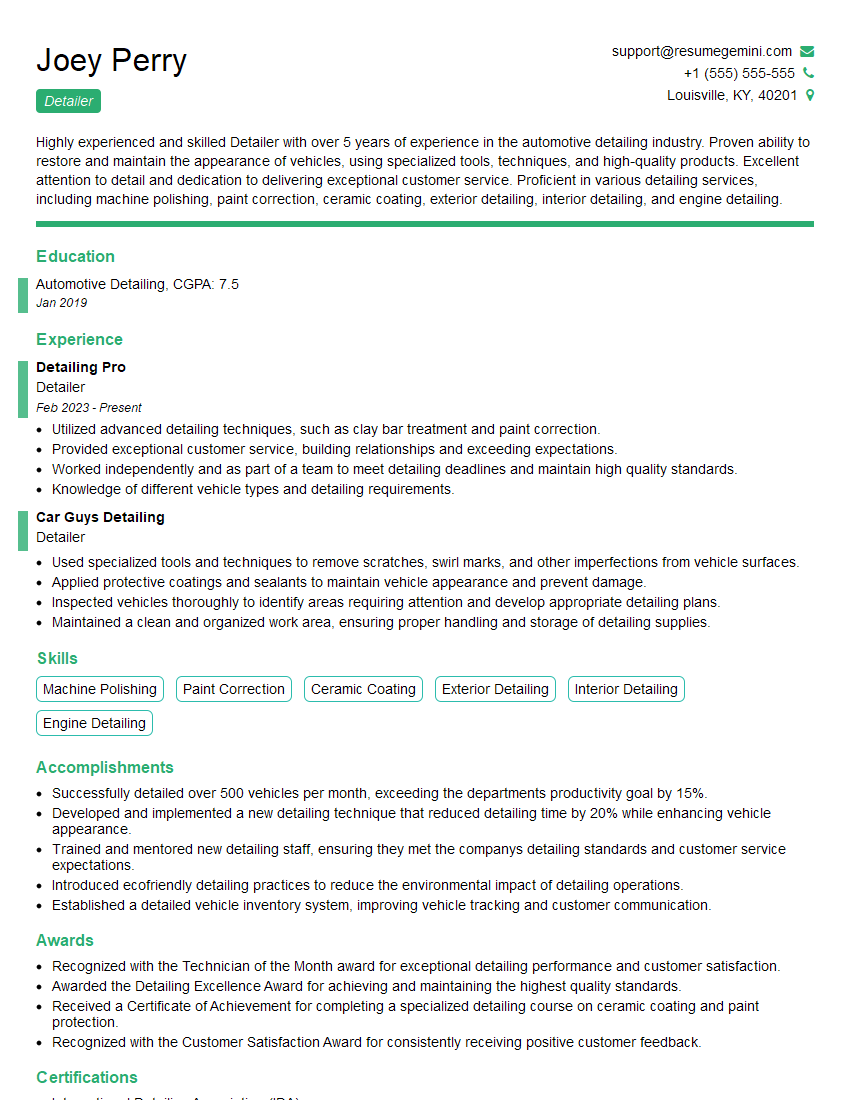
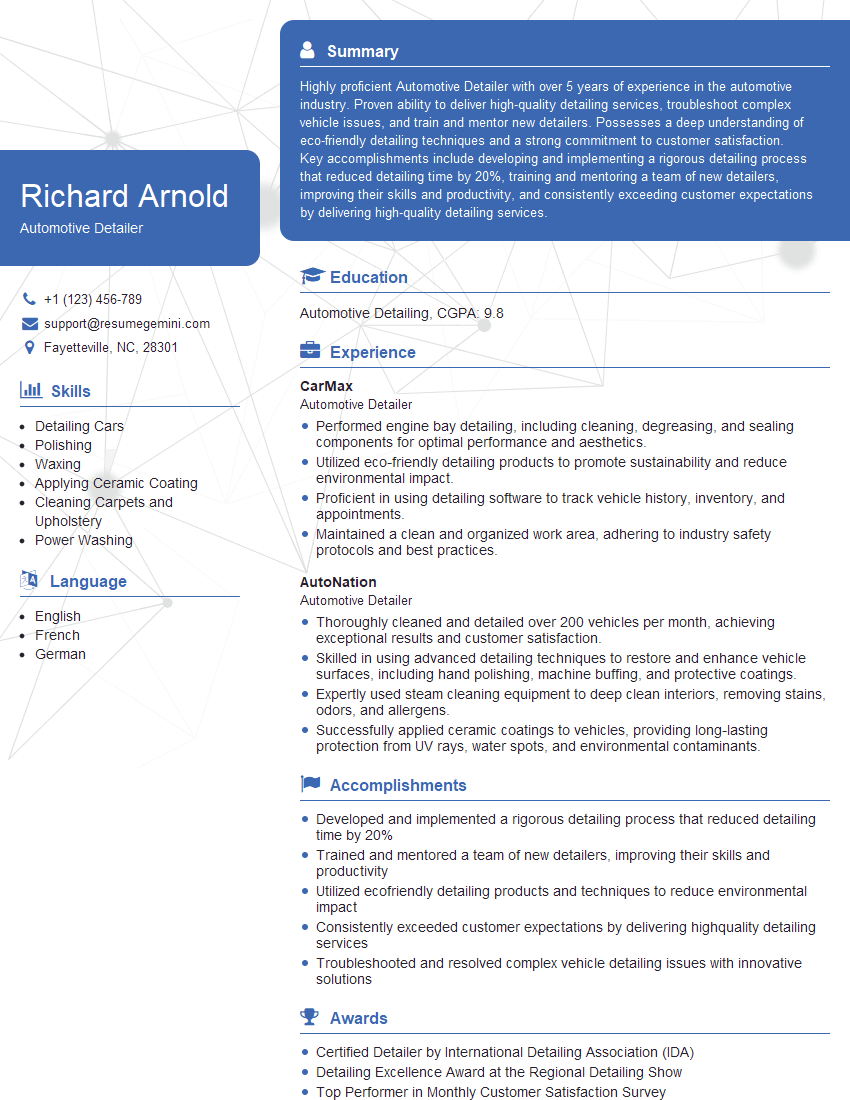
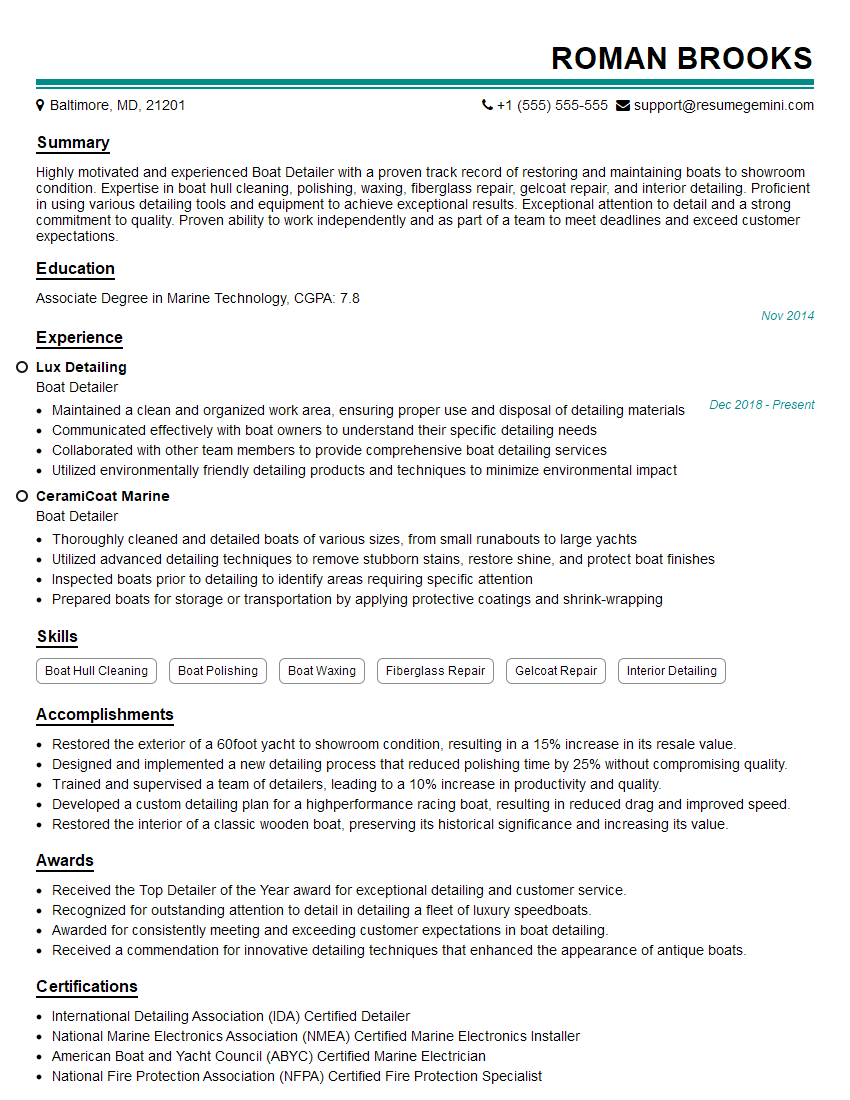
Mastering vehicle polishing opens doors to exciting career opportunities in the automotive detailing industry. To maximize your job prospects, create a compelling and ATS-friendly resume that highlights your skills and experience. ResumeGemini is a trusted resource that can help you build a professional resume that stands out. They provide examples of resumes tailored to the vehicle polishing field, ensuring your application makes a lasting impression. Invest in your future—craft a resume that showcases your expertise and lands you your dream job.

Explore more articles
Users Rating of Our Blogs
Share Your Experience
We value your feedback! Please rate our content and share your thoughts (optional).
What Readers Say About Our Blog
To the interviewgemini.com Webmaster.
Very helpful and content specific questions to help prepare me for my interview!
Thank you
To the interviewgemini.com Webmaster.
This was kind of a unique content I found around the specialized skills. Very helpful questions and good detailed answers.
Very Helpful blog, thank you Interviewgemini team.