Preparation is the key to success in any interview. In this post, we’ll explore crucial Experience in wildlife habitat assessment and monitoring interview questions and equip you with strategies to craft impactful answers. Whether you’re a beginner or a pro, these tips will elevate your preparation.
Questions Asked in Experience in wildlife habitat assessment and monitoring Interview
Q 1. Describe your experience with different wildlife habitat assessment methodologies.
Wildlife habitat assessment employs diverse methodologies, each with strengths and limitations. I’ve extensive experience with several key approaches:
- Transect surveys: These involve systematically walking or driving predetermined lines, recording observations of species presence and habitat features. This is useful for assessing species distribution and abundance, especially for readily visible species. For example, I used transects to assess the distribution of nesting raptors in a grassland ecosystem, noting vegetation height, nest tree species, and proximity to human activity.
- Quadrat sampling: This method involves establishing square plots (quadrats) of a fixed size to quantify vegetation characteristics and species richness within a defined area. I’ve used this technique in forest ecosystems, measuring tree density, species composition, and understory vegetation cover to assess habitat suitability for various forest mammals.
- Remote sensing and GIS: Analyzing satellite imagery and aerial photographs allows for large-scale habitat mapping and assessment of landscape-level features, such as forest fragmentation and habitat connectivity. This is particularly valuable for large study areas where ground-based methods are impractical. I’ll elaborate on this further in response to question 3.
- Camera trapping: This non-invasive technique uses motion-triggered cameras to detect and record wildlife presence, providing valuable data on species richness, abundance, and activity patterns, especially for elusive or nocturnal animals. In a recent project focusing on small mammal diversity in a fragmented forest, camera trapping was instrumental in identifying key species and assessing habitat use.
- Mark-recapture studies: These population estimation techniques are vital in monitoring population dynamics and habitat use of specific species. I’ll further elaborate on this in my response to question 6.
The choice of method depends on the research question, the species of interest, available resources, and the characteristics of the study area. Often, a combination of methods offers the most comprehensive assessment.
Q 2. How do you determine the appropriate sampling design for a wildlife habitat assessment?
Selecting the appropriate sampling design is critical for obtaining reliable and representative data in wildlife habitat assessment. It depends on several factors:
- Study objectives: What specific questions are you trying to answer? Are you interested in species richness, abundance, distribution, or habitat quality?
- Species characteristics: Are the target species mobile or sedentary? Are they easily observable, or are they elusive? This dictates the appropriate survey methods (transects, quadrats, camera trapping, etc.).
- Habitat characteristics: Is the habitat homogeneous or heterogeneous? A heterogeneous habitat may require a stratified sampling design, dividing the area into strata based on key habitat characteristics and sampling each stratum independently. This ensures representation of all habitat types.
- Resources: Time, funding, and personnel limitations directly influence the complexity and scale of the sampling design.
- Statistical power: The sample size needs to be sufficiently large to achieve the desired level of statistical power, allowing for robust conclusions. Sample size calculations are crucial to ensure that the results are reliable.
For instance, assessing bird diversity in a fragmented forest might require a stratified random sampling design, with strata representing different forest types (e.g., mature forest, young forest, edge habitat). In contrast, a study on the abundance of a large, easily observable mammal might employ a systematic transect design.
Q 3. Explain your experience with GIS software in habitat mapping and analysis.
GIS software is indispensable in habitat mapping and analysis. I have extensive experience using ArcGIS and QGIS. My work routinely involves:
- Habitat mapping: I utilize remote sensing data (satellite imagery, aerial photographs) to classify different habitat types based on spectral signatures. This often involves supervised or unsupervised classification techniques. For example, I used Landsat imagery to map different forest types based on differences in vegetation density and canopy cover.
- Spatial analysis: GIS allows for sophisticated spatial analysis to quantify habitat fragmentation, calculate habitat patch sizes, and measure distances between habitat patches. This is crucial for assessing the connectivity of habitats and predicting wildlife movement.
- Overlay analysis: GIS enables combining different datasets, such as habitat maps, elevation data, and species distribution data, to identify areas of high habitat suitability or areas of conflict between wildlife and human activities.
- Data visualization: Creating maps and graphs using GIS facilitates communication of results to stakeholders and decision-makers.
For example, in a project assessing the impact of road development on wildlife movement, I used GIS to map road networks, habitat patches, and wildlife corridors. The analysis revealed areas of high habitat fragmentation and identified potential mitigation strategies.
Q 4. What are the key indicators of habitat quality for a specific species (e.g., nesting birds, mammals)?
Key indicators of habitat quality vary considerably depending on the species. For nesting birds, these might include:
- Nest site availability: Abundance and quality of suitable nesting sites (e.g., tree cavities, shrubs, ground cover).
- Food availability: Abundance and diversity of suitable food sources (insects, seeds, fruits).
- Predator protection: Presence of protective vegetation or other features that reduce predation risk.
- Nest success rate: Proportion of nests that successfully fledge young.
For mammals, key indicators might include:
- Food resources: Abundance and quality of preferred food plants or prey animals.
- Shelter availability: Presence of suitable dens, burrows, or other forms of shelter.
- Water sources: Proximity to reliable water sources.
- Home range size: Area required for an individual or a social group to meet their needs.
Understanding the specific requirements of the target species is crucial for determining habitat quality. For example, a forest-dwelling mammal might require a minimum amount of undisturbed forest cover, while a grassland bird might need a specific mix of grasses and forbs.
Q 5. How do you interpret vegetation indices derived from remote sensing data in a habitat context?
Vegetation indices derived from remote sensing data, such as the Normalized Difference Vegetation Index (NDVI), provide valuable information about vegetation health and productivity. In a habitat context, these indices can be interpreted as indicators of habitat quality:
- Higher NDVI values generally indicate more vigorous vegetation, suggesting higher primary productivity, which can translate to better food availability for herbivores. This might indicate high-quality grazing habitat.
- Lower NDVI values may reflect poor vegetation health, suggesting areas of low productivity, potential degradation, or disturbance. For example, low NDVI might indicate areas impacted by deforestation or drought, affecting habitat quality negatively.
- Spatial patterns in NDVI can reveal habitat heterogeneity, identifying areas of high and low productivity. This is useful for understanding habitat patchiness and its implications for wildlife.
It’s important to consider the limitations of vegetation indices. NDVI is sensitive to environmental factors like soil moisture and atmospheric conditions, and it doesn’t directly measure all aspects of habitat quality relevant to wildlife. Combining NDVI with other data sources (e.g., field surveys, species distribution data) enhances the interpretation and provides a more comprehensive assessment.
Q 6. Describe your experience with population estimation techniques for wildlife.
Population estimation techniques are crucial for monitoring wildlife populations and assessing habitat quality. My experience includes various methods:
- Mark-recapture: This involves capturing, marking, and releasing a sample of animals, followed by subsequent recapture events to estimate population size. Different models are used depending on the assumptions made about capture probability and survival rates. I’ve used this technique to estimate the population size of small mammals in a variety of habitats.
- Line transect sampling: Observing animals along predetermined transects, accounting for detection probability, enables estimation of abundance. This is useful for larger, more easily observable animals, allowing for better distance measurements and improved accuracy.
- Distance sampling: This method involves estimating the abundance of animals by recording the distance to animals encountered along transects, incorporating detectability functions to account for imperfect detection. This is a widely used technique for a variety of species.
- N-mixture models: These statistical models use data from multiple surveys (e.g., repeated counts, camera trap data) to separate the effects of detectability and abundance. This is particularly useful when detection probability is variable.
The best method depends on the species, the study design, and available resources. I often employ multiple methods and integrate the results to provide the most reliable estimates.
Q 7. How do you assess the impact of habitat fragmentation on wildlife populations?
Habitat fragmentation negatively impacts wildlife populations in several ways, reducing habitat area, increasing edge effects, isolating populations, and hindering movement. I assess these impacts using several approaches:
- Landscape metrics: Using GIS, I calculate landscape metrics (e.g., patch size, edge density, shape index, connectivity) to quantify fragmentation levels and their potential effects on wildlife movement, gene flow, and overall population viability.
- Species distribution modeling: This involves predicting species distributions based on environmental variables (e.g., habitat type, distance to roads) and then comparing predicted distributions under different fragmentation scenarios. This helps understand how fragmentation might affect the distribution and abundance of species in the future.
- Population viability analysis (PVA): Using demographic data (e.g., survival rates, birth rates) and landscape connectivity data, PVA can predict the probability of a population persisting over time under different fragmentation scenarios. This is a crucial tool for conservation planning.
- Field observations: I use field surveys (e.g., camera trapping, transect surveys) to directly assess the effects of fragmentation on wildlife behavior (e.g., reduced movement, increased risk of road mortality). Combining this with spatial data provides a clear picture of the impacts.
For example, in a study assessing the impact of deforestation on a primate population, I used landscape metrics to quantify the degree of fragmentation, species distribution models to predict the species’ potential distribution following habitat loss and PVA to estimate the probability of population persistence under different levels of habitat loss. This provided critical data for conservation strategies focused on preserving connectivity and habitat quality.
Q 8. What are the common threats to wildlife habitats and how can they be mitigated?
Wildlife habitats face numerous threats, broadly categorized as habitat loss and degradation, climate change, invasive species, pollution, and human-wildlife conflict. Let’s examine each:
- Habitat Loss and Degradation: This is the biggest threat, driven by deforestation, urbanization, agriculture, and infrastructure development. It fragments habitats, reducing the area available for wildlife and hindering their movement. Mitigation involves habitat protection through designated reserves and protected areas, sustainable land management practices, and promoting responsible urban planning.
- Climate Change: Shifting climate patterns alter species distributions, affect breeding cycles, and increase the frequency and intensity of extreme weather events. Mitigation requires reducing greenhouse gas emissions, implementing climate-resilient conservation strategies, and creating wildlife corridors to facilitate species migration.
- Invasive Species: Non-native species can outcompete native wildlife for resources, introduce diseases, and alter habitat structure. Mitigation involves early detection and rapid response, control measures like trapping or biological control, and prevention through strict biosecurity measures.
- Pollution: Air, water, and soil pollution can directly harm wildlife and contaminate their food sources. Mitigation necessitates stricter environmental regulations, responsible waste management, and the adoption of sustainable agricultural practices.
- Human-Wildlife Conflict: This arises when human activities encroach upon wildlife habitats, leading to crop raiding, livestock predation, and even human injury or death. Mitigation involves community engagement, conflict mitigation strategies like livestock guarding dogs or crop protection techniques, and promoting co-existence initiatives.
Effective mitigation requires a multi-pronged approach, involving government policies, community participation, scientific research, and international collaboration. For example, in a recent project, we successfully implemented a community-based conservation program that reduced human-elephant conflict by establishing elephant corridors and providing alternative income sources for local communities.
Q 9. Explain your experience with habitat restoration projects.
I’ve been involved in several habitat restoration projects, ranging from wetland restoration to forest regeneration. One particularly impactful project involved restoring a degraded riparian zone along a river. This involved:
- Assessment: We first conducted a thorough assessment of the existing conditions, including vegetation surveys, soil analysis, and water quality testing. This helped us identify the key degradation factors (in this case, erosion and invasive plant species).
- Planning: Based on our assessment, we developed a detailed restoration plan. This included selecting native plant species appropriate for the site, designing erosion control measures (e.g., planting vegetation along the banks), and creating a monitoring plan.
- Implementation: The restoration work involved removing invasive species, re-contouring the banks to reduce erosion, and planting native trees and shrubs. We utilized both native seed sowing and planting of saplings.
- Monitoring: Post-implementation, we monitored the site regularly to assess the success of the restoration efforts. This involved tracking plant growth, measuring soil erosion, and monitoring water quality. This data informed adaptive management decisions, allowing us to adjust our approach as needed.
The project resulted in a significant increase in native vegetation cover, improved water quality, and the return of several key wildlife species. This demonstrates the importance of a scientifically sound and community-engaged approach to habitat restoration.
Q 10. How do you prioritize habitat restoration efforts?
Prioritizing habitat restoration efforts requires a systematic approach. I typically use a framework that considers ecological importance, feasibility, and cost-effectiveness. Here’s how I prioritize:
- Ecological Importance: I assess the ecological value of the habitat, considering factors such as biodiversity, the presence of endangered species, and the habitat’s role in ecological processes. Habitats supporting endangered species or key ecological functions are prioritized.
- Feasibility: I evaluate the practical aspects of restoration, considering land ownership, stakeholder support, and the availability of resources. Projects with high feasibility, meaning a higher likelihood of success, are given priority.
- Cost-Effectiveness: I analyze the cost-benefit ratio of each restoration project. This involves considering the costs of implementation and monitoring against the potential ecological benefits. Projects with higher returns on investment are favored.
- Cumulative Effects: I also consider the cumulative effect of restoration projects. Prioritizing projects that build upon or synergistically interact with other conservation efforts can enhance overall impact.
For example, I might prioritize restoring a crucial wetland that supports several endangered bird species even if another area requires less financial investment. The ecological return justifies the increased cost in this scenario.
Q 11. Describe your experience with data analysis and reporting in wildlife habitat assessment.
My experience in data analysis and reporting for wildlife habitat assessment involves a range of techniques, from basic descriptive statistics to advanced spatial analysis. I use data collected through various methods including:
- Field Surveys: Collecting data on vegetation cover, species abundance, and habitat characteristics directly in the field using quadrats, transects, and point counts.
- Remote Sensing: Utilizing satellite imagery and aerial photography to assess habitat extent, fragmentation, and changes over time. This includes using software like ArcGIS to analyze satellite data.
- Camera Trapping: Deploying camera traps to monitor wildlife presence, abundance, and activity patterns. Data is analyzed to assess species richness and abundance.
The data is then analyzed using statistical software (as discussed below) to identify patterns, trends, and relationships. The findings are presented in reports and presentations, using graphs, maps, and tables to effectively communicate the results to a diverse audience, including scientists, policymakers, and the public.
Q 12. How do you integrate various data sources (e.g., field observations, remote sensing) in your analysis?
Integrating diverse data sources is crucial for a comprehensive habitat assessment. I employ a multi-step process:
- Data Harmonization: This involves converting data into a common format and spatial reference system. For instance, converting GPS coordinates from field surveys into a geographic coordinate system compatible with remote sensing data.
- Data Cleaning: Errors and outliers are identified and corrected. This may involve removing erroneous data points, interpolating missing values, or using statistical methods to handle outliers.
- Data Fusion: Combining different data sets through various techniques, including overlaying maps (e.g., combining vegetation maps from remote sensing with species distribution maps from field surveys), or creating composite indices representing habitat quality.
- Spatial Analysis: Using GIS software to analyze the spatial patterns and relationships between different data layers. For example, calculating habitat fragmentation indices based on land cover maps and wildlife distribution data.
For example, in a recent project, we integrated field-based vegetation surveys with satellite imagery to assess the impact of a wildfire on habitat quality. The combined data provided a much more accurate and comprehensive picture than either data source alone.
Q 13. What statistical software are you proficient in?
I am proficient in several statistical software packages relevant to wildlife habitat assessment, including:
- R: A powerful and versatile open-source language with extensive libraries for statistical analysis, data visualization, and spatial analysis. I use R for various tasks such as generalized linear models (GLMs), species distribution modeling (SDM), and statistical analysis of camera trap data.
- ArcGIS: A GIS software package widely used for spatial data analysis, mapping, and visualization. I leverage ArcGIS for tasks such as creating habitat maps, analyzing spatial patterns, and overlaying different data layers.
- SPSS: A statistical software package commonly used for descriptive statistics, hypothesis testing, and correlation analysis. I use SPSS for analyzing data from field surveys, such as vegetation cover and species abundance.
The choice of software depends on the specific analysis required and the nature of the data. For instance, R is preferred for complex statistical modeling while ArcGIS is essential for spatial analysis.
Q 14. How do you ensure the accuracy and reliability of your habitat assessment data?
Ensuring accuracy and reliability of habitat assessment data is paramount. I employ several strategies:
- Rigorous Sampling Design: Using statistically sound sampling techniques, such as stratified random sampling, to ensure representative data collection. The sample size is carefully determined to achieve desired levels of precision.
- Quality Control Measures: Implementing quality control procedures during data collection, including double-checking measurements, using standardized protocols, and regularly calibrating equipment.
- Data Validation: Checking data for errors, inconsistencies, and outliers before analysis. This may involve visual inspection of data plots or using statistical methods to detect anomalies.
- Data Auditing: Maintaining detailed records of data collection methods, including metadata about the equipment used, data processing steps, and any modifications made to the data. This ensures data traceability and facilitates replication of the study.
- Peer Review: Subjectivity in data interpretation is minimized through peer review, where other experts can review the methods, analysis, and conclusions.
Transparency in methods and data documentation are key. This allows others to scrutinize the results and increases the overall reliability and credibility of the findings.
Q 15. What are the limitations of different habitat assessment methods?
Habitat assessment methods, while crucial for understanding wildlife needs, have inherent limitations. The accuracy and scope of any method depend on factors like the species being studied, the habitat’s complexity, available resources, and the expertise of the assessors.
Remote Sensing (e.g., satellite imagery, aerial photography): While efficient for large-scale assessments, it can lack the fine-scale detail needed for accurate species-specific habitat characterization. Cloud cover and seasonal variations can also significantly impact data quality. For example, identifying individual burrows of a small mammal using satellite imagery is practically impossible.
Field Surveys (e.g., transect walks, quadrat sampling): These are labor-intensive and can be biased by observer error or limited sampling effort. The accuracy depends heavily on the skill and experience of the surveyor in identifying signs and species. For instance, a less experienced surveyor might misidentify animal tracks, leading to inaccurate data.
Modeling (e.g., Habitat Suitability Index (HSI) models): These rely on data availability and the accuracy of the underlying relationships between environmental variables and species occurrence. Poorly parameterized models can lead to inaccurate predictions of habitat quality. For example, a model lacking key environmental factors might underestimate the suitability of a specific habitat for a particular species.
To overcome these limitations, a combination of methods is often used, leveraging the strengths of each while mitigating their weaknesses. This approach, known as integrated assessment, provides a more robust and comprehensive understanding of the habitat.
Career Expert Tips:
- Ace those interviews! Prepare effectively by reviewing the Top 50 Most Common Interview Questions on ResumeGemini.
- Navigate your job search with confidence! Explore a wide range of Career Tips on ResumeGemini. Learn about common challenges and recommendations to overcome them.
- Craft the perfect resume! Master the Art of Resume Writing with ResumeGemini’s guide. Showcase your unique qualifications and achievements effectively.
- Don’t miss out on holiday savings! Build your dream resume with ResumeGemini’s ATS optimized templates.
Q 16. Describe your experience with environmental regulations related to wildlife habitat.
My experience encompasses working with a variety of environmental regulations, primarily focusing on the Endangered Species Act (ESA) in the US and similar international conventions. I’ve been involved in projects requiring compliance with these regulations, including habitat assessments for federally listed species, development of conservation plans, and environmental impact assessments for projects potentially affecting critical habitats. This includes understanding and applying permitting requirements, such as obtaining an Incidental Take Permit (ITP) under the ESA, which allows for some level of incidental harm to a listed species if stringent mitigation measures are in place. I’ve collaborated with regulatory agencies to ensure compliance and to develop ecologically sound solutions that balance conservation needs with human development. For example, in a recent project, we worked with the Fish and Wildlife Service to design a mitigation strategy for a road construction project that minimized the impact on a sensitive wetland ecosystem crucial for a threatened amphibian species.
Q 17. How do you communicate complex ecological information to non-technical audiences?
Communicating complex ecological information effectively to non-technical audiences requires adapting the language, format, and approach. I use several key strategies:
Analogies and metaphors: I relate ecological concepts to everyday experiences. For instance, I might explain the importance of biodiversity by comparing it to the diversity of ingredients needed for a delicious and nutritious meal.
Visual aids: Graphs, charts, maps, and photographs can effectively convey data and illustrate key findings more easily than lengthy written reports. For example, a map showing habitat fragmentation helps people immediately grasp the issue.
Storytelling: Sharing real-world examples and anecdotes can engage the audience and make the information more relatable and memorable. I might describe a specific case study of successful habitat restoration, bringing to life the impact of the work.
Interactive communication: Instead of one-way presentations, I prefer discussions, Q&A sessions, and workshops to foster understanding and ensure that everyone feels included.
The goal is not to simplify the information to the point of inaccuracy, but rather to translate it into a language that is easily understood and relevant to the audience’s background and interests.
Q 18. How do you manage conflicts of interest related to habitat conservation?
Conflicts of interest in habitat conservation are common, arising from competing land-use demands, economic interests, and differing stakeholder perspectives. My approach involves:
Transparency and open communication: Early identification and clear articulation of all interests and potential conflicts are essential. Facilitating open dialogues among stakeholders creates a space for understanding opposing viewpoints.
Objective data analysis: Using scientific data and evidence-based reasoning allows us to evaluate the potential impacts of different options and support decisions with solid information, helping to move beyond emotional arguments.
Mediation and negotiation: When conflicts arise, I employ negotiation techniques to find common ground and compromise solutions. This might involve helping conflicting parties identify shared values and goals to reach mutually beneficial outcomes.
Ethical decision-making: Prioritizing the ecological integrity of the habitat is paramount. While considering all stakeholders’ interests, I ensure the conservation goals remain central to any decision-making process.
In practice, this might involve mediating between developers and conservation groups to find a compromise that reduces habitat impact while still allowing for development, such as through habitat mitigation and offsetting initiatives.
Q 19. Describe your experience with community engagement in habitat conservation initiatives.
Community engagement is critical for successful habitat conservation initiatives. My experience includes facilitating workshops, public forums, and collaborative planning sessions with local communities, landowners, and indigenous groups. I’ve found that effective engagement requires:
Active listening and respect: Understanding the community’s perspective, concerns, and traditional knowledge is crucial. This approach helps build trust and ensure that the conservation efforts are relevant and acceptable to the local community.
Participatory approaches: Involving communities in the planning and implementation phases empowers them and increases the likelihood of project success. This might involve co-creating conservation plans and monitoring programs.
Education and outreach: Raising awareness about the importance of the habitat and the conservation efforts is vital. I use a variety of educational methods, including workshops, presentations, and printed materials, tailored to different community groups.
Building partnerships: Collaborating with local organizations, schools, and businesses creates a strong network of support and strengthens the community’s involvement in the long term.
For example, in one project, we worked closely with a local indigenous community to develop a habitat management plan that incorporated their traditional ecological knowledge and ensured that the conservation efforts respected their cultural heritage.
Q 20. Explain your knowledge of endangered species acts and regulations.
My understanding of endangered species acts and regulations is extensive, encompassing both national (e.g., the US Endangered Species Act) and international legislation (e.g., CITES). I am knowledgeable about the legal definitions of threatened and endangered species, the criteria for listing species, the process of designating critical habitats, and the requirements for obtaining permits for activities that may affect these species. This includes understanding the complexities of incidental take permits, habitat conservation plans, and the responsibilities of landowners and developers under these regulations. I am also familiar with the enforcement mechanisms and the potential penalties for non-compliance. For example, I have helped organizations navigate the permitting processes for construction projects near endangered species habitats, ensuring compliance with all relevant federal and state regulations.
Q 21. How do you handle unexpected challenges or setbacks during field work?
Fieldwork is inherently unpredictable; challenges are inevitable. My approach to handling unexpected setbacks emphasizes preparedness, adaptability, and problem-solving.
Pre-field planning: Thorough planning, including contingency plans for equipment failures, weather events, and logistical issues, helps mitigate potential problems. We always carry backup equipment and have alternative communication methods.
Adaptability and improvisation: Unexpected challenges necessitate a flexible approach. This may mean adapting sampling methods, modifying the research design, or finding creative solutions to overcome obstacles. For example, encountering a flash flood during a field survey might necessitate altering the sampling design to collect data in safer locations.
Safety protocols: Prioritizing safety is crucial. We adhere to strict safety protocols, including risk assessments, emergency communication plans, and appropriate safety gear, to minimize risk.
Documentation and communication: Meticulous record-keeping and clear communication with colleagues and supervisors ensure that the impact of any setback is minimized and that appropriate adjustments are made.
A strong team dynamic and good problem-solving skills are essential. Unexpected challenges often become valuable learning experiences, enhancing our future preparedness and resilience.
Q 22. Describe your experience with different wildlife monitoring technologies (e.g., camera traps, GPS collars).
My experience spans a wide range of wildlife monitoring technologies. Camera traps, for instance, are invaluable for documenting species presence, abundance, and behavior without causing disturbance. I’ve extensively used them in diverse ecosystems, from tropical rainforests to arid grasslands, deploying them strategically to maximize detection probability, considering factors like animal activity patterns and trail placement. Data analysis typically involves identifying individual animals through unique markings and calculating occupancy rates using appropriate statistical models.
GPS collars provide a different perspective, offering fine-scale data on animal movement, habitat use, and home range size. I’ve worked with GPS collared animals ranging from large mammals like elk and wolves to smaller species, using custom-designed collars that balance data collection frequency with battery life. Analyzing GPS data involves spatial analysis techniques, such as kernel density estimation to map home ranges and resource selection functions to understand habitat preferences.
Beyond these, I’m also proficient with acoustic monitoring (using recorders to detect vocalizations), mark-recapture studies (for population estimation), and even drones for remote surveys, particularly in areas difficult to access on foot.
Q 23. How do you select appropriate monitoring metrics for a given habitat and species?
Selecting appropriate monitoring metrics is crucial for efficient and effective wildlife monitoring. It’s a decision driven by the specific research question, the target species, and the available resources. For example, if the goal is to assess the population size of a threatened bird species, we might use metrics like density (individuals per unit area), abundance (total number of individuals), or occupancy (proportion of suitable habitats occupied).
For a species with a wide-ranging home range, like a large carnivore, GPS collar data and analysis of its movement patterns are more pertinent. Metrics like home range size, habitat use, and movement corridors would be essential. If we’re interested in community structure, we might use species richness, diversity indices, or functional diversity.
The choice of metrics also needs to consider feasibility. Some metrics, while ideal, might be impossible to collect due to cost, logistical constraints, or the elusive nature of the target species. A robust monitoring plan incorporates multiple metrics that complement each other and provide a holistic picture.
Q 24. Explain your experience with analyzing time-series data in wildlife monitoring.
Analyzing time-series data, such as camera trap or GPS collar data, is a core aspect of my work. These datasets often reveal important temporal patterns in wildlife activity and habitat use. I commonly use statistical software like R to analyze these data. For example, I might use time-series analysis to identify seasonal changes in animal activity or detect trends in population size over time.
Techniques I frequently employ include autocorrelation analysis to identify temporal dependencies in the data, change point analysis to pinpoint abrupt shifts in patterns, and various time-series models to predict future trends. For example, I once used a generalized additive model (GAM) to predict the seasonal abundance of a particular bird species based on environmental variables recorded over several years. The results helped understand the impact of climate change on its population dynamics.
Visualizing the data is also critical, using line graphs, histograms, and other graphical representations to communicate trends clearly to both scientific and non-scientific audiences.
Q 25. How do you assess the effectiveness of conservation efforts?
Assessing the effectiveness of conservation efforts requires a before-and-after comparison approach, ideally with a control site that lacks intervention. We use a combination of metrics to track changes, comparing data collected before and after conservation actions. This might involve comparing population sizes, habitat quality indicators, or species diversity between treatment and control sites. Statistical tests are applied to determine if the observed changes are significant.
For example, if we implement a habitat restoration project, we might compare the density of a key species or the abundance of indicator plant species in the restored area with a similar, unrestored area. If we implement anti-poaching measures, we’d compare poaching incidents in the protected area with a similar, unprotected area. These comparisons, complemented by qualitative assessments of the local community’s input and perception, help gauge the true impact of our interventions.
Q 26. Describe a situation where you had to make a difficult decision regarding wildlife habitat management.
During a project involving a threatened primate population, we faced a difficult decision regarding habitat management. The preferred solution was habitat restoration, which involved removing invasive plant species, but this would temporarily disrupt the primate’s access to some food sources. The alternative was to do nothing, allowing the invasive species to continue degrading the habitat, jeopardizing the long-term survival of the primates.
We opted for a phased approach: a carefully planned restoration strategy with mitigation measures implemented simultaneously. We provided supplemental food and water during the sensitive period of habitat manipulation, closely monitoring the primate population’s response. This required a lot of stakeholder collaboration and risk assessment. It was a challenging but ultimately successful strategy: the restoration efforts resulted in a long-term improvement in habitat quality, and the supplementary feeding successfully mitigated the short-term disruption.
Q 27. What are your long-term career goals in wildlife habitat assessment and monitoring?
My long-term career goals center around advancing the field of wildlife conservation through innovative monitoring techniques and effective habitat management strategies. I aim to contribute to robust scientific research that informs policy decisions and guides conservation actions. I’m particularly interested in exploring the use of advanced technologies, such as machine learning and artificial intelligence, to enhance the efficiency and accuracy of wildlife monitoring and data analysis.
Ultimately, I want to contribute to a future where we have a deeper understanding of wildlife populations and their interactions with their environments, allowing us to develop more sustainable and effective strategies for conserving biodiversity.
Q 28. What is your experience with invasive species management and its effect on native wildlife habitats?
Invasive species management is an increasingly critical aspect of wildlife habitat assessment and monitoring. I’ve been involved in several projects addressing the impacts of invasive species on native ecosystems. Invasive species often outcompete native flora and fauna, leading to biodiversity loss and habitat degradation.
My experience involves assessing the extent of invasive species infestations, monitoring their spread, and evaluating the effectiveness of different control measures. This might include mechanical removal of invasive plants, biological control (using natural predators or pathogens), or chemical control (in specific cases and with careful consideration of non-target impacts). I’ve also contributed to developing integrated pest management plans that combine multiple control methods to achieve long-term sustainability. It’s vital to carefully assess the potential consequences of control methods to minimize any negative impacts on native species or the ecosystem as a whole.
Key Topics to Learn for Wildlife Habitat Assessment and Monitoring Interviews
- Habitat Selection and Suitability: Understanding factors influencing species distribution and habitat preferences (e.g., vegetation structure, water availability, prey abundance). Practical application: Analyzing spatial data (GIS) to identify suitable habitat patches for a target species.
- Survey Techniques: Mastering various monitoring methods (e.g., camera trapping, transect surveys, mark-recapture studies, acoustic monitoring). Practical application: Designing a cost-effective and efficient survey protocol to address specific research questions or management objectives.
- Data Analysis and Interpretation: Proficiency in statistical analysis techniques to interpret ecological data, assess population trends, and identify habitat limitations. Practical application: Using statistical software (e.g., R, SPSS) to analyze survey data and draw meaningful conclusions.
- Impact Assessment and Mitigation: Evaluating the impacts of human activities (e.g., land use change, climate change) on wildlife habitats and developing mitigation strategies. Practical application: Contributing to environmental impact assessments for development projects.
- Conservation Planning and Management: Applying ecological knowledge to develop effective conservation plans and management strategies for wildlife habitats. Practical application: Participating in the development of habitat restoration projects.
- Communication and Collaboration: Effectively communicating scientific findings to diverse audiences (e.g., scientists, policymakers, the public) and working collaboratively within interdisciplinary teams. Practical application: Presenting research results at conferences or writing reports for stakeholders.
- Ethical Considerations: Understanding and adhering to ethical guidelines for wildlife research and conservation, including animal welfare and data integrity. Practical application: Implementing appropriate protocols to minimize disturbance to wildlife during surveys.
Next Steps
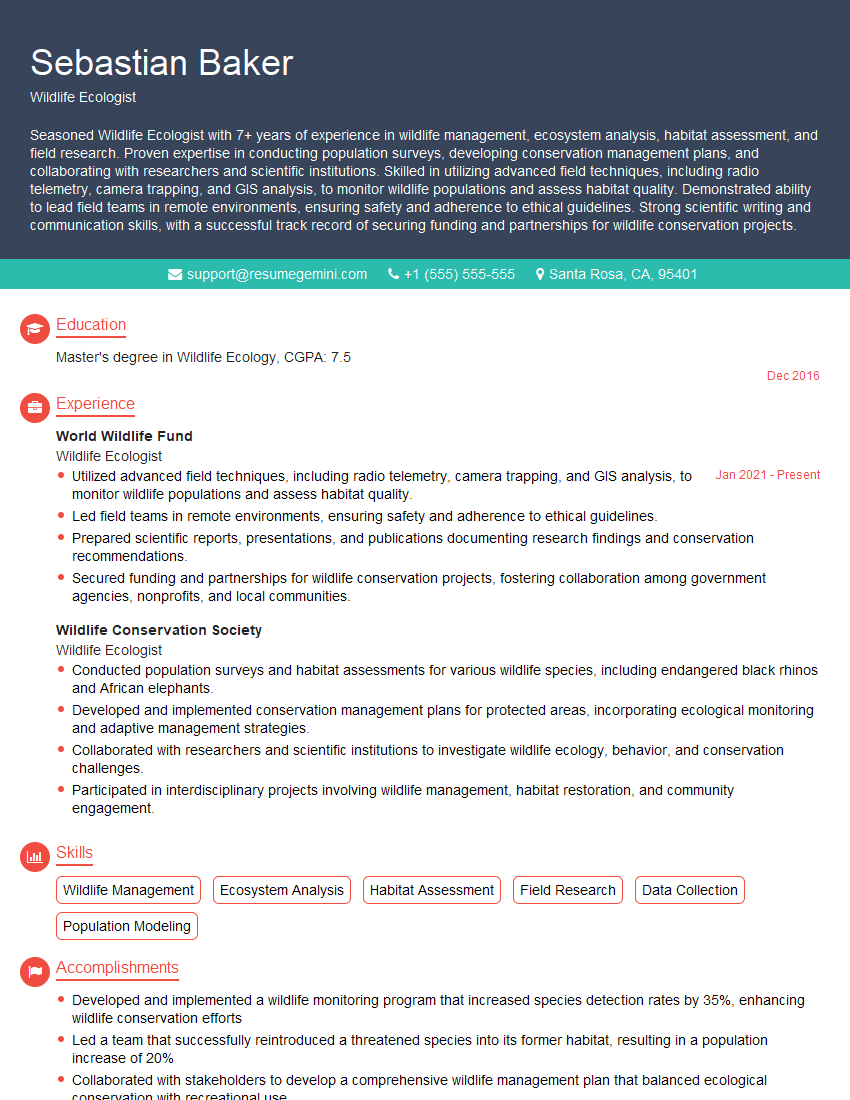
Mastering wildlife habitat assessment and monitoring is crucial for career advancement in conservation, environmental management, and research. A strong understanding of these principles will significantly enhance your interview performance and open doors to exciting opportunities. Creating an ATS-friendly resume is essential to get your application noticed. ResumeGemini is a trusted resource to help you build a professional and impactful resume that highlights your skills and experience. Examples of resumes tailored to wildlife habitat assessment and monitoring are available to guide you through this process.


Explore more articles
Users Rating of Our Blogs
Share Your Experience
We value your feedback! Please rate our content and share your thoughts (optional).
What Readers Say About Our Blog
To the interviewgemini.com Webmaster.
Very helpful and content specific questions to help prepare me for my interview!
Thank you
To the interviewgemini.com Webmaster.
This was kind of a unique content I found around the specialized skills. Very helpful questions and good detailed answers.
Very Helpful blog, thank you Interviewgemini team.