Cracking a skill-specific interview, like one for Pipefitting Certification, requires understanding the nuances of the role. In this blog, we present the questions you’re most likely to encounter, along with insights into how to answer them effectively. Let’s ensure you’re ready to make a strong impression.
Questions Asked in Pipefitting Certification Interview
Q 1. Explain the different types of pipe fittings and their applications.
Pipe fittings are essential components that connect, change direction, or branch pipe sections. They come in various types, each suited to different applications and pressure ratings. Let’s explore some key categories:
- Elbows: Used to change the direction of a pipe run. They come in various angles, such as 45° and 90°, and are crucial for navigating obstacles in a piping system. For example, a 90° elbow might be used to turn a pipe around a corner in a building’s plumbing system.
- Tees: Create a branch connection, allowing the flow to split or merge. They can be used to add a new pipe to an existing line, like adding a new water supply to a section of a manufacturing plant.
- Couplings: Connect two pipes of the same diameter, often used to join lengths of pipe during installation. Think of these as pipe connectors. They’re essential for making long pipelines.
- Reducers: Connect pipes of different diameters, gradually reducing or increasing the pipe size. This is needed when pipes of different sizes need to be connected.
- Caps: Close the end of a pipe, sealing it to prevent leaks or unwanted flow. Essential for sealing the end of a dead-end pipe.
- Flanges: These are used for creating strong, easily removable connections. They consist of two mating faces bolted together to create a seal. These are particularly useful in high-pressure systems where frequent maintenance might be needed.
- Unions: Disconnectable fittings that allow for easy separation of pipe sections for maintenance or repair, without having to completely dismantle the pipeline. They’re incredibly useful in situations where you need easy access for repair or cleaning.
The choice of fitting depends on several factors, including the pipe material, pressure rating, temperature, and the specific application. For instance, a high-pressure steam line would require fittings with much higher pressure ratings than a low-pressure water line. Furthermore, material compatibility is crucial to prevent corrosion.
Q 2. Describe the process of installing a flange connection.
Installing a flange connection is a precise process demanding attention to detail. Here’s a step-by-step guide:
- Prepare the Pipes: Ensure the pipe ends are clean, square, and free of burrs. Any imperfections can lead to leaks.
- Install Gaskets: Place the appropriate gasket(s) between the flange faces. The gasket material is selected based on the fluid being handled and pressure rating. Improper gasket selection can lead to leaks or premature failure.
- Align and Bolt: Carefully align the flanges, ensuring they are flush against each other. Begin tightening bolts in a star pattern, gradually increasing the torque to ensure even pressure distribution and prevent leaks. Torque is crucial to prevent leaks and ensure proper sealing.
- Tighten Bolts: Use a torque wrench to tighten bolts to the manufacturer’s specified torque value. Over-tightening can damage the flanges or gasket. Under-tightening can lead to leaks. The appropriate torque is crucial for the system’s integrity.
- Inspect for Leaks: After installation, pressure test the connection to check for any leaks. This is a critical step for identifying potential problems before they become catastrophic.
It’s important to use the correct type of flange, gasket, and bolts for the specific application and pipe material. Failure to do so can lead to leaks, damage, or even catastrophic failures.
Q 3. What are the safety precautions you must take when working with high-pressure piping systems?
Working with high-pressure piping systems presents significant safety hazards. Rigorous adherence to safety protocols is paramount. Here are some crucial precautions:
- Lockout/Tagout Procedures: Before any work begins, the system must be properly isolated and locked out using lockout/tagout procedures to prevent accidental energization. This is non-negotiable.
- Personal Protective Equipment (PPE): Appropriate PPE is essential, including safety glasses, hard hats, safety shoes, and hearing protection. Depending on the substance and pressure, specialized clothing such as fire-resistant suits might also be necessary.
- Pressure Relief Devices: Ensure pressure relief valves are properly installed and functioning correctly. These devices protect the system from over-pressurization, preventing explosions.
- Regular Inspections: Conduct regular inspections of the piping system for signs of wear, corrosion, or leaks. Early detection of these issues can prevent more significant problems.
- Training and Competency: All personnel involved must be properly trained and competent in the safe handling of high-pressure piping systems. Training is vital to mitigating risks.
- Emergency Response Plan: A clear emergency response plan should be in place and known to all personnel, detailing steps to take in case of an incident. Being prepared is crucial in high-risk environments.
Ignoring these safety measures can have severe consequences, including injury, death, and significant property damage. Safety should always be the top priority.
Q 4. How do you identify different pipe materials and their suitability for specific applications?
Identifying pipe materials and assessing their suitability is crucial for successful pipefitting. Different materials have varying properties and are suited for different applications. Here’s how we do it:
- Visual Inspection: Many materials have distinct visual characteristics. For example, copper is reddish-brown, steel is gray, and PVC is white or a similar color. This is often the first indication.
- Material Identification Marks: Pipes often have markings that indicate their material (e.g., ASTM standards, manufacturer codes), grade, and size. Checking these markings can give you more specific material information.
- Physical Testing: If visual inspection or markings aren’t sufficient, more rigorous physical testing methods may be employed, such as hardness testing or chemical analysis, to determine precise material composition. This is less common but may be necessary in uncertain situations.
Material Suitability: Once the material is identified, its suitability for a specific application is determined based on factors such as:
- Pressure Rating: The maximum pressure the pipe can safely withstand.
- Temperature Rating: The maximum temperature the pipe can handle without significant degradation.
- Corrosion Resistance: The ability of the pipe material to resist corrosion from the fluid it carries.
- Chemical Compatibility: Whether the pipe material will react negatively with the fluid being transported.
For instance, PVC is suitable for low-pressure water lines but not for high-pressure steam lines. Similarly, stainless steel is highly resistant to corrosion, making it ideal for handling many chemicals, while carbon steel might be more cost-effective for less corrosive applications. Choosing the wrong material can lead to premature failure, leaks, and safety hazards.
Q 5. Explain the importance of proper pipe support and its impact on system integrity.
Proper pipe support is absolutely critical to maintaining the integrity of a piping system. Without adequate support, pipes can sag, vibrate, and ultimately fail, leading to leaks, damage, and even catastrophic events. Think of a bridge: If it lacks proper supports, it will collapse under its own weight.
Types of Support: Pipe supports come in various forms, depending on the pipe size, material, fluid content, and operating conditions. These include:
- Hangers: Used to support pipes from above.
- Supports: Used for lateral support, preventing sagging.
- Anchors: Used to fix pipes in place to prevent movement.
- Guides: Prevent excessive movement from thermal expansion or other forces.
Impact on System Integrity: Inadequate pipe support can lead to:
- Pipe Sagging: Leading to stress concentrations, potential leaks, and damage.
- Vibration: Causing fatigue and premature failure of the pipe.
- Stress on Connections: Resulting in leaks at joints and fittings.
- Pipe Misalignment: Interfering with flow and causing operational issues.
Proper support design considers factors like pipe weight, fluid pressure, thermal expansion, and vibration. A qualified engineer usually designs these support systems to meet specific application requirements. Neglecting this crucial aspect can compromise the entire system’s safety and reliability.
Q 6. Describe your experience with different welding techniques used in pipefitting.
My experience encompasses several welding techniques used in pipefitting, each suited to different pipe materials and diameters. These include:
- Shielded Metal Arc Welding (SMAW): Commonly known as stick welding, SMAW is a versatile technique used for various materials and readily adaptable to field conditions. It’s particularly useful in less-accessible areas. I’ve extensively used this for steel pipe welding in various industrial settings.
- Gas Metal Arc Welding (GMAW): Also known as MIG welding, GMAW offers higher deposition rates and is often preferred for faster welding of thicker materials. This is my preferred method for larger diameter pipes.
- Gas Tungsten Arc Welding (GTAW): Known as TIG welding, GTAW provides exceptional control and high-quality welds, making it ideal for thinner-walled pipes and materials demanding high precision. I often employ GTAW for stainless steel or other specialized applications.
- Flux-Cored Arc Welding (FCAW): Similar to GMAW, but using a tubular electrode containing flux, making it suitable for welding in outdoor environments where shielding gas might be affected by wind. I have successfully utilized FCAW for several projects requiring robust welds in challenging conditions.
Each technique requires specific skill and knowledge of parameters like current, voltage, and shielding gas to produce sound welds that meet codes and standards. I regularly ensure my welding skills stay up to date through certifications and continuous professional development.
Q 7. How do you interpret blueprints and piping and instrumentation diagrams (P&IDs)?
Interpreting blueprints and piping and instrumentation diagrams (P&IDs) is fundamental to successful pipefitting. These documents are essentially the roadmap for the project.
Blueprints: Provide a visual representation of the piping system layout, showing the location, size, and routing of pipes, as well as the locations of equipment and fittings. I use blueprints to understand the physical layout of the system and its relation to the surroundings.
P&IDs: P&IDs show the process flow, equipment, and instrumentation of the piping system. They provide information on valves, instruments, and other process control elements, allowing me to understand not only the piping but the process it serves. They are crucial for understanding the functionality of the system beyond its mere physical layout. For example, the P&ID will indicate how valves control flow, and the location of pressure gauges and other monitoring instruments.
My approach involves:
- Careful Review: Thoroughly review the documents to understand the overall system design.
- Isometric Drawings: Refer to isometric drawings that provide detailed three-dimensional views of the pipe runs.
- Specifications: Pay close attention to material specifications, pressure ratings, and other relevant technical details.
- Symbol Recognition: Accurate identification of symbols representing various components and equipment is vital for accurate interpretation.
- Verification: Confirming that the actual installation matches the plans is crucial for a successful and safe project.
The ability to accurately interpret these documents prevents errors, ensures compliance with regulations, and ensures that the final system meets design specifications.
Q 8. What are the common causes of pipe leaks and how are they repaired?
Pipe leaks are a common problem in plumbing and industrial systems, stemming from various causes. Let’s explore some of the most frequent culprits and their repair solutions.
- Corrosion: Over time, pipes, especially those made of ferrous metals, can corrode, leading to thinning and eventual failure. This is particularly prevalent in environments with high humidity or exposure to chemicals. Repair: This often requires replacing the corroded section of pipe. The extent of repair depends on the severity of the corrosion.
- Mechanical Damage: External forces, such as impacts from construction equipment or settling ground, can damage pipes, causing cracks or punctures. Repair: Depending on the severity, repairs can range from simple patching with epoxy resins to replacing damaged sections.
- Improper Installation: Incorrect fitting, inadequate support, or insufficient tightening of connections are common causes of leaks. Repair: This involves carefully inspecting the connections, retightening fittings, or redoing the installation as needed.
- Thermal Expansion and Contraction: Fluctuations in temperature can cause pipes to expand and contract, putting stress on joints and welds. Repair: Proper expansion loops or flexible joints should be used during installation to mitigate this issue. Leaks arising from thermal stress often require replacing the affected section.
- Joint Failures: Faulty welds, loose threaded connections, or gasket problems can all lead to leaks at pipe joints. Repair: This requires careful examination of the joint. Welding may need to be redone, threads repaired or replaced, and gaskets replaced or reseated.
Repairing a pipe leak requires careful consideration of the cause. Safety is paramount – always isolate the affected section of the piping system before attempting any repairs. Furthermore, the repair method will depend on the type of pipe, the material, and the severity of the leak.
Q 9. Explain the procedures for pressure testing a piping system.
Pressure testing is a crucial step in verifying the integrity of a piping system before it’s put into service. It involves pressurizing the system to a predetermined level and observing for any leaks or weaknesses. Here’s a typical procedure:
- System Isolation: Completely isolate the piping system from any connected equipment or other systems.
- Inspection: Thoroughly inspect the entire system for any visible flaws or damage before pressurization.
- Pressure Medium Selection: Choose an appropriate pressure medium; water is commonly used, but air or inert gas may be necessary for certain applications. The medium must be compatible with the pipe material.
- Pressurization: Gradually increase the pressure to the test pressure specified in relevant codes and standards, usually 1.5 times the operating pressure. Monitor the pressure gauge closely.
- Leak Detection: Carefully inspect all joints, welds, and connections for any signs of leakage (water seepage, bubbles in the case of water testing). Leak detection tools like pressure gauges, soap solution, or electronic leak detectors can be used.
- Holding Time: Maintain the test pressure for a specified duration (e.g., 30 minutes). This helps identify slow leaks.
- Pressure Drop Observation: Any significant pressure drop during the holding time indicates a leak. The system must be depressurized and inspected to locate the leak.
- Repair and Retest: Repair any leaks identified and retest the system to ensure its integrity. Documentation is essential, recording all pressure readings, leak locations, and repair methods.
Pressure testing is a critical safety measure. Improperly conducted pressure tests can lead to serious incidents. Always follow established safety procedures and use appropriate personal protective equipment (PPE).
Q 10. What are the different types of pipe threading techniques?
Pipe threading is a crucial skill in pipefitting, allowing for the creation of strong, leak-proof connections. Different techniques exist, each suited to specific pipe materials and applications.
- Manual Threading: This traditional method uses hand tools like dies and stocks to cut threads onto the pipe. It’s suitable for smaller diameter pipes but requires skill and precision to achieve uniform threads.
- Power Threading: Power threading machines significantly increase efficiency and speed, especially for larger diameter pipes. These machines provide consistent thread quality and reduce manual effort. However, they require specialized equipment and operator training.
- Rolling Threading: This method forms threads by shaping the pipe material rather than cutting it, resulting in stronger and more durable threads. It’s frequently used for high-pressure applications but requires specialized equipment.
The choice of threading technique depends on factors such as pipe size, material, required thread quality, and available resources. Each method necessitates adherence to specific safety procedures, and thorough understanding of equipment operation for optimal results and safety.
Q 11. How do you ensure compliance with relevant safety codes and standards?
Compliance with safety codes and standards is paramount in pipefitting. Negligence can have serious consequences, from minor leaks to catastrophic failures. Here’s how compliance is ensured:
- Knowledge of Codes: Thorough familiarity with relevant codes like ASME B31.1 (Power Piping) or ASME B31.3 (Process Piping) and local building codes is essential. These codes specify materials, design criteria, installation procedures, and testing requirements.
- Material Selection: Choosing appropriate pipe materials according to code requirements is crucial for ensuring the system’s durability and safety under design conditions.
- Welding Procedures: Welding is often a critical component of pipe systems, and adhering to stringent welding codes and using qualified welders is vital. Welds must undergo non-destructive testing (NDT) to verify their integrity.
- Proper Installation Techniques: Following the manufacturer’s recommendations and adhering to installation best practices are critical. This includes proper support, alignment, and tightening of fittings.
- Record Keeping: Maintaining accurate records of materials used, welding procedures, inspections, and testing results is essential for demonstrating compliance. Detailed documentation is a key element of traceability and quality control.
- Regular Inspections: Periodic inspections of piping systems help identify potential problems early on. These should follow a schedule determined by the risk assessment for the system.
Compliance is not just a matter of following rules; it’s a commitment to safety and professionalism. Regular training, ongoing education, and staying updated on code changes are crucial for maintaining compliance and professional proficiency.
Q 12. Describe your experience with pipe insulation and its purpose.
Pipe insulation plays a vital role in energy efficiency, safety, and process control. It’s used to reduce heat loss or gain, preventing energy waste and maintaining the desired process temperature.
Purpose of Pipe Insulation:
- Energy Conservation: Insulation minimizes heat transfer, reducing energy consumption in heating or cooling systems. This translates to lower operational costs and a smaller environmental footprint.
- Personnel Safety: Insulation protects personnel from burns or scalding by reducing surface temperatures of hot pipes. This is particularly crucial in industrial settings.
- Process Control: For processes requiring precise temperature control, insulation helps maintain consistent temperatures, preventing undesirable temperature fluctuations and ensuring product quality.
- Corrosion Prevention: In some cases, insulation can help prevent corrosion by minimizing condensation on pipes, which often contains corrosive substances.
My Experience: I’ve worked extensively with various insulation materials, including fiberglass, mineral wool, cellular glass, and polyurethane foam. The choice of material depends on the application’s temperature range, environmental conditions, and specific requirements. Proper insulation installation is crucial to ensure its effectiveness and durability. I am familiar with best practices for insulation thickness, joint sealing, and vapor barriers to achieve optimal performance.
Q 13. What are the different methods of pipe bending?
Pipe bending is a crucial skill in pipefitting, allowing for the creation of curved sections in piping systems. Several methods are employed, each with its advantages and limitations.
- Hand Bending: Using tools like bending shoes and spring inserts, this method is suitable for smaller pipes and simpler bends. It’s labor-intensive but allows for precise control.
- Hydraulic Bending: Hydraulic benders use hydraulic pressure to form bends in pipes, offering greater capacity and precision for larger diameters and tighter radii. They often provide more uniform bend radius.
- Mechanical Bending: Mechanical benders use rollers or other mechanisms to shape the pipe. These offer high speed and efficiency but might cause more wall thinning or damage if not precisely controlled.
Choosing the appropriate bending method involves several considerations, including pipe material, diameter, required bend radius, and available equipment. Proper technique is critical to prevent pipe damage or collapse during the bending process.
Q 14. Explain the process of cutting and beveling pipes.
Cutting and beveling pipes are essential steps in pipefitting, preparing pipes for welding or other joining methods. Precision is key to ensure strong, leak-proof connections.
Cutting:
- Mechanical Cutting: Pipe cutters, hacksaws, and abrasive wheels are commonly used for cutting pipes. The choice of tool depends on pipe material, diameter, and the desired cut quality.
- Thermal Cutting: Methods like oxy-fuel cutting or plasma cutting offer speed and efficiency for thicker pipes, but they can generate heat-affected zones which might need to be addressed.
Beveling:
After cutting, pipes are often beveled to prepare for welding. This involves creating a sloped edge to allow for better weld penetration and a stronger joint. Beveling tools include hand-held beveling tools, mechanized beveling machines, or even grinding methods to obtain the desired angle and surface finish. The bevel angle is typically determined by the pipe diameter, wall thickness, and welding procedure specifications. Inaccurate beveling can lead to weld defects.
Proper cutting and beveling techniques are vital for ensuring weld quality and system integrity. Using the correct tools and techniques, and performing accurate measurements are essential for achieving optimal results.
Q 15. How do you handle different types of pipe joints (e.g., threaded, welded, flanged)?
Handling different pipe joints requires understanding their strengths and weaknesses. Each type demands a specific approach for installation and maintenance.
- Threaded Joints: These are relatively simple to assemble and disassemble, ideal for smaller pipes and lower pressure applications. However, they’re susceptible to leakage if not properly sealed with Teflon tape or pipe dope. I always ensure meticulous thread engagement and proper tightening torque to prevent leaks. Think of it like screwing a lightbulb—too loose, and it falls; too tight, and you risk damage.
- Welded Joints: Offering superior strength and leak-tightness, particularly for high-pressure systems, welded joints require skilled welders adhering to strict codes. I’m proficient in various welding techniques, including butt welds, fillet welds, and socket welds, and always ensure pre- and post-weld inspections to guarantee structural integrity. It’s like forging a strong link in a chain – each weld must be perfect.
- Flanged Joints: Flanged joints are easily disassembled for maintenance or replacement, making them suitable for larger pipes or systems requiring frequent access. Proper alignment and bolt tightening are critical to prevent leaks. Using torque wrenches is essential here to achieve uniform tightening and avoid damage. This is like putting together a complex engine – precision and torque are vital.
My experience spans across various joint types and materials, enabling me to select the optimal joint based on the application’s specific requirements—pressure, temperature, fluid type, and accessibility for maintenance.
Career Expert Tips:
- Ace those interviews! Prepare effectively by reviewing the Top 50 Most Common Interview Questions on ResumeGemini.
- Navigate your job search with confidence! Explore a wide range of Career Tips on ResumeGemini. Learn about common challenges and recommendations to overcome them.
- Craft the perfect resume! Master the Art of Resume Writing with ResumeGemini’s guide. Showcase your unique qualifications and achievements effectively.
- Don’t miss out on holiday savings! Build your dream resume with ResumeGemini’s ATS optimized templates.
Q 16. What is your experience with different types of pipe hangers and supports?
Pipe hangers and supports are crucial for maintaining pipe alignment, preventing stress, and ensuring system longevity. Incorrect support can lead to sagging, vibrations, and ultimately, system failure.
- Rigid Hangers: These provide fixed support, ideal for preventing movement in critical areas. I’ve extensively used them in high-vibration environments, ensuring proper anchor points and load calculations.
- Spring Hangers: These compensate for thermal expansion and contraction, preventing stress on the pipe. I’m skilled at selecting the appropriate spring capacity based on pipe diameter, material, and operating temperatures. Think of them as shock absorbers for the piping system.
- Variable Spring Hangers: Offering adjustable spring tension, these are versatile and essential for systems with changing loads or temperatures. My experience includes field-adjusting these hangers to compensate for unforeseen conditions.
- Constant Support Hangers: These maintain constant support regardless of pipe movement. I have experience installing these in applications where consistent load distribution is critical.
Selecting the right hanger type involves careful consideration of the fluid’s properties, temperature fluctuations, and potential stress on the pipe. It’s a balancing act between stability and flexibility, and I’ve successfully managed numerous projects involving diverse hanger systems.
Q 17. Explain the importance of proper pipe alignment and its impact on system performance.
Proper pipe alignment is paramount for optimal system performance and longevity. Misalignment introduces stress points, increasing the risk of leaks, vibrations, and premature failure.
Misaligned pipes can lead to:
- Increased Stress and Strain: Forces from the fluid flow are unevenly distributed, causing weak points and potential failure over time. Imagine bending a straw repeatedly in one spot—it’ll eventually break.
- Vibration and Noise: Misalignment can cause vibrations, leading to noise and potential damage to connected components.
- Reduced Flow Efficiency: Flow restrictions can occur due to misalignment, decreasing the system’s efficiency and increasing energy consumption. The fluid flow is like a river – obstructions cause turbulence and reduce its speed.
- Leaks: Stress from misalignment can compromise the integrity of joints, increasing the risk of leaks and potential environmental hazards.
I always use laser alignment tools and precision measuring techniques to ensure that pipes are perfectly aligned during installation. This methodical approach minimizes stress and contributes to a reliable and efficient system.
Q 18. What are the signs of pipe corrosion and how can it be prevented?
Pipe corrosion is a significant concern, leading to leaks, reduced flow, and potential system failure. Early detection and prevention are crucial.
Signs of pipe corrosion include:
- Pitting: Small holes or depressions on the pipe surface.
- Rust: Formation of reddish-brown oxide.
- Scaling: Build-up of mineral deposits.
- Leaks: Visible water or fluid leakage.
- Reduced Flow Rate: Corrosion can narrow the pipe diameter, restricting flow.
Corrosion prevention strategies involve:
- Material Selection: Choosing corrosion-resistant materials like stainless steel or using protective coatings.
- Cathodic Protection: Using sacrificial anodes to protect the pipe from corrosion.
- Regular Inspection: Conducting routine inspections to identify corrosion early on.
- Water Treatment: Controlling water chemistry to minimize corrosion.
I have extensive experience in identifying corrosion, recommending suitable preventative measures, and implementing them to ensure long-term system integrity. Preventing corrosion is like regular car maintenance—it’s proactive and prevents costly repairs down the line.
Q 19. How do you troubleshoot a piping system malfunction?
Troubleshooting piping system malfunctions requires a systematic approach. I follow a structured methodology:
- Identify the Problem: Pinpoint the exact location and nature of the malfunction – is it a leak, reduced flow, or complete blockage?
- Gather Information: Collect data about the system’s operating conditions, pressure readings, and any recent changes or maintenance.
- Visual Inspection: Examine the piping system for visible damage, leaks, or corrosion.
- Pressure Testing: Conduct pressure tests to identify leaks or pressure drops.
- Flow Measurement: Measure flow rates to identify any restrictions or blockages.
- Component Testing: Test individual components like valves, pumps, and sensors to determine their functionality.
- Root Cause Analysis: Based on the findings, determine the root cause of the malfunction.
- Repair or Replacement: Implement the necessary repairs or component replacements.
My experience allows me to efficiently diagnose the issue, identify the root cause, and implement effective solutions. This systematic process prevents unnecessary work and ensures a rapid return to normal operation. It’s akin to detective work – examining clues to solve the mystery of a malfunctioning system.
Q 20. Describe your experience with different pipe fabrication techniques.
Pipe fabrication techniques vary based on the pipe material and project requirements. My experience encompasses various methods:
- Cutting: Using various tools, including saws, plasma cutters, and abrasive wheels, for precise cuts based on the material and desired finish.
- Bending: Employing bending machines and techniques to achieve accurate bends without compromising the pipe’s integrity. This requires careful calculation to avoid kinks or weakening of the pipe.
- Welding: Proficient in various welding techniques including SMAW, GMAW, and GTAW, ensuring strong and leak-free joints.
- Flanging: Attaching flanges to pipe ends, using specialized tools and techniques to ensure proper alignment and seal.
- Threading: Cutting threads onto pipe ends using appropriate dies and machinery to achieve accurate and leak-tight connections.
Safety is paramount in pipe fabrication. I strictly adhere to all safety regulations and best practices, ensuring a safe working environment. I have successfully managed numerous pipe fabrication projects adhering to all relevant codes and regulations.
Q 21. What are the different types of valves used in piping systems and their applications?
Piping systems employ a variety of valves, each serving a specific purpose:
- Gate Valves: Used for on/off service; provide full flow when open but slow to operate. They’re typically used in larger diameter pipes or lines that don’t require frequent operation.
- Globe Valves: Provide throttling and on/off service; ideal for applications requiring flow regulation but are not as efficient as ball valves for full flow.
- Ball Valves: Fast on/off service; provide excellent flow control and are commonly used in residential and commercial applications due to ease of use and quick actuation.
- Butterfly Valves: Used for throttling and on/off service in larger pipes; their compact design makes them suitable where space is limited.
- Check Valves: Prevent reverse flow; automatically open and close depending on the direction of flow – critical for preventing backflow in pumps and other systems.
- Control Valves: Used for precise flow regulation; often automated with actuators to maintain desired pressure or flow rate.
Selecting the right valve depends on factors such as the fluid type, pressure, temperature, flow rate, and frequency of operation. Understanding these factors is critical for ensuring the safety and efficiency of the entire piping system.
Q 22. How do you measure pipe dimensions accurately?
Accurately measuring pipe dimensions is fundamental to successful pipefitting. It ensures proper fit, prevents leaks, and maintains system integrity. We use a variety of tools depending on the situation. For outer diameter and length, I typically use a high-quality steel measuring tape, ensuring it’s taut to avoid inaccuracies. For inner diameter, especially with smaller pipes, I might use calipers or a digital measuring device for precision. When dealing with complex shapes or bends, I’ll use a flexible measuring tape to conform to the curves, carefully noting the measurements at key points. Always double-check measurements, especially for critical connections, to avoid costly mistakes later. I also account for tolerances specified in the blueprints or project plans – a crucial step in ensuring compatibility with other components.
For instance, when working on a high-pressure steam line, even a minor deviation in pipe diameter could compromise the system’s integrity. In such a case, I would meticulously verify measurements using both a measuring tape and calipers, documenting every step to ensure traceability.
Q 23. What are your skills in using pipefitting tools and equipment?
My skills with pipefitting tools and equipment are extensive, encompassing both hand tools and power tools. I’m proficient in using various types of pipe wrenches (chain, pipe, adjustable), threaders, cutters, benders, and flaring tools. I’m also experienced with power tools such as welding equipment (MIG, TIG, stick), cutting torches, and pneumatic tools. Safety is paramount, so I’m adept at using these tools according to manufacturers’ guidelines and adhering strictly to all safety regulations. For example, I consistently use appropriate personal protective equipment (PPE), such as safety glasses, gloves, and hearing protection, and I am trained in lockout/tagout procedures for power tools.
I’m also comfortable operating and maintaining equipment like pipe beveling machines, ensuring accurate preparation for welding. My practical experience extends to using specialized tools such as pipe expansion tools and various types of measuring instruments, including laser levels for precise alignment.
Q 24. Describe your experience with working at heights and in confined spaces.
I have significant experience working at heights and in confined spaces. I am certified in fall protection techniques and am comfortable using harnesses, lifelines, and other safety equipment. Before starting any work at height, I always thoroughly inspect the equipment and the work area, ensuring that it is safe and stable. In confined spaces, I’m trained to recognize and mitigate potential hazards such as oxygen deficiency, toxic gases, and confined space entry procedures. This includes using appropriate respiratory protection, monitoring air quality, and adhering to entry/exit protocols and emergency response procedures. I’m also familiar with using specialized equipment for accessing and working in confined spaces, like man-lifts and confined space access systems.
For instance, during a recent project involving the installation of a pipe network in a large industrial plant, I had to work both at significant heights and in confined spaces. I ensured a safety briefing was conducted before commencing work, and utilized appropriate PPE and safety protocols to safely complete the task.
Q 25. How do you maintain a safe and organized workspace?
Maintaining a safe and organized workspace is crucial for efficiency and safety. I always begin by clearing the work area of unnecessary materials and ensuring sufficient lighting. Tools and equipment are neatly arranged, readily accessible, but not creating obstacles. I use designated storage areas for materials and tools, and frequently clean up debris and leftover materials to prevent accidents. All electrical equipment is grounded and regularly inspected to prevent shocks or fires. Color-coded systems might be employed to identify different pipe types and materials for quick identification and to avoid mix-ups.
This organized approach helps prevent accidents caused by tripping hazards, tool misplacement, and material confusion. It also facilitates efficient workflows and reduces the risk of damage to equipment or materials. For example, clearly labeling pipes by size and material prevents incorrect installation, saving time and preventing potential issues down the line.
Q 26. Describe your problem-solving skills in a practical pipefitting scenario.
In pipefitting, problem-solving is a daily occurrence. One instance involved a complex valve installation where the existing pipework presented unexpected misalignment. Instead of forcing a fit, which could damage the valve or the pipes, I systematically analyzed the issue. First, I reviewed the blueprints and specifications to understand the intended design. Then, I measured the existing pipework’s deviations from the plan and assessed the available space for adjustments. I decided a combination of using flexible pipe sections and custom-fabricated pipe connectors would resolve the problem while maintaining the integrity of the system.
This involved precision cutting, precise measurements, and the careful selection of appropriate connectors to ensure a leak-proof and functional fit. The systematic approach not only fixed the misalignment but also allowed us to complete the installation on schedule, demonstrating a practical and safe solution.
Q 27. What is your understanding of different pipe materials’ thermal expansion properties?
Understanding the thermal expansion properties of different pipe materials is vital for designing and installing safe and reliable piping systems. Different materials expand and contract at different rates when exposed to temperature changes. Steel, for instance, has a relatively high coefficient of thermal expansion compared to copper or plastic. This means a steel pipe will expand significantly more than a copper pipe under the same temperature increase. Failure to account for this can lead to stress on the piping system, causing leaks or even catastrophic failures.
Knowing these properties allows us to incorporate expansion loops, expansion joints, or other compensation mechanisms into the design to accommodate these changes. For instance, when working with high-temperature steam lines, I would carefully select materials with appropriate expansion characteristics and design expansion loops to mitigate potential stress and prevent failures.
Q 28. How do you ensure the proper alignment and installation of expansion joints?
Proper alignment and installation of expansion joints are critical to prevent stress and damage in piping systems. Expansion joints, also known as expansion loops, are designed to absorb the thermal expansion and contraction of pipes. Before installing an expansion joint, I carefully verify its specifications against the project plans. This includes ensuring that the joint’s capacity matches the expected thermal movement of the pipe section. Accurate alignment is ensured using laser levels and other precision instruments to guarantee that the joint is correctly positioned and oriented to absorb movement effectively.
The installation process itself requires careful attention to detail, following the manufacturer’s instructions meticulously. Bolting is done evenly and gradually to ensure a secure and balanced connection. After installation, I usually perform a visual inspection and sometimes a pressure test to ensure there are no leaks or alignment issues. Ignoring these precautions could lead to premature failure of the joint or damage to the piping system.
Key Topics to Learn for Your Pipefitting Certification Interview
Ace your interview by mastering these core areas of pipefitting. Remember, a strong understanding of both theory and practical application is key!
- Blueprint Reading and Interpretation: Understanding blueprints is fundamental. Practice interpreting complex diagrams to accurately determine pipe sizes, materials, and installation methods.
- Pipefitting Math and Geometry: Accurate measurements and calculations are crucial. Brush up on your trigonometry, geometry, and ability to calculate pipe offsets and angles.
- Pipe Fabrication Techniques: Demonstrate your knowledge of various cutting, bending, and joining methods for different pipe materials (steel, copper, PVC, etc.). Be prepared to discuss the tools and equipment involved.
- Welding and Joining Processes: Depending on the certification level, a deep understanding of various welding techniques (e.g., SMAW, GMAW, GTAW) and their applications is essential. Know safety procedures and quality control measures.
- Pipe Support and Hanger Systems: Explain your knowledge of different support systems and their selection based on pipe size, material, and system pressure. Understand stress and strain principles.
- Safety Regulations and Best Practices: Showcase your commitment to safety. Be prepared to discuss OSHA regulations, lockout/tagout procedures, and other safety protocols relevant to pipefitting.
- Troubleshooting and Problem-Solving: Interviewers want to see how you handle challenges. Prepare examples demonstrating your ability to identify and resolve issues during pipefitting installations.
- Materials Science and Properties: Understand the properties of different pipe materials and their suitability for various applications. Discuss factors affecting material selection, such as pressure, temperature, and corrosive environments.
Next Steps: Unlock Your Career Potential
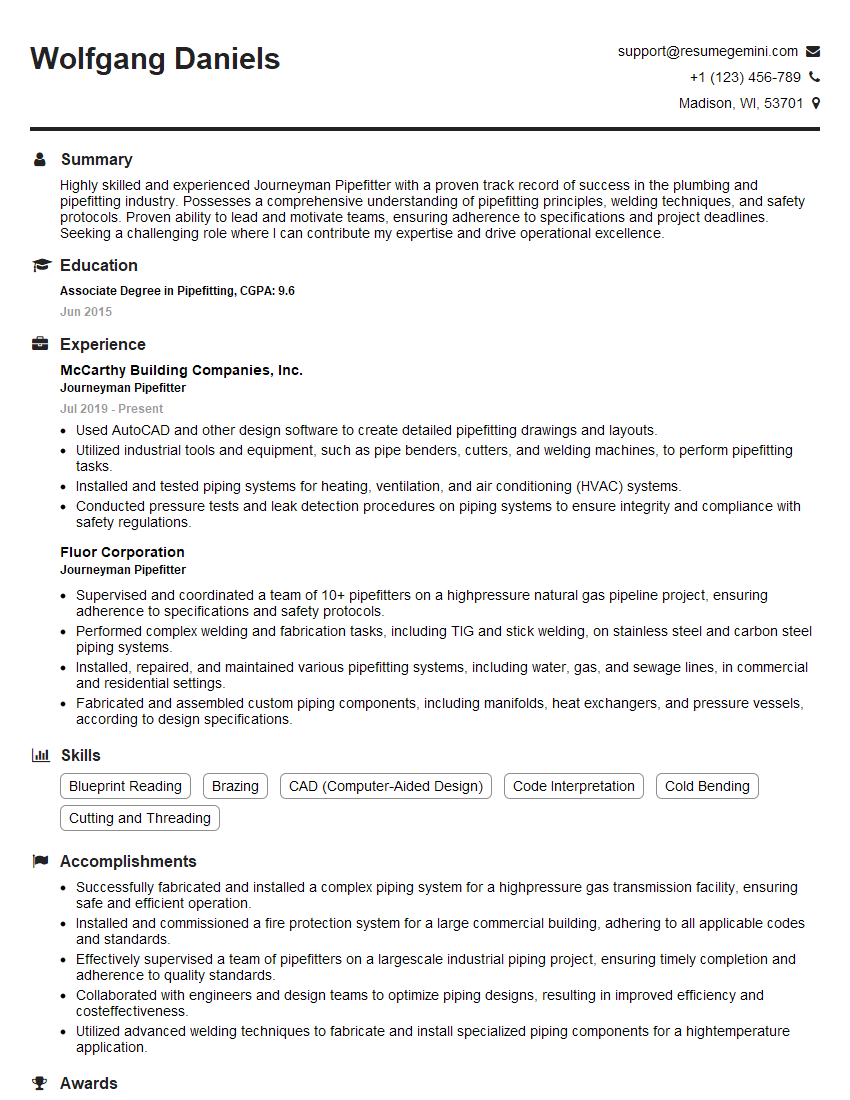
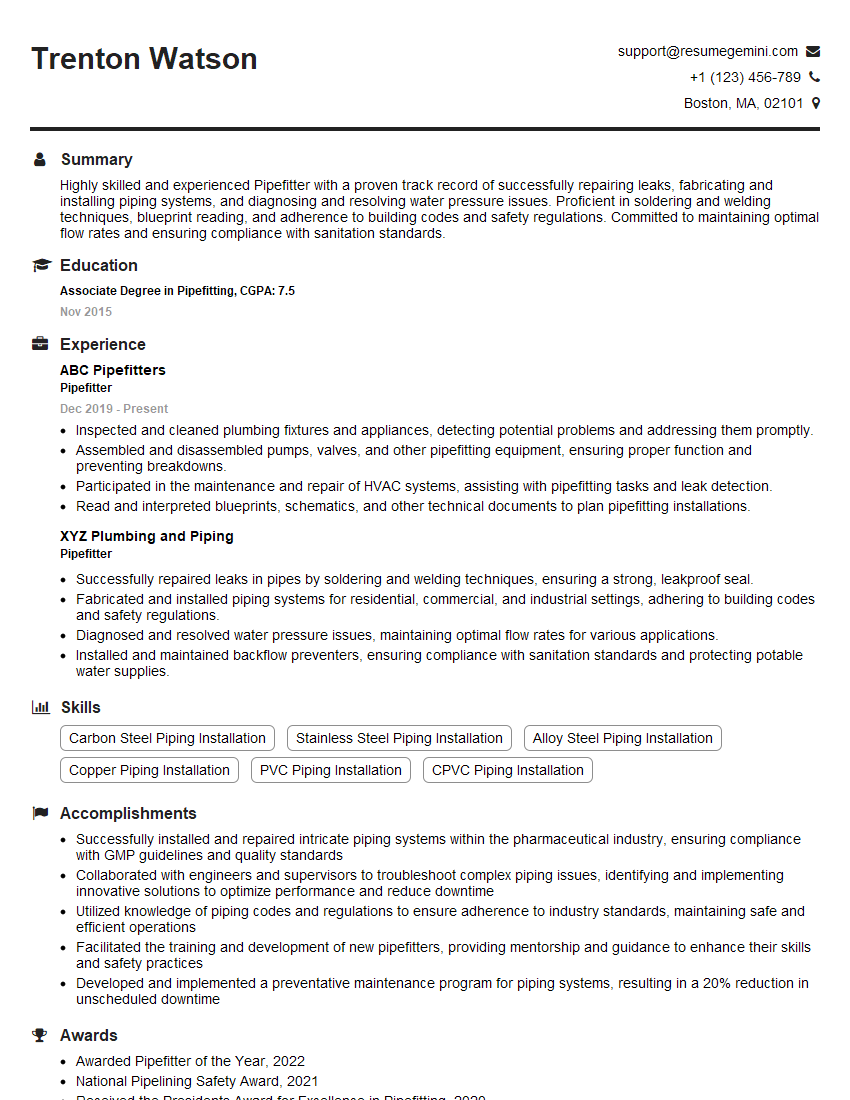
Earning your Pipefitting Certification opens doors to rewarding careers with excellent growth potential. To maximize your job prospects, focus on creating a compelling, ATS-friendly resume that highlights your skills and experience. ResumeGemini is a trusted resource that can help you build a professional resume that stands out. We provide examples of resumes tailored to Pipefitting Certification to help you get started.
Explore more articles
Users Rating of Our Blogs
Share Your Experience
We value your feedback! Please rate our content and share your thoughts (optional).
What Readers Say About Our Blog
To the interviewgemini.com Webmaster.
Very helpful and content specific questions to help prepare me for my interview!
Thank you
To the interviewgemini.com Webmaster.
This was kind of a unique content I found around the specialized skills. Very helpful questions and good detailed answers.
Very Helpful blog, thank you Interviewgemini team.