Are you ready to stand out in your next interview? Understanding and preparing for SCUBA Diving and Field Surveys interview questions is a game-changer. In this blog, we’ve compiled key questions and expert advice to help you showcase your skills with confidence and precision. Let’s get started on your journey to acing the interview.
Questions Asked in SCUBA Diving and Field Surveys Interview
Q 1. Describe your experience with different SCUBA diving equipment and its maintenance.
My experience encompasses a wide range of SCUBA diving equipment, from basic BCD (Buoyancy Compensator Device) and regulator systems to advanced rebreathers and drysuits. I’m proficient with various brands and models, understanding their specific functionalities and maintenance requirements. Regular maintenance is crucial for safety and equipment longevity. This includes:
- Visual inspections: Before each dive, I meticulously check for any damage, wear, or corrosion on all components. This includes hoses, O-rings, and fittings.
- Functional checks: This involves testing the buoyancy of the BCD, the proper inflation and deflation of the power inflator, and the smooth operation of the regulator, including the free flow and alternate air source.
- Regular servicing: I adhere to manufacturer’s recommendations for annual servicing by certified technicians. This involves complete disassembly, cleaning, lubrication, and testing of critical components like regulators and submersible pressure gauges. This is non-negotiable for safe diving practices.
- Storage and care: Proper storage is key to preventing corrosion and damage. Equipment should be rinsed thoroughly with fresh water after each use and allowed to dry completely before storage in a cool, dry place.
For example, during a recent research project involving deep dives, I meticulously checked the integrity of my drysuit seals before each immersion, ensuring waterproofness to avoid hypothermia in the cold water environment. Any minor issues were addressed immediately to prevent potential problems.
Q 2. Explain the procedures for conducting a proper pre-dive safety check.
A pre-dive safety check is a non-negotiable ritual that I religiously follow before every dive. It’s a systematic process ensuring equipment functions correctly and mitigating potential risks. The acronym ‘BWRAF’ helps me remember the key areas:
- Buoyancy Compensator (BCD): Check inflation and deflation mechanisms, straps, and overall condition.
- Weight system: Ensure proper weight configuration for optimal buoyancy control and secure attachment.
- Regulator: Verify the first and second stages operate smoothly, checking for free flow and proper air delivery through the alternate air source.
- Alternate Air Source: Confirm that your alternate air source is properly connected and functioning correctly.
- Finals: A final visual inspection of all gear, including mask, fins, and dive computer to ensure everything is in place and functioning correctly.
Beyond BWRAF, I also include checks on the dive plan, weather conditions, buddy communication, and ensuring sufficient air supply. Imagine neglecting your air supply check – the consequences could be catastrophic. Therefore, this thorough pre-dive checklist is paramount to successful and safe diving.
Q 3. What are the different types of underwater survey techniques you are proficient in?
My proficiency in underwater survey techniques includes a variety of methods adapted to the specific environment and project objectives. These include:
- Transect surveys: These involve laying out a line along a specific path and recording observations along that line. This is excellent for quantifying the abundance and distribution of benthic organisms.
- Quadrat surveys: Using square frames of known area (quadrats) to sample organisms within a defined area. This method provides valuable data on species density and diversity.
- Photogrammetry and video surveys: Taking overlapping images or video footage of the survey area to create a 3D model. This is especially useful for mapping complex habitats, such as coral reefs or shipwrecks.
- Acoustic techniques: Employing sonar or other acoustic methods for mapping larger areas, particularly where visibility is poor. This can help in identifying submerged structures or features.
The choice of technique depends greatly on the study’s aims. For example, a benthic habitat study might use a combination of transect and quadrat surveys, while a shipwreck assessment might rely on photogrammetry or sonar.
Q 4. How do you ensure accurate data recording and documentation during underwater surveys?
Accurate data recording and documentation are essential for maintaining the integrity and validity of underwater surveys. My approach involves a multi-layered system:
- Underwater data sheets/slates: Waterproof slates and pencils or digital underwater tablets are used for immediate recording of observations and measurements during the dive.
- High-resolution photography and videography: Images and videos provide visual confirmation of observations and allow for later analysis. Metadata, including date, time, location, and depth, is meticulously documented.
- GPS and DGPS data logging: Positional data is logged using appropriate technology (explained in the next answer) to precisely locate observations.
- Post-dive data entry and analysis: Data from underwater slates, photographs, videos, and GPS/DGPS are carefully transferred to a digital database, checked for consistency, and analyzed using appropriate statistical tools. A detailed dive log is maintained for each survey.
Using a systematic approach minimizes errors and ensures the integrity of the survey data, which is crucial for generating scientifically robust conclusions.
Q 5. Describe your experience with underwater positioning systems (e.g., GPS, DGPS, USBL).
I have extensive experience with various underwater positioning systems. Each has its strengths and weaknesses depending on the environment and the desired accuracy:
- GPS (Global Positioning System): Useful for surface positioning, but its signal is often attenuated underwater, limiting its application to shallow water surveys.
- DGPS (Differential GPS): Improves GPS accuracy by using a base station to correct for errors. Provides better accuracy than standard GPS, particularly for shallow water work.
- USBL (Ultra-Short Baseline): Uses acoustic signals to determine the position of a submerged transponder relative to a surface unit. USBL is highly accurate and useful for deep-water surveys and precise positioning of underwater equipment.
For instance, during a recent deep-water coral reef survey, we employed a USBL system coupled with a remotely operated vehicle (ROV) equipped with a high-definition camera. The USBL ensured we precisely mapped the extent and features of the coral community.
Q 6. Explain the different types of underwater hazards and how to mitigate them.
Underwater hazards are diverse and can range from environmental to equipment-related issues. Understanding and mitigating these risks is paramount. Some common hazards include:
- Marine life: Encounters with potentially dangerous creatures (sharks, jellyfish, etc.) require awareness, appropriate precautions (protective suits, avoidance strategies), and knowledge of their behavior.
- Entanglement: Fishing nets, lines, or debris can create serious entanglement hazards. Careful navigation and the use of appropriate cutting tools are crucial.
- Poor visibility: Reduced visibility necessitates careful navigation, using a dive buddy, and employing appropriate signaling devices.
- Currents: Strong currents can lead to exhaustion or disorientation. Dive planning should consider current conditions, and appropriate buoyancy control is essential.
- Equipment malfunction: Proper equipment maintenance (as described earlier) and the use of redundant systems (alternate air source) are critical for mitigating equipment-related problems.
Risk mitigation involves thorough planning, including site familiarization, assessing environmental conditions, using appropriate equipment, and adhering to safe diving practices. For example, in strong current conditions, a safety line may be used, allowing a diver to easily return to the dive boat.
Q 7. How do you handle unexpected situations or emergencies during a dive?
Handling unexpected situations requires calm, decisive action based on training and experience. My response depends on the specific emergency, but the principles remain consistent:
- Assessment: Quickly assess the situation to identify the problem and potential threats.
- Communication: Clear communication with my dive buddy is vital. Using hand signals and other means to relay critical information is essential, especially in low visibility conditions.
- Problem-solving: Employing problem-solving skills and dive training to address the situation appropriately. This could involve implementing contingency plans or executing emergency procedures (e.g., emergency ascent).
- Safety First: Prioritizing safety above all else. This may mean abandoning the dive, if necessary, or seeking help from the surface support team.
- Post-dive debrief: After the incident, reviewing what happened to identify contributing factors and refine procedures for future dives.
For example, if a regulator malfunctions during a dive, I would immediately switch to my alternate air source, signal my buddy, and initiate a controlled ascent. A post-dive debrief would analyze the situation and check the faulty regulator to determine the cause of the failure.
Q 8. Describe your experience with underwater photography or videography for survey purposes.
Underwater photography and videography are crucial for documenting observations during field surveys. I’m proficient in using both still and video cameras housed in waterproof underwater housings, capturing high-resolution images and videos of benthic habitats, marine life, and survey markers. My experience includes using various lighting techniques, from natural ambient light to specialized underwater strobes and video lights, to ensure optimal image quality in diverse underwater conditions. For example, during a recent coral reef survey in the Caribbean, I used a GoPro Hero 10 with a red filter to compensate for light absorption and capture the true vibrant colors of the coral at depth. I also utilized a more professional DSLR system in a subsea housing to capture detailed images of specific species for later identification and analysis. Post-processing involves software like Adobe Lightroom and Premiere Pro for color correction, enhancement, and video editing.
Q 9. Explain your understanding of decompression procedures and the importance of dive planning.
Decompression procedures are vital to prevent decompression sickness (DCS), also known as ‘the bends’. This condition occurs when dissolved inert gases, primarily nitrogen, form bubbles in the bloodstream as a diver ascends too quickly. Dive planning is paramount in mitigating this risk. It involves carefully calculating dive profiles, considering factors like depth, bottom time, and ascent rate. We utilize dive computers and dive tables to determine safe decompression stops, allowing the body to safely offload excess nitrogen. For instance, a deep dive to 30 meters might require multiple decompression stops, carefully planned and executed to prevent bubble formation. Poorly planned dives, ignoring decompression stops or ascending too rapidly, significantly increase the risk of DCS, potentially leading to serious health consequences or even death.
Q 10. How familiar are you with different types of dive computers and their functionalities?
I’m familiar with a range of dive computers, from basic models that track depth and dive time to sophisticated units with advanced features like multi-gas mixing capabilities, tissue saturation models, and integrated GPS. I have experience with Suunto, Shearwater, and Garmin dive computers. The functionality of a dive computer greatly impacts the safety and efficiency of a survey. For example, a computer with a built-in bottom timer ensures accurate tracking of dive time, while more advanced models, such as those with full decompression algorithms, are vital for complex multi-level dives. My proficiency extends to understanding the limitations of each computer and using their data to inform decision-making during a dive, ensuring our team stays within safe parameters.
Q 11. Describe your experience with underwater communication systems.
Underwater communication is crucial for team coordination and safety. We primarily use underwater communication systems like diver-to-diver communication devices, employing acoustic signals or hand signals, depending on the conditions and level of required communication. In clearer waters, hand signals are sufficient for many interactions; however, in murky conditions or for conveying more complex information, dedicated underwater communication systems are vital. These can range from simple diver-to-surface signaling devices to sophisticated underwater communication systems capable of transmitting voice messages. The effectiveness of these systems depends on factors like water clarity, depth, and the quality of the equipment. We always have backup communication plans, such as pre-agreed hand signals, for situations where the primary system fails.
Q 12. How do you ensure the safety of yourself and your dive team during a survey?
Safety is the absolute priority in all underwater surveys. This involves several key measures: pre-dive briefings to review the dive plan, the assignment of roles and responsibilities, and the identification of potential hazards; using proper equipment checks of all SCUBA gear before and after every dive to identify and address any potential problems; buddy-system diving; maintaining visual contact with dive buddies; constant monitoring of depth, air supply, and dive time; adherence to strict decompression procedures; and the appropriate use of safety equipment (such as dive floats or emergency ascent lines). In case of an emergency, our team is trained in rescue techniques, including the effective use of emergency ascent methods and the provision of first aid. Regular safety drills further reinforce these procedures, preparing us for potential problems.
Q 13. What software or tools are you proficient in for processing and analyzing underwater survey data?
Data processing and analysis are critical aspects of underwater surveys. I’m proficient in using various software packages including ArcGIS, QGIS, and specialized benthic habitat mapping software. ArcGIS and QGIS allow for the georeferencing and mapping of underwater survey data, creating detailed maps of the surveyed area. Benthic habitat mapping software aids in classifying and quantifying different habitats. Image analysis software, such as ImageJ, can be utilized for analyzing photographic data, such as measuring the size of organisms or calculating coral cover. In addition to this, I’m experienced in using spreadsheets and statistical software for data analysis, summarizing and interpreting our findings to provide robust, quantitative conclusions to our research.
Q 14. Describe your experience with different types of underwater habitats and ecosystems.
My experience encompasses a wide range of underwater habitats and ecosystems. I’ve worked in diverse environments, including coral reefs, kelp forests, seagrass beds, rocky shores, and soft-sediment bottoms. Each environment presents unique challenges and demands specific survey techniques. For example, surveying a coral reef requires careful navigation to avoid damage to the fragile ecosystem, while surveying a soft-sediment bottom might involve using specialized equipment to ensure accurate sampling. My understanding extends to the ecological factors influencing these habitats, including the impact of water quality, currents, and human activities. This knowledge allows me to select appropriate survey techniques and interpret the results effectively within their ecological context.
Q 15. Explain your knowledge of marine life and its impact on survey operations.
Understanding marine life is paramount for successful and safe field surveys. Different species exhibit varying behaviors that can directly impact data collection. For example, a shoal of fish might obscure visibility during a benthic habitat survey, requiring adjustments to methodology or dive planning. Conversely, the presence of aggressive species like lionfish necessitates additional safety precautions, including buddy diving and carrying appropriate deterrents. My knowledge encompasses identifying various species, understanding their habitat preferences, and predicting their potential impact on survey operations.
For instance, during a coral reef survey in the Caribbean, we encountered a large aggregation of parrotfish. While beautiful, their feeding behavior significantly affected the visibility, making accurate measurements of coral cover challenging. We adapted by using a higher-powered underwater camera with better lighting and extending our dive time to accommodate reduced visibility. We also carefully documented the presence and abundance of parrotfish, as this is valuable ecological data.
Career Expert Tips:
- Ace those interviews! Prepare effectively by reviewing the Top 50 Most Common Interview Questions on ResumeGemini.
- Navigate your job search with confidence! Explore a wide range of Career Tips on ResumeGemini. Learn about common challenges and recommendations to overcome them.
- Craft the perfect resume! Master the Art of Resume Writing with ResumeGemini’s guide. Showcase your unique qualifications and achievements effectively.
- Don’t miss out on holiday savings! Build your dream resume with ResumeGemini’s ATS optimized templates.
Q 16. How do you identify and handle marine life encounters responsibly?
Responsible marine life encounters are governed by a ‘look, don’t touch’ policy. Identification is crucial; I leverage my experience with species identification guides, underwater photography for later analysis, and consulting with marine biologists when uncertain. I never harass, chase, or provoke marine life. I maintain a safe distance, avoiding sudden movements or creating disturbances to their natural behavior. If a creature approaches me, I remain calm and slowly move away.
For example, during a kelp forest survey, I encountered a sea otter. These playful animals are inquisitive, but also powerful. I maintained a considerable distance, ensuring it felt safe and undisturbed while continuing the survey at a slightly altered trajectory to avoid a close encounter. Proper buoyancy control is paramount to avoid accidentally disturbing delicate habitats or striking animals.
Q 17. Explain your understanding of marine environmental regulations and permits.
Marine environmental regulations are crucial and vary significantly by location. I am well-versed in national and international regulations pertaining to marine protected areas (MPAs), protected species, and the collection of biological samples. Obtaining necessary permits is a non-negotiable part of my work, always preceded by a thorough application process adhering to specific agency guidelines. These permits often dictate the methods, locations, and quantities of samples permitted. Failure to comply can result in significant penalties, including fines and legal action.
For example, when conducting a seagrass survey in a designated MPA, I must obtain permits from the relevant authority, detailing the survey methodology, the species I may encounter, and how samples will be handled. These permits specify the allowed sampling techniques and the number of samples I can collect, which significantly impacts my survey design.
Q 18. Describe your experience with conducting underwater surveys in various environmental conditions (e.g., currents, visibility).
My experience spans a wide range of underwater conditions. I’ve conducted surveys in strong currents utilizing specialized techniques like deploying a weighted survey line to maintain position. Reduced visibility demands meticulous attention to navigation, utilizing a compass and maintaining close contact with my dive buddy for safety. In extremely poor visibility, we may opt for alternative methods like using sonar or reducing the scope of the survey to areas with better visibility.
During a deep-water wreck survey with strong currents, we used a weighted dive line for reference and deployed a drop camera with lighting to survey the wreck’s structure when visibility was too poor for divers to effectively assess the structure.
Q 19. How do you manage your air consumption effectively during extended dives?
Efficient air consumption is vital for extended dives, especially when conducting detailed surveys. This involves proper pre-dive planning, which includes accurately calculating air supply based on depth, duration, and workload. Maintaining a slow, controlled breathing rate helps conserve air. Proper buoyancy control minimizes energy expenditure, which also reduces air consumption. I regularly practice controlled buoyancy techniques and maintain good fitness to optimize my oxygen use during dives.
For long-duration deep dives, I utilize dive computers to monitor my air consumption in real-time, providing early warnings if my air supply is depleting faster than anticipated. This allows me to adjust my dive plan, potentially shortening the bottom time or making an early ascent if necessary.
Q 20. Explain the different methods for collecting underwater samples.
Collecting underwater samples involves various methods, chosen based on the target sample and environmental conditions. For sediment samples, I use corers, grabs, or scoops. Benthic invertebrate samples are often collected using quadrats, nets, or hand-picking. Water samples require specialized bottles to collect at specific depths and ensure minimal contamination. All samples are meticulously labeled and documented with location, date, time, and depth.
When collecting coral samples for analysis, I would utilize a small hammer and chisel to extract a small piece, ensuring minimal damage to the surrounding reef structure. The sample would be carefully packaged and preserved to maintain its integrity for later laboratory analysis. All sample collection adheres to strict ethical and environmental guidelines.
Q 21. Describe your experience with conducting underwater inspections of structures or equipment.
Underwater inspections of structures and equipment, such as pipelines, oil rigs, or underwater cables, require specialized skills and training. I utilize underwater cameras, video recording equipment, and sometimes remotely operated vehicles (ROVs) to capture detailed images and videos. I am proficient in identifying potential structural defects, corrosion, or biofouling (the accumulation of organisms on surfaces). My reports are detailed, documented with photos and videos, and presented in a clear, concise manner to stakeholders.
During an inspection of an underwater pipeline, we used an ROV equipped with a high-definition camera and sonar to identify areas of corrosion. The ROV’s maneuverability allowed us to inspect hard-to-reach areas, gathering detailed visual and sonar data which we then analyzed to assess the integrity of the pipeline and provide recommendations for maintenance.
Q 22. What is your experience with using underwater remotely operated vehicles (ROVs)?
My experience with underwater remotely operated vehicles (ROVs) spans several years and various projects. I’m proficient in operating various ROV models, from small, tethered units for shallow-water inspections to more sophisticated systems equipped with high-resolution cameras, manipulators, and sensors for deep-sea exploration. This includes pre-dive planning, deployment, navigation, data acquisition, and post-dive maintenance. For example, on a recent project assessing the structural integrity of an offshore platform, I used an ROV fitted with a sonar system to create a 3D model of the platform’s underwater components, identifying areas of corrosion and damage far more efficiently than traditional SCUBA diving methods would have allowed. I also have experience with ROVs equipped with water quality sensors, enabling me to collect data on parameters such as turbidity, temperature, and salinity in a non-invasive manner.
Q 23. Explain the process of reporting your findings after completing an underwater survey.
Reporting findings after an underwater survey is a crucial step, and it involves a systematic approach to ensure clarity and accuracy. The process typically begins with data compilation—organizing all collected data, including photos, videos, measurements, and sensor readings. Then, I meticulously analyze the data, looking for patterns, anomalies, and significant findings. This analysis is often complemented by creating maps, cross-sections, or 3D models to visualize the survey area and its features. The final report is structured and well-documented. It includes a clear description of the survey objectives, methodology, results, and conclusions, often accompanied by high-quality visual aids such as detailed maps and photographs. I always ensure the report is tailored to the client’s needs and meets the required standards of precision and clarity. For instance, in a recent marine habitat assessment, we created a detailed report with comprehensive maps illustrating the distribution of coral species and other benthic organisms, along with an analysis of the overall health of the ecosystem.
Q 24. How do you ensure the accuracy and precision of your underwater measurements?
Ensuring accuracy and precision in underwater measurements requires a multi-faceted approach. Firstly, I use calibrated instruments, regularly checked and maintained. This includes depth gauges, compasses, and measuring tapes that are specifically designed for underwater use. Secondly, I employ meticulous survey techniques, like establishing clear reference points and using triangulation methods to account for current and water movement. For example, when measuring the size of a coral colony, I might use multiple measurements from different angles and take into account the perspective distortion caused by the water. Thirdly, I use appropriate technology. For instance, using a total station (a surveying instrument) integrated with a GPS system can significantly improve positional accuracy. Finally, careful data logging and thorough documentation of all procedures is vital to ensure traceability and allow for repeatability of measurements. I always double-check my data and maintain a thorough chain of custody for all samples and measurements.
Q 25. Describe your experience with working on a team during underwater survey operations.
Teamwork is paramount in underwater survey operations. I have extensive experience collaborating effectively with dive buddies, survey technicians, scientists, and boat crews. Successful teamwork depends on clear communication, shared responsibility, and mutual respect. Before any dive, we have thorough briefings to outline the plan, discuss safety protocols, and assign roles. Underwater, we rely on hand signals and clear non-verbal communication to avoid confusion and ensure safety. After each dive, we debrief, discuss findings, and address any issues encountered. I value open communication and actively encourage team members to share their observations and insights. For example, during a wreck survey, my ability to effectively collaborate with the ROV pilot allowed us to obtain highly detailed images and measurements of the wreck, far surpassing what we could have achieved individually.
Q 26. How do you manage stress and pressure while conducting underwater surveys?
Managing stress and pressure during underwater surveys is crucial for safety and efficiency. Proper training, experience, and adherence to established safety protocols form the foundation of my approach. I always maintain a calm and focused demeanor, carefully assessing risks before diving and developing contingency plans. Moreover, I prioritize good physical and mental health, ensuring adequate rest and avoiding stressful situations outside of work. Regular physical exercise and relaxation techniques such as meditation help me to stay mentally and physically prepared. Understanding my own limitations and knowing when to call off a dive if conditions become unsafe is a critical part of this process. I consider safety to be non-negotiable, always placing the well-being of myself and my team above all else.
Q 27. Describe your experience with data analysis and interpretation related to underwater surveys.
Data analysis and interpretation are key aspects of my work. I’m proficient in using various software packages to process and analyze underwater survey data. This includes photogrammetry software to create 3D models from underwater images, GIS software for spatial analysis and mapping, and statistical packages for quantitative data analysis. My analytical skills enable me to identify patterns, interpret results, and draw meaningful conclusions from the data. For instance, in a recent project studying the impact of pollution on a coastal ecosystem, I used statistical analysis to determine correlations between pollution levels and the abundance of key species. The results were then visualized and presented in a clear and concise report, facilitating informed decision-making by stakeholders. I strive to present my findings in a way that is both technically sound and easily understandable for a wide audience.
Q 28. What are your career goals within the field of SCUBA diving and field surveys?
My career goals involve expanding my expertise in advanced underwater survey techniques and technologies. I aim to become a leading expert in the application of autonomous underwater vehicles (AUVs) and advanced sensor systems for environmental monitoring and research. I’m also keen on contributing to the development of new methods for data analysis and interpretation, specifically focused on enhancing the accuracy and efficiency of underwater surveys. Ultimately, I aspire to lead complex research projects that address significant environmental challenges, utilizing my expertise in SCUBA diving and field surveys to contribute to a greater understanding and preservation of our marine ecosystems. My long-term ambition is to help bridge the gap between scientific research and effective conservation strategies.
Key Topics to Learn for SCUBA Diving and Field Surveys Interview
- SCUBA Diving Safety Procedures: Understanding emergency procedures, buddy system protocols, and decompression theory. Practical application: Describing how you’d handle an equipment malfunction or a diver experiencing distress.
- Underwater Navigation and Survey Techniques: Mastering compass navigation, using underwater survey equipment (e.g., rangefinders, depth gauges), and accurate data recording. Practical application: Explaining your experience with underwater mapping or site assessment.
- Marine Life Identification and Ecology: Familiarizing yourself with common marine species and their habitats. Practical application: Discussing how ecological understanding influences survey design and data interpretation.
- Data Collection and Analysis Methods: Understanding various survey methods (e.g., transects, quadrats), data recording techniques, and statistical analysis for interpreting findings. Practical application: Explaining your proficiency in using specific software or techniques for data analysis.
- Environmental Considerations and Regulations: Knowledge of environmental impact assessments, marine protected areas, and relevant regulations. Practical application: Describing how you ensure environmentally responsible survey practices.
- Equipment Maintenance and Troubleshooting: Proficiency in maintaining and troubleshooting SCUBA equipment and field survey tools. Practical application: Explaining your experience with preventative maintenance and problem-solving during fieldwork.
- Communication and Teamwork: Effective communication skills crucial for teamwork in underwater environments. Practical application: Providing an example of successful teamwork during a challenging dive or survey.
Next Steps
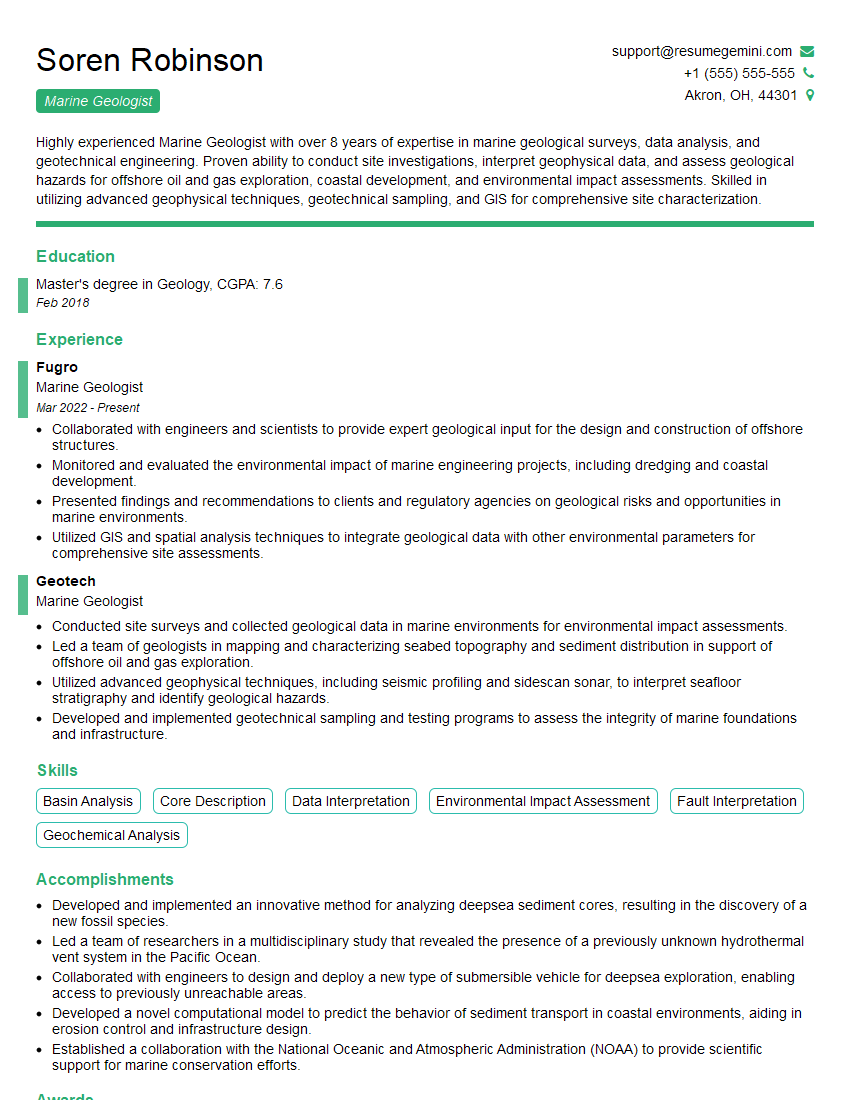
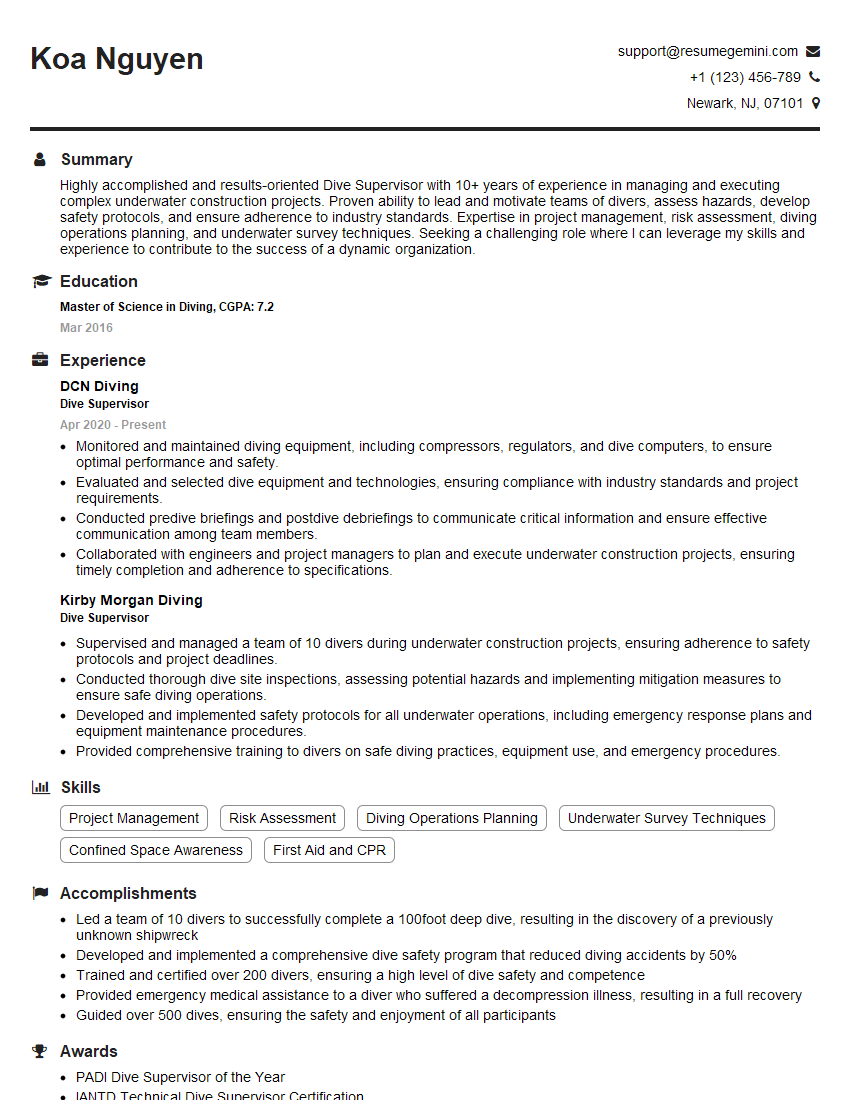
Mastering SCUBA diving and field survey skills opens doors to exciting careers in marine research, environmental consulting, and underwater construction. To significantly boost your job prospects, a well-crafted, ATS-friendly resume is essential. ResumeGemini is a trusted resource to help you build a professional and impactful resume that highlights your unique skills and experience. We provide examples of resumes tailored to SCUBA Diving and Field Surveys to help you get started. Invest time in crafting a compelling resume—it’s your first impression on potential employers.
Explore more articles
Users Rating of Our Blogs
Share Your Experience
We value your feedback! Please rate our content and share your thoughts (optional).
What Readers Say About Our Blog
To the interviewgemini.com Webmaster.
Very helpful and content specific questions to help prepare me for my interview!
Thank you
To the interviewgemini.com Webmaster.
This was kind of a unique content I found around the specialized skills. Very helpful questions and good detailed answers.
Very Helpful blog, thank you Interviewgemini team.