Unlock your full potential by mastering the most common Assisting with product development and testing interview questions. This blog offers a deep dive into the critical topics, ensuring you’re not only prepared to answer but to excel. With these insights, you’ll approach your interview with clarity and confidence.
Questions Asked in Assisting with product development and testing Interview
Q 1. Describe your experience with different software testing methodologies (e.g., Agile, Waterfall).
My experience encompasses both Agile and Waterfall methodologies, each demanding a distinct approach to testing. In Waterfall, testing is typically a separate phase following development, often involving comprehensive documentation and a sequential process. This works well for projects with stable requirements. I’ve worked on several Waterfall projects, meticulously following test plans and reporting defects systematically, often using test management tools like Jira. For instance, I was involved in testing a large-scale ERP system where a detailed test plan covering functional, integration, and system testing was crucial.
Conversely, Agile methodologies prioritize iterative development and continuous testing. In Agile, testing is integrated throughout the development lifecycle, with frequent feedback loops and close collaboration between developers and testers. I’ve actively participated in Agile sprints, performing unit, integration, and acceptance testing concurrently with development. This approach allowed for quicker identification and resolution of bugs, ultimately leading to faster delivery cycles. A recent project involving a mobile application benefited immensely from this approach – each sprint ended with a testable increment, allowing for rapid user feedback and continuous improvement.
Q 2. Explain the difference between black-box and white-box testing.
Black-box testing treats the software as a ‘black box,’ meaning the internal structure and code are unknown to the tester. The focus is solely on the functionality, verifying inputs and outputs against expected behavior. Think of it like testing a vending machine: you put in money (input), select an item (action), and expect to receive the chosen item (output). You don’t need to know the internal mechanics of the machine.
White-box testing, conversely, involves a deep understanding of the software’s internal workings. Testers analyze the code, design, and architecture to identify potential vulnerabilities or flaws. It’s like having access to the vending machine’s blueprints and checking the mechanics for potential failures. This technique is particularly useful for uncovering hidden defects and improving code quality. I’ve employed both extensively, choosing the approach depending on the project’s specific needs and priorities. White-box testing is often more time-consuming but is vital for critical systems.
Q 3. What are some common software testing techniques you’ve used?
My testing toolkit includes a variety of techniques, including:
- Functional testing: Verifying that the software meets its specified requirements and performs its intended functions. This includes unit testing, integration testing, system testing, and user acceptance testing (UAT).
- Performance testing: Evaluating the software’s responsiveness, stability, and scalability under different load conditions. This involves load testing, stress testing, and endurance testing.
- Security testing: Identifying vulnerabilities and weaknesses that could be exploited by malicious actors. This includes penetration testing, vulnerability scanning, and security audits.
- Usability testing: Assessing the software’s ease of use and user experience. This involves observing users interacting with the software and gathering their feedback.
For example, during performance testing of an e-commerce website, I employed load testing tools to simulate thousands of concurrent users, ensuring the website remained responsive and stable under heavy traffic. In a recent security audit of a financial application, I successfully identified and reported a critical SQL injection vulnerability.
Q 4. How do you handle bugs or defects discovered during testing?
My approach to handling bugs involves a systematic process:
- Reproduce the bug: I meticulously document the steps to reproduce the issue consistently.
- Isolate the problem: I try to pinpoint the root cause of the bug, distinguishing between software and hardware issues.
- Report the defect: Using a bug tracking system (e.g., Jira, Bugzilla), I create a detailed bug report, including steps to reproduce, expected vs. actual behavior, severity level, and any relevant screenshots or logs.
- Verify the fix: Once the developers fix the bug, I retest to ensure the issue is resolved and doesn’t introduce new problems.
- Close the bug report: Once verified, I close the report in the tracking system.
Clear and concise communication is key. I maintain open communication with developers and stakeholders throughout this process.
Q 5. Describe your experience with test case design and creation.
Test case design is a crucial part of my role. I use various techniques, depending on the project’s complexity and requirements:
- Equivalence partitioning: Dividing input data into groups that are expected to be treated similarly by the system.
- Boundary value analysis: Focusing on the boundaries of input data to identify potential errors.
- Decision table testing: Creating a table that outlines different input combinations and their corresponding expected outputs.
- State transition testing: Modeling the system’s different states and the transitions between them.
For example, when testing a login form, I would use equivalence partitioning to create test cases for valid usernames and passwords, invalid usernames, invalid passwords, and empty fields. I would also use boundary value analysis to test edge cases, such as the maximum length of usernames and passwords.
Q 6. How do you prioritize test cases when time is limited?
When faced with limited time, prioritizing test cases is essential. I employ risk-based testing, focusing on:
- Critical functionalities: Tests covering the core features of the software are prioritized as they directly impact the user experience and core functionality.
- High-risk areas: Tests focusing on areas prone to errors or potential failures based on prior experience or risk assessment are given preference.
- High-impact features: Features with significant business value or user impact are prioritized.
I use a risk matrix to assess and rank test cases based on their severity and likelihood of failure. This ensures that the most critical aspects of the software are thoroughly tested, even within a compressed timeframe. This often involves communicating priorities to stakeholders to ensure everyone is on the same page.
Q 7. What is your experience with test automation frameworks (e.g., Selenium, Appium)?
I have significant experience with test automation frameworks, primarily Selenium and Appium. Selenium is my go-to tool for automating web application testing, allowing me to create robust and maintainable automated tests. I’ve used it to automate regression testing, functional testing, and user acceptance testing (UAT). I am proficient in writing test scripts in languages like Java and Python. For example, I used Selenium to create automated tests for a large e-commerce website, significantly reducing testing time and improving accuracy.
Appium provides similar capabilities for mobile applications (iOS and Android). I’ve used it to automate UI testing for mobile apps, ensuring compatibility across different devices and operating systems. My skills extend to integrating these frameworks with CI/CD pipelines to enable continuous testing and fast feedback. I am also experienced with other tools such as JUnit and TestNG for managing and running automated test suites.
Q 8. Explain your approach to performance testing.
Performance testing is crucial for ensuring a product meets its expected speed, stability, and scalability under various load conditions. My approach is systematic and involves several key phases. First, I define clear performance goals, such as response times, throughput, and resource utilization. This requires a thorough understanding of the product’s intended use and user base. Next, I design test scenarios that simulate real-world usage patterns. This might include load tests (simulating many concurrent users), stress tests (pushing the system beyond its limits), and endurance tests (testing long-term stability). I then select appropriate tools – like JMeter or LoadRunner – to execute these tests. Crucially, I monitor key performance indicators (KPIs) throughout the testing process and analyze the results. Finally, I report on the findings, highlighting bottlenecks and areas for improvement. For example, during performance testing on an e-commerce platform, I might discover that the database query for product details is a major bottleneck during peak shopping hours, requiring optimization. This iterative process of testing, analysis, and optimization ensures the product performs optimally.
Q 9. How do you ensure test coverage is adequate?
Achieving adequate test coverage is about ensuring that all aspects of the software are thoroughly tested. My strategy combines several techniques. Firstly, I use requirement-based testing, ensuring that each requirement has associated test cases. Secondly, I employ risk-based testing, prioritizing tests for high-risk areas identified through risk analysis. This could involve using a risk assessment matrix to identify the severity and probability of failures. Thirdly, I utilize various testing methods, including unit, integration, system, and acceptance testing. For example, unit tests will verify individual components, while integration tests will check the interaction between components. Finally, I track test coverage metrics, such as code coverage (how much code is executed by tests), requirement coverage, and defect density. Regularly reviewing these metrics helps to identify gaps in testing and prioritize further test efforts. Think of it like painting a house – you need to cover all the surfaces (requirements and code) to ensure complete protection (reliable software).
Q 10. Describe your experience with security testing.
Security testing is a critical part of my workflow. My experience includes conducting various security tests, such as vulnerability scanning, penetration testing, and security audits. I use tools like OWASP ZAP to identify common vulnerabilities like SQL injection, cross-site scripting (XSS), and cross-site request forgery (CSRF). Penetration testing simulates real-world attacks to identify weaknesses in the system’s defenses. Security audits involve a thorough review of the security design and implementation. For instance, during a recent project, I uncovered a critical SQL injection vulnerability in a web application during a penetration test. This vulnerability could have allowed attackers to access sensitive user data. Identifying and reporting this vulnerability prevented a potential security breach. My approach to security testing is proactive and risk-focused. I work closely with developers to address security issues promptly and effectively.
Q 11. How do you handle conflicts with developers regarding bug fixes?
Conflicts with developers regarding bug fixes are inevitable, but a collaborative approach is key. I start by clearly documenting the bug, including detailed steps to reproduce it and the expected behavior. I then prioritize communication. I discuss the issue with the developer directly, explaining the impact of the bug and providing all necessary information to help them understand and fix it. If a disagreement arises on the severity or priority of a bug, I present evidence to support my assessment, such as user impact reports or performance data. Involving a senior engineer or project manager can facilitate conflict resolution if necessary. Ultimately, the goal is to find a solution that works for both the testing and development teams. A respectful and professional dialogue is paramount, focusing on the common goal of delivering a high-quality product.
Q 12. Explain your understanding of the software development lifecycle (SDLC).
The Software Development Life Cycle (SDLC) is a structured process for building software. I’m familiar with various SDLC methodologies, including Agile, Waterfall, and DevOps. Understanding the SDLC is crucial for effective testing because it dictates the flow of activities and provides a framework for planning and executing tests at each stage. In an Agile environment, I participate in sprint planning and daily stand-ups, working closely with the development team to ensure testing is integrated into the iterative development process. In a Waterfall approach, testing often happens in a dedicated phase after development, requiring more comprehensive and structured test planning upfront. Regardless of the methodology, my focus is always on continuous integration and continuous testing to ensure early detection and resolution of defects. This makes the process more efficient and reduces the cost of fixing bugs later in the cycle.
Q 13. What is your experience with version control systems (e.g., Git)?
I have extensive experience with Git, the most popular distributed version control system. I use Git daily for managing code, collaborating with teams, and tracking changes. My proficiency encompasses branching strategies (like Gitflow), merging, resolving conflicts, and utilizing Git for managing test scripts and test data. I understand the importance of using meaningful commit messages and following a structured branching strategy to maintain a clean and organized repository. For example, I frequently use feature branches to develop and test new features in isolation before merging them into the main branch. This approach minimizes the risk of introducing bugs into the main codebase and facilitates efficient collaboration among team members.
Q 14. How do you document your testing process and results?
Thorough documentation is crucial for effective testing. I document the testing process using a combination of methods. Test plans outline the overall testing strategy, including objectives, scope, schedule, and resources. Test cases are documented individually, specifying the steps to reproduce the test, expected results, and actual results. Test reports summarize the testing results, identifying defects, their severity, and their status. Bug reports provide detailed descriptions of discovered defects, including steps to reproduce, screenshots, and logs. I utilize test management tools to track test cases, defects, and reports. Furthermore, I maintain a test repository, making it easy for others to access test documentation and understand the testing process. Clear and concise documentation ensures that the testing process is transparent and reproducible, which is essential for quality assurance and ongoing maintenance.
Q 15. What are some common metrics you use to measure testing effectiveness?
Measuring testing effectiveness involves a multifaceted approach, going beyond simply finding bugs. We need to understand how well our testing process prevents defects from reaching production. Key metrics include:
- Defect Density: This measures the number of defects found per lines of code or per feature. A lower defect density indicates higher quality.
- Defect Severity: Categorizing defects by their impact (critical, major, minor) helps prioritize fixes and understand the risk posed by undetected bugs. A high proportion of critical defects is a serious concern.
- Test Coverage: This represents the percentage of the codebase or functionalities that have been tested. While 100% coverage is ideal, it’s often unrealistic; focusing on high-risk areas is crucial. We utilize tools like SonarQube to monitor this.
- Escape Rate: This metric measures the percentage of defects that slip through testing and reach the production environment. A low escape rate is the ultimate goal.
- Test Efficiency: This evaluates the cost-effectiveness of testing. We track things like the number of defects found per testing hour to assess resource utilization.
- Time to Resolution: Tracking the time taken to identify, analyze, and fix defects helps identify bottlenecks in the development and testing processes.
For example, if we find 10 defects in 1000 lines of code, the defect density is 0.01. Analyzing the severity of these defects provides further insight into the overall software quality.
Career Expert Tips:
- Ace those interviews! Prepare effectively by reviewing the Top 50 Most Common Interview Questions on ResumeGemini.
- Navigate your job search with confidence! Explore a wide range of Career Tips on ResumeGemini. Learn about common challenges and recommendations to overcome them.
- Craft the perfect resume! Master the Art of Resume Writing with ResumeGemini’s guide. Showcase your unique qualifications and achievements effectively.
- Don’t miss out on holiday savings! Build your dream resume with ResumeGemini’s ATS optimized templates.
Q 16. How do you stay up-to-date with the latest testing tools and technologies?
Staying current in the rapidly evolving world of software testing requires a proactive approach. I employ several strategies:
- Conferences and Webinars: Attending industry events like Test Automation University and Software Test Professionals conferences provides invaluable insights into the latest trends and tools.
- Online Courses and Tutorials: Platforms like Udemy, Coursera, and LinkedIn Learning offer a wealth of resources for learning new testing techniques and mastering specific tools.
- Industry Publications and Blogs: Following leading publications and blogs (e.g., Ministry of Testing, TestRail blog) keeps me informed about new technologies and best practices.
- Professional Networks: Engaging with other testing professionals on platforms like LinkedIn and participating in online communities allows me to learn from others’ experiences and stay updated on emerging challenges.
- Hands-on Practice: I actively seek opportunities to use and experiment with new tools and technologies. Personal projects are excellent for this purpose.
For instance, recently I’ve been exploring the capabilities of Cypress for end-to-end testing and have been impressed by its ease of use and robust features.
Q 17. Describe a time you had to troubleshoot a complex technical issue during testing.
During testing of a large-scale e-commerce application, we encountered intermittent failures in the payment gateway integration. The errors were inconsistent and difficult to reproduce, making debugging a challenge. We followed a systematic approach:
- Reproduce the issue: We carefully documented the steps to reproduce the error, including browser type, network conditions, and user actions. We found that the error was more prevalent under high-load conditions.
- Gather Logs and Metrics: We analyzed server logs, application logs, and database logs for clues. We also monitored key performance indicators (KPIs) to identify any anomalies during the failed transactions.
- Isolate the Problem: By comparing successful and unsuccessful transactions, we identified inconsistencies in the communication between the application and the payment gateway. It turned out to be a race condition in a critical section of the code.
- Develop and Test a Solution: After careful analysis, we implemented a synchronization mechanism to resolve the race condition. Thorough testing, including load testing, was crucial to validate the solution’s efficacy.
- Implement Monitoring: To prevent future occurrences, we incorporated enhanced monitoring to detect similar errors early on.
This incident highlighted the importance of methodical investigation, detailed logging, and thorough testing in resolving complex technical challenges.
Q 18. Explain your experience with database testing.
My experience with database testing encompasses a wide range of activities. I’m proficient in writing SQL queries to validate data integrity, consistency, and accuracy. I’ve worked extensively with various database systems, including MySQL, PostgreSQL, and SQL Server. My approach involves:
- Data Validation: Verifying data types, constraints, and relationships. For example, I ensure that foreign key relationships are properly enforced and that data conforms to defined business rules.
- Data Integrity Testing: Checking for inconsistencies, duplicates, and null values. This may involve writing custom SQL scripts or using database administration tools.
- Performance Testing: Evaluating the database’s response time and throughput under various load conditions. Tools like JMeter are used here.
- Security Testing: Assessing vulnerabilities related to data access, authorization, and encryption. Techniques such as SQL injection testing are implemented.
- Backup and Recovery Testing: Verifying the effectiveness of database backup and recovery procedures. This ensures business continuity in case of failure.
In one project, I discovered a critical issue in the database schema that could have led to data corruption. By proactively testing the database structure and validating data relationships, I prevented a significant production incident.
Q 19. How do you ensure the quality of your test data?
Ensuring high-quality test data is paramount for reliable testing. My approach involves:
- Data Masking: Protecting sensitive data (e.g., PII) by replacing it with realistic but non-sensitive substitutes, maintaining data structure and relationships while ensuring privacy. Tools like DBmaestro are valuable here.
- Test Data Generation: Utilizing tools to create realistic test data sets, covering a variety of scenarios and edge cases. This might involve creating synthetic data that conforms to specific distributions or using subsets of real data.
- Data Subsetting: Extracting a representative sample from a large dataset for efficient testing, ensuring the subset accurately reflects the overall characteristics of the production data.
- Data Refreshment: Regularly updating test data sets to reflect changes in the production database. This is especially crucial when schema updates occur.
- Data Governance: Establishing clear processes and documentation for managing test data, ensuring traceability and accountability.
For instance, I once used a combination of data masking and synthetic data generation to create a test database for a financial application, ensuring the security and privacy of real customer data while simulating realistic transaction scenarios.
Q 20. What is your experience with API testing?
API testing is a crucial part of my testing repertoire. I have experience testing RESTful and SOAP APIs using various tools and techniques:
- REST Assured (Java): For automated testing of RESTful APIs, verifying HTTP requests and responses. I use this to test the API’s functionalities and ensure data integrity.
- Postman: For manual testing and exploration of APIs, to quickly check endpoints and responses.
- SOAPUI: For testing SOAP APIs, validating XML messages and interactions.
- Contract Testing: Validating the API’s interface using contract specifications. This ensures compatibility between different services.
- Security Testing: Evaluating APIs’ resilience against attacks such as injection, unauthorized access, and cross-site scripting (XSS).
In a recent project, I used REST Assured to automate API testing, significantly improving testing speed and coverage compared to manual testing. This allowed for more frequent testing and improved early detection of issues.
Q 21. Describe your experience with mobile application testing.
My mobile application testing experience includes both iOS and Android platforms, encompassing:
- Functional Testing: Verifying the app’s features and functionalities across different devices and operating systems.
- Usability Testing: Assessing the app’s ease of use and navigation.
- Performance Testing: Evaluating the app’s responsiveness, stability, and battery consumption under various load conditions. Tools like Perfecto Mobile are used.
- Compatibility Testing: Ensuring the app’s compatibility with different screen sizes, resolutions, and operating system versions.
- Security Testing: Identifying vulnerabilities related to data security, access controls, and other security aspects.
- Automation: Utilizing frameworks like Appium to automate UI testing, increasing testing efficiency.
I’ve had significant success in identifying performance bottlenecks in a mobile banking application through performance testing, resulting in improvements to the user experience. The use of automation significantly shortened the testing cycle and allowed for more frequent regression testing.
Q 22. How do you handle a situation where a critical bug is found late in the development cycle?
Discovering a critical bug late in the development cycle is a serious but manageable challenge. The key is to react swiftly and methodically, prioritizing transparency and collaboration. First, we need a calm assessment of the bug’s severity and impact on the product’s functionality. Is it a showstopper, preventing core features from working, or a minor visual glitch? This dictates our response.
- Severity Assessment: We use a bug severity scale (e.g., critical, major, minor) to categorize the issue. This helps prioritize fixing the most impactful bugs first.
- Impact Analysis: We determine the number of users affected, the potential risks (data loss, security breaches), and the overall business impact. This allows for better resource allocation.
- Immediate Mitigation: If the bug is a showstopper, we might consider implementing a hotfix or workaround to stabilize the system, even before a complete fix. This can involve deploying a temporary patch or providing alternative instructions to users.
- Collaboration and Communication: This situation requires clear and timely communication with the development team, project manager, and stakeholders. We need to agree on a fix strategy, communicate the timeline to stakeholders, and manage expectations.
- Root Cause Analysis: Once the immediate problem is addressed, a thorough investigation of the root cause is vital to prevent similar issues in the future. This often involves code review and process improvements.
- Testing and Validation: After implementing the fix, we thoroughly test the changes to ensure it resolves the bug without introducing new issues. Regression testing is crucial.
For example, imagine a critical bug in an e-commerce website where users can’t complete purchases. We would immediately implement a temporary workaround (e.g., disabling online payments and directing users to alternative methods) while the development team works on a permanent fix. This prevents revenue loss and maintains customer trust.
Q 23. What is your experience with cross-browser testing?
Cross-browser testing is essential for ensuring a consistent user experience across different web browsers and devices. My experience includes using various tools and techniques to test websites and applications on different browsers (Chrome, Firefox, Safari, Edge) and their various versions. I’m proficient in identifying and resolving browser-specific compatibility issues such as rendering problems, layout inconsistencies, and JavaScript errors.
My approach typically involves:
- Manual Testing: Directly testing the application on different browsers and devices to identify visual and functional discrepancies.
- Automated Testing: Using frameworks like Selenium or Cypress to automate repetitive testing tasks and speed up the process. This allows for regular testing across multiple browsers and versions with minimal manual effort.
- BrowserStack/Sauce Labs: Utilizing cloud-based testing platforms to access a wider range of browsers and devices without the need for a large in-house testing infrastructure. This expands the testing reach significantly.
- Responsive Testing: Ensuring the application adapts correctly to various screen sizes and resolutions, providing an optimal user experience on desktops, tablets, and smartphones.
In a previous project, we discovered a significant CSS layout issue only affecting Internet Explorer 11. By using automated browser testing, we quickly pinpointed the problem, fixed it, and avoided a major post-release issue.
Q 24. Explain your understanding of usability testing.
Usability testing focuses on evaluating how user-friendly a product or system is. It aims to identify areas where the design or functionality hinders users from accomplishing their goals efficiently and effectively. It involves observing users interacting with the product to understand their experiences and identify usability problems.
My experience includes conducting both moderated and unmoderated usability tests. I am familiar with various usability testing methods including:
- Heuristic Evaluation: Experts evaluate the product based on established usability principles (Nielsen’s heuristics).
- Cognitive Walkthroughs: Experts simulate user tasks to identify potential usability problems.
- User Interviews: Gathering feedback directly from users through structured interviews.
- A/B testing: Comparing different design options to determine which performs better.
- Eye-tracking studies: Observing user eye movements to understand attention patterns.
A recent example involved testing a new mobile banking app. Through usability testing, we discovered that users found the navigation confusing and the transaction process too lengthy. Based on this feedback, we made design changes that improved the overall user experience, making the app much more intuitive and efficient.
Q 25. How do you collaborate with other team members during the testing process?
Collaboration is the cornerstone of effective testing. I believe in open communication and proactive teamwork. My approach involves:
- Test Plan Review: Actively participating in test plan reviews to ensure clear objectives, appropriate test coverage, and efficient resource allocation.
- Daily Stand-ups: Attending daily stand-up meetings to communicate progress, identify roadblocks, and coordinate efforts with developers and other QA team members.
- Defect Reporting: Using a consistent bug tracking system (like Jira) to document all bugs accurately, providing detailed descriptions, steps to reproduce, screenshots, and expected versus actual results.
- Knowledge Sharing: Regularly sharing testing findings and best practices with the team to continuously improve the testing process.
- Pair Testing: Occasionally collaborating with another tester to review test cases, identify blind spots, and enhance the overall quality of testing.
For example, in one project, I worked closely with developers to reproduce and debug a complex performance issue. By collaborating and sharing detailed testing logs, we quickly identified and resolved the problem, saving significant time and resources.
Q 26. Describe your experience with using bug tracking systems (e.g., Jira, Bugzilla).
I have extensive experience using bug tracking systems, primarily Jira and Bugzilla. I’m proficient in creating, assigning, prioritizing, and managing bugs throughout their lifecycle. I understand the importance of accurate and detailed bug reports to facilitate effective debugging and resolution.
My workflow generally involves:
- Detailed Bug Reporting: Creating comprehensive bug reports with accurate steps to reproduce, screenshots, and expected vs. actual results.
- Prioritization and Triage: Assisting in prioritizing bugs based on severity and impact, ensuring that critical bugs are addressed promptly.
- Status Updates: Regularly updating bug statuses, providing clear communication regarding bug resolution progress.
- Test Case Management: Integrating test cases with the bug tracking system to link test results to specific issues.
- Reporting and Metrics: Generating reports on bug trends and metrics to assess the overall quality of the product and the effectiveness of testing efforts.
In a previous role, I successfully implemented a new workflow in Jira, improving the team’s bug tracking and resolution process, resulting in a significant reduction in bug cycle times.
Q 27. How do you contribute to improving the overall quality of the product?
Improving overall product quality is a continuous process that requires a proactive and multifaceted approach. My contribution includes:
- Proactive Testing: Developing comprehensive test plans and executing rigorous testing throughout the development lifecycle, identifying and reporting issues early.
- Process Improvement: Identifying areas for improvement in the development process to enhance the overall quality of the product.
- Code Review Participation: Participating in code reviews to identify potential bugs or areas for improvement in the codebase, even before testing begins.
- Automation: Developing and implementing automated tests to improve testing efficiency and ensure consistent test coverage.
- Mentorship and Training: Sharing best practices with other team members and contributing to training efforts to improve the overall testing skills within the team.
For example, by introducing a new automated testing framework, we reduced testing time by 40%, freeing up resources for more exploratory testing and improving overall product quality.
Q 28. What are your salary expectations?
My salary expectations are in the range of [Insert Salary Range] annually, depending on the specifics of the role, company benefits, and overall compensation package. This range is based on my experience, skills, and the current market rate for similar positions.
I’m flexible and open to discussing this further once I have a better understanding of the overall compensation package and the opportunities offered within this role.
Key Topics to Learn for Assisting with Product Development and Testing Interviews
- Understanding the Product Development Lifecycle (PDLC): Familiarize yourself with the different stages (concept, design, development, testing, deployment, maintenance) and your potential role at each stage. Consider Agile methodologies and their impact on the process.
- Testing Methodologies: Learn about various testing types (unit, integration, system, user acceptance testing) and their purpose. Understand the difference between black-box and white-box testing techniques.
- Defect Reporting and Tracking: Practice documenting bugs clearly and concisely, including steps to reproduce, expected vs. actual results, and severity levels. Familiarity with bug tracking systems (e.g., Jira) is beneficial.
- Collaboration and Communication: Develop your ability to effectively communicate technical information to both technical and non-technical audiences. Highlight your teamwork skills and ability to contribute to a collaborative environment.
- Technical Proficiency (depending on the role): Depending on the specific role, you might need to demonstrate proficiency in specific tools or technologies relevant to testing (e.g., specific testing frameworks, scripting languages, databases). Tailor your preparation based on the job description.
- Problem-Solving and Analytical Skills: Prepare examples demonstrating your ability to identify and solve problems effectively. Highlight your analytical skills and attention to detail in identifying and reporting defects.
Next Steps
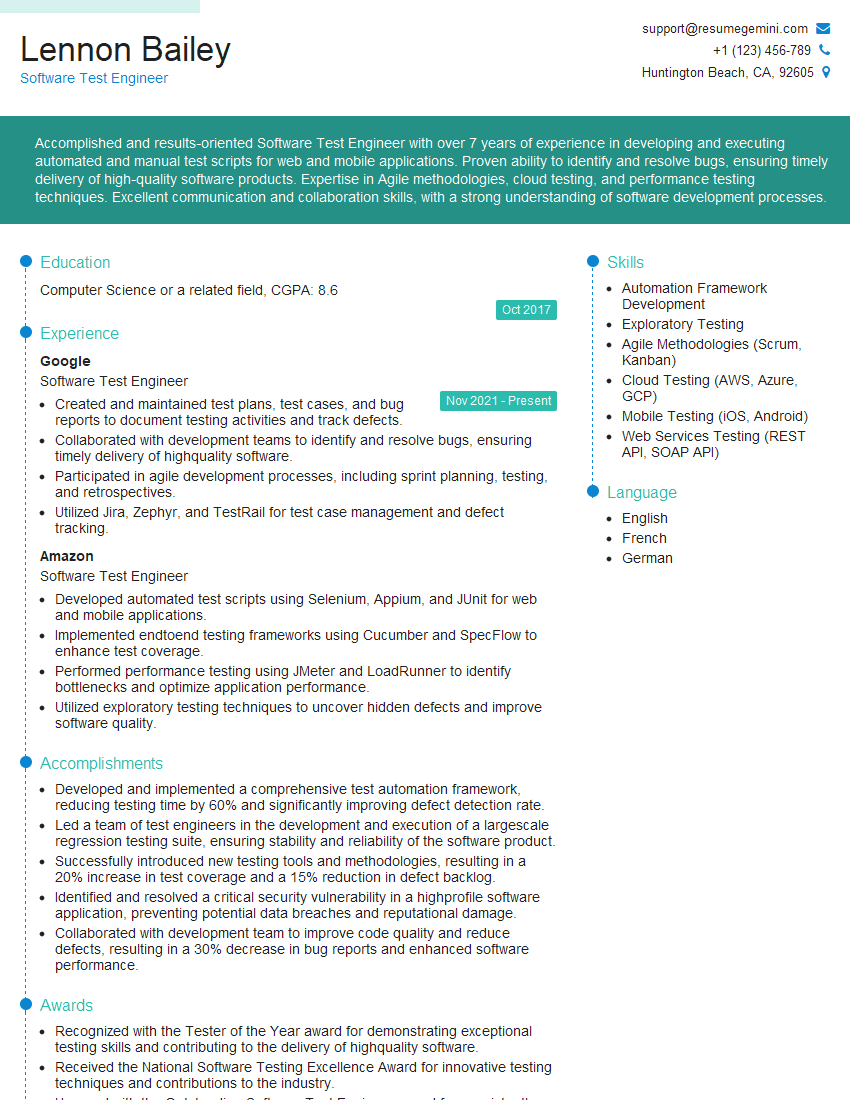
Mastering the skills related to assisting with product development and testing opens doors to exciting career opportunities in a rapidly evolving technological landscape. Strong skills in this area are highly valued, leading to increased job prospects and higher earning potential. To maximize your chances of landing your dream role, crafting a compelling and ATS-friendly resume is crucial. ResumeGemini can help you build a professional and effective resume that highlights your key skills and experiences. ResumeGemini provides examples of resumes tailored to assisting with product development and testing to guide you in creating a standout application. Invest time in creating a strong resume; it’s your first impression on potential employers.
Explore more articles
Users Rating of Our Blogs
Share Your Experience
We value your feedback! Please rate our content and share your thoughts (optional).
What Readers Say About Our Blog
To the interviewgemini.com Webmaster.
Very helpful and content specific questions to help prepare me for my interview!
Thank you
To the interviewgemini.com Webmaster.
This was kind of a unique content I found around the specialized skills. Very helpful questions and good detailed answers.
Very Helpful blog, thank you Interviewgemini team.