Are you ready to stand out in your next interview? Understanding and preparing for Ecological Flow Modeling interview questions is a game-changer. In this blog, we’ve compiled key questions and expert advice to help you showcase your skills with confidence and precision. Let’s get started on your journey to acing the interview.
Questions Asked in Ecological Flow Modeling Interview
Q 1. Explain the concept of ecological flow regimes.
Ecological flow regimes describe the natural variability of water flow in a river or stream over time. Think of it like a river’s heartbeat – it’s not a constant, steady flow, but rather a dynamic pattern of high and low flows, floods, droughts, and everything in between. These patterns are crucial because they shape the physical habitat, influence water quality, and dictate the life cycles of aquatic organisms. A healthy river ecosystem depends on the natural rhythm of its flow regime, which includes the magnitude, frequency, duration, timing, and rate of change of flows.
For example, a specific species of fish might require a particular flow rate for spawning, while another might depend on periodic flooding to create new habitat. Understanding the natural flow regime is essential for maintaining biodiversity and the overall health of the aquatic ecosystem.
Q 2. Describe different methods for determining ecological flow requirements.
Determining ecological flow requirements involves a variety of methods, each with its strengths and weaknesses. These methods broadly fall into three categories:
- Hydrological methods: These methods focus on analyzing historical flow data to establish a baseline of natural flow variability. They often involve statistical analyses to identify flow characteristics that are essential for maintaining ecosystem health. A simple example is establishing a minimum flow based on a certain percentile of historical flow data (e.g., the 75th percentile low flow).
- Hydraulic methods: These methods assess the physical habitat requirements of aquatic species. They use hydraulic modeling to simulate how different flow regimes affect channel morphology, water depth, and velocity, ultimately determining the flow needed to maintain suitable habitats.
- Biological methods: These approaches directly assess the responses of aquatic organisms to different flow regimes. This can involve field surveys to determine species composition and abundance at various flow levels, or laboratory experiments to determine the tolerance of species to different flow conditions. These methods are often more expensive and time-consuming but can provide more direct links between flow and biological responses.
Often, a holistic approach combining these methods is used to provide a robust estimate of ecological flow requirements.
Q 3. What are the key environmental flow assessment (EFA) methods?
Key Environmental Flow Assessment (EFA) methods encompass a range of approaches, but several stand out:
- Holistic methods: These methods aim to consider all aspects of the ecosystem, including hydrological, hydraulic, and biological factors. They often involve expert judgment and stakeholder consultation. The Building Block Method is a prime example, systematically analyzing flows needed for different ecological processes.
- Habitat simulation methods: These employ hydraulic and habitat models to simulate the effects of different flow regimes on physical habitat characteristics (e.g., depth, velocity, substrate). The Instream Flow Incremental Methodology (IFIM) is a widely used example.
- Flow regime-based methods: These methods analyze the entire flow regime and compare it to historical or reference conditions. This approach highlights the importance of flow variability and its impact on ecological processes. Examples include the flow regime classification approaches that compare current flow patterns with unimpaired flow data.
- Species-specific methods: These methods focus on the specific flow requirements of key indicator species. This is useful for protecting species of conservation concern. They often use biological data to develop flow-response relationships.
The choice of method depends heavily on the specific context, data availability, and project objectives. Often, a combination of methods is employed.
Q 4. Discuss the limitations of different EFA methods.
Limitations exist within every EFA method. For instance:
- Hydrological methods often rely on historical data, which might not reflect future climate change impacts or the effects of past human alterations.
- Hydraulic methods are computationally intensive and may require detailed data on channel geometry and hydraulic properties which might not always be readily available or accurate.
- Biological methods can be costly, time-consuming, and may not capture the full range of ecological responses to flow variations. Determining causality between flow and biological responses can also be challenging.
- Holistic methods, while aiming for comprehensiveness, can suffer from uncertainty due to the inherent complexity of integrating multiple data sources and expert opinions.
Understanding these limitations is crucial for interpreting EFA results and for acknowledging uncertainties in flow recommendations.
Q 5. How do you incorporate uncertainty into ecological flow assessments?
Incorporating uncertainty is vital for responsible and transparent EFA. This is typically done through:
- Sensitivity analysis: This involves examining how the EFA results change when input parameters (e.g., flow data, habitat parameters, biological data) are varied within their uncertainty ranges.
- Probabilistic methods: These methods use statistical approaches (like Monte Carlo simulations) to generate a range of possible flow recommendations, reflecting the uncertainty in the input data and model parameters.
- Scenario planning: This involves evaluating the impacts of different flow scenarios, including worst-case and best-case scenarios, to assess the robustness of the flow recommendations.
- Clearly communicating uncertainty: It’s crucial to clearly and transparently communicate the limitations and uncertainties associated with the EFA process and the resulting flow recommendations to stakeholders.
By acknowledging and quantifying uncertainty, we can provide a more realistic and robust assessment of ecological flow requirements and support more informed decision-making.
Q 6. What are the key ecological indicators used in flow assessments?
Key ecological indicators used in flow assessments vary based on the specific ecosystem and project goals. However, common indicators include:
- Species richness and abundance: The number and abundance of different aquatic species can indicate the overall health of the ecosystem and its response to flow changes.
- Habitat suitability: This assesses the extent and quality of suitable habitats for different species, considering factors like water depth, velocity, and substrate.
- Community composition: Analyzing the types of species present and their relative proportions can provide insight into the ecosystem’s condition and its sensitivity to flow alterations.
- Water quality: Indicators like dissolved oxygen, temperature, and nutrient levels are essential as flow changes directly impact water quality.
- Riparian vegetation: The health and extent of riparian vegetation can be used as an indicator of the overall health of the river ecosystem and its connection to the surrounding landscape.
- Sediment transport: Sediment movement is vital for maintaining channel morphology and providing habitat for various species; disruptions to natural sediment transport can negatively impact the ecosystem.
The selection of appropriate indicators necessitates a thorough understanding of the specific ecosystem and its response to flow variations. A combination of indicators often provides a more comprehensive assessment.
Q 7. How do you assess the impact of dams on downstream ecological flows?
Dams significantly impact downstream ecological flows by altering the natural flow regime. The impacts include:
- Reduced flow variability: Dams often regulate flows, leading to more uniform and less variable flows downstream, which can negatively affect species that rely on natural flow fluctuations.
- Changes in flow timing: Dams can alter the timing of high and low flows, disrupting the life cycles of aquatic organisms that are adapted to specific seasonal flow patterns.
- Altered sediment transport: Dams trap sediment, reducing sediment supply downstream, which can lead to channel incision, habitat loss, and changes in water quality.
- Changes in water temperature: Dams can alter water temperature regimes, impacting aquatic organisms sensitive to temperature fluctuations.
Assessing these impacts involves comparing the pre-dam flow regime (often using historical data or reconstructed unimpaired flows) with the post-dam flow regime. This involves using hydrological modeling to simulate flow conditions both with and without the dam, and combining that with biological and hydraulic assessments to determine the extent of ecological impacts. Mitigation strategies like flow releases that mimic natural flow variability can be explored to minimize negative ecological consequences.
Q 8. Explain the role of hydrological modeling in ecological flow assessment.
Hydrological modeling forms the backbone of ecological flow assessments. It provides the quantitative description of water flow regimes – the timing, magnitude, frequency, and duration of flows – that are crucial for supporting aquatic and riparian ecosystems. Essentially, it’s like creating a detailed blueprint of how water moves through a river system. We use these models to simulate different flow scenarios, for example, under various dam operations or climate change impacts. This allows us to predict how changes in flow will affect the river’s ecosystem.
For instance, a hydrological model might incorporate data on rainfall, snowmelt, evapotranspiration, groundwater recharge, and river channel geometry to predict daily or even hourly streamflows at various points along a river. This information then feeds into the ecological flow assessment to determine the flow regime needed to sustain specific ecological functions like fish spawning, riparian vegetation growth, or nutrient cycling.
Common hydrological models used in this context include HEC-RAS (Hydrologic Engineering Center’s River Analysis System) and MIKE SHE (System Hydrological European). They differ in their complexity and application, with some being better suited for specific river systems or ecological questions.
Q 9. What are the challenges in modeling ecological responses to flow alterations?
Modeling ecological responses to flow alterations presents significant challenges. One major hurdle is the inherent complexity of ecological systems. These systems are rarely linear, meaning that a small change in flow might have a disproportionately large impact, or vice-versa. We’re dealing with intricate interactions between numerous species, their habitats, and environmental factors, all of which respond in complex ways to changes in flow. For example, a reduction in flow might directly impact fish spawning success, but it could also indirectly affect insect populations, leading to cascading impacts throughout the food web.
Another challenge lies in data limitations. High-quality, long-term ecological data are often scarce, especially for less-studied systems. This makes it difficult to calibrate and validate ecological models accurately. Uncertainty is also a major factor. The inputs to our models (e.g., rainfall, temperature, species abundance) are subject to uncertainties, leading to uncertainties in the model outputs. Finally, the spatial and temporal scales of ecological processes can be challenging to represent in models, requiring careful consideration of the model’s resolution and extent.
Q 10. How do you validate ecological flow models?
Validating ecological flow models is crucial to ensure that they provide reliable predictions. We use several approaches, combining quantitative and qualitative methods. A quantitative approach might involve comparing model predictions of key ecological indicators (e.g., fish abundance, habitat area) to observed data collected from field surveys or long-term monitoring programs. A good model will show a strong correlation between predicted and observed values. However, we should remember that ecological data is often patchy and might not perfectly reflect the true state of the ecosystem.
Qualitative validation involves comparing the model’s predictions with expert knowledge and understanding of the system’s ecology. Do the model outputs make sense in the context of established ecological principles and expert judgment? Do the predicted changes align with what we’d expect based on our understanding of the ecosystem’s responses to flow changes? For example, if a model predicts a drastic decline in a fish species known to be sensitive to low flows and this aligns with observations or expert knowledge, this adds confidence to the model’s validity.
Sensitivity analysis helps us evaluate the influence of various input parameters on the model’s outputs, allowing for a better understanding of uncertainties and critical factors in the system. We can then focus research efforts and data collection to address the biggest uncertainties.
Q 11. Describe your experience with specific ecological flow modeling software (e.g., HEC-RAS, MIKE SHE).
I have extensive experience with both HEC-RAS and MIKE SHE, using them for various ecological flow modeling projects. HEC-RAS is particularly useful for hydraulic modeling of river channels, enabling us to simulate water depths, velocities, and sediment transport under different flow regimes. This hydraulic information is then used as input for ecological habitat models. I’ve used it to assess the impact of dam releases on downstream fish habitat in several river basins.
MIKE SHE is a more comprehensive, integrated hydrological model, capable of simulating water flow in both surface and subsurface systems. This is especially beneficial when analyzing the influence of groundwater on riparian ecosystems. I employed MIKE SHE in a project assessing the impact of groundwater abstraction on wetland ecosystems, using it to model changes in groundwater levels and surface water flow regimes. The choice of software depends on the specific project needs and the nature of the river system being studied; the available data often plays a decisive role in software selection.
Q 12. How do you integrate stakeholder perspectives into ecological flow assessments?
Integrating stakeholder perspectives is critical for successful ecological flow assessments. These assessments are not solely scientific exercises; they often have significant social and economic implications for communities that depend on river resources. Engaging stakeholders from the outset ensures that the assessment considers the diverse values and needs of all interested parties. This also improves the acceptance and implementation of resulting management strategies.
I typically employ participatory methods, such as workshops, interviews, and public forums, to gather information and perspectives from diverse stakeholders, including local communities, water managers, environmental groups, and industries. This collaborative approach enables a better understanding of the trade-offs involved in ecological flow management. It also helps to identify practical and socially acceptable solutions that balance ecological needs with human demands on water resources. For example, in a recent project, we used a participatory modeling approach to collaboratively develop scenarios for managing flows that balanced downstream ecological needs with the needs of upstream hydropower generation.
Q 13. What are the legal and regulatory frameworks governing ecological flow management in [specific region]?
Please specify the region you are interested in. The legal and regulatory frameworks governing ecological flow management vary significantly across jurisdictions. For example, in [**Insert Specific Region Here**], the relevant legislation might include [**Insert Specific Legislation Here**], which outlines guidelines for minimum flows or environmental water allocations. These regulations often specify criteria for determining ecological flows and provide mechanisms for enforcement. The specific legal and regulatory details would greatly depend on the region; I need that information to provide a complete and accurate response.
These frameworks typically aim to balance competing water uses, ensuring sufficient flows to maintain ecosystem health while also accommodating human needs for water supply, irrigation, and power generation. The enforcement mechanisms may include licensing requirements, monitoring programs, and penalties for violations.
Q 14. Discuss the relationship between ecological flows and water quality.
Ecological flows and water quality are inextricably linked. The flow regime profoundly influences water quality through several mechanisms. For instance, sufficient flows ensure adequate dilution of pollutants, preventing harmful concentrations from accumulating. They also influence the transport of sediments and nutrients, affecting water clarity and nutrient availability for aquatic life. Low flows can lead to increased concentrations of pollutants and reduced oxygen levels, negatively impacting water quality and aquatic ecosystems. Conversely, high flows, especially during flood events, can lead to erosion, resulting in increased sediment loads, which negatively impact water quality and aquatic habitats.
For example, maintaining appropriate flows can help reduce the impact of agricultural runoff by diluting pollutants. Conversely, reduced flows can lead to the stagnation of water, increasing the concentration of harmful substances and degrading water quality. Therefore, integrated water resource management plans should consider both water quality and ecological flow requirements to ensure the sustainability of aquatic ecosystems.
Q 15. Explain the concept of flow permanence and its ecological significance.
Flow permanence, in ecological flow modeling, refers to the consistency and predictability of water flow in a river or stream. It’s not simply about the *amount* of water, but also the *timing* and *duration* of flow events throughout the year. High flow permanence indicates a consistently flowing water body, while low permanence suggests intermittent or ephemeral flows.
Ecologically, flow permanence is crucial because many aquatic organisms, from insects to fish, have life cycles tightly coupled to the hydrological regime. For example, some fish species require consistent flows for spawning and egg development. Intermittent flows can lead to habitat loss, disrupt breeding cycles, and increase vulnerability to predation. Imagine a river that dries up periodically: the aquatic plants and animals relying on it must adapt to these dramatic changes or perish. A consistently flowing river, on the other hand, provides a stable and predictable habitat supporting greater biodiversity and ecological resilience.
Consider a riparian ecosystem: the area adjacent to the river. Consistent flows support the growth of riparian vegetation, providing habitat for terrestrial wildlife and also helping to stabilize riverbanks, preventing erosion. In contrast, intermittent flows can lead to desertification of riverbanks and disrupt this crucial ecosystem interaction.
Career Expert Tips:
- Ace those interviews! Prepare effectively by reviewing the Top 50 Most Common Interview Questions on ResumeGemini.
- Navigate your job search with confidence! Explore a wide range of Career Tips on ResumeGemini. Learn about common challenges and recommendations to overcome them.
- Craft the perfect resume! Master the Art of Resume Writing with ResumeGemini’s guide. Showcase your unique qualifications and achievements effectively.
- Don’t miss out on holiday savings! Build your dream resume with ResumeGemini’s ATS optimized templates.
Q 16. How do you assess the impact of climate change on ecological flows?
Assessing the impact of climate change on ecological flows requires a multifaceted approach. We need to consider several key factors:
- Changes in precipitation patterns: Increased intensity and frequency of droughts or floods can drastically alter flow regimes, leading to increased flow variability and reduced permanence.
- Altered snowmelt: In many regions, glacial melt and snowpack contribute significantly to river flows. Climate change is accelerating snowmelt and glacial recession, leading to changes in the timing and magnitude of spring runoff.
- Increased evaporation: Higher temperatures can lead to increased evaporation rates, reducing water availability and altering downstream flows.
- Sea-level rise: In coastal areas, sea-level rise can lead to saltwater intrusion into freshwater ecosystems, dramatically impacting both flow regimes and water quality.
To assess these impacts, we use various methods: hydrological modeling (e.g., using models like SWAT or HBV), statistical analysis of historical flow data and climate projections (often incorporating downscaled climate data), and scenario planning to explore different future climate scenarios. We might also incorporate remote sensing data, such as satellite imagery of snowpack or vegetation indices, to monitor changes over time.
For example, in a recent project, we used a hydrological model to project changes in streamflow under various climate change scenarios. This allowed stakeholders to understand the potential risks to aquatic ecosystems and inform water management strategies.
Q 17. What are the economic implications of implementing ecological flow recommendations?
Implementing ecological flow recommendations often carries significant economic implications, impacting various sectors. There can be both costs and benefits.
Costs: Implementing ecological flows can require significant investments in infrastructure upgrades, such as dam modifications or water storage improvements, to maintain sufficient flows downstream. These costs can be substantial, especially for large-scale projects. Furthermore, water restrictions imposed to meet ecological flow targets might affect irrigation for agriculture or industrial water use, leading to economic losses in these sectors.
Benefits: The benefits, however, are multifaceted. Maintaining healthy river ecosystems enhances ecosystem services, such as improved water quality (leading to reduced treatment costs), increased fisheries yields, and enhanced recreational opportunities (boosting tourism). A healthy river ecosystem contributes to overall economic resilience, with reduced risks associated with floods, droughts, and ecosystem collapse.
Cost-benefit analysis, incorporating both economic and ecological factors, is crucial for evaluating the economic viability and overall social value of ecological flow recommendations. The analysis needs to consider various time scales, discount rates, and uncertainty in projections.
Q 18. Describe your experience with data analysis techniques used in ecological flow modeling.
My experience with data analysis in ecological flow modeling encompasses a range of techniques.
- Statistical analysis: I frequently use statistical methods like time series analysis (e.g., ARIMA modeling) to analyze historical flow data, identify trends, and predict future flows. I also use various regression techniques to explore relationships between flow variables and environmental factors.
- Hydrological modeling: I’m proficient in using hydrological models (SWAT, HBV, etc.) to simulate river flows under various scenarios, including climate change impacts and different water management strategies.
- Multivariate analysis: Techniques such as principal component analysis (PCA) and cluster analysis are valuable for reducing data dimensionality and identifying patterns in large datasets of hydrological and ecological data.
- Geospatial analysis: I utilize GIS software to analyze spatial patterns in flow data, map habitat suitability for aquatic organisms, and assess the connectivity of river networks.
For instance, in one project involving a large river basin, we used PCA to identify the key environmental drivers influencing fish populations, which allowed us to focus management efforts on the most critical factors. In another, we used a hydrological model to evaluate the effectiveness of different dam operation strategies in maintaining ecological flows.
Q 19. How do you handle missing data in ecological flow assessments?
Missing data is a common challenge in ecological flow assessments, often due to gaps in historical records or limitations in monitoring networks. Addressing this requires careful consideration.
- Data imputation: We can use various methods to fill in missing data, such as linear interpolation, spline interpolation, or more sophisticated techniques like multiple imputation. The choice of method depends on the nature of the data and the potential biases it might introduce.
- Data augmentation: In some cases, we might augment the available data by using information from nearby gauging stations or by using hydrological models to simulate flow in ungauged catchments.
- Sensitivity analysis: It is critical to assess the sensitivity of the results to the imputation method. If the results are significantly affected by the chosen imputation method, it indicates that more data are required or that alternative analytical approaches should be used.
- Robust statistical methods: We can utilize robust statistical methods which are less sensitive to outliers and missing data.
The selection of the appropriate method depends on the extent of missing data, the pattern of missingness, and the specific research question. It’s crucial to document the data handling procedures to ensure transparency and reproducibility.
Q 20. What are the ethical considerations in ecological flow management?
Ethical considerations in ecological flow management are paramount. We must consider the impacts on various stakeholders and ensure equitable and sustainable water resource allocation.
- Intergenerational equity: We have a responsibility to ensure that future generations have access to the same level of ecological integrity as we do today. Over-exploitation of water resources for short-term economic gains is unethical if it compromises the long-term health of ecosystems.
- Intra-generational equity: We need to ensure fair distribution of water resources among different stakeholders, including agricultural users, urban populations, and the environment. Prioritizing human needs over environmental needs can be problematic and may lead to ecological damage and long-term social and economic consequences. Conversely, ignoring the economic necessities of communities can be just as detrimental.
- Precautionary principle: In situations of scientific uncertainty, it’s ethically sound to adopt a precautionary approach and err on the side of caution, prioritizing environmental protection.
- Transparency and participation: Decision-making processes should be transparent, and stakeholders should be involved in setting ecological flow targets and developing management plans. This allows for open dialogue and promotes trust among stakeholders.
Ethical considerations often require navigating complex trade-offs between different values and priorities, and it is our responsibility to find sustainable solutions that respect both the needs of human societies and the well-being of our planet.
Q 21. Explain the difference between minimum flow requirements and environmental flow requirements.
While both minimum flow requirements and environmental flow requirements aim to protect aquatic ecosystems, there’s a key difference in their scope and approach.
Minimum flow requirements (MFRs) often focus on maintaining a basic level of flow to prevent the complete drying up of a water body or to support a narrow range of human uses. These requirements are often established based on the minimum flow needed to prevent water quality problems or maintain navigation. They usually represent a simplified approach and may not adequately consider the full ecological needs of the ecosystem.
Environmental flow requirements (EFRs), on the other hand, are more holistic. They seek to maintain a more complete and natural flow regime, considering the full range of flow variability, including seasonal changes, floods, and droughts. EFRs are developed through a more comprehensive assessment that considers the ecological requirements of all the species within an ecosystem. They take into account the impacts on fish migration, spawning, sediment transport, nutrient cycling, and the maintenance of healthy riparian habitats. EFRs are thus more ecologically robust and provide a more complete safeguard for river ecosystems.
In essence, MFRs are a minimum threshold, often focused on avoiding catastrophic damage, whereas EFRs strive to maintain a more natural and ecologically sustainable flow regime.
Q 22. How do you prioritize different ecological values in flow management decisions?
Prioritizing ecological values in flow management is a complex process that often involves balancing competing interests. It’s not simply about picking the ‘most important’ value; instead, it requires a structured approach that considers the interconnectedness of different aspects of the river ecosystem.
We typically use a multi-criteria decision analysis (MCDA) framework. This involves:
- Identifying relevant values: This might include maintaining fish spawning habitat, supporting riparian vegetation, ensuring water quality, or preserving recreational opportunities. Each value needs a clear definition and measurable indicators.
- Weighting values: This is often the most challenging step, involving stakeholder engagement and scientific assessment. We might use techniques like pairwise comparisons or analytic hierarchy process (AHP) to determine the relative importance of each value. For example, in a region heavily reliant on fisheries, maintaining fish spawning flows might receive a higher weight than maintaining specific water levels for recreation.
- Scoring alternative flow regimes: Different flow regimes (e.g., constant flow, pulsed flow) are evaluated against each ecological value. Scores might range from 1 (poor performance) to 5 (excellent performance), based on scientific evidence and expert judgment.
- Synthesizing results: Finally, we combine the weighted values and scores to rank the alternative flow regimes. The regime with the highest overall score is generally preferred, but sensitivity analysis is essential to test the robustness of the results to changes in weighting or scoring.
For example, in a project I worked on in the Colorado River Basin, we used this approach to balance the needs of endangered fish species with the demands of irrigation. By explicitly weighting ecological values, we could justify and transparently communicate our flow recommendations.
Q 23. Describe your experience with flow monitoring and data collection techniques.
My experience with flow monitoring and data collection spans over 15 years, encompassing a variety of techniques and technologies. We rarely rely on a single method; instead, we employ a suite of approaches tailored to the specific river system and research question.
- In-situ measurements: This includes using stream gauges to continuously monitor water levels and discharge. We also use a variety of sensors to measure water temperature, turbidity, and dissolved oxygen. These sensors can be deployed at fixed locations or mounted on mobile platforms for spatial surveys.
- Remote sensing: Satellite imagery and aerial photography provide valuable data on water surface area, vegetation cover, and other landscape features relevant to flow regime assessments. For instance, we use Landsat imagery to track changes in riparian vegetation health related to altered flow patterns.
- Acoustic Doppler current profilers (ADCPs): These are invaluable for measuring velocity profiles and discharge in rivers, providing a detailed understanding of flow dynamics. We frequently use ADCPs to assess flow patterns in complex channel reaches.
- Biological surveys: Collecting biological data (fish populations, macroinvertebrates) allows us to directly assess the ecological response to flow regimes. This involves field surveys, electrofishing, and laboratory analysis.
Data quality control is paramount. We follow rigorous protocols for calibration, data validation, and error analysis. Data management is also crucial; we use dedicated databases and software to store, manage, and analyze the vast datasets generated from these diverse sources.
Q 24. Discuss the role of adaptive management in ecological flow management.
Adaptive management is crucial for ecological flow management because river systems are dynamic and our understanding of them is constantly evolving. It’s a cyclical process of planning, implementing, monitoring, and adjusting flow regimes based on feedback.
The process generally looks like this:
- Develop a preliminary flow regime: This initial flow regime is often based on existing ecological flow models and expert knowledge. It could also be a modification of the pre-existing flow regime.
- Implement and monitor: The chosen flow regime is implemented, and key ecological indicators are carefully monitored. This may involve long-term monitoring of both physical parameters (flow, temperature) and biological parameters (fish abundance, water quality).
- Assess performance: After a specified period, the performance of the flow regime is assessed using quantitative metrics. Did the flow regime achieve the desired ecological outcomes? This often involves statistical analysis to determine if changes in biological indicators are statistically significant and correlated with flow changes.
- Adapt the flow regime: Based on the assessment, the flow regime is adjusted. This might involve minor tweaks or more substantial changes, depending on the results of the monitoring and assessment. The whole cycle then repeats itself.
This iterative process allows for learning and improvement over time, leading to more effective and sustainable flow management. For example, in restoring a degraded river, initial flow recommendations might be based on historical flow data and habitat requirements of key species. Monitoring could reveal that the actual response of the ecosystem differs from expectations, leading to adjustments in the flow regime.
Q 25. What are the future trends and challenges in ecological flow modeling?
The future of ecological flow modeling is exciting and faces several key challenges:
- Climate change impacts: Climate change is altering precipitation patterns, increasing the frequency and intensity of extreme events, and significantly impacting river flows. Models must incorporate these changes to accurately predict future conditions and develop resilient management strategies.
- Integration of multiple stressors: Rivers are impacted by multiple stressors, including habitat degradation, pollution, and invasive species. Future models must integrate these stressors to provide a more holistic understanding of ecosystem responses. We need integrated models that incorporate hydrology, ecology, and other relevant fields.
- Advancements in computational power and data analytics: The availability of large datasets and sophisticated computational tools is enabling the development of more complex and realistic flow models. Methods such as machine learning and artificial intelligence offer new approaches to analyze data and predict ecosystem responses to changes in flow.
- Increased stakeholder engagement and communication: Flow management decisions have significant social and economic implications, making effective communication with diverse stakeholders crucial. This requires making complex scientific information more accessible and engaging.
One of the most promising trends is the development of integrated modeling frameworks that combine hydrological, ecological, and socioeconomic models. These models can help us evaluate trade-offs between competing demands on water resources and develop more sustainable management strategies.
Q 26. Explain how you would approach the development of an ecological flow management plan for a specific river system.
Developing an ecological flow management plan is a multi-stage process, requiring strong collaboration among ecologists, hydrologists, engineers, and stakeholders. My approach would be:
- Define the scope and objectives: Clearly define the geographic boundaries of the river system, identify key stakeholders, and specify the goals of the plan (e.g., improve water quality, protect endangered species, enhance recreation). Establishing clear objectives is paramount before beginning the process.
- Data collection and analysis: Gather historical flow data, conduct field surveys to assess current ecological conditions, and review existing literature on the river system. Use this data to calibrate and validate ecological flow models.
- Ecological flow assessment: Employ appropriate ecological flow methods (e.g., habitat simulation models, flow regime analysis) to determine suitable flow regimes for the river system. These methods help predict the ecological impacts of different flow scenarios.
- Stakeholder engagement and consultation: Actively involve stakeholders in the process through workshops, public meetings, and surveys. Addressing stakeholder concerns and integrating different perspectives into the plan is vital for its success and buy-in.
- Develop and implement the flow management plan: Based on the ecological flow assessment and stakeholder input, develop a detailed flow management plan that outlines specific flow targets, monitoring protocols, and adaptive management strategies.
- Monitoring and evaluation: Implement a robust monitoring program to track the effectiveness of the flow management plan and make adjustments as needed. This forms the adaptive management component.
For example, if we’re developing a plan for a river impacted by dam operations, we would use hydrological models to simulate different dam release strategies and assess their impacts on downstream flow regimes and ecological conditions.
Q 27. How do you communicate complex ecological flow data to non-technical audiences?
Communicating complex ecological flow data to non-technical audiences requires a strategic approach focused on clarity, simplicity, and visual aids. My approach involves:
- Use plain language: Avoid technical jargon and use simple, everyday language to explain key concepts. Analogies and metaphors are helpful to make abstract ideas more relatable. For instance, I would explain the concept of minimum flow as the amount of water needed to keep the ‘river alive’ rather than using scientific terms.
- Visualize data: Charts, graphs, and maps are effective tools to communicate complex information visually. For example, a simple bar graph showing changes in fish populations before and after implementing a new flow regime is far more engaging than a table of numbers. Maps showing areas that are affected by changes in flow are also very helpful.
- Tell stories: People connect with narratives. Use storytelling to illustrate the importance of ecological flows and the potential consequences of inaction. I might describe the impacts on a specific fish species or other animals that are easily related to by the community.
- Focus on key messages: Identify 2-3 key messages to emphasize and keep the communication focused. Avoid overwhelming the audience with too much information.
- Use interactive tools: Web-based interactive tools and visualizations can engage the audience and allow them to explore the data at their own pace.
For instance, when presenting to a community about a river restoration project, I would use photographs of the river in its degraded state and in a restored state to demonstrate the improvements achieved by implementing better flow management strategies. I would also employ infographics highlighting the changes in water quality or fish populations to help convey the positive impacts.
Key Topics to Learn for Ecological Flow Modeling Interview
- Fundamental Concepts: Understanding hydrological processes, water balance equations, and ecological responses to flow regimes.
- Modeling Techniques: Proficiency in various modeling approaches, including statistical, process-based, and coupled hydrological-ecological models. Familiarize yourself with model strengths and limitations.
- Data Analysis & Interpretation: Experience with data acquisition, processing, and analysis relevant to flow modeling, including time series analysis and statistical inference.
- Practical Applications: Understanding the application of ecological flow modeling in river restoration, dam management, water resource allocation, and impact assessments.
- Calibration and Validation: Mastering techniques for model calibration, validation, and uncertainty analysis. Understand the importance of model sensitivity analysis.
- Software Proficiency: Demonstrate familiarity with relevant software packages used in ecological flow modeling (mention specific software if applicable to your target audience, e.g., HEC-RAS, MIKE SHE).
- Scenario Planning & Prediction: Ability to use models for predicting future ecological responses under different flow scenarios (e.g., climate change, land-use change).
- Communication & Visualization: Effectively communicating complex modeling results through clear reports, presentations, and data visualizations.
Next Steps
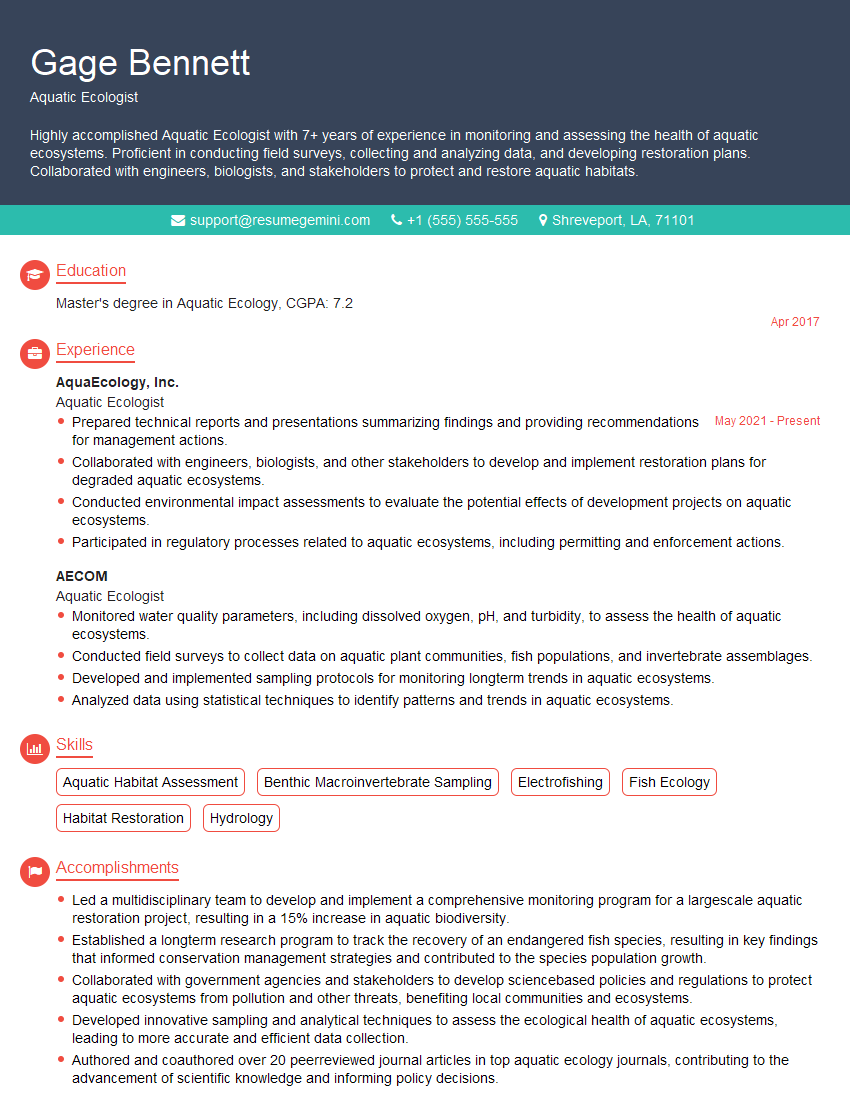
Mastering ecological flow modeling opens doors to exciting careers in environmental consulting, research, and government agencies. It positions you as a valuable asset in addressing critical water resource and ecological challenges. To maximize your job prospects, creating a strong, ATS-friendly resume is crucial. ResumeGemini is a trusted resource that can help you craft a compelling resume highlighting your skills and experience in this specialized field. Examples of resumes tailored to Ecological Flow Modeling are available to further guide your preparation.
Explore more articles
Users Rating of Our Blogs
Share Your Experience
We value your feedback! Please rate our content and share your thoughts (optional).
What Readers Say About Our Blog
To the interviewgemini.com Webmaster.
Very helpful and content specific questions to help prepare me for my interview!
Thank you
To the interviewgemini.com Webmaster.
This was kind of a unique content I found around the specialized skills. Very helpful questions and good detailed answers.
Very Helpful blog, thank you Interviewgemini team.