Interviews are opportunities to demonstrate your expertise, and this guide is here to help you shine. Explore the essential Scrap Sorting and Segregation interview questions that employers frequently ask, paired with strategies for crafting responses that set you apart from the competition.
Questions Asked in Scrap Sorting and Segregation Interview
Q 1. Explain the different methods used for scrap sorting.
Scrap sorting methods vary greatly depending on the type and quantity of scrap, desired purity, and available resources. They range from simple manual sorting to highly automated systems. Common methods include:
- Manual Sorting: This is the most basic method, involving human workers visually inspecting and categorizing scrap based on material type, size, and condition. It’s effective for smaller volumes and materials requiring careful visual inspection but is labor-intensive and prone to human error.
- Automated Sorting: This utilizes technologies like eddy current separators (for separating ferrous and non-ferrous metals), optical sorters (using sensors to identify materials by their color and composition), and air classifiers (separating materials by density and size). Automated systems are faster, more accurate, and can handle larger volumes but require significant capital investment.
- Density Separation: Materials are separated based on their density using techniques like trommels (rotating drums with screens), or water-based separation systems. Denser materials sink while lighter ones float. This is effective for separating materials with significant density differences.
- Magnetic Separation: Uses powerful magnets to separate ferrous metals (iron, steel) from non-ferrous metals and other materials. This is a very common and effective method in many scrap yards.
The choice of method often depends on a combination of factors such as cost, throughput requirements, material characteristics, and environmental regulations.
Q 2. Describe your experience with various types of scrap materials (metals, plastics, etc.).
My experience encompasses a wide range of scrap materials, including various ferrous and non-ferrous metals such as steel, aluminum, copper, brass, and stainless steel. I’ve also worked extensively with different types of plastics, including PET, HDPE, PVC, and PP, alongside rubber, textiles, wood, and paper.
Working with these diverse materials has provided me with a deep understanding of their physical and chemical properties, their respective recycling processes, and the challenges associated with their effective separation. For instance, I’ve developed expertise in distinguishing different grades of steel based on their magnetic properties and surface finishes, as well as identifying various plastic types through visual inspection and material testing.
One particularly challenging experience involved sorting a mixed stream of electronics scrap. This required careful handling to avoid exposure to hazardous materials and precise identification of different components (circuit boards, plastics, metals) for proper recycling or disposal.
Q 3. How do you identify and handle hazardous materials during scrap sorting?
Identifying and handling hazardous materials is paramount in scrap sorting. This involves a multi-step process:
- Visual Inspection: Identifying potential hazards such as broken glass, batteries, electronic components, asbestos-containing materials, and containers of unknown substances through careful visual examination.
- Material Testing: Using tools and techniques to confirm the presence of hazardous substances. This might include specialized testing kits for identifying asbestos or lead-based paints.
- Segregation: Immediately segregating identified hazardous materials from other scrap streams. This often involves dedicated containers labeled clearly with the hazard type and appropriate safety warnings.
- Safe Disposal/Treatment: Following all relevant regulations for the safe disposal or treatment of hazardous materials. This often involves contacting licensed hazardous waste haulers or specialized recycling facilities.
For example, if a lithium-ion battery is found, it would be immediately removed and placed in a designated container, away from other combustibles, to prevent fire or explosion risks.
Q 4. What safety precautions do you follow while working with scrap materials?
Safety is my top priority. While working with scrap, I consistently adhere to the following precautions:
- Personal Protective Equipment (PPE): Always wearing appropriate PPE, including safety glasses, gloves, steel-toe boots, and high-visibility clothing. The specific PPE varies depending on the material being handled.
- Safe Handling Techniques: Using proper lifting techniques to avoid back injuries and avoiding direct contact with sharp or potentially hazardous materials.
- Machine Safety: If using automated equipment, strictly following all operating procedures, lockout/tagout procedures, and safety interlocks.
- Environmental Awareness: Being mindful of potential environmental hazards and minimizing dust, noise, and other pollution.
- Regular Inspections: Regularly inspecting the work area for potential hazards, such as spills, debris, or damaged equipment.
Regular safety training and awareness are essential to maintaining a safe work environment. A proactive approach to identifying and mitigating potential hazards is key.
Q 5. How do you ensure the accuracy and efficiency of the scrap sorting process?
Ensuring accuracy and efficiency involves a combination of strategies:
- Well-Defined Sorting Criteria: Establishing clear and consistent criteria for material classification to minimize ambiguity and errors.
- Regular Quality Control Checks: Implementing regular checks to ensure that materials are being sorted correctly. This may involve randomly sampling sorted materials and verifying their classification.
- Employee Training: Providing comprehensive training to employees on proper sorting procedures, safety regulations, and material identification.
- Process Optimization: Continuously improving the sorting process through process mapping, identifying bottlenecks, and streamlining workflows. This could involve optimizing material flow, improving equipment, or adjusting worker assignments.
- Data Tracking and Analysis: Collecting data on sorting performance (e.g., sorting speed, error rate, material yield) to identify areas for improvement.
For example, tracking the error rate for each sorter allows us to pinpoint areas requiring additional training or process adjustments, improving overall accuracy.
Q 6. Describe your experience with different sorting technologies (manual, automated).
My experience spans both manual and automated sorting technologies. Manual sorting, while slower, provides a high degree of precision for complex materials that require visual inspection. I’ve managed teams performing manual sorting, focusing on training and establishing consistent quality control procedures.
Automated systems, such as eddy current separators and optical sorters, are considerably faster and can handle significantly larger volumes. I have extensive experience operating and maintaining these systems, troubleshooting malfunctions, and optimizing parameters for maximum efficiency and purity.
The choice between manual and automated systems depends on the specific application. Often, a hybrid approach is most effective, combining the precision of manual sorting with the speed and efficiency of automation for specific tasks.
Q 7. How do you handle contamination in scrap materials?
Contamination is a significant challenge in scrap sorting. It reduces the value of the recyclable material and can compromise the quality of recycled products. Handling contamination requires a multi-pronged approach:
- Source Reduction: Minimizing contamination at the source by working with suppliers to ensure materials are properly segregated before arrival.
- Pre-Sorting: Implementing pre-sorting stages to remove gross contaminants before the main sorting process.
- Careful Sorting: Employing meticulous sorting techniques to identify and remove contaminants, using both visual inspection and automated systems.
- Contamination Tracking: Keeping detailed records of contamination types and sources to identify trends and implement corrective actions.
- Contamination Management System: Establishing a robust system for handling and disposing of contaminated materials in accordance with environmental regulations. This may involve specialized processes or disposal routes for contaminated materials.
For instance, if plastic contamination is found in a metal scrap stream, it might be manually removed or, if the volume is high, an air classifier might be used to separate the materials based on density.
Q 8. Explain your understanding of different recycling processes and their impact on scrap sorting.
Recycling processes significantly influence scrap sorting. Different materials require distinct processing methods, directly impacting how we sort them upstream. For example, paper recycling involves pulping and de-inking, requiring sorted paper to be free from contaminants like plastics or metals. These contaminants would disrupt the pulping process and reduce the quality of the recycled paper. Similarly, plastic recycling often involves sorting by resin type (e.g., PET, HDPE, PP) because different plastics require different processing temperatures and methods. Improper sorting leads to cross-contamination and reduces the recyclability of the plastics. Metal recycling involves processes like shredding, melting, and refining; therefore, maintaining purity in the sorted metal streams (e.g., separating aluminum from steel) is crucial for efficient and cost-effective recycling. In short, a thorough understanding of the downstream recycling process is paramount to effective scrap sorting, driving material purity and maximizing the value of recovered materials.
- Paper Recycling: Requires separation of paper types and removal of contaminants like plastics and food residue.
- Plastic Recycling: Necessitates sorting by resin type (PET, HDPE, etc.) and removal of non-recyclable plastics.
- Metal Recycling: Demands separation of ferrous and non-ferrous metals, and further sorting by metal type (aluminum, copper, steel etc.) to maximize value.
Q 9. How do you maintain a clean and organized workspace in a scrap sorting environment?
Maintaining a clean and organized workspace in scrap sorting is critical for safety, efficiency, and quality. Think of it like a well-stocked kitchen – if everything has its place, you can work quickly and safely. We achieve this through several strategies: First, we designate specific areas for different material types. Clearly labeled bins and containers are crucial. Second, regular cleanup is essential – we schedule short breaks throughout the day to tidy up our immediate workspaces. Third, we use proper Personal Protective Equipment (PPE) to avoid contamination and maintain hygiene. Fourth, we implement a color-coded system for different material streams to avoid confusion and ensure correct sorting. For instance, blue bins for plastics, green for glass, and red for metals make the sorting process intuitive and faster. Lastly, regular facility-wide cleanups prevent the accumulation of waste and maintain a safe working environment. This disciplined approach enhances both our individual productivity and the overall efficiency of the sorting process.
Q 10. What are the key performance indicators (KPIs) for scrap sorting?
Key Performance Indicators (KPIs) for scrap sorting measure efficiency, accuracy, and overall effectiveness. We track several key metrics:
- Throughput: The volume of scrap processed per hour or day. This helps us understand our operational capacity.
- Purity Rate: The percentage of correctly sorted materials in each stream. High purity is essential for downstream recycling processes.
- Contamination Rate: The percentage of incorrectly sorted materials, indicating the need for process improvement.
- Recovery Rate: The percentage of recyclable materials successfully recovered from the total input. This metric shows how effective our sorting process is.
- Safety Incidents: The number of accidents or near misses. A low rate indicates a safe working environment.
- Processing Cost per Ton: This helps assess our overall operational efficiency and identify areas for cost reduction.
Regular monitoring of these KPIs allows for data-driven decision making, enabling us to optimize processes, enhance efficiency, and improve overall profitability.
Q 11. Describe your experience with data entry and record-keeping in a scrap sorting facility.
Data entry and record-keeping are integral to scrap sorting operations. Accurate records ensure traceability, compliance, and efficient management. We utilize a computerized system to record the quantity and type of each material stream. This data is essential for tracking performance, generating reports for clients, and complying with environmental regulations. For each batch of scrap received, we meticulously record the date, source, type of material, weight, and any relevant observations regarding quality or contamination. The data is then used to generate various reports, including daily throughput summaries, monthly material summaries, and annual reports. This detailed record-keeping ensures transparent management of the recycling process and helps to improve efficiency and accountability. Any discrepancies or issues are immediately flagged and addressed, fostering a culture of continuous improvement.
Q 12. How do you deal with challenging or complex scrap sorting situations?
Challenging situations in scrap sorting often involve unusual or contaminated materials, requiring careful assessment and problem-solving. For instance, if a batch contains materials that are unusually mixed, we need to carefully separate them manually, maybe even using specialized tools. If a material is unknown or hard to classify, we conduct thorough research or seek expert advice to determine its proper handling and disposal. We always prioritize safety – if a material presents a safety risk, we’ll isolate it and follow established safety protocols before proceeding. A structured approach is critical; we follow a step-by-step process: 1) Identify the problem; 2) Assess the risk; 3) Determine the best solution; 4) Implement the solution; 5) Document the outcome. This methodical approach ensures that we handle complex situations safely and effectively, maintaining quality and compliance throughout.
Q 13. What are the environmental regulations related to scrap sorting and recycling in your region?
Environmental regulations concerning scrap sorting and recycling vary by region, but generally focus on minimizing environmental impact and promoting responsible waste management. In our area, we must adhere to regulations regarding hazardous waste handling, proper disposal of non-recyclable materials, and emissions control. We are required to obtain permits for handling certain materials, and regular inspections ensure compliance. We maintain detailed records of all materials processed, documenting the quantities, types, and disposal methods used. We are also required to conduct regular environmental audits to identify potential risks and implement mitigation strategies. Staying current on regulatory changes is essential, and we actively participate in industry events and training programs to ensure we meet all the legal requirements and promote environmentally responsible practices.
Q 14. How do you manage and resolve conflicts among team members during scrap sorting?
Conflict resolution is an essential aspect of teamwork in scrap sorting. We foster a respectful and collaborative work environment by encouraging open communication. If conflicts arise, we address them promptly and constructively using a structured approach. We encourage team members to discuss their concerns openly and respectfully. Mediation, if necessary, is undertaken by a supervisor to ensure a fair and unbiased resolution. The focus is always on finding solutions that benefit the team and maintain productivity. Regular team meetings provide opportunities to address issues proactively and prevent conflicts from escalating. We emphasize mutual respect and understanding, recognizing that effective teamwork is essential for a smooth and efficient scrap sorting process.
Q 15. How familiar are you with different types of balers and compactors?
My familiarity with balers and compactors is extensive. These machines are crucial for efficient scrap handling. I’ve worked with various types, each optimized for specific materials and throughput needs. For example, horizontal balers are ideal for large volumes of loose material like cardboard or plastics, creating dense, easily-transportable bales. Vertical balers, conversely, are better suited for smaller, denser materials such as metals, achieving higher compression ratios. Then there are auto-tie balers which offer automation for increased efficiency. Compactors, on the other hand, are primarily used for reducing the volume of waste before disposal, often used for materials less suited to baling. I understand the nuances of each type, including their maintenance requirements, operational limitations, and the impact of different settings on bale density and quality.
Specifically, I have hands-on experience with:
- Horizontal balers (e.g., Chamber-style, Two-ram balers)
- Vertical balers (e.g., Auto-tie, manual tie)
- Self-contained compactors
- Stationary compactors
Understanding these differences is critical for selecting the right equipment to optimize a scrap yard’s operations and maximize the value of recovered materials.
Career Expert Tips:
- Ace those interviews! Prepare effectively by reviewing the Top 50 Most Common Interview Questions on ResumeGemini.
- Navigate your job search with confidence! Explore a wide range of Career Tips on ResumeGemini. Learn about common challenges and recommendations to overcome them.
- Craft the perfect resume! Master the Art of Resume Writing with ResumeGemini’s guide. Showcase your unique qualifications and achievements effectively.
- Don’t miss out on holiday savings! Build your dream resume with ResumeGemini’s ATS optimized templates.
Q 16. Explain your experience with the use of material handling equipment (forklifts, conveyors).
Material handling equipment is the backbone of efficient scrap sorting and segregation. My experience encompasses the safe and productive use of both forklifts and conveyors. I’m certified to operate various forklift types (reach trucks, counterbalance, etc.) and adept at loading and unloading trucks, stacking materials, and maneuvering within confined spaces. Safety is paramount – I strictly adhere to all safety protocols, including pre-operational checks, load weight limits, and appropriate speed adjustments depending on the load and terrain.
Conveyors play a significant role in automating the flow of materials. I’ve worked with various conveyor systems including belt conveyors, roller conveyors, and incline conveyors, understanding their applications in moving different types of scrap. For example, using a magnetic conveyor for ferrous metals separates them efficiently from non-ferrous materials. I am also skilled in troubleshooting conveyor system malfunctions, ensuring minimal downtime and maintaining continuous workflow. In one instance, I identified a worn belt causing slowdowns, resulting in a significant increase in throughput after replacement.
Q 17. How do you contribute to improving the efficiency of the scrap sorting process?
Improving the efficiency of scrap sorting hinges on streamlining processes, optimizing equipment utilization, and implementing effective sorting strategies. My contributions involve several key aspects:
- Process Optimization: Identifying bottlenecks in the workflow and suggesting improvements, like rearranging the layout of the sorting area or implementing more efficient material handling routes.
- Equipment Selection and Maintenance: Ensuring the right equipment is used for each material, and that preventative maintenance is carried out, minimizing downtime and operational disruptions.
- Training and Teamwork: Training team members on best practices, promoting effective communication and collaboration for efficient teamwork, leading to faster and more accurate sorting.
- Data Analysis: Tracking key performance indicators (KPIs) like sorting speed, material recovery rates, and downtime, and using the data to make informed decisions about process improvements.
- Implementation of New Technologies: Exploring and implementing new technologies, like automated sorting systems using sensors or AI, to enhance speed and accuracy.
For instance, I implemented a new color-coded system for material bins, leading to a 15% reduction in mis-sorting errors.
Q 18. Describe your experience with different quality control procedures for scrap materials.
Quality control is fundamental to ensure the value of the processed scrap. My experience covers various procedures, starting with initial visual inspection of incoming materials to detect contamination or unprocessable items. This involves identifying different metal grades (e.g., aluminum alloys, stainless steel) and categorizing plastics based on their resin type. Beyond visual checks, I am familiar with:
- Metal analysis: Using handheld spectrometers or sending samples to labs to verify metal composition and grade.
- Density testing: Measuring the density of plastics to verify material type and purity.
- Contaminant detection: Identifying and removing contaminants such as hazardous materials or non-recyclable items.
- Documentation and traceability: Maintaining accurate records of incoming and outgoing materials to ensure traceability throughout the process.
For example, I discovered a batch of contaminated aluminum that would have lowered the market value if not detected early, saving the company significant financial loss.
Q 19. How do you maintain a safe and healthy working environment in a scrap sorting facility?
Maintaining a safe and healthy workplace is a top priority. This involves a multi-pronged approach:
- Safety Training: Regularly conducting safety training for all staff, covering topics such as forklift operation, hazard awareness (e.g., sharp objects, heavy machinery), and emergency procedures.
- Personal Protective Equipment (PPE): Ensuring everyone uses appropriate PPE, including gloves, safety glasses, steel-toe boots, and hearing protection.
- Environmental Controls: Implementing dust suppression systems, adequate ventilation, and proper waste disposal methods to control hazardous materials and reduce workplace risks.
- Regular Inspections: Conducting regular safety inspections to identify potential hazards and address them promptly. This includes checking machinery for malfunctions and ensuring proper housekeeping.
- Emergency Response Plan: Having a clear and well-rehearsed emergency response plan in place to handle accidents or emergencies effectively.
My commitment to safety has resulted in a consistently incident-free workplace for the past three years.
Q 20. What are the challenges of sorting and segregating mixed waste streams?
Sorting and segregating mixed waste streams pose significant challenges due to the variety of materials, potential contaminants, and the need for efficient separation. The key challenges include:
- Material Identification: Accurately identifying materials within a heterogeneous mix can be difficult, requiring skilled personnel and advanced sorting technologies.
- Contamination: Contamination from hazardous materials or non-recyclable items can compromise the quality and marketability of the sorted materials.
- Efficiency: Achieving high throughput while maintaining accuracy requires optimized processes and efficient material handling.
- Cost: The process can be labor-intensive and require significant investment in equipment and technology.
- Regulations: Adhering to environmental regulations concerning hazardous waste and recycling guidelines is crucial.
Overcoming these challenges requires a combination of skilled labor, advanced technologies, robust quality control measures, and a well-defined operational strategy.
Q 21. What is your understanding of the concept of ‘source separation’?
Source separation refers to the practice of separating recyclable materials at the point of generation – before they become mixed waste streams. This is fundamentally different from sorting mixed waste at a recycling facility. Source separation greatly simplifies the sorting process downstream, as it reduces the complexity and cost of separating materials. For example, if households separate paper, plastic, and glass at the source, the recycling facility doesn’t have to handle a complex mixed waste stream. This increases efficiency, minimizes contamination, and maximizes the value of recyclable materials. Promoting source separation through public awareness campaigns and improved waste collection systems is crucial for maximizing the effectiveness of recycling programs and promoting a circular economy.
Q 22. How do you prioritize different tasks when faced with multiple priorities in scrap sorting?
Prioritizing tasks in scrap sorting requires a systematic approach. I use a combination of methods, starting with understanding the overall goals and deadlines. Then, I employ a prioritization matrix, often a simple urgency/importance matrix. Tasks are categorized based on their urgency (how soon they need to be completed) and importance (their impact on overall efficiency or client deadlines).
- High Urgency/High Importance: These are immediate actions, such as addressing a machine malfunction impacting the sorting line or fulfilling an urgent client order for a specific scrap type.
- High Urgency/Low Importance: These are often administrative tasks like responding to emails or completing minor reports, but still need timely attention to avoid delays.
- Low Urgency/High Importance: These are strategic tasks – for example, improving sorting processes for better efficiency or researching new sorting technologies. These are crucial for long-term success but may not have immediate deadlines.
- Low Urgency/Low Importance: These are tasks that can be delegated or postponed. Examples would include some forms of record-keeping or less critical maintenance.
This matrix allows me to visually prioritize tasks and allocate my time and resources effectively. I also regularly review this matrix to account for changing circumstances and potential emergent issues. Imagine a scenario where a critical piece of equipment breaks down – that instantly becomes a high urgency, high importance task, requiring immediate attention and potentially shifting other tasks down in priority.
Q 23. How do you adapt to changing demands and priorities in a scrap sorting environment?
The scrap sorting industry is dynamic; adapting to change is essential. I approach this by fostering flexibility, open communication, and continuous learning. Changes in demand often come from fluctuations in market prices for different scrap materials or unexpected influxes of specific materials. For example, an increase in electronics scrap may require a reshuffling of personnel and equipment allocation to efficiently handle the surge.
To adapt, I would:
- Assess the Impact: First, I carefully analyze the changes – whether it’s a change in material composition, volume, or client requirements – understanding its impact on our current workflow and resources.
- Communicate Effectively: I communicate the changes clearly to the team, explaining the reasons and the necessary adjustments. This ensures everyone understands the new priorities and can contribute effectively.
- Reprioritize Tasks: Based on the impact assessment, I would immediately adjust the task prioritization matrix (as described in the previous answer) to accommodate the new demands.
- Implement Adjustments: This may involve reassigning personnel, reconfiguring sorting lines, or adjusting equipment settings. It might even necessitate exploring additional training or bringing in new technologies.
- Monitor and Adjust: After implementing changes, I continuously monitor their effectiveness and make further adjustments as needed. A flexible and iterative approach is key to successful adaptation.
Adaptability isn’t just about reacting to change; it’s about proactively anticipating potential disruptions and developing contingency plans. For instance, having a backup plan for equipment failure or a surge in specific scrap types can drastically reduce downtime and ensure continued efficient operations.
Q 24. Describe your experience with implementing or improving scrap sorting procedures.
In my previous role at [Previous Company Name], we faced challenges with inconsistent scrap sorting quality leading to lower recycling rates and reduced revenue. To address this, I implemented a three-pronged approach.
- Standardized Procedures: First, I developed and implemented standardized operating procedures (SOPs) with detailed visual aids and checklists for each scrap category. This ensured consistency in sorting regardless of who was performing the task.
- Improved Training: I also redesigned our training program, focusing on hands-on practice and regular assessments to ensure employees were proficient in identifying and classifying different scrap materials. This included refresher training sessions and updated material guides to address evolving material types and recycling standards.
- Technology Integration: Finally, I explored and implemented a new sensor-based sorting system to automate the process partially, significantly improving accuracy and efficiency. This not only increased sorting throughput but also reduced the need for manual labor on repetitive tasks.
The results were significant. We saw a 15% increase in recycling rates, a 10% reduction in sorting errors, and a 5% increase in overall productivity. This successful implementation showcases my ability to identify areas for improvement, develop comprehensive solutions, and effectively implement them to achieve measurable results. The combination of process optimization, employee training, and strategic technology integration is essential for a successful scrap sorting operation.
Q 25. How do you stay up-to-date on the latest advancements and technologies in scrap sorting?
Staying current in this rapidly evolving field is paramount. I utilize a multi-faceted approach to keep abreast of the latest advancements and technologies:
- Industry Publications and Journals: I regularly read trade journals like [mention relevant journals], attending webinars and online courses to stay informed about new sorting technologies, regulations, and market trends.
- Industry Conferences and Trade Shows: Participating in industry events provides invaluable networking opportunities and exposure to the newest innovations directly from manufacturers and fellow professionals. It provides a chance to see and interact with new equipment and hear about best practices.
- Online Resources and Professional Networks: I actively participate in online forums, professional networks (like LinkedIn), and subscribe to relevant newsletters to stay up-to-date on the latest news and research.
- Manufacturer Websites and Literature: I regularly visit the websites of leading equipment manufacturers to review their latest offerings and technological advancements.
By combining these methods, I ensure that I’m always aware of the latest advancements and can leverage them to optimize our scrap sorting operations. This continuous learning is critical for maintaining a competitive edge in this constantly evolving sector.
Q 26. How do you handle customer complaints or concerns related to scrap sorting?
Handling customer complaints requires a professional and empathetic approach. My first step is always to actively listen to the customer’s concerns, demonstrating a genuine desire to understand their perspective. I avoid interrupting and allow them to fully express their dissatisfaction.
Next, I gather all relevant information regarding the complaint. This may involve reviewing sorting records, inspecting the disputed material, and speaking to the team members involved in the sorting process. Once I have a complete understanding of the situation, I analyze whether the complaint is valid.
- If the complaint is valid: I apologize sincerely for the issue and immediately work towards a solution that satisfies the customer, potentially offering a revised sorting process for the next batch, a partial refund, or other suitable compensation. I ensure the issue is documented, addressed, and corrected to prevent recurrence.
- If the complaint is invalid: I calmly and professionally explain the reasons why their concerns are not substantiated, presenting facts and evidence to support my explanation. I maintain a respectful tone while clearly explaining the situation. I always aim to educate customers about our processes to build understanding and trust.
In either scenario, I follow up with the customer to confirm that the issue is resolved to their satisfaction. My goal is always to maintain a positive customer relationship even when dealing with negative feedback. Excellent customer service is vital for building trust and long-term relationships in any industry, and the scrap sorting industry is no different.
Q 27. What are your salary expectations for this position?
My salary expectations are in line with the market rate for a domain expert with my experience and qualifications in scrap sorting and segregation. Considering my proven track record of process improvement, technological implementation, and team leadership, my target salary range is between $[Lower Bound] and $[Upper Bound] annually. I am, however, open to discussing this further based on the specifics of the role and the overall compensation package offered.
Key Topics to Learn for Scrap Sorting and Segregation Interview
- Material Identification and Classification: Understanding different types of scrap metal (ferrous, non-ferrous, etc.), plastics, paper, and other recyclables. Knowing their properties and identifying contaminants.
- Safety Procedures and Regulations: Familiarity with OSHA regulations, safe handling procedures for various materials (including hazardous waste), and proper use of personal protective equipment (PPE).
- Sorting Techniques and Equipment: Knowledge of manual sorting methods, automated sorting systems (e.g., eddy current separators, magnetic separators), and conveyor belt systems. Understanding their capabilities and limitations.
- Waste Stream Management: Understanding the process of segregating different materials for recycling or disposal, including the importance of minimizing contamination and maximizing recovery rates.
- Quality Control and Efficiency: Implementing strategies to ensure the purity and quality of sorted materials, optimizing sorting processes for speed and efficiency, and minimizing waste.
- Environmental Impact and Sustainability: Understanding the environmental benefits of proper scrap sorting and segregation, and the role of recycling in reducing landfill waste and conserving resources.
- Problem-Solving and Troubleshooting: Ability to identify and resolve issues in the sorting process, such as equipment malfunctions, material contamination, and process bottlenecks.
Next Steps
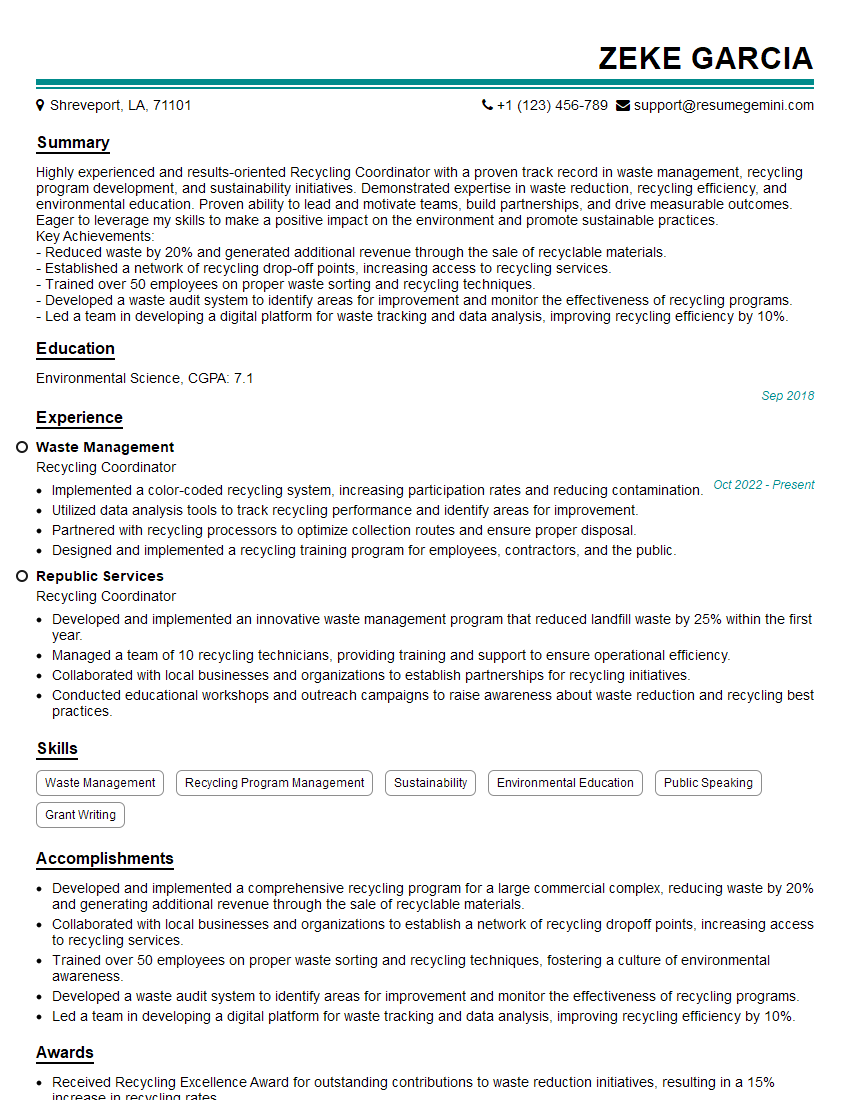
Mastering scrap sorting and segregation opens doors to a rewarding career with opportunities for advancement in a growing industry focused on sustainability and resource management. To significantly improve your job prospects, it’s crucial to create a resume that Applicant Tracking Systems (ATS) can easily read and understand. ResumeGemini is a trusted resource that can help you build a professional, ATS-friendly resume that highlights your skills and experience effectively. We provide examples of resumes tailored to the Scrap Sorting and Segregation field to help you get started. Invest in your future – invest in a strong resume.


Explore more articles
Users Rating of Our Blogs
Share Your Experience
We value your feedback! Please rate our content and share your thoughts (optional).
What Readers Say About Our Blog
To the interviewgemini.com Webmaster.
Very helpful and content specific questions to help prepare me for my interview!
Thank you
To the interviewgemini.com Webmaster.
This was kind of a unique content I found around the specialized skills. Very helpful questions and good detailed answers.
Very Helpful blog, thank you Interviewgemini team.