Interviews are more than just a Q&A session—they’re a chance to prove your worth. This blog dives into essential Hydrologic Modeling (HEC-HMS) interview questions and expert tips to help you align your answers with what hiring managers are looking for. Start preparing to shine!
Questions Asked in Hydrologic Modeling (HEC-HMS) Interview
Q 1. Explain the key components of a HEC-HMS model.
A HEC-HMS model is built upon several interconnected components working together to simulate the hydrological processes of a watershed. Think of it like a plumbing system for a landscape; each part plays a crucial role in the overall flow.
Meteorological Models: These provide the input data driving the simulation, such as rainfall, snowmelt, and evapotranspiration. Different models exist, ranging from simple constant rainfall to complex spatially-varying rainfall patterns from weather radar data. Selecting the appropriate model depends on the available data and the complexity of the event being simulated. For instance, a simple SCS curve number method might suffice for smaller, less data-rich catchments, while a more sophisticated model incorporating gridded precipitation data would be necessary for larger, complex basins.
Basin Models: These represent the physical characteristics of the watershed, including land use, soil type, and topography. They use this information to estimate runoff generation and transformation. Key elements here are subbasins and their connections – defining these correctly is vital for accurate simulation. Each subbasin can be treated differently depending on its characteristics. Think of these as individual buckets in our landscape plumbing system, each collecting rainfall based on its properties.
Loss Methods: These determine how much of the precipitation infiltrates the ground or is intercepted by vegetation, leaving the remainder as runoff that enters the channel network. Common methods include the Curve Number method (SCS), the Green-Ampt infiltration model, and the Philip infiltration model. The choice of loss method depends significantly on the availability of data and the nature of the watershed.
Transform Methods: These describe how the runoff moves through the watershed. They account for delays and attenuation caused by the channel network, taking into account channel geometry and flow characteristics. Methods include the Muskingum method, the kinematic wave method, and the diffusion wave method. Selection here depends on the desired level of detail and computational resources.
Routing Methods: These simulate the flow of water through the channel network and reservoirs. HEC-HMS offers several options, including Muskingum, Muskingum-Cunge, and reservoir routing methods. Choosing a suitable method is critical for modeling the propagation of flood waves.
Reservoir Models: These simulate the operation of reservoirs, including their inflow, outflow, storage, and spillway discharge. This component is vital for flood control studies.
Q 2. Describe the different types of loss methods available in HEC-HMS and their applications.
HEC-HMS offers various loss methods, each suited to different conditions and data availability. The choice depends on the complexity of the catchment and the available data. Imagine them as different filters in your landscape plumbing system, each handling rainfall differently.
SCS Curve Number (CN): This is a widely used empirical method requiring limited data; primarily land use and soil type. It’s simple but may not be as accurate for complex hydrologic processes. It’s excellent for quick assessments or where detailed data is lacking.
Green-Ampt: This physically-based infiltration model uses soil properties like hydraulic conductivity and suction head to determine infiltration. It provides more accurate results but requires more data than the CN method. It’s preferred when detailed soil information is available.
Philip: Another physically-based infiltration model, more complex than Green-Ampt, providing even better accuracy, especially for prolonged rainfall events. However, it requires significant soil parameters.
Initial and Constant Loss: Simple methods where a fixed amount of rainfall is removed from the total before accounting for further losses. Often used when limited data is available. This could be thought of as initial interception by vegetation and a constant loss due to evaporation or other factors.
In practice, I’d usually start with the SCS Curve Number method due to its simplicity and data requirements. If the results are unsatisfactory or more accurate results are needed, then I would switch to a physically based model like Green-Ampt or Philip, depending on data availability.
Q 3. How do you calibrate and validate a HEC-HMS model?
Calibration and validation are crucial steps for ensuring a HEC-HMS model accurately represents the watershed’s hydrological behavior. It’s like fine-tuning your plumbing system until water flows as it should in the real world.
Calibration: This involves adjusting model parameters to match simulated results with observed historical data (e.g., streamflow). This is typically an iterative process involving:
Comparing simulated and observed hydrographs: Visually inspecting hydrographs for peak flows, timing, and volumes.
Using statistical metrics: Quantifying the model performance using metrics like the Nash-Sutcliffe efficiency (NSE), the coefficient of determination (R²), and the root mean square error (RMSE). Higher NSE and R² values, along with lower RMSE, indicate better model performance.
Adjusting parameters: Systematically adjusting parameters (e.g., CN values, routing coefficients) until a satisfactory match is achieved. This is often done using automated calibration techniques or manual adjustments based on experience and understanding of the hydrological processes involved.
Validation: After calibration, the model is tested using a separate dataset (different from the calibration dataset) to ensure its generalizability and predictive capability. This involves running the model using this new data and comparing the results against observed values. A good validation result confirms the model’s ability to accurately simulate watershed response for different conditions.
For example, I might calibrate the model using 5 years of streamflow data and then validate it using an independent dataset of 2 years of streamflow data. The validation dataset should be similar in characteristics to the calibration dataset, but it should be independent to avoid overfitting the model.
Q 4. What are the different types of routing methods in HEC-HMS, and when would you use each?
HEC-HMS provides several routing methods to simulate the movement of water through the channel network. Each method offers a different balance between accuracy, computational cost, and data requirements.
Muskingum: A simple and widely used hydrological routing method. It’s computationally efficient, requiring limited data, making it suitable for preliminary analyses or smaller basins. It’s based on a linear reservoir concept.
Muskingum-Cunge: An improvement over the basic Muskingum method, accounting for the non-linearity of flow in channels. It’s more accurate than Muskingum, especially for steep channels, but demands more computational effort.
Kinematic Wave: A physically-based method that solves the Saint-Venant equations under simplifying assumptions. It’s more accurate than the Muskingum methods for large and complex river systems, but it’s also more computationally demanding. Its accuracy is highly dependent on the input data and the channel characteristics.
Diffusion Wave: A more complex method, approximating the full Saint-Venant equations with more accurate representation of flow dynamics in channels. It is very accurate, but also computationally expensive, requiring more data and often more computational resources. Ideal for complex channels or high precision simulations.
The choice of routing method depends on the complexity of the watershed, data availability, and desired accuracy. For instance, I would opt for the Muskingum method for a quick preliminary analysis of a smaller watershed with limited data. However, for larger and more complex basins, I might use the kinematic wave or diffusion wave method for higher accuracy, even if it means more computation time.
Q 5. Explain the concept of a basin model in HEC-HMS.
A basin model in HEC-HMS is a representation of the entire watershed, breaking it down into smaller units called subbasins. Think of it as a detailed map of the landscape showing how rainfall flows downhill. Each subbasin is characterized by its own hydrological properties (land use, soil type, etc.), and their connections define the flow path of water through the basin. The delineation of subbasins directly influences the accuracy of the model. Therefore, careful consideration must be given to the selection of subbasin boundaries.
The basin model contains the information needed to transform precipitation into runoff and route it through the channel network. It’s essentially the framework upon which the entire HEC-HMS simulation runs. Accurate representation of the basin is vital for reliable results. For example, an accurate representation of the basin’s topography is essential for simulating overland flow and the propagation of flood waves.
The complexity of a basin model depends on the specific requirements of the analysis and the available data. For instance, a simpler basin model might suffice for a preliminary flood assessment, whereas a more detailed model might be needed for a comprehensive water resources management plan.
Q 6. How do you handle missing data in HEC-HMS?
Missing data is a common challenge in hydrological modeling. In HEC-HMS, several strategies can be employed to handle this, depending on the type and extent of missing data. It’s like patching holes in our landscape plumbing system.
Data imputation: This involves estimating missing values based on available data. Techniques range from simple methods like linear interpolation or using the average of nearby values to more sophisticated approaches employing time series analysis or machine learning algorithms. The choice depends on the nature and extent of missing data, and the potential impact on the results.
Data gap filling: Similar to imputation but might involve creating a synthetic dataset based on statistical characteristics of the existing data. This is useful for large gaps in the data record.
Sensitivity analysis: Evaluate the impact of different missing data treatments by running the model with different imputation methods or by using different assumptions. This approach helps assess the uncertainty associated with the missing data.
The best approach often involves a combination of these methods. For example, I might use linear interpolation for small data gaps and a more advanced time series analysis method for longer periods of missing data. A sensitivity analysis would then be conducted to ensure the choice of imputation method does not significantly impact the overall results. Careful documentation of the data handling techniques used is also vital for transparency and repeatability.
Q 7. Describe your experience using different HEC-HMS components (e.g., meteorological models, basin models, reservoir routing).
Throughout my career, I’ve extensively used various HEC-HMS components for diverse hydrological projects. Here are some examples illustrating my experience:
Meteorological Models: I’ve used both simple constant rainfall models and more advanced models incorporating spatially distributed rainfall data from radar networks. In one project, we used a high-resolution radar-based rainfall model to simulate the impact of a severe thunderstorm on a large urban watershed.
Basin Models: I’ve developed basin models for watersheds ranging from small rural areas to large river basins. This involved defining subbasins, assigning hydrological parameters, and specifying channel network geometries. In one study, we used high-resolution digital elevation models (DEMs) to create a highly accurate basin model for a mountainous region.
Reservoir Routing: I’ve used the reservoir routing component of HEC-HMS to model the operation of several large reservoirs for flood control and water supply studies. This involved calibrating the reservoir’s outflow characteristics and simulating different operating scenarios. For example, in a flood control study, we simulated the impact of different reservoir release strategies on downstream flood levels.
My experience extends to using various loss and transformation methods, tailoring them to the specific characteristics of the watershed under consideration and data availability. I have experience in various calibration and validation techniques and am proficient in using various statistical metrics to evaluate model performance and uncertainty.
Q 8. How do you incorporate GIS data into your HEC-HMS models?
Incorporating GIS data into HEC-HMS is crucial for creating realistic and geographically accurate hydrologic models. We leverage GIS data to define the model’s spatial characteristics, including the basin delineation, subbasin boundaries, reach lengths, and the location of rainfall gauges, stream gauges, and other relevant features. This is typically done through shapefiles or other geospatial formats.
The process usually involves:
- Basin Delineation: Using a Digital Elevation Model (DEM) in GIS software, we delineate the watershed boundaries and subbasins. This defines the areas contributing runoff to specific points in the model.
- Geometry Definition: We extract reach lengths, channel slopes, and other geometric parameters from GIS data. This is vital for accurately representing the flow pathways within the watershed.
- Data Import: GIS data is then imported into HEC-HMS. This often involves using the HEC-GeoHMS extension, a powerful tool that streamlines this process by automatically generating the necessary input files for the model. It essentially translates the GIS data into a format HEC-HMS can understand.
- Gauge Location: We use GIS to precisely locate rainfall and streamflow gauges, linking their geographic coordinates to the corresponding points in the HEC-HMS model. This ensures that the model uses data from the appropriate locations.
For example, in a recent project modeling a large urban watershed, we used ArcGIS to delineate subbasins based on a high-resolution DEM, then imported the resulting shapefiles into HEC-GeoHMS to automatically create the HEC-HMS model’s spatial configuration. This saved significant time and reduced errors compared to manually entering the data.
Q 9. Explain the difference between continuous and event-based simulation in HEC-HMS.
The key difference between continuous and event-based simulations in HEC-HMS lies in how they handle rainfall input and model the hydrologic processes.
Continuous Simulation: Models the watershed’s response to continuous rainfall data over an extended period (months or years). It’s ideal for long-term water resources planning, assessing flood risks over many years, and analyzing the impact of climate change. Rainfall input is a continuous time series of rainfall intensity. The model tracks the changes in storage within the watershed continuously. Think of it like watching a river’s flow day-by-day, year-by-year.
Event-Based Simulation: Focuses on the watershed’s response to individual rainfall events. This is useful for analyzing specific storm events and their resulting flood peaks. Rainfall input is usually a single, discrete storm event (e.g., a hyetograph). It’s computationally less intensive than continuous simulation, making it suitable for rapid analyses and multiple scenario evaluations. This is more like focusing on a single, intense rainstorm and its immediate effects.
Choosing between the two depends on the specific objectives of the study. Continuous simulation provides a broader picture of long-term behavior, while event-based simulation offers detailed analysis of individual events.
Q 10. How do you assess the uncertainty in your HEC-HMS model results?
Assessing uncertainty in HEC-HMS model results is crucial for reliable decision-making. Uncertainty arises from various sources, including:
- Input Data Uncertainty: Inaccuracies in rainfall, streamflow, and other input data.
- Model Parameter Uncertainty: Uncertainties in the values assigned to the model’s parameters (e.g., curve numbers, Manning’s roughness coefficients).
- Model Structural Uncertainty: Limitations or simplifications in the model’s representation of the real-world hydrologic processes.
We employ several techniques to quantify and address uncertainty:
- Sensitivity Analysis: Identifies the parameters that most significantly influence the model’s output. This helps focus efforts on improving the accuracy of these critical parameters.
- Monte Carlo Simulation: Uses random sampling of input parameters to generate a range of possible model outputs, providing a probability distribution of results rather than a single deterministic result. This distribution gives us a measure of uncertainty.
- GLUE (Generalized Likelihood Uncertainty Estimation): A more sophisticated Bayesian approach that combines model outputs with observed data to evaluate the likelihood of different parameter sets. This can help refine our understanding of the likely ranges of parameters.
For example, in a flood risk assessment, we might use Monte Carlo simulation to generate a range of possible flood depths, allowing us to provide a probabilistic flood risk map indicating areas of high and low risk, rather than simply presenting a single flood depth prediction.
Q 11. What are the limitations of HEC-HMS?
While HEC-HMS is a powerful and widely used hydrologic modeling software, it does have limitations:
- Simplified Representation of Hydrologic Processes: HEC-HMS relies on simplified equations and assumptions that may not perfectly capture the complexity of real-world processes, particularly in highly heterogeneous or dynamic environments.
- Data Requirements: It needs sufficient and reliable input data. Lack of data, especially for ungauged basins, can significantly limit the model’s accuracy and applicability.
- Computational Limitations: Modeling large and complex basins can be computationally intensive, requiring significant computing power and time.
- Calibration Challenges: Calibration of the model, i.e., adjusting parameters to match observed data, can be challenging and subjective. Different calibration techniques can lead to different results.
- Limited Capabilities in Certain Areas: HEC-HMS may not be ideal for certain specialized applications, such as modeling groundwater interactions or complex flow processes in highly urbanized areas. More sophisticated models may be necessary for these scenarios.
It’s crucial to be aware of these limitations and choose the appropriate modeling tools and approaches based on the specific project requirements and available data.
Q 12. Describe a challenging hydrologic modeling project you worked on and how you overcame the challenges.
One challenging project involved modeling a watershed impacted by a major wildfire. The fire significantly altered the watershed’s hydrologic characteristics by reducing vegetation cover and increasing soil erosion. This led to increased runoff and a higher risk of flash flooding.
The main challenges were:
- Post-fire Data Scarcity: Gathering accurate post-fire data (e.g., soil infiltration rates, vegetation cover) was difficult due to the remote location and extensive damage. We had to rely on remote sensing data (satellite imagery) and limited field measurements.
- Parameter Uncertainty: The significant changes in land cover made it challenging to accurately estimate model parameters (e.g., curve numbers). The conventional methods were insufficient.
- Model Calibration: Calibrating the model to accurately capture the changed hydrologic behavior required iterative adjustments of parameters and careful evaluation of model outputs against limited post-fire data.
To overcome these challenges, we employed:
- Remote Sensing Data: Used satellite imagery and aerial photography to estimate changes in vegetation cover and burn severity, which helped in refining model parameters.
- Expert Judgement: Integrated knowledge from hydrology and fire ecology experts to inform parameter estimates and model structure.
- Sensitivity Analysis & Monte Carlo Simulation: Identified critical parameters and conducted extensive uncertainty analysis to quantify the uncertainty in our predictions.
- Bayesian Calibration Methods: Explored Bayesian approaches to integrate prior knowledge and observed data for more robust parameter estimation.
By combining these methods, we produced a reliable model that effectively captured the post-fire hydrologic response and allowed us to provide meaningful flood risk assessments for the community. The project highlighted the importance of interdisciplinary collaboration and adaptive modeling techniques in addressing complex environmental challenges.
Q 13. How do you determine the appropriate time step for your HEC-HMS model?
Selecting the appropriate time step in HEC-HMS is crucial for balancing accuracy and computational efficiency. The time step should be short enough to capture the significant hydrological processes, but not so short as to increase computational burden unnecessarily.
The choice depends on several factors:
- Rainfall Intensity: For high-intensity rainfall events, a shorter time step (e.g., 5 minutes or even 1 minute) is needed to accurately capture the rapid changes in runoff. For low-intensity events, a longer time step might suffice.
- Basin Characteristics: Smaller, faster-responding basins often require shorter time steps than larger, slower-responding basins.
- Model Components: The specific components used in the model (e.g., unit hydrographs, loss methods) can influence the appropriate time step. Some methods are inherently designed for specific time steps.
- Computational Resources: Shorter time steps significantly increase computational time and resource needs. A balance must be struck between accuracy and feasibility.
A common approach is to start with a relatively short time step (e.g., 15 minutes) and then perform sensitivity analyses to assess the effect of changing the time step. If changing the time step has minimal impact on the results, a longer time step can be used to improve computational efficiency. However, if the change in time step significantly alters the results, then you must choose the shorter time step, even if it results in higher computation time.
Q 14. Explain the concept of model sensitivity analysis in HEC-HMS.
Model sensitivity analysis in HEC-HMS helps determine which parameters have the greatest influence on the model’s output. This is crucial for model calibration, uncertainty analysis, and resource allocation. It allows us to focus efforts on accurately determining the most influential parameters.
Several techniques can be employed for sensitivity analysis in HEC-HMS:
- One-at-a-Time (OAT): This simple method involves systematically changing one parameter at a time while holding others constant. The change in the output is then assessed to determine the parameter’s sensitivity.
- Morris Method: A more sophisticated screening method that provides an estimate of the main and interaction effects of multiple parameters. It is more efficient than OAT for many parameters.
- Sobol Method: This variance-based method quantifies the contribution of each parameter and their interactions to the total output variance. It provides a more comprehensive analysis than OAT and Morris methods.
- Partial Rank Correlation Coefficient (PRCC): This approach measures the correlation between input parameters and output variables, ranking the parameters based on their influence. It’s useful for non-linear models.
The results of a sensitivity analysis guide the calibration process. We focus on accurately estimating the most sensitive parameters, as errors in these parameters will significantly affect the model’s predictions. It also informs uncertainty analysis by focusing efforts on characterizing uncertainty for the most sensitive parameters. For example, if the curve number is found to be highly sensitive, then we dedicate more resources to accurately estimating it, potentially using multiple data sources and applying advanced estimation techniques.
Q 15. How do you use HEC-HMS to analyze flood risk?
HEC-HMS is a powerful tool for analyzing flood risk by simulating the entire hydrologic cycle. We use it to model rainfall-runoff processes, predict streamflow, and estimate flood inundation areas. The process begins with defining the watershed’s characteristics, including its geometry, land use, and soil type. Then, we input rainfall data (from historical records or synthetically generated), which is routed through the basin using various components like sub-basins, reach elements, and reservoirs, finally producing hydrographs (graphs showing flow over time) at points of interest. By comparing simulated hydrographs with historical flood events or using design storms (rainfall events with specific return periods), we can assess the probability of future flooding and determine the magnitude of potential flood events. This allows us to delineate floodplains, design flood mitigation structures, and inform land-use planning decisions.
For example, in a recent project analyzing flood risk in a coastal city, we used HEC-HMS to simulate the impact of different storm scenarios on the city’s drainage system. The results revealed critical areas vulnerable to flooding and helped us recommend improvements to infrastructure and emergency response plans.
Career Expert Tips:
- Ace those interviews! Prepare effectively by reviewing the Top 50 Most Common Interview Questions on ResumeGemini.
- Navigate your job search with confidence! Explore a wide range of Career Tips on ResumeGemini. Learn about common challenges and recommendations to overcome them.
- Craft the perfect resume! Master the Art of Resume Writing with ResumeGemini’s guide. Showcase your unique qualifications and achievements effectively.
- Don’t miss out on holiday savings! Build your dream resume with ResumeGemini’s ATS optimized templates.
Q 16. Describe your experience with different types of rainfall data used in HEC-HMS.
My experience encompasses a wide range of rainfall data types used in HEC-HMS. These include:
- Gauge Data: This is the most common and reliable type, consisting of observed rainfall measurements from rain gauges. The accuracy depends on the gauge density and the spatial variability of rainfall within the watershed. We often use techniques like Thiessen polygons or Inverse Distance Weighting (IDW) to interpolate rainfall data from sparse gauge networks.
- Radar Data: Radar provides spatially distributed rainfall estimates, offering better coverage than gauge networks, particularly in sparsely gauged regions. However, radar data tends to be less accurate than gauge data and often requires corrections for attenuation and other errors. In HEC-HMS, we can import radar data in various formats and utilize quality control measures to ensure reliability.
- Synthetic Rainfall Data: When historical rainfall data is unavailable or insufficient, we generate synthetic data using statistical methods that replicate the characteristics of the historical rainfall records (e.g., frequency, intensity, and duration). This requires careful statistical analysis and validation to ensure the synthetic data reflects the true rainfall patterns.
- Rainfall-Runoff Relationships: In some situations where gauge data is extremely limited, we may leverage existing rainfall-runoff relationships (e.g., unit hydrographs) developed for similar watersheds to estimate the runoff response to rainfall events. This approach is less precise but can provide reasonable estimates when resources are limited.
The choice of rainfall data depends on data availability, accuracy requirements, and the specific objectives of the study. We always prioritize using the most reliable data available, supplementing with other methods when necessary.
Q 17. How do you incorporate snowmelt into your HEC-HMS models?
Incorporating snowmelt into HEC-HMS models is crucial in regions experiencing significant snowfall. We use the ‘Snowmelt’ component within HEC-HMS, which simulates the snow accumulation and melt processes. This component requires inputs such as temperature, precipitation type (rain or snow), and snow water equivalent (SWE). The snowmelt model uses energy balance calculations to estimate the rate of snowmelt, considering factors like solar radiation, air temperature, and wind speed. The melted snow is then routed into the hydrological model as additional runoff.
Several snowmelt models are available within HEC-HMS, each with different levels of complexity. The choice of model depends on the availability of input data and the desired level of accuracy. Calibration and validation of the snowmelt parameters using observed streamflow data is essential to ensure the model accurately represents the snowmelt processes in the watershed.
For instance, in a mountainous watershed, we would carefully model snow accumulation and melt using a detailed snowmelt model, potentially incorporating temperature lapse rates and elevation-dependent snowpacks. We’d use observed snow data from snow courses or remote sensing to calibrate and validate our model’s parameters.
Q 18. Explain the different types of boundary conditions used in HEC-HMS.
HEC-HMS employs various boundary conditions to represent the flow entering and leaving the modeled watershed. The most common types include:
- Specified Flow: This condition defines the inflow hydrograph at the upstream boundary of the basin. This hydrograph is typically obtained from upstream gauges or simulations. This boundary condition is frequently used at the headwaters of a basin.
- Specified Stage: This defines the water level (stage) at the boundary, often at a downstream location connected to a larger river or reservoir. This is particularly useful when the downstream water level influences the flow in the modeled reach.
- Rating Curve: A rating curve establishes the relationship between stage and discharge at a location, allowing HEC-HMS to dynamically adjust the boundary flow based on the stage. This can be particularly valuable when considering the influence of downstream conditions or backwater effects.
- Junctions: These represent locations where several sub-basins or reaches converge, allowing for the accurate simulation of tributary inflows.
The selection of the appropriate boundary condition depends on the specific characteristics of the watershed and the available data. For example, in a large river basin, we might use specified flow at the upstream boundaries and a rating curve at the downstream outlet.
Q 19. How do you manage and analyze the output data from HEC-HMS?
HEC-HMS provides extensive output data, including hydrographs, rainfall hyetographs, reservoir storage and release, and more. Managing and analyzing this data requires a systematic approach. HEC-HMS’s built-in tools provide visualization capabilities, but external tools significantly enhance the analysis process. We use:
- HEC-DSSVue: This is HEC’s own data management and visualization software, ideal for exploring time-series data generated by HEC-HMS. It allows for easy plotting, comparison of multiple scenarios, and export of data to other software.
- Spreadsheet Software (Excel, Google Sheets): These are valuable for data manipulation, statistical analysis, and creation of tables and charts summarizing key results.
- Statistical Software (R, Python): These are powerful tools for in-depth statistical analysis, including uncertainty analysis, sensitivity analysis, and calibration of model parameters. They are essential for a more rigorous evaluation of the model’s results.
- GIS Software (ArcGIS, QGIS): GIS is crucial for integrating the model outputs with spatial data, visualizing flood inundation maps, and assessing potential flood impacts on infrastructure and population.
The choice of tools depends on the complexity of the analysis and the specific goals of the study. We often employ a combination of these tools to effectively manage and interpret the vast amount of data generated by HEC-HMS.
Q 20. What are some common errors encountered while using HEC-HMS, and how do you troubleshoot them?
Common errors in HEC-HMS often stem from data input, model setup, and parameter calibration. Some examples include:
- Incorrect Data Units: Ensuring consistent units throughout the model (e.g., meters, seconds, cubic meters per second) is crucial. Inconsistencies can lead to inaccurate results.
- Improper Model Setup: Errors in defining basin geometry, reach elements, or reservoir characteristics can affect the flow routing and overall simulation. A thorough review of the model components is essential.
- Convergence Issues: Numerical issues can lead to convergence problems during the model’s solution process. Adjusting the simulation parameters, such as the time step, can often resolve this.
- Parameter Calibration Challenges: Obtaining appropriate parameter values often involves trial-and-error calibration using observed streamflow data. It’s common to encounter difficulties finding parameter sets that adequately replicate the observed data. Advanced calibration techniques, such as optimization algorithms, can assist.
- Data Gaps: Missing or incomplete input data can significantly impact the accuracy of the model. Employing data interpolation or gap-filling techniques can mitigate this, but it may introduce uncertainties.
Troubleshooting involves a systematic investigation. We start by reviewing the model setup, checking data inputs, and inspecting any error messages generated by the software. We then may adjust the model parameters or employ diagnostic tools within HEC-HMS. In some instances, simplified models may be used initially to identify the source of the problem before adding complexity.
Q 21. How do you ensure the accuracy and reliability of your HEC-HMS models?
Ensuring the accuracy and reliability of HEC-HMS models is paramount. This involves several key steps:
- Data Quality Control: Thoroughly checking input data for errors, inconsistencies, and outliers is essential. Data validation techniques are employed to verify the accuracy and completeness of the data.
- Model Calibration and Validation: Calibrating the model using observed streamflow data allows us to adjust parameters to improve the model’s representation of the watershed’s hydrologic behavior. Validation, using independent data not used in calibration, is crucial to assess the model’s ability to predict flows in unseen conditions.
- Sensitivity Analysis: This determines which model parameters have the most significant impact on the model’s output. This helps focus calibration efforts on the most important parameters and highlights uncertainties associated with poorly known parameters.
- Uncertainty Analysis: Quantifying the uncertainty associated with model inputs, parameters, and outputs is crucial. Monte Carlo simulations or other techniques are used to generate a range of possible outcomes, highlighting the model’s limitations.
- Peer Review: Having another hydrologist review the model setup, data, and results is essential for identifying potential errors or biases and ensures the model is developed and used in a robust manner.
By adhering to these practices, we can build confidence in the reliability of the HEC-HMS model and ensure its results are useful for decision-making.
Q 22. Describe your experience with different HEC-HMS visualization tools.
HEC-HMS offers several visualization tools crucial for understanding model results. The most common are the time series plots, which display flow, precipitation, or other variables over time. These are essential for identifying peak flows, assessing the timing of events, and comparing simulated results to observed data. For instance, comparing a simulated hydrograph to a gauged hydrograph allows us to evaluate model accuracy.
Beyond time series, HEC-HMS provides cross-section views, allowing us to visualize the water surface elevation at different points along a river reach. This is invaluable for flood inundation studies. Furthermore, the software generates maps showing spatial distribution of variables like water depth or velocity, particularly helpful in assessing the impact of flood events on a landscape. Finally, the summary tables provide a concise summary of key results, including peak flows, volumes, and timing, useful for reporting purposes. In my experience, effectively leveraging these visualization tools is as crucial as the modeling itself – they’re vital for interpretation and communication of results to stakeholders.
Q 23. What is your experience with model parameter optimization techniques?
Model parameter optimization is critical for achieving accurate simulations in HEC-HMS. I’m proficient in several techniques. Manual calibration, where parameters are adjusted iteratively based on comparing simulated and observed data, is a fundamental approach. It’s time-consuming but allows for a deep understanding of the model and its behavior. I’ve also extensively used automated optimization techniques, including the widely used ‘trial and error’ method, sensitivity analysis and the shuffled complex evolution (SCE-UA) algorithm. SCE-UA is particularly efficient for complex models with many parameters. In one project, SCE-UA significantly reduced the time required to calibrate a large watershed model compared to manual calibration, leading to a more accurate representation of the system. For highly complex scenarios, I’ve incorporated Bayesian optimization techniques, which offer enhanced efficiency in exploring parameter space, especially when dealing with limited or noisy data.
Q 24. How do you handle data inconsistencies or errors in your input datasets?
Data inconsistencies and errors are common in hydrological modeling. My approach involves a multi-step process. First, I perform thorough data quality checks, visually inspecting data for outliers or anomalies. I utilize statistical methods to identify inconsistencies. This includes checks for missing data, data gaps and consistency in units. For instance, I might use time series plots to visually inspect precipitation data for implausible values. Second, I employ data pre-processing techniques such as interpolation or gap-filling to address missing data. The choice of method depends on the type of data and the extent of missing values. For instance, I might use linear interpolation for filling small gaps in a continuous variable. For larger gaps or more complex patterns, more sophisticated techniques may be needed, potentially involving external data sources. Third, for significant data errors, I may need to investigate the source of the error and potentially contact data providers for clarification or correction. If data quality remains an issue despite these efforts, I document the limitations in the model report, transparently acknowledging the potential impact on results. In essence, data quality assurance is an iterative process ensuring reliability of results.
Q 25. How familiar are you with other hydrological modeling software packages (e.g., MIKE FLOOD, SWMM)?
While HEC-HMS is my primary hydrological modeling tool, I possess working knowledge of other software packages. I’ve used MIKE FLOOD for 1D and 2D hydrodynamic modeling, particularly in projects requiring detailed flow routing and inundation mapping. This offers a complementary approach to HEC-HMS, especially in areas where detailed hydraulic modeling is necessary. Similarly, I’ve worked with SWMM (Storm Water Management Model) for urban drainage modeling, leveraging its capabilities to simulate complex sewer networks and stormwater runoff in urban areas. My familiarity with these other packages allows me to select the most appropriate tool for a given project, recognizing the strengths and limitations of each. This often involves integrating results from different models to provide a comprehensive understanding of the hydrological system.
Q 26. Describe your understanding of hydrological processes and their representation in HEC-HMS.
My understanding of hydrological processes is fundamental to my work with HEC-HMS. The software represents these processes using a series of interconnected components, including precipitation, evapotranspiration, infiltration, runoff, and flow routing. HEC-HMS incorporates various methods for simulating these processes; for example, the SCS curve number method for estimating runoff, and the Muskingum method or kinematic wave method for routing flow through channels. Understanding the assumptions and limitations of each method is crucial for model selection and interpretation. For instance, using the SCS curve number method requires accurate estimation of the curve number, which is influenced by land use and soil type. Incorrect curve number estimation will directly affect the accuracy of runoff estimation. Accurate representation of these hydrological processes is paramount and directly dictates the overall model performance. I ensure that the selected methods are appropriate for the specific characteristics of the watershed being studied. This involves carefully considering factors like climate, topography, soil type, and land use.
Q 27. How would you explain complex hydrological modeling concepts to a non-technical audience?
Explaining complex hydrological modeling to a non-technical audience requires clear and concise communication, avoiding jargon. I typically start by using an analogy, perhaps comparing a watershed to a giant bathtub. Precipitation is like water filling the tub, infiltration is the water soaking into the tub’s surface, and runoff is the water overflowing the tub. We then use this simple concept to build upon. Flow routing through the rivers and channels is like the water flowing out through the drain. Hydrological modeling is simply a sophisticated way of predicting how much water will fill the tub and how quickly it will overflow based on various factors such as the size of the tub, the rate at which it’s being filled, and how quickly the drain can handle the water. This helps visualize the processes. Then I use visual aids, such as graphs and maps to illustrate key findings. For example, showing a simple hydrograph (a graph of water level over time) helps them understand how quickly water levels can rise during a storm. The goal is to present the information in a way that is accessible and relatable, ensuring they understand the significance of the results and the implications for decision-making.
Key Topics to Learn for Hydrologic Modeling (HEC-HMS) Interview
- Hydrologic Processes: Understanding rainfall-runoff processes, infiltration, evapotranspiration, and their representation within HEC-HMS. Consider exploring different methods and their limitations.
- Basin Characterization: Developing accurate basin representations, including defining subbasins, assigning parameters (e.g., CN, SCS Curve Number), and managing spatial data. Practice creating and interpreting basin maps.
- Model Calibration and Validation: Mastering techniques for calibrating and validating your HEC-HMS models using observed streamflow data. Understand the importance of statistical measures and sensitivity analysis.
- Loss Methods: Gain a firm grasp of different loss methods (e.g., SCS Curve Number, Green-Ampt) and their applicability based on basin characteristics and data availability. Be prepared to explain your choices.
- Routing Methods: Familiarize yourself with various routing methods (e.g., Muskingum, kinematic wave) and their implications on model output. Be able to explain the differences and choose the appropriate method.
- Data Management: Effective management of rainfall, temperature, and other input datasets within HEC-HMS is critical. Practice organizing and preprocessing data for accurate modeling.
- Uncertainty Analysis: Understanding and communicating the uncertainties inherent in hydrologic modeling is vital. Be prepared to discuss methods for quantifying and addressing these uncertainties.
- HEC-HMS Interface: Demonstrate proficiency in navigating the HEC-HMS software interface, including setting up projects, managing parameters, and interpreting results.
- Scenario Analysis and Applications: Explain how you would use HEC-HMS to analyze various scenarios (e.g., flood forecasting, water resources management) and interpret the results to provide actionable insights.
- Model Limitations and Assumptions: Critically evaluate the limitations and assumptions of HEC-HMS and hydrologic modeling in general. Be prepared to discuss these during an interview setting.
Next Steps
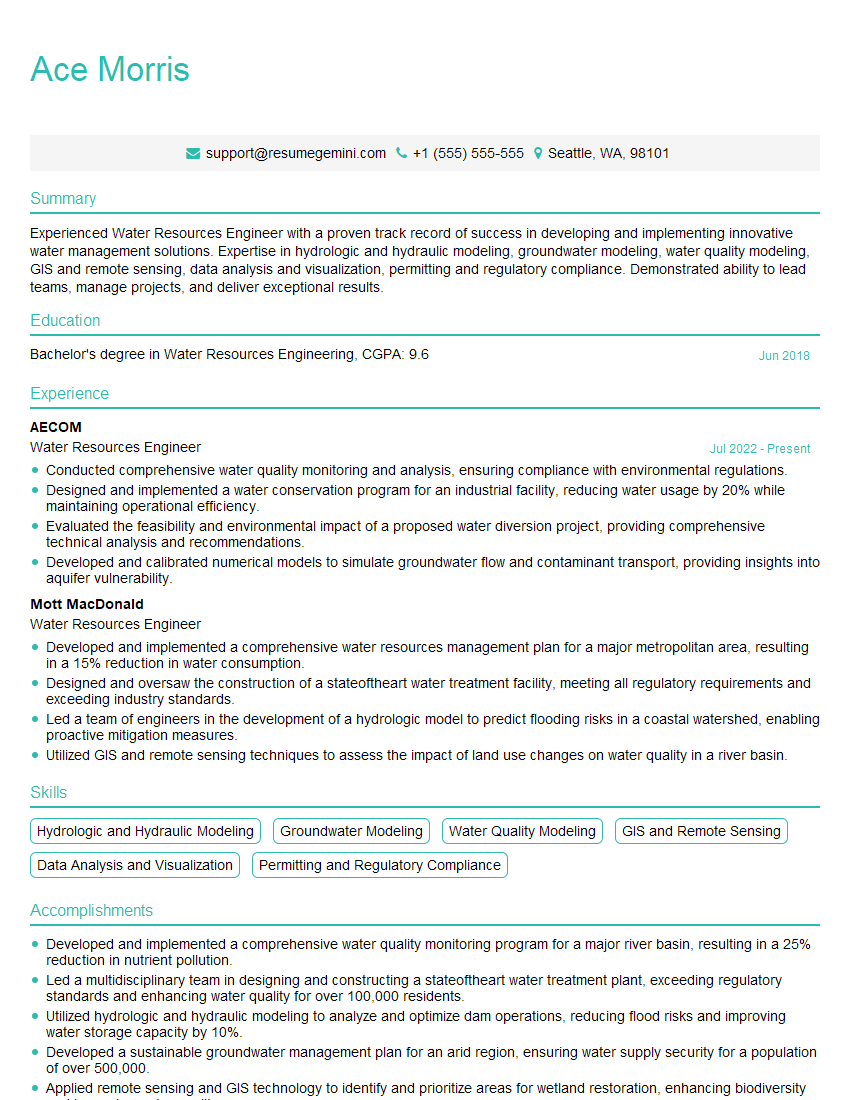
Mastering Hydrologic Modeling with HEC-HMS is highly valuable, opening doors to exciting careers in water resources management, environmental consulting, and related fields. A strong resume showcasing your skills is essential to secure these opportunities. Building an ATS-friendly resume significantly increases your chances of getting your application noticed. We encourage you to leverage ResumeGemini, a trusted resource for creating professional and impactful resumes. ResumeGemini provides examples of resumes tailored to Hydrologic Modeling (HEC-HMS) roles, offering you a valuable head-start in your job search.







Explore more articles
Users Rating of Our Blogs
Share Your Experience
We value your feedback! Please rate our content and share your thoughts (optional).
What Readers Say About Our Blog
To the interviewgemini.com Webmaster.
Very helpful and content specific questions to help prepare me for my interview!
Thank you
To the interviewgemini.com Webmaster.
This was kind of a unique content I found around the specialized skills. Very helpful questions and good detailed answers.
Very Helpful blog, thank you Interviewgemini team.