Preparation is the key to success in any interview. In this post, we’ll explore crucial Routing and Scheduling Software interview questions and equip you with strategies to craft impactful answers. Whether you’re a beginner or a pro, these tips will elevate your preparation.
Questions Asked in Routing and Scheduling Software Interview
Q 1. Explain the difference between Dijkstra’s algorithm and A* search for route optimization.
Both Dijkstra’s algorithm and A* search are graph traversal algorithms used for finding the shortest path between nodes, but they differ in their approach. Dijkstra’s algorithm is a greedy algorithm that explores all possible paths from a starting node until it finds the shortest path to the destination. It doesn’t use any information about the destination’s location to guide its search. Think of it like systematically searching every street in a city until you find your destination.
A*, on the other hand, is a heuristic search algorithm. It uses a heuristic function, which estimates the remaining distance to the destination, to guide its search. This allows A* to prioritize exploring paths that are more likely to lead to the destination quickly. Imagine using a map with a direct line showing your destination; A* uses this information to make smarter decisions about which paths to explore first. This often results in significantly faster search times, especially in large graphs.
In short: Dijkstra’s is guaranteed to find the shortest path but can be slow, while A* is often faster but doesn’t guarantee finding the absolute shortest path unless the heuristic is admissible (never overestimates the actual distance).
Example: Imagine finding the shortest route between two cities on a map. Dijkstra’s would explore all possible routes, whereas A* would use the straight-line distance between the cities as a heuristic to prioritize exploring paths that head generally in the right direction.
Q 2. Describe different types of routing problems (e.g., TSP, VRP).
Routing problems involve finding optimal paths or routes based on specific criteria. Several types exist:
- Traveling Salesperson Problem (TSP): Finding the shortest route that visits all cities exactly once and returns to the starting city. Think of a delivery truck needing to visit multiple locations and return to its depot.
- Vehicle Routing Problem (VRP): Extends TSP by considering multiple vehicles, capacity constraints, time windows (deliveries must happen within specific timeframes), and other real-world factors. Imagine a fleet of delivery vans serving numerous customers with varying delivery deadlines and cargo limits.
- Capacitated Vehicle Routing Problem (CVRP): A VRP variant where each vehicle has a limited carrying capacity. A common scenario is waste collection, where garbage trucks have size limits.
- Vehicle Routing Problem with Time Windows (VRPTW): Accounts for time constraints, specifying time windows for service at each location. Think of food delivery services needing to reach customers during a chosen delivery window.
- Dial-a-Ride Problem (DARP): A VRP variant where requests for transportation arise dynamically, often involving shared rides. A good example is a ride-sharing app managing requests.
These problems vary in complexity; TSP is NP-hard, meaning finding the absolute best solution takes exponentially increasing time as the number of cities grows. Therefore, approximations and heuristics are often employed for larger instances.
Q 3. What are the key factors to consider when choosing a routing algorithm?
Choosing the right routing algorithm depends on several key factors:
- Problem Size: For small problems, Dijkstra’s algorithm might suffice. For larger problems, A* or more advanced heuristics are necessary.
- Data Characteristics: The structure and characteristics of the network (road network, graph topology) influence algorithm choice. For example, hierarchical routing is efficient for large road networks.
- Computational Resources: The available computing power and memory will limit the complexity of the algorithm that can be used.
- Real-time Requirements: Real-time applications require algorithms that can quickly find near-optimal solutions within strict time constraints. Approximation algorithms are often favored.
- Constraints: The presence of constraints like time windows, vehicle capacities, or specific route restrictions significantly impacts the algorithm choice. Constraint programming techniques are very useful here.
- Accuracy Requirements: The acceptable level of deviation from the optimal solution is important. Some applications tolerate approximate solutions for speed.
Careful consideration of these factors ensures selecting an algorithm that balances solution quality and computational efficiency.
Q 4. How do you handle real-time updates and unexpected events in a routing system?
Handling real-time updates and unexpected events in a routing system is crucial for its effectiveness. Strategies involve:
- Dynamic Routing: Instead of computing a static route in advance, dynamic routing continuously monitors the network for changes (traffic, road closures) and recomputes the route accordingly. This often uses algorithms that can quickly adapt to changes, such as A* with efficient update mechanisms.
- Predictive Modeling: Using historical data and real-time information (traffic sensors, weather forecasts) to anticipate potential delays and adjust routes proactively. Machine learning techniques are valuable here.
- Redundant Routes: Identifying and pre-calculating alternative routes to mitigate disruptions caused by unforeseen events. This acts as a form of fail-safe.
- Event Handling Mechanisms: Implementing a robust system for detecting and responding to events (road closures, accidents) in real-time. This typically involves integrating with external data sources (e.g., traffic APIs).
- Route Optimization with Constraints: Adapting route optimization algorithms to include dynamic constraints (e.g., temporary road closures as constraints).
A robust system needs a combination of these approaches to deal effectively with the unpredictable nature of real-world situations.
Q 5. Explain the concept of constraint programming in routing and scheduling.
Constraint programming is a powerful technique for solving complex optimization problems by explicitly representing constraints. In routing and scheduling, it allows you to model various restrictions and limitations.
Concept: You define the problem’s variables (e.g., vehicle assignments, delivery times, routes), their domains (possible values), and constraints (restrictions on variable values). A constraint solver then searches for a solution that satisfies all constraints while optimizing an objective function (e.g., minimizing total travel time or distance). This approach is particularly useful for handling intricate real-world scenarios with multiple interacting constraints.
Example: In VRP, constraints might include:
- Each customer must be visited exactly once.
- Each vehicle has a limited capacity.
- Deliveries must occur within specific time windows.
- Vehicles must return to the depot.
A constraint programming solver would find a schedule that respects all these constraints while minimizing, for instance, the total distance traveled.
Benefits: Constraint programming provides a declarative approach, focusing on what needs to be satisfied rather than how to find the solution. This makes it easier to model complex problems and adapt to changes in constraints.
Q 6. What are some common performance bottlenecks in routing and scheduling software?
Performance bottlenecks in routing and scheduling software can stem from various sources:
- Inefficient Algorithms: Using algorithms unsuitable for the problem size or data characteristics. Choosing algorithms that scale poorly with increasing data volume can significantly impact performance.
- Data Structures: Employing inefficient data structures to represent the road network or scheduling information. For example, using a naive adjacency matrix for a sparse graph is memory-intensive and slow.
- Database Access: Frequent and inefficient access to databases to retrieve route information or customer data. Optimization techniques such as caching and database indexing can mitigate this.
- Lack of Parallelization: Not taking advantage of parallel processing capabilities to speed up computations, especially when dealing with large-scale problems. Techniques like multithreading can help.
- Poor Code Optimization: Inefficient coding practices and lack of optimization can lead to performance issues. Profiling and optimizing code is essential.
- Inadequate Hardware: Insufficient computing power (CPU, RAM) to handle the computational demands of the algorithms and data. Upgrading hardware can improve performance.
Profiling tools and performance analysis are crucial for identifying and addressing these bottlenecks effectively. Optimization often requires a multi-faceted approach addressing several of these areas simultaneously.
Q 7. How do you optimize for fuel efficiency in vehicle routing problems?
Optimizing for fuel efficiency in VRP involves incorporating fuel consumption models into the route optimization process. Strategies include:
- Fuel Consumption Models: Incorporate accurate models that account for factors like vehicle speed, acceleration, terrain, and load. These models translate route characteristics (distance, elevation changes) into fuel consumption estimates.
- Speed Optimization: Prioritize routes with lower average speeds where applicable, since fuel efficiency often peaks at a moderate speed. This balances travel time with fuel savings.
- Route Smoothing: Reducing the number of turns and stops, as sharp turns and frequent accelerations/decelerations consume more fuel. Algorithms can focus on smoother, less jerky routes.
- Vehicle Selection: Optimizing vehicle selection based on fuel efficiency and the route characteristics. This could mean assigning more fuel-efficient vehicles to specific routes.
- Real-time Traffic Data: Using real-time traffic data to avoid congested areas, since idling in traffic consumes significant fuel.
- Advanced Routing Algorithms: Integrating fuel consumption into the objective function of the optimization algorithm (e.g., using a weighted cost function that considers both distance and fuel). This could mean using algorithms like A* with a fuel consumption-based heuristic.
The key is to balance fuel efficiency with other factors like total distance and delivery time constraints. Often, a small increase in travel time can lead to significant fuel savings.
Q 8. How do you handle time windows and delivery deadlines in route optimization?
Time windows and deadlines are crucial in route optimization, representing the allowed time intervals for service at each location. We handle them by incorporating these constraints directly into the optimization model. Instead of simply minimizing distance, the algorithm now aims to minimize distance while ensuring all deliveries are made within their specified time windows. This often involves sophisticated scheduling techniques.
For example, imagine a delivery route where a hospital needs medication delivered between 9:00 AM and 9:30 AM. The algorithm would prioritize reaching that location within that window, even if it means taking a slightly longer route than the shortest path. It might involve prioritizing tasks based on their deadlines, considering traffic conditions, and potentially adjusting the overall route to accommodate strict time windows.
Technically, this is accomplished by adding constraints to the mathematical model used by the routing algorithm. These constraints ensure that the arrival time at each location falls within its designated time window. Constraint programming or linear programming solvers are commonly used for this purpose. Penalty functions can also be implemented to quantify the severity of violating a time window, allowing for a degree of flexibility when absolute adherence is impossible due to unforeseen circumstances, like unexpected traffic.
Q 9. What are the benefits and drawbacks of using heuristics vs. exact algorithms?
Heuristics and exact algorithms represent different approaches to solving routing problems. Heuristics are shortcut methods that provide good, but not necessarily optimal, solutions quickly. Exact algorithms, on the other hand, guarantee finding the absolute best solution but can be computationally expensive, especially for large-scale problems.
- Heuristics: Offer fast solutions suitable for real-time applications where speed is prioritized over absolute optimality. Examples include nearest neighbor, Clarke-Wright, and savings algorithms. They are easy to implement and understand, making them practical for many scenarios.
- Exact Algorithms: Use methods like integer programming or dynamic programming to explore all possible solutions and guarantee finding the best one. However, their computation time grows exponentially with problem size, rendering them unsuitable for very large-scale problems. They’re better suited for offline planning or smaller-scale problems where optimality is paramount.
The choice depends on the context. For a small delivery service with a handful of stops and a need for optimal solutions, an exact algorithm might be feasible. But for a large logistics company managing thousands of deliveries daily, heuristics are often the more practical approach, sacrificing some optimality for speed and efficiency. Often, a hybrid approach is employed, using heuristics for an initial solution and then refining it with local search techniques or metaheuristics like simulated annealing or genetic algorithms.
Q 10. Explain your experience with different routing software packages (e.g., OR-Tools, OptaPlanner).
I have extensive experience with several routing software packages. My work with Google OR-Tools has been particularly extensive. OR-Tools offers a robust set of optimization algorithms, including constraint programming and linear programming solvers, providing flexibility for various routing problems. I’ve used its Vehicle Routing Problem (VRP) solver to address complex scenarios involving multiple depots, time windows, and diverse vehicle constraints.
I’ve also worked with OptaPlanner, known for its powerful constraint satisfaction capabilities. Its rule-based approach is particularly useful for more complex, customized routing problems where intricate business rules and constraints need to be incorporated. OptaPlanner’s strength lies in its ability to handle complex business logic and integrate easily into existing systems, offering advanced features like score calculation and visualization tools.
My experience with these tools encompasses all stages of the routing process: model formulation, algorithm selection, parameter tuning, result analysis, and integration with other systems. I understand the trade-offs between different algorithms and their suitability for different problem characteristics.
Q 11. Describe your experience with various data structures used in routing algorithms.
Several data structures are fundamental to efficient routing algorithms. The choice of data structure significantly impacts performance.
- Graphs: Representing the network of locations and connections between them is crucial. Adjacency matrices or adjacency lists are commonly used to store graph data. Adjacency matrices provide fast lookup times for connections but consume more memory, while adjacency lists are memory-efficient but slower for checking connectivity.
- Priority Queues: Algorithms like Dijkstra’s and A* employ priority queues to efficiently manage nodes to be explored, prioritizing nodes with the lowest estimated distance or cost.
- Arrays and Lists: Used to store node information, routes, and other data related to the problem. Efficient organization of this data is essential for performance, particularly when dealing with large numbers of nodes or vehicles.
For example, when working with a large network, the choice between an adjacency matrix and an adjacency list becomes significant. If memory is a constraint, an adjacency list is preferred, accepting a slight performance trade-off in lookups. Understanding the strengths and weaknesses of these data structures and their impact on algorithm efficiency is crucial for efficient routing software development.
Q 12. How do you handle multiple depots or multiple vehicles in a routing problem?
Handling multiple depots and vehicles significantly increases the complexity of the routing problem. These scenarios require extensions of the basic VRP (Vehicle Routing Problem). Multiple depots introduce the additional challenge of assigning vehicles to their respective starting depots and optimally routing them across the network.
There are various approaches. One is to decompose the problem into subproblems, one for each depot, solving each subproblem independently and then combining the results. This might be efficient, but it does not necessarily yield the optimal solution. More advanced methods use mathematical models capable of explicitly handling multiple depots and vehicle assignments simultaneously. These models usually involve additional decision variables to indicate the vehicle assigned to each route and the depot from which it starts.
Algorithms like Clarke and Wright’s savings heuristic can be extended to handle multiple depots by considering savings based on the depot location and then merging routes intelligently. Alternatively, metaheuristics, such as genetic algorithms or simulated annealing, can effectively handle the complex search space of the multi-depot, multi-vehicle problem.
In practice, you’d use software packages capable of defining constraints for depot assignments and vehicle capacity. This involves setting up the problem correctly within the software, clearly defining the locations of multiple depots, and specifying the vehicles available at each.
Q 13. What metrics do you use to evaluate the performance of a routing solution?
Evaluating routing solutions involves using several metrics to assess different aspects of performance.
- Total Distance or Travel Time: A fundamental metric measuring the overall efficiency of the route. Minimizing this is a primary objective.
- Number of Vehicles Used: Reducing the number of vehicles needed can have significant cost implications.
- Maximum Travel Time or Distance per Vehicle: Ensuring fair workload distribution among vehicles and preventing driver fatigue.
- Route Duration: Considering time windows and other time-related constraints.
- Computational Time: The time taken by the algorithm to find a solution; crucial for real-time applications.
- Service Level: Measures adherence to time windows and other service requirements.
The choice of metrics depends on the specific context and priorities. For example, in a last-mile delivery service, minimizing total distance might be the primary concern, while in a courier service with strict deadlines, adherence to time windows becomes paramount. A comprehensive evaluation often involves considering a combination of these metrics.
Q 14. How do you incorporate traffic data into your routing algorithms?
Incorporating real-time traffic data is essential for creating realistic and efficient routes. Static routing algorithms, which only consider fixed travel times, are often inaccurate and inefficient in dynamic environments. Real-time traffic data can be integrated using various techniques:
- Dynamic Routing Algorithms: These algorithms constantly adapt routes based on real-time traffic updates. A* search or its variants are often used, with the heuristic function adjusted based on current traffic conditions. Algorithms might re-optimize the routes periodically based on updated traffic information.
- Traffic APIs: Services like Google Maps Platform or other map providers offer real-time traffic information that can be easily integrated into routing algorithms. This typically involves making API calls to fetch traffic data for specific road segments along the route.
- Predictive Traffic Models: Advanced approaches use machine learning to predict future traffic conditions, enabling preemptive route adjustments. This offers more proactive route planning, potentially avoiding congestion before it occurs.
The choice of method depends on data availability, computational resources, and the level of accuracy required. For example, a simple approach might involve periodically updating the travel times in the route optimization model based on traffic API data. More advanced methods might use machine learning to predict traffic and proactively adjust routes.
Q 15. Explain the difference between static and dynamic routing.
Static routing and dynamic routing are two fundamentally different approaches to determining the best path for data packets in a network, or in our case, vehicles in a routing and scheduling system. Think of it like planning a road trip.
Static routing is like meticulously planning your route beforehand using a map and sticking to it no matter what. The routes are configured manually by a network administrator and remain unchanged unless manually altered. This is simple and predictable, but inflexible. If a road is closed (a network link fails), your trip is disrupted. In a network context, this means if a network link goes down, data packets will be lost or delayed significantly.
Dynamic routing, on the other hand, is like using a GPS navigation system. It constantly monitors traffic conditions (network status) and automatically adjusts the route to avoid congestion or road closures (network failures). This adapts to changing conditions, offering resilience and efficiency. Algorithms like OSPF (Open Shortest Path First) or BGP (Border Gateway Protocol) are common dynamic routing protocols that constantly exchange information about network topology and link costs to determine the best path.
In routing and scheduling software, static routing might involve pre-defining vehicle routes based on historical data or fixed schedules. Dynamic routing would involve constantly updating routes based on real-time information like traffic, weather, or unexpected events (like a delivery address change).
Career Expert Tips:
- Ace those interviews! Prepare effectively by reviewing the Top 50 Most Common Interview Questions on ResumeGemini.
- Navigate your job search with confidence! Explore a wide range of Career Tips on ResumeGemini. Learn about common challenges and recommendations to overcome them.
- Craft the perfect resume! Master the Art of Resume Writing with ResumeGemini’s guide. Showcase your unique qualifications and achievements effectively.
- Don’t miss out on holiday savings! Build your dream resume with ResumeGemini’s ATS optimized templates.
Q 16. Describe your experience with different optimization techniques (e.g., linear programming, metaheuristics).
My experience encompasses a range of optimization techniques crucial for efficient routing and scheduling. I’ve extensively used linear programming (LP) for simpler problems with well-defined constraints and objective functions, such as optimizing a single vehicle’s route with known travel times and delivery windows. LP provides optimal solutions, but its applicability is limited when the problem complexity increases (e.g., multiple vehicles, complex constraints).
For more complex scenarios like the Vehicle Routing Problem (VRP) with numerous vehicles, time windows, and capacity constraints, I’ve employed metaheuristic algorithms. These include genetic algorithms, which mimic natural selection to evolve solutions toward optimality, and simulated annealing, which explores the solution space by accepting or rejecting solutions based on a probability function related to the temperature parameter. I have also worked with ant colony optimization which simulates the foraging behavior of ants to find optimal paths. These methods, while not guaranteed to find the absolute best solution, provide near-optimal results in a reasonable timeframe, especially for large-scale problems that are computationally intractable for exact methods.
For example, I once used a genetic algorithm to optimize the routes of a fleet of delivery trucks servicing a large metropolitan area. The algorithm considered real-time traffic data to dynamically adjust routes and ensure timely deliveries. The results were a significant improvement in delivery efficiency compared to a simpler, static routing approach.
Q 17. How do you ensure the scalability of a routing and scheduling system?
Ensuring scalability in a routing and scheduling system is paramount, especially when dealing with large numbers of vehicles, locations, or orders. This involves several key strategies:
- Database Optimization: Employing efficient database systems and indexing techniques is vital to quickly retrieve and update location data, vehicle availability, and order details. Spatial databases (like PostGIS) offer significant advantages for location-based queries.
- Parallel Processing: Breaking down the routing and scheduling task into smaller, independent subproblems that can be solved concurrently on multiple processors significantly reduces computation time. This is particularly beneficial for large-scale VRPs.
- Algorithmic Efficiency: Choosing efficient algorithms is crucial. Approximation algorithms or heuristics, though not always finding the absolute best solution, offer significant improvements in speed for large datasets compared to exact methods.
- Caching and Pre-computation: Storing frequently accessed data in cache memory and pre-computing certain routing components (like shortest distances between locations) reduces computation time for recurring tasks.
- Microservices Architecture: Breaking the system into smaller, independent microservices allows for scaling individual components independently based on demand. For instance, the route optimization service can be scaled separately from the user interface.
Scalability isn’t just about handling large datasets; it’s about maintaining performance and responsiveness as the system grows. By strategically employing these techniques, a routing and scheduling system can gracefully handle increasing demands.
Q 18. Explain your understanding of the Traveling Salesperson Problem (TSP).
The Traveling Salesperson Problem (TSP) is a classic optimization problem: finding the shortest possible route that visits each city exactly once and returns to the origin city. Imagine a salesperson needing to visit multiple cities, minimizing travel distance. This problem is NP-hard, meaning that finding the absolute best solution takes exponential time as the number of cities grows, making it computationally intractable for large numbers of cities.
Various approaches address the TSP. For a small number of cities, exhaustive search (checking all possible routes) is feasible. However, for larger instances, approximation algorithms and heuristics are necessary. These include greedy algorithms (selecting the nearest unvisited city at each step), local search methods (iteratively improving a solution by making small changes), and metaheuristics like genetic algorithms or simulated annealing which I mentioned earlier.
Understanding the TSP is fundamental to solving more complex routing problems. Many real-world applications, like delivery route planning, can be modeled as variations of the TSP.
Q 19. Describe your experience with Vehicle Routing Problem (VRP) variations (e.g., CVRP, DVRP).
My experience with Vehicle Routing Problem (VRP) variations is extensive. The basic VRP seeks to optimize the routes of a fleet of vehicles to serve a set of customers, minimizing total distance or travel time. However, numerous variations exist to capture the complexities of real-world scenarios.
- Capacitated Vehicle Routing Problem (CVRP): This adds a vehicle capacity constraint. Each vehicle has a limited capacity, and the algorithm must ensure that the total demand of customers assigned to a vehicle doesn’t exceed its capacity. This is common in delivery scenarios where trucks have weight or volume limits.
- Distance-Constrained Vehicle Routing Problem (DVRP): This includes maximum distance constraints for each vehicle, ensuring no route exceeds a specified distance (perhaps due to fuel limitations or driver work hours).
- Vehicle Routing Problem with Time Windows (VRPTW): This involves time windows at each customer location – services must be provided within a specified time interval. This is critical for scenarios with strict delivery deadlines.
These variations significantly increase problem complexity, often necessitating the use of sophisticated optimization techniques like metaheuristics. In practice, I’ve tackled VRPTW scenarios involving a large fleet of delivery trucks with time-sensitive orders, utilizing advanced optimization algorithms and real-time traffic data to generate efficient routes that satisfy all constraints.
Q 20. How do you handle unexpected delays or disruptions in a dynamic routing system?
Handling unexpected delays or disruptions in a dynamic routing system requires a robust and adaptive approach. This typically involves:
- Real-time Monitoring: Continuous monitoring of vehicle locations, traffic conditions, and potential incidents (accidents, road closures) through GPS tracking and external data feeds.
- Event Handling: Implementing a system to detect and respond to disruptions. This might involve triggering alerts, re-optimizing routes, or reassigning tasks to other available vehicles.
- Route Replanning: Employing algorithms that can quickly recalculate optimal routes based on real-time changes. This might involve local search heuristics or incremental adjustments to the existing routes rather than fully recomputing them from scratch.
- Communication: Effective communication with drivers to inform them of route changes or delays. This might involve in-app notifications or dispatch communication systems.
- Contingency Planning: Having pre-defined backup routes or strategies to handle common disruptions. This reduces reaction time and increases system robustness.
A good example is a delivery company using a dynamic routing system during a severe weather event. The system detects road closures, re-routes vehicles in real-time, and notifies drivers of alternative routes, minimizing delivery delays and ensuring customer satisfaction.
Q 21. Explain your experience with Geographic Information Systems (GIS) in routing.
Geographic Information Systems (GIS) play a vital role in routing and scheduling by providing spatial data and analysis capabilities. GIS data includes road networks, location coordinates, geographical features (rivers, mountains), and other spatial information crucial for route optimization.
In my experience, GIS data is integrated with routing algorithms to:
- Determine shortest paths: GIS provides the road network data (nodes and edges) necessary for pathfinding algorithms like Dijkstra’s algorithm or A* search.
- Calculate travel times and distances: GIS can account for road types (highway vs. city street), speed limits, and traffic data to generate realistic travel time estimates.
- Visualize routes: GIS allows for the visual representation of routes on maps, making it easier for users to understand and manage their operations.
- Perform spatial analysis: GIS helps in identifying optimal depot locations, analyzing service areas, and assessing the impact of potential route changes.
For example, in a project involving waste collection route optimization, we integrated GIS data with a VRP algorithm to create efficient routes that considered road conditions, traffic patterns, and the locations of waste bins. The result was a significant reduction in fuel consumption and waste collection time.
Q 22. What are some common challenges in implementing and maintaining routing and scheduling software?
Implementing and maintaining routing and scheduling software presents several significant challenges. These can be broadly categorized into data management, algorithm complexity, real-world variability, and integration complexities.
- Data Management: Keeping the system fed with accurate and up-to-date data (location data, traffic information, vehicle availability, driver schedules, customer details, etc.) is crucial. Inconsistent or missing data can lead to inaccurate routes and inefficient schedules. Data cleansing and validation are ongoing needs.
- Algorithm Complexity: Optimizing routes and schedules efficiently is computationally intensive. The Traveling Salesperson Problem (TSP) and its variations, frequently encountered in routing, are NP-hard, meaning finding the absolute best solution can take an impractical amount of time for larger datasets. Sophisticated algorithms and heuristics are needed, requiring careful selection and tuning based on specific requirements.
- Real-World Variability: Unpredictable events like traffic congestion, road closures, accidents, and driver delays constantly disrupt planned routes and schedules. The software needs to be robust enough to adapt and re-optimize in real-time, often requiring dynamic rerouting capabilities.
- Integration Complexities: Routing and scheduling software seldom operates in isolation. Seamless integration with other systems like order management, warehouse management, and fleet management systems is vital, requiring careful consideration of data formats, APIs, and communication protocols.
For example, a large logistics company might face challenges in integrating data from its legacy order management system with a new routing optimization platform, leading to delays and inefficiencies if not properly addressed.
Q 23. How do you handle data inconsistencies and errors in a routing system?
Handling data inconsistencies and errors requires a multi-faceted approach. The key is proactive data validation and error handling, coupled with robust mechanisms to correct and prevent future issues.
- Data Validation: Implementing input validation rules at every stage prevents erroneous data from entering the system. This might involve checking data types, ranges, and formats. For example, latitude and longitude coordinates must fall within valid ranges.
- Data Cleansing: Regular data cleansing processes are needed to identify and correct inconsistencies, such as duplicate entries, missing values, or outdated information. This could involve scripting or using specialized data cleansing tools.
- Error Handling: The software should gracefully handle errors, logging them for analysis and providing informative feedback to users. For instance, if a location address is invalid, the system should notify the user and suggest possible corrections.
- Data Reconciliation: Comparing data from multiple sources to identify and resolve discrepancies. For instance, comparing driver-reported mileage with GPS tracking data to identify inconsistencies.
- Redundancy and Backup: Maintaining data backups ensures business continuity in case of data loss or corruption.
Imagine a scenario where a delivery driver’s GPS coordinates are inaccurate. Robust error handling would alert the dispatcher, allowing them to manually correct the location and reroute the driver, preventing a missed delivery.
Q 24. Describe your experience with API integration for routing and scheduling.
My experience with API integration for routing and scheduling is extensive. I’ve worked with various APIs, including those offered by Google Maps Platform, Mapbox, and HERE Technologies for map data and routing calculations. I’ve also integrated with custom APIs for warehouse management systems, fleet tracking systems, and order management systems.
This integration typically involves understanding the API documentation, selecting appropriate HTTP methods (GET, POST, PUT, DELETE), handling authentication and authorization, parsing JSON or XML responses, and managing error handling. I am proficient in using RESTful APIs and have experience with SOAP-based APIs as well.
For example, I integrated a routing engine with a warehouse management system using a RESTful API. The API allowed the routing software to receive order details (origin, destination, package dimensions), retrieve vehicle availability from the fleet management system, and send optimized routes back to the warehouse for dispatch. I’ve used languages like Python and Java extensively for this type of integration, leveraging libraries like requests (Python) and Apache HttpClient (Java).
Q 25. How do you ensure the accuracy and reliability of routing solutions?
Ensuring accuracy and reliability in routing solutions is paramount. It requires a combination of techniques and careful consideration of data quality and algorithm selection.
- Data Validation and Cleansing: As discussed earlier, rigorously validating and cleaning input data is crucial. Inaccurate addresses or faulty traffic data will directly impact route accuracy.
- Algorithm Selection: Choosing the right routing algorithm is vital. Algorithms like Dijkstra’s algorithm, A*, and various heuristic approaches (e.g., Clarke & Wright savings algorithm) offer different trade-offs between solution quality and computation time. The best choice depends on the problem’s scale and complexity.
- Real-time Data Integration: Incorporating real-time traffic data, incident reports, and weather conditions improves the accuracy of route calculations and allows for dynamic rerouting when necessary. This requires efficient data ingestion and processing capabilities.
- Route Verification: Implementing mechanisms to verify the generated routes is essential. This could involve comparing the calculated route distance and travel time with historical data or GPS tracking data.
- Regular Testing and Validation: Regularly testing the system with diverse scenarios and comparing the output against known solutions or ground truth data is crucial for identifying and addressing potential issues.
Imagine a scenario where a delivery route is calculated based on outdated traffic data. Real-time integration would allow the system to adapt to unforeseen congestion and provide a more accurate and efficient route, ensuring timely deliveries.
Q 26. Explain your experience with different programming languages used in routing and scheduling.
My experience spans several programming languages commonly used in routing and scheduling. I’m proficient in Python, Java, and C++. Each language offers advantages depending on the specific task.
- Python: Python’s extensive libraries like
NetworkXandSciPy, coupled with its ease of use, make it ideal for prototyping, data analysis, and implementing less computationally intensive algorithms. It’s excellent for integrating with various APIs and data sources. - Java: Java’s robustness and scalability make it suitable for developing large-scale, high-performance routing and scheduling systems, especially in enterprise environments. Its JVM (Java Virtual Machine) offers platform independence.
- C++: C++ is preferred when performance is paramount and tight control over system resources is needed. It allows for highly optimized algorithms to tackle complex routing problems efficiently, but comes with increased development complexity.
For example, I used Python to develop a prototype for a route optimization algorithm, leveraging its rich data science libraries. However, for the final production system, I chose Java to ensure scalability and reliability in handling a large number of simultaneous requests.
Q 27. How do you balance route optimization with other logistical considerations (e.g., driver preferences, vehicle capacity)?
Balancing route optimization with other logistical considerations is crucial for creating practical and acceptable solutions. A purely optimized route might be impractical if it ignores constraints like driver preferences, vehicle capacity, or delivery time windows.
Techniques to achieve this balance include:
- Constraint Programming: Incorporating constraints into the optimization model. For example, specifying maximum driving time, vehicle capacity, driver availability, or specific delivery time windows.
- Multi-objective Optimization: Defining multiple objective functions, such as minimizing travel time and minimizing fuel consumption, and finding a Pareto optimal solution that balances these objectives.
- Weighting and Prioritization: Assigning weights to different factors to reflect their relative importance. For example, minimizing travel time might be given higher weight than minimizing fuel consumption.
- Heuristics and Metaheuristics: Employing heuristic or metaheuristic search algorithms (e.g., genetic algorithms, simulated annealing) that can efficiently explore the solution space while incorporating various constraints.
For instance, a delivery company might prioritize routes that minimize fuel consumption while also considering driver preferences for specific routes or avoiding certain areas during peak traffic hours. This necessitates a sophisticated optimization process that considers both cost efficiency and driver satisfaction.
Q 28. Describe a complex routing or scheduling problem you solved and the techniques you used.
I once worked on a project involving the optimization of waste collection routes for a large metropolitan area. The challenge was significant due to the large number of collection points, varying collection frequencies (daily, weekly), diverse vehicle capacities, and strict time windows for collection.
The problem was tackled using a combination of techniques:
- Clustering: We first clustered collection points based on geographical proximity and collection frequency using k-means clustering to reduce the problem’s complexity.
- Vehicle Routing Problem with Time Windows (VRPTW): We formulated the problem as a VRPTW and employed a metaheuristic algorithm, specifically a genetic algorithm, to find near-optimal solutions. The genetic algorithm was chosen for its ability to handle complex constraints and explore a large solution space efficiently.
- Real-time Traffic Data Integration: Real-time traffic data from city sensors and traffic APIs was integrated to allow for dynamic adjustments to the routes during collection.
- Simulation and Validation: The optimized routes were simulated using historical data and validated against the actual collection times to ensure feasibility and accuracy.
This approach resulted in a significant reduction in travel time and fuel consumption, leading to cost savings and improved operational efficiency for the waste management company.
Key Topics to Learn for Routing and Scheduling Software Interview
- Algorithm Fundamentals: Understand the core algorithms behind route optimization (e.g., Dijkstra’s algorithm, A*, genetic algorithms). Consider their strengths, weaknesses, and applicability in different scenarios.
- Data Structures: Grasp the importance of efficient data structures like graphs, trees, and heaps in representing networks and schedules. Be prepared to discuss their use in optimizing routing and scheduling processes.
- Constraint Programming: Familiarize yourself with how constraint satisfaction problems are modeled and solved within the context of routing and scheduling. Understand the role of constraints in real-world applications.
- Heuristics and Metaheuristics: Learn about various heuristic and metaheuristic optimization techniques used to find near-optimal solutions in complex routing and scheduling problems, especially when exact solutions are computationally infeasible.
- Software Architecture: Gain an understanding of the typical architecture of routing and scheduling software, including components like the route calculation engine, the scheduling engine, the user interface, and the data storage.
- Practical Applications: Explore diverse applications of routing and scheduling software across various industries (logistics, transportation, healthcare, manufacturing) and be ready to discuss specific use cases and challenges.
- Performance Evaluation: Understand key performance indicators (KPIs) used to evaluate the efficiency and effectiveness of routing and scheduling solutions (e.g., total distance, travel time, delivery time, resource utilization).
- Real-world Problem Solving: Practice tackling realistic scenarios involving route optimization, resource allocation, and schedule generation, considering factors like time windows, capacity constraints, and real-time updates.
- Software Specifics (if applicable): If you’re targeting a specific routing and scheduling software package (e.g., specific APIs, functionalities), delve deep into its features and capabilities.
Next Steps
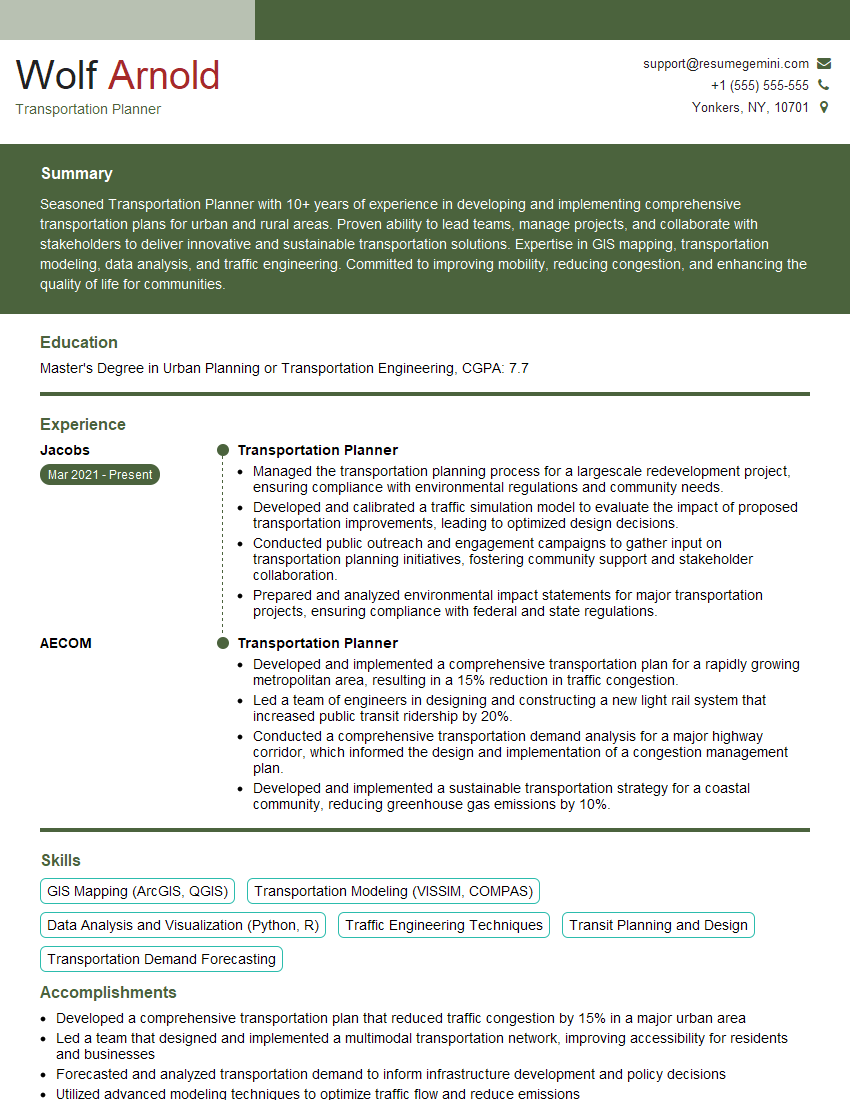
Mastering routing and scheduling software opens doors to exciting and high-demand roles in various sectors. To maximize your job prospects, crafting a compelling and ATS-friendly resume is crucial. ResumeGemini can be a valuable partner in this process, helping you build a professional resume that highlights your skills and experience effectively. They provide examples of resumes tailored specifically to the Routing and Scheduling Software field, ensuring your application stands out. Invest the time in creating a strong resume – it’s your first impression on potential employers.
Explore more articles
Users Rating of Our Blogs
Share Your Experience
We value your feedback! Please rate our content and share your thoughts (optional).
What Readers Say About Our Blog
To the interviewgemini.com Webmaster.
Very helpful and content specific questions to help prepare me for my interview!
Thank you
To the interviewgemini.com Webmaster.
This was kind of a unique content I found around the specialized skills. Very helpful questions and good detailed answers.
Very Helpful blog, thank you Interviewgemini team.