Are you ready to stand out in your next interview? Understanding and preparing for Vaulted Ceiling Installation interview questions is a game-changer. In this blog, we’ve compiled key questions and expert advice to help you showcase your skills with confidence and precision. Let’s get started on your journey to acing the interview.
Questions Asked in Vaulted Ceiling Installation Interview
Q 1. Explain the different types of vaulted ceilings and their construction methods.
Vaulted ceilings add architectural drama and height to a room, but their construction varies. The most common types are:
- Barrel Vaults: These are semi-circular arches extending along the length of the room, often constructed with curved lumber framing, then sheathed and finished.
- Groin Vaults: Formed by the intersection of two barrel vaults, creating a more complex structure often requiring careful planning of framing and drywall installation.
- Cathedral Ceilings: These are typically simple angled ceilings that slope from the walls to a ridge, generally easier to construct than barrel or groin vaults.
- Gothic Vaults: These are pointed arches, adding a distinct visual style, and involve intricate framing that often requires custom design and construction techniques.
Construction methods generally involve framing with lumber, often engineered lumber for larger spans or complex curves. This framing supports the sheathing (plywood or OSB), which acts as a base for the drywall. Curved ceilings may require bending the framing lumber or using specialized techniques such as creating a framework of smaller pieces to form the curve.
For example, on a barrel vault, we might use bent lumber or multiple layers of thinner boards to achieve the desired radius. With a groin vault, it’s crucial to ensure the intersection points are precisely engineered for structural integrity. The choice of construction method heavily depends on the ceiling’s design, size, and structural requirements.
Q 2. Describe your experience with installing various types of drywall in vaulted ceilings.
My experience encompasses working with various drywall types on vaulted ceilings, each offering distinct advantages:
- Standard Drywall: Commonly used for simpler vaulted ceilings. It’s cost-effective but can be challenging to manipulate into complex curves without cracking.
- Moisture-Resistant Drywall: Ideal for bathrooms or kitchens with vaulted ceilings, offering protection against moisture damage. This is crucial in preventing mold growth in higher humidity areas.
- Fire-Rated Drywall: Used in areas requiring enhanced fire protection, offering superior fire resistance compared to standard drywall. It is thicker, heavier, and more difficult to handle.
- Lightweight Drywall: Suitable for reducing the overall load on the ceiling structure, particularly advantageous for larger, more complex vaulted ceilings. It is easier to handle but is slightly less robust than standard drywall.
I’ve worked with all these types, selecting the appropriate drywall based on the project’s specific needs. For instance, on a recent project with a large groin vault, we opted for lightweight drywall to lessen the load on the intricate frame. In another job, a bathroom renovation with a vaulted ceiling necessitated using moisture-resistant drywall to safeguard against potential water damage.
Q 3. How do you ensure proper insulation and soundproofing in a vaulted ceiling?
Proper insulation and soundproofing are crucial for comfort and energy efficiency in vaulted ceilings. For insulation, I generally recommend using blown-in cellulose or fiberglass insulation. These materials fill the cavities effectively, minimizing heat transfer and improving energy efficiency. Batt insulation can also be used but requires more careful installation to avoid gaps.
For soundproofing, a multi-layered approach is most effective. This often involves adding a layer of sound-dampening material, such as mass-loaded vinyl, between the framing and drywall. This layer helps absorb sound waves, reducing noise transfer. Additionally, using thicker drywall or a double layer of drywall significantly improves sound insulation. Finally, sealing all gaps and cracks is crucial; even small openings can allow significant sound transmission.
For example, on a recent home theater project with a vaulted ceiling, we used blown-in cellulose for insulation and added a layer of mass-loaded vinyl to reduce outside noise. The result was a remarkably quiet and energy-efficient space.
Q 4. What safety precautions do you take when working on vaulted ceilings?
Safety is paramount when working on vaulted ceilings. The heightened working area presents unique hazards, requiring extra precautions:
- Fall Protection: Harnesses and safety lines are always used. A secure anchor point is essential, and spotters are frequently used for added security. Working at heights always requires a safety plan and appropriate equipment.
- Proper Tool Usage: Tools are inspected before use to ensure they are in good working order. This prevents accidents from faulty equipment. Power tools require the use of appropriate safety equipment such as eye and ear protection.
- Clear Work Area: The workspace is kept clean and organized to prevent falls due to trip hazards. Tools and materials are kept where they are easily accessible to avoid dangerous reaches.
- Proper Lifting Techniques: Drywall is heavy; lifting is done using proper techniques to avoid back injuries. We always employ mechanical assistance such as lift gates where possible.
- Head Protection: Hard hats are mandatory to protect against falling debris. This minimizes the risks associated with working at heights.
Ignoring these precautions can lead to serious injury. We always prioritize safety, using the right equipment and techniques to ensure a safe working environment for everyone on the team.
Q 5. How do you measure and cut drywall for a vaulted ceiling?
Measuring and cutting drywall for a vaulted ceiling requires precision. It’s not a simple matter of cutting straight lines. Here’s a step-by-step process:
- Accurate Measurements: Each piece of drywall needs precise measurements taken directly from the ceiling structure. This often involves using a flexible tape measure to follow the curves and angles.
- Create Templates: For complex curves, creating cardboard templates from the ceiling structure is extremely helpful. This ensures an accurate cut, minimizing waste and maximizing efficiency.
- Transfer Measurements: Transfer the template measurements onto the drywall using a pencil. This ensures accurate cutting and minimizes errors.
- Cutting Drywall: Utilize a drywall saw for straight cuts and a utility knife for curves, guided by the marked lines. For intricate curves, a jigsaw with a fine-tooth blade might be necessary.
- Test Fit: Before securing, test-fit each piece to ensure a proper fit and make adjustments if needed. This step minimizes mistakes and rework.
I often use a combination of techniques. For example, on a recent cathedral ceiling, I used a straight cut for the angled sections and a utility knife for the transition to the flat sections at the edges. Accurate measurements and careful cutting are essential to a clean, professional-looking finish.
Q 6. Explain your process for installing crown molding on a vaulted ceiling.
Installing crown molding on a vaulted ceiling adds a touch of elegance but requires skill and patience. The process involves:
- Precise Measurement & Cutting: Measure and cut the molding to fit each section of the vaulted ceiling, accounting for the varying angles and curves. Using miter saw with a fine blade is essential for accuracy.
- Compound Mitering: Crown molding often requires compound miter cuts to precisely fit the angles and curves of the vault. The angles need to be calculated carefully. This step requires understanding of geometry.
- Secure Mounting: Use construction adhesive and finishing nails to mount the molding. Apply adhesive liberally to ensure a strong bond, especially on the curves.
- Fill & Sand: Fill nail holes and gaps with wood filler, sand smooth, and prime before painting.
- Caulking: Carefully caulk all joints to create a seamless finish. This hides gaps and offers a professional look.
For example, on a recent project with a barrel vault ceiling, I utilized a combination of compound miter cuts and carefully applied adhesive to achieve a flawless installation of crown molding. Accurate measurements and patience are key for success in this detail-oriented process.
Q 7. How do you handle complex angles and curves in a vaulted ceiling installation?
Handling complex angles and curves in vaulted ceiling installation requires a strategic approach:
- Careful Planning: Start with detailed measurements and drawings, often creating 3D models to visualize the complexities. This allows for planning and pre-cutting to reduce on-site errors.
- Specialized Tools: Utilize tools like a jigsaw, coping saw, and specialized miter saws designed for handling complex angles. Precise cutting is key to a successful outcome.
- Dry-Fitting: Before fastening anything, dry-fit the components to ensure proper alignment and adjust as needed. This avoids costly mistakes and saves time.
- Flexible Materials: In some cases, using flexible materials like flexible drywall or thin wood can help conform to complex curves. This technique is especially useful when dealing with tight radii.
- Piecemeal Approach: Instead of trying to install large, complex sections at once, break down the process into smaller, manageable pieces. This makes the process simpler and easier to manage.
For example, on a recent project with a challenging gothic vault, we used a combination of flexible drywall and a piecemeal approach to install the drywall. We carefully measured and pre-cut each section, ensuring a tight fit at each angle. This strategy allowed us to achieve a beautifully finished ceiling without major difficulties.
Q 8. Describe your experience with installing lighting fixtures in vaulted ceilings.
Installing lighting fixtures in vaulted ceilings requires meticulous planning and execution, differing significantly from flat ceiling installations. The higher angles and often-limited access demand specialized techniques.
First, I always carefully plan the fixture placement, considering the overall design and ensuring sufficient clearance for access during maintenance. This includes accounting for the sloped angle to determine appropriate fixture length and mounting hardware. Next, I use specialized tools like extension poles and magnetic retrieval systems to access difficult-to-reach areas, ensuring safe and accurate placement. For example, I recently installed recessed lighting in a steeply pitched cathedral ceiling. Using a long extension pole with a strong magnetic head, I could easily maneuver the fixtures into their precisely marked locations, achieving a perfectly symmetrical look. Finally, I always test the fixture’s functionality before finalizing the installation, confirming proper wiring and secure mounting.
Another crucial aspect is considering the weight of the fixture. Heavier fixtures require robust mounting systems specifically designed for angled surfaces. Using inadequate hardware could result in the fixture detaching over time, causing damage and safety hazards. I always select mounting hardware based on the weight of the fixture and the type of ceiling material.
Q 9. How do you ensure a seamless finish and prevent cracking in vaulted ceilings?
Achieving a seamless finish and preventing cracking in vaulted ceilings necessitates attention to detail throughout the installation process. Think of it like building a finely crafted arch – every piece must fit perfectly.
- Proper Substrate Preparation: A smooth, clean surface is paramount. Any imperfections, like uneven drywall or gaps in the framing, need to be addressed before applying the final finish. I often use a high-quality drywall compound and multiple thin coats to achieve a seamless surface, sanding thoroughly between each coat.
- Appropriate Joint Treatment: The seams between drywall sheets in a vaulted ceiling are often more pronounced and require extra attention. I use a wide knife, applying a generous amount of compound and feathering it out smoothly to prevent cracks. Using fiberglass tape on the seams helps reinforce the joint and provides an extra layer of crack prevention.
- Flexible Materials: In areas with significant curvature, I use flexible drywall or specialized joint compound designed to accommodate movement and prevent cracking. This is particularly important where the ceiling changes angle abruptly.
- Expansion Joints: In larger vaulted ceilings, strategically placed expansion joints are crucial to accommodate movement due to temperature fluctuations and building settling. These joints are carefully concealed using flexible caulking or trim.
I’ve found that paying close attention to these details significantly reduces the risk of cracks and ensures a beautifully finished ceiling that lasts.
Q 10. What are the common challenges faced during vaulted ceiling installation?
Vaulted ceiling installation presents unique challenges that demand experience and problem-solving skills. These challenges often stem from the angled surfaces and increased complexity compared to flat ceilings.
- Accessibility: Reaching high points requires specialized equipment and safety precautions, increasing both time and cost. Working at height always demands careful planning and use of appropriate safety measures, such as harnesses and scaffolding.
- Material Waste: Cutting and fitting materials accurately becomes more complex with angled surfaces, often resulting in more material waste.
- Framing Complexity: The framing for vaulted ceilings is more intricate and requires precision in construction to support the weight and maintain structural integrity. Incorrect framing will manifest in sags, unevenness, or even catastrophic failure.
- Seam Management: Managing seams on sloped surfaces requires more skill and attention to detail to achieve a seamless and crack-free finish.
- Lighting Considerations: Planning and installing lighting fixtures on a vaulted ceiling presents its own specific challenges that require advanced knowledge and safety procedures.
Addressing these challenges often involves careful planning, the selection of appropriate materials and tools, and strict adherence to safety regulations.
Q 11. How do you manage time and resources effectively in a vaulted ceiling project?
Effective time and resource management in vaulted ceiling projects is vital for successful completion and client satisfaction. My approach revolves around meticulous pre-planning and efficient execution.
- Detailed Planning: This includes thorough measurements, material calculations, and a detailed schedule outlining each phase of the project. This prevents delays caused by unexpected issues.
- Teamwork and Communication: Clear communication with my team and the client is crucial. A collaborative approach ensures everyone is on the same page, minimizing miscommunication and rework.
- Efficient Material Handling: Organizing materials logically and having them readily available at the right time minimizes unnecessary trips and wasted time. This includes pre-cutting and marking materials where possible.
- Prioritization: Focusing on critical path activities first helps maintain the project’s momentum. This involves identifying and addressing potential bottlenecks before they significantly impact the timeline.
- Contingency Planning: Building in a buffer for unforeseen events and delays is essential to minimize the impact on the overall project schedule. This could include setting aside time for potential repairs or material replacements.
By implementing these strategies, I consistently deliver vaulted ceiling projects on time and within budget, while maintaining the highest standards of quality.
Q 12. What are your preferred tools and materials for vaulted ceiling installation?
My tool selection for vaulted ceiling installations depends on the specific materials being used but generally includes:
- Measuring Tools: Laser measures, tape measures, levels, squares – precision is key.
- Cutting Tools: Jigsaw, circular saw (with appropriate blades), utility knife.
- Fastening Tools: Drill, impact driver, nail gun (for appropriate applications).
- Finishing Tools: Putty knives (various sizes), sanding tools (sandpaper, sanding blocks, orbital sander), taping knives.
- Safety Equipment: Safety glasses, hearing protection, harnesses, scaffolding (when necessary), dust masks.
- Specialized Tools: Extension poles, magnetic retrieval systems for high access points.
Regarding materials, the choice depends heavily on the design and client’s preferences. Common materials include drywall, plywood, plaster, and various types of wood paneling. I always use high-quality materials that meet or exceed building codes and ensure longevity and durability.
Q 13. Describe your experience working with different types of ceiling materials (e.g., wood, plaster).
My experience encompasses working with a range of ceiling materials, each presenting unique characteristics and installation techniques.
- Wood: Working with wood, whether it’s planks, beams, or tongue-and-groove paneling, demands precise cuts and careful fitting to create a visually appealing and structurally sound ceiling. I’m skilled in using various joinery techniques to achieve a seamless look, accounting for wood movement due to humidity changes.
- Plaster: Plaster requires a different approach, focusing on proper mixing, application techniques, and achieving a smooth, even finish. This often requires multiple coats and meticulous sanding to create a flawless surface. The weight and drying time of plaster are important factors to consider, particularly on angled surfaces.
- Drywall: Drywall is a common and versatile option, requiring attention to detail regarding taping, mudding, and sanding to achieve a seamless and crack-free finish, especially crucial for the angled surfaces of vaulted ceilings.
The choice of material influences tool selection and the overall approach to installation. I always carefully consider the material’s properties, maintenance requirements, and suitability for the specific environment before starting the installation process.
Q 14. How do you handle unexpected issues or problems during installation?
Unexpected issues arise in every project. My response always prioritizes safety and finding a solution that maintains the integrity of the finished product. I approach unexpected issues systematically.
- Assessment: First, I carefully assess the issue’s nature, scope, and potential impact on the project’s timeline and budget.
- Problem Solving: Next, I brainstorm solutions, considering several approaches before choosing the most effective and practical one, always prioritizing safety and structural integrity.
- Communication: I keep the client informed throughout the process, explaining the problem, proposed solutions, and any potential adjustments to the schedule or budget. Transparency is vital in building trust.
- Documentation: Thorough documentation of the issue, solution, and any corrective actions taken ensures proper record-keeping and helps avoid similar issues in future projects.
For instance, I once encountered unexpected framing inconsistencies during a vaulted ceiling installation. Instead of rushing a solution that compromised quality, I collaborated with the structural engineer to rectify the framing, ensuring the long-term stability and safety of the ceiling, although it did cause a minor schedule delay. Client communication and transparency throughout the process ensured their understanding and cooperation.
Q 15. What is your experience with working from heights?
Safety is paramount in my work, especially when dealing with heights. I’ve been working at heights for over 15 years, consistently adhering to stringent safety protocols. This includes proper harness usage, fall protection systems like anchored lifelines and safety nets, and thorough pre-job risk assessments. I’m fully certified in fall protection and regularly undergo refresher training. For example, on a recent cathedral ceiling installation, we employed a double-point anchoring system to the roof trusses for added security during the installation of the framing.
I’m not just comfortable with heights; I understand the inherent risks and manage them proactively. I always double-check my equipment and ensure my team does the same. It’s not just about following rules, it’s about developing a safety-first mindset that becomes second nature.
Career Expert Tips:
- Ace those interviews! Prepare effectively by reviewing the Top 50 Most Common Interview Questions on ResumeGemini.
- Navigate your job search with confidence! Explore a wide range of Career Tips on ResumeGemini. Learn about common challenges and recommendations to overcome them.
- Craft the perfect resume! Master the Art of Resume Writing with ResumeGemini’s guide. Showcase your unique qualifications and achievements effectively.
- Don’t miss out on holiday savings! Build your dream resume with ResumeGemini’s ATS optimized templates.
Q 16. Explain your understanding of building codes and regulations related to vaulted ceilings.
Building codes, particularly those concerning structural integrity, load-bearing capacity, and fire safety, are crucial for vaulted ceiling installations. My understanding encompasses local, state, and national codes. I’m familiar with requirements for proper rafter spacing, the use of approved materials, and ensuring sufficient insulation to meet energy efficiency standards. For example, the International Building Code (IBC) dictates specific requirements for the design and construction of roofs and ceilings, including those with complex geometries like vaulted ceilings.
I regularly consult the relevant codes for each project and incorporate them into my plans from the outset. This includes checking for any specific requirements related to the ceiling’s span, the materials used, and the overall structural load it needs to support. Ignoring these regulations can lead to serious structural weaknesses, posing significant safety hazards. I prioritize compliance to ensure a safe, compliant, and long-lasting structure.
Q 17. Describe your experience with using blueprints and construction drawings.
Blueprint reading and interpretation are fundamental to my work. I can seamlessly translate architectural drawings into a practical construction plan. I’m proficient in understanding different drafting conventions, including those relating to scale, dimensions, and material specifications. I’m adept at identifying key elements such as rafter angles, ceiling height, and the placement of structural members.
In one project, the blueprints indicated a subtle change in the vaulted ceiling’s pitch midway through the structure. This wasn’t immediately apparent but was crucial for accurate framing. By meticulously studying the drawings, I identified this detail and incorporated the necessary adjustments into the framing plan, preventing structural problems later in the project. Proficient blueprint reading avoids costly rework and ensures a precise final product.
Q 18. How do you collaborate with other tradespeople on a vaulted ceiling project?
Collaboration is vital on a vaulted ceiling project, involving various trades like electricians, plumbers, and drywallers. I initiate communication early on, scheduling meetings to coordinate tasks and ensure a smooth workflow. We establish clear timelines and responsibilities to avoid conflicts and delays. For example, electricians need to run wiring before insulation and drywall installation. Open communication prevents unexpected issues.
I believe in a proactive approach, fostering a positive collaborative environment. Open dialogue and mutual respect are key. By keeping everyone informed of our progress, we anticipate potential issues and resolve them collaboratively. This prevents delays and ensures everyone works efficiently towards a shared goal. Clear communication saves time and resources while promoting a higher-quality outcome.
Q 19. How do you ensure the structural integrity of a vaulted ceiling?
Ensuring structural integrity is paramount. This begins with careful planning, incorporating accurate calculations for load-bearing capacity and rafter spacing. We use engineered wood products or traditional lumber, selecting the appropriate size and grade based on the span and the anticipated load. Proper fastening techniques are critical, using appropriately sized nails, screws, or other connectors for secure joints.
Regular inspections throughout the installation process are essential, checking for any signs of weakness or misalignment. We might use temporary supports during construction to maintain structural integrity until the ceiling is fully framed and sheathed. In some cases, we may consult with structural engineers to ensure the design can handle the weight and loads involved, particularly for larger or more complex vaulted ceilings. This cautious approach prevents potential failures and ensures longevity.
Q 20. What are the different techniques for finishing and painting a vaulted ceiling?
Finishing and painting a vaulted ceiling requires careful preparation. The process often includes drywall installation, taping, mudding, and sanding to create a smooth surface. Primer is crucial for good paint adhesion, particularly on the textured surfaces of some drywall. Different techniques exist for painting, depending on the desired finish. For instance, a roller with an extension pole is often used for larger areas, whereas a brush provides more precision for detail work.
For a high-end finish, we may apply multiple coats of paint, ensuring complete coverage and uniform color. Careful attention to detail is needed, particularly around corners and edges. Various paint types are available, such as matte, satin, or gloss, each affecting the overall look and feel of the ceiling. The choice of paint depends on factors such as moisture resistance, durability, and aesthetic preference.
Q 21. Describe your experience with various types of ceiling fans and their installation in vaulted ceilings.
Installing ceiling fans in vaulted ceilings requires careful consideration of the fan’s size, type, and mounting method. Standard ceiling fans may not be suitable for high ceilings, necessitating the use of extension rods or specialized fans designed for high ceilings. The weight of the fan and its potential movement needs to be factored into the installation plan to ensure the structural integrity of the ceiling is not compromised. We carefully select fans compatible with the vaulted ceiling height and structural support.
Safety is also critical. We use appropriate safety measures when working at height to install the fan and ensure it’s securely attached to the supporting structure. Electrical safety standards are meticulously followed, ensuring the fan is properly wired and grounded to prevent electrical hazards. Proper fan balance is also important to minimize vibration and noise, creating a pleasant experience for the homeowner.
Q 22. How do you address moisture issues in vaulted ceilings?
Moisture is the enemy of any ceiling, especially a vaulted one with its increased surface area and potential for trapped air. Addressing it requires a multi-pronged approach focusing on prevention and mitigation.
Proper Ventilation: Adequate attic ventilation is paramount. This involves strategically placed vents to allow for air circulation and prevent moisture buildup. Think of it like a house’s lungs – it needs to breathe! Insufficient ventilation can lead to mold, mildew, and structural damage.
Vapor Barriers: Installing a continuous vapor barrier on the warm side of the insulation is crucial. This prevents moisture from migrating into the insulation and the ceiling structure. It’s like putting a raincoat on your ceiling to keep it dry.
Proper Insulation: Choosing the right type and amount of insulation is vital. Insulation helps control temperature fluctuations which can lead to condensation. Think of it as a thermal blanket protecting your ceiling from temperature extremes.
Sealed Joints and Seams: Ensuring all seams and joints in the drywall, vapor barrier, and insulation are properly sealed prevents moisture intrusion. Any gap is an opportunity for moisture to sneak in.
Moisture Meter Checks: Regularly checking for moisture using a moisture meter, especially after periods of high humidity or rain, is a proactive way to detect potential problems early.
Ignoring moisture issues can lead to costly repairs down the line, so prevention is always the best solution.
Q 23. How do you determine the appropriate framing techniques for different vaulted ceiling designs?
Framing a vaulted ceiling depends heavily on the design’s complexity and the span of the ceiling. Different techniques are needed for simple cathedral ceilings versus more intricate barrel vaults or groin vaults.
Simple Cathedral Ceilings: These often use standard wall framing techniques extended upwards at an angle. Properly engineered trusses can simplify construction and ensure structural integrity. Imagine them as the supporting bones of your ceiling.
Complex Vaults (Barrel, Groin, etc.): These demand more intricate framing, often involving custom-cut lumber and potentially engineered wood products (like I-joists) to span larger distances. Experienced framers will often create detailed blueprints to ensure proper support and load distribution. Think of these as complex architectural puzzles requiring precision and expertise.
Load Calculations: Accurate load calculations are essential to determine the appropriate size and spacing of framing members. This ensures the ceiling can safely support its weight, insulation, drywall, and any additional fixtures (lighting, etc.). This is the engineering foundation of the project, critical for structural safety.
Failure to use appropriate framing techniques can result in structural weakness, sagging, and potentially catastrophic failure. Always consult building codes and seek engineering advice for complex designs.
Q 24. Describe your process for inspecting and ensuring the quality of your vaulted ceiling installation.
My inspection process is thorough and meticulous, starting from the initial framing and continuing through each stage of the installation. I check for:
Squareness and Plumb: Ensuring all framing members are square and plumb ensures a structurally sound and aesthetically pleasing ceiling. Using a level and square is fundamental.
Correct Fastener Placement: Verifying that all fasteners (nails, screws) are properly placed and secured prevents movement and structural compromise. Under-fastening can lead to significant problems later.
Drywall Installation: I check for proper alignment, minimal gaps, and even screw spacing to ensure a smooth and seamless surface. This is where the aesthetics really come into play.
Tape and Mud Application: Proper taping and mudding are crucial for a professional finish. I meticulously check for smooth surfaces, proper feathering, and absence of cracks. This step takes patience and skill.
Final Finish: The final inspection verifies the ceiling’s overall appearance, ensuring it meets the client’s specifications and my own quality standards. Any imperfections are addressed before final approval.
My commitment to quality is reflected in my rigorous inspection and attention to detail at each step of the process. I take pride in a flawless finish.
Q 25. Explain your experience with different types of drywall tape and mud.
My experience spans a range of drywall tape and mud products, each with its own strengths and weaknesses. I adapt my choice based on the specific project requirements and desired finish.
Tape: I’ve worked with paper tape, fiberglass tape, and mesh tape. Paper tape is traditional and cost-effective but can require more skill in application. Fiberglass tape offers better strength and resistance to cracking, especially in high-stress areas. Mesh tape is suitable for larger areas and curves. The choice depends on the project’s specific demands and my personal preference based on experience.
Mud: I’m proficient with both pre-mixed and powdered mud. Pre-mixed is convenient, but powdered mud allows for better control over consistency and is often preferred for larger projects. Each type has specific application techniques that I’ve mastered through years of practice. The key is achieving a smooth, seamless finish.
Ultimately, the best tape and mud are those that provide a durable, smooth finish, making the ceiling look professional and last a long time. This is crucial to my overall process and the final product.
Q 26. How do you manage waste and dispose of materials responsibly during installation?
Responsible waste management is a priority on every project. My process involves:
Recycling: I diligently separate recyclable materials like cardboard, plastic, and metal for proper disposal. This minimizes the environmental impact.
Disposal of Drywall: Drywall requires special handling and disposal in accordance with local regulations. I always follow proper guidelines to avoid environmental contamination.
Waste Reduction: I carefully plan material quantities to minimize waste. Precise measuring and efficient cutting techniques are key to this.
Donation: Usable scraps of lumber or other materials are often donated to local charities or construction schools. Reducing waste supports sustainability.
Partnering with Waste Management Companies: I work with reputable waste management companies to ensure proper and legal disposal of all non-recyclable materials.
Environmental responsibility is an important part of my professional ethos. My commitment ensures compliance with all regulations and a positive environmental impact.
Q 27. What are your salary expectations for this role?
My salary expectations are competitive and commensurate with my experience and skillset in vaulted ceiling installation. I’m open to discussing a specific range based on the details of the role and benefits package offered. I’m confident my expertise will add significant value to your team.
Q 28. Are you available to work overtime or on weekends if needed?
Yes, I am available to work overtime or weekends as needed to meet project deadlines and ensure client satisfaction. I understand that some projects require flexibility, and I’m willing to accommodate such needs.
Key Topics to Learn for Vaulted Ceiling Installation Interview
- Understanding Vaulted Ceiling Types: Familiarize yourself with different vaulted ceiling designs (e.g., barrel, groin, cathedral) and their structural implications.
- Material Selection and Properties: Learn about the characteristics of various materials used in vaulted ceiling construction (e.g., wood, drywall, metal) and their suitability for different applications. Understand factors like weight, strength, and fire resistance.
- Framing Techniques: Master the principles of framing vaulted ceilings, including proper techniques for creating arches, supporting structures, and ensuring stability.
- Drywall Installation and Finishing: Develop expertise in installing and finishing drywall on curved surfaces, including taping, mudding, and sanding techniques to achieve a smooth, professional finish.
- Safety Procedures and Regulations: Understand and adhere to all relevant safety regulations and best practices for working at heights and with power tools.
- Troubleshooting Common Issues: Be prepared to discuss common problems encountered during vaulted ceiling installation (e.g., sagging, cracking, uneven surfaces) and their solutions.
- Code Compliance and Building Permits: Gain a working knowledge of building codes and permit requirements related to vaulted ceiling installations.
- Estimating and Budgeting: Practice calculating material costs and labor hours for accurate project budgeting.
- Project Management and Coordination: Understand the importance of effective project planning, scheduling, and communication with clients and other tradespeople.
Next Steps
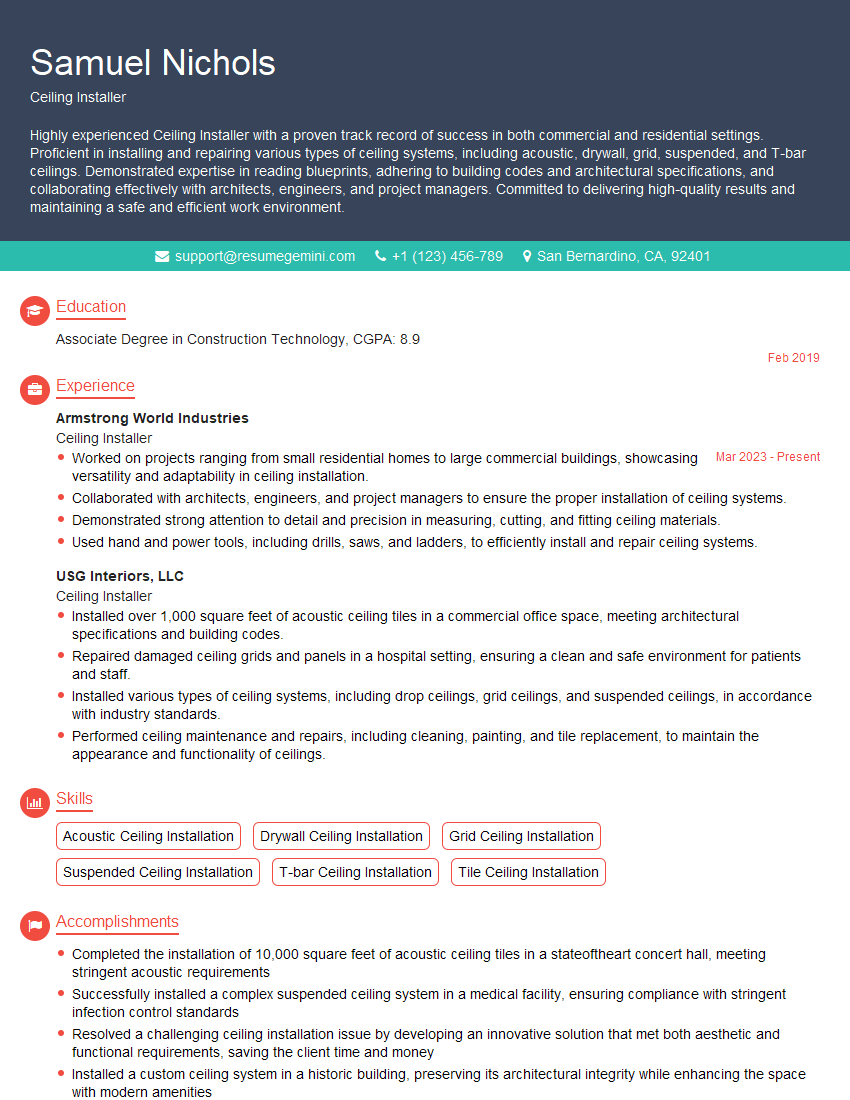
Mastering vaulted ceiling installation opens doors to exciting career opportunities in construction and interior finishing. Demonstrating proficiency in this specialized skill significantly increases your value to employers. To maximize your job prospects, it’s crucial to present your skills effectively. Creating an ATS-friendly resume is essential for getting your application noticed. We highly recommend using ResumeGemini to build a professional and impactful resume that highlights your expertise. ResumeGemini provides examples of resumes tailored to Vaulted Ceiling Installation to help you get started. Invest the time to craft a compelling resume – it’s your first impression and a key to unlocking your career potential.
Explore more articles
Users Rating of Our Blogs
Share Your Experience
We value your feedback! Please rate our content and share your thoughts (optional).
What Readers Say About Our Blog
To the interviewgemini.com Webmaster.
Very helpful and content specific questions to help prepare me for my interview!
Thank you
To the interviewgemini.com Webmaster.
This was kind of a unique content I found around the specialized skills. Very helpful questions and good detailed answers.
Very Helpful blog, thank you Interviewgemini team.