Feeling uncertain about what to expect in your upcoming interview? We’ve got you covered! This blog highlights the most important Sanding and Smoothing Drywall Surfaces interview questions and provides actionable advice to help you stand out as the ideal candidate. Let’s pave the way for your success.
Questions Asked in Sanding and Smoothing Drywall Surfaces Interview
Q 1. What types of drywall sanding tools are you proficient with?
My drywall sanding proficiency spans a range of tools, from the basic hand sanding block for smaller, detailed areas to more powerful electric sanders. I’m experienced with various types of electric sanders, including:
- Orbital sanders: These are excellent for large, flat surfaces, offering a smooth finish with minimal scratching. I often use these for the majority of a wall.
- Random orbital sanders: Similar to orbital sanders but with a more random pattern, minimizing swirl marks, especially important for achieving a pristine finish.
- Detail sanders: These are invaluable for sanding corners, edges, and hard-to-reach areas where larger sanders are unsuitable.
- Longboard sanders: These are best for covering large areas quickly and efficiently, particularly useful when working on ceilings.
Choosing the right tool depends entirely on the project; for instance, a longboard sander would be overkill for a small patch, whereas a hand sanding block might be too time-consuming for large walls.
Q 2. Explain the process of preparing drywall for painting.
Preparing drywall for painting is a crucial step that directly impacts the final look. It involves several key stages:
- Repairing Imperfections: This is the first and often most time-consuming step. Filling nail holes, cracks, and seams with drywall compound is essential. I typically apply multiple thin coats, allowing each to dry completely before sanding.
- Sanding: After the compound dries, I thoroughly sand all filled areas until smooth and flush with the surrounding surface. I start with coarser grit sandpaper and gradually move to finer grits to refine the surface. Proper lighting is crucial here to catch any imperfections.
- Priming: Priming seals the drywall, providing a uniform surface for the paint to adhere to and preventing the drywall from absorbing the paint unevenly, which can lead to unsightly blotches.
- Cleaning: Before painting, I make sure to thoroughly clean the entire surface, removing all dust and debris from sanding. This is done with a tack cloth or a slightly damp sponge.
Skipping any of these steps, especially proper sanding and priming, can result in a poor-quality paint job, with visible imperfections or inconsistent color.
Q 3. What are the different types of drywall mud and their applications?
Drywall mud, or joint compound, comes in several types, each suited to different applications:
- All-Purpose Compound: This is a versatile compound ideal for most tasks, including taping, topping, and filling minor imperfections. It offers a good balance of workability and drying time.
- Lightweight Compound: Lighter than all-purpose, this compound is less prone to cracking and sagging, making it suitable for large areas and ceilings. It often requires more coats.
- Setting-Type Compound: This type dries quickly, allowing for faster finishing. However, it’s crucial to work swiftly, as it sets rapidly. It’s often used for multiple coats in quick succession.
- All-Purpose Lightweight Compound: This combines the best features of all-purpose and lightweight compounds, offering good workability and reduced cracking/sagging.
Choosing the right compound depends on the project’s scale and the desired level of smoothness. For instance, I might use lightweight compound for a large, high ceiling to minimize sagging.
Q 4. How do you achieve a smooth, flawless drywall finish?
Achieving a flawless drywall finish requires attention to detail and patience. It’s a multi-step process:
- Proper Application of Compound: Apply thin, even coats of compound, avoiding globs or excessive buildup. This minimizes sanding and prevents cracking.
- Meticulous Sanding: Sanding is key to achieving a smooth surface. Use a variety of grits, starting with coarser grits to remove significant imperfections and gradually moving to finer grits for a smooth finish. Use smooth, even strokes, avoiding excessive pressure which could lead to scratches.
- Multiple Coats: Usually, multiple coats are necessary to achieve a perfectly smooth surface. Each coat should be allowed to dry thoroughly before sanding.
- Lighting: Good lighting is absolutely essential. Inspect your work from different angles to detect imperfections.
- Proper Tools: Using the right tools for the job – sanders, knives, and appropriate sandpaper – makes a significant difference.
Think of it like sculpting: you start with rough shaping, and then carefully refine it with finer tools until it’s perfectly smooth.
Q 5. Describe your experience with different drywall textures.
My experience with drywall textures encompasses a wide variety, including:
- Smooth: This is the most common finish and requires careful attention to sanding and finishing to achieve a perfect, even surface.
- Orange Peel: This texture is created using a hopper gun and produces a slightly textured surface. It’s relatively easy to achieve a consistent look, but care must be taken to maintain an even application.
- Knockdown: Similar to orange peel, but the peaks are lightly knocked down after application, creating a smoother yet still textured appearance.
- Skip Trowel: This more dramatic texture involves applying thicker coats of compound and then using a tool to create irregular patterns. This is a more artistic application and requires skill and practice for consistency.
Each texture has its own challenges; smooth requires more meticulous sanding, while textured finishes require consistent application techniques.
Q 6. What are the common problems encountered during drywall sanding and how do you address them?
Common problems encountered during drywall sanding include:
- Sanding Through the Compound: This usually happens when too much pressure is applied or when insufficient compound has been applied. The solution is to reapply compound and sand gently.
- Swirl Marks: These are caused by using the wrong type of sander or applying too much pressure. Using a random orbital sander and lighter pressure helps prevent this.
- Dust: Dust is unavoidable but can be minimized by using a vacuum attachment with your sander and wearing a respirator.
- Uneven Finish: This can result from inconsistent compound application or insufficient sanding. Careful application and multiple coats are key to avoiding this.
Addressing these issues involves careful observation, using the right tools, and employing proper techniques. Experience allows for quick identification and efficient solutions.
Q 7. How do you ensure consistent coverage with drywall compound?
Consistent coverage with drywall compound is achieved through a combination of techniques:
- Using the Right Tools: Employing a putty knife of appropriate size and flexibility is critical. For larger areas, a broader knife is beneficial, while smaller knives are suitable for detailed work.
- Thin Coats: Applying thin, even coats is paramount. Thick coats are more prone to cracking and require excessive sanding.
- Consistent Pressure: Maintaining consistent pressure while applying the compound prevents variations in thickness and ensures a uniform surface.
- Feathering Edges: Feathering the edges of each coat ensures a seamless blend with the surrounding area, avoiding noticeable transitions.
- Multiple Coats: For a truly flawless finish, multiple thin coats are often necessary. Allow each coat to dry completely before applying the next.
Think of it as painting: thin, even coats and proper blending techniques are key to achieving a professional look.
Q 8. Explain the importance of proper sanding techniques to avoid damage.
Proper sanding techniques are crucial for achieving a smooth, flawless drywall surface and preventing damage. Improper sanding can lead to gouges, scratches, and uneven textures that are difficult and time-consuming to repair. It’s like sculpting with sandpaper – a delicate touch is needed to achieve the desired finish.
The key is to use the right grit sandpaper, starting with a coarser grit to remove the bulk of the imperfections, then gradually progressing to finer grits to refine the surface. Applying too much pressure or using too coarse a grit initially can easily damage the drywall paper, creating more work later. Think of it like sanding wood: you wouldn’t start with 80-grit sandpaper on a delicate piece of furniture!
For example, using a 120-grit sandpaper initially on a freshly taped and mudded joint is far too aggressive. You risk tearing the paper, exposing the gypsum core, and creating an even larger problem. Instead, you should start with something around 180-grit and work your way up to 220 or even 320 grit for a flawlessly smooth finish.
Q 9. What safety precautions do you take when sanding drywall?
Safety is paramount when sanding drywall. Drywall dust is incredibly fine and can be harmful if inhaled. My safety routine always begins with proper respiratory protection. I always wear a NIOSH-approved respirator, specifically an N95 or better, to filter out the fine particles. I also use safety glasses to protect my eyes from flying debris.
Furthermore, I ensure adequate ventilation. This might involve opening windows, using a fan to exhaust dust away from the work area, or even utilizing a HEPA-filtered vacuum system specifically designed for drywall dust. Loose clothing and jewelry are avoided to prevent entanglement. I make sure the area is well-lit and the work surface is stable to prevent falls and injuries.
Finally, regular breaks are essential to avoid dust inhalation and fatigue. Taking frequent breaks allows for proper hydration and prevents overexertion, a common cause of workplace accidents. It’s a multifaceted approach – it’s not just about wearing the right gear, but implementing a whole safety mindset.
Q 10. How do you manage dust during the sanding process?
Dust management is vital, both for the quality of the finish and for worker health. My primary method is using a high-quality HEPA vacuum with a sanding attachment. This allows me to collect dust directly at the source, minimizing airborne particles. This is far superior to simply sweeping or using a shop vacuum which isn’t designed for fine dust containment.
In addition to the vacuum, I use plastic sheeting to contain the dust and protect areas not being sanded. This includes masking off adjacent areas with painter’s tape and plastic sheeting to prevent cross-contamination. The plastic sheeting also helps to catch larger particles, making cleanup considerably easier. After sanding, I thoroughly vacuum the area, then damp-wipe all surfaces to eliminate remaining dust. This two-step process ensures maximum dust containment.
For larger jobs or those in sensitive areas, I might employ a negative air pressure system to further minimize dust dispersion. This involves using industrial-grade fans to create a controlled airflow that draws dust away from the work area and out of the building. This extra precaution is especially important in homes with sensitive individuals like asthmatics or allergy sufferers.
Q 11. Describe your experience with various drywall joint compounds.
My experience encompasses a wide range of drywall joint compounds, each with its own properties and applications. I’m proficient with all-purpose compounds, lightweight compounds, and setting-type compounds. Each type has its strengths and weaknesses.
All-purpose compounds are versatile and suitable for most applications, offering a good balance of strength and workability. Lightweight compounds are excellent for reducing the overall weight of the wall, especially crucial in areas with structural limitations. Setting-type compounds, on the other hand, are designed for quicker drying times, but they often require more skill to apply smoothly. Understanding these differences is key to selecting the right compound for the job.
For instance, in a situation where fast drying times are critical, I’d use a setting-type compound. However, for a large, intricate wall, I’d opt for a lighter compound to manage weight and prevent unnecessary strain on the structure. Careful selection is always necessary for a flawless end result.
Q 12. What is your experience with different types of drywall (e.g., fire-resistant)?
My experience includes working with various types of drywall, including standard drywall, fire-resistant drywall, and moisture-resistant drywall. Each type presents unique challenges and requires specific considerations during sanding.
Fire-resistant drywall, often thicker and denser than standard drywall, requires more careful sanding to avoid creating deep gouges or damaging the fire-retardant properties. Moisture-resistant drywall, commonly used in bathrooms and kitchens, can be more prone to moisture absorption, which can affect the sanding process and the adhesion of the joint compound. Understanding the characteristics of each type allows me to adjust my techniques accordingly to ensure optimal results.
For example, when sanding fire-resistant drywall, I use a finer grit sandpaper and apply less pressure to prevent premature wear on the sanding tools and avoid damaging the protective layer. With moisture-resistant drywall, I carefully monitor the drying time to prevent the compound from absorbing excess moisture, which could result in a less robust and less aesthetically pleasing finish.
Q 13. How do you identify and repair imperfections in drywall?
Identifying and repairing drywall imperfections is a key part of my expertise. I start by carefully inspecting the surface, looking for common issues like nail pops, cracks, holes, and uneven texture. Each imperfection requires a unique approach to repair.
For nail pops, I carefully tap them down and apply a small amount of joint compound to fill the gap. For larger cracks, I might need to use a reinforcing mesh to prevent the crack from recurring before filling it with compound. Holes are usually filled with compound, and multiple coats are applied, ensuring each coat is completely dry before the next is applied.
Uneven textures may require more extensive sanding, potentially using different grits to smooth the surface. I carefully observe the light reflections to identify areas that require further attention. My approach is systematic and methodical, addressing each issue individually and working methodically through the repair process to ensure no area is missed.
Q 14. What are your preferred methods for feathering edges?
Feathering edges is crucial for a seamless finish, avoiding visible transitions between the compound and the drywall. My preferred method involves applying multiple thin coats of compound, gradually blending the edges outwards, using a wide putty knife or taping knife.
I start by applying a thin coat, slightly wider than the previous application, ensuring the edges are smoothly blended. I let each coat dry completely before applying the next. The key is patience and gradual application. It’s not a race to finish quickly; it’s about creating an imperceptible transition that only shows an improvement in the wall’s quality. This iterative approach, with attention to detail, is vital for a professional finish.
For example, on a corner joint, I might use a flexible taping knife to ensure complete coverage and smoothness while maintaining a consistent flow along the corner. After applying several thin coats, I follow up with progressively finer grits of sandpaper to achieve a perfectly smooth and invisible transition.
Q 15. How do you ensure a consistent level of finish across large surfaces?
Maintaining a consistent finish across large surfaces requires meticulous planning and execution. Think of it like painting a mural – you wouldn’t just start slapping paint on without a plan! First, I always ensure the initial drywall application is flawlessly smooth. This means paying close attention to the seams and avoiding any significant dips or bumps. Then, I work in manageable sections, typically 4ft x 8ft panels, ensuring each section is completely sanded and inspected before moving on to the next. This prevents me from overlooking imperfections and helps maintain consistency. I use a long, level sanding pole for larger areas to keep my strokes even and avoid creating new unevenness. Finally, I use consistent lighting throughout the project to highlight any missed spots.
Example: On a recent project, I divided a large wall into four sections and worked methodically on each. After finishing a section, I’d step back and use a strong light source to inspect it before moving on, ensuring the overall consistency across each area.
Career Expert Tips:
- Ace those interviews! Prepare effectively by reviewing the Top 50 Most Common Interview Questions on ResumeGemini.
- Navigate your job search with confidence! Explore a wide range of Career Tips on ResumeGemini. Learn about common challenges and recommendations to overcome them.
- Craft the perfect resume! Master the Art of Resume Writing with ResumeGemini’s guide. Showcase your unique qualifications and achievements effectively.
- Don’t miss out on holiday savings! Build your dream resume with ResumeGemini’s ATS optimized templates.
Q 16. How do you work efficiently and effectively within a team?
Effective teamwork in drywall finishing is crucial. Clear communication is key. Before starting, we always discuss the project scope, individual responsibilities, and the desired finish level. For instance, one team member might focus on taping and mudding while another handles sanding. We utilize a system where each person is responsible for their section of the wall but we constantly check each other’s work for consistency. We also prioritize efficient workflow, organizing tools and materials to minimize wasted time. A well-organized workspace is a must for efficient team work.
Example: On a recent large project, we assigned specific tasks to each team member based on their expertise, this approach optimized our workflow and produced better results in a shorter span.
Q 17. What is your understanding of different taping methods?
There are several taping methods, each with its pros and cons. The most common is the ‘hot mud’ method, where a fast-setting compound is used for a quick initial coat. This method is efficient but requires more skill to avoid creating too many ridges. The ‘cold mud’ method, using a slower-setting compound, allows for more time to smooth the tape, but takes longer to dry. Then there’s the ‘double taping’ technique for larger gaps, applying a second layer of tape to reinforce the joint before applying compound. My preference depends on the project requirements and the ambient conditions, but I’m proficient in all techniques.
Example: In a humid environment, I’d likely favor the ‘hot mud’ method to avoid extended drying times, whereas in a cooler, drier environment, ‘cold mud’ might be preferable for better control and smoother results.
Q 18. How do you prepare for a large drywall finishing project?
Preparing for a large drywall finishing project involves thorough planning. First, a detailed assessment of the project scope, including surface area and complexity, is essential. Then, I compile a detailed material list, ensuring I have ample drywall compound, tape, sanding supplies (sandpaper of various grits, sanding blocks, sanding poles), and appropriate personal protective equipment (PPE). I also factor in potential delays or unexpected issues that might occur, to maintain a buffer in the timeline. Lastly, I coordinate with the team to clarify roles and responsibilities, ensuring a smooth execution.
Example: For a large commercial project, I created a spreadsheet detailing the materials needed, including specific quantities of each compound type and sandpaper grit. This ensured that we wouldn’t run out of supplies mid-project.
Q 19. What is your experience with different sanding grits and their uses?
Different sanding grits play a crucial role in achieving a smooth finish. Lower grits (e.g., 80-100) are used for initial sanding to remove large imperfections. Medium grits (e.g., 120-150) smooth out the surface further. Higher grits (e.g., 180-220) are used for the final sanding to create an extremely smooth, almost glassy surface. It’s crucial to progress gradually through the grits, never skipping a step. Imagine it like sculpting – you wouldn’t start with a fine detail tool before removing the rough shape.
Example: I typically start with 80-grit to remove major imperfections, move to 120-grit for a smoother surface, and finally use 220-grit to achieve the desired final finish.
Q 20. How do you determine when a drywall surface is adequately smoothed?
Determining whether a drywall surface is adequately smoothed involves a combination of visual inspection and tactile assessment. I start by examining the surface under consistent, bright lighting to identify any remaining imperfections. Then, I run my hand across the surface to detect subtle bumps or dips. A properly smoothed surface should feel consistently smooth and even. If irregularities are present, further sanding is required. A final check is using a bright light skimming across the wall to catch any shadows indicating unevenness.
Example: I often use a flashlight held at a low angle to highlight any subtle imperfections that might be missed under normal lighting. This technique is particularly useful for catching minor variations in the surface.
Q 21. How do you handle challenging areas, such as corners and angles?
Corners and angles require special attention and techniques. For inside corners, I use a corner taping tool to apply the tape neatly and then use a flexible putty knife to apply the compound smoothly, ensuring a consistent thickness. Outside corners require a different approach; I use a corner bead to protect and create a sharp, clean edge. For both inside and outside corners, I sand carefully to avoid creating dips or rounding off the edges. I use smaller sanding tools, like sanding sponges or sanding blocks, for better control in these tighter spaces.
Example: On a recent project with many outside corners, I used a flexible corner bead to make sure that each edge was straight and crisp before applying compound and finishing the smoothing process.
Q 22. What is your experience with repairing damaged drywall surfaces?
Repairing damaged drywall is a crucial part of my work. My experience encompasses a wide range of damage types, from small nail holes and cracks to extensive water damage and impact damage. I’m proficient in assessing the extent of the damage, selecting the appropriate repair technique, and ensuring a seamless, invisible repair. This involves careful removal of damaged sections, applying patching compounds, sanding to a smooth finish, and priming and painting to match the surrounding area. I’ve worked on both residential and commercial projects, handling various levels of damage complexity.
For example, I once repaired a large section of water-damaged drywall in a basement. This required careful removal of the affected area, treating the framing for mold prevention, installing new drywall, and then meticulously taping, mudding, and sanding the repair to match the existing wall.
Q 23. Describe your experience with different types of drywall repair techniques.
My experience covers a variety of drywall repair techniques, tailored to the specific damage. For small holes, I use a patching compound and a putty knife. Larger holes might require cutting out the damaged section and installing a new piece of drywall, carefully taping and mudding the seams. For cracks, I typically use a crack filler and reinforcing tape to prevent future cracking. More complex repairs, such as those involving water damage, often require more extensive work, including moisture mitigation, mold remediation, and the replacement of damaged framing members before any drywall work begins.
I’m also skilled in using various joint compounds, from lightweight all-purpose compounds to high-performance setting compounds, depending on the need for quick drying or superior strength. The choice of compound is dictated by factors like the size of the repair and the desired level of smoothness.
Q 24. How do you deal with difficult customers or unexpected situations on the job site?
Handling difficult customers or unexpected situations requires patience, clear communication, and a problem-solving approach. I always aim to understand the customer’s concerns and address them directly, offering solutions that meet their needs while maintaining professional standards. For instance, if a customer is unhappy with the progress, I explain the process, manage expectations, and adjust my approach if necessary. Unexpected situations, such as finding hidden plumbing issues during a repair, are handled by immediately informing the customer, providing options, and finding a mutually acceptable solution. My priority is always to ensure project success and customer satisfaction.
I view these challenges as opportunities to demonstrate my professionalism and commitment to providing exceptional service, even when faced with obstacles.
Q 25. What are some common mistakes to avoid during drywall finishing?
Common mistakes during drywall finishing include applying too much joint compound at once, leading to cracking or uneven surfaces. Another frequent error is insufficient sanding, leaving noticeable imperfections. Failing to properly prime the surface before painting can also result in an uneven finish or paint adhesion problems. Over-sanding can also thin the drywall and create a weak point. Finally, not allowing sufficient drying time between coats of compound can cause cracking and bubbling.
Avoiding these mistakes requires careful planning, attention to detail, and the use of proper techniques, and the right tools. Think of it like baking a cake; you need the right ingredients and the correct process to get a good result.
Q 26. How do you ensure quality control throughout the drywall finishing process?
Quality control is an ongoing process, starting with careful preparation and continuing throughout the project. I inspect the drywall for any damage before beginning, and check the framing for soundness. During the taping and mudding process, I regularly inspect my work for imperfections. Each coat of compound is allowed to dry completely before sanding to ensure the previous coat is fully cured and bonded properly. I use different grits of sandpaper to achieve a progressively finer finish, and I always check for imperfections under various lighting conditions. Finally, a thorough final inspection is performed before painting.
This meticulous approach ensures a high-quality, flawless finish every time.
Q 27. What are your strengths and weaknesses as a drywall finisher?
My strengths include attention to detail, a commitment to quality, and the ability to work efficiently and independently. I’m also a quick learner and readily adapt to new techniques and challenges. I take pride in my craftsmanship and strive for perfection in every project.
An area where I’m always striving to improve is time management on particularly large or complex projects. While I’m efficient, I sometimes find myself needing to further refine my organizational skills to stay perfectly on schedule for large jobs. I actively work on improving this aspect by utilizing project management tools and techniques.
Q 28. Describe a time you had to troubleshoot a problem during drywall finishing.
On one project, I encountered excessive cracking in a newly mudded seam, even after allowing ample drying time. I initially suspected a problem with the joint compound, but after further investigation, I realized the underlying framing was slightly bowed.
My solution involved carefully reinforcing the framing with additional bracing before re-applying the joint compound. This time, I used a flexible joint compound designed to handle movement, which prevented further cracking. This experience highlighted the importance of thoroughly investigating the root cause of any issue, rather than simply addressing the symptom.
Key Topics to Learn for Sanding and Smoothing Drywall Surfaces Interview
- Understanding Drywall Types and Textures: Knowing the different types of drywall (e.g., standard, fire-resistant) and their impact on sanding techniques is crucial. This includes recognizing common surface textures and their appropriate finishing methods.
- Sanding Techniques and Tools: Mastering various sanding techniques, from hand-sanding to using power sanders (orbital, pole sanders, etc.), is essential. Understanding the appropriate grit selection for different stages of the process and maintaining optimal sanding pressure are key practical applications.
- Joint Compound Application and Finishing: A solid understanding of applying joint compound (mud) – including taping, bedding, and topping coats – is vital. Knowing how different coats affect the final sanding process and achieving a smooth, even surface is critical.
- Identifying and Addressing Common Defects: Interviewers will assess your ability to identify and rectify common drywall imperfections like nail pops, cracks, and inconsistencies in surface texture. Understanding repair techniques and the subsequent sanding needed will demonstrate your practical skills.
- Safety Procedures and Equipment Maintenance: Demonstrating awareness of safety protocols (e.g., using proper PPE, dust control measures) and the maintenance of sanding equipment is essential for a safe and efficient workflow. This showcases professionalism and responsibility.
- Finishing Techniques and Achieving a Professional Finish: This includes understanding the nuances of achieving a smooth, flawless surface ready for paint or other finishes. Knowing the difference between a level 5 and level 4 finish, for example, showcases expertise.
Next Steps
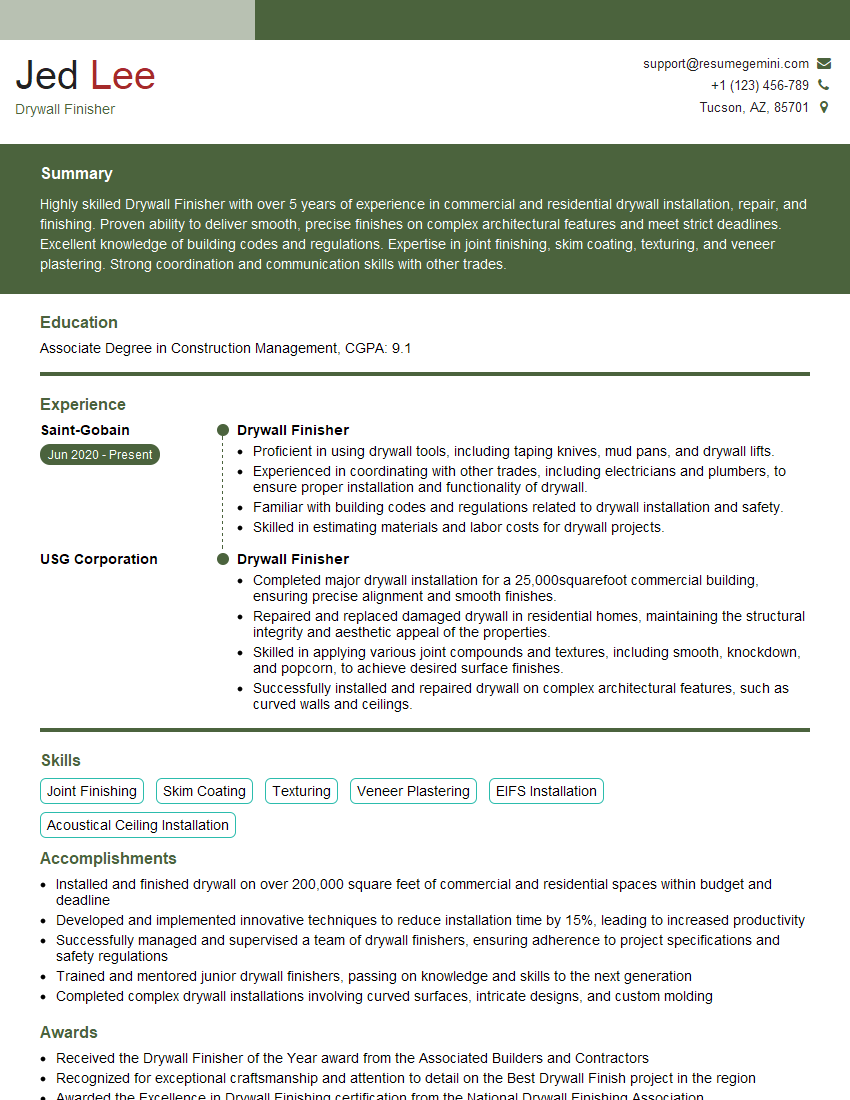
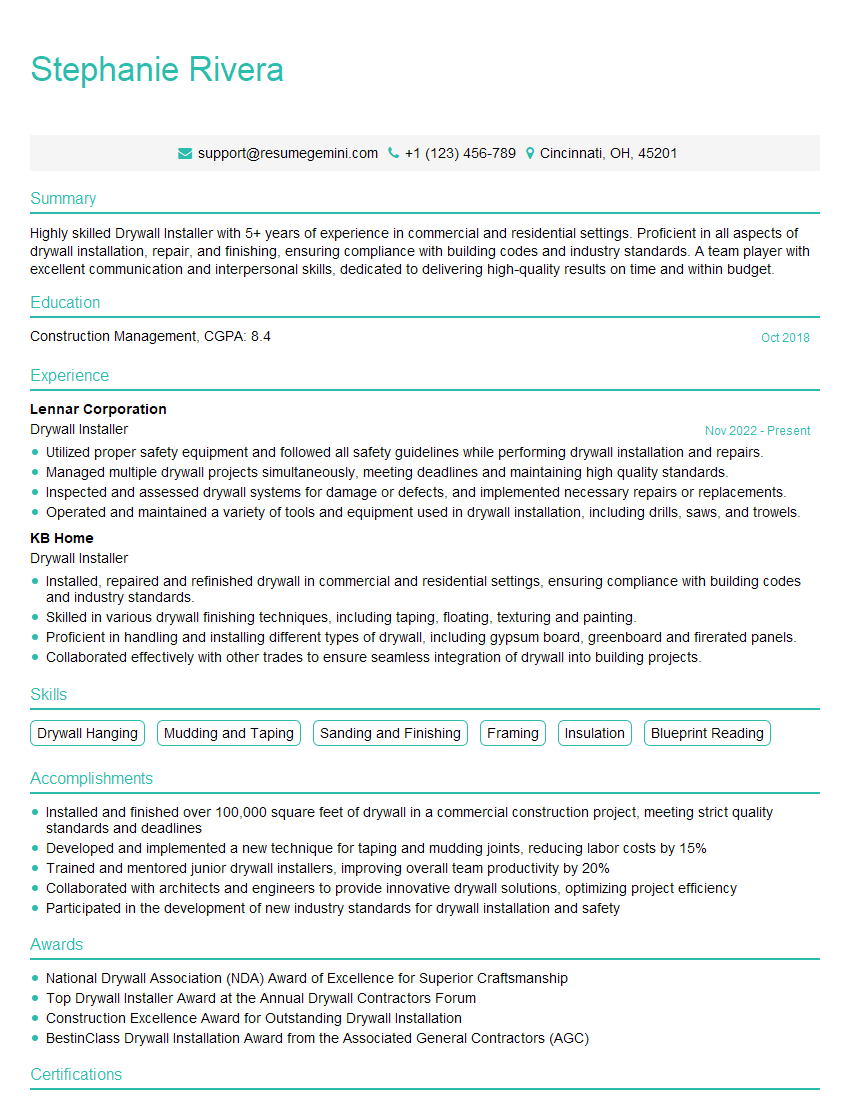
Mastering the art of sanding and smoothing drywall surfaces is a highly valuable skill that significantly enhances your career prospects in the construction industry. A strong understanding of these techniques translates to increased efficiency, higher-quality work, and greater earning potential. To maximize your chances of securing your dream role, create an ATS-friendly resume that highlights your skills and experience effectively. ResumeGemini is a trusted resource that can help you build a professional and impactful resume, ensuring your application gets noticed. Examples of resumes tailored specifically to Sanding and Smoothing Drywall Surfaces are available to guide you.
Explore more articles
Users Rating of Our Blogs
Share Your Experience
We value your feedback! Please rate our content and share your thoughts (optional).
What Readers Say About Our Blog
To the interviewgemini.com Webmaster.
Very helpful and content specific questions to help prepare me for my interview!
Thank you
To the interviewgemini.com Webmaster.
This was kind of a unique content I found around the specialized skills. Very helpful questions and good detailed answers.
Very Helpful blog, thank you Interviewgemini team.