Feeling uncertain about what to expect in your upcoming interview? We’ve got you covered! This blog highlights the most important Experience with Taping Tools and Techniques interview questions and provides actionable advice to help you stand out as the ideal candidate. Let’s pave the way for your success.
Questions Asked in Experience with Taping Tools and Techniques Interview
Q 1. What types of taping knives are you familiar with?
Taping knives come in a variety of sizes and shapes, each designed for a specific task in drywall finishing. The most common types include:
- 6-inch taping knife: Ideal for applying the initial coat of joint compound to drywall seams and corners. Its smaller size allows for precision and maneuverability in tight spaces.
- 8-inch taping knife: A versatile size, frequently used for both initial and subsequent coats. It offers a good balance between control and coverage.
- 10-inch and 12-inch taping knives: Used for applying wider coats of joint compound, particularly during the final smoothing stages. Larger knives cover more surface area faster but require a bit more skill to avoid uneven application.
- Corner knives: Specifically designed for finishing inside and outside corners. These knives typically have a flexible blade to conform to the corner’s shape.
- Putty knives: While not strictly ‘taping’ knives, they’re useful for smaller repairs and touch-ups around the taped seams.
Choosing the right knife depends on the task and your personal preference. I often start with a 6-inch for the initial coat and gradually increase the size as I progress to the final smoothing.
Q 2. Describe the process of taping drywall seams.
Taping drywall seams is a crucial step in achieving a smooth, professional finish. Here’s a step-by-step process:
- Prepare the seam: Ensure the drywall sheets are properly aligned and any gaps are filled with joint compound. This creates a solid base for the tape.
- Apply the tape: Unroll the drywall tape (typically paper or fiberglass mesh) over the seam, pressing it firmly to ensure good adhesion. Overlapping the tape slightly at the edges ensures complete coverage.
- Embed the tape: Apply a thin coat of joint compound over the tape, completely embedding it into the compound. Use a flexible taping knife to smooth the compound and eliminate any air bubbles or wrinkles.
- Dry and sand: Allow the joint compound to dry completely. This typically takes several hours. Once dry, use a sanding sponge or fine-grit sandpaper to smooth any imperfections.
- Apply subsequent coats: Apply additional coats of joint compound, feathering the edges to blend seamlessly with the surrounding wall. Sanding between each coat is necessary to achieve a smooth finish.
Remember to use a light touch when applying joint compound, particularly on the first coat. Too much compound can lead to cracking and an uneven finish. Think of it like painting – multiple thin coats are better than one thick coat.
Q 3. How do you prepare drywall for taping?
Proper drywall preparation is essential for a successful taping job. It prevents problems later on and significantly improves the final finish:
- Clean the surface: Remove any loose debris, dust, or paint chips from the drywall seams. A clean surface ensures proper adhesion of the joint compound and tape.
- Fill large gaps: For any significant gaps between drywall sheets, use a setting-type compound to fill the void. This will provide a solid base for further taping.
- Caulk corners: Apply paintable caulk to interior and exterior corners before taping to prevent cracking in those vulnerable areas.
- Prime porous areas: If dealing with porous drywall, a primer coat helps improve the joint compound adhesion and prevents it from being absorbed too quickly.
Taking the time for this preparation pays off in the end. Think of it as the foundation of a house – a strong foundation ensures a stable and lasting structure.
Q 4. What are the different types of joint compound used in drywall finishing?
Different types of joint compound are used depending on the stage of the drywall finishing process:
- All-purpose compound: Suitable for most applications, this is a versatile option for both taping and finishing.
- Lightweight compound: This compound is lighter and easier to sand, ideal for multiple coats and achieving a smooth finish. However, it can be more prone to cracking if applied too thickly.
- Setting-type compound: This compound dries quickly, making it useful for filling large gaps and for repairs. It’s not ideal for all coats, particularly final smoothing coats.
The choice of compound often depends on personal preference and the specific project requirements. Many professionals use a combination of types for optimal results.
Q 5. Explain the proper techniques for applying joint compound.
Applying joint compound is an art that takes practice to perfect. Key techniques include:
- Use a thin coat: Apply a thin, even layer of compound, avoiding excess material. Too much compound will lead to cracking and increased sanding time.
- Proper knife angle: Hold the taping knife at a slight angle (around 45 degrees) to the wall, allowing the compound to spread smoothly.
- Feather the edges: Blend the edges of the compound seamlessly into the surrounding drywall. This helps to create a smooth transition and avoids noticeable lines.
- Remove excess compound: Use a clean, damp sponge to remove excess compound from the taping knife between passes to prevent clumps and buildup.
Imagine you’re spreading butter on bread – you want an even, thin layer that spreads easily and blends naturally.
Q 6. How do you achieve a smooth, seamless finish on drywall?
Achieving a smooth, seamless finish on drywall requires patience and attention to detail. It’s a multi-step process involving several coats of joint compound and meticulous sanding:
- Multiple thin coats: Apply several thin coats of joint compound, allowing each coat to dry completely before sanding. This builds up a smooth surface gradually.
- Careful sanding: Use fine-grit sandpaper (120-220 grit) or sanding sponges to smooth the surface between each coat. Sand gently to avoid creating dips or scratches.
- Proper drying time: Allow ample drying time between coats. Rushing the process can lead to cracking and an uneven finish.
- Consistent pressure: Maintain even pressure when applying the compound and sanding. This avoids unevenness in the final finish.
A smooth finish is a testament to the skill and care taken throughout the process. It requires consistent technique and attention to detail, rewarding the effort with a professional result.
Q 7. What are the common problems encountered during taping and how do you solve them?
Common problems encountered during taping include:
- Cracking: Caused by applying too thick a coat of compound or insufficient drying time between coats. Solution: Use thinner coats and allow adequate drying time. For existing cracks, carefully remove the damaged compound and reapply.
- Bubbles: Occur when air is trapped under the tape or compound. Solution: Ensure the tape is firmly pressed onto the seam, avoiding wrinkles. Smooth the compound carefully to remove air bubbles.
- Uneven surface: Results from inconsistent application or sanding. Solution: Apply even pressure when applying the compound and sanding. Use multiple thin coats for a smoother surface.
- Tape showing through: Happens when the tape isn’t fully embedded in the compound. Solution: Apply additional coats of compound, ensuring full coverage of the tape.
Experience helps identify and address these problems quickly. Knowing the causes allows you to prevent them from happening in the first place, leading to a more efficient and successful outcome.
Q 8. What safety precautions do you take while working with taping tools?
Safety is paramount when working with taping tools. My routine begins with a thorough inspection of all tools for damage – loose parts, frayed cords, or dull blades are immediate red flags. I always wear appropriate safety gear, including safety glasses to protect my eyes from flying debris, a dust mask to prevent inhaling drywall dust (a known respiratory irritant), and work gloves to protect my hands from cuts and abrasions. Working in well-lit areas is crucial to prevent accidents. Furthermore, I maintain a clean workspace, free from clutter, to avoid tripping hazards. When using power tools, I always ensure the power cord is safely managed to avoid entanglement and accidental disconnection. Lastly, I follow the manufacturer’s instructions for every tool meticulously. For instance, when using a power taping knife, I always ensure the blade is properly secured before use, and I never force the tool, which could lead to a kickback.
Q 9. Describe your experience with different types of taping tools (e.g., hand tools, power tools).
My experience encompasses a wide range of taping tools. I’m proficient with hand tools like putty knives (various sizes for different applications – from 4” for detail work to 12” for broader areas), taping knives (with both flexible and rigid blades for navigating corners and curves), and corner tools for creating perfectly finished inside and outside corners. With power tools, I’m experienced with automatic taping tools that significantly increase efficiency, especially on large projects. These tools offer varying levels of control and precision, allowing for adjustment based on the desired coat thickness and the type of drywall being used. I’ve also used various styles of mud pans to make the whole process smoother and more organized. The choice of tool depends on factors like project size, the type of drywall, and the desired finish. For example, hand tools provide more control and precision for intricate details, while power tools significantly accelerate the process on large, flat surfaces.
Q 10. How do you clean your taping tools after use?
Cleaning my taping tools immediately after use is crucial for maintaining their longevity and preventing the joint compound from hardening and damaging the tool. For hand tools, I first scrape off the excess joint compound using a separate putty knife or even a wire brush for stubborn residue. Then, I wash the tools thoroughly with warm water and a mild detergent, paying close attention to removing all traces of compound from the blade and the handle. I always ensure the tools are completely dry before storing them to avoid rusting. For power tools, I follow the manufacturer’s cleaning instructions carefully; some require specific cleaning solutions or procedures. After cleaning, I lightly lubricate any moving parts as recommended by the manufacturer to ensure smooth operation for future use. For instance, automatic taping tools often benefit from a small amount of silicone-based lubricant.
Q 11. How do you handle challenging angles or curves during the taping process?
Handling challenging angles and curves requires a combination of skill and the right tools. For inside corners, I use a corner tool to create a perfectly crisp, 90-degree angle. For outside corners, I carefully apply the tape and compound, feathering it out smoothly to avoid creating a bulky edge. Flexible taping knives are invaluable for navigating curves, allowing me to apply the compound evenly and prevent any noticeable bumps or ridges. The key is to work in thin coats and allow each coat to dry thoroughly before applying the next. I often use a smaller taping knife to get precise compound placement in tight spaces and curves. Practice is essential; mastering these techniques requires patience and attention to detail, but the result is a seamless, professional-looking finish.
Q 12. Explain your experience with different types of drywall (e.g., standard, fire-resistant).
My experience includes working with various types of drywall, including standard drywall, moisture-resistant drywall (often used in bathrooms and kitchens), and fire-resistant drywall (required in certain areas for fire safety). The type of drywall influences the taping process because different types have varying densities and absorption rates. Fire-resistant drywall, for instance, often requires additional coats of joint compound to achieve a smooth finish because it tends to absorb more compound than standard drywall. Moisture-resistant drywall requires careful attention to detail to prevent water damage and mold growth. Understanding the properties of each type of drywall enables me to adjust my techniques and material choices accordingly to guarantee a high-quality, durable finish.
Q 13. What is the importance of proper preparation in achieving a high-quality drywall finish?
Proper preparation is absolutely critical for achieving a high-quality drywall finish. This includes thoroughly cleaning the seams to remove any loose debris or dust that might compromise the adhesion of the tape. Priming the seams helps ensure better adhesion and helps prevent the drywall from absorbing the compound too quickly. Using the correct type and width of tape for the joint is essential for a strong and consistent finish. A properly prepared surface creates a strong base for the joint compound to adhere to, preventing cracking or other imperfections in the finished wall. Imagine trying to build a sandcastle on loose sand; it will be weak and unstable! Similarly, a poorly prepared surface will result in a poor-quality finish.
Q 14. How do you ensure consistent thickness of joint compound application?
Maintaining a consistent thickness of joint compound is vital for a smooth, professional finish. This involves using the right amount of compound on the taping knife, avoiding overloading it. I work in thin coats, carefully feathering the edges to avoid creating thick build-ups. I use different-sized putty knives depending on the width of the joint and the required amount of compound. For example, a wider knife is used for wider joints while a narrower knife is used for filling smaller gaps or nail holes. The key is practice; with experience, you develop a feel for how much compound to apply to achieve the desired consistency. Allowing each coat to dry thoroughly before applying the next layer is also crucial to prevent cracking and ensure the compound sets properly. This is why multi-step finishing is usually preferred.
Q 15. How do you manage your time effectively when taping large areas of drywall?
Efficiently taping large drywall areas requires meticulous planning and execution. Think of it like a painter tackling a large mural – you wouldn’t just start slapping paint on randomly. I start by thoroughly assessing the area, breaking it down into manageable sections. This might involve mapping out the wall in my head, or even making quick sketches to visualize the workflow. Then, I prioritize the most visible or critical sections first, creating a logical sequence to my work. This avoids wasted movement and ensures a consistent pace.
I also employ a system of pre-taping preparation. This includes having all my materials readily available – plenty of joint compound, tape, knives, and clean-up supplies within easy reach. This prevents constant interruptions and maintains momentum. I use a variety of techniques depending on the situation, sometimes pre-mixing batches of compound to have enough for each section, avoiding constantly mixing smaller batches. Regular short breaks also help maintain focus and prevent fatigue, which improves overall quality. Think of it as a marathon, not a sprint.
Career Expert Tips:
- Ace those interviews! Prepare effectively by reviewing the Top 50 Most Common Interview Questions on ResumeGemini.
- Navigate your job search with confidence! Explore a wide range of Career Tips on ResumeGemini. Learn about common challenges and recommendations to overcome them.
- Craft the perfect resume! Master the Art of Resume Writing with ResumeGemini’s guide. Showcase your unique qualifications and achievements effectively.
- Don’t miss out on holiday savings! Build your dream resume with ResumeGemini’s ATS optimized templates.
Q 16. Describe your experience with different types of joint compound (e.g., all-purpose, lightweight).
My experience spans a wide range of joint compounds, each with its own properties and applications. All-purpose compound is my go-to for most situations; it’s versatile, readily available, and offers a good balance of strength and workability. I often use it for initial coats and finishing layers on most projects. Lightweight compound, on the other hand, is ideal for situations where minimizing weight is crucial, like on ceilings or in areas with a lot of existing coats. It’s easier to spread thin, which helps in achieving smoother finishes. I’ve also worked with quick-setting compounds for when a fast turnaround is necessary; however, those require more precision and experience to avoid issues with cracking. Choosing the right compound is about understanding the job’s specific needs and choosing the material best suited for the task.
Q 17. What is your experience with taping over textured drywall?
Taping over textured drywall presents unique challenges. The texture itself can interfere with the tape adhesion, and the added depth makes achieving a smooth finish more demanding. My approach involves carefully embedding the tape into the texture, ensuring good contact with the drywall surface. I use a thinner coat of compound on the initial application to prevent excess build-up and avoid making the texture more pronounced. Multiple, thin coats are preferred to achieve a seamless finish. I often employ a flexible taping knife to better conform to the textured surface and use techniques like feathering out the edges of the compound to minimize build up and help it blend seamlessly into the texture. Patience and precision are key here – rushing the process can lead to visible imperfections. The key is to work methodically and avoid excessive compound.
Q 18. How do you identify and repair imperfections in drywall before taping?
Identifying and repairing imperfections is a critical first step. Before even considering taping, I meticulously inspect the drywall for any cracks, holes, nail pops, or loose areas. For minor imperfections like small holes, I use a patching compound, carefully filling them and sanding them smooth after they have dried. Larger holes require more extensive repair, often involving using drywall patches and ensuring a proper fit and secure attachment. Nail pops need careful attention – I gently tap them back into place, then apply compound to fill the gap and ensure that the nail is seated firmly. The key is to create a flawlessly smooth surface before applying tape, as any remaining imperfections will show through in the finished product.
Q 19. What is your experience with repairing damaged drywall sections before taping?
Repairing damaged drywall sections before taping often involves a combination of techniques. I assess the extent of the damage; if it’s a small area, I might just use patching compound. For larger areas, I’ll cut out the damaged section and install a replacement drywall piece. I then use joint compound to fill the seams and integrate the patch seamlessly with the existing drywall. It’s important to ensure the patch is properly secured and the edges are flush with the surrounding wall. This involves using appropriate screws, ensuring they are properly spaced and driven in deep enough. Once the patch is set and the compound is dry, I sand it smooth, making sure the surface is ready for priming and then taping.
Q 20. What are the common causes of cracking in taped drywall seams?
Cracking in taped drywall seams typically stems from several common causes. Movement in the house’s structure is a major culprit. This can be due to settling, temperature fluctuations, or even the movement of appliances that create vibrations. Improper installation techniques, such as insufficiently securing the drywall or using the wrong type of tape or compound, can also contribute. Poor preparation of the surface before taping, including the presence of imperfections or excessive sanding dust, can compromise the bond between the tape and compound. And finally, using too thick a coat of compound in a single application can introduce stress that can manifest as cracks over time.
Q 21. How do you prevent cracking in taped drywall seams?
Preventing cracks requires a multifaceted approach. First, ensuring proper drywall installation is paramount – securely fastening the sheets and minimizing gaps is key. I always use high-quality tape specifically designed for drywall seams. Applying thin, even coats of compound is crucial. Multiple thin coats allow for better adhesion and reduce the stress on the tape and compound. Allowing adequate drying time between coats prevents cracking due to shrinking. Employing flexible joint compounds can help accommodate some minor building movement. And finally, using appropriate techniques like feathering the edges of the compound helps to distribute stress and create a more durable and seamless finish. Careful preparation and attention to detail are your best allies in preventing cracks. Think of it as building a strong foundation – the more care you put into the base layers, the more resilient your final result will be.
Q 22. Describe your experience with applying different coats of joint compound.
Applying multiple coats of joint compound is crucial for achieving a smooth, seamless drywall finish. The process typically involves several stages, each with a specific purpose. The first coat, often referred to as the ‘base coat,’ is applied generously to embed the tape and cover the joint completely. This coat should be slightly over-filled to allow for sanding later. It’s like building a foundation; you want a substantial base to work with. The second coat, often thinner than the first, is applied after the first has dried completely. Its purpose is to feather out the edges and further smooth the surface, essentially reducing the noticeable texture. Subsequent coats, if needed (depending on the joint width and desired smoothness), further refine the finish, building a flawlessly blended surface. I carefully monitor the drying time between coats to avoid cracking or issues with adhesion. For instance, in a recent project with wide gaps, I applied three coats, each slightly thinner than the last, ensuring a smooth transition from the drywall to the joint compound, achieving an almost invisible seam.
Q 23. How do you handle difficult situations, such as uneven walls or damaged drywall?
Uneven walls and damaged drywall present unique challenges, but with the right approach, they are manageable. For uneven walls, I begin by assessing the severity of the irregularity. Minor imperfections can be addressed with multiple thin coats of joint compound, carefully building up the surface to create an even plane. Think of it like sculpting; you slowly add and refine until you reach the desired form. For more significant imperfections, I might use a drywall patch or even a reinforcing mesh tape under the compound for added strength and support. With damaged drywall, I first carefully remove any loose or broken pieces. Then, I assess the extent of the damage. Small holes can be filled directly with joint compound, while larger holes might require a drywall patch for structural integrity. In one project, I encountered severely damaged drywall caused by water leakage. I had to replace the affected section entirely, ensuring a robust and water-resistant repair before finishing.
Q 24. What is your experience with different types of primers and paints used with drywall finishing?
My experience with primers and paints encompasses various types, each suited for specific applications. Primers are crucial for ensuring proper adhesion and providing a uniform base for the topcoat. I often use a stain-blocking primer to prevent bleed-through from underlying materials, especially when working with darker colors or areas with potential staining. For instance, in a project where we had water stains, a high-quality stain-blocking primer was key to achieving a clean, consistent finish. In terms of paint, I typically select paints designed for interior walls, focusing on durability, washability, and the desired finish (e.g., matte, eggshell, satin). The selection is often dictated by client preferences and the intended use of the space. In high-traffic areas, I often opt for a more durable, scrubbable paint to ensure longevity.
Q 25. How do you ensure a quality finish even in tight spaces?
Working in tight spaces requires precision and the right tools. Narrow putty knives and flexible taping knives are essential for navigating corners and confined areas. I often use smaller amounts of joint compound at a time to avoid excessive build-up and ensure even application. Patience is crucial; it’s better to apply several thin coats than one thick, uneven coat. In one project, I was tasked with finishing the drywall in a small closet. I used a 2-inch taping knife and applied multiple thin coats, taking extra care around the corners and edges. The result was a smooth, professional finish, despite the challenging space.
Q 26. What are some best practices for efficient and effective taping and mudding?
Efficient and effective taping and mudding rely on several key best practices. Proper preparation is crucial, including ensuring the drywall is clean, securely fastened, and all seams are properly aligned. Using high-quality joint compound and taping tools is also vital. Applying thin, even coats and allowing adequate drying time between each coat prevents cracking and ensures a smooth finish. Proper sanding techniques are essential to achieve a flawless surface. I always recommend using dust masks and appropriate safety equipment when sanding. In my workflow, I prioritize quality over speed. While speed is important in completing projects on schedule, compromising on quality is never worth it.
Q 27. Describe your experience with working as part of a team on large-scale drywall finishing projects.
My experience working in teams on large-scale projects has been extensive. Effective teamwork in drywall finishing involves clear communication, coordination, and a shared commitment to quality. We often divide tasks based on individual strengths and skills, ensuring a smooth and efficient workflow. For example, one team member might focus on taping, another on mudding, while others handle priming and painting. Regular communication is key, especially regarding progress, challenges, and any adjustments needed to the schedule. I’ve worked on several multi-unit residential projects, and efficient teamwork was paramount in completing each project within the deadlines and budget.
Key Topics to Learn for Experience with Taping Tools and Techniques Interview
- Types of Taping Tools: Understanding the differences between various taping tools (e.g., hand-held dispensers, automatic taping machines, specialized applicators) and their appropriate applications.
- Taping Techniques: Mastering different taping methods (e.g., straight taping, curved taping, overlapping techniques) for various materials and surfaces, ensuring consistent quality and adhesion.
- Material Selection: Knowing the properties of different tapes (e.g., adhesive strength, temperature resistance, thickness) and selecting the optimal tape for specific applications and environmental conditions.
- Health and Safety: Familiarizing yourself with proper safety procedures, including personal protective equipment (PPE) requirements and hazard identification related to taping tools and materials.
- Troubleshooting: Developing problem-solving skills to identify and resolve common issues such as tape jams, poor adhesion, and uneven application.
- Quality Control: Understanding the importance of maintaining consistent quality in taping applications and implementing effective quality control measures.
- Efficiency and Productivity: Learning techniques to optimize taping processes for increased speed and efficiency without compromising quality.
- Maintenance and Care: Knowing how to properly maintain and care for taping tools to extend their lifespan and ensure optimal performance.
- Industry Standards and Best Practices: Staying updated on industry standards and best practices for taping techniques and safety regulations.
Next Steps
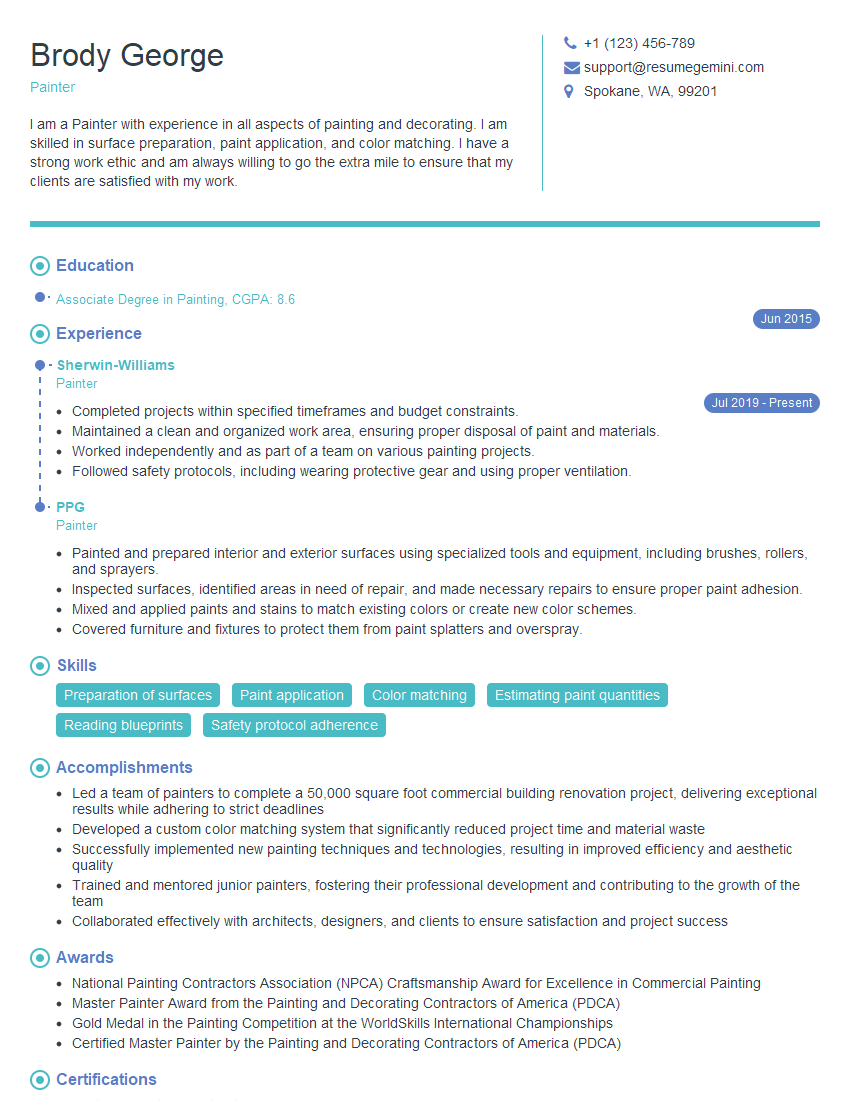
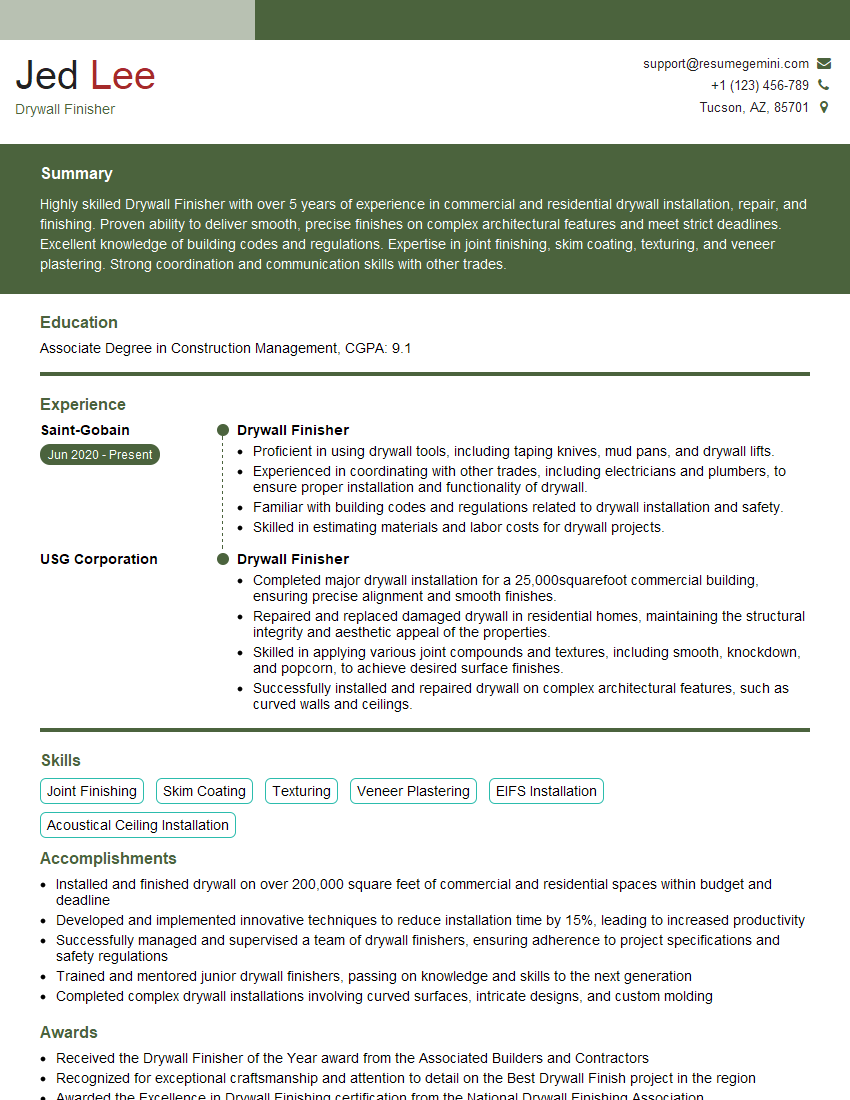
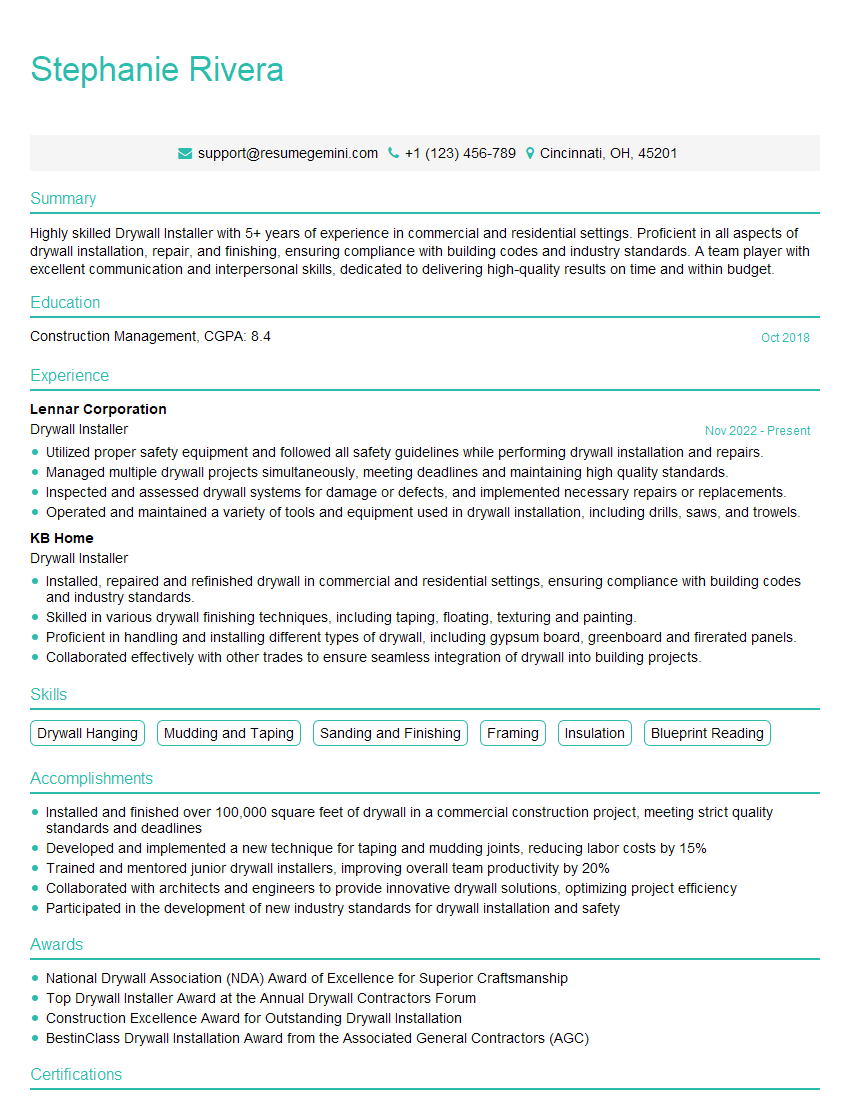
Mastering Experience with Taping Tools and Techniques is crucial for career advancement in many industries. A strong understanding of these skills demonstrates proficiency and attention to detail, qualities highly valued by employers. To maximize your job prospects, create an ATS-friendly resume that effectively highlights your abilities. ResumeGemini is a trusted resource that can help you build a professional and impactful resume, ensuring your skills and experience shine. Examples of resumes tailored to Experience with Taping Tools and Techniques are available to guide you.

Explore more articles
Users Rating of Our Blogs
Share Your Experience
We value your feedback! Please rate our content and share your thoughts (optional).
What Readers Say About Our Blog
To the interviewgemini.com Webmaster.
Very helpful and content specific questions to help prepare me for my interview!
Thank you
To the interviewgemini.com Webmaster.
This was kind of a unique content I found around the specialized skills. Very helpful questions and good detailed answers.
Very Helpful blog, thank you Interviewgemini team.