The right preparation can turn an interview into an opportunity to showcase your expertise. This guide to Knowledge of Drywall Materials and Properties interview questions is your ultimate resource, providing key insights and tips to help you ace your responses and stand out as a top candidate.
Questions Asked in Knowledge of Drywall Materials and Properties Interview
Q 1. What are the different types of drywall and their applications?
Drywall, also known as gypsum board, comes in various types, each suited for specific applications. The most common types include:
- Type X: Fire-resistant drywall, crucial for walls and ceilings in high-fire-risk areas like stairwells and corridors. It contains fire-retardant additives.
- Standard (Type A): The most common type, used for general-purpose interior walls and ceilings in residential and commercial settings. It offers good sound insulation.
- Moisture-Resistant (Type C): Designed for areas prone to moisture, like bathrooms and kitchens. It has a green paper facing and offers some protection against mold and mildew but isn’t fully waterproof.
- Mold-Resistant (Type R): Specifically formulated to inhibit mold and mildew growth. Often used in high-humidity environments, but still not appropriate for areas with direct water exposure.
- Water-Resistant (Type W): Offers superior moisture resistance compared to Type C and is ideal for areas exposed to high humidity or potential water spills. It is often used in areas like shower surrounds. However, even this isn’t completely waterproof and requires proper waterproofing membranes behind it.
- Soundproof Drywall: Designed with extra density or specialized materials to improve sound insulation. Often used in studios, theaters, or apartments requiring superior sound attenuation.
The choice of drywall depends on the specific needs of the project, considering factors like fire safety, moisture exposure, and sound control. For example, in a new home construction, you’d typically use Type X drywall in hallways and Type C in bathrooms, while standard drywall suffices in bedrooms.
Q 2. Explain the difference between Type X and standard drywall.
The key difference between Type X and standard drywall lies in its fire resistance. Type X drywall contains gypsum core with added fire-retardant ingredients, significantly increasing its fire-resistance rating. Standard drywall, while not flammable itself, lacks these additives. In a fire, Type X drywall will hold up much longer, delaying the spread of flames and helping to contain the fire, thus providing crucial extra time for escape and firefighter response. Think of it like this: standard drywall is like regular clothing – it might char, but it will burn relatively quickly. Type X drywall is more like a fire-resistant suit – designed to withstand significantly higher temperatures and for a longer duration.
Q 3. Describe the process of taping and mudding drywall.
Taping and mudding is the crucial finishing process for drywall, creating a smooth, paintable surface. It involves several steps:
- Taping: Applying special drywall tape over the joints between drywall sheets to cover the seams.
- First Coat: Applying a thin layer of joint compound (mud) over the tape, embedding it and covering any gaps or imperfections.
- Drying: Allowing the mud to completely dry.
- Second Coat: Applying another layer of mud, feathering the edges to blend seamlessly with the drywall surface.
- Sanding: Sanding the dried mud to achieve a perfectly smooth surface, typically using a sanding pole and fine grit sandpaper. Always wear a dust mask!
- Third Coat (Optional): Sometimes a third, very thin coat is applied for an ultra-smooth finish.
- Final Sanding: If necessary, more sanding after the third coat to smooth things out completely.
The key is thin coats to prevent cracking and ensure a smooth, even finish. Over-mudding is a common mistake. Each layer needs to dry fully before the next is applied. Think of it like baking a cake; you don’t rush the baking process, and you need each layer to set properly before adding the next.
Q 4. How do you prepare a surface for drywall installation?
Preparing the surface for drywall installation is vital for a successful project. This involves ensuring the framing is straight, plumb, and level. Any gaps or protrusions should be addressed. This could involve adding blocking or shims to the framing to create a perfectly flat surface. Also crucial is cleaning the surface; dust, debris, and grease can significantly impact the adhesion of the drywall to the framing, so make sure the studs are clean and free of obstructions.
Q 5. What are the common problems encountered during drywall installation and their solutions?
Common problems during drywall installation include:
- Uneven surfaces: Caused by improper framing; solution: correct the framing before installing the drywall.
- Nail pops: Nails pushing through the drywall; solution: use appropriate nail length, sink nails correctly, and use a nail set.
- Cracking: Caused by movement of the building or improper taping; solution: use appropriate joint compound and taping techniques, ensure proper support.
- Sagging: Drywall sagging between supports; solution: Use appropriate spacing between supports, avoid overly large drywall sheets.
- Poor Mudding/Taping: leading to imperfections; solution: practice proper taping and mudding techniques, use appropriate tools.
Careful planning and execution can prevent most issues. A little extra time spent on preparation drastically reduces problems down the line.
Q 6. What safety precautions should be taken during drywall installation?
Safety is paramount during drywall installation. Always wear:
- Safety glasses: To protect your eyes from debris.
- Dust mask: To prevent inhaling drywall dust, which can be harmful to your lungs.
- Gloves: To protect your hands from cuts and abrasions.
- Hearing protection: When using power tools.
Work safely using appropriate lifting techniques when handling drywall sheets. Never work alone at heights, and always secure scaffolding or ladders properly. Dispose of waste properly, and never overextend yourself during installation.
Q 7. How do you handle drywall corners?
Handling drywall corners requires specialized techniques. There are two main methods:
- Corner Bead: A metal or plastic L-shaped molding applied to outside corners, providing a straight, durable edge for the drywall tape and compound. This prevents damage and cracking at vulnerable points.
- Inside Corner Taping: Inside corners typically require special inside corner tape to create a neat, smooth finish. The tape is applied and then mudded, requiring careful attention to detail to avoid build-up.
Proper corner treatment enhances the aesthetics and durability of the finished drywall. Using proper tools and techniques is crucial to get a professional finish.
Q 8. Explain the importance of proper moisture control in drywall installation.
Proper moisture control is paramount in drywall installation because drywall, being a gypsum-based product, is susceptible to damage from excessive moisture. Exposure to high humidity or water can lead to several problems, including swelling, weakening of the material, the growth of mold and mildew, and ultimately, failure of the wall system. Imagine a sponge absorbing water – it expands and loses its structural integrity; drywall behaves similarly.
To prevent these issues, several strategies are crucial:
- Proper ventilation: Ensure adequate ventilation in the space during and after installation to allow moisture to escape. This is especially critical in bathrooms, kitchens, and basements.
- Moisture barriers: Use vapor barriers, especially in areas prone to moisture, to prevent moisture from migrating into the drywall from the outside.
- Careful handling: Protect drywall sheets from rain and direct exposure to water during storage and transportation.
- Prompt attention to leaks: Address any water leaks immediately to prevent prolonged exposure to moisture.
By diligently following these moisture control measures, you ensure a long-lasting and structurally sound drywall installation. Ignoring them can lead to costly repairs and structural issues down the line.
Q 9. What are the different types of drywall screws and their applications?
Drywall screws are crucial for securing drywall sheets to the framing. Different types cater to various needs:
- Standard Drywall Screws: These are the most common type, typically featuring a sharp point for easy penetration and coarse threads for excellent holding power. They’re ideal for general drywall applications.
- Self-Tapping Screws: Designed for harder materials, these screws often have a more aggressive thread profile, enabling them to penetrate wood or metal studs without pre-drilling (though pre-drilling is often recommended for best results).
- Drywall Screws with Bugle Heads: These screws have a slightly larger head than standard screws, creating a countersinking effect that makes filling and finishing the screw holes easier.
- Specialty Drywall Screws (e.g., for metal studs): These are designed for specific applications, such as metal framing, often with threads optimized for grip in metal.
The choice of screw depends on several factors: the type of framing material (wood, metal), the thickness of the drywall, and the desired level of hold. Always use the appropriate screw length to fully penetrate the stud, preventing the drywall from becoming loose.
Q 10. How do you calculate the amount of drywall needed for a project?
Calculating drywall needs requires accurate measurements and a bit of math. Here’s a step-by-step process:
- Measure the wall areas: Calculate the total surface area of all walls to be covered. For each wall, multiply the height by the width. Remember to subtract the area of any openings (windows, doors).
- Account for waste: Add 5-10% to the total area to account for cuts, mistakes, and unusable scraps. More complex projects might require a higher percentage.
- Standard Sheet Size: Drywall sheets are typically 4 feet wide by 8 feet long, or 4′ x 12′. Consider the standard sheet dimensions when calculating quantities to minimize waste.
- Convert to sheets: Divide the total area (including waste) by the area of one drywall sheet (32 sq. ft for 4×8). Round up to the nearest whole number as you can’t buy fractions of sheets.
Example: A room with four walls each 8ft high and 10ft wide has a total area of (8 x 10) x 4 = 320 sq ft. Adding 10% waste: 320 x 1.1 = 352 sq ft. Divide by 32 sq ft/sheet: 352 / 32 = 11 sheets. You would need to buy 11 sheets of drywall for this room.
Q 11. What are the different joint compounds used in drywall finishing?
Joint compound, also known as drywall mud, is used to fill the gaps between drywall sheets and to create smooth, seamless surfaces. Several types exist:
- All-Purpose Compound: A versatile option suitable for most applications. It offers a good balance of workability and drying time.
- Lightweight Compound: This compound is less dense than all-purpose compound, making it easier to sand, especially for large areas. It is often preferred for multiple coats.
- Setting-Type Compound: This compound dries quickly and is useful for rapid patching or repairs, but it requires careful application to avoid cracking.
- Taping Compound: Specifically designed for the initial taping process, this compound helps create a strong bond with the tape and reduces cracking.
Choosing the right compound depends on the project and personal preferences. Many professionals use a combination of types, such as a taping compound for the first coat and all-purpose or lightweight for subsequent coats.
Q 12. Describe the process of sanding drywall.
Sanding drywall is crucial for achieving a perfectly smooth finish. The process involves carefully removing excess joint compound to create an even surface. Here’s how to do it:
- Wait for drying: Allow the joint compound to dry completely before sanding. Drying times vary depending on the type of compound and environmental conditions.
- Use appropriate tools: Start with coarser grit sandpaper (80-100 grit) for initial smoothing and gradually move to finer grits (120-220 grit) for a final finish. Consider using a sanding sponge or sanding block for better control.
- Sand gently: Apply even pressure to avoid gouging the surface or creating unevenness. Use long, smooth strokes and avoid excessive pressure in one area.
- Clean up: After sanding, thoroughly clean the surface of dust using a vacuum cleaner or damp cloth to prevent dust from settling on the wet compound.
Improper sanding can leave imperfections, so patience and a light touch are essential. Wear a dust mask to protect your lungs from inhaling drywall dust.
Q 13. What are the different types of drywall finishing tools?
A variety of tools facilitate efficient and professional drywall finishing:
- Putty Knives: Various sizes (6”, 8”, 10”, 12”) are used for applying joint compound. Wider knives are used for larger areas, while smaller knives are better for detail work.
- Taping Knives: These narrower knives are specifically designed for embedding the drywall tape smoothly and evenly into the joint compound.
- Sanding Blocks and Sponges: These tools provide a more even sanding surface and help to prevent uneven sanding marks.
- Sandpaper: Various grits for different stages of the sanding process.
- Drywall Corner Tools: These tools help create clean, sharp corners when finishing inside and outside corners.
- Vacuum Cleaner: Essential for cleaning up drywall dust after sanding.
The right tools enable a smoother and more professional finish. Investing in quality tools will pay off in terms of the final look and reduced effort.
Q 14. How do you repair damaged drywall?
Repairing damaged drywall depends on the type and extent of the damage. Minor repairs can be handled with simple patching, while more extensive damage may require replacing sections of drywall.
For minor holes and cracks:
- Clean the area: Remove any loose debris or paint from the damaged area.
- Apply joint compound: Use a putty knife to fill the hole or crack with joint compound. Feather the edges to create a smooth transition with the surrounding drywall.
- Let it dry: Allow the compound to dry completely.
- Sand smooth: Sand the repaired area until it’s flush with the surrounding surface.
- Prime and paint: Apply a primer to the repaired area, followed by paint to match the existing wall.
For larger holes or significant damage:
- Cut out the damaged section: Carefully cut out the damaged portion of the drywall, creating a clean, square opening.
- Install a patch: Cut a piece of drywall to fit the opening. Secure it to the framing using drywall screws.
- Apply joint compound: Cover the edges and seams with joint compound, feathering it smoothly into the existing wall.
- Dry, sand, and finish: Allow to dry, sand smooth, and apply primer and paint.
The key is to create a seamless repair, blending the patch or repair seamlessly into the surrounding wall. Remember, proper preparation is key to successful drywall repair.
Q 15. What are the common causes of drywall cracking?
Drywall cracking is a common problem stemming from several factors, often a combination rather than a single cause. Think of it like a delicate puzzle; if one piece is stressed, the whole structure can be affected.
Settlement of the House: As a house ages, the foundation can settle unevenly, putting stress on the drywall. This is particularly true in older homes or those built on unstable ground. Imagine a picture frame – if the frame shifts, the picture within will crack.
Movement of the Structure: Temperature and humidity changes cause wood framing to expand and contract. Drywall, being less flexible, can’t adapt as easily and cracks can result. This is like trying to fit a rigid metal plate into a slightly changing wooden frame.
Improper Installation: Insufficient support or improper fastening techniques leave drywall vulnerable to cracking. Think of it like building a wall with weak mortar – the bricks will be prone to falling apart.
Impact Damage: Accidents happen! A bump or a dropped object can cause a crack, often unnoticed until later.
Poor Joint Taping and Finishing: Gaps in the joints can lead to cracking as the drywall expands and contracts. If the mudding and taping aren’t done properly, the cracks may show up soon after finishing.
Career Expert Tips:
- Ace those interviews! Prepare effectively by reviewing the Top 50 Most Common Interview Questions on ResumeGemini.
- Navigate your job search with confidence! Explore a wide range of Career Tips on ResumeGemini. Learn about common challenges and recommendations to overcome them.
- Craft the perfect resume! Master the Art of Resume Writing with ResumeGemini’s guide. Showcase your unique qualifications and achievements effectively.
- Don’t miss out on holiday savings! Build your dream resume with ResumeGemini’s ATS optimized templates.
Q 16. How do you prevent drywall cracking?
Preventing drywall cracks is all about minimizing stress on the material. It’s proactive maintenance, like regularly checking your car’s tires to prevent flats.
Proper Framing: Ensure your framing is straight, properly braced, and adequately spaced. This provides a stable base for the drywall.
Use Appropriate Fasteners: Use the correct type and length of screws, spaced properly to avoid stress points. Don’t over-tighten.
Control Humidity: Maintain consistent humidity levels in your home to minimize expansion and contraction of framing materials. A dehumidifier in humid climates or a humidifier in dry climates can be helpful.
Reinforce High-Stress Areas: Use additional framing support or reinforcement tape in areas prone to cracking, such as corners, doorways, and around windows.
Proper Joint Taping and Finishing: This is crucial. Ensure proper coverage of all joints, and use quality taping and mudding compounds.
Address Foundation Issues: If your foundation is settling, consult a structural engineer to prevent future problems.
Q 17. Describe the process of installing drywall around windows and doors.
Installing drywall around windows and doors requires precision and attention to detail. Imagine it as framing a precious painting – you need the right tools and techniques to ensure a perfect fit.
Measure and Cut: Accurately measure the openings and cut the drywall pieces to fit. This requires careful planning and often involves creating custom shapes.
Install Drywall around Openings: Secure the drywall pieces around the window or door frame, ensuring proper alignment and support. You’ll likely need to create cutouts or utilize special pieces to accommodate the frame.
Fasten Securely: Use screws spaced appropriately to firmly attach the drywall to the framing without over-tightening.
Caulk and Tape: Apply caulk to seal the gaps between the drywall and the window or door frame. Then, tape and mud all joints to create a smooth, seamless finish.
Sand and Prime: Sand the mudded areas to create a smooth surface. Finally, apply a primer before painting.
This process often involves using special techniques, such as creating returns around the edges and using corner bead to prevent cracking.
Q 18. Explain the importance of using proper ventilation during drywall installation.
Proper ventilation during drywall installation is vital to prevent moisture problems. Imagine trying to dry clothes in a sealed room – they’ll stay damp. Similarly, moisture trapped in the drywall can lead to mold, mildew, and structural damage.
Adequate ventilation ensures that the moisture created during the installation process (from mud and adhesives) can evaporate properly. This prevents the buildup of moisture, leading to faster drying times and preventing damage. This can involve using fans, dehumidifiers, or ensuring sufficient airflow in the work area.
Q 19. What are the fire-resistant properties of Type X drywall?
Type X drywall, also known as fire-resistant drywall, contains gypsum core mixed with special fire-retardant additives. Think of it as a protective shield against fire. It’s designed to significantly slow the spread of fire and contain it longer than standard drywall. While it doesn’t prevent fires, it provides crucial extra time for evacuation and limits the damage.
The fire-resistant properties are due to the additives that create a more stable structure that resists heat and combustion. The higher density and added components extend the time it takes for the drywall to break down in a fire compared to regular drywall. Its rating is typically specified as a ‘fire rating’ in hours.
Q 20. How do you identify and address moisture problems in drywall?
Moisture problems in drywall are serious, leading to mold, mildew, and structural damage. Early detection is crucial – it’s like identifying a small leak before it floods the house.
Identifying Moisture Problems: Look for signs like discoloration (dark spots or stains), bubbling or peeling paint, a musty odor, and soft or spongy drywall. A moisture meter can be used to measure moisture levels quantitatively.
Addressing Moisture Problems: The approach depends on the cause and extent of the damage. Minor problems might require simple drying, while significant damage might require removal and replacement of affected sections. Addressing the source of the moisture (leaky pipes, improper ventilation, etc.) is crucial to prevent recurrence. In severe cases, professional help might be needed to ensure proper remediation and prevent mold growth.
Q 21. What are the different types of drywall edges and their uses?
Drywall edges are designed to facilitate the creation of neat and strong joints. Think of them as puzzle pieces that fit together perfectly.
Tapered Edge: This edge is beveled on one side, creating a tapered profile. It’s used for creating smooth, seamless joints when using drywall tape and joint compound.
Square Edge: This edge has a clean, un-beveled cut. It’s often used in areas where butt joints are not visible (behind cabinetry).
Beveled Edge: Similar to the tapered edge, but the bevel is often more pronounced.
Round Edge: This has a rounded profile, mostly for aesthetic purposes and is less frequently used for interior walls.
Choosing the right edge type depends on the application and the desired finish. Tapered edges are the most common for interior walls because they provide a strong and seamless joint for hiding the seam.
Q 22. How do you ensure a smooth and even drywall finish?
Achieving a smooth and even drywall finish is crucial for a professional-looking result. It’s a multi-step process that starts long before the final sanding. Think of it like baking a cake – you need the right ingredients and techniques for a perfect outcome.
- Proper Preparation: This includes ensuring the wall studs are straight and evenly spaced. Any imperfections in the framing will show through the finished drywall. Using a quality drywall compound is also critical; choosing one with a smooth consistency will minimize patching and sanding.
- Careful Installation: Drywall sheets must be installed flush with the framing, avoiding gaps or uneven seams. Using the correct fasteners and spacing is paramount for preventing buckling or nail pops. Remember to countersink the screws appropriately.
- Multiple Coats of Compound: Applying thin, even coats of joint compound is key. Avoid overloading the taping knife; this will lead to cracking and uneven drying. The first coat is for the tape, subsequent coats are for feathering out the edges until perfectly smooth.
- Meticulous Sanding: Sanding between coats is crucial to remove any bumps or ridges. Use various grits of sandpaper, starting coarser and progressing to finer grits for a silky smooth finish. Use a sanding pole or block to maintain consistency and prevent over-sanding in one area.
- Priming and Painting: A quality primer seals the drywall, allowing for better paint adhesion and a more even finish. This step is often overlooked, but crucial for longevity and appearance.
For example, on a recent project, we encountered some bowed studs. By carefully shimming the studs before installing the drywall, we eliminated the unevenness that would have been visible otherwise. Paying close attention to these details is what sets apart a truly professional finish.
Q 23. What are the different methods for installing drywall?
Drywall installation methods vary depending on the project scope and wall type, but generally fall into these categories:
- Direct Application: This is the most common method, where drywall sheets are directly attached to wall studs or framing using screws or nails. This is suitable for most residential and commercial applications.
- Metal Stud Framing: This involves installing drywall on a metal frame, commonly used in commercial or industrial settings where fire resistance or strength is a concern. This differs from wood stud framing mostly in the fastener type and spacing.
- Ceiling Installation: Installing drywall on ceilings often involves using specialized tools and techniques due to the overhead working position. It frequently requires more than one person, and often involves using lifts for larger panels.
- Special Applications: There are niche methods, such as using drywall for curved walls or for creating special architectural features. These may require specialized tools, techniques, or even custom-cut drywall panels.
Consider the complexity of the project. A simple room may only require direct application, while complex projects might require combining methods such as using metal framing for specific sections and then utilizing direct application elsewhere.
Q 24. Explain the difference between a drywall screw and a nail.
While both drywall screws and nails are used to fasten drywall to framing, there are key differences that impact the overall quality of the installation.
- Drywall Screws: Offer superior holding power and reduce the risk of nail pops, those annoying bumps that appear after the drywall is finished. Their threads allow for a secure bite into the framing, providing a stronger, more consistent attachment. They also allow for adjustments during installation; you can easily remove and reposition a screw.
- Drywall Nails: Are typically less expensive, but offer less holding power and are more prone to causing nail pops as the wood expands and contracts. They require more careful hammering to avoid damaging the drywall surface.
In practice, screws are almost universally preferred for professional drywall installations due to their superior performance and the reduced risk of issues down the line. Imagine the extra cost involved in re-patching multiple nail pops across an entire wall – the screw’s superior reliability translates to time and cost savings.
Q 25. What are the implications of improper drywall installation?
Improper drywall installation can lead to a multitude of problems, impacting both the aesthetics and structural integrity of the building.
- Nail Pops/Screw Pops: These are unsightly bulges where the fasteners have pulled away from the drywall, often caused by improper installation or inadequate fastening.
- Cracks: Uneven installation, insufficient taping, or poor quality joint compound can all lead to cracks in the drywall, detracting from the appearance and potentially compromising the structural integrity.
- Loose Drywall: Poorly fastened drywall can become loose over time, leading to rattling, movement, and even damage to the finish.
- Moisture Damage: If the drywall isn’t properly sealed or is exposed to moisture, it can become susceptible to mold and mildew growth, leading to health issues and costly repairs.
- Fire Hazards: In extreme cases, improper installation can compromise fire resistance, increasing the risk of fire spreading.
For instance, a failure to properly seal the seams can lead to moisture intrusion behind the drywall, resulting in significant mold problems and costly remediation. This underscores the importance of attention to detail in every stage of the process.
Q 26. How do you determine the appropriate thickness of drywall for a given application?
Choosing the right drywall thickness depends largely on the application and building codes. Think of it like choosing the right size wrench for a specific bolt – a too-small or too-large one won’t work properly.
- Residential Applications: ½ inch drywall is standard for walls and ceilings in most residential construction. However, thicker drywall (⅝ inch or even ¾ inch) might be required in areas subject to impact damage, such as hallways or basements.
- Commercial Applications: Commercial buildings often require thicker drywall (⅝ inch or more) to meet fire resistance and soundproofing requirements. This is often dictated by building codes and the project’s specifications.
- High Impact Areas: Areas likely to experience impact, such as hallways or garages, might require ½ inch type X fire-resistant drywall for added protection.
Local building codes will dictate the minimum thickness of drywall required in different areas of a building. Always consult local regulations for specific requirements before starting a project.
Q 27. Describe your experience with different types of drywall accessories (e.g., corner beads, bead).
Drywall accessories are essential for achieving a professional finish and ensuring structural integrity. They’re like the finishing touches on a masterpiece, adding both beauty and function.
- Corner Beads: These are metal or plastic strips applied to outside corners to protect the drywall from damage during installation and use. They provide a crisp, clean edge and prevent cracking or denting. Different types are available based on materials (aluminum, vinyl, etc.) and designs (flat, rounded).
- J-Beads: Used to create a smooth, finished edge along the perimeter of walls, especially around windows and doors. They provide a clean edge for the joint compound, reducing cracking and making finishing smoother.
- Metal Beads: Used in various ways depending on their design. Some provide support for curved surfaces, whilst others are used to add decorative accents to the drywall.
- Self-adhesive Tape: This is a flexible mesh tape that reinforces joints and seams, preventing cracks and providing a better surface for the compound to adhere to. It is an essential part of creating durable, smooth drywall.
In my experience, using high-quality accessories is critical. Cheap corner beads can bend or rust, ruining the aesthetic appeal of the finished wall. Using the appropriate type of bead for the specific application, also ensures a strong and lasting finish.
Q 28. How do you ensure compliance with building codes and safety regulations during drywall installation?
Compliance with building codes and safety regulations is paramount for any drywall installation project. Neglecting these aspects can lead to serious consequences, including structural failure, injuries, and legal liabilities.
- Understanding Local Codes: Before starting any project, I always review local building codes and regulations to ensure the chosen materials and methods meet all requirements. These codes specify requirements regarding drywall type, thickness, fastening methods, and fire resistance.
- Safety Procedures: I adhere to strict safety procedures on all jobs, including using appropriate personal protective equipment (PPE) such as safety glasses, gloves, and dust masks. I also follow safe lifting and handling procedures, especially when working with large drywall sheets on ceilings.
- Proper Waste Disposal: Drywall debris can be hazardous, and I ensure that waste is properly disposed of according to local regulations. This often involves separating materials for recycling.
- Inspections: I coordinate with inspectors as needed, ensuring that the work meets all code requirements and is completed to the highest standards.
By consistently following these guidelines, we not only ensure a safe working environment but also prevent costly mistakes and potential legal issues further down the line. It’s a matter of professionalism and responsibility.
Key Topics to Learn for Knowledge of Drywall Materials and Properties Interview
- Types of Drywall: Understanding the differences between various drywall types (e.g., standard, fire-resistant, moisture-resistant) and their respective applications.
- Drywall Composition and Properties: Knowing the core materials (gypsum core, paper facing) and how they contribute to the overall performance of the drywall, including strength, fire resistance, and moisture resistance.
- Installation Techniques: Familiarity with proper installation methods, including cutting, fastening, taping, and finishing techniques. This includes understanding the tools and equipment used.
- Finishing Techniques: A comprehensive understanding of joint compound application, sanding, and priming techniques to achieve a smooth, professional finish.
- Code Compliance and Safety Regulations: Awareness of relevant building codes and safety regulations related to drywall installation and finishing.
- Troubleshooting Common Issues: Ability to identify and resolve common problems encountered during drywall installation and finishing, such as cracks, seams, and surface imperfections.
- Material Selection and Cost Estimation: Understanding the factors influencing material selection (e.g., project requirements, budget constraints) and the ability to estimate material costs for various projects.
- Environmental Considerations: Awareness of the environmental impact of drywall materials and disposal practices.
- Industry Best Practices: Staying updated on the latest industry standards, advancements, and best practices in drywall installation and finishing.
Next Steps
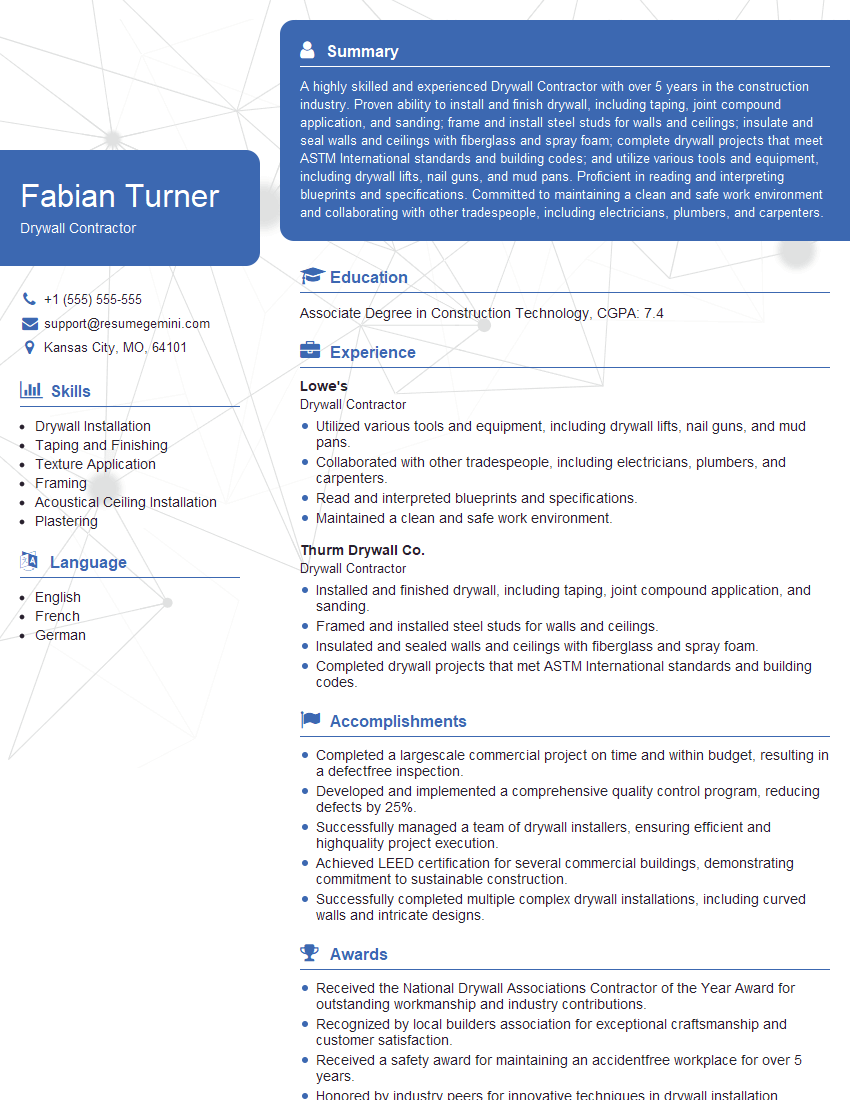
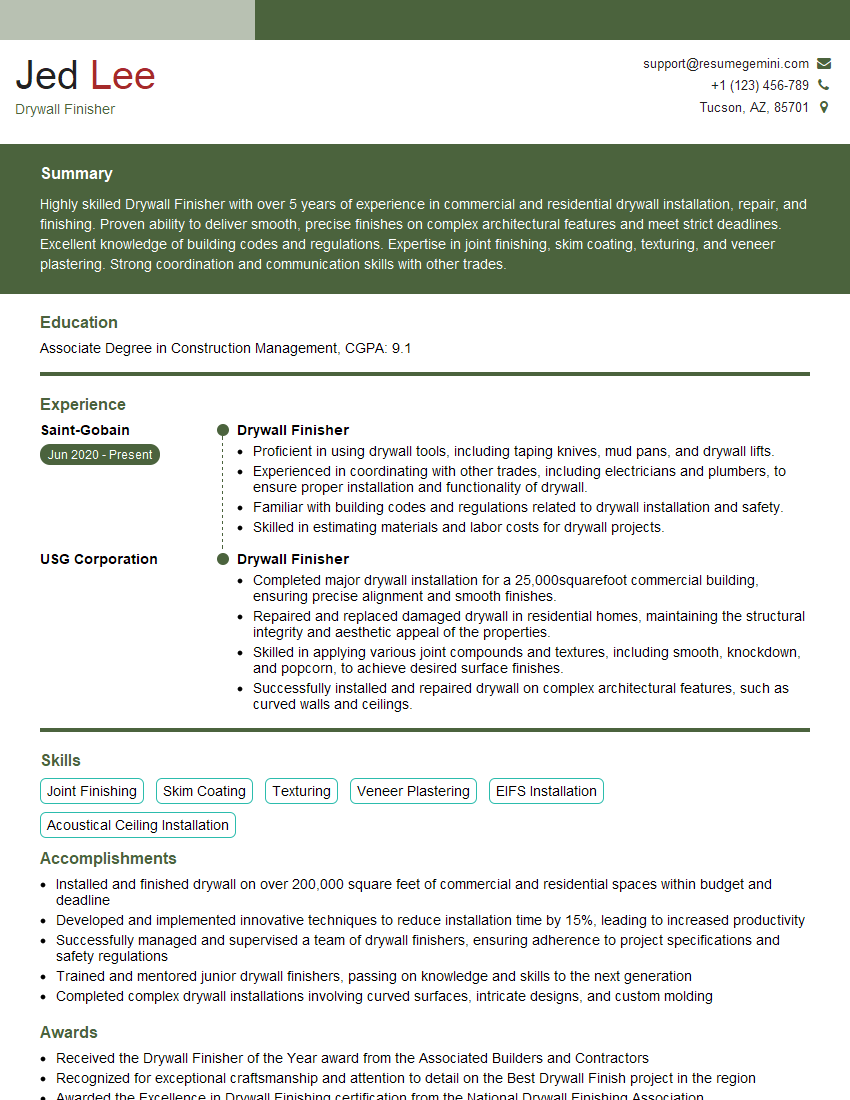
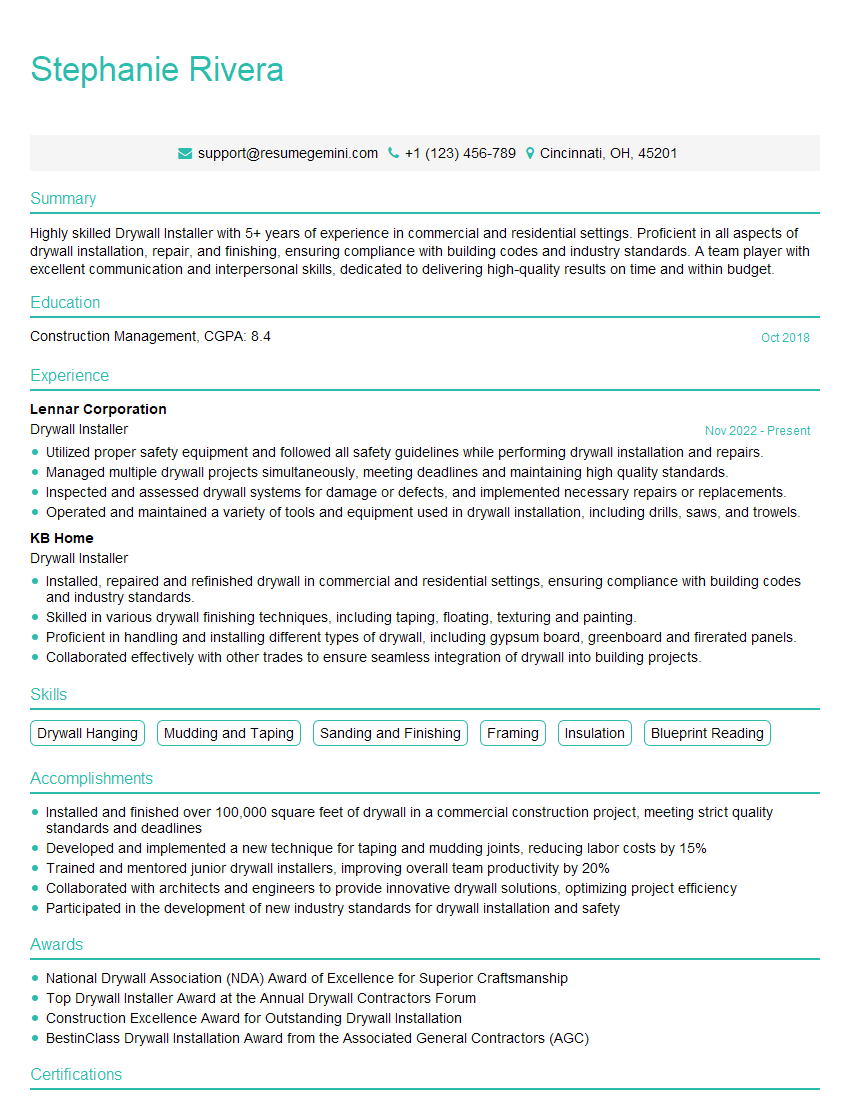
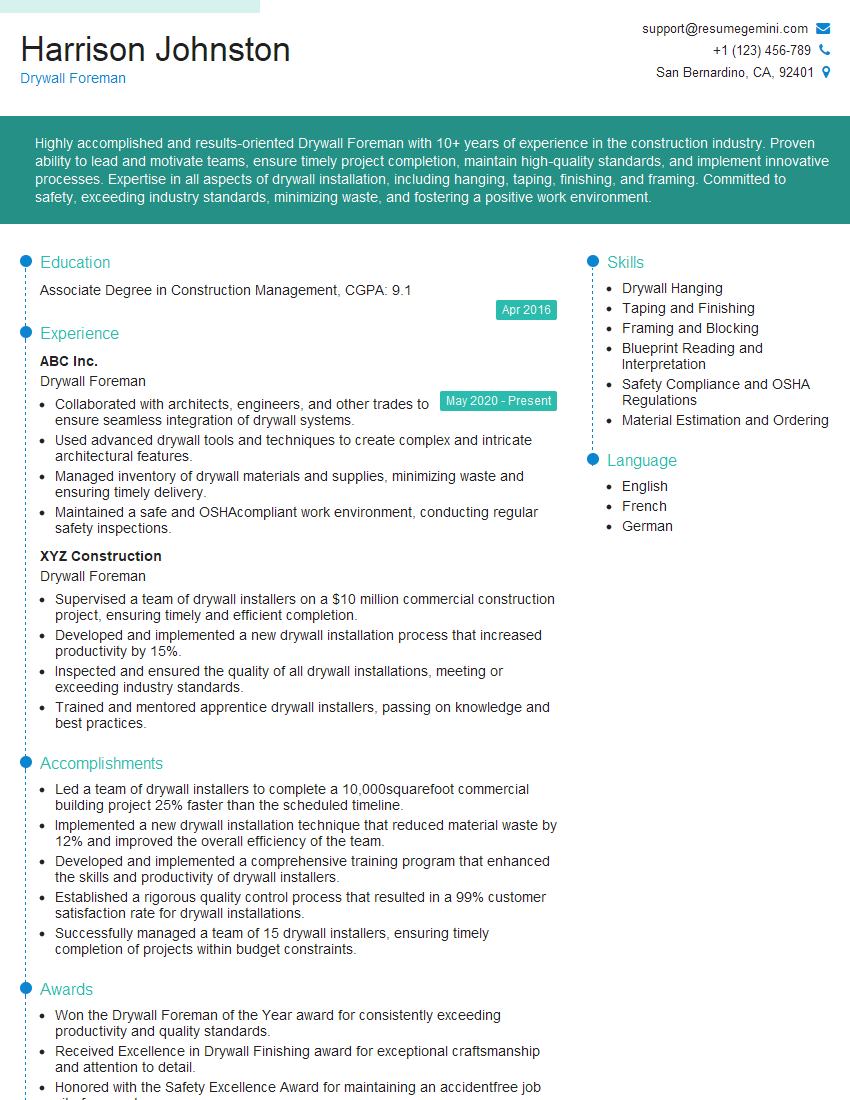
Mastering knowledge of drywall materials and properties is crucial for career advancement in the construction and renovation industries. A strong understanding of these concepts demonstrates expertise and increases your value to potential employers. To maximize your job prospects, it’s essential to create an ATS-friendly resume that highlights your skills and experience effectively. ResumeGemini is a trusted resource that can help you build a professional and impactful resume tailored to the specific requirements of drywall-related roles. Examples of resumes tailored to showcasing expertise in Knowledge of Drywall Materials and Properties are available through ResumeGemini to help guide your resume creation process.

Explore more articles
Users Rating of Our Blogs
Share Your Experience
We value your feedback! Please rate our content and share your thoughts (optional).
What Readers Say About Our Blog
To the interviewgemini.com Webmaster.
Very helpful and content specific questions to help prepare me for my interview!
Thank you
To the interviewgemini.com Webmaster.
This was kind of a unique content I found around the specialized skills. Very helpful questions and good detailed answers.
Very Helpful blog, thank you Interviewgemini team.