Every successful interview starts with knowing what to expect. In this blog, we’ll take you through the top Ability to Perform Basic Electrical and Plumbing Work interview questions, breaking them down with expert tips to help you deliver impactful answers. Step into your next interview fully prepared and ready to succeed.
Questions Asked in Ability to Perform Basic Electrical and Plumbing Work Interview
Q 1. What are the basic safety precautions when working with electricity?
Working with electricity is inherently risky, so safety is paramount. The most basic precautions involve treating all electrical circuits as live until proven otherwise. Always de-energize the circuit before working on it. This involves turning off the breaker at the electrical panel corresponding to the circuit you’re working on. Don’t rely solely on switches; they can be faulty. Furthermore, use insulated tools to avoid accidental shocks. Never work with wet hands or in wet conditions. If you’re unsure about any aspect of the work, always consult a qualified electrician. Think of electricity like water – you wouldn’t stick your hand into a high-pressure water jet; similarly, you shouldn’t carelessly handle electricity.
- Always de-energize the circuit: Turn off the breaker at the panel.
- Use insulated tools: Screwdrivers, pliers, and wire strippers should have insulated handles.
- Never work with wet hands or in wet conditions: Water increases conductivity, leading to greater risk of shock.
- Wear appropriate safety gear: Safety glasses protect your eyes from flying debris, and rubber gloves protect your hands from shocks.
- Know how to call for emergency help: Be prepared in case of an accident.
Q 2. How do you identify a blown fuse?
A blown fuse is a safety device that melts or breaks when excess current flows through it, protecting the circuit from damage. Identifying a blown fuse usually involves visually inspecting it. A blown fuse will typically show a broken filament, a charred appearance, or a clearly visible break in the metal strip inside the fuse. Some fuses have a small window that allows you to see the filament; if it’s broken, the fuse is blown. Remember, always turn off the power before inspecting or replacing a fuse.
For example, I once helped a homeowner troubleshoot a non-functioning outlet. After checking the breaker, I carefully removed the fuse from the fuse box and saw a clearly visible break in the metal strip – a sure sign it was blown. Replacing it with a fuse of the same amperage rating restored power.
Q 3. Explain the difference between AC and DC current.
AC and DC are two fundamental types of electrical current. AC, or Alternating Current, is characterized by its periodically reversing direction of current flow. The electrons oscillate back and forth, changing direction many times per second. The frequency of this oscillation is typically 50 or 60 Hertz (Hz), depending on the region. Household electricity is almost always AC. In contrast, DC, or Direct Current, flows in only one direction. Batteries produce DC, as does most electronic equipment after it’s been converted from the AC electricity in your house.
Think of it like this: AC is like a seesaw, constantly going up and down; DC is like a slide, flowing consistently in one direction. The difference is critical because AC can be easily transformed to different voltages using transformers, something not possible with DC without sophisticated electronics.
Q 4. How do you test for continuity in a circuit?
Continuity testing verifies whether there is a complete, unbroken electrical path in a circuit. A multimeter is used for this, usually set to the continuity test mode (often symbolized by a diode or a continuity symbol). Touch the probes to the two points in the circuit you want to test. If the circuit is complete (continuous), the multimeter will usually beep and display a reading near zero ohms. This indicates that there’s a good flow of electrons; if the circuit is open (discontinuous), there will be no beep and a high resistance reading, usually an ‘OL’ or ‘infinite’ reading.
For example, when troubleshooting a faulty light fixture, I’d use a multimeter to check for continuity between the wires leading to the fixture. No continuity indicated a break in the wiring, which I repaired to solve the problem.
Q 5. Describe the process of replacing a light switch.
Replacing a light switch involves several steps that prioritize safety. First, always turn off the power at the breaker panel. Then, remove the switch plate and use a voltage tester to double-check that the power is off. Next, carefully remove the wires connected to the switch, taking note of their positions (usually marked or easily distinguishable by their colors). Now, unscrew the switch from the electrical box and replace it with the new switch, ensuring that all wires are connected correctly to the corresponding terminals of the new switch. Secure the new switch to the box with screws, install the switch plate, and turn the power back on to test the functionality. Remember: if you’re uncomfortable with any of these steps, it is always advisable to hire a qualified electrician.
The most important part is paying close attention to the wiring colors to ensure you connect them accurately to the new switch. Incorrect wiring could lead to electrical hazards or a non-functional switch.
Q 6. What are the common types of plumbing pipes?
Plumbing pipes come in various materials, each with its own advantages and disadvantages. Common types include:
- Copper: Durable, corrosion-resistant, and reliable, but can be relatively expensive.
- PVC (Polyvinyl Chloride): Lightweight, inexpensive, and easy to install, but less durable than copper and susceptible to damage from extreme temperatures.
- CPVC (Chlorinated Polyvinyl Chloride): Similar to PVC but designed for higher temperature applications.
- PEX (Cross-linked Polyethylene): Flexible, resistant to freezing, and easy to install, often used in modern plumbing systems.
- Cast Iron: Heavy-duty and durable but prone to rust and corrosion over time.
- Galvanized Steel: Relatively strong and affordable, but prone to corrosion over time.
The choice of pipe material often depends on factors like cost, durability requirements, and the application. For instance, copper is ideal for hot and cold water supply lines due to its durability and resistance to corrosion, while PEX is favored for its flexibility and resistance to freezing in colder climates.
Q 7. How do you identify a leaking pipe?
Identifying a leaking pipe involves a combination of visual inspection and other detection methods. Visual inspection often involves checking for obvious signs of water, such as damp spots, puddles, or water stains on walls, ceilings, or floors. You might also hear dripping or running water sounds. Sometimes, a leak is hidden behind walls or under floors. If you suspect a hidden leak, you can use more advanced detection methods such as a moisture meter or listening devices to pinpoint the source of the leak. You should check around faucets, pipes, and connections for visible water damage. For larger leaks, the water pressure may be noticeably lower than normal.
In one instance, I helped a homeowner find a slow leak behind a wall. The homeowner noticed a consistently damp spot on a wall, leading me to suspect a hidden leak. By using a moisture meter, I was able to pinpoint the exact location of the leak, allowing for targeted repair and preventing further damage.
Q 8. Explain the function of a P-trap.
A P-trap is a curved section of pipe, typically found under sinks and other plumbing fixtures, designed to prevent sewer gases from entering your home. Think of it as a water-filled barrier. The curve holds water, creating a seal that blocks the passage of unpleasant and potentially harmful gases.
Imagine a siphon. The water in the P-trap acts like a plug, stopping sewer gas from traveling upwards. Without a P-trap, those gases would easily escape into your house, creating an unpleasant odor and potentially exposing you to harmful bacteria.
Q 9. How do you unclog a drain using a plunger?
Unclogging a drain with a plunger requires a bit of technique. First, ensure the drain is clear of standing water – you want a good seal. Then, fill the sink or tub with enough water to cover the cup of the plunger. Create an airtight seal by firmly pressing the plunger over the drain opening. Now comes the rhythmic part. Push and pull the plunger vigorously up and down for 15-20 seconds, maintaining that seal. The pressure changes created dislodge the clog.
If this doesn’t work on the first try, repeat the process, adding a bit more water if needed. You might even try adding some hot water to the drain beforehand to help loosen the clog. Stubborn clogs might require a different approach, like a drain snake.
Q 10. Describe the process of replacing a faucet.
Replacing a faucet is a common DIY plumbing project, but requires careful attention to detail. Begin by turning off the water supply to the faucet—usually located under the sink. Then, disconnect the water supply lines from the faucet using adjustable pliers or wrenches. Next, remove any decorative caps and nuts securing the faucet to the sink. You might need a basin wrench for hard-to-reach nuts. Carefully remove the old faucet, taking note of how the components are assembled. Installation of the new faucet involves reversing these steps, ensuring that all connections are tight and secure. Always check for leaks after reconnecting the water supply.
Remember to consult the manufacturer’s instructions for your specific faucet model. This will help ensure a smooth and correct installation.
Q 11. What are the different types of plumbing fixtures?
Plumbing fixtures are the components of a plumbing system that are directly used by people. Examples include:
- Sinks: Kitchen sinks, bathroom sinks, utility sinks.
- Toilets: Different types exist, including one-piece and two-piece toilets.
- Showers and Tubs: Including different types of shower heads and tub spouts.
- Faucets: Various styles and functions, like single-handle or double-handle faucets.
- Water Heaters: Provide hot water throughout the house.
The selection and installation of these fixtures depend on factors such as space, budget, and aesthetic preferences.
Q 12. What are the basic tools required for basic electrical work?
Basic electrical work requires a few essential tools. Safety is paramount, so always remember to turn off power at the breaker box before beginning any work. Here’s a list:
- Screwdrivers (Phillips and flathead): For removing and installing screws.
- Wire strippers/cutters: To prepare wires for connections.
- Voltage tester: Essential for ensuring power is off before working on circuits. Never skip this step!
- Pliers (needle-nose and lineman’s): Useful for gripping and bending wires.
- Electrical tape: For insulating wire connections.
- Wire nuts: To securely connect wires together.
More specialized tools may be needed for more complex tasks.
Q 13. What are the basic tools required for basic plumbing work?
Basic plumbing tasks require a collection of tools that make the job easier and safer. These include:
- Adjustable wrenches: For tightening and loosening nuts and bolts.
- Pipe wrenches: Specifically designed for gripping and turning pipes.
- Basin wrench: A specialized wrench for accessing hard-to-reach nuts under sinks.
- Pliers (channel-lock and slip-joint): For gripping and turning various fittings.
- Plumber’s putty: Used to create watertight seals.
- Teflon tape: For sealing threaded pipe connections.
Depending on the task, additional tools such as a drain snake, hacksaw, and soldering equipment might be necessary.
Q 14. How do you solder copper pipes?
Soldering copper pipes is a skill that requires practice and caution. It involves melting solder to create a strong, watertight joint between copper pipes and fittings. First, clean the pipe and fitting surfaces thoroughly with sandpaper or a wire brush to remove any oxides or debris that could prevent a good bond. Then, apply flux to the surfaces to help the solder flow. Next, heat the joint using a propane torch, evenly heating the pipe and fitting until they are hot enough to melt the solder. Finally, apply solder to the heated joint, allowing it to flow evenly and completely fill the gap. Always allow the solder to cool completely before testing for leaks.
Safety is paramount when soldering. Always wear appropriate safety glasses and gloves. Proper ventilation is also essential to prevent inhalation of fumes. Practice on scrap pieces of copper pipe before tackling your project.
Q 15. Explain the difference between PVC and CPVC pipes.
PVC (Polyvinyl Chloride) and CPVC (Chlorinated Polyvinyl Chloride) are both types of plastic pipes commonly used in plumbing, but they have key differences. PVC is a rigid, less expensive option suitable for cold water applications. Think of it as the workhorse of plumbing – it’s sturdy, reliable, and does the job well for most standard situations. CPVC, on the other hand, is a more resilient material that can withstand higher temperatures. This makes it ideal for hot water lines and applications where the water might reach temperatures above 140°F (60°C), something PVC wouldn’t handle as well. Imagine it as the upgraded, high-temperature version of PVC. The added chlorine in CPVC makes it more flexible and resistant to high temperatures and pressures. Both materials require proper solvent welding for reliable joints, but CPVC’s higher temperature resistance makes it preferable for hot water distribution systems in houses and buildings.
In short: Choose PVC for cold water applications and CPVC for hot water applications to ensure longevity and safety.
Career Expert Tips:
- Ace those interviews! Prepare effectively by reviewing the Top 50 Most Common Interview Questions on ResumeGemini.
- Navigate your job search with confidence! Explore a wide range of Career Tips on ResumeGemini. Learn about common challenges and recommendations to overcome them.
- Craft the perfect resume! Master the Art of Resume Writing with ResumeGemini’s guide. Showcase your unique qualifications and achievements effectively.
- Don’t miss out on holiday savings! Build your dream resume with ResumeGemini’s ATS optimized templates.
Q 16. How do you read a basic electrical schematic?
Reading an electrical schematic is like reading a map for electricity. It shows you the path of the electrical current through a circuit. Schematics use standardized symbols to represent components: wires, switches, outlets, lights, and other electrical devices. These symbols are generally universally understood across various countries and industries.
- Lines: Represent wires connecting components.
- Symbols: Represent specific components (e.g., a circle with a cross inside represents a ground).
- Numbers/Letters: Can represent wire sizes, circuit numbers, or device designations.
To interpret a schematic, you start at the power source (often a breaker box) and follow the path of the lines. You’ll see how the electricity flows through each component, allowing you to trace the complete circuit. For example, you may see a line leading from the breaker box, followed by a light switch, then to a light fixture. This tells you that the switch controls the electricity to the light.
Understanding the symbols is crucial. For instance, knowing the symbol for a resistor will give you insight into its intended function in the circuit.
With practice, you will become adept at tracing the pathway of electrical current, identifying individual components, and understanding the overall function of the circuit described by the schematic. Many online resources provide comprehensive symbol lists and more complex examples.
Q 17. How do you interpret a plumbing blueprint?
Plumbing blueprints are detailed drawings that show the layout and configuration of all plumbing fixtures, pipes, and other components in a building or system. They are like maps for your plumbing system, providing crucial information for installation, maintenance, and repairs. They use a variety of symbols to represent pipes, valves, fixtures (toilets, sinks, etc.), and other elements.
Interpreting a plumbing blueprint involves understanding these symbols and their placement on the plan. For example, a specific symbol might indicate a 1-1/2” diameter pipe, its material (PVC, copper), and its direction. The blueprint also shows the location of crucial features such as valves, water heaters, and drains. Pipe sizing is indicated using specific designations which must be interpreted to understand the intended flow capacity.
You will often find cross sections that provide a clearer view of pipe arrangement in walls or floors. You might also find notes explaining special considerations. By understanding the blueprint’s information, you can effectively plan, design, and fix plumbing issues.
It’s crucial to read the blueprint’s legend (usually a small chart that shows what each symbol means) to avoid misinterpreting the information.
Q 18. What is the purpose of a ground wire?
The ground wire, typically green or bare copper, is a crucial safety feature in electrical systems. Its main purpose is to provide a low-resistance path for fault currents to flow back to the ground, preventing dangerous voltage buildup on the metal parts of appliances and electrical equipment. Think of it as an emergency escape route for electricity.
If a ‘hot’ wire accidentally touches the metal casing of an appliance, the ground wire provides a direct path for that current to flow harmlessly into the earth. Without a ground wire, the metal casing could become energized, posing a significant shock hazard. A properly grounded system dramatically reduces the risk of electric shock.
The ground wire completes a circuit, ensuring that any stray current is diverted safely, preventing dangerous voltage buildup and protecting both the equipment and people from electric shocks. It is an essential component in preventing many electrically related accidents and damage to equipment.
Q 19. What is the purpose of a circuit breaker?
A circuit breaker is a safety device designed to protect an electrical circuit from damage caused by overcurrents (too much electrical current flowing through the circuit) or short circuits. It’s like a safety valve in your electrical system.
When the current flowing through a circuit exceeds a safe level, the circuit breaker automatically trips, cutting off the power supply. This prevents overheating, fires, and damage to appliances. If a short circuit occurs (when a hot wire touches a neutral wire or ground), the sudden surge in current triggers the breaker to trip, again preventing damage and hazards. Circuit breakers are resettable, meaning once the fault is fixed, you can restore power by switching it back on.
Circuit breakers are essential for safety and prevent significant damage to electrical equipment and a building, ultimately protecting people from risks associated with electrical malfunction.
Q 20. Explain the concept of voltage, current, and resistance.
Voltage, current, and resistance are fundamental concepts in electricity and are related by Ohm’s Law (V = IR).
- Voltage (V): This is the electrical potential difference between two points in a circuit. Think of it as the ‘electrical pressure’ pushing the current through the circuit. It’s measured in volts (V).
- Current (I): This is the flow of electrical charge (electrons) through a circuit. Think of it as the rate of electron flow. It’s measured in amperes (A) or amps.
- Resistance (R): This is the opposition to the flow of current in a circuit. Think of it as friction in the electrical pathway. It’s measured in ohms (Ω).
Ohm’s Law (V = IR) states that the voltage across a conductor is directly proportional to the current flowing through it, and the constant of proportionality is the resistance. This means if you increase the voltage, the current will increase proportionally, assuming resistance stays constant. Conversely, if you increase the resistance, the current will decrease. These concepts are crucial for understanding how electrical circuits work and for troubleshooting electrical problems.
For example, a higher voltage will mean a larger push and a stronger flow of electrons; a high resistance will restrict that flow. The relationship between voltage, current, and resistance is fundamental to working safely with electricity.
Q 21. How do you troubleshoot a faulty electrical outlet?
Troubleshooting a faulty electrical outlet involves a systematic approach to identify the problem. Always prioritize safety – turn off the power to the outlet at the breaker box before beginning any work.
- Check the breaker: The most common cause is a tripped circuit breaker. Check the breaker box and see if the breaker serving that outlet is in the ‘off’ position. If so, reset it.
- Test the outlet with a voltage tester: Use a non-contact voltage tester to check if there is power at the outlet. If there’s no power, the problem lies upstream of the outlet (wiring or breaker). If there is power, the issue is with the outlet itself or the wiring within the outlet.
- Inspect the outlet: Carefully examine the outlet for loose or damaged wires, burnt marks, or any signs of physical damage. Often, a wire may become loose, disrupting the electrical connection. Examine the outlet from both sides.
- Test the outlet with a multimeter: A multimeter can check for voltage at the outlet terminals. It can also help to test for continuity and resistance, to further analyze circuit issues.
- Check for GFCI protection: Some outlets have Ground Fault Circuit Interrupters (GFCIs) which trip when they detect ground faults. Reset the GFCI by pressing the ‘reset’ button if it has tripped.
- Replace or repair the outlet: If the outlet is damaged or the wiring is faulty, you’ll need to replace the outlet or repair the wiring. This requires more electrical knowledge and appropriate safety measures. If unsure, contact a qualified electrician.
Remember: If you are not comfortable working with electricity, always call a qualified electrician. Working with electricity can be dangerous if not done correctly.
Q 22. How do you troubleshoot a running toilet?
Troubleshooting a running toilet involves systematically checking for the most common causes. Think of it like detective work – you need to find the culprit causing the continuous flow.
First, check the flapper. This rubber seal at the bottom of the tank controls water flow into the bowl. If it’s not sealing properly, water will constantly leak into the bowl. A simple visual inspection often reveals a worn or damaged flapper; a replacement is usually inexpensive and easily installed.
Next, examine the fill valve. This valve regulates the water level in the tank. If it’s malfunctioning, it might overfill the tank, causing water to overflow and run constantly. You might hear a constant hissing sound if this is the problem. A simple adjustment or replacement may resolve the issue.
Check the chain connecting the flapper to the handle. If it’s too long, it might prevent the flapper from sealing completely. Shortening or adjusting the chain is a quick fix.
The float, a buoyant ball that controls the fill valve, can also be problematic. If it’s not floating correctly, it might prevent the tank from filling properly or at all leading to a running toilet. Again, replacement may be necessary.
Finally, if none of these simple checks reveal the problem, there might be a more serious leak within the tank or bowl itself, requiring more in-depth repair or possibly even replacement of the toilet.
Q 23. Describe your experience with different types of wire strippers.
I’ve extensive experience with various wire strippers, from simple manual tools to more advanced automatic models. My experience ranges from using basic wire strippers with adjustable blades for different gauge wires to high-quality strippers that can handle a broader range of wire sizes and types, including stranded and solid core wires.
Basic Strippers: These are essential for everyday tasks and are suitable for stripping wires from small gauge to medium gauge. I’ve used numerous brands, all offering similar functionality: a cutting blade and adjustable holes to accommodate different wire gauges. The trick is to find the right hole size to avoid nicking the wire’s conductor. Overstripping leads to increased resistance and potential connection problems, even leading to fire hazards if done incorrectly.
Automatic Strippers: These are more efficient for high-volume work or when precision is critical. They offer faster stripping, cleaner cuts, and consistent results across different wire gauges. They use a mechanism that precisely adjusts the stripping length automatically based on the wire size. My experience has shown these to be reliable and efficient on large projects, increasing productivity significantly.
Specialty Strippers: I’ve also worked with specialty wire strippers designed for coaxial cables, fiber optic cables, or other specialized wiring types. Each of these demands specific tools and techniques to avoid damaging the delicate internal components of the cables.
Q 24. Describe your experience with different types of pipe wrenches.
My experience encompasses a wide variety of pipe wrenches, each suited for different pipe sizes and materials. Choosing the right wrench is crucial for efficient and safe work. Improper wrench use can lead to damage to the pipe or even injury.
Adjustable Wrenches (Crescent Wrenches): These are highly versatile, accommodating a range of pipe sizes. I regularly use them for general plumbing tasks and minor adjustments where precise grip isn’t paramount. The jaw adjustment allows adaptation to various pipe diameters.
Chain Wrenches: These are invaluable when dealing with old, rusty, or damaged pipes that are difficult to grip with other wrenches. The chain provides a secure grip even on irregularly shaped pipes, minimizing damage to the pipe itself. I’ve frequently used them when working in older buildings with deteriorated plumbing.
Pipe Wrenches (Stillson Wrenches): These are heavier-duty wrenches, often used for larger pipes and fittings. The design allows for excellent torque application, enabling tight connections. However, it’s crucial to be cautious to prevent over-tightening or damaging the pipe.
Basin Wrenches: Used for tightening or loosening nuts under sinks or tight spaces, these have a specialized design for access and torque in confined areas. They are essential for efficient work in areas where space is limited.
Q 25. How do you ensure proper grounding in electrical installations?
Ensuring proper grounding in electrical installations is paramount for safety. It provides a low-resistance path for fault currents to flow to the earth, preventing dangerous voltage buildup and protecting people and equipment from electrical shocks. Imagine grounding as a safety valve – it provides an escape route for stray electricity.
Grounding Wire: A dedicated grounding wire, typically bare or green-coated copper wire, is connected to the system’s grounding electrode. This electrode can be a metal rod driven into the earth, a metal water pipe, or a grounding electrode conductor connected to the building’s grounding system.
Grounding Rod: If a dedicated grounding electrode system isn’t already in place, I’ll install a grounding rod, typically 8 feet long, driven deep into the earth for optimum conductivity.
Ground Fault Circuit Interrupters (GFCIs): These safety devices quickly detect ground faults and interrupt the power supply before significant current flows to the ground. They are critical in preventing electric shock particularly in areas prone to moisture like bathrooms and kitchens. This is crucial safety measure beyond just proper grounding.
Grounding Connections: All metallic enclosures, equipment casings, and conduit systems must have secure connections to the grounding system, creating a continuous path for fault currents. I meticulously check all connections for tightness and corrosion, ensuring the integrity of the grounding path.
Q 26. How do you prevent water hammer in plumbing systems?
Water hammer, that loud banging sound in your pipes, occurs when water flow suddenly stops. Think of it like a car suddenly braking – the momentum of the water creates a shockwave that travels through the pipes, causing the banging. Preventing it requires careful planning and installation.
Water Hammer Arrestors: These devices, usually installed near fixtures such as faucets and appliances, absorb the shockwave by allowing the water to momentarily compress a small air chamber or spring mechanism. They’re like shock absorbers for your plumbing system.
Air Chambers: Traditionally, air chambers were incorporated into plumbing systems. These vertical sections of pipe filled with air would absorb the water hammer shock. While less common in modern plumbing, they are still an effective solution.
Proper Pipe Support: Loose or poorly supported pipes can amplify the effects of water hammer. Securely anchoring pipes prevents vibrations and reduces the impact of water hammer. This is essential, particularly in older buildings.
Slow Closing Valves: Valves that close too quickly can initiate water hammer. Using slow-closing valves, which gradually reduce water flow, minimizes the sudden pressure changes that create the problem.
Q 27. Describe your experience with different types of plumbing joints.
My experience includes a range of plumbing joints, each with its own advantages and disadvantages depending on the application and material involved. The choice of joint is crucial to ensuring a watertight and durable system. I carefully choose the appropriate joint type according to the pressure rating, material compatibility, and ease of installation.
Threaded Joints: These are common for metal pipes, using threaded fittings to create a secure connection. Proper thread sealing tape or compound is essential for a leak-proof joint. Over-tightening can damage threads.
Compression Joints: These utilize compression rings and nuts to create a tight seal around the pipe. They are quick and easy to install and can be used with different pipe materials. However, regular inspection is needed to ensure the compression fittings haven’t loosened over time.
Solvent Weld Joints: For PVC and CPVC pipes, solvent welding creates a permanent, chemically bonded joint. This requires precise cleaning and application of the solvent cement to ensure a strong and leak-free bond.
Flanged Joints: These are typically used for larger pipes and in situations requiring easy disassembly. They use flanges and bolts for a secure and readily accessible connection. These offer great flexibility for repairs and maintenance.
Q 28. Describe your experience working with different types of electrical connectors.
My experience with electrical connectors spans a wide range, catering to various wire sizes, applications, and safety requirements. Choosing the right connector is vital for safe and reliable electrical connections.
Wire Nuts (Twist-on Connectors): These are widely used for joining wires of the same gauge within junction boxes. It’s essential to use the correct size wire nut for the number and size of wires being joined for a secure connection. Incorrect sizing can be a fire hazard.
Push-in Connectors: These connectors offer quick and easy installation; the wire is simply pushed into the connector, eliminating the need for stripping or twisting. They’re suitable for smaller wire gauges and lower current applications.
Screw-type Connectors: These connectors use screws to securely clamp the wires, offering a very reliable and robust connection. They are frequently used in higher-current applications where a tight and secure connection is essential.
Terminal Blocks: These are invaluable when connecting multiple wires or for applications requiring easy disconnection. They provide clear labeling options and facilitate troubleshooting and maintenance.
Crimp Connectors: These use specialized tools to crimp connectors onto wires. This creates a secure and reliable connection, often used in applications demanding durability and vibration resistance.
Key Topics to Learn for Ability to Perform Basic Electrical and Plumbing Work Interview
- Electrical Safety: Understanding voltage, amperage, and electrical hazards; safe practices for working with electricity; recognizing and avoiding common electrical dangers.
- Basic Wiring: Familiarity with different wire types and gauges; understanding basic wiring diagrams; experience with installing and replacing simple electrical fixtures (e.g., light switches, outlets).
- Troubleshooting Electrical Problems: Identifying common electrical issues (e.g., blown fuses, tripped breakers); basic troubleshooting techniques; understanding the importance of using appropriate testing equipment.
- Plumbing Fixtures: Understanding the function and operation of common plumbing fixtures (e.g., toilets, sinks, faucets); experience with basic repair and maintenance of these fixtures.
- Pipe Fitting and Repair: Familiarity with different types of pipes and fittings; experience with basic pipe repair techniques (e.g., fixing leaks, replacing damaged sections); understanding of pipe sizing and pressure.
- Water Pressure and Flow: Understanding the importance of proper water pressure and flow; identifying and troubleshooting issues related to low water pressure or flow; experience with using pressure testing equipment.
- Plumbing Codes and Regulations: Basic understanding of relevant plumbing codes and regulations; ensuring work meets safety and compliance standards.
- Problem-Solving and Troubleshooting: Developing systematic approaches to identify, diagnose, and resolve both electrical and plumbing issues; documenting work and maintaining clear records.
- Tool Knowledge and Usage: Demonstrating proficiency in using common hand tools and power tools safely and effectively for both electrical and plumbing tasks.
Next Steps
Mastering basic electrical and plumbing skills significantly enhances your employability across various sectors, opening doors to rewarding and stable careers. A well-crafted resume is your key to unlocking these opportunities. Make sure your resume is ATS-friendly to ensure it gets noticed by potential employers. ResumeGemini is a trusted resource to help you build a professional and impactful resume that highlights your skills and experience effectively. Examples of resumes tailored to showcase your Ability to Perform Basic Electrical and Plumbing Work are available to help you get started.
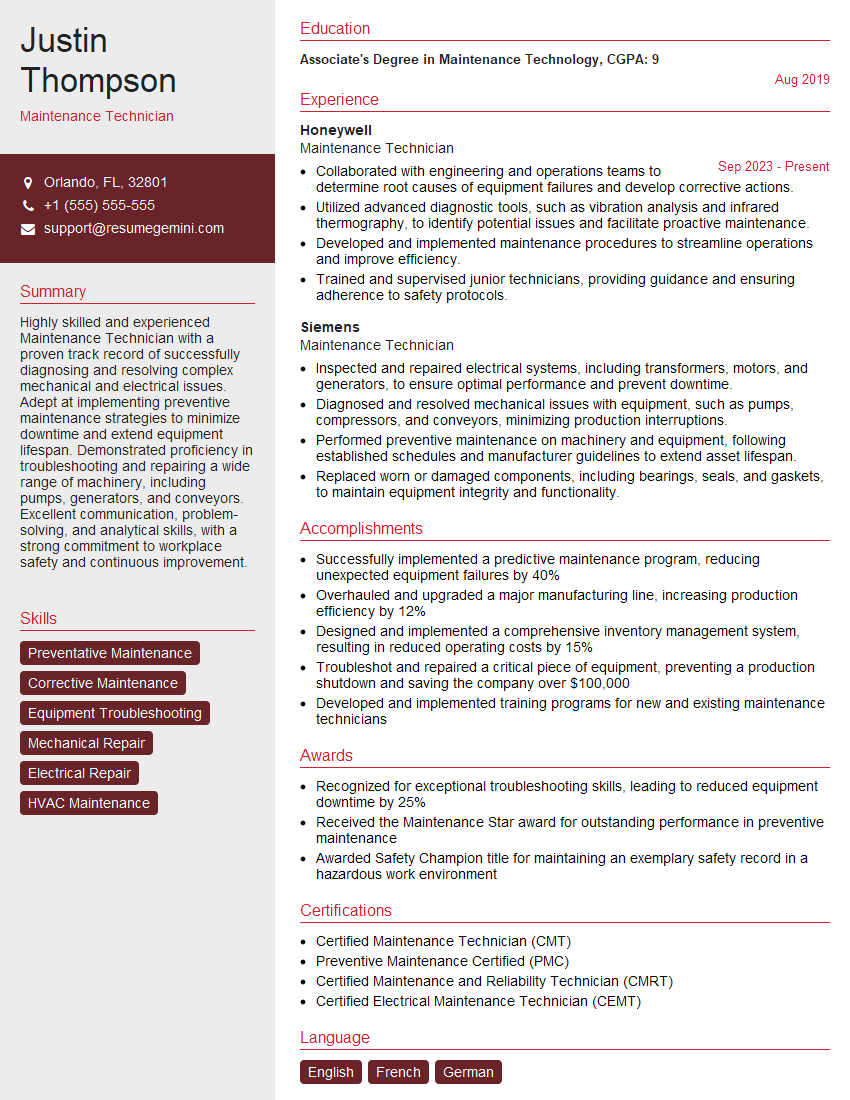
Maintenance Technician Resume Sample

Field Technician Resume Sample
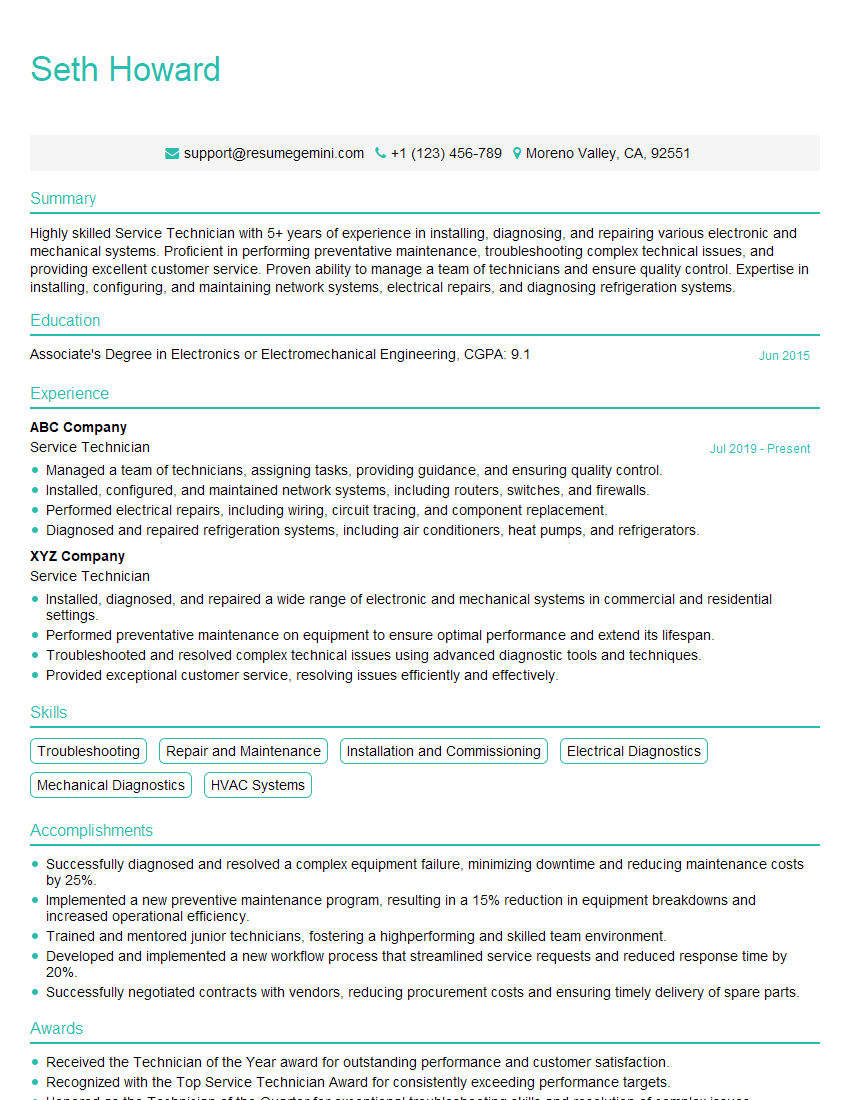
Service Technician Resume Sample
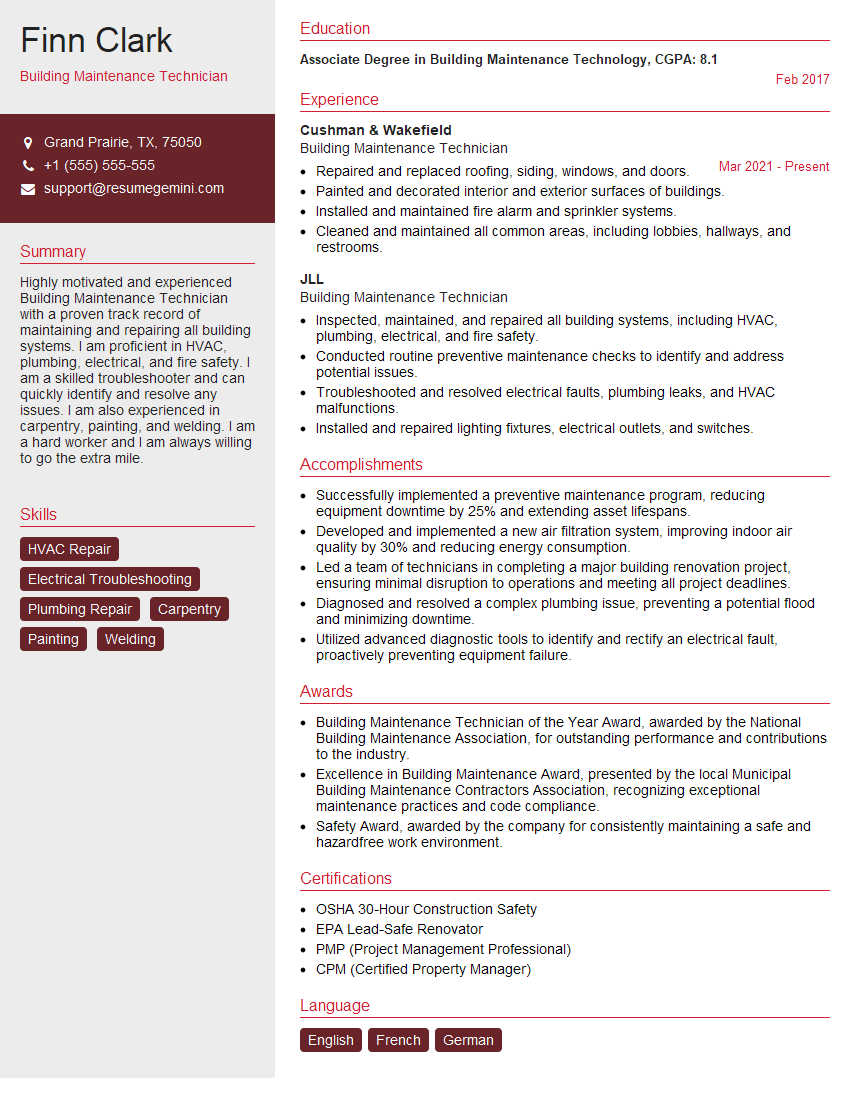
Building Maintenance Technician Resume Sample
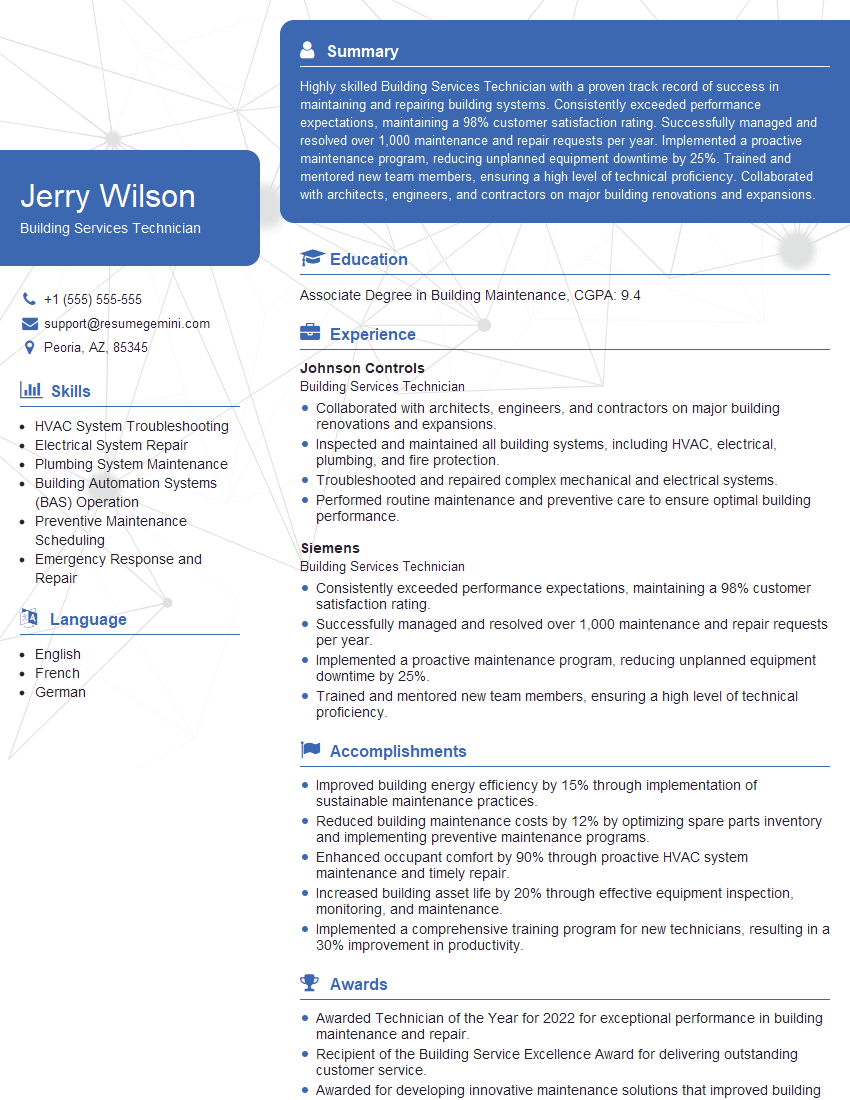
Building Services Technician Resume Sample
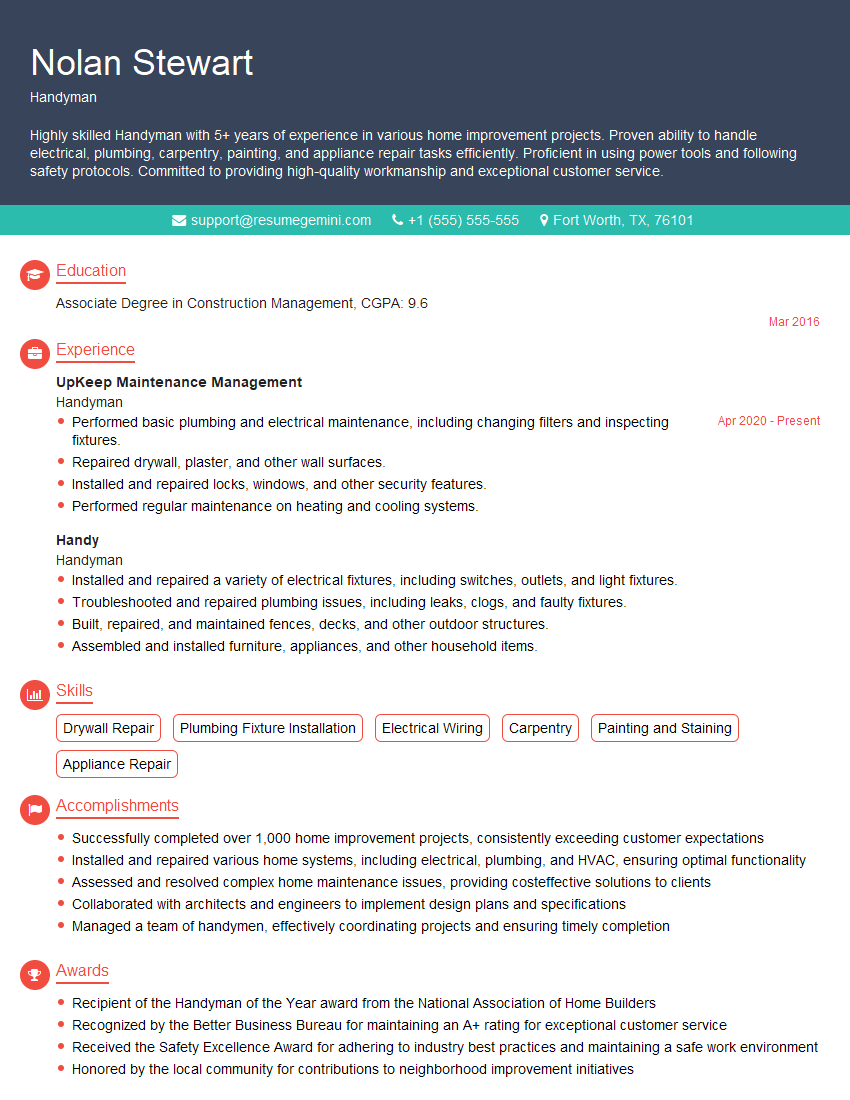
Handyman Resume Sample
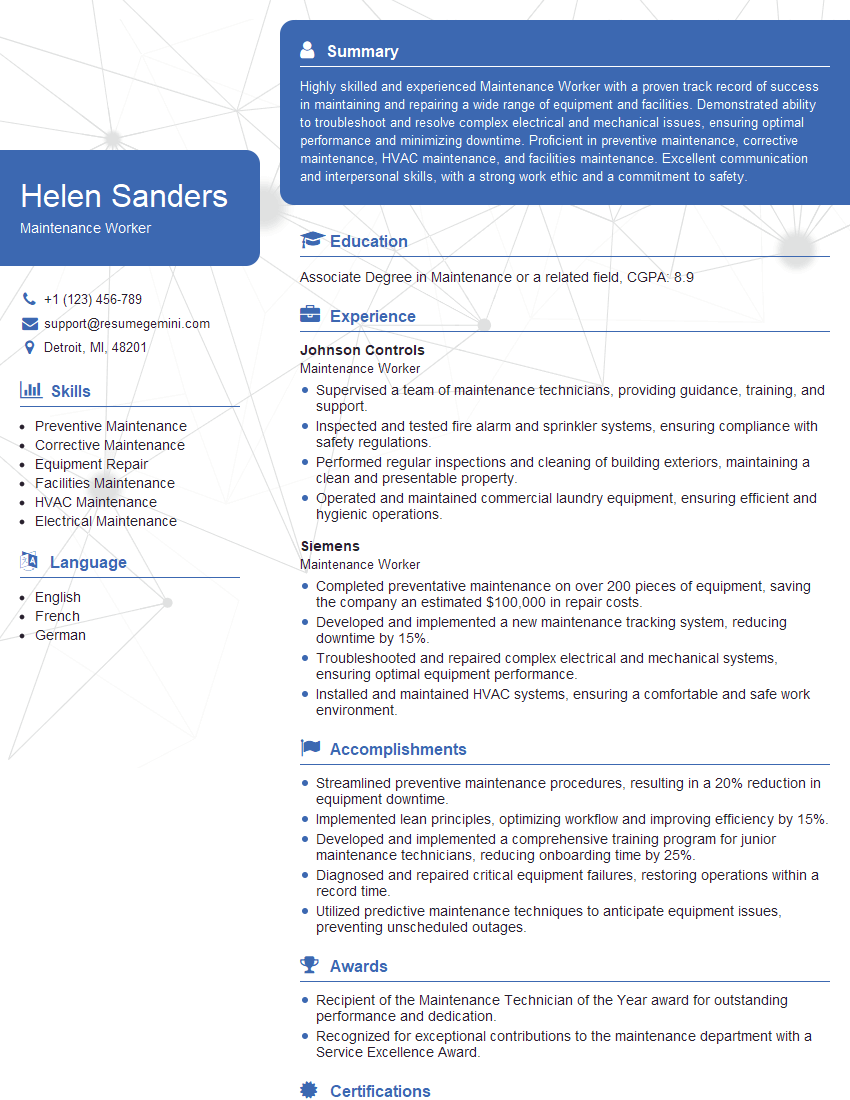
Maintenance Worker Resume Sample
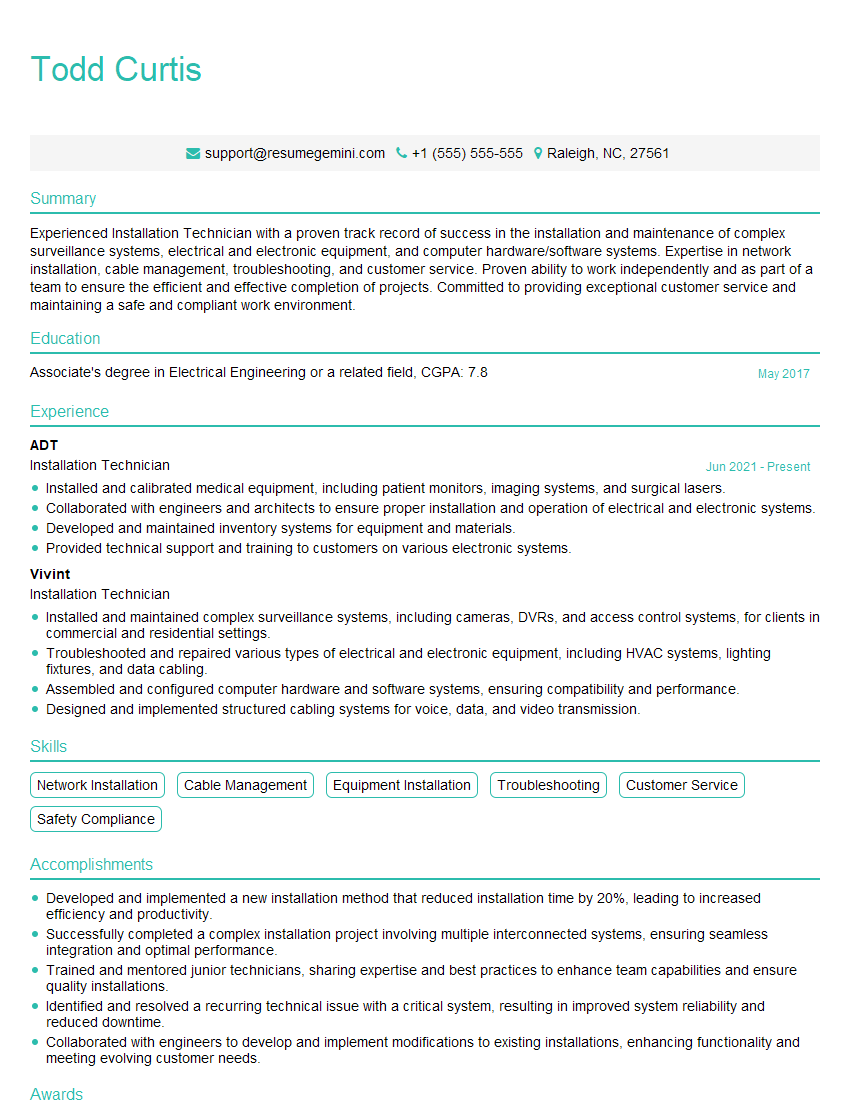
Installation Technician Resume Sample
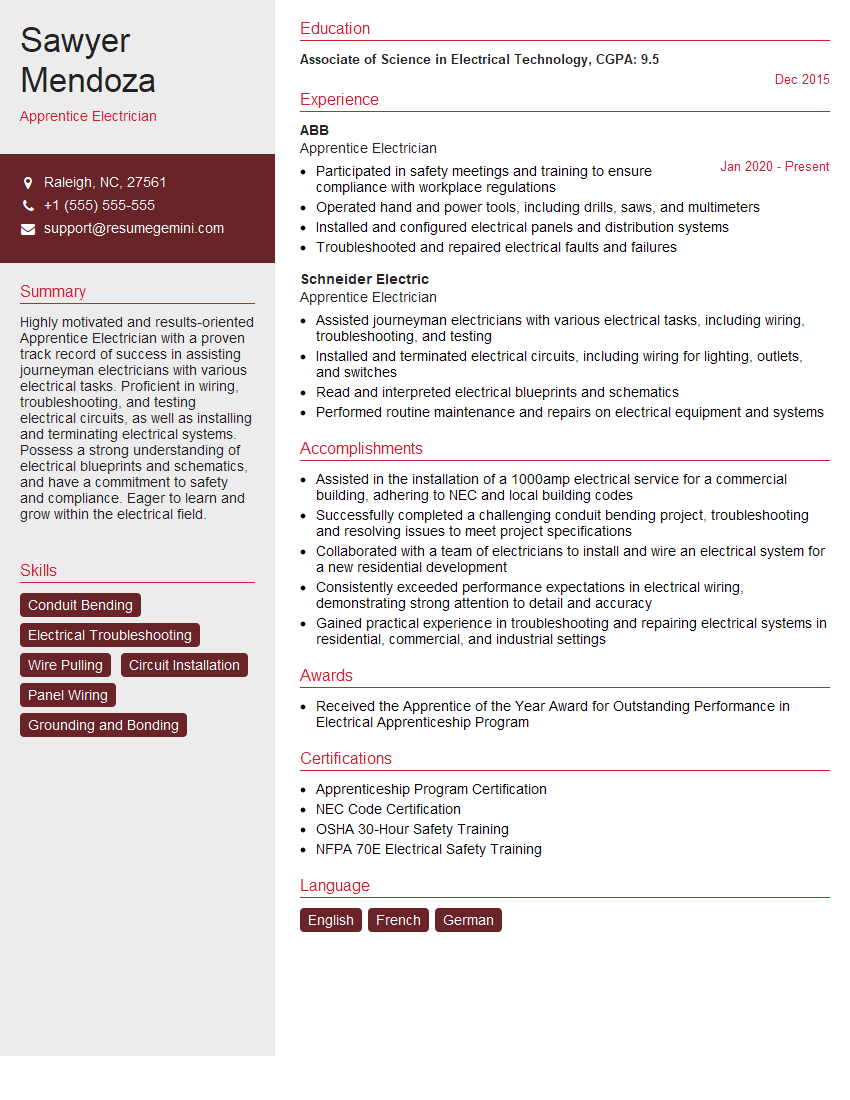
Apprentice Electrician Resume Sample

Apprentice Plumber Resume Sample
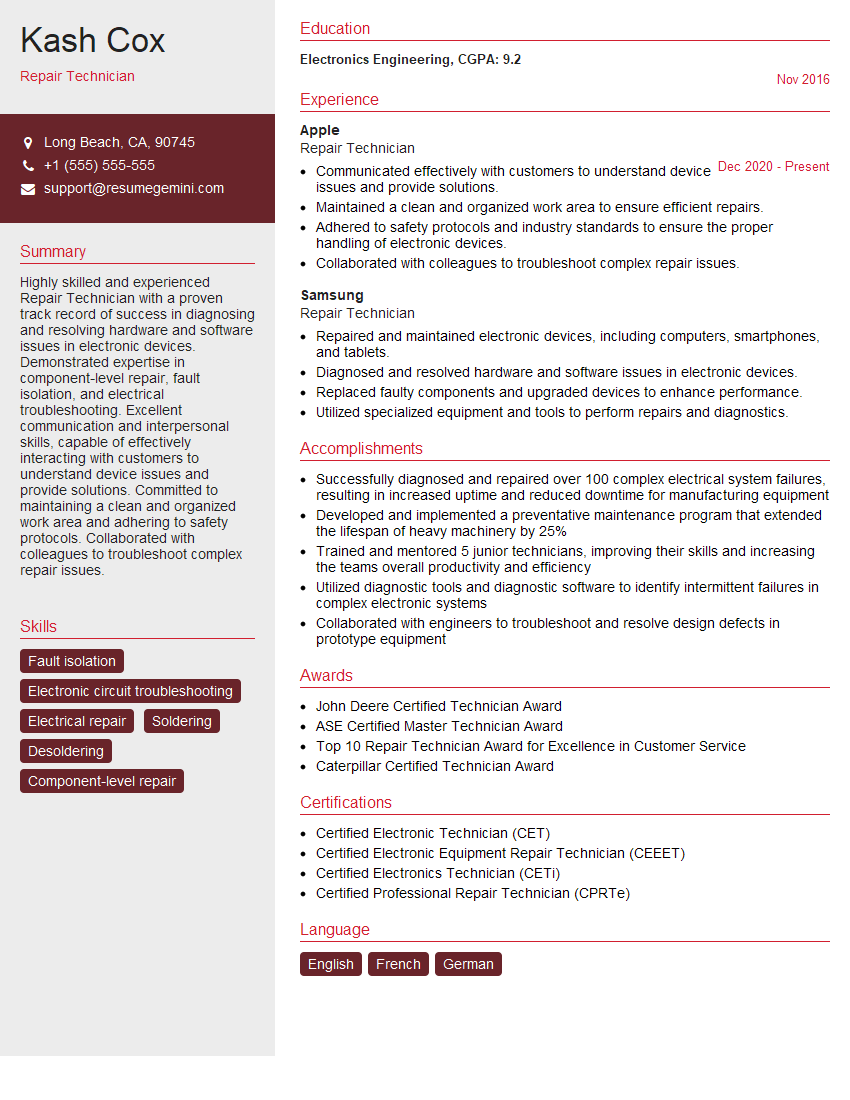
Repair Technician Resume Sample
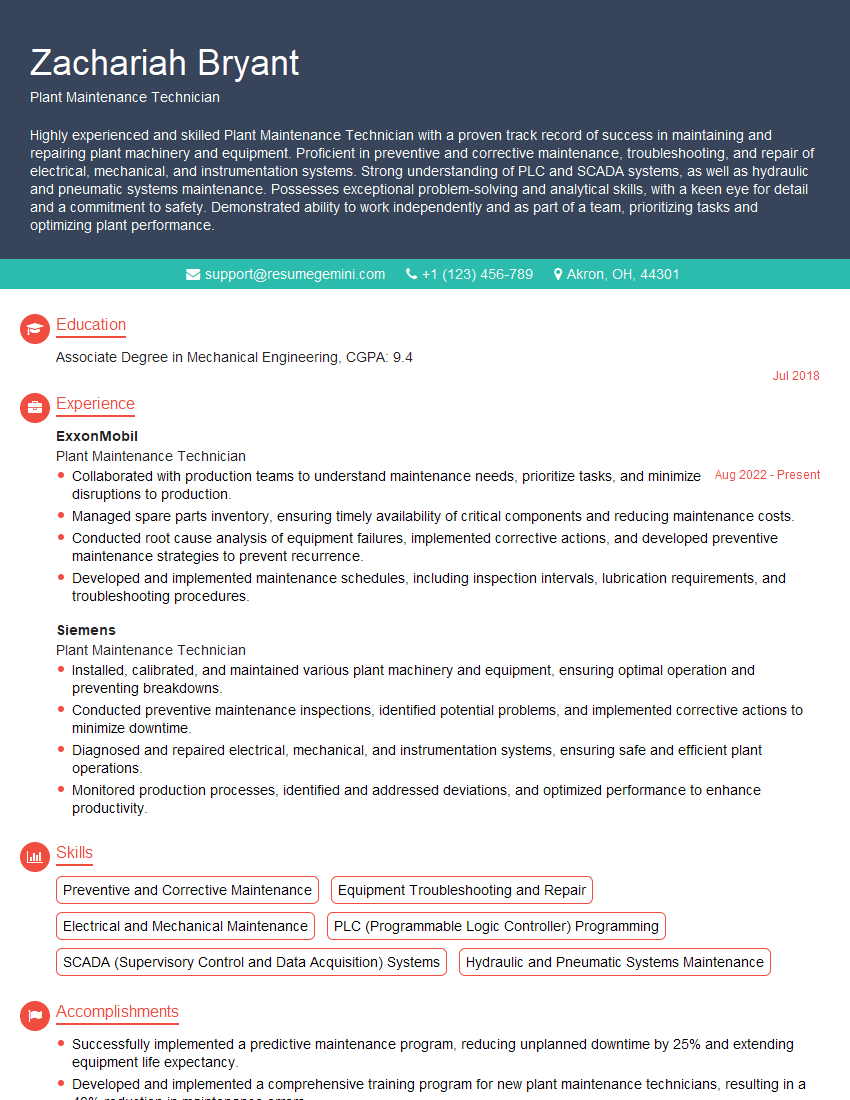
Plant Maintenance Technician Resume Sample
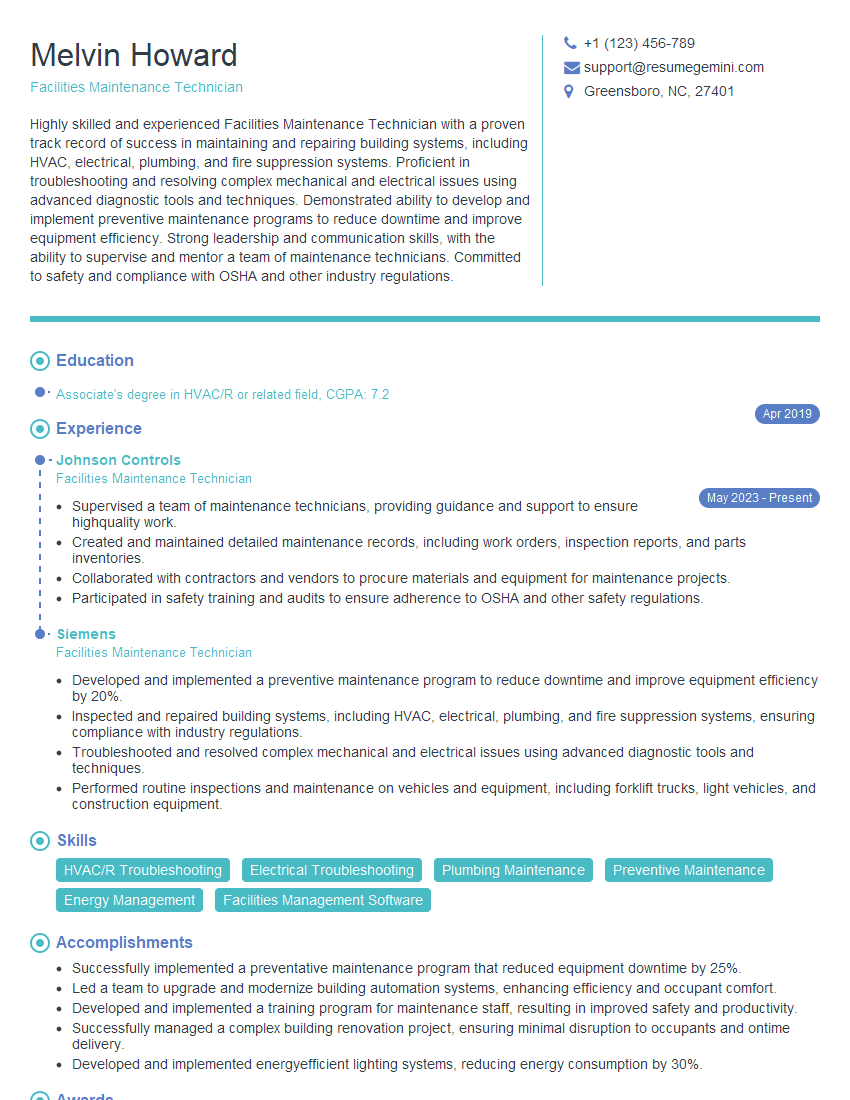
Facilities Maintenance Technician Resume Sample
Explore more articles
Users Rating of Our Blogs
Share Your Experience
We value your feedback! Please rate our content and share your thoughts (optional).
What Readers Say About Our Blog
To the interviewgemini.com Webmaster.
Very helpful and content specific questions to help prepare me for my interview!
Thank you
To the interviewgemini.com Webmaster.
This was kind of a unique content I found around the specialized skills. Very helpful questions and good detailed answers.
Very Helpful blog, thank you Interviewgemini team.