Preparation is the key to success in any interview. In this post, we’ll explore crucial Molecular Replacement interview questions and equip you with strategies to craft impactful answers. Whether you’re a beginner or a pro, these tips will elevate your preparation.
Questions Asked in Molecular Replacement Interview
Q 1. Explain the principle of Molecular Replacement.
Molecular Replacement (MR) is a powerful crystallographic technique used to determine the three-dimensional structure of a protein or macromolecular complex. It leverages the known structure of a homologous molecule (the search model) to find its orientation and position within the unit cell of a new crystal (the target structure) whose diffraction data has been collected. Think of it like a jigsaw puzzle – you have a picture of a piece (search model) and a pile of jumbled pieces (diffraction data); MR helps you find where that piece fits within the puzzle.
Essentially, MR uses the known structure’s atomic coordinates to guide the search for the identical or similar structure within the experimental diffraction data of the target. This drastically reduces the computational complexity compared to de novo structure determination, making it a significantly faster process when a suitable search model is available.
Q 2. Describe the steps involved in a Molecular Replacement workflow.
A typical Molecular Replacement workflow involves several key steps:
- Data Preparation: This includes processing the diffraction data from the target crystal to obtain accurate intensities. Scaling and merging of multiple datasets (if available) are crucial to improve data quality.
- Search Model Selection: Choosing a homologous structure with high sequence similarity and known coordinates is critical. The model should be refined and complete, and potentially should undergo rigid-body refinement before the next steps.
- Rotation Function: This step searches for the correct orientation of the search model within the unit cell. This is achieved by calculating the Patterson correlation between the model’s self-rotation function and the target’s Patterson function. Several algorithms and software tools (e.g., Phaser, MOLREP) are used for this step.
- Translation Function: Once the best rotation solution is identified, the translation function determines the model’s correct position within the unit cell, leading to a preliminary model placement.
- Refinement: After initial placement, the model undergoes iterative refinement to optimize its fit to the diffraction data. This is done by adjusting atomic positions, bond lengths, and angles to reduce the R-factor, a measure of discrepancy between observed and calculated structure factors.
- Model Validation: The final model is carefully validated by checking for stereochemical correctness, Ramachandran plot analysis, and other measures to ensure its accuracy and reliability. This is crucial to avoid the trap of false positive solutions, which may appear similar but are wrong.
Q 3. What are the key challenges in Molecular Replacement?
Molecular Replacement faces several challenges:
- Search Model Quality: The quality of the search model significantly impacts the success of MR. A poor-quality model or a model with significant structural differences from the target can lead to failure or erroneous solutions. This is especially true if there are large insertions, deletions, or conformational changes between the search and target models.
- Sequence Similarity: MR is more challenging when the sequence similarity between the search model and the target protein is low. Below 30% sequence identity, MR may be difficult or impossible.
- Non-isomorphism: If the crystal packing of the target differs significantly from the search model, or if there are multiple molecules in the asymmetric unit that are structurally similar (and potentially related by symmetry operations), the search can become very challenging.
- Multiple Solutions: Sometimes, MR can yield multiple solutions that appear equally good. Carefully analyzing these solutions and selecting the most plausible one is crucial.
- Model Bias: The reliance on a pre-existing model introduces a potential bias into the results. Refinement and validation steps are crucial to mitigate this bias.
Q 4. How do you select a suitable search model for Molecular Replacement?
Selecting a suitable search model is paramount for successful MR. The ideal search model exhibits:
- High Sequence Similarity: The higher the sequence identity between the search model and the target, the greater the chance of successful MR. Generally, >30% sequence identity is preferred, although successful MR can sometimes be achieved with lower similarity, especially if the target’s known structure is closely related through homology modelling.
- High Resolution: A high-resolution search model provides more accurate atomic coordinates, leading to a more reliable MR solution. Low resolution search models tend to produce poorer results.
- Completeness: The model should have a complete polypeptide chain or the major components of the macromolecular complex. Missing regions can impede successful placement.
- Refinement: The search model should be well-refined, with optimal geometry and low R-factor. This reduces potential biases that can lead to errors.
- Close Phylogenetic Relationship: Consider the evolutionary relationship between your target and the potential search models. Consider using a homologue with similar function from a closely-related organism.
Databases such as the Protein Data Bank (PDB) are invaluable resources for finding potential search models. Sequence alignment tools can help assess the degree of sequence similarity between the target and potential search models.
Q 5. What are the common metrics used to assess the quality of a Molecular Replacement solution?
Several metrics assess the quality of a Molecular Replacement solution:
- R-factor: This is the most commonly used metric and measures the correlation between observed and calculated structure factors. A lower R-factor indicates a better fit between the model and data. However, it should always be used in conjunction with other indicators because it is sometimes sensitive to model bias.
- R-free: This is a cross-validation R-factor calculated using a subset of the diffraction data excluded from refinement. R-free is considered a more reliable indicator of model quality than R-factor since it is less prone to overfitting.
- Correlation Coefficient (CC): This measures the correlation between the observed and calculated structure factor amplitudes. A higher CC indicates a better fit.
- Real-space correlation: This assesses the overlap between the electron density map calculated from the model and the experimental electron density map. A high correlation coefficient shows good agreement.
- Ramachandran Plot: This assesses the stereochemical quality of the model by plotting the dihedral angles of amino acid residues. A high proportion of residues in favored regions of the plot indicates good stereochemistry.
Q 6. Explain the concept of rotation function in Molecular Replacement.
The rotation function is a mathematical algorithm that determines the orientation (rotation) of the search model within the unit cell of the crystal. It does this by comparing the self-rotation function of the search model with the Patterson function derived from the diffraction data of the target crystal. The Patterson function is a representation of the interatomic vectors within the crystal structure. By correlating the model’s rotational information with the target’s interatomic vector information, the algorithm identifies rotations that maximize the overlap, indicating the correct orientation of the search model. Think of it as comparing the ‘shape’ of the model’s internal arrangements of atoms with the ‘shape’ derived from the diffraction pattern, but solely focusing on orientation.
Several algorithms exist for calculating the rotation function, such as Crowther’s fast rotation function and the more sophisticated algorithms employed in modern software packages. The output typically shows a series of peaks, each representing a possible orientation of the search model. The highest peak generally represents the best solution.
Q 7. Describe the concept of translation function in Molecular Replacement.
Once the best rotation solution is identified, the translation function finds the correct position (translation) of the rotated search model within the unit cell. It does this by calculating the correlation between the electron density of the rotated search model and the electron density calculated from the diffraction data. The position that maximises this correlation indicates the model’s correct location within the unit cell.
This function uses the information about the orientation obtained from the rotation function. The function is effectively a search for the correct translation vector – a shift – required to locate the model within the correct position of the unit cell. Similar to the rotation function, the translation function often produces peaks. The highest peak(s) in the resulting map(s) correspond to the most likely position for the model. This step ensures the model is not only properly oriented, but also correctly positioned relative to the crystal lattice.
Q 8. How do you deal with non-crystallographic symmetry (NCS) in Molecular Replacement?
Non-crystallographic symmetry (NCS) refers to the presence of identical or very similar molecules within the asymmetric unit of a crystal, but without the symmetry operations imposed by the crystal lattice itself. Imagine multiple copies of a protein arranged in a specific pattern within the crystal, but this pattern isn’t a standard crystallographic symmetry operation like a rotation or a screw axis. In Molecular Replacement (MR), NCS is crucial to address because it impacts the search model and refinement process. Ignoring it could lead to inaccurate and misleading results.
We deal with NCS in MR in several ways:
- Averaging: If the NCS is strong and readily apparent, we can average the density of the NCS-related molecules within the asymmetric unit to create a more robust and less noisy search model. This averaging step reduces the impact of errors in the individual copies.
- Using NCS restraints during refinement: During refinement, we use software to constrain the NCS-related molecules to move similarly. This prevents overfitting and improves the overall quality of the model. It’s like having multiple copies of a puzzle piece; we want to ensure they assemble consistently.
- Specialized software: Several programs like PHENIX and CCP4 incorporate sophisticated algorithms to automatically detect and utilize NCS information during both the search and refinement stages, making the process significantly easier and more reliable.
For instance, if we are solving the structure of a viral capsid with many copies of the same protein subunit, we would definitely leverage NCS information during MR to improve the accuracy and speed of structure determination.
Q 9. What is the role of phasing in Molecular Replacement?
Phasing, in the context of Molecular Replacement, is the process of determining the phases of the structure factors derived from the X-ray diffraction data. Structure factors are mathematical representations of the electron density within the crystal. They have both an amplitude (magnitude) and a phase (which we don’t directly measure experimentally). Phase information is essential for reconstructing the electron density map, which allows us to build the 3D model.
In MR, we use the known phase information from a homologous structure (our search model) as a starting point. This homologous structure provides initial phase estimates. The process doesn’t directly determine the phases like ‘ab initio’ methods do; instead, it leverages known information from a similar structure to guide the initial phase estimation. The subsequent refinement process improves these initial phases, leading to a higher-resolution and more accurate electron density map.
Think of it like assembling a jigsaw puzzle: You have the pictures on the pieces (amplitudes), but you need to know how they fit together (phases). A similar, partially solved puzzle provides an initial guess on how the pieces might connect, which you then refine to complete the picture.
Q 10. How do you refine a Molecular Replacement solution?
Refining a Molecular Replacement solution means improving the fit between the experimental data and the model. The initial MR solution is often not perfect; there are errors in the placement and conformation of the model relative to the experimental electron density. Refinement involves adjusting the model’s position, conformation, and atomic parameters to minimize the difference between the observed and calculated structure factors.
This refinement process typically involves:
- Rigid body refinement: Initial adjustment of the overall position and orientation of the model as a whole.
- Real space refinement: Directly adjusting atomic positions based on the electron density map.
- Individual B-factor refinement: Adjusting individual atom parameters to reflect their flexibility and thermal motion.
- Water molecule addition: Adding water molecules into the model where appropriate.
- Side-chain refinement: Refining the position and conformation of side chains based on the density.
Refinement is done iteratively, using programs such as PHENIX and REFMAC. Each refinement cycle improves the model’s fit to the data, often assessed by metrics like R-factor and Rfree. The goal is to obtain a model with the best possible fit to the data and reasonable stereochemistry.
Q 11. What are the limitations of Molecular Replacement?
Molecular Replacement, while a powerful technique, has limitations. The most significant limitations include:
- Requirement of a homologous structure: MR requires a search model with significant sequence and structural similarity to the target protein. If no suitable model exists, MR is not feasible. The more distant the relationship, the more challenging the MR process becomes.
- Sensitivity to model quality: Errors or inaccuracies in the search model can propagate into the MR solution. If the search model has significant errors, the MR result will likely be inaccurate as well.
- Multiple solutions: The MR search may yield multiple solutions, which need careful evaluation and validation. Distinguishing between the correct solution and spurious solutions can be challenging.
- Low sequence similarity: MR can be challenging if the sequence similarity between the target and the search model is low. If there are significant structural differences, the MR search might fail or produce misleading results.
- Domain movements: Large conformational changes between the search model and target can hinder the search process.
For example, if you are trying to solve the structure of a protein with no close homologue in the PDB, MR is unlikely to be successful. One might need to resort to alternative phasing methods such as SAD or MAD.
Q 12. What software packages are commonly used for Molecular Replacement?
Several powerful software packages are commonly used for Molecular Replacement. The most prominent ones are:
- Phaser (CCP4): A widely used and highly versatile program that offers a variety of search strategies and options for dealing with NCS and other complexities.
- MOLREP (CCP4): Another robust program within the CCP4 suite, known for its speed and efficiency, particularly useful for smaller structures.
- PHENIX: A comprehensive crystallographic software package that includes a powerful MR module with advanced features such as automated model building and refinement.
- AutoMR: An automated pipeline that combines different MR programs and strategies for high-throughput structure determination.
The choice of software depends on factors like the size and complexity of the structure, the quality of the data, and the available computational resources. Many researchers employ a combination of these packages for optimal results.
Q 13. How do you handle multiple solutions in Molecular Replacement?
Multiple solutions in Molecular Replacement are a common challenge. The search algorithm might identify several possible placements of the search model within the unit cell. This arises because the initial stages of the search rely on correlation coefficients; similar regions of the search model and the experimental Patterson function may accidentally overlap, giving rise to multiple solutions.
Handling multiple solutions requires careful analysis and evaluation:
- Examine the correlation coefficients: Solutions with higher correlation coefficients are more likely to be correct, but this is not always definitive.
- Visual inspection of the electron density maps: Inspecting the maps generated by the different solutions can reveal if they are chemically reasonable and fit the experimental data.
- Refinement of multiple solutions: Refining each solution individually allows for a more thorough evaluation of the quality of each placement.
- R-factor and Rfree analysis: Assess the R-factor and Rfree values for each solution. Lower values generally indicate a better fit between the model and data.
- Use of additional data: Consider using additional data such as anomalous scattering data to help discriminate between solutions.
In practice, you may need to iteratively refine and evaluate several solutions to arrive at the correct placement. Experience and judgment are key in deciding on the best solution. Sometimes, none of the solutions will be entirely correct, signaling that a different search model or alternative phasing methods may be necessary.
Q 14. How do you assess the reliability of a Molecular Replacement solution?
Assessing the reliability of an MR solution is critical to ensure that the subsequent model building and refinement are based on a solid foundation. Several factors contribute to this assessment:
- Correlation coefficient: A high correlation coefficient between the search model and the experimental data suggests a good initial fit.
- R-factor and Rfree: These refinement statistics provide indicators of the overall fit of the model to the data. Lower R-factors are generally preferred but should be considered along with other metrics.
- Electron density maps: Visual inspection of electron density maps is crucial for verifying the quality of the fit. Well-defined density around the model is reassuring, while poor or unclear density suggests problems.
- Stereochemistry: The stereochemistry of the resulting model should be assessed using programs like PROCHECK or MolProbity. Unfavorable or strained conformations may indicate errors in the solution.
- Completeness of the model: A more complete model, with a lower percentage of missing residues, is generally preferred.
- Comparison to homologous structures: Comparing the obtained model to other homologous structures can provide insights into its reliability and consistency.
In summary, a reliable MR solution displays a good fit to the experimental data, reasonable stereochemistry, and consistency with existing biological knowledge. The assessment is not just about a single metric but a holistic evaluation of the entire process and its outputs. It requires careful interpretation of various indicators to gauge the trustworthiness of the determined structure.
Q 15. What are some common errors encountered during Molecular Replacement?
Molecular Replacement (MR) is a powerful technique, but several pitfalls can lead to failure. Common errors include using an inappropriate search model, poor data quality, incorrect space group assignment, and twinning in the data. Let’s break these down:
Inappropriate Search Model: The search model (a known structure used to find the position of your unknown structure) needs to be sufficiently similar to the target structure. If the sequence identity is too low or the structures are significantly different, MR may fail. Imagine trying to find a specific key in a huge keyring – if your key looks nothing like the others, you’ll have trouble finding it.
Poor Data Quality: Data affected by radiation damage, poor crystal quality, or inadequate processing will reduce the chances of successful MR. This is akin to searching for the key in a dark, cluttered room – it’s much harder.
Incorrect Space Group: Assigning the wrong space group (a way of describing the symmetry of a crystal) to your data will lead to incorrect phasing. Think of it like trying to fit a square peg into a round hole.
Twinning: Twinning is a crystallographic phenomenon where multiple crystals intergrow, leading to data redundancy and increased noise. This can significantly hamper successful MR, making it hard to identify the ‘true’ structure from the overlapping signals.
Career Expert Tips:
- Ace those interviews! Prepare effectively by reviewing the Top 50 Most Common Interview Questions on ResumeGemini.
- Navigate your job search with confidence! Explore a wide range of Career Tips on ResumeGemini. Learn about common challenges and recommendations to overcome them.
- Craft the perfect resume! Master the Art of Resume Writing with ResumeGemini’s guide. Showcase your unique qualifications and achievements effectively.
- Don’t miss out on holiday savings! Build your dream resume with ResumeGemini’s ATS optimized templates.
Q 16. How do you troubleshoot a failed Molecular Replacement experiment?
Troubleshooting a failed MR experiment involves a systematic approach. Here’s a step-by-step process:
Assess Data Quality: Examine your diffraction data for signs of radiation damage, poor mosaicity (crystal disorder), or other issues using tools like XDS or Aimless. Poor data is often the root cause.
Verify Space Group: Double-check the space group assignment. Use programs like POINTLESS and the integrated modules in CCP4 to confirm.
Evaluate Search Model: Ensure your search model is appropriate. Consider using a homologous structure with high sequence identity and removing flexible loops or disordered regions. If necessary, try different search models of varying sequence similarity.
Check for Twinning: Analyze your data for twinning using programs like Xtriage. If detected, apply appropriate twinning corrections.
Adjust Parameters: Modify MR parameters in your software, such as the search radius or the tolerance for rotations and translations. Experiment with different search algorithms if your initial attempt fails.
Consider Alternative Methods: If MR consistently fails, explore alternative phasing methods like SAD or SIRAS. These methods use additional experimental data to solve the phase problem.
Remember, thorough documentation at each step is vital for understanding and resolving the problem.
Q 17. Explain the difference between rigid-body refinement and individual atom refinement.
Both rigid-body and individual atom refinement are crucial steps in MR, but they refine different aspects of the model:
Rigid-body refinement: This initial step treats the entire search model as a single rigid unit, adjusting its orientation and position to best fit the experimental data. Think of it like moving a complete LEGO structure to find its best position without changing the structure of individual LEGO bricks.
Individual atom refinement: This subsequent step adjusts the individual atomic coordinates, bond lengths, and angles within the model. This is like adjusting each individual LEGO brick to make the whole structure fit even better.
Rigid-body refinement provides a rough initial placement; individual atom refinement improves the accuracy and detail of the model. The transition from rigid-body to individual atom refinement allows for a gradual adjustment, preventing drastic model shifts that could lead to unrealistic outcomes.
Q 18. Describe the use of different search models (e.g., homologous structures).
The choice of search model is critical in MR. Homologous structures, those sharing evolutionary ancestry, are frequently used. The quality and relatedness of the search model directly impacts the success of MR.
High sequence identity: Models with high sequence identity (ideally > 30%) are generally preferred. These provide a strong starting point, allowing for easier positioning.
Remote homologs: When high-identity models are unavailable, more distantly related homologs can be used. The risk of model bias increases, but it’s better than nothing.
Fragment replacement: In some cases, individual domains or fragments from homologous structures may be used as search models, especially if the target protein comprises multiple distinct domains.
Model preparation: Regardless of the search model’s origin, it requires careful preparation: removing ligands, solvent molecules, and any regions of significant structural disorder can improve the results. A cleaner search model will produce a more accurate solution.
Q 19. How do you choose appropriate resolution for your data in Molecular Replacement?
The resolution of your diffraction data significantly impacts MR. Higher resolution data generally leads to more successful MR outcomes because higher-resolution data provides more precise structural information, resulting in a more accurate and detailed model.
Ideally, you want to use the highest-resolution data available that is also of sufficient completeness and quality. However, using data beyond its ‘reliable’ resolution limit can be detrimental to the MR process as it may amplify noise. A good starting point is to use data extending to the resolution where the I/σI (intensity-to-standard-deviation ratio) falls below a critical value – commonly around 1 or 2. Practical experience and the assessment of the data quality are important factors in making this decision.
Q 20. What are the implications of model bias in Molecular Replacement?
Model bias in MR refers to the situation where the characteristics of the search model influence the final refined model, even if those characteristics are not present in the actual structure. This can result in the refined structure being too similar to the search model, even if it introduces errors or biases the refinement process toward a false solution.
For example, if the search model is incomplete or contains errors, the refinement process might try to fit the experimental data to this flawed model, resulting in an inaccurate final structure. To mitigate this, you should always be critical of your search model selection, critically evaluate your refinement results, and consider using multiple search models with different levels of similarity.
Q 21. How does the quality of the diffraction data affect Molecular Replacement?
The quality of diffraction data is paramount in MR. High-quality data, characterized by high completeness, good resolution, low mosaicity, and high signal-to-noise ratio, significantly increases the likelihood of successful MR. Conversely, low-quality data leads to difficulties in locating the correct solution.
Imagine trying to find a needle in a haystack. High-quality data is like having a well-lit haystack with a clear view; you can easily locate the needle. Low-quality data is like a dark, cluttered haystack; the needle is hard, if not impossible, to find.
Specific data quality metrics that influence MR are resolution, R-merge, completeness, and I/σI. Low R-merge (a measure of data consistency) and high completeness (the fraction of observed reflections) indicate higher quality data, which is essential for achieving a reliable solution.
Q 22. Explain the concept of R-factor and R-free in the context of Molecular Replacement.
In Molecular Replacement (MR), we use a known structure (search model) to find the orientation and position of a similar molecule within a new experimental dataset (target). The R-factor and R-free are crucial measures of how well the search model fits the experimental data. Think of it like assembling a jigsaw puzzle – the R-factor tells you how well all the pieces fit together, while R-free provides an independent assessment of how well the assembled puzzle represents the true picture.
The R-factor (Rwork) is calculated using the entire dataset. A lower R-factor indicates a better fit between the model and the data. However, it can be ‘over-optimized’ to the data, meaning the model might fit the noise rather than true structural features. This is where R-free comes in. R-free is calculated using a randomly selected subset (typically 5-10%) of the data that is not used during refinement. It provides a more objective assessment of model quality and helps prevent overfitting.
Ideally, you want both R-factor and R-free to be low. A significant difference between R-factor and R-free often suggests overfitting. A good R-free value typically falls below 30% at a high resolution, but this varies with resolution and data quality. For instance, an R-free of 25% would generally indicate a good solution, while an R-free of 45% would be cause for concern, suggesting potential errors in the MR process or the quality of the data.
Q 23. How do you address model building challenges after Molecular Replacement?
After an initial MR solution, model building is critical to refining the structure. Challenges often arise due to regions of poor electron density, conformational changes between the search model and the target, and errors in the initial MR placement. Addressing these requires a multi-faceted approach.
- Iterative Refinement: Initially, the model might fit poorly in certain areas. Repeated cycles of refinement using programs like REFMAC or PHENIX will improve the model’s fit to the electron density map.
- Manual Model Building: Using molecular graphics programs like Coot, you manually adjust the model to better fit the density. This is especially crucial in poorly defined regions. You must carefully consider the stereochemistry and bond angles while doing this.
- Dealing with Missing Residues or Domains: If parts of the structure are missing in the initial model, you may need to add them manually or use homology modeling techniques to predict their structure, assuming there are structurally similar proteins available in the Protein Data Bank (PDB).
- Addressing Conformational Changes: If there are significant conformational differences between the search model and the target, you might need to loop model or remodel segments of the structure. This process can be time-consuming and requires careful interpretation of the electron density.
Remember, it’s an iterative process. You refine the model, calculate new maps, and then use this improved information to further build the model. This cycle continues until a satisfactory R-free value and overall model quality is achieved.
Q 24. Describe the importance of proper data preprocessing before Molecular Replacement.
Proper data preprocessing is paramount for successful MR. Poorly processed data can lead to incorrect solutions or failure to find a solution altogether. It’s like trying to assemble a puzzle with missing or damaged pieces – you won’t get the full picture.
- Indexing and Integration: Accurate indexing and integration of the diffraction data are fundamental. Errors here will propagate throughout the structure determination process.
- Scaling and Merging: Scaling corrects for variations in intensity between different datasets or different parts of the same dataset, while merging combines symmetry-related reflections. Proper scaling and merging enhance data quality and improve the signal-to-noise ratio.
- Space Group Determination: Correctly assigning the space group is vital as it defines the symmetry of the crystal lattice. An incorrect assignment can lead to a failed MR search or an incorrect model.
- Anomalous Signal Treatment: If anomalous data is collected, it is usually beneficial to incorporate this information into the refinement, potentially improving the accuracy of the model.
- Data Quality Assessment: Assessing the resolution, completeness, I/σ(I) values and Rmerge of the data provides an essential understanding of data quality before beginning MR.
Using programs like XDS, xia2, or iMosflm for data processing ensures high-quality data as input for Molecular Replacement.
Q 25. What is the role of solvent flattening in improving MR solutions?
Solvent flattening is a density modification technique used to improve the quality of electron density maps, particularly in the initial stages of MR or when dealing with low-resolution data. It’s like cleaning up a blurry photograph to make the details clearer.
After an initial MR solution, the electron density map often contains noise and artifacts. Solvent flattening uses the assumption that most of the volume outside the protein molecule is occupied by solvent (water) to improve the map. The algorithm identifies regions likely to be solvent and sets their density to an average value. This process enhances the signal-to-noise ratio, making the protein density stand out more clearly. Improved density maps facilitate model building and refinement.
Solvent flattening is particularly useful when the initial MR solution is ambiguous or has a high R-factor. It improves the electron density map, making the model building process more accurate and efficient. It’s frequently used in conjunction with other density modification techniques such as histogram matching.
Q 26. How do you interpret the results of a Molecular Replacement search?
Interpreting MR results requires careful analysis of multiple factors. It’s not just about finding a solution – it’s about assessing the quality of that solution.
- Rotation Function (RF) and Translation Function (TF) Scores: The initial steps of MR involve rotation and translation functions. High peaks in these functions suggest a possible orientation and position of the search model. The height and significance of these peaks, often expressed as Z-scores, need careful evaluation. Several peaks may appear, and they should be carefully investigated.
- R-factor and R-free: As discussed previously, lower R-factor and R-free values indicate a better fit of the model to the data. A significant difference between R-factor and R-free is a warning sign.
- Visual Inspection of the Electron Density Map: This is critical. A good MR solution should show clear and continuous electron density corresponding to the protein structure. Poor density or unexpected features might indicate problems with the search model or the MR solution.
- Real-space correlation coefficients: Correlation coefficients measure the similarity between the experimental and calculated density maps. These provide a quantitative way to measure the success of the MR solution.
If the peaks in the RF and TF are weak, the R-factor and R-free are high, and the electron density map is poor, it’s likely the MR solution is incorrect. You should consider alternative search models, adjusting parameters, or using different algorithms.
Q 27. Discuss the advantages and disadvantages of using different search algorithms.
Various search algorithms are available for MR, each with its strengths and weaknesses. The choice depends on factors like the quality of the data, the similarity between the search model and the target, and the available computational resources.
- Rotation Function Algorithms (e.g., Patterson correlation, Crowther method): These algorithms search for the correct orientation of the search model. Patterson correlation methods are robust but computationally intensive. The Crowther method is faster but might miss solutions.
- Translation Function Algorithms (e.g., fast rotation/translation, rigid-body refinement): Once the orientation is found, translation functions search for the correct position. Fast rotation/translation methods are efficient, while rigid-body refinement optimizes both orientation and position simultaneously.
Advantages and Disadvantages:
- Patterson correlation methods: Advantage: Robustness. Disadvantage: Computationally intensive.
- Crowther method: Advantage: Speed. Disadvantage: Can miss solutions.
- Fast rotation/translation: Advantage: Speed and efficiency. Disadvantage: May not be as accurate as other methods.
- Rigid-body refinement: Advantage: Optimizes both orientation and position simultaneously. Disadvantage: Requires a good initial solution.
The selection of an appropriate algorithm requires careful consideration of the specific problem and the available computational resources. Sometimes it is beneficial to try multiple algorithms for comparison.
Q 28. Explain how you would approach Molecular Replacement if you had a very low-resolution dataset.
Low-resolution data presents significant challenges for MR. The limited detail in the data makes it difficult to identify the correct solution. The approach would need to be more cautious and iterative.
- Careful Selection of the Search Model: A very similar search model is essential, as low resolution means that only large-scale features are discernible.
- Multiple Search Models: It might be beneficial to search with multiple search models, including models with various levels of conformational flexibility.
- Density Modification Techniques: Solvent flattening and histogram matching are particularly crucial at low resolution to improve the quality of the electron density map.
- Molecular Averaging: For cases with multiple copies of the molecule in the asymmetric unit, molecular averaging can greatly improve the electron density maps.
- Low-Resolution Refinement Techniques: Special refinement techniques are needed for low-resolution data. The refinement strategy often involves tight constraints on the model geometry to reduce the chance of overfitting.
- Careful Interpretation of Results: It is crucial to exercise caution when interpreting the results from low-resolution MR. A solution that looks promising with low-resolution data may be incorrect.
Low-resolution MR often requires more advanced techniques and a deeper understanding of the limitations of the data. The process may be significantly slower and less certain.
Key Topics to Learn for Molecular Replacement Interview
- Crystallographic Data: Understanding data formats (MTZ, PDB), data quality assessment (R-factor, I/σI), and preprocessing techniques.
- Search Models: Selecting appropriate search models (homologous structures), model preparation (removing ligands, waters, side chains), and assessing model quality.
- Rotation and Translation Functions: Understanding the principles behind these functions, interpreting results (peaks, correlation coefficients), and dealing with ambiguities.
- Refinement Strategies: Familiarizing yourself with different refinement methods (rigid-body, restrained, individual atom), and assessing refinement statistics (R-work, R-free).
- Model Building and Validation: Techniques for manual model building, validation of the refined model (geometry, Ramachandran plot), and interpretation of electron density maps.
- Software Packages: Practical experience with commonly used software like Phaser, Molrep, Refmac, Coot.
- Troubleshooting Common Issues: Identifying and addressing issues like model bias, incorrect placement, and poor refinement convergence.
- Practical Applications: Understanding how Molecular Replacement is used in various fields like drug discovery, structural biology, and enzymology.
- Theoretical Concepts: A strong grasp of the underlying principles of diffraction, Patterson functions, and the relationship between structure and function.
Next Steps
Mastering Molecular Replacement significantly enhances your prospects in structural biology and related fields, opening doors to exciting research and development opportunities. A strong understanding of these techniques is highly valued by employers. To maximize your chances of securing your dream role, it’s crucial to present your skills effectively. Creating an ATS-friendly resume is essential for getting your application noticed. We strongly recommend using ResumeGemini to build a professional and impactful resume that highlights your expertise in Molecular Replacement. ResumeGemini provides examples of resumes tailored to this specific field, helping you showcase your qualifications in the best possible light.

Professor Resume Sample

Research Associate Resume Sample

Senior Scientist Resume Sample

Research Scientist Resume Sample

Bioinformatician Resume Sample

Assistant Professor Resume Sample

Associate Professor Resume Sample

Research Fellow Resume Sample

Computational Biologist Resume Sample
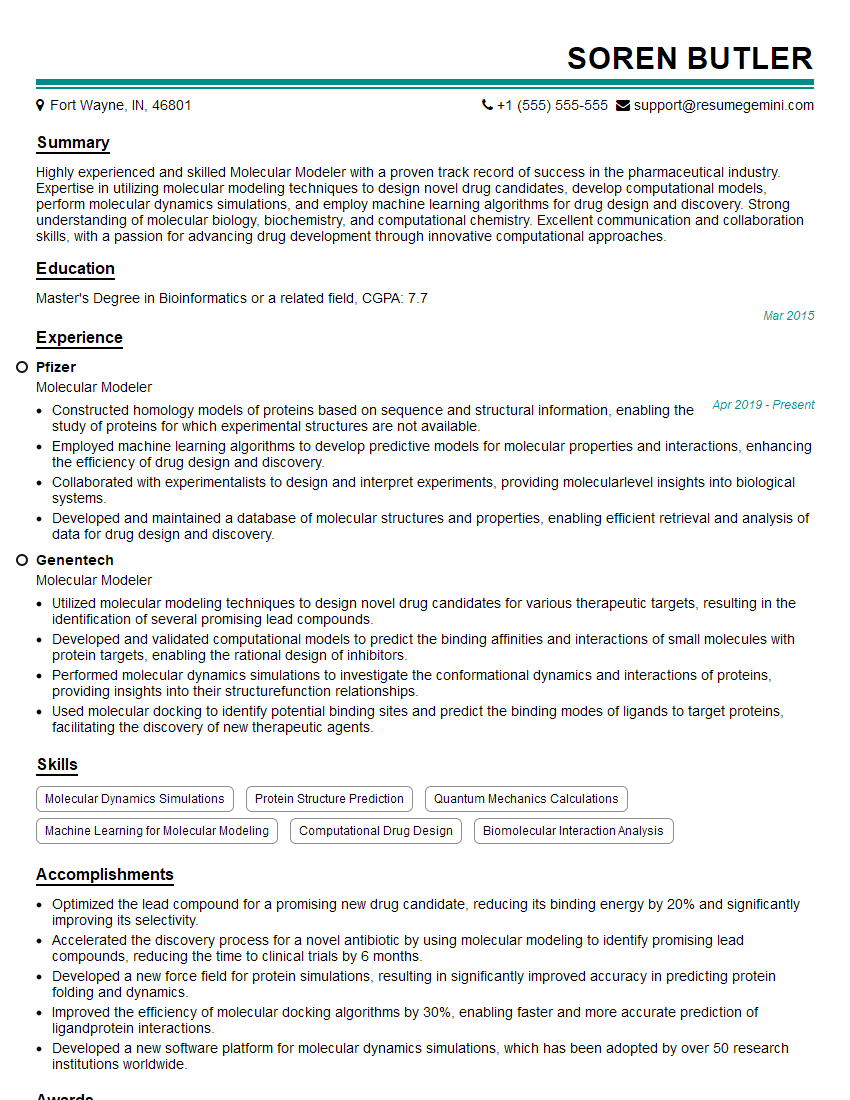
Molecular Modeler Resume Sample
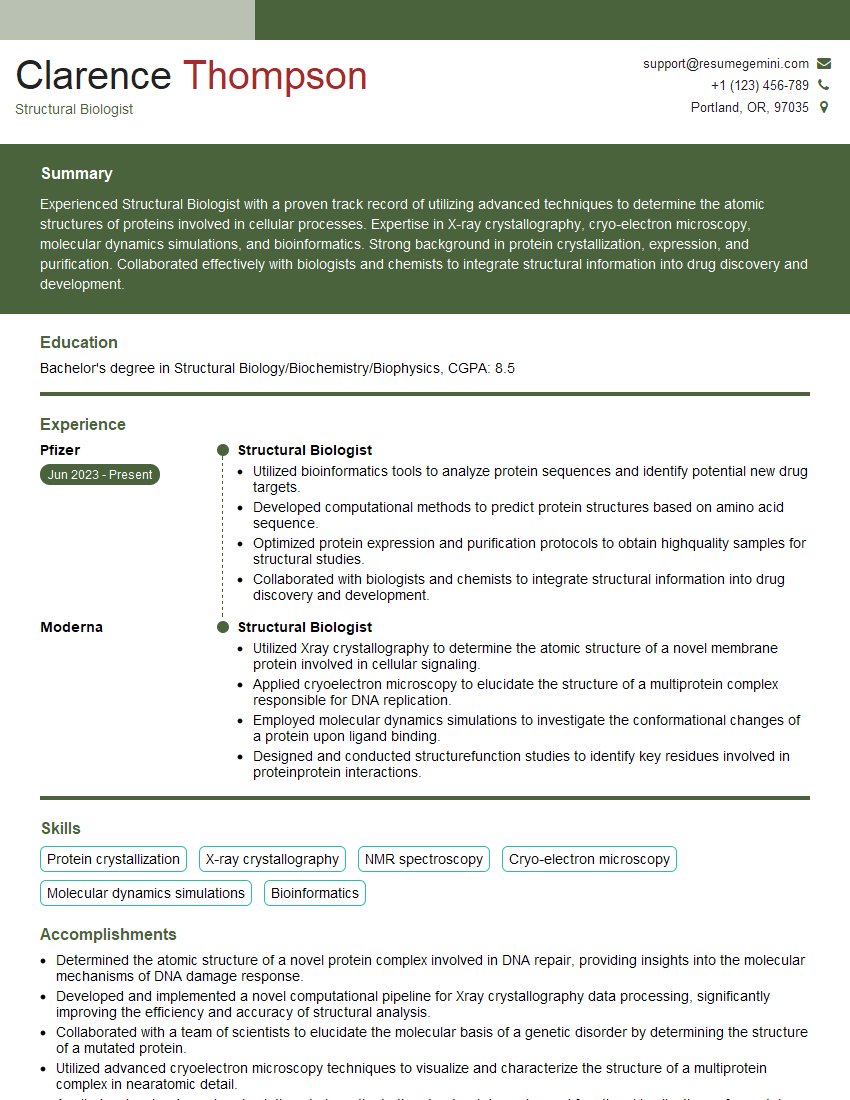
Structural Biologist Resume Sample

Principal Investigator Resume Sample
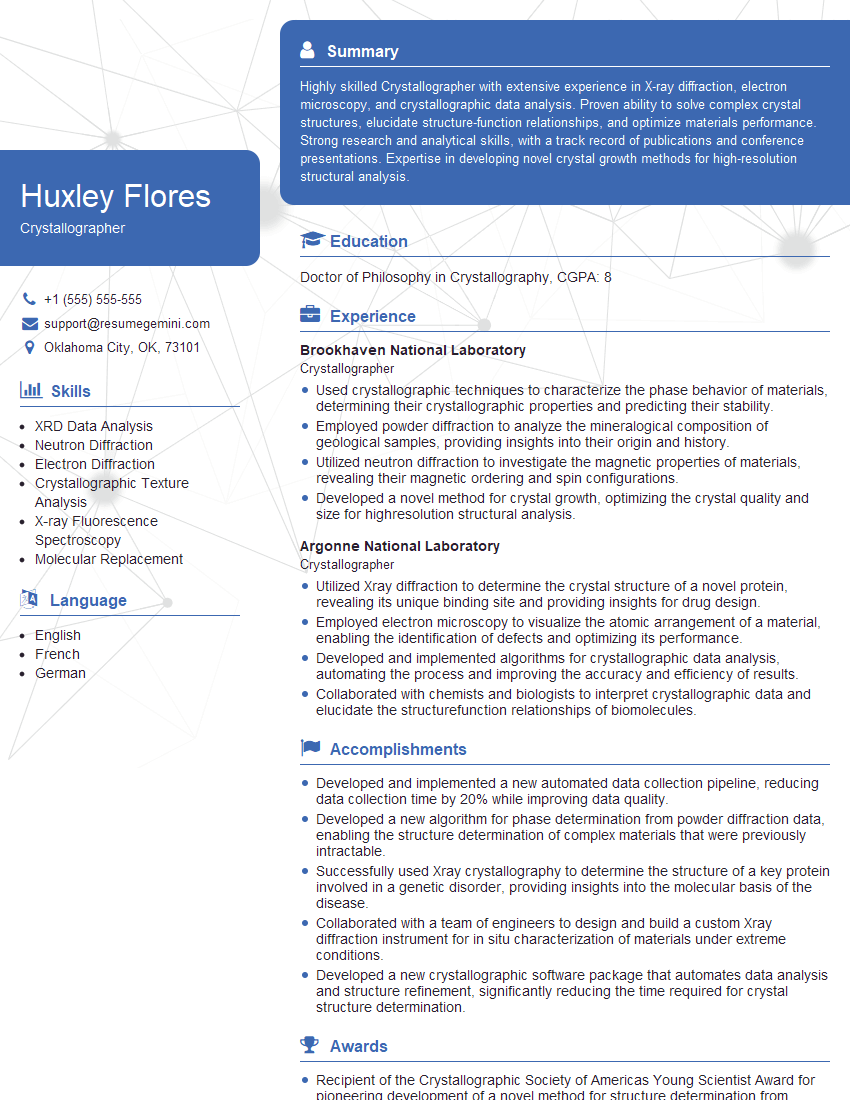
Crystallographer Resume Sample
Explore more articles
Users Rating of Our Blogs
Share Your Experience
We value your feedback! Please rate our content and share your thoughts (optional).
What Readers Say About Our Blog
To the interviewgemini.com Webmaster.
Very helpful and content specific questions to help prepare me for my interview!
Thank you
To the interviewgemini.com Webmaster.
This was kind of a unique content I found around the specialized skills. Very helpful questions and good detailed answers.
Very Helpful blog, thank you Interviewgemini team.