Interviews are opportunities to demonstrate your expertise, and this guide is here to help you shine. Explore the essential Exploration and Prospect Evaluation interview questions that employers frequently ask, paired with strategies for crafting responses that set you apart from the competition.
Questions Asked in Exploration and Prospect Evaluation Interview
Q 1. Explain the difference between exploration and appraisal in the context of resource evaluation.
Exploration and appraisal are distinct phases in resource evaluation, focusing on different objectives. Exploration aims to discover and define the presence of hydrocarbons (oil and gas) in a given area. It’s a high-risk, high-reward endeavor, involving a systematic search for geological indicators suggesting the potential for hydrocarbon accumulation. Think of it as the ‘treasure hunt’ phase. Appraisal, on the other hand, follows a successful exploration discovery and focuses on accurately determining the size, shape, and quality of the discovered resource. This involves detailed subsurface mapping, reservoir testing, and data analysis to estimate the commercially viable quantity of hydrocarbons. It’s the ‘treasure evaluation’ phase. A successful exploration well might lead to an appraisal program to assess its potential for development.
Q 2. Describe the various stages involved in a typical exploration project lifecycle.
A typical exploration project lifecycle can be broken down into several key stages:
- Regional Exploration: This initial phase involves gathering and interpreting regional geological and geophysical data (e.g., satellite imagery, gravity surveys) to identify areas with high hydrocarbon prospectivity. This is often done on a large scale and is about narrowing down vast areas of interest.
- Prospect Generation: Based on the regional data, specific areas with promising geological features are identified as prospects. More detailed geophysical surveys (e.g., seismic surveys) are conducted to refine the understanding of the subsurface geology.
- Prospect Evaluation: This stage involves detailed geological and geophysical interpretation to assess the prospectivity of each identified prospect. This includes assessing the presence of a potential reservoir rock, a trap mechanism, and a source rock. Risk assessment plays a crucial role here.
- Drilling Exploration Wells: If the evaluation is positive, exploration wells are drilled to test the presence of hydrocarbons. This is a crucial and expensive stage.
- Well Testing and Data Analysis: Once drilled, wells are tested to determine the reservoir’s properties, such as pressure, temperature, and fluid composition. Data from these tests, along with the geological and geophysical data, is used to estimate the size and quality of the resource.
- Appraisal and Development Planning: If the well is successful, an appraisal program is initiated to delineate the reservoir boundaries and estimate the recoverable reserves. This information is then used to plan the development of the field.
Q 3. What are the key geological and geophysical techniques used in prospect identification and evaluation?
Prospect identification and evaluation relies heavily on a combination of geological and geophysical techniques. Geological techniques focus on studying surface and subsurface rock formations, while geophysical techniques use physical measurements to infer subsurface structures. Key methods include:
- Geological Mapping & Surface Geology: Observing and mapping surface outcrops, examining rock samples, and studying geological formations to understand the regional stratigraphy and structural history.
- Seismic Surveys (Reflection & Refraction): These use sound waves to image subsurface structures. Reflection seismic is particularly important for imaging potential hydrocarbon traps. Refraction seismic can determine near surface velocities.
- Gravity & Magnetic Surveys: These measure variations in the Earth’s gravitational and magnetic fields, which can indicate changes in subsurface rock density and magnetization – potentially indicating geological structures of interest.
- Well Logging: While not a direct prospect identification tool, well logs (measurements taken in boreholes) provide crucial information about reservoir properties such as porosity, permeability, and fluid saturation once a well is drilled.
- Remote Sensing: Satellite and aerial imagery can identify surface features that might indicate subsurface structures, such as lineaments (fractures) or subtle topographic changes.
Q 4. How do you interpret seismic data to identify potential hydrocarbon traps?
Interpreting seismic data to identify potential hydrocarbon traps involves careful analysis of seismic reflection events. Hydrocarbon traps are geological structures that prevent hydrocarbons from migrating to the surface. Seismically, we look for:
- Structural Traps: These are formed by folds (anticlines, synclines) or faults that create a closure trapping hydrocarbons. On seismic data, these appear as closed contours or discontinuities in the subsurface reflectivity.
- Stratigraphic Traps: These are formed by changes in lithology (rock type) or geometry that create a barrier to hydrocarbon migration. These may appear as onlaps, pinch-outs, or unconformities on seismic data, showing changes in sedimentary layering.
- Combination Traps: Many traps are a combination of structural and stratigraphic elements. Seismic interpretation needs to consider both.
The process involves identifying key seismic reflections representing different geological layers, mapping their geometry, and analyzing their amplitude and continuity. Sophisticated software packages are used to process and interpret the data, and experienced geophysicists are crucial to understanding and mapping the subtle features indicative of hydrocarbon traps. For example, a bright reflection (high amplitude) could indicate a gas-water contact, a key element of a hydrocarbon trap.
Q 5. Explain the concept of risk assessment in exploration and how it impacts decision-making.
Risk assessment in exploration is a crucial process that quantifies the uncertainties associated with finding and developing a commercial hydrocarbon accumulation. It helps decision-makers evaluate the potential for success versus failure, aiding in resource allocation and investment decisions. Risks are categorized into geological, geophysical, operational, and commercial categories. Geological risks include the presence of hydrocarbons, reservoir quality, and trap integrity. Geophysical risks involve the accuracy and reliability of seismic data interpretation. Operational risks relate to drilling difficulties, while commercial risks encompass market conditions and regulatory approvals. Risk assessment methods vary from simple qualitative assessments to sophisticated quantitative techniques like Monte Carlo simulations. These methods assign probabilities and potential outcomes to various scenarios, allowing for a more informed decision. A high-risk, high-reward prospect might be pursued if the potential reward outweighs the potential loss, while a low-risk, low-reward prospect might be less attractive.
Q 6. What are the different types of hydrocarbon traps, and how do they form?
Several types of hydrocarbon traps exist, each forming through different geological processes:
- Anticline Traps: These are formed by upward folding of rock layers, creating a dome-like structure that traps hydrocarbons at the crest. These are formed by tectonic compression.
- Fault Traps: These form when displacement along a fault creates a barrier to hydrocarbon migration. A fault sealing the reservoir is essential.
- Salt Domes: Diapiric salt movement can create structural traps, pushing up surrounding sedimentary rocks and forming a dome-shaped structure.
- Stratigraphic Traps:
- Unconformity Traps: These form where a layer of permeable reservoir rock is sealed by an unconformity (erosional surface).
- Pinch-out Traps: These form where a reservoir rock layer thins and ultimately disappears laterally.
- Lens Traps: These are isolated bodies of reservoir rock surrounded by impermeable layers.
The formation of these traps is linked to tectonic activity, sedimentary depositional processes, and diagenesis (post-depositional alteration). Understanding the geological history of an area is critical to identifying potential trap types.
Q 7. Describe your experience with geological modeling and reservoir simulation.
I have extensive experience in geological modeling and reservoir simulation, using software such as Petrel and Eclipse. My work has involved creating 3D geological models based on seismic and well data, integrating geological interpretations, and building reservoir simulations to predict reservoir performance. I have built models for various projects including clastic reservoirs in the North Sea and carbonate reservoirs in the Middle East. Specifically, I have experience in:
- Building static geological models: This includes interpreting seismic data to create subsurface structural frameworks, incorporating well log data to define reservoir properties (porosity, permeability), and generating property distributions using geostatistical methods.
- Developing dynamic reservoir simulations: This involves using reservoir simulation software to predict fluid flow, pressure, and production behavior over time under various scenarios. This helps predict production rates and recovery factors, which are vital for evaluating the economic viability of a prospect.
- Uncertainty analysis: A vital aspect of reservoir modeling and simulation. I use techniques like Monte Carlo simulation to assess the uncertainty associated with reservoir parameters and production forecasts. This provides a range of possible outcomes rather than a single prediction, leading to a more robust investment analysis.
For instance, in a recent project, I constructed a 3D geological model of a carbonate reservoir, incorporating complex fracture networks. The resulting reservoir simulation showed that the production strategy significantly impacted the ultimate recovery factor. This led to recommending an optimized well placement strategy, increasing projected production significantly.
Q 8. How do you evaluate the economic viability of an exploration prospect?
Evaluating the economic viability of an exploration prospect involves a meticulous assessment of various factors to determine if the potential return on investment justifies the exploration risk. It’s essentially a cost-benefit analysis, weighing the potential profit from hydrocarbon production against the exploration and development costs.
This evaluation typically involves several steps:
- Estimating Reserves/Resources: This involves using geological and geophysical data to estimate the volume of hydrocarbons potentially recoverable. We use various techniques like volumetric calculations, decline curve analysis, and material balance calculations depending on the exploration stage.
- Estimating Production Costs: This includes drilling costs, well completion costs, facility construction, and ongoing operational expenses. Factors like well depth, reservoir pressure, and geographical location significantly impact these costs.
- Estimating Revenue: This is based on projected oil and gas prices, production rates, and the timing of production. We often use price forecasting models and sensitivity analyses to account for price volatility.
- Calculating Net Present Value (NPV): This is a crucial financial metric that considers the time value of money. It discounts future cash flows back to the present, allowing us to compare projects with different timelines. A positive NPV indicates economic viability.
- Risk Assessment: Exploration is inherently risky. We incorporate various geological uncertainties (e.g., reservoir quality, hydrocarbon saturation) and economic uncertainties (e.g., price fluctuations, operating costs) into our analysis through Monte Carlo simulations or sensitivity analyses.
Example: Imagine we’re evaluating a prospect with estimated reserves of 10 million barrels of oil. If the estimated production cost per barrel is $30 and the projected oil price is $60, the potential profit looks substantial. However, if the drilling risk is high (e.g., 50% chance of encountering no hydrocarbons), a thorough risk assessment will drastically alter the economic outlook. The NPV calculation, incorporating these risks, will provide a clearer picture of the project’s viability.
Q 9. Discuss your experience with well log interpretation and its application in reservoir characterization.
Well log interpretation is a crucial aspect of reservoir characterization. Well logs are continuous recordings of various physical properties of the subsurface formations as a drilling tool passes through them. Analyzing these logs allows us to infer vital information about lithology, porosity, permeability, and fluid saturation, which are essential for understanding reservoir potential.
My experience includes interpreting various types of well logs, including:
- Gamma Ray Logs: These measure natural radioactivity and help identify different rock layers (e.g., shale, sandstone). Higher gamma ray readings usually indicate shale.
- Neutron Porosity Logs: These logs measure the hydrogen index and are used to estimate porosity, particularly in porous and permeable formations.
- Density Logs: These logs measure the bulk density of the formation and can be used in conjunction with neutron logs to improve porosity estimation.
- Resistivity Logs: These measure the electrical conductivity of the formation and can help identify hydrocarbon-bearing zones (hydrocarbons are less conductive than water).
Application in Reservoir Characterization: We use well log data to build detailed reservoir models. By correlating different log types, we can define reservoir boundaries, identify pay zones (hydrocarbon-bearing layers), and estimate reservoir properties like porosity and permeability. This information is essential for estimating hydrocarbon reserves, designing well completions, and optimizing production strategies. For instance, identifying a high-porosity, high-permeability sandstone layer using well logs would indicate a potentially productive reservoir.
I am proficient in using various software packages for well log interpretation, including Petrel, Kingdom, and Schlumberger’s interpretation suite.
Q 10. How do you integrate data from different sources (e.g., seismic, well logs, geological maps) to build a comprehensive geological model?
Building a comprehensive geological model requires integrating data from diverse sources to create a three-dimensional representation of the subsurface. This integration is a crucial step in exploration and prospect evaluation, enabling a more robust and accurate understanding of the subsurface.
The process involves:
- Data Acquisition and Processing: Gathering and processing data from various sources, such as seismic surveys (2D and 3D), well logs, core samples, geological maps, and geochemical data.
- Seismic Interpretation: Analyzing seismic data to identify geological structures (faults, folds, unconformities) and potential reservoir horizons. This often involves identifying key reflectors that correspond to specific geological formations.
- Well Log Correlation: Correlating well log data across different wells to establish the lateral continuity of geological formations and reservoir properties.
- Geological Mapping: Integrating geological information (e.g., lithology, stratigraphy) from surface exposures, outcrop studies, and subsurface data to create structural and stratigraphic maps.
- Petrophysical Analysis: Using well log data and core analysis results to estimate reservoir properties (porosity, permeability, water saturation) and refine the reservoir model.
- Geocellular Modeling: Creating a 3D model of the reservoir using the integrated data. This model is a gridded representation of the reservoir and helps visualize subsurface heterogeneity.
- Model Validation and Calibration: Comparing the model predictions to actual production data (if available) to assess the accuracy and reliability of the model.
Example: We might use seismic data to map the extent of a potential reservoir, well logs to characterize the reservoir properties within the identified area, and geological maps to understand the regional geological setting and constrain the model. The final geocellular model will integrate all this information to provide a realistic picture of the reservoir.
Q 11. What are the key factors influencing reservoir quality?
Reservoir quality, which determines the ability of a reservoir to store and transmit hydrocarbons, is influenced by several key factors.
- Porosity: The percentage of void space within a rock. Higher porosity indicates a greater capacity to store hydrocarbons.
- Permeability: The ability of a rock to allow fluids (oil, gas, water) to flow through it. High permeability is crucial for efficient hydrocarbon production.
- Lithology: The type of rock. Sandstones and carbonates are generally better reservoir rocks than shales due to their higher porosity and permeability.
- Diagenesis: The post-depositional alteration of sediments. Cementation (filling of pore spaces) reduces porosity and permeability, while dissolution can enhance them.
- Fractures: Natural cracks in the rock can significantly increase permeability, especially in otherwise tight reservoirs.
- Fluid Saturation: The proportion of hydrocarbons in the pore space. Higher hydrocarbon saturation means more recoverable hydrocarbons.
- Depth and Pressure: Depth affects the pressure and temperature of the reservoir, which can influence fluid properties and reservoir quality.
Example: A sandstone reservoir with high porosity and permeability, low clay content, and well-connected pore spaces would be considered high-quality. Conversely, a shale reservoir with low porosity and permeability would be a poor-quality reservoir.
Q 12. Explain the concept of porosity and permeability and their importance in hydrocarbon exploration.
Porosity and permeability are two fundamental properties of reservoir rocks that are essential for hydrocarbon exploration and production.
- Porosity: The proportion of void space in a rock, usually expressed as a percentage. It represents the storage capacity of the rock. Think of it like the amount of space available in a sponge to hold water – a sponge with lots of holes (high porosity) can hold more water than one with few holes.
- Permeability: The capacity of a rock to transmit fluids (oil, gas, water). It is measured in Darcy or millidarcy (md). Permeability depends on both the porosity and the interconnectedness of the pores. Imagine the sponge again: even if it has lots of holes (high porosity), if the holes aren’t connected (low permeability), the water won’t flow easily.
Importance in Hydrocarbon Exploration: High porosity and permeability are crucial for a successful hydrocarbon reservoir. High porosity means that the rock can store a large volume of hydrocarbons, while high permeability ensures that these hydrocarbons can be extracted efficiently. Reservoirs with low porosity and permeability are difficult to produce from, and even if hydrocarbons are present, they may be uneconomical to extract.
Example: A sandstone reservoir with 20% porosity and 100 md permeability is considered a good reservoir. However, a shale reservoir with 5% porosity and 0.1 md permeability would be a poor reservoir, making hydrocarbon extraction challenging and potentially uneconomical.
Q 13. How do you assess the uncertainty associated with resource estimates?
Assessing the uncertainty associated with resource estimates is a critical aspect of exploration and prospect evaluation. Because subsurface geology is inherently complex and incompletely known, resource estimates always come with a degree of uncertainty.
We use various methods to assess and quantify this uncertainty:
- Probabilistic Methods: Techniques like Monte Carlo simulations are used to model the uncertainty in various input parameters (e.g., porosity, permeability, hydrocarbon saturation) and generate a range of possible resource estimates. This provides a probability distribution of potential resource volumes, rather than a single deterministic estimate.
- Sensitivity Analysis: This identifies the input parameters that have the greatest impact on the resource estimate. This helps focus efforts on reducing uncertainty in the most critical parameters.
- Classification of Resources: We use standardized classifications (e.g., SPE PRMS) to categorize resources based on their level of certainty. These categories (e.g., Prospective Resources, Contingent Resources, Proved Reserves) reflect the different levels of geological and economic certainty associated with the resources.
- Geological Uncertainty Modeling: We incorporate geological uncertainty by representing different geological scenarios, such as different reservoir geometries, fault configurations, or variations in lithology. Each scenario yields a different resource estimate, showing the possible range of outcomes.
Example: Instead of reporting a single figure for a prospect’s oil reserves (e.g., 10 million barrels), a probabilistic assessment might yield a range of 5-15 million barrels with a mean of 10 million barrels and a specified confidence level (e.g., P90-P10 representing the range where we are 90% certain the true value lies).
Q 14. What software and tools are you proficient in using for exploration and prospect evaluation?
I am proficient in using a variety of software and tools for exploration and prospect evaluation. My expertise spans various platforms and includes:
- Petrel: A comprehensive reservoir modeling and simulation software widely used in the industry. I use it for geocellular modeling, seismic interpretation, well log analysis, and reservoir simulation.
- Kingdom: Another industry-standard software used for seismic interpretation, visualization, and attribute analysis. It excels in handling large seismic datasets and integrating them with other data types.
- Schlumberger’s Petrel and IHS Kingdom: These suites provide a complete workflow for processing and interpreting well logs, including quality control, editing, and advanced interpretation techniques.
- OpenWorks: A powerful platform for advanced seismic processing, interpretation, and visualization.
- Python scripting: I utilize Python scripting to automate workflows, perform data analysis, and develop custom tools for tasks such as data processing and visualization.
- GIS software (ArcGIS): For creating and managing maps and integrating geological and geophysical data.
My proficiency in these tools, coupled with my understanding of geological principles, allows me to effectively integrate diverse data sources and build accurate and reliable geological models.
Q 15. Describe your experience with different types of geological mapping techniques.
Geological mapping is the foundation of exploration. My experience encompasses various techniques, ranging from traditional field mapping to advanced remote sensing methods. Traditional methods involve detailed fieldwork, meticulously recording rock types, structures (faults, folds), and stratigraphic relationships. This includes creating geological cross-sections and maps illustrating subsurface geology based on surface observations. I’m proficient in using tools like Brunton compasses, geological hammers, and hand lenses.
More advanced techniques include remote sensing, utilizing satellite imagery (Landsat, ASTER) and airborne geophysical data (magnetic, gravity, electromagnetic surveys). These data help identify geological features hidden beneath the surface, such as buried structures or alteration zones indicative of mineralization or hydrocarbon reservoirs. I’m experienced in interpreting these datasets using GIS software, such as ArcGIS, to integrate different data layers and create comprehensive geological models. For example, I once used airborne magnetic data to identify a previously unknown fault system which significantly impacted the interpretation of a sedimentary basin’s potential for hydrocarbon accumulation.
Furthermore, I have experience with subsurface mapping techniques. These involve integrating well log data (gamma ray, resistivity, sonic logs), seismic data, and core analysis to build 3D geological models. This allows for a much more detailed understanding of the subsurface geology than surface mapping alone can provide. This is crucial for reservoir characterization and well placement optimization.
Career Expert Tips:
- Ace those interviews! Prepare effectively by reviewing the Top 50 Most Common Interview Questions on ResumeGemini.
- Navigate your job search with confidence! Explore a wide range of Career Tips on ResumeGemini. Learn about common challenges and recommendations to overcome them.
- Craft the perfect resume! Master the Art of Resume Writing with ResumeGemini’s guide. Showcase your unique qualifications and achievements effectively.
- Don’t miss out on holiday savings! Build your dream resume with ResumeGemini’s ATS optimized templates.
Q 16. How do you handle conflicting data sets in your analysis?
Conflicting data sets are common in exploration. My approach involves a systematic investigation to identify the source of the discrepancy and prioritize the most reliable data. I start by carefully reviewing the methodologies used to acquire each dataset, assessing potential sources of error, and considering the resolution and accuracy of each data type. For instance, older geological maps might have lower accuracy compared to modern high-resolution satellite imagery.
Statistical analysis can help identify outliers and anomalies within datasets, while geological reasoning is crucial to interpret the data within a geological context. I often utilize cross-validation techniques, comparing different data sets against each other and independent geological observations to identify inconsistencies. If the conflict is significant and cannot be resolved through analysis, I might incorporate a probabilistic approach using geostatistical methods to generate multiple plausible geological models, representing the uncertainty inherent in the data.
For example, in one project, conflicting interpretations arose between surface geological mapping and seismic data regarding the location of a fault. By carefully comparing the spatial resolution and accuracy of both datasets, analyzing the seismic attributes and conducting further fieldwork, we identified errors in the initial surface mapping and produced a reconciled model. This iterative process, combining data analysis and sound geological judgment, is essential to arrive at a robust interpretation.
Q 17. Explain the concept of reserves classification (Proved, Probable, Possible).
Reserves classification (Proved, Probable, Possible) is a standardized system used to categorize hydrocarbon resources based on the level of geological certainty and economic feasibility. This is vital for investment decisions, reporting, and regulatory compliance. The classification follows a hierarchical structure, with ‘Proved’ being the highest confidence level.
- Proved Reserves: Represent hydrocarbons that, with reasonable certainty, can be economically produced under existing economic and operating conditions. This implies a high level of geological and engineering confidence, often supported by extensive data from wells, seismic surveys, and production history.
- Probable Reserves: Involve hydrocarbons that have a high probability of being recovered, but there is a degree of uncertainty related to geological parameters or economic factors. While likely recoverable, the amount is less certain than Proved reserves.
- Possible Reserves: Represent hydrocarbons with a lower probability of recovery than Probable reserves. They are more speculative, often based on limited data or less-certain geological interpretations. These resources may become Probable or Proved reserves with further exploration and development.
The classification is critical for resource management and financial reporting. Companies are required to report their reserves according to these categories, which influence stock valuations and investment decisions. A clear understanding of the uncertainties associated with each category is essential for transparent reporting.
Q 18. Describe your experience with the evaluation of unconventional hydrocarbon resources (e.g., shale gas, tight oil).
My experience in unconventional hydrocarbon resource evaluation focuses primarily on shale gas and tight oil. These resources differ significantly from conventional reservoirs, requiring specialized evaluation techniques. The low permeability of these formations means that conventional reservoir engineering principles don’t fully apply.
My work involves analyzing various data sets, including: core analysis (porosity, permeability, gas content), well logs (density, neutron porosity, resistivity logs to identify fracture networks), and microseismic data (monitoring induced seismicity during hydraulic fracturing). Interpreting these data allows us to build sophisticated reservoir models that accurately represent the complex fracture networks and matrix properties which control production. I utilize specialized software packages designed for unconventional reservoir simulation, incorporating information on rock mechanics, fracture propagation, and fluid flow in porous media.
For instance, I worked on a project evaluating a shale gas play where we integrated core data, well logs, and 3D seismic data to map the distribution of organic-rich shale and identify favorable fracture zones. By utilizing a geomechanical model, we predicted the effectiveness of hydraulic fracturing in stimulating production. This ultimately led to optimized well placement and completion strategies, significantly improving project economics.
Q 19. What are the environmental considerations in exploration and production?
Environmental considerations are paramount throughout the exploration and production lifecycle. Minimizing environmental impact is not just ethically responsible, it’s increasingly mandated by regulations. Key areas of concern include:
- Greenhouse Gas Emissions: The industry needs to reduce its carbon footprint through improved energy efficiency, carbon capture and storage (CCS) technologies, and the exploration of lower-carbon energy sources.
- Water Management: Responsible management of water resources is crucial. This includes minimizing water usage during drilling and hydraulic fracturing, treating produced water, and preventing contamination of surface and groundwater resources.
- Waste Management: Proper management and disposal of drilling waste, produced fluids, and other materials is essential to protect ecosystems and human health. This often requires specialized treatment and disposal methods.
- Biodiversity and Habitat Protection: Exploration activities must avoid harming sensitive ecosystems and wildlife habitats. Environmental impact assessments (EIAs) are crucial to identify and mitigate potential negative impacts.
- Air Quality: Emission control measures are essential to reduce air pollutants released during drilling, production, and transportation of hydrocarbons.
Furthermore, adhering to stringent environmental regulations and engaging in transparent communication with stakeholders are vital for sustainable practices.
Q 20. How do you communicate complex technical information to a non-technical audience?
Communicating complex technical information to a non-technical audience requires clear, concise, and relatable language. I avoid jargon and technical terms whenever possible, using analogies and visual aids to explain concepts. For example, instead of describing porosity using technical terms, I might compare a reservoir rock to a sponge, explaining how its ability to hold fluids is influenced by the size and interconnectedness of its pores.
I often tailor my communication style to the audience. When presenting to investors, I focus on the economic aspects of a project, using clear financial metrics. When communicating with local communities, I prioritize transparency, addressing their concerns and highlighting the benefits and mitigation measures related to the project. I find using visual tools like maps, charts, and diagrams very effective in conveying complex information in an easily digestible format. Successful communication requires active listening and responsiveness to questions, ensuring the audience understands the key message.
Q 21. Describe a challenging exploration project you worked on and how you overcame the challenges.
One challenging project involved evaluating a deepwater prospect with complex geological structures and limited data. The area was characterized by significant faulting and potential for instability, adding risk to the exploration. Initial seismic data was ambiguous, making it challenging to accurately delineate the reservoir. The limited well control data further amplified the uncertainty.
To overcome these challenges, we adopted a multi-disciplinary approach, integrating various datasets and techniques. We utilized advanced seismic processing and interpretation techniques, including pre-stack depth migration and seismic attribute analysis to improve the image quality. We also incorporated well data from offset fields to constrain our geological models, integrating geological analogues and expert judgment to fill the gaps in our understanding. We utilized geomechanical modeling to assess the risks associated with faulting and wellbore stability, guiding our well planning strategy.
Despite the inherent risks and challenges, we were able to successfully delineate the reservoir, refine our geological model and ultimately make a sound recommendation for drilling. This required close collaboration across multiple disciplines, rigorous data analysis and a flexible and iterative approach to problem-solving. The success of the project highlighted the importance of innovative data integration and a well-coordinated team effort in tackling complex exploration challenges.
Q 22. What are the different types of seismic surveys and their applications?
Seismic surveys are geophysical methods used to image the subsurface by analyzing the reflection and refraction of seismic waves. Different types cater to specific exploration needs and subsurface complexities.
- 2D Seismic Surveys: These surveys utilize a single line of geophones (sensors) to record seismic data along a profile. They are cost-effective but provide limited subsurface information, primarily used for reconnaissance or regional studies. Think of it as taking a single slice of a cake to understand the entire cake’s structure – you get a partial picture.
- 3D Seismic Surveys: These use a grid of geophones to acquire data over a 2D area. This produces a 3D image of the subsurface, providing a much more detailed view of geological structures like faults, folds, and stratigraphic layers. Imagine this as taking multiple slices of the cake from various angles – you get a far more complete understanding.
- 4D Seismic Surveys (Time-lapse): This technique involves repeating 3D surveys over time to monitor changes in reservoir properties, such as fluid movement or pressure changes during production. This is crucial for optimizing reservoir management and maximizing hydrocarbon recovery. It’s like taking multiple images of the cake over time to monitor how it changes – you can see how the cake ‘breathes’ and shifts.
- Seismic Refraction Surveys: These surveys primarily focus on the refracted waves to investigate shallow subsurface features, such as bedrock depth or the presence of shallow geological structures. These are useful in engineering and environmental studies.
The choice of seismic survey type depends on factors such as exploration budget, target depth, desired resolution, and the complexity of the geological setting.
Q 23. Explain the concept of AVO analysis and its use in hydrocarbon exploration.
AVO (Amplitude Variation with Offset) analysis is a seismic technique used to identify subtle changes in seismic amplitude as a function of source-receiver offset (distance). These variations are sensitive to the acoustic properties of the subsurface, especially the ratio of P-wave impedance to S-wave impedance. This is crucial for hydrocarbon exploration because different rock types exhibit distinct AVO responses.
Hydrocarbons often reside in porous rocks saturated with fluids. The presence of hydrocarbons can significantly alter the acoustic properties of a rock layer, resulting in characteristic AVO signatures. For example, a gas sand might show a strong positive AVO anomaly (amplitude increases with offset), while an oil sand might show a weaker positive or even a negative anomaly. These differences allow us to differentiate hydrocarbon-bearing layers from water-bearing layers, even before drilling a well.
AVO analysis enhances exploration efficiency by helping us to prioritize potential hydrocarbon traps and reduce exploration risk. It’s a crucial pre-drilling step, making it a vital part of the decision-making process in exploration projects.
Q 24. How do you use geological cross-sections to interpret subsurface geology?
Geological cross-sections are 2D representations of subsurface geology, providing a vertical slice through the earth’s layers. They are created by integrating data from various sources like seismic surveys, well logs, and surface geology maps.
To interpret these sections, I follow a systematic approach. First, I carefully examine the data and identify key stratigraphic markers, faults, and other geological features. Next, I correlate these features across different wells and seismic lines to develop a consistent geological model. This interpretation often involves evaluating dip and strike of formations, determining thicknesses, and identifying potential traps. Then, I use this information to build a 3D understanding of the subsurface and predict the distribution of various rock formations and potential reservoirs. For instance, I look for structural features like anticlines and faults that could trap hydrocarbons, and for stratigraphic traps like pinchouts and unconformities. Finally, I incorporate my understanding of the regional geological context to refine my interpretation.
In essence, geological cross-sections provide a critical visualization tool that allows for the integration of various data types into a cohesive model of the subsurface, guiding exploration efforts and informing reservoir management decisions.
Q 25. Describe your understanding of different rock types and their influence on reservoir properties.
Different rock types significantly impact reservoir properties. Understanding these relationships is vital in exploration and production.
- Sandstones: These clastic sedimentary rocks are common reservoir rocks. Their porosity and permeability depend on grain size, sorting, cementation, and compaction. Well-sorted, poorly cemented sandstones typically exhibit high porosity and permeability, making them excellent reservoirs.
- Carbonates: These sedimentary rocks (limestones and dolomites) can also form excellent reservoirs. Their porosity and permeability are often controlled by fracturing, dolomitization, and dissolution features. Fractured carbonates can have surprisingly high permeability despite low matrix permeability.
- Shales: These fine-grained sedimentary rocks generally have low porosity and permeability, making them poor reservoirs but excellent cap rocks (sealing layers) for hydrocarbon traps.
- Conglomerates: These rocks consist of rounded gravel and cobbles cemented together. Their reservoir properties are variable, depending on the cementation and the porosity of the constituent clasts.
The rock type influences several key reservoir properties, including porosity (the amount of void space), permeability (the interconnectedness of pore spaces), and wettability (the preference of the rock surface for water or oil). Understanding these properties is crucial for accurately estimating hydrocarbon reserves and predicting production performance.
Q 26. What are the key factors to consider when designing an exploration well?
Designing an exploration well involves a multifaceted process that requires careful consideration of numerous factors.
- Geological Objectives: Clearly defined geological objectives are crucial, including identifying the target reservoir, understanding its depth and thickness, and assessing the potential hydrocarbon accumulation. These are derived from integrating all the available data, including seismic, geological mapping, and existing well information.
- Well Trajectory: The planned path of the wellbore (vertical, deviated, or horizontal) must be carefully designed to optimize access to the target zone, while minimizing risks such as drilling through challenging formations or intersecting pre-existing faults.
- Drilling Engineering Considerations: The well design must account for drilling challenges, including formation pressures, the strength of the overburden, and the presence of hazardous conditions (H2S, high temperature, etc.). This involves selecting appropriate drilling fluids, casing programs, and drilling techniques.
- Logistical Aspects: This includes factors such as location accessibility, rig availability, environmental concerns, and regulatory compliance. Remote locations may require significant logistical planning.
- Economic Feasibility: The well design should be cost-effective, balancing the potential rewards against the drilling costs. This often involves considering the risk of failure and the potential return on investment.
Each element of well design is carefully interlinked. A poorly designed well can lead to costly complications, delays, and even the failure to achieve the exploration objectives.
Q 27. How do you interpret pressure-volume-temperature (PVT) data?
Pressure-Volume-Temperature (PVT) data describes the physical properties of reservoir fluids (oil, gas, and water) under various pressure and temperature conditions. This data is essential for understanding reservoir behavior and accurately estimating hydrocarbon reserves and production performance.
Interpreting PVT data involves analyzing the relationships between pressure, volume, and temperature to determine crucial fluid properties such as:
- Formation Volume Factor (FVF): The ratio of the volume of fluid at reservoir conditions to the volume of fluid at standard conditions. This is crucial for converting reservoir fluid volumes to surface volumes.
- Solution Gas-Oil Ratio (Rs): The volume of gas dissolved in a barrel of oil at reservoir conditions. This changes with pressure and influences oil production.
- Oil and Gas Compressibility: The change in volume of oil or gas with a change in pressure. This is important for predicting reservoir performance during production.
- Viscosity: The resistance of the fluid to flow. Viscosity significantly impacts fluid movement in the reservoir and production rates.
PVT data is typically obtained from laboratory analysis of reservoir fluid samples. This data is then used to build reservoir simulation models that accurately predict the behavior of the reservoir under various production scenarios. This leads to optimized production strategies and improved economic outcomes. Misinterpreting PVT data can lead to inaccurate predictions and flawed reservoir management decisions.
Q 28. Explain your experience with data analysis and interpretation using statistical methods.
My experience in data analysis and interpretation using statistical methods is extensive and spans various aspects of exploration and production. I routinely use statistical software (e.g., R, Python with relevant libraries like SciPy and Pandas) to perform tasks such as:
- Geostatistical Analysis: I use kriging and other geostatistical techniques to interpolate reservoir properties (porosity, permeability, hydrocarbon saturation) from sparse data points to create detailed 3D reservoir models. This is critical for estimating reserves and optimizing production strategies.
- Uncertainty Analysis: I employ Monte Carlo simulations and other methods to quantify uncertainty in reservoir parameters and predictions. This allows for a robust assessment of exploration risks and the creation of probabilistic reserve estimates.
- Well Log Analysis: I use statistical methods to calibrate and interpret well log data, including identifying lithological boundaries and estimating porosity and permeability. Regression analysis helps to establish relationships between different well log measurements.
- Seismic Data Processing: Statistical methods play a key role in seismic data processing and interpretation, including noise reduction, signal enhancement, and AVO analysis. This ensures the extraction of high-quality subsurface images.
I am adept at selecting appropriate statistical techniques based on the nature of the data and the specific geological problem. I am also proficient in visualizing and presenting statistical results effectively to communicate insights to stakeholders and inform decision-making.
For instance, in one project, I used Bayesian methods to integrate seismic data, well logs, and geological knowledge to create a more robust and accurate prediction of reservoir properties than was previously possible using deterministic methods alone. The improved prediction resulted in a more efficient drilling plan and reduced exploration risk.
Key Topics to Learn for Exploration and Prospect Evaluation Interview
- Geological Mapping and Interpretation: Understanding geological maps, cross-sections, and subsurface data to identify prospective areas. Practical application includes interpreting seismic data and well logs to define reservoir geometry and properties.
- Reservoir Characterization: Defining reservoir properties such as porosity, permeability, and hydrocarbon saturation. Practical application includes using well test data and petrophysical analysis to build reservoir models.
- Exploration Techniques: Familiarity with various exploration methods, including seismic surveys, gravity and magnetic surveys, and electromagnetic methods. Practical application involves understanding the strengths and limitations of each technique and integrating data from multiple sources.
- Prospect Generation and Evaluation: Identifying and ranking potential hydrocarbon prospects based on geological understanding and risk assessment. Practical application involves using mapping software and economic evaluation techniques to determine the prospectivity of a play.
- Risk Assessment and Management: Understanding and quantifying geological, technical, and economic risks associated with exploration projects. Practical application includes using Monte Carlo simulations and decision trees to analyze risk and uncertainty.
- Data Analysis and Interpretation: Proficiency in using software and techniques for data analysis, visualization, and interpretation. Practical application involves using geostatistical methods to model reservoir properties and uncertainties.
- Economic Evaluation: Understanding the economic aspects of exploration projects, including capital costs, operating costs, and revenue projections. Practical application includes performing discounted cash flow analysis and sensitivity analysis.
Next Steps
Mastering Exploration and Prospect Evaluation opens doors to exciting and challenging careers in the energy industry, offering opportunities for growth and innovation. A strong resume is crucial for showcasing your skills and experience to potential employers. Creating an ATS-friendly resume increases your chances of getting noticed by recruiters and landing interviews. We strongly recommend using ResumeGemini to build a professional and effective resume tailored to your expertise in Exploration and Prospect Evaluation. Examples of resumes specifically designed for this field are available to help guide you through the process.

Reservoir Engineer Resume Sample

Exploration Geologist Resume Sample

Drilling Engineer Resume Sample
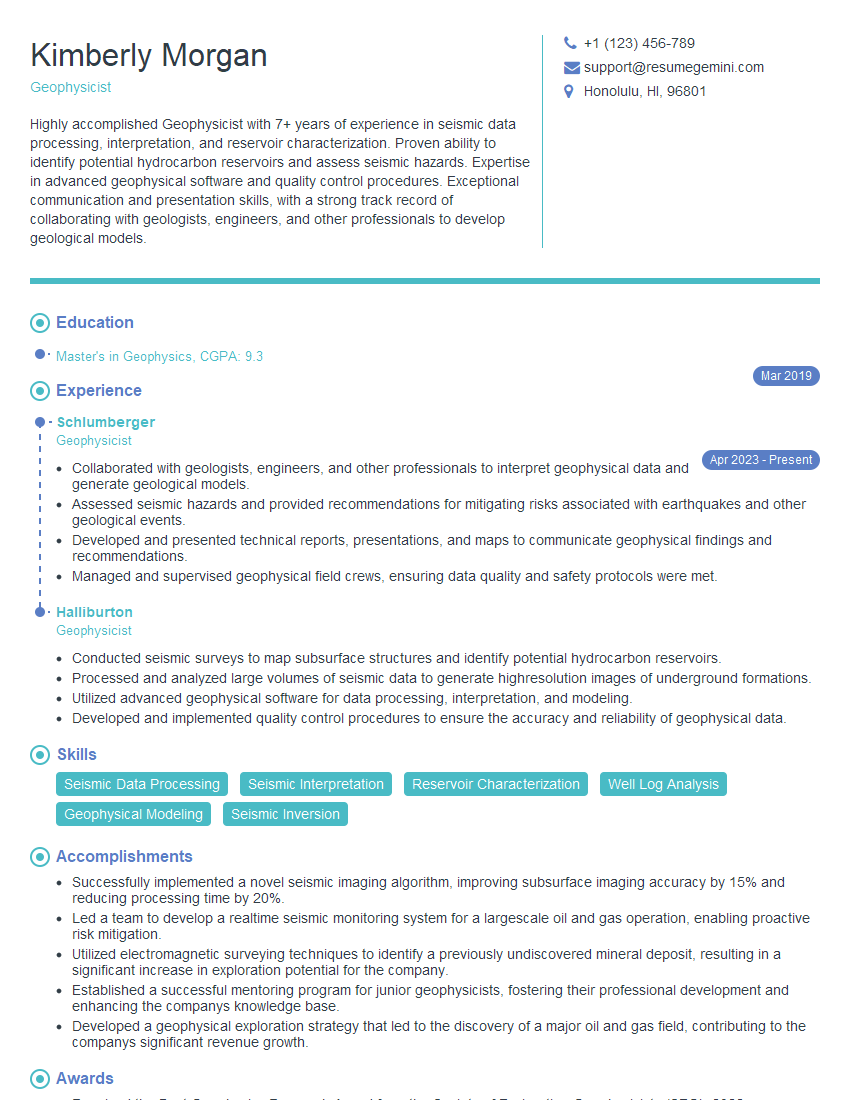
Geophysicist Resume Sample

Petroleum Geologist Resume Sample
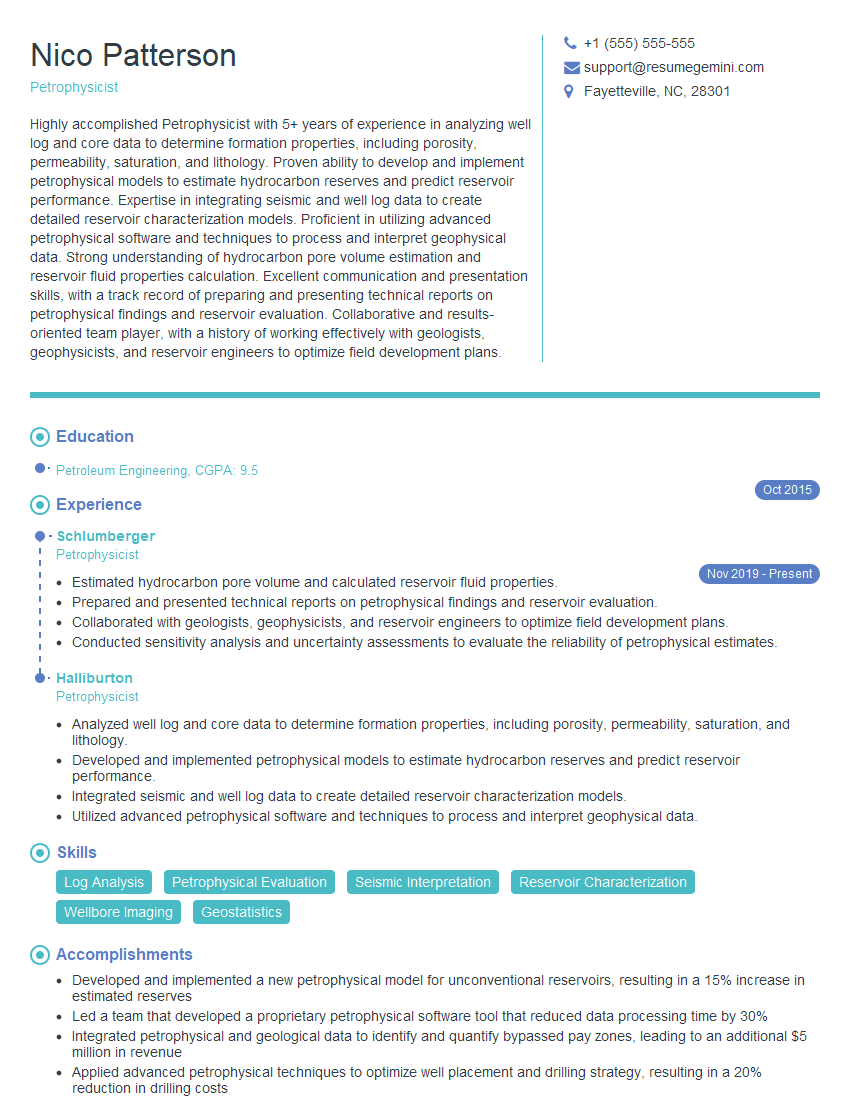
Petrophysicist Resume Sample

Project Geologist Resume Sample
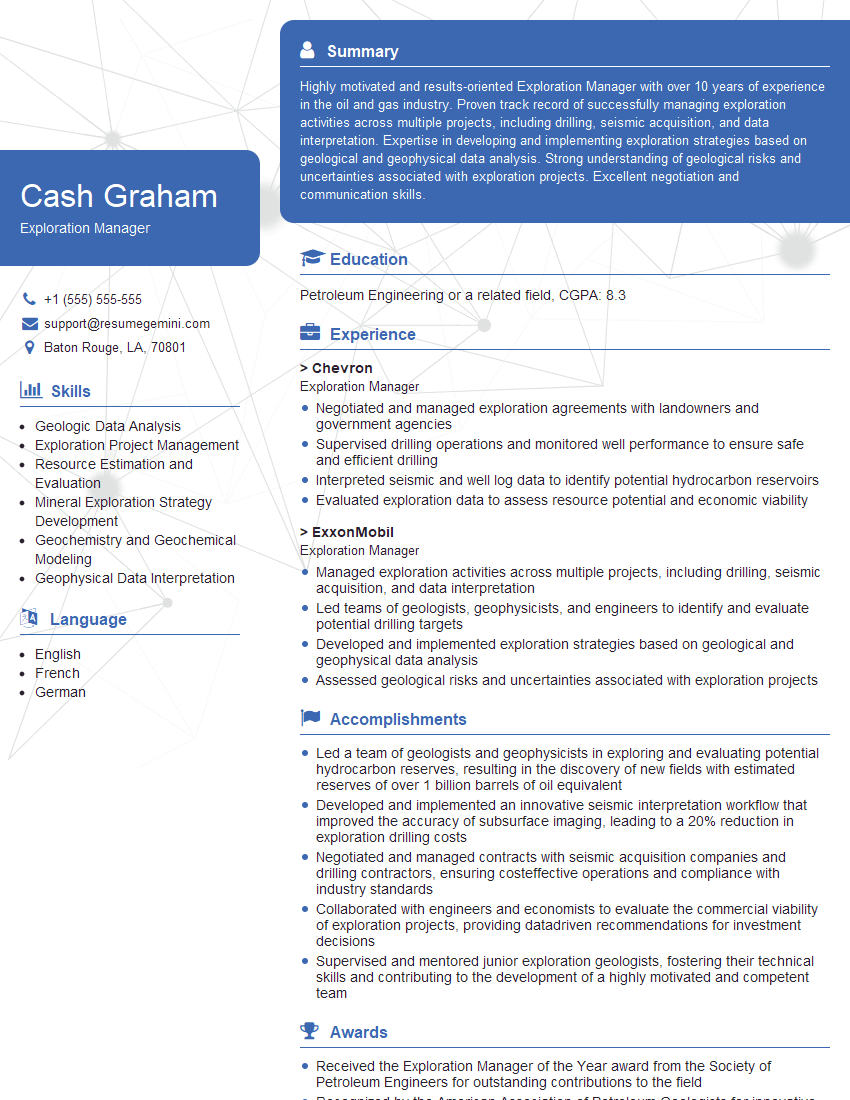
Exploration Manager Resume Sample

Geological Technician Resume Sample
Explore more articles
Users Rating of Our Blogs
Share Your Experience
We value your feedback! Please rate our content and share your thoughts (optional).
What Readers Say About Our Blog
To the interviewgemini.com Webmaster.
Very helpful and content specific questions to help prepare me for my interview!
Thank you
To the interviewgemini.com Webmaster.
This was kind of a unique content I found around the specialized skills. Very helpful questions and good detailed answers.
Very Helpful blog, thank you Interviewgemini team.