Every successful interview starts with knowing what to expect. In this blog, we’ll take you through the top GIS and Geoscience Software interview questions, breaking them down with expert tips to help you deliver impactful answers. Step into your next interview fully prepared and ready to succeed.
Questions Asked in GIS and Geoscience Software Interview
Q 1. Explain the difference between vector and raster data.
Vector and raster data are two fundamental ways to represent geographic information in GIS. Think of it like drawing a map: vector data is like using precise lines and points to draw features, while raster data is like using a grid of colored pixels to represent an image.
- Vector Data: Represents geographic features as points, lines, and polygons. Each feature has precise coordinates and can be stored with attributes (e.g., a point representing a well might have attributes like depth, flow rate, and date drilled). Examples include road networks, building footprints, and administrative boundaries. Vector data is ideal when precise location and attribute data is crucial. It’s often smaller in file size than equivalent raster data because it only stores the coordinates of the features.
- Raster Data: Represents geographic features as a grid of cells (pixels) each with a value representing a specific attribute. Think of aerial photos or satellite imagery. Each cell holds a single value, representing data such as elevation, temperature, or land cover. Raster data excels at representing continuous phenomena like elevation or temperature. However, it can be quite large in file size and less precise in geometric representation compared to vector data.
For instance, a road network would be efficiently represented as vector lines, while a satellite image showing land cover would be represented as raster data.
Q 2. What are the common file formats used in GIS?
GIS uses a variety of file formats, each with strengths and weaknesses. Some of the most common include:
- Shapefile (.shp): A widely used vector format storing point, line, and polygon data. It’s actually a collection of files (`.shp`, `.shx`, `.dbf`, `.prj`) working together. It’s a simple format, but lacks the ability to store multiple features in a single file.
- GeoJSON (.geojson): A text-based vector format that’s becoming increasingly popular because it’s human-readable and easily integrated into web applications. It’s a good choice for data exchange and web mapping.
- GeoTIFF (.tif, .tiff): A common raster format that supports georeferencing (location information) and metadata. This allows to store information about the image’s projection and location making it widely used in remote sensing.
- KML/KMZ (.kml, .kmz): Keyhole Markup Language, used primarily for sharing geographic data in Google Earth. KMZ is a compressed version of KML.
- Grid (.asc, .grd): Simple raster data formats that store elevation data.
Choosing the right format depends on the specific data, intended use, and compatibility with software tools.
Q 3. Describe your experience with geoprocessing tools.
I have extensive experience with geoprocessing tools within ArcGIS, QGIS, and Python’s geospatial libraries (e.g., GDAL, GeoPandas). My work has involved a wide array of tasks:
- Data conversion and transformation: Converting data between various formats (e.g., shapefile to GeoJSON, raster to vector) and reprojecting data to different coordinate systems.
- Spatial analysis: Performing overlay operations (union, intersect, clip), buffer analysis, proximity analysis, and network analysis. For example, I used buffer analysis to identify areas within a certain distance of a proposed pipeline route, allowing for environmental impact assessment.
- Data management: Creating and managing geodatabases, cleaning and correcting data errors, and performing data aggregation and summarization.
- Automation using Python scripting: I have created custom scripts to automate repetitive geoprocessing tasks, improving efficiency and accuracy. For instance, I wrote a script to automatically extract elevation profiles along river networks from a DEM.
I am comfortable working with both GUI-based tools and scripting to execute complex spatial processing workflows.
Q 4. How do you handle spatial data projection and coordinate systems?
Spatial data projection and coordinate systems are critical for accurate spatial analysis and visualization. A coordinate system defines how locations on Earth are represented numerically. Projections translate the 3D surface of the Earth onto a 2D plane, inevitably introducing some distortion.
I handle these aspects by:
- Identifying the coordinate system: Determining the appropriate coordinate system for the data based on the geographic area and the application. For example, UTM zones are suitable for local-scale analysis, whereas geographic coordinates (latitude/longitude) are appropriate for global-scale projects.
- Projecting data: Using GIS software tools to reproject data from one coordinate system to another, ensuring consistency in analysis. I am careful to choose appropriate projection methods to minimize distortion based on the project’s needs.
- Understanding datum transformations: Addressing differences in datums (reference ellipsoids) that define the shape and size of the Earth. This is crucial when working with data from multiple sources or in different regions.
- Using tools to assist: Utilizing the built-in projection tools within GIS software and ensuring that the correct parameters (e.g., datum transformation, projection method) are employed.
Ignoring projection and coordinate system discrepancies can lead to significant errors in spatial analysis and distance calculations. For example, using data in different projections when calculating distances can lead to substantial inaccuracy. Careful consideration of these aspects is essential for all geospatial work.
Q 5. What are the different types of map projections and when would you use each?
Map projections are methods for representing the Earth’s curved surface on a flat map. Each projection introduces distortions in area, shape, distance, or direction. The choice depends on the specific application and the type of distortion that can be tolerated.
- Equirectangular (Plate Carrée): Simple projection with minimal distortion near the equator, useful for world maps where area distortion is less critical.
- Mercator: Preserves direction, making it suitable for navigation, but severely distorts areas at higher latitudes.
- Albers Equal-Area Conic: Preserves area, ideal for mid-latitude regions where accurate area representation is paramount. Used often for thematic mapping.
- Lambert Conformal Conic: Preserves shape and direction, suitable for areas stretching across latitudes. Often used for mapping regional areas.
- UTM (Universal Transverse Mercator): Divides the Earth into zones, each projected using a transverse Mercator projection. It minimizes distortion within each zone, making it suitable for large-scale mapping.
The selection of a projection involves understanding the trade-offs between distortion types and the specific needs of the map or analysis. For instance, a map displaying population density would benefit from an equal-area projection, while a map for navigation would require one that preserves direction.
Q 6. Explain your understanding of spatial analysis techniques.
Spatial analysis techniques involve examining geographic data to identify patterns, relationships, and trends. My understanding encompasses various techniques, including:
- Overlay analysis: Combining different spatial datasets to identify relationships (e.g., finding areas where soil suitability overlaps with suitable climate conditions for a specific crop).
- Proximity analysis: Determining the distance from features to other features (e.g., calculating the distance of houses to the nearest fire station).
- Network analysis: Modeling networks (e.g., roads, rivers) to solve problems like finding the shortest route or optimizing delivery networks.
- Spatial interpolation: Estimating values at unsampled locations based on known values (e.g., estimating rainfall across a region based on point measurements).
- Density analysis: Measuring the concentration of features (e.g., calculating population density).
These techniques help uncover spatial patterns and relationships that might not be apparent from simply visualizing the data. For example, overlay analysis can be used to identify suitable locations for renewable energy projects by combining datasets on land use, solar irradiance, and proximity to the electricity grid.
Q 7. Describe your experience with spatial statistics.
My experience with spatial statistics involves applying statistical methods to geographic data to quantify spatial patterns and relationships. I am proficient in techniques such as:
- Spatial autocorrelation: Measuring the degree to which values at nearby locations are similar (e.g., determining if houses with high property values tend to cluster together).
- Geostatistics: Modeling spatial variability in data, such as kriging for spatial interpolation of continuous variables.
- Point pattern analysis: Analyzing the spatial distribution of points, identifying clustering or dispersion (e.g., examining the spatial distribution of disease cases to identify potential hot spots).
- Spatial regression: Modeling relationships between variables while accounting for spatial dependencies (e.g., modelling air pollution levels as a function of distance to major roads).
I use these techniques to understand underlying spatial processes, make predictions, and draw statistically sound conclusions from geographic data. For example, I used spatial regression to investigate the relationship between forest cover and biodiversity, accounting for spatial autocorrelation in the data.
Q 8. How do you perform georeferencing?
Georeferencing is the process of assigning geographic coordinates (latitude and longitude) to points on an image or map that doesn’t already have them. Think of it like putting a picture on a map in the correct location. It’s crucial for integrating various data sources within a GIS environment.
The process typically involves identifying control points – points with known coordinates on both the image and a reference map (e.g., a topographic map or aerial photograph with existing georeferencing). These control points are used by GIS software to perform a transformation, mathematically aligning the image to the real-world coordinate system. Different transformation methods are employed depending on the image’s distortion and the number of control points available; common ones include polynomial transformations (like affine or polynomial transformations).
For example, let’s say I have a scanned historical map of a city. To use this map in a modern GIS, I’d need to georeference it. I’d identify several landmarks on the map (like street intersections or building corners) whose real-world coordinates I can obtain from a current map. I then input these control points into GIS software (like ArcGIS or QGIS), which uses them to calculate a transformation and accurately place the historical map within the geographic coordinate system.
- Step 1: Identify Control Points: Select at least three points on both the image and the reference map. More control points generally lead to better accuracy.
- Step 2: Input Control Points: Enter the coordinates of each control point into the GIS software.
- Step 3: Choose Transformation Method: Select the appropriate transformation based on image distortion.
- Step 4: Transform and Rectify: The software performs the transformation and georeferences the image.
- Step 5: Validate Accuracy: Check the accuracy of the georeferencing by examining the alignment and RMSE (Root Mean Square Error).
Q 9. What is your experience with database management systems in a GIS context?
My experience with database management systems (DBMS) in a GIS context is extensive. I’ve worked with various systems, including PostgreSQL/PostGIS, Oracle Spatial, and SQL Server, to manage and query large spatial datasets. Understanding DBMS is essential for efficient storage, retrieval, and analysis of geographic information. I’m proficient in database design, schema creation, data loading, and optimization techniques specific to spatial data, such as spatial indexes (e.g., R-tree, GiST).
In one project, I designed and implemented a PostgreSQL/PostGIS database to store and manage millions of points representing sensor readings from a national-scale environmental monitoring network. Proper database design was crucial for maintaining data integrity and enabling fast query execution for spatial analysis.
Q 10. Explain your experience with SQL queries related to spatial data.
I’m highly proficient in writing SQL queries to manipulate and analyze spatial data. My expertise extends beyond basic SELECT statements to encompass complex spatial functions and joins. I frequently use functions like ST_Intersects, ST_Contains, ST_Distance, and ST_Buffer to perform spatial selections, proximity analysis, and overlay operations.
For instance, I might use the following query in PostGIS to find all buildings within 500 meters of a particular park:
SELECT b.building_name FROM buildings b, parks p WHERE ST_DWithin(b.geom, p.geom, 500) AND p.park_name = 'Central Park';This query utilizes the ST_DWithin function, a powerful spatial predicate, for efficient proximity searching. I am also experienced with using window functions and common table expressions (CTEs) to improve query performance and readability when dealing with substantial spatial datasets.
Q 11. How familiar are you with different GIS software packages (e.g., ArcGIS, QGIS, ERDAS IMAGINE)?
I possess extensive experience with various GIS software packages, including ArcGIS (ArcMap and ArcGIS Pro), QGIS, and ERDAS IMAGINE. My proficiency extends to using these platforms for a wide array of tasks, from data management and analysis to cartography and remote sensing.
ArcGIS is my primary software, and I’m comfortable using its advanced spatial analysis tools, geoprocessing capabilities, and custom scripting with Python. QGIS, with its open-source nature, is my go-to tool for specific tasks like raster processing and open data manipulation. ERDAS IMAGINE, on the other hand, is my preferred choice for high-resolution satellite imagery processing and analysis, especially for orthorectification and image classification tasks. I can adapt my workflow easily between these different platforms based on the project’s requirements and the strengths of each package.
Q 12. Describe your experience with remote sensing data processing and analysis.
My experience in remote sensing data processing and analysis is substantial. I’m proficient in various techniques, including image classification (supervised and unsupervised), change detection, and orthorectification. I’ve worked with diverse sensor data, including Landsat, Sentinel, and high-resolution commercial imagery.
In one project, I used Landsat imagery to monitor deforestation in the Amazon rainforest. This involved image preprocessing, cloud masking, classification of land cover types (forest, pasture, etc.), and change detection analysis to quantify deforestation rates over time. This required expertise in using image processing software like ERDAS IMAGINE or ENVI, as well as in-depth understanding of remote sensing principles and data characteristics.
Q 13. How do you ensure data accuracy and quality in GIS projects?
Data accuracy and quality are paramount in any GIS project. My approach involves a multi-step process to ensure data integrity from acquisition to analysis.
- Data Source Evaluation: I meticulously evaluate the reliability and accuracy of data sources, considering factors like spatial resolution, accuracy assessment reports, and the source’s reputation.
- Data Cleaning and Preprocessing: I rigorously clean and preprocess data to identify and correct errors, inconsistencies, or outliers. This may involve spatial checks (e.g., topology checks), attribute validation, and data transformation.
- Metadata Management: I maintain comprehensive metadata for all datasets, documenting data provenance, accuracy, and limitations. This allows for reproducibility and transparency in analysis.
- Quality Control Checks: I employ various quality control checks throughout the workflow, including visual inspection of data, statistical analysis, and validation against independent datasets.
- Error Propagation Assessment: I’m aware of error propagation and take steps to minimize its impact on the final results.
For instance, in a cadastral mapping project, I’d use a combination of GPS data, existing maps, and ground truthing to ensure that the data used is as accurate and reliable as possible.
Q 14. Explain your experience with creating thematic maps.
I have extensive experience in creating thematic maps – maps that display geographic data related to a specific theme. My expertise covers the entire process, from data preparation to map design and layout.
I’m proficient in using various cartographic techniques, including graduated color schemes, choropleth mapping, isopleth mapping, dot density mapping, and cartograms, to effectively communicate geographic patterns and trends. My goal is always to create clear, visually appealing, and informative maps that accurately reflect the data.
For example, I’ve created thematic maps showing population density, election results, soil types, and environmental hazards. The selection of appropriate cartographic techniques and symbology was essential for effective communication of these complex datasets to diverse audiences.
Software like ArcGIS Pro and QGIS provide many tools for map creation and customization, and I have expertise in utilizing those functionalities for map layouts, labeling, and overall aesthetic presentation.
Q 15. How do you handle large datasets in GIS?
Handling large datasets in GIS requires a multi-pronged approach focusing on data management, processing efficiency, and appropriate software selection. Imagine trying to edit a massive photo – you wouldn’t try to do it all at once! Similarly, we employ strategies to manage GIS data’s size and complexity.
Data Compression and File Formats: Using compressed file formats like GeoTIFF with appropriate compression algorithms (e.g., LZW, DEFLATE) significantly reduces file sizes without substantial data loss. Choosing the right format for the data type (raster vs. vector) is also crucial for efficiency.
Database Management Systems (DBMS): For truly massive datasets, spatial databases like PostGIS (extension for PostgreSQL) or Oracle Spatial are essential. They allow for efficient querying, indexing, and retrieval of spatial data, significantly speeding up analysis and visualization. Think of it as a highly organized library for your spatial data.
Data Subsetting and Tiling: Processing the entire dataset at once is often impractical. Subsetting – working with a smaller, manageable portion of the data at a time – is crucial. Tiling, where large datasets are broken into smaller, overlapping tiles, further enhances processing speed and reduces memory requirements. This is similar to assembling a large jigsaw puzzle one section at a time.
Cloud Computing: Cloud platforms like AWS, Azure, and Google Cloud offer scalable computing resources and storage solutions perfect for large GIS projects. This provides on-demand access to high-performance computing for data processing and analysis, making it ideal for projects that require extensive processing power.
Data Pyramids and Caching: Creating data pyramids (multiple resolutions of the same data) allows for faster rendering at different zoom levels. Caching frequently accessed data in memory or on a faster storage medium further improves performance. This is like having a frequently used dictionary readily available instead of always searching for the definitions.
Career Expert Tips:
- Ace those interviews! Prepare effectively by reviewing the Top 50 Most Common Interview Questions on ResumeGemini.
- Navigate your job search with confidence! Explore a wide range of Career Tips on ResumeGemini. Learn about common challenges and recommendations to overcome them.
- Craft the perfect resume! Master the Art of Resume Writing with ResumeGemini’s guide. Showcase your unique qualifications and achievements effectively.
- Don’t miss out on holiday savings! Build your dream resume with ResumeGemini’s ATS optimized templates.
Q 16. What are your troubleshooting skills related to GIS software issues?
My troubleshooting approach in GIS software is systematic and methodical. I break down the problem into smaller, manageable parts to identify the root cause. It’s like detective work, following a trail of clues until I find the culprit.
Error Messages: I carefully analyze error messages generated by the software, paying close attention to the specifics of the error. These messages often provide valuable hints as to the problem’s nature.
Data Integrity Checks: I verify data integrity – ensuring that the data is consistent and free from errors. This often involves checking coordinate systems, projections, and data types.
Software Updates and Reinstallation: Often, outdated software or corrupted installations are the culprits. Updating the software to the latest version or reinstalling it can resolve many issues.
Online Resources and Communities: When confronted with a particularly challenging problem, I leverage online forums, GIS communities, and documentation to find solutions. Many GIS experts share their experiences and solutions online.
Testing in Simplified Scenarios: When working with complex datasets or workflows, I often create simplified test cases to isolate the problem. This allows me to identify the problematic element within the workflow more easily.
Contacting Support: Finally, if all else fails, I directly contact the software vendor’s support team for assistance.
Q 17. Describe your experience working with GPS data.
My experience with GPS data encompasses data acquisition, processing, and analysis using various software and techniques. I’ve worked with both post-processed kinematic (PPK) and real-time kinematic (RTK) GPS data. Think of it like taking high-resolution photos – you need to process them to get the best results.
Data Acquisition: I’ve used various GPS receivers and data loggers, ranging from handheld units to precise geodetic receivers, for various applications.
Post-Processing: I’m proficient in using software like RTKLIB and other processing packages to correct for atmospheric and other errors to get highly accurate positional data. This is crucial for accurate mapping and surveying.
Error Analysis: I understand various error sources in GPS data, including atmospheric delays, multipath errors, and receiver noise. My expertise allows me to identify and mitigate these errors for better accuracy.
For example, in one project, we used RTK GPS data to create a highly accurate map of a coastal erosion zone, where the precision of the GPS data was essential to accurately measure the changes over time.
Q 18. How do you ensure data security and privacy in GIS projects?
Data security and privacy in GIS projects are paramount. My approach is multi-layered, incorporating technical safeguards, procedural controls, and adherence to relevant regulations. Think of it like securing a valuable vault—multiple layers of protection are needed.
Access Control: Implementing robust access control measures, using role-based access control (RBAC) to restrict data access based on user roles and responsibilities.
Data Encryption: Encrypting data both at rest (on storage devices) and in transit (during data transfer) using appropriate encryption algorithms (e.g., AES).
Secure Storage: Storing data in secure locations with appropriate physical and cybersecurity measures, including firewalls, intrusion detection systems, and regular security audits.
Data Anonymization and Generalization: When dealing with sensitive data, anonymizing or generalizing data can protect individual privacy without losing the value of spatial analysis. For instance, aggregating data to larger spatial units can help hide the identity of individuals while still preserving patterns.
Compliance with Regulations: Adhering to relevant data privacy regulations, such as GDPR (General Data Protection Regulation) or CCPA (California Consumer Privacy Act), depending on the project’s geographic location and data sensitivity.
Data Governance Policies: Developing clear data governance policies and procedures that define roles, responsibilities, and data handling practices within the organization.
Q 19. What is your experience with 3D GIS?
My experience with 3D GIS includes working with various 3D data formats, software packages, and applications. 3D GIS allows for a more realistic and comprehensive understanding of the world, going beyond the limitations of 2D maps. Think of it as upgrading from a flat photo to a 3D model.
Data Formats: I’m familiar with various 3D data formats, such as CityGML, 3D Tiles, and point cloud data (LAS, LAZ).
Software: I have experience using 3D GIS software packages like ArcGIS Pro, QGIS, and other specialized software for 3D visualization and analysis.
Applications: I have applied 3D GIS in various applications, including urban planning, infrastructure management, and environmental modeling. For example, creating 3D models of cities to visualize urban growth and plan infrastructure projects.
Q 20. Describe your experience with LiDAR data processing and analysis.
My LiDAR data processing and analysis experience involves the entire workflow, from data acquisition to meaningful insights. LiDAR, or Light Detection and Ranging, provides incredibly detailed 3D information about the earth’s surface. Think of it as a very high-resolution 3D scanner for the Earth.
Data Preprocessing: This stage involves removing noise and artifacts from the raw LiDAR data, including classifying points into ground and non-ground points using tools like LAStools.
Data Processing: Creating various products from the LiDAR data, such as digital elevation models (DEMs), digital surface models (DSMs), and point cloud classifications. Software such as ArcGIS Pro, Global Mapper, and specialized point cloud software are essential for this.
Data Analysis: Analyzing the processed LiDAR data to extract meaningful information. This might involve calculating slope, aspect, and other terrain attributes, or identifying objects such as trees or buildings based on point cloud classification.
Applications: I have utilized LiDAR data for various applications, including creating high-resolution topographic maps, assessing forest biomass, and modeling floodplains. The high accuracy of LiDAR makes it invaluable for detailed analysis.
Q 21. Explain your understanding of spatial interpolation techniques.
Spatial interpolation techniques are methods used to estimate values at unsampled locations based on known values at nearby sample points. It’s like filling in the gaps in a puzzle using the surrounding pieces. This is crucial when we have data only at specific locations and need to understand the overall pattern.
Inverse Distance Weighting (IDW): This method assigns weights to nearby sample points inversely proportional to their distances from the unsampled location. Points closer to the unsampled location have a greater influence on the interpolated value.
Kriging: A geostatistical method that takes into account the spatial autocorrelation of the data – how values at nearby locations are related. It provides a more sophisticated interpolation compared to IDW, incorporating uncertainties and spatial variability.
Spline Interpolation: Creates a smooth surface that passes through or near the sample points. Different spline types (e.g., thin-plate splines, natural neighbor splines) offer varying degrees of smoothness.
Other Methods: Other techniques such as nearest neighbor interpolation (assigns the value of the closest sample point), bilinear interpolation (for raster data), and radial basis functions are also commonly used.
The choice of interpolation method depends on the characteristics of the data and the application. For example, Kriging is often preferred when spatial autocorrelation is significant, while IDW is simpler and computationally less expensive.
Q 22. What experience do you have with creating web maps and web GIS applications?
Creating web maps and web GIS applications is a core part of my expertise. I’ve extensively used platforms like ArcGIS Online, ArcGIS Enterprise, and QGIS Server to develop interactive web maps, incorporating various data layers, custom styling, and interactive tools. For example, I developed a web map for a city planning department that allowed users to visualize proposed zoning changes, overlaid with demographic data and environmental impact assessments. This involved using JavaScript libraries like Leaflet and OpenLayers to create custom map interactions and dynamically display data from a geodatabase. In another project, I built a web GIS application using ArcGIS Enterprise which integrated with a custom database to track and manage assets for a utility company, providing real-time updates and spatial analysis capabilities to field technicians.
My experience also includes the implementation of various map services such as feature services, tile services and WMS (Web Map Service) for seamless data integration and optimized performance. I am adept at designing user-friendly interfaces that cater to both technical and non-technical users, employing responsive design principles to ensure accessibility across various devices.
Q 23. Describe your experience with Python scripting for GIS tasks.
Python is my go-to scripting language for automating GIS tasks and performing spatial analysis. I’m proficient in using libraries like geopandas, shapely, rasterio, and arcpy (for ArcGIS integration). For instance, I used geopandas and shapely to automate the processing of hundreds of shapefiles, performing geometric operations like buffering and intersection to analyze land-use patterns. I’ve also used rasterio to process and analyze large raster datasets, such as satellite imagery, to detect changes in deforestation over time. A particular project involved using arcpy to automate the creation of hundreds of custom maps with varying parameters based on user input, streamlining a previously tedious manual process.
My scripting skills extend to data manipulation, cleaning, and transformation, working with various data formats including CSV, GeoJSON, and shapefiles. I frequently employ Python to build custom workflows for data preprocessing, analysis, and visualization, saving significant time and improving accuracy compared to manual methods.
Q 24. How do you manage and collaborate on GIS projects with teams?
Effective collaboration is crucial in GIS projects. I use a combination of tools and strategies to manage and collaborate effectively with teams. We use version control systems like Git to track changes to code and data, ensuring everyone is working with the latest version. For project management, I leverage platforms like Jira or Asana to define tasks, track progress, and facilitate communication. We use cloud-based storage (like Google Drive or SharePoint) for shared access to data and documents.
Regular team meetings are essential to discuss progress, address challenges, and ensure alignment on goals. I believe in open communication, actively encouraging team members to share their ideas and expertise. We also employ collaborative mapping tools, allowing multiple users to contribute to map creation and editing simultaneously. Clear communication protocols, detailed documentation and well-defined roles and responsibilities are pivotal to ensure smooth collaboration.
Q 25. Explain your knowledge of different types of spatial indexes.
Spatial indexes are crucial for efficiently querying and retrieving spatial data. They accelerate spatial operations by reducing the search space. Different types of spatial indexes are suitable for different data structures and query types.
- R-tree: A tree-like structure that partitions space into rectangles. It’s well-suited for point, line, and polygon data and is efficient for range queries (finding objects within a specific area).
- Quadtree: Divides space recursively into quadrants, ideal for point data and efficient for queries based on location.
- Grid index: Partitions space into a regular grid, simple and effective for large datasets, especially when dealing with points.
- RTree variants (e.g., R*-tree, STR-tree): These are optimized versions of the R-tree designed to improve query performance and reduce disk I/O.
The choice of spatial index depends on the specific application. For example, an R-tree might be preferred for a system that frequently needs to locate all buildings within a certain radius, while a grid index might be more suitable for analyzing the density of point data across a large area.
Q 26. What is your experience with cloud-based GIS platforms?
I have substantial experience with cloud-based GIS platforms, including ArcGIS Online, ArcGIS Enterprise on AWS/Azure, and Google Earth Engine. I’ve used these platforms to host and manage geospatial data, develop web mapping applications, and perform large-scale spatial analyses. For instance, I utilized Google Earth Engine to process massive satellite imagery datasets to monitor changes in land cover over time, something impossible to do efficiently using only local resources.
The advantages of cloud-based platforms include scalability, accessibility, and reduced infrastructure costs. I’m familiar with the security and access control mechanisms in these environments, and I understand how to optimize data storage and processing for cost-effectiveness. I am also comfortable with the deployment of web applications through cloud platforms and implementing robust security measures to safeguard geospatial data.
Q 27. Describe your understanding of the limitations of GIS technology.
While GIS technology is incredibly powerful, it has limitations. One key limitation is the inherent inaccuracy of geospatial data. Data accuracy depends on the data source, collection methods, and processing techniques. Errors can arise from positional inaccuracies, generalization, and attribute errors. This can lead to misinterpretations and incorrect analyses if not properly addressed.
Another limitation is the computational intensity of spatial analysis, especially when dealing with large datasets. Processing large rasters or performing complex spatial operations can require significant computing power and time. Furthermore, the complexity of spatial data models can make it challenging to represent real-world phenomena accurately and comprehensively. Finally, interpreting GIS outputs requires careful consideration of the underlying data and methodologies; visualisations can be misleading if their limitations are not fully understood.
Q 28. How familiar are you with open-source GIS software?
I’m very familiar with open-source GIS software, primarily QGIS. I’ve used QGIS extensively for various tasks, from data processing and analysis to map creation and visualization. Its versatility and extensibility through plugins make it a powerful and cost-effective alternative to proprietary software. I have experience using various QGIS plugins for specialized tasks, such as raster processing, spatial statistics, and geoprocessing.
My open-source experience also includes working with PostGIS, a spatial extension for PostgreSQL, enabling me to manage and query large spatial databases efficiently. The open-source community is a great resource for support and innovation, offering a collaborative environment for development and troubleshooting.
Key Topics to Learn for Your GIS and Geoscience Software Interview
Landing your dream GIS or Geoscience Software role requires a solid understanding of both theoretical concepts and practical applications. Prepare yourself by focusing on these key areas:
- Spatial Data Structures and Models: Understand vector and raster data, projections (e.g., UTM, Geographic), coordinate systems, and geodatabases. Consider the strengths and weaknesses of each for different applications.
- Geoprocessing Techniques: Familiarize yourself with common geoprocessing tools and workflows like spatial analysis (overlay, buffering, proximity), data conversion, and data management. Be ready to discuss specific examples of how you’ve used these techniques to solve problems.
- GIS Software Proficiency: Showcase your expertise in industry-standard software like ArcGIS, QGIS, or other relevant platforms. Highlight your skills in data visualization, map creation, and spatial querying. Be prepared to discuss projects where you’ve utilized these tools effectively.
- Remote Sensing and Image Analysis: If applicable to the role, understand fundamental principles of remote sensing, image classification techniques, and the use of satellite imagery or aerial photography in GIS applications. Discuss your experience with image processing software.
- Geospatial Databases and Data Management: Demonstrate your knowledge of managing large geospatial datasets, including data import/export, data cleaning, and database administration techniques. Highlight your ability to maintain data integrity and efficiency.
- Programming and Scripting (Python, R): If relevant to the job description, showcase your proficiency in automating GIS tasks using scripting languages. Be ready to discuss examples of your code and its applications.
- Problem-Solving and Analytical Skills: Prepare to discuss how you approach complex geospatial problems. Highlight your ability to analyze data, identify patterns, and draw meaningful conclusions.
Next Steps: Unlock Your Career Potential
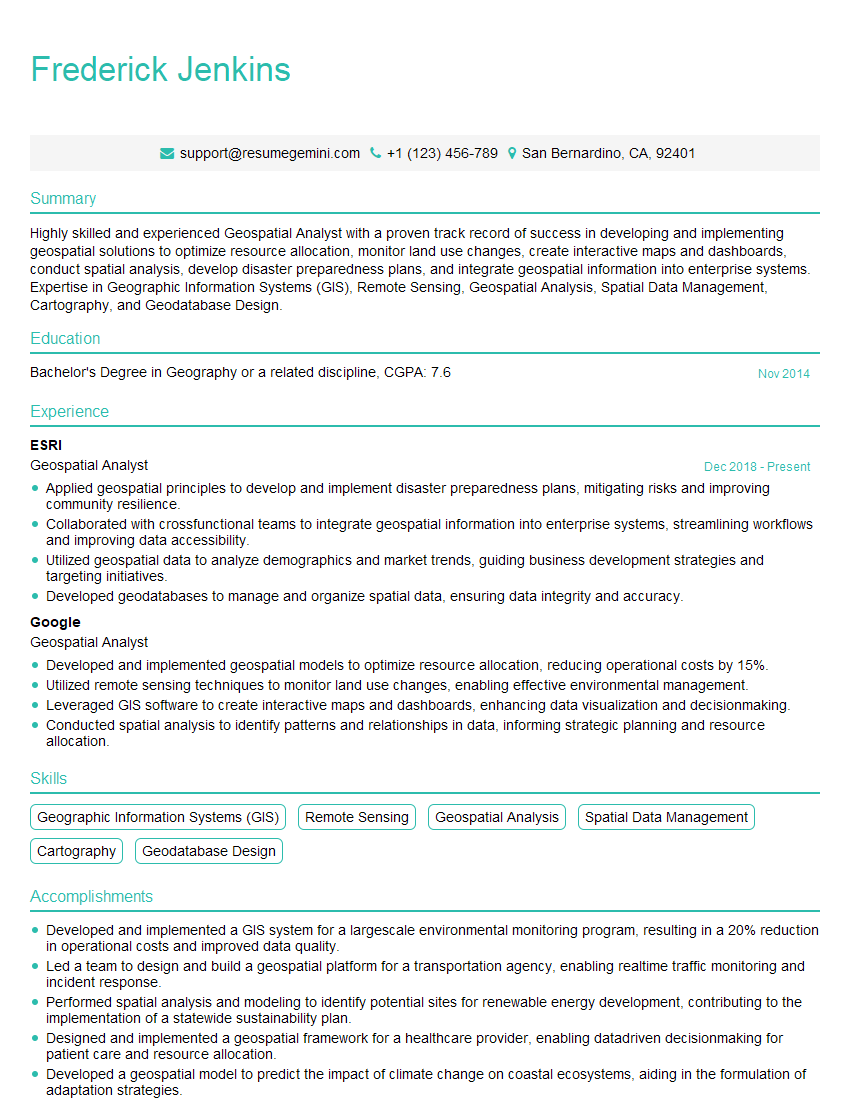
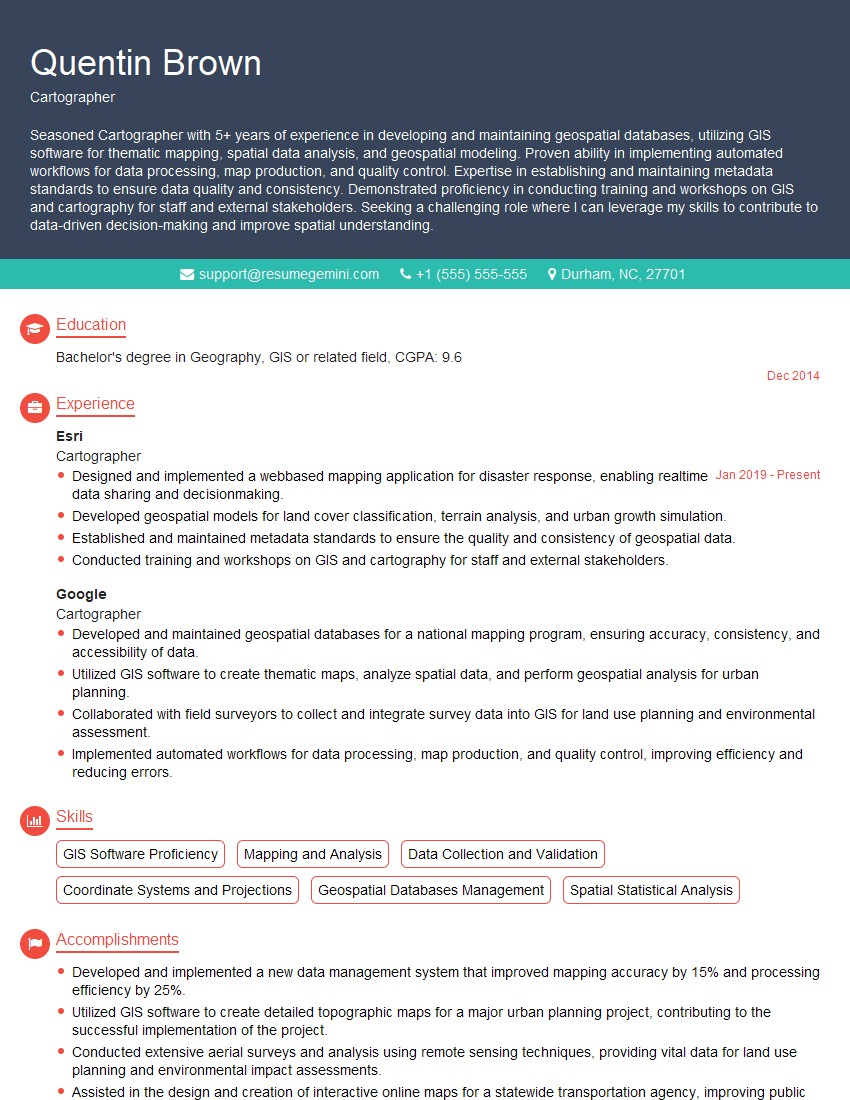
Mastering GIS and Geoscience Software opens doors to exciting and impactful career opportunities. To maximize your chances of success, focus on crafting a compelling and ATS-friendly resume that highlights your skills and experience effectively. ResumeGemini is a trusted resource to help you build a professional resume that stands out. They provide examples of resumes tailored specifically to GIS and Geoscience Software roles, giving you a head start in showcasing your qualifications. Invest time in creating a strong resume – it’s your first impression and a critical step in advancing your career.
Explore more articles
Users Rating of Our Blogs
Share Your Experience
We value your feedback! Please rate our content and share your thoughts (optional).
What Readers Say About Our Blog
To the interviewgemini.com Webmaster.
Very helpful and content specific questions to help prepare me for my interview!
Thank you
To the interviewgemini.com Webmaster.
This was kind of a unique content I found around the specialized skills. Very helpful questions and good detailed answers.
Very Helpful blog, thank you Interviewgemini team.