Every successful interview starts with knowing what to expect. In this blog, we’ll take you through the top Skilled in Installing Various Types of Drywall interview questions, breaking them down with expert tips to help you deliver impactful answers. Step into your next interview fully prepared and ready to succeed.
Questions Asked in Skilled in Installing Various Types of Drywall Interview
Q 1. What types of drywall have you worked with (e.g., standard, fire-resistant, moisture-resistant)?
Throughout my career, I’ve worked extensively with various types of drywall, each suited for specific applications. The most common is standard drywall, typically ½ inch thick, used for general interior walls and ceilings. It’s cost-effective and versatile. Then there’s fire-resistant drywall (Type X), easily identifiable by its slightly pinkish hue. This is crucial in areas requiring enhanced fire protection, like hallways and stairwells. Its higher density and gypsum content provide increased fire resistance. Lastly, I’ve had significant experience with moisture-resistant drywall (greenboard). This is essential in bathrooms, kitchens, and other areas prone to moisture. Its special coating prevents water damage and mold growth. I’m also familiar with specialty boards like soundproof drywall for noise reduction, often found in media rooms or apartments.
Q 2. Describe your experience with drywall hanging techniques.
Drywall hanging is a precise process. My experience encompasses various techniques, from the basic use of a drywall square and level for accurate placement to more advanced strategies using laser levels for large projects and perfectly plumb walls. I’m proficient in both single and double-layer hanging, selecting the appropriate technique based on the project’s needs and building codes. For instance, in a commercial project needing extra strength, I’d opt for double layers with staggered seams. My approach always involves pre-planning – I meticulously check framing for plumbness and squareness, ensuring a solid foundation. This preventative measure saves time and effort down the line. I always prioritize safety, using proper lifting techniques and safety harnesses when working at heights.
Q 3. Explain the process of taping and mudding drywall.
Taping and mudding are crucial for a seamless finish. It’s a multi-step process. First, I apply drywall tape, carefully embedding it into the joint compound (mud) to create a smooth transition between drywall sheets. I use a taping knife to ensure the tape is fully adhered. This is usually followed by multiple coats of joint compound, each coat allowed to dry completely before sanding. The first coat covers the tape, the second fills any imperfections, and subsequent coats (depending on the desired finish) achieve a perfectly smooth surface. I use various sizes of knives, from 6-inch for the initial coat to wider ones for filling and smoothing. I carefully sand each coat to achieve a smooth surface before applying the next, ensuring the final surface is ready for primer and paint. Proper drying time between coats is vital; rushing this step will result in cracking and other issues. I often use a primer specifically designed for drywall before applying the finish coat of paint.
Q 4. What tools and equipment are essential for efficient drywall installation?
Efficient drywall installation depends on having the right tools. My essential toolkit includes various sizes of taping knives (6”, 8”, 12”), a utility knife, a drywall saw, a measuring tape, a level, a T-square, a stud finder, a drywall lift, and a sanding pole with various grits of sandpaper. For larger jobs, power tools like a mud mixer and a drywall screw gun significantly increase efficiency. Safety equipment like safety glasses, dust masks, and hearing protection are non-negotiable. Proper lighting is also important to identify any imperfections.
Q 5. How do you ensure proper alignment and straight seams during installation?
Achieving perfectly aligned seams and straight walls is key to a professional finish. I start by ensuring the framing is perfectly plumb and square before hanging any drywall. I use a laser level to check both vertical and horizontal alignments throughout the process. I meticulously measure and mark the location of each sheet before installing it. This minimizes waste and ensures accurate placement. For straight seams, I use a T-square and level to ensure each sheet is aligned precisely with the adjacent sheet. I also utilize spacers to maintain consistent spacing between sheets, especially during double-layer installations. These precision methods allow for a clean, flawless final product, needing minimal mud and taping.
Q 6. What are the different types of drywall finishes you’re familiar with?
I’m experienced with various drywall finishes, each providing a different aesthetic. A Level 1 finish is a basic finish, suitable for areas where the final coat will be heavy texture. A Level 2 finish is smoother, requiring more meticulous taping and mudding, perfect for rooms with lighter textures or wallpapers. A Level 3 finish is the smoothest, requiring multiple coats of mud and meticulous sanding, ideal for areas where the final coat is paint or a fine texture. Choosing the right finish depends on the project requirements and the desired aesthetic.
Q 7. Describe your experience with drywall repair techniques.
Drywall repair is a common part of my work. I’ve repaired everything from minor nail pops and cracks to extensive water damage. For nail pops, I simply re-nail the affected area, then apply mud to fill the gap and sand it smooth. Cracks require more extensive repair, often involving cutting out the damaged section, installing a new piece of drywall, and carefully blending it with the surrounding area. In the case of significant water damage or mold, it often requires more than just drywall repair; it might involve the removal of damaged insulation and the treatment of affected areas before installing new drywall.
Q 8. How do you handle difficult angles or curves during installation?
Handling difficult angles and curves in drywall installation requires specialized techniques and materials. Think of it like sculpting with drywall – you need the right tools and approach for a smooth, professional finish.
For curves: I use flexible drywall, often referred to as ‘curve-able’ drywall. This type of drywall is more malleable and can be bent to conform to rounded surfaces. I’ll often pre-score the back of the sheet to make it easier to bend without cracking. For very tight curves, I might even use multiple smaller pieces, carefully fitting them together for a seamless look. Think of it like fitting together puzzle pieces, ensuring a precise fit.
For angles: Precise measurements are crucial. I’ll use a bevel square and measuring tape to carefully mark the angle on the drywall sheet before cutting. A utility knife or drywall saw is employed for clean cuts. When dealing with unusual angles, I often make a template from cardboard to accurately trace the shape onto the drywall, minimizing errors.
Fastening: Regardless of the shape, appropriate fasteners are key. For curved sections, I often use smaller, more frequent screws to prevent cracking, applying them strategically. For angled sections, using a screw gun with a clutch setting to control the depth of the screws is essential to avoid damage.
Remember, patience and precision are key to successfully installing drywall on challenging surfaces. Taking my time and meticulously measuring and cutting yields the best results.
Q 9. What safety precautions do you follow when installing drywall?
Safety is paramount in drywall installation. I always prioritize protecting myself and others on the job site. Think of it as a checklist I go through before I even begin a project.
Personal Protective Equipment (PPE): This is non-negotiable. I always wear safety glasses to protect my eyes from flying debris, hearing protection from the noise of power tools, work gloves to protect my hands, and a dust mask to prevent inhalation of drywall dust. A hard hat is also essential when working at heights.
Fall Protection: When working at heights, I use harnesses and proper fall protection systems. No job is worth a serious injury.
Tool Safety: I ensure that all my tools are in good working order and properly maintained. I regularly inspect my power tools for damage and only use tools that I am proficient with. I always disconnect power tools before changing blades or making adjustments.
Housekeeping: A clean worksite is a safe worksite. I keep the area clear of debris and obstacles to prevent tripping hazards. I carefully dispose of all waste materials according to local regulations.
Awareness: I’m constantly aware of my surroundings and the potential hazards. This includes checking for electrical wiring, plumbing, and other utilities before cutting or drilling.
Q 10. How do you calculate the amount of drywall needed for a project?
Accurately calculating drywall needs prevents waste and ensures I have enough material. It’s a straightforward calculation, but accuracy is key. I usually start by meticulously measuring the surface area of the walls and ceilings.
Measurement: I measure the height and width of each wall and ceiling section separately. For complex shapes, I break them down into smaller, more manageable rectangles and triangles. It’s like solving a math puzzle. I double-check all my measurements to avoid errors.
Calculations: I calculate the area of each section using standard formulas (e.g., length x width for rectangles). Once I have the area of all the sections, I sum them up to get the total surface area.
Waste Factor: I always add a waste factor, typically 5-10%, to account for cuts, mistakes, and damaged sheets. This is crucial as it helps prevent running out of material mid-project. This buffer is like adding a contingency to the budget.
Standard Sheet Size: I consider the standard size of drywall sheets (typically 4’x8′ or 4’x12′) when calculating the number of sheets needed. I arrange the sheets efficiently on the wall to minimize waste.
It’s always better to have a few extra sheets than to be short. Accurate calculation combined with a waste factor ensures a smooth, efficient project.
Q 11. Explain your experience with different types of drywall screws and fasteners.
My experience encompasses a wide range of drywall screws and fasteners, each suited for specific applications. Choosing the right screw is as important as choosing the right drywall itself.
Drywall Screws: I commonly use self-tapping drywall screws, which are designed to penetrate both wood and drywall efficiently. The screw type varies depending on the thickness of the drywall and the type of framing (wood or metal). For example, longer screws are needed for thicker drywall.
Screw Length: The length of the screw is crucial to ensure proper penetration into the framing without protruding through the drywall surface. A screw that is too short won’t provide adequate support. Too long and it might damage the other side.
Fasteners for Metal Framing: When working with metal studs, I’ll use specialized drywall screws designed for metal. These screws have a sharper point for easier penetration and a self-drilling tip that makes the process quicker.
Specialty Fasteners: For specific applications, like attaching drywall to concrete or masonry, I use specialized anchors or fasteners. These are often designed to create a strong bond even in non-porous substrates.
My experience allows me to select the correct fastener for any given situation, ensuring strength, durability, and a flawless finish.
Q 12. How do you prepare a surface for drywall installation (e.g., framing, insulation)?
Proper surface preparation is fundamental to a successful drywall installation. It ensures a smooth, even surface and prevents problems later. I think of it as laying a strong foundation for a house.
Framing: The framing must be square, plumb, and level. Any imperfections in the framing will show through the finished drywall. I’ll use a level and plumb bob to ensure that the framing is correctly aligned.
Insulation: If insulation is required, I make sure it’s installed properly and securely. This not only provides thermal insulation but also helps to prevent sound transmission. Proper insulation also helps to avoid air leakage and reduces heating and cooling costs.
Electrical and Plumbing: All electrical wiring and plumbing must be properly installed and protected before drywall installation. I’ll ensure that all electrical boxes are properly mounted and that plumbing pipes are securely fastened. I always use caution when working near electrical and plumbing installations.
Surface Cleaning: I clean the framing and surfaces thoroughly to remove any dust, debris, or loose materials. A clean surface creates a better bond between the drywall and the framing. The cleaner it is, the better the bond will be.
Vapor Barrier: In certain climates, a vapor barrier may be needed to prevent moisture damage to the walls. This barrier should be installed according to building codes and local regulations.
Careful preparation translates to less rework and a superior final product. It’s about getting the fundamentals right first.
Q 13. Describe your experience with using joint compound and finishing tools.
Joint compound, or mud, is the cornerstone of a professional drywall finish. My experience includes using various types of joint compound and a variety of finishing tools.
Joint Compound Types: I use different types of joint compound depending on the application. All-purpose compound is good for the initial taping, while lightweight compounds are used for subsequent coats, providing a smoother finish. Using the right compound at the right time is important.
Taping Knives: I utilize a variety of taping knives, ranging in size from 4 to 12 inches. The wider knives are used for larger areas and to achieve smooth, even coats of compound.
Putty Knives: Putty knives are used for fine-tuning and correcting small imperfections. They allow for very precise application of compound.
Sanding Tools: After the compound has dried, sanding is crucial to achieving a smooth surface. I’ll use sanding sponges, sanding blocks, and even electric sanders for larger areas. The goal is to get a completely flat surface.
The art of mudding and finishing comes with practice and experience, and I’m always aiming for a seamless, flawless finish.
Q 14. How do you achieve a smooth, flawless finish on drywall?
Achieving a smooth, flawless finish is the ultimate goal in drywall installation. It’s a process, not a single step. Think of it as layering, like painting a masterpiece.
Proper Taping: Careful and precise taping is the first step. I make sure the tape is embedded firmly in the compound and covers the joints completely to prevent cracks. Any gaps or poorly applied tape will show through.
Multiple Coats of Compound: I generally apply multiple coats of joint compound, allowing each coat to dry thoroughly before applying the next. Thin coats are better than thick coats, preventing cracking and ensuring a smooth finish.
Sanding between Coats: Thorough sanding between each coat is crucial to remove any imperfections and achieve a level surface. Careful sanding prevents excessive gouges and ensures a smooth, even finish.
Priming and Painting: After the final sanding, priming the walls helps to seal the surface and provides a good base for paint. High-quality paint provides a professional-looking finish.
The final finish depends on attention to detail and practice. Every step contributes to the overall quality of the work.
Q 15. What are some common problems encountered during drywall installation, and how do you solve them?
Common drywall installation problems often stem from poor preparation or unforeseen site conditions. For instance, uneven walls can lead to difficulty hanging the sheets straight, resulting in unsightly seams and potential cracking. Another frequent issue is improper taping and mudding, leading to weak joints and a less-than-smooth finish. Occasionally, we encounter problems with moisture damage in the substrate, requiring additional preparation before drywall can be installed.
Uneven Walls: I address this by first using a laser level to identify high and low points. This allows for strategic placement of furring strips to create a level surface for the drywall to adhere to.
Improper Taping and Mudding: My approach here involves using high-quality joint compound, applying thin coats, and allowing ample drying time between coats. This prevents cracking and ensures a smooth, professional finish. I also meticulously feather the edges to avoid buildup.
Moisture Damage: If moisture is an issue, I use a moisture meter to assess the extent of the damage. Severe damage may require replacing the existing substrate entirely. For minor issues, applying a primer specifically designed for moisture-damaged surfaces helps prevent future problems.
Career Expert Tips:
- Ace those interviews! Prepare effectively by reviewing the Top 50 Most Common Interview Questions on ResumeGemini.
- Navigate your job search with confidence! Explore a wide range of Career Tips on ResumeGemini. Learn about common challenges and recommendations to overcome them.
- Craft the perfect resume! Master the Art of Resume Writing with ResumeGemini’s guide. Showcase your unique qualifications and achievements effectively.
- Don’t miss out on holiday savings! Build your dream resume with ResumeGemini’s ATS optimized templates.
Q 16. Explain your experience with installing different types of drywall textures.
My experience encompasses a wide range of drywall textures, including smooth, knockdown, orange peel, and skip trowel. Each texture requires a slightly different technique during application. Smooth is, of course, the simplest, requiring careful attention to detail in the mudding process. Knockdown involves creating a textured surface with a specialized tool after the compound is applied. Orange peel and skip trowel require a bit more finesse, as the desired texture is created through the application itself, relying on the consistency of the mud and the speed of the trowel.
For instance, achieving a consistent orange peel texture demands a steady hand and the right amount of pressure while applying the compound. I’ve found that practice and attention to detail are key to mastering these various techniques. Each project requires a thorough understanding of the client’s expectations, and I always present samples beforehand to ensure we’re on the same page.
Q 17. How do you manage your time and workload effectively during a drywall project?
Effective time management in drywall installation hinges on careful planning and efficient execution. I always start by thoroughly reviewing the blueprints and creating a detailed schedule, breaking down the project into manageable phases. This includes ordering materials well in advance to avoid delays. On-site, I prioritize tasks based on their dependencies; for example, framing needs to be completed before drywall hanging can begin. I also delegate tasks within the team effectively, ensuring everyone has clear roles and responsibilities. Regular communication and progress monitoring help us stay on track and identify any potential bottlenecks early on.
For example, on a recent large-scale project, we used a Kanban board to visually track the progress of each stage of the installation process, keeping both the team and the client informed every step of the way.
Q 18. Describe your experience working with a team on drywall installation projects.
Teamwork is crucial in drywall installation. I thrive in collaborative environments and have extensive experience working with teams of various sizes. Successful teamwork relies on clear communication, mutual respect, and a shared understanding of project goals. My role often involves coordinating the work, assigning tasks based on each team member’s strengths, and ensuring everyone adheres to safety protocols. I find that fostering a positive and supportive atmosphere leads to increased productivity and higher-quality results.
I recall one project where a team member encountered difficulty with a particularly challenging section of the ceiling. By working collaboratively, we were able to troubleshoot the problem, finding a solution that maintained structural integrity while minimizing wasted time and materials. This experience highlights the value of teamwork and open communication in overcoming unforeseen hurdles.
Q 19. How do you handle unexpected changes or challenges on a job site?
Unexpected changes are part and parcel of the construction industry. My approach is to remain flexible and adaptable. When faced with unexpected challenges, I calmly assess the situation, determine the extent of the changes, and collaborate with the project manager and other relevant stakeholders to formulate a revised plan. This often involves adjusting the schedule and possibly ordering additional materials. Clear communication is vital to minimize disruptions and keep everyone informed about the adjustments.
For instance, discovering faulty electrical wiring mid-installation requires a coordinated effort with the electrician to rectify the issue before proceeding with the drywall. I am adept at improvising solutions to overcome setbacks, ensuring project completion while maintaining high standards of workmanship.
Q 20. What are your preferred methods for cleaning up after a drywall installation?
Maintaining a clean job site is essential for safety and productivity. My cleanup process involves removing all debris, including scrap drywall, excess joint compound, and packaging materials, daily. This minimizes tripping hazards and keeps the work area organized. I use appropriate tools such as shop vacuums and dustpans to ensure thorough removal of fine dust particles. At the end of each day, the work area is swept, and all tools and equipment are stored neatly. We also make use of drop cloths to minimize mess and protect existing finishes.
Proper disposal of waste materials, in accordance with local regulations, is also a top priority. This usually involves separating recyclable materials like cardboard and metal from non-recyclable waste like drywall scraps.
Q 21. How do you ensure the drywall installation meets building codes and regulations?
Adherence to building codes and regulations is paramount. Before commencing any project, I thoroughly review all relevant codes and specifications to ensure the installation meets all requirements. This includes aspects such as fire resistance ratings, moisture resistance, and proper fastening techniques. Throughout the project, I meticulously maintain records of materials used, ensuring everything aligns with the approved plans. I am also familiar with local inspection processes and coordinate with inspectors to ensure the work meets all necessary approvals.
For example, the proper spacing of fasteners is critical to meet fire-resistance ratings. I am well-versed in the necessary standards and ensure all installation methods align with those requirements. This diligence prevents potential problems during inspections and ensures the safety and integrity of the finished work.
Q 22. Describe your experience with working at heights.
Working at heights is a significant part of drywall installation, especially in larger projects or those involving high ceilings. My experience includes extensive work on scaffolding, using harnesses and fall protection equipment, and adhering strictly to safety regulations. I’m comfortable and proficient in assessing risk, choosing appropriate safety measures, and executing tasks safely at any height. For example, on a recent project renovating a two-story house, I was responsible for installing drywall on the second-floor ceilings. We employed a properly secured scaffold system, ensuring all team members had the appropriate training and safety gear. This systematic approach ensured a safe and productive workday.
Q 23. What is your experience with using power tools for drywall installation?
Power tools are essential for efficient and precise drywall installation. My expertise encompasses the safe and effective use of various tools, including:
- Drywall lift: This significantly reduces strain and speeds up the process, especially with larger sheets.
- Drill/driver: Used for installing screws with consistent depth and minimizing damage to the drywall.
- Cut-off saw: Enables precise cutting of drywall around obstacles or for creating custom shapes and sizes.
- Reciprocating saw: Useful for cutting through thicker materials or difficult-to-access areas.
Regular maintenance and understanding the limitations of each tool are critical. For instance, knowing the appropriate drill bit size for different screw types prevents stripping or damage. I always prioritize safety by using appropriate safety glasses and hearing protection when operating power tools.
Q 24. How do you deal with damaged drywall during installation?
Damaged drywall during installation is a common occurrence, and addressing it properly is crucial for a quality finish. The approach depends on the extent and type of damage. Minor dents or scratches can often be repaired with joint compound and careful sanding. More significant damage, such as large holes or cracks, might necessitate patching with a piece of drywall, ensuring a secure fit and blending the patch seamlessly with the surrounding area. For example, if a large hole occurs, I’d carefully cut a square or rectangular patch, slightly larger than the hole, ensuring square edges for better adhesion. This patch is then fastened securely with screws and finished with multiple coats of joint compound and sanding for a flawless finish.
Q 25. Explain your experience with different types of drywall finishing tools (e.g., knives, sanders).
My experience encompasses a wide range of drywall finishing tools, understanding their nuances and choosing the right tool for the job. This includes:
- Various sizes of taping knives: From 4” to 12”, used for applying and smoothing joint compound for taping and finishing seams.
- Putty knives: For filling small holes and imperfections.
- Drywall sanders: Both hand-held and power sanders are used for smoothing the joint compound, ensuring a perfectly flat surface. I use varying grits of sandpaper depending on the stage of the finishing process – coarser grits initially, finer grits for a final smooth finish.
I understand the importance of maintaining these tools – cleaning them after each use and storing them properly to extend their life and maintain their effectiveness. The right technique with these tools is crucial; for instance, applying even pressure and using the correct angle with the taping knives ensures a smooth, professional finish.
Q 26. What is your understanding of different types of drywall corner bead?
Different types of drywall corner beads are selected based on the application and desired aesthetic. My experience includes working with:
- Standard corner beads: Used for inside and outside corners, providing a strong, straight edge.
- Bullnose corner beads: Create a rounded edge, often preferred for a softer, more decorative look.
- L-bead corner beads: Useful in situations requiring additional support or when installing drywall over existing structures.
- Flexible corner beads: Essential for curved or irregular corners.
The correct selection and proper installation are crucial for preventing cracking and creating a durable, visually appealing finish. For instance, using flexible corner bead on a curved wall section prevents the cracking that would occur with a standard bead.
Q 27. How do you maintain consistent quality and precision throughout large-scale drywall installations?
Maintaining consistent quality and precision on large-scale projects requires a methodical and organized approach. Key strategies include:
- Careful planning and layout: Accurately measuring and planning the placement of drywall sheets minimizes waste and ensures consistent seams.
- Consistent fastening: Using the correct screw type and length and maintaining consistent spacing ensures proper adhesion and prevents cracking.
- Teamwork and communication: Clear communication and collaboration within the team ensures everyone is working towards the same high standards.
- Regular quality checks: Throughout the installation process, I regularly inspect my work and correct any inconsistencies.
On a recent large commercial project, this approach allowed us to finish ahead of schedule and within budget, maintaining a consistently high level of quality throughout the entire space.
Q 28. What methods do you use to prevent cracking or sagging of drywall?
Preventing cracking and sagging involves careful attention to detail throughout the installation process. Key techniques include:
- Proper fastening: Using the correct screw type, length and spacing, and ensuring screws are countersunk appropriately.
- Appropriate support: Using proper supports and bracing, especially for large sheets or areas with less structural support.
- Correct joint taping and finishing: Applying joint compound correctly to minimize stress points along seams and corners.
- Addressing expansion and contraction: Allowing for expansion and contraction of the drywall, particularly in areas prone to temperature fluctuations.
For instance, using additional supports around door and window frames helps prevent cracking due to stress around these openings. Also, ensuring appropriate spacing between screws minimizes the likelihood of buckling. A proactive approach is key here – addressing potential issues early on.
Key Topics to Learn for Skilled in Installing Various Types of Drywall Interview
- Types of Drywall: Understanding the properties and applications of different drywall types (e.g., standard, fire-resistant, moisture-resistant) is crucial. Consider their thicknesses, strengths, and suitability for various environments.
- Installation Techniques: Mastering proper hanging, taping, mudding, and finishing techniques for different drywall types. This includes understanding the use of various tools and materials.
- Framing Knowledge: A solid understanding of proper framing techniques and their impact on drywall installation. This includes recognizing and addressing common framing issues that could affect the final result.
- Finishing Techniques: Proficiency in applying joint compound, sanding, and priming to achieve a smooth, professional finish. This includes understanding different levels of finish quality.
- Safety Procedures: Demonstrate knowledge of safety regulations and best practices related to drywall installation, including proper use of personal protective equipment (PPE).
- Troubleshooting: Ability to identify and solve common problems encountered during drywall installation, such as cracks, uneven surfaces, and damaged panels.
- Tools and Equipment: Familiarity with the various tools and equipment used in drywall installation, and their proper usage and maintenance.
- Estimating and Measurement: Accurate measurement and estimation skills to determine material needs and project timelines.
- Code Compliance: Understanding relevant building codes and regulations related to drywall installation.
- Working with Other Trades: Collaboration with other tradespeople on a construction site.
Next Steps
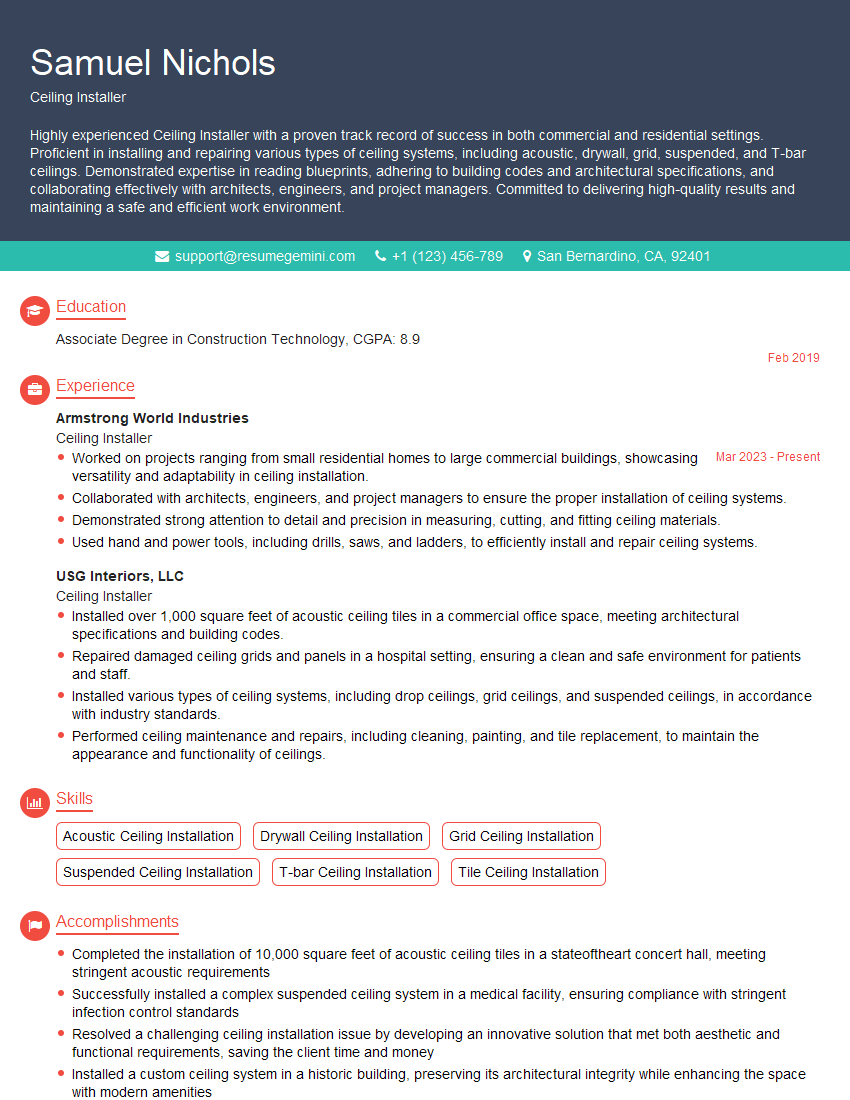
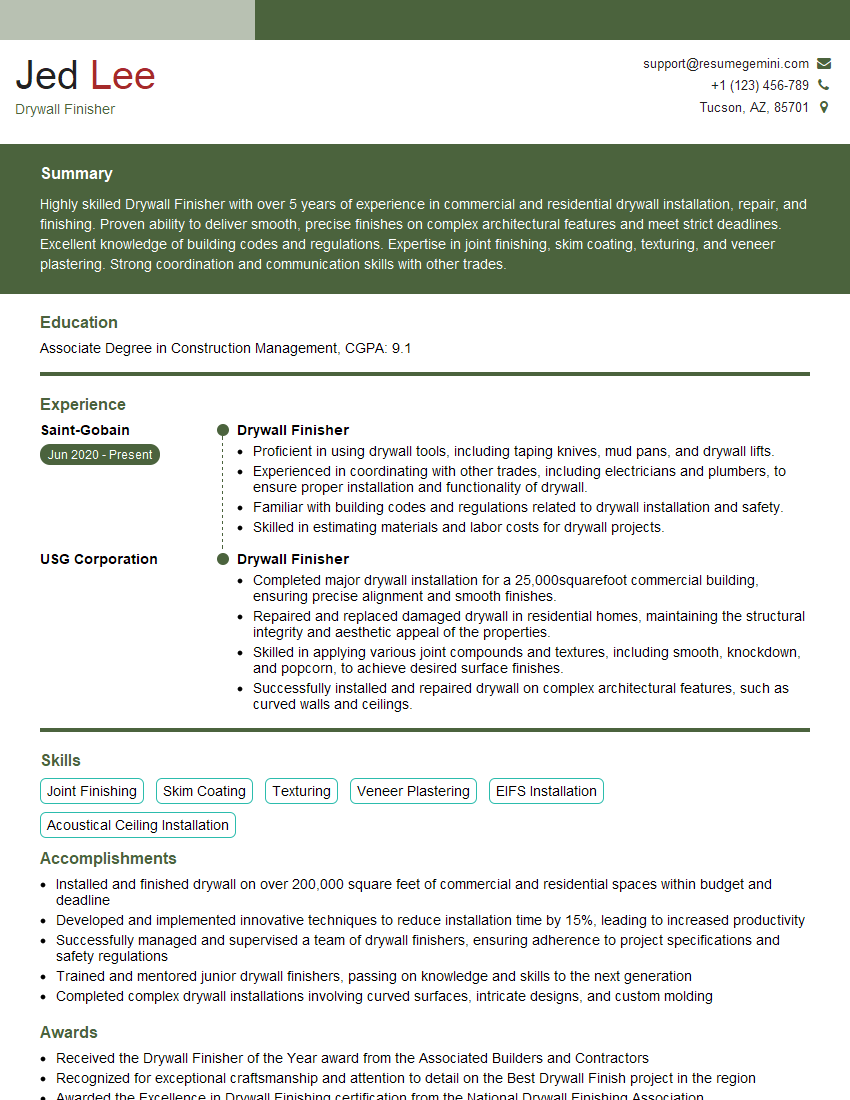
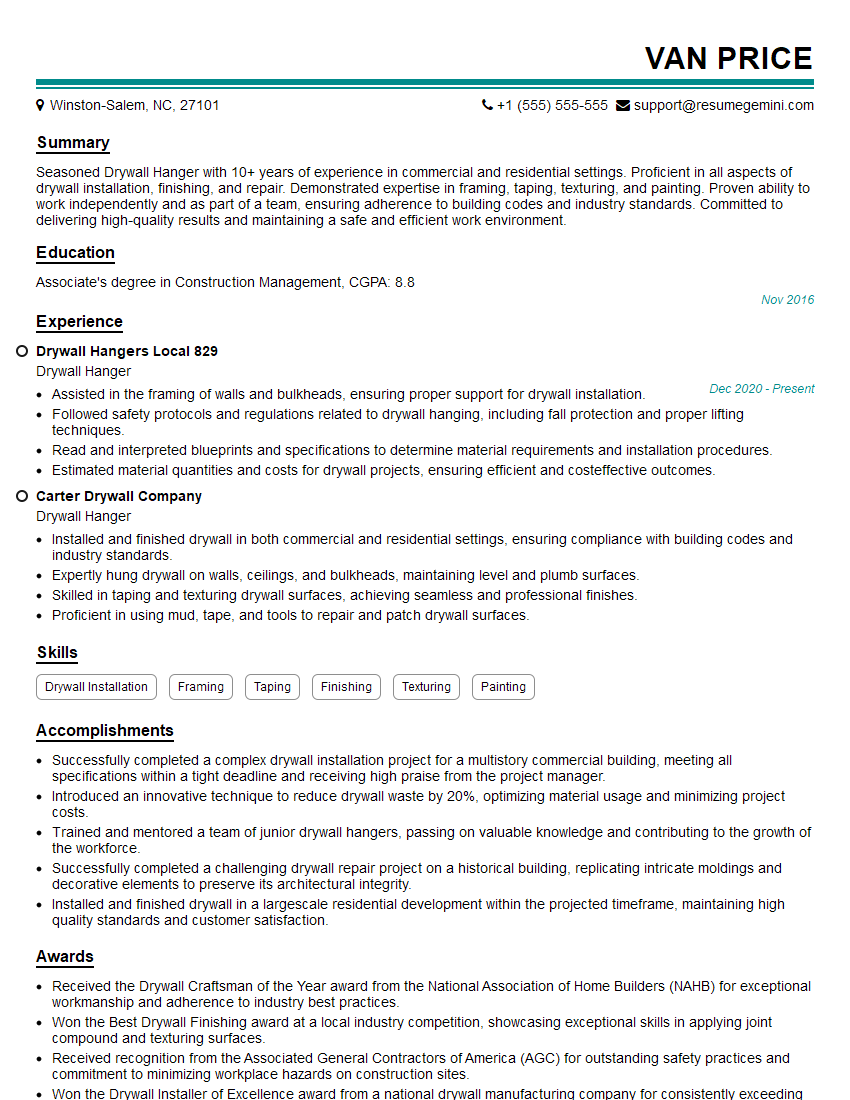
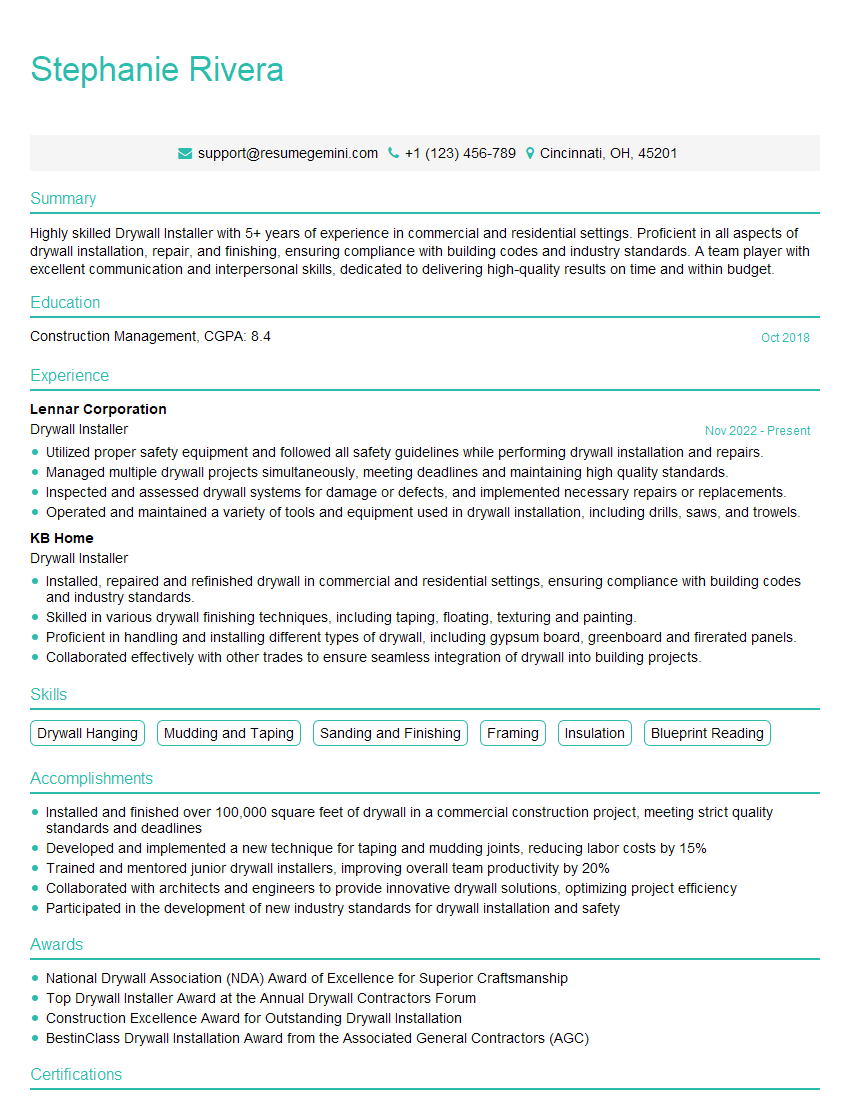
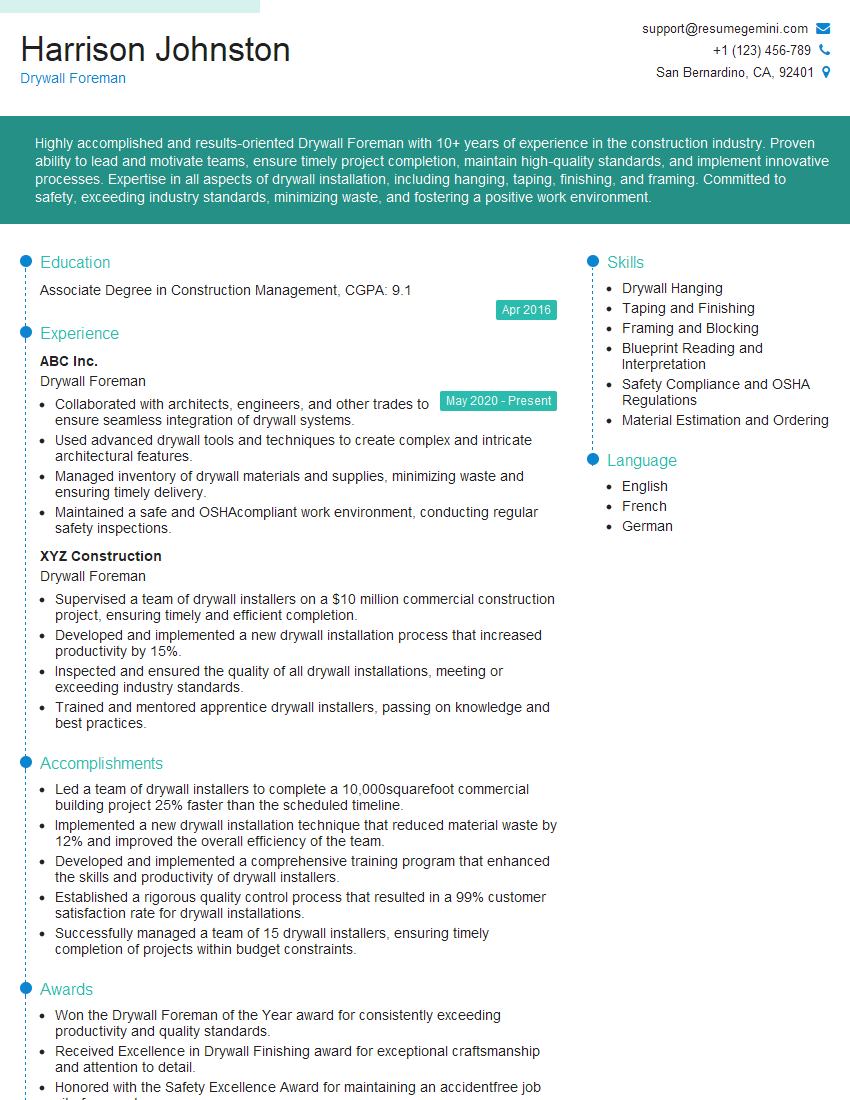
Mastering the skills involved in installing various types of drywall is essential for career advancement in the construction industry, leading to higher pay, increased responsibility, and greater job security. To maximize your job prospects, creating an ATS-friendly resume is critical. ResumeGemini is a trusted resource that can help you build a professional and effective resume that highlights your skills and experience. Examples of resumes tailored to showcasing expertise in installing various types of drywall are available to help you craft a compelling application.

Explore more articles
Users Rating of Our Blogs
Share Your Experience
We value your feedback! Please rate our content and share your thoughts (optional).
What Readers Say About Our Blog
To the interviewgemini.com Webmaster.
Very helpful and content specific questions to help prepare me for my interview!
Thank you
To the interviewgemini.com Webmaster.
This was kind of a unique content I found around the specialized skills. Very helpful questions and good detailed answers.
Very Helpful blog, thank you Interviewgemini team.