Interviews are more than just a Q&A session—they’re a chance to prove your worth. This blog dives into essential Skilled in Installing Drywall Ceilings and Walls interview questions and expert tips to help you align your answers with what hiring managers are looking for. Start preparing to shine!
Questions Asked in Skilled in Installing Drywall Ceilings and Walls Interview
Q 1. Describe your experience with different types of drywall.
My experience encompasses a wide range of drywall types, each with its own properties and applications. I’ve worked extensively with standard 1/2-inch and 5/8-inch gypsum board for general wall and ceiling applications. These are your workhorses – readily available, versatile, and cost-effective. I’m also proficient with moisture-resistant drywall (often green-colored), crucial for bathrooms and kitchens where humidity is a concern. This type resists water damage far better than standard drywall. Furthermore, I’ve used fire-resistant drywall (often pink or purple), especially in areas requiring enhanced fire safety, like stairwells or near fireplaces. Finally, my experience includes working with specialty drywall types like sound-dampening drywall (often a higher density), which is perfect for home theaters or areas requiring noise reduction, and cement board, a durable, water-resistant option often used in exterior applications or shower surrounds. Choosing the correct type is critical for project success and longevity.
Q 2. Explain the process of hanging drywall on a wall.
Hanging drywall on a wall is a systematic process. It starts with preparing the framing, ensuring it’s plumb and square. Then, we measure and cut the drywall sheets to fit, allowing for slight overlaps. Next, we lift the sheet into place, ensuring it’s properly aligned with the framing and adjacent sheets. We use drywall screws, spaced appropriately (typically every 6-8 inches along edges and 12 inches in the field), to fasten the sheet securely to the studs. We use a screw gun for efficiency. After securing the first sheet, we carefully position and fasten subsequent sheets, maintaining consistent spacing and alignment. Always use the correct screw length to avoid puncturing the facing paper or driving the screw too deep.
For example, on a recent project, we encountered an unusually tricky wall with multiple offsets. By pre-planning the cuts and carefully measuring, we avoided significant waste and ensured a clean, professional finish. Using a level at every stage is crucial. A small inconsistency in one area can lead to noticeable problems down the line.
Q 3. How do you ensure proper alignment and spacing of drywall sheets?
Proper alignment and spacing are paramount for a seamless finish. We achieve this through a combination of careful measurement and the use of tools. Before installing any sheet, we use a level and a measuring tape to ensure the framing is plumb and square. This forms the foundation for accurate drywall placement. When hanging each sheet, we use a level to check both vertical and horizontal alignment, making adjustments as needed. Consistent spacing between sheets is essential for a professional look; typical spacing is maintained through carefully measuring and using spacers as needed. This is all about planning and precision. A slight misalignment, particularly on large walls, will be very visible after the finishing process. Always double-check your work; a few minutes spent ensuring precision now will save hours later.
Q 4. What tools and equipment are essential for drywall installation?
The tools and equipment required for efficient drywall installation are varied. Essential tools include a tape measure for accurate measurements, a level to ensure proper alignment, a utility knife for precise cutting, a drywall square for creating accurate 90-degree angles, a drywall saw for cutting around obstructions, a screw gun for fastening the drywall, drywall screws of appropriate length, a trowel for applying joint compound, and putty knives for smoothing the compound. Safety gear such as safety glasses and a dust mask are also crucial. In addition to these hand tools, we may use a lift for larger sheets to ensure safety and efficiency, especially on ceilings.
Depending on the project, we may also utilize specialized tools like a drywall lift or a power taping tool. These greatly aid speed and efficiency, especially on larger projects. Regular maintenance of these tools is key to ensuring longevity and accuracy. A dull blade, for example, can lead to ragged cuts and ultimately impact the finished look.
Q 5. Describe your experience with taping and mudding drywall.
Taping and mudding are critical steps that determine the final appearance of the drywall. After hanging the drywall, we apply drywall tape over the seams, embedding it in a thin layer of joint compound (also known as mud). This creates a smooth, flat surface. We then apply additional coats of mud, allowing each coat to dry completely before applying the next. This process involves several stages: applying the initial coat, feathering the edges, and then adding subsequent coats to achieve a smooth, seamless transition. We usually apply three coats of joint compound, carefully sanding between each coat to achieve a smooth finish. Different types of mud are available for different purposes; often all-purpose mud suffices.
For instance, on one project, we used a lightweight compound for a faster drying time to keep the project on schedule. The key is patience and consistency; rushing this process invariably leads to defects.
Q 6. What techniques do you use to achieve a smooth, seamless finish?
Achieving a smooth, seamless finish requires attention to detail at every stage. Proper preparation, such as ensuring the drywall is properly hung and the seams are straight, is essential. Careful application of the joint compound, ensuring even coats and proper feathering, is critical. Each coat should be allowed to dry completely before sanding. Sanding is a crucial step; using fine-grit sandpaper will remove imperfections, revealing the smooth surface underneath. Finally, a final inspection with bright lighting will identify any remaining inconsistencies that can be addressed before priming and painting. The goal is an invisible seam.
I often use a technique called ‘wet sanding’, which involves lightly sanding the mud while still slightly damp to avoid damaging the surrounding drywall. This gives a better result and reduces dust.
Q 7. How do you handle corners and edges during drywall installation?
Corners and edges require special attention to ensure a professional finish. Interior corners are typically finished using corner bead, a metal or plastic strip that provides a straight, clean edge. The bead is embedded in joint compound and then mudded over to create a smooth, even corner. Exterior corners can be finished using a variety of techniques, including using corner bead or applying a layer of mud that is carefully shaped and sanded to create a smooth, rounded edge. Careful attention to the mudding process at the corners is crucial to prevent cracking and achieve a durable, attractive finish. The tools used here will often be smaller putty knives for more precise work.
I’ve found that using a corner roller tool greatly improves the consistency and efficiency of applying mud to corner bead. It’s a relatively small investment that has dramatically improved my work.
Q 8. What are the different types of drywall tape, and when would you use each?
Drywall tape comes in several types, each suited for different situations. The choice depends on the joint being taped and the desired finish.
- Paper Tape: This is the most common type, inexpensive, and easy to use. It’s ideal for most interior walls and ceilings, especially in areas that will be painted. It’s flexible and conforms well to the joint, making it excellent for straight seams.
- Mesh Tape: Mesh tape, often made of fiberglass, is stronger and more resistant to cracking than paper tape. It’s excellent for high-stress areas like corners or where movement is expected (e.g., near doorways). The embedded mesh provides reinforcement that prevents cracks from showing through the finish.
- Metal Tape: Metal tape is usually aluminum or stainless steel and is used primarily for exterior applications or in extremely high-moisture environments where durability is paramount. It’s less common in interior residential work.
- Self-adhesive Tape: This type eliminates the need for joint compound application before taping. Convenient for smaller projects, it’s faster but might not offer the same long-term strength and durability as traditional paper tape for larger areas.
For example, I’d use paper tape for standard interior walls, mesh tape for the corner bead in a bathroom, and possibly metal tape in a commercial kitchen. The decision depends on the specifics of the project and the desired level of durability.
Q 9. How do you repair damaged or cracked drywall?
Repairing damaged drywall depends on the extent of the damage. Minor cracks can often be fixed with joint compound, while larger holes require patching or replacement.
- Minor Cracks: Clean the crack, apply a thin layer of joint compound, let it dry, sand smooth, and prime before painting.
- Larger Holes: For holes larger than a few inches, use a drywall patch or cut out a section of the damaged drywall and replace it with a new piece. Secure the patch or new piece with screws, apply joint compound in several thin coats, allowing each coat to dry before sanding. A mesh tape reinforcement over the joint will help prevent future cracking.
- Deep Gouges or Punctures: For deeper damage, carefully clean and then use a self-adhering drywall mesh tape to reinforce the hole before applying multiple coats of joint compound to create a smooth surface.
Think of it like patching a road. A small pothole gets filled, a larger section might need replacement, and a huge crater needs a major repair!
Q 10. Explain the process of installing drywall in a vaulted ceiling.
Installing drywall in a vaulted ceiling requires careful planning and execution. The process is more complex than flat ceilings because of the angles and varying heights.
- Measure and Cut: Accurately measure the angles and curves of the ceiling. Pre-cutting drywall pieces to fit is crucial for a clean installation.
- Support System: A robust framework of supporting members, often including furring strips or special metal framing, is necessary to accommodate the irregular shape.
- Strategic Placement: Drywall sheets are installed to minimize waste and seams. Often, this involves cutting and fitting panels along the sloped surfaces.
- Seamless Finish: Special attention is paid to taping and mudding the seams to achieve a smooth, seamless finish, often requiring multiple coats of joint compound and careful sanding between coats.
- Safety First: Extra safety precautions are needed due to the overhead work and potentially awkward angles. Proper harnesses and scaffolding are usually essential.
I’ve worked on numerous vaulted ceilings, and the key is meticulous planning, precise cutting, and patience. It takes extra time but the result is worth it.
Q 11. Describe your experience with installing drywall around windows and doorways.
Installing drywall around windows and doorways requires precision and attention to detail. The goal is to create a neat, finished look that complements the architectural features.
- Accurate Measurement: Precise measurements are essential to ensure the drywall fits snugly around the window or door frame.
- Cutting Techniques: Utilizing a sharp utility knife and/or drywall saw is important for creating clean, precise cuts. It’s crucial to avoid damaging the frame.
- Proper Framing: Ensuring the framing around the window or doorway is square and level is vital to facilitate a smooth drywall installation.
- Taping and Mudding: Careful taping and mudding are needed to create a smooth transition between the drywall and the window/door trim. Often a corner bead is used for the outside corners.
- Caulk Application: Applying caulk between the drywall and trim helps to seal gaps and create a professional finish.
I always take extra care around these areas, as any mistakes are highly visible. It’s all about patience and precision.
Q 12. How do you ensure proper ventilation during drywall installation?
Proper ventilation during drywall installation is important to prevent moisture buildup, which can lead to mold and mildew growth. Drywall absorbs moisture during installation, especially when using joint compound.
- Open Windows and Doors: When working indoors, keep windows and doors open as much as feasible to allow for good air circulation.
- Fans: Use exhaust fans or dehumidifiers to remove excess moisture from the air. This is especially important in smaller or poorly ventilated spaces.
- Avoid Over-application of Mud: Applying too much joint compound at once can trap moisture and hinder drying.
- Proper Drying Time: Allow adequate time for each coat of joint compound to dry completely before sanding and applying the next layer.
Think of it like baking a cake; you need the right temperature and airflow for it to bake properly. The same principle applies to drywall installation.
Q 13. What safety precautions do you take when working with drywall?
Safety is paramount when working with drywall. It’s a physically demanding job with potential hazards.
- Personal Protective Equipment (PPE): Always wear safety glasses or goggles, a dust mask (especially when sanding), gloves, and sturdy work boots. Hearing protection might be necessary if using power tools for extended periods.
- Lifting Techniques: Use proper lifting techniques to avoid back injuries. Never lift more weight than you can comfortably handle. Get help with heavy sheets.
- Tool Safety: Use tools correctly and keep them in good working order. Regularly inspect and maintain power tools to prevent accidents.
- Work Area Safety: Keep the work area clean and organized. Remove debris regularly to prevent tripping hazards.
- Fall Protection: If working at heights, always use appropriate fall protection equipment, such as harnesses and scaffolding.
I’ve seen firsthand the consequences of neglecting safety, so it’s always my top priority. It’s better to be cautious than to suffer a preventable injury.
Q 14. How do you manage and dispose of drywall waste responsibly?
Responsible management and disposal of drywall waste is crucial for environmental protection and compliance with local regulations.
- Waste Minimization: Careful planning and accurate measuring help to minimize waste. Using efficient cutting techniques and using scraps for smaller projects also helps reduce waste.
- Recycling: Many areas have facilities that accept drywall for recycling. Check with your local waste management company for options.
- Landfill Disposal: If recycling isn’t an option, drywall waste must be disposed of in a landfill according to local regulations. Usually, it needs to be separated from other construction debris.
- Hazardous Waste: Be aware of any hazardous materials incorporated into the drywall, like asbestos (in older buildings), and handle them according to safety guidelines and regulations.
I always prioritize responsible disposal. It’s not just about tidying up the job site; it’s about protecting the environment and adhering to regulations.
Q 15. What are the different types of drywall screws and nails?
Drywall screws and nails come in various types, each suited for specific applications. The key differences lie in their material, length, and type of head.
- Screws: These offer superior holding power and are generally preferred. Common types include:
- Self-tapping screws: These screws are designed to cut their own threads into the drywall, making them ideal for most applications. They come in different lengths and gauges. For example, a 1-inch screw is suitable for thinner drywall while a 1 5/8 inch screw is necessary for thicker drywall or when attaching to framing.
- Drywall screws with different head types: These include bugle heads (for a slightly countersunk finish), pan heads (for a flush finish), and wafer heads (for very shallow countersinking).
- Nails: Though less common now, ring-shank nails are sometimes used. Their ringed shank provides more grip than a standard nail.
Choosing the right screw or nail type is crucial for a secure and aesthetically pleasing finish. Using a screw that’s too short will result in a weak hold and potentially visible screw heads, while a screw that’s too long could puncture the framing.
Career Expert Tips:
- Ace those interviews! Prepare effectively by reviewing the Top 50 Most Common Interview Questions on ResumeGemini.
- Navigate your job search with confidence! Explore a wide range of Career Tips on ResumeGemini. Learn about common challenges and recommendations to overcome them.
- Craft the perfect resume! Master the Art of Resume Writing with ResumeGemini’s guide. Showcase your unique qualifications and achievements effectively.
- Don’t miss out on holiday savings! Build your dream resume with ResumeGemini’s ATS optimized templates.
Q 16. Explain the importance of using the correct screws and nails for different applications.
Using the correct fasteners is paramount for drywall installation. The wrong choice leads to problems ranging from loose panels to structural failure. Here’s why it’s so important:
- Material Compatibility: Using the wrong type of fastener can lead to the drywall cracking or the fastener pulling out. For instance, using nails in places designed for screws will often result in the drywall tearing around the nail.
- Holding Power: The length and gauge of the screw directly relate to its holding power. Too short, and the drywall won’t be securely fastened. Too long, and the screw might protrude through the other side. Consider the thickness of the drywall, and the material it’s being screwed into (wood studs, metal studs etc.).
- Appearance: The head type influences the final look. Bagle-head screws are often preferred because they are easier to cover with mud, while pan-head screws provide a flush finish but may require more careful countersinking.
For example, in a high-moisture environment like a bathroom, you might opt for corrosion-resistant screws to prevent rust. In areas with heavy vibrations, extra-long screws might be necessary.
Q 17. How do you calculate the amount of drywall needed for a project?
Calculating drywall quantities requires careful measurement and a bit of math. It’s best to overestimate slightly to account for cuts and waste. Here’s a step-by-step process:
- Measure the area: Measure the length and width of each wall and ceiling section requiring drywall. For irregular shapes, break them into smaller, easily measurable sections.
- Calculate the area: Multiply the length and width of each section to find its area (length x width = area). Add up the area of all sections to get the total square footage.
- Account for waste: Add 5-10% to the total area to account for cuts, mistakes, and unusable pieces. This percentage may need to be increased if dealing with complex shapes or many cutouts.
- Consider panel size: Standard drywall sheets are 4′ x 8′ (32 square feet). Divide the total calculated area (including waste) by 32 to determine the number of sheets needed. Always round up to the nearest whole number.
For instance, if you have 200 square feet of wall area and add 10% for waste (20 square feet), you’ll need approximately 6.9 sheets, so you should order 7 sheets.
Q 18. Describe your experience working with different types of drywall mud.
I’ve worked extensively with various drywall muds, each having unique properties and applications. They range from ‘all-purpose’ to specialty compounds.
- All-purpose joint compound: This is the most common type, ideal for taping and finishing seams. It offers a good balance of setting time and ease of sanding. I’ve used it on countless residential projects.
- Lightweight joint compound: This is lighter than all-purpose compound and is great for large areas, reducing the overall weight of the mud. However, it can be less durable, and may require more coats.
- All-purpose setting type compound:This compound dries faster than the standard all-purpose compound and is good for larger projects where speed is a consideration. However, because it dries fast, it’s more challenging to work with and requires skill to avoid issues.
- Topping compound: Used for the final coat, it creates a very smooth, paintable surface. It’s often finer textured and sands more easily than other compounds. I find this vital for achieving a professional finish.
My experience has taught me that choosing the right mud significantly impacts the final quality and efficiency of the job. The drying time of each compound is a critical factor when planning the project’s timeline.
Q 19. What are the best practices for sanding drywall?
Sanding drywall is crucial for achieving a smooth, paintable surface. It’s a process that requires patience and the right tools. Here’s what I do:
- Use the right tools: I use various grades of sandpaper, from coarse to fine, depending on the stage of sanding. I also prefer a sanding pole for larger areas. This reduces arm fatigue and makes it easier to achieve a uniform finish.
- Start coarse, finish fine: I begin with a coarser grit (like 80-100 grit) to remove the bulk of the imperfections. Then I progressively move to finer grits (120-180 grit, and even 220 for a super-smooth finish). This ensures the surface is smooth without creating unnecessary dust.
- Sand evenly: Avoid over-sanding in one area, which could create low spots. Use long, even strokes and keep the sandpaper moving. A random orbital sander can be useful on large, flat surfaces, but attention must be paid to edges.
- Clean thoroughly: After sanding, I thoroughly clean the surface to remove all dust before priming and painting. A vacuum cleaner with a brush attachment is best, followed by a tack cloth to pick up any remaining dust particles. This prevents imperfections from showing through the paint.
Proper sanding makes all the difference in the final appearance of the drywall. A well-sanded surface provides a great base for paint, minimizing the appearance of any imperfections.
Q 20. How do you prepare a surface for drywall installation?
Surface preparation is the foundation of a successful drywall installation. A poorly prepared surface leads to problems down the line. My process typically includes:
- Cleaning: Removing any loose debris, dust, cobwebs, and existing paint that is chipping or flaking. Pressure washing can be helpful for exterior walls. Using a wire brush for any rust on metal studs.
- Repairing: Addressing any structural issues such as cracks, holes, or unevenness in the existing wall or ceiling. This may involve patching and filling large holes with appropriate patching compounds.
- Priming: Applying a primer to the existing wall or ceiling surface. This helps to seal the surface and provides a better base for the drywall.
- Framing: For new construction, ensuring the framing is square, plumb, and level is essential. Any discrepancies will show through the drywall.
Think of it like building a house: You wouldn’t start building walls on a shaky foundation, would you? Similarly, a well-prepared surface guarantees a flawless drywall installation.
Q 21. How do you handle issues such as uneven walls or ceilings?
Uneven walls and ceilings are common challenges, and addressing them properly is key to a quality finish. My approach involves:
- Assessing the unevenness: First, I use a level and a straight edge to pinpoint exactly where the deviations occur and how significant they are.
- Minor imperfections: For slight imperfections, shimming behind the drywall or using thicker layers of mud might suffice. This might involve placing thin wood shims or even using self-adhesive foam strips between the studs and drywall.
- Significant unevenness: For significant unevenness, I might use furring strips to create a more level surface before installing the drywall. These are thin strips of wood attached to the existing structure to create a perfectly level surface for the drywall.
- Drywall patching: If there are substantial holes or repairs required, I will use a patching compound to fill the voids and level the surface before finishing. Once dry, I will sand the areas smooth. This can also be applied to create a level surface across a larger area.
These methods work in tandem to provide a consistent surface, no matter the existing wall or ceiling conditions. The goal is always to create a perfect plane for the drywall to rest upon, thereby ensuring an excellent finished product.
Q 22. What is your experience with using a drywall lift?
Drywall lifts are indispensable for safely and efficiently installing drywall on ceilings. My experience encompasses operating various models, from manual lifts to powered ones. I’m proficient in assembling and disassembling them, ensuring they’re properly balanced and secured before each use. Safety is paramount; I always conduct thorough pre-lift checks, including verifying the load capacity and securing the drywall sheets to prevent slippage. Using a lift significantly reduces strain on the body, improving worker safety and boosting productivity, especially when handling larger or heavier sheets.
For instance, on a recent project involving 12-foot ceilings, the drywall lift allowed us to install sheets quickly and accurately, minimizing the risk of back injuries. We could also maneuver sheets into tighter corners with greater ease than manual handling would allow. Proper usage, including the use of safety straps and ensuring even weight distribution, is critical for avoiding accidents.
Q 23. Describe your experience with different types of drywall finishing tools.
My experience spans a wide range of drywall finishing tools, including various types of knives (6”, 8”, 12”), taping knives (6”, 12”), and putties (pre-mixed and powder). I am adept at using different types of sanding tools, from hand sanding blocks to power sanders with various grits. The choice of tool depends on the specific task and desired finish. For example, a 6” knife is ideal for feathering edges, while a 12” knife is better for applying a wider, smoother coat of mud. I’m also familiar with specialized tools like corner rollers and corner beads for creating clean, consistent corners.
Furthermore, I understand the importance of maintaining tools. Proper cleaning and sharpening of knives are critical to achieving a smooth, professional finish. A dull knife will create ridges and uneven surfaces, requiring additional work to rectify. This attention to detail helps ensure quality workmanship and reduces time spent on rework.
Q 24. How do you troubleshoot common drywall installation problems?
Troubleshooting drywall installation problems requires a systematic approach. Common issues include uneven seams, nail pops, cracks, and surface imperfections. I start by carefully inspecting the problem area to determine the root cause. For example, nail pops often indicate inadequate fastening or movement in the framing. Uneven seams typically stem from improper taping or mud application. Cracks might indicate structural issues or settling.
My troubleshooting process typically involves:
- Identifying the problem.
- Determining the root cause (e.g., faulty framing, improper installation techniques, etc.).
- Selecting the appropriate repair method (e.g., re-nailing, additional mud coats, crack repair, etc.).
- Implementing the repair.
- Inspecting the repair to ensure it’s successful.
For instance, if I encounter nail pops, I would first check the framing for movement or looseness. If found, I’d address the framing issue before re-nailing and applying additional mud to fill the popped nail hole. Experience allows me to quickly diagnose and effectively solve these issues, minimizing rework and project delays.
Q 25. Describe a time you had to problem-solve a complex drywall installation issue.
On one project, we encountered a particularly challenging situation involving an oddly shaped room with multiple angles and recessed areas in the ceiling. Standard drywall sheets wouldn’t fit without significant waste and difficult cutting. To solve this, we collaborated as a team and created a detailed plan involving precise measurements and custom-cut drywall panels. We utilized specialized cutting tools and templates to ensure perfectly fitting pieces. This meticulous approach minimized waste and resulted in a flawless, aesthetically pleasing finish. This experience highlighted the importance of careful planning and teamwork in overcoming complex installation challenges.
The problem was not just cutting the drywall, but also ensuring the taped seams were invisible. Careful planning involved pre-cutting the sheets to minimize visible seams in high-traffic areas. The success depended on clear communication and careful coordination within the team.
Q 26. Explain your understanding of building codes and regulations related to drywall.
My understanding of building codes and regulations concerning drywall is comprehensive. I’m familiar with local, state, and national codes addressing fire resistance ratings, moisture resistance, and installation methods. This includes knowing the requirements for different types of drywall in various applications, such as fire-rated walls and moisture-resistant bathrooms. I understand the importance of proper fastener spacing and the necessity of using approved materials and techniques to meet code requirements. I ensure that every project adheres to these standards to guarantee a safe and compliant structure.
For example, in areas requiring fire-rated drywall, I would carefully select the appropriate type and thickness, ensuring the correct number of fasteners are used and spaced accordingly. Ignoring these regulations can lead to costly mistakes and potential safety hazards.
Q 27. What is your experience with acoustical drywall?
I have experience installing acoustical drywall, which is specifically designed to reduce noise transmission. This type of drywall often has a higher density or incorporates sound-dampening materials. The installation process is similar to standard drywall, but extra care is needed to ensure proper sealing of seams to maximize sound absorption. This involves using special tapes and compounds designed for acoustical applications. The proper preparation of the framing is also critical for effective sound dampening.
For example, in a home theater or recording studio, acoustical drywall is crucial for creating a quiet and controlled acoustic environment. Incorrect installation could negate the benefits of using this specialized material.
Q 28. Describe your experience working as part of a team on large-scale drywall projects.
I’ve consistently worked as part of a team on large-scale drywall projects. Effective teamwork is crucial for efficiency and safety. My approach involves open communication, clear task delegation, and mutual respect among team members. I’m comfortable taking initiative, offering assistance to colleagues, and following directions from project leads. This collaborative approach ensures that tasks are completed on time and to the highest standards. I believe in fostering a positive team environment where everyone feels valued and empowered to contribute their skills.
On a recent large commercial project, our team successfully installed drywall in a large warehouse within the allotted timeframe. This was achieved through careful planning, efficient workflow, and open communication among all team members. Effective teamwork allowed us to handle any unexpected issues quickly and efficiently, maintaining the project schedule.
Key Topics to Learn for Skilled in Installing Drywall Ceilings and Walls Interview
- Understanding Drywall Types: Learn the properties and applications of different drywall types (e.g., moisture-resistant, fire-resistant) and when to use each.
- Framing and Measurement Techniques: Master accurate measurement, layout, and preparation of framing for both walls and ceilings, including understanding different framing techniques.
- Cutting and Handling Drywall: Develop proficiency in safely and accurately cutting drywall sheets to size, minimizing waste and ensuring clean cuts.
- Installation Techniques: Practice proper installation methods for both walls and ceilings, including fastening techniques, joint taping, and mudding.
- Joint Finishing and Taping: Master the art of creating smooth, seamless joints using various taping and mudding techniques to achieve professional-looking finishes.
- Finishing Techniques (Sanding, Priming): Understand the importance of proper sanding and priming for a high-quality finish, ensuring a smooth surface ready for paint.
- Safety Procedures and Regulations: Demonstrate a thorough understanding of relevant safety regulations and procedures, including proper use of tools and personal protective equipment (PPE).
- Troubleshooting Common Issues: Learn to identify and solve common problems encountered during drywall installation, such as uneven surfaces, cracks, and damage repair.
- Tools and Equipment Knowledge: Familiarize yourself with the various tools and equipment used in drywall installation and their proper usage and maintenance.
- Building Codes and Regulations: Understand relevant building codes and regulations related to drywall installation in your area.
Next Steps
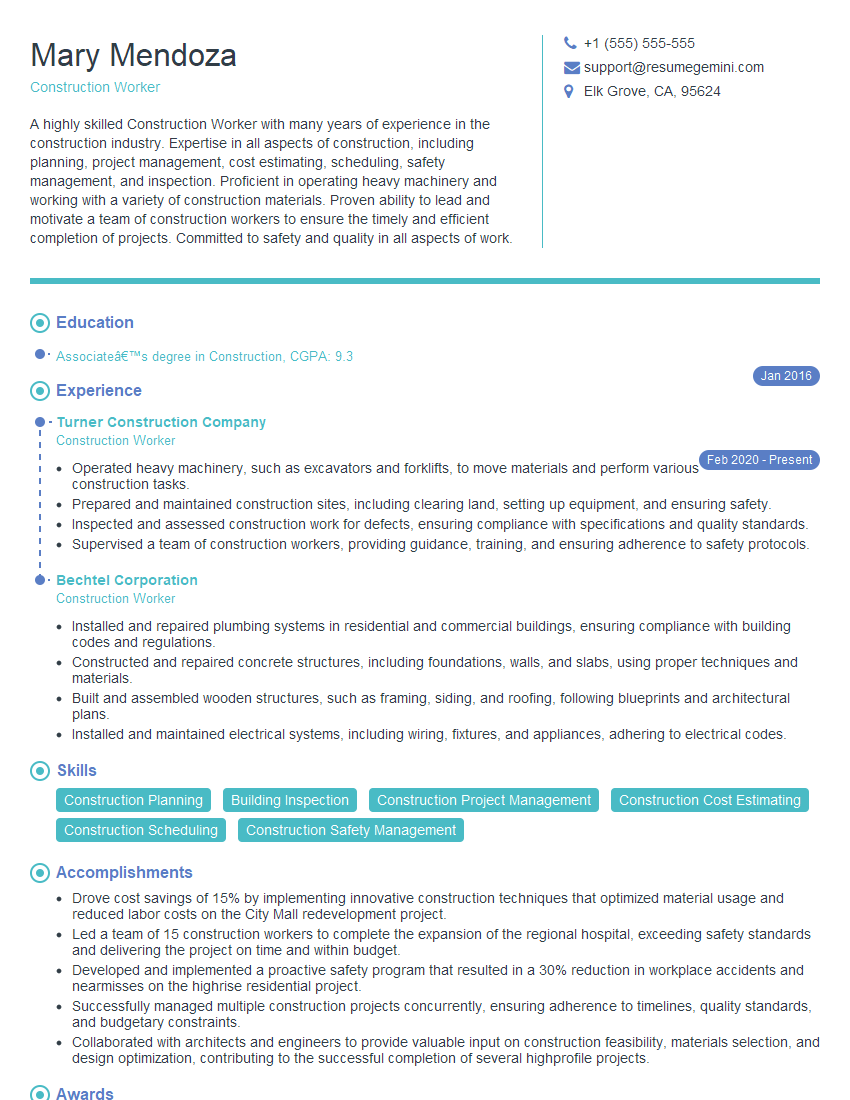
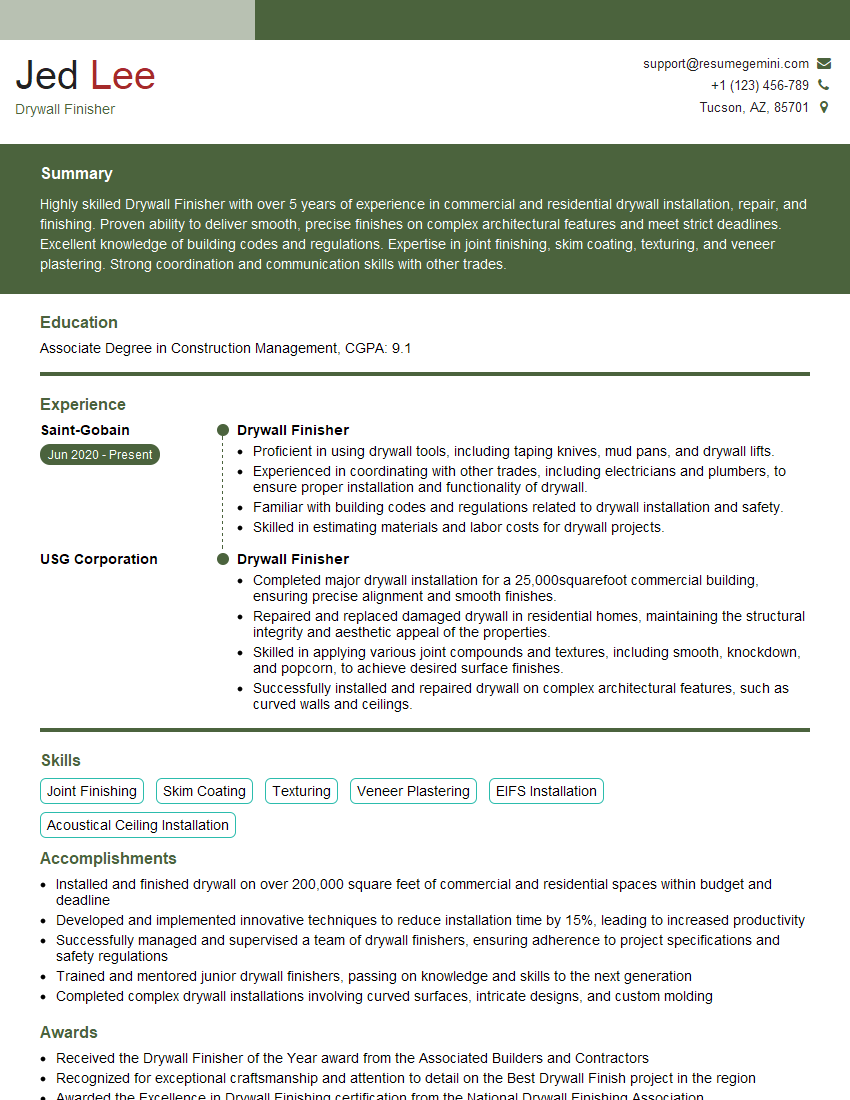
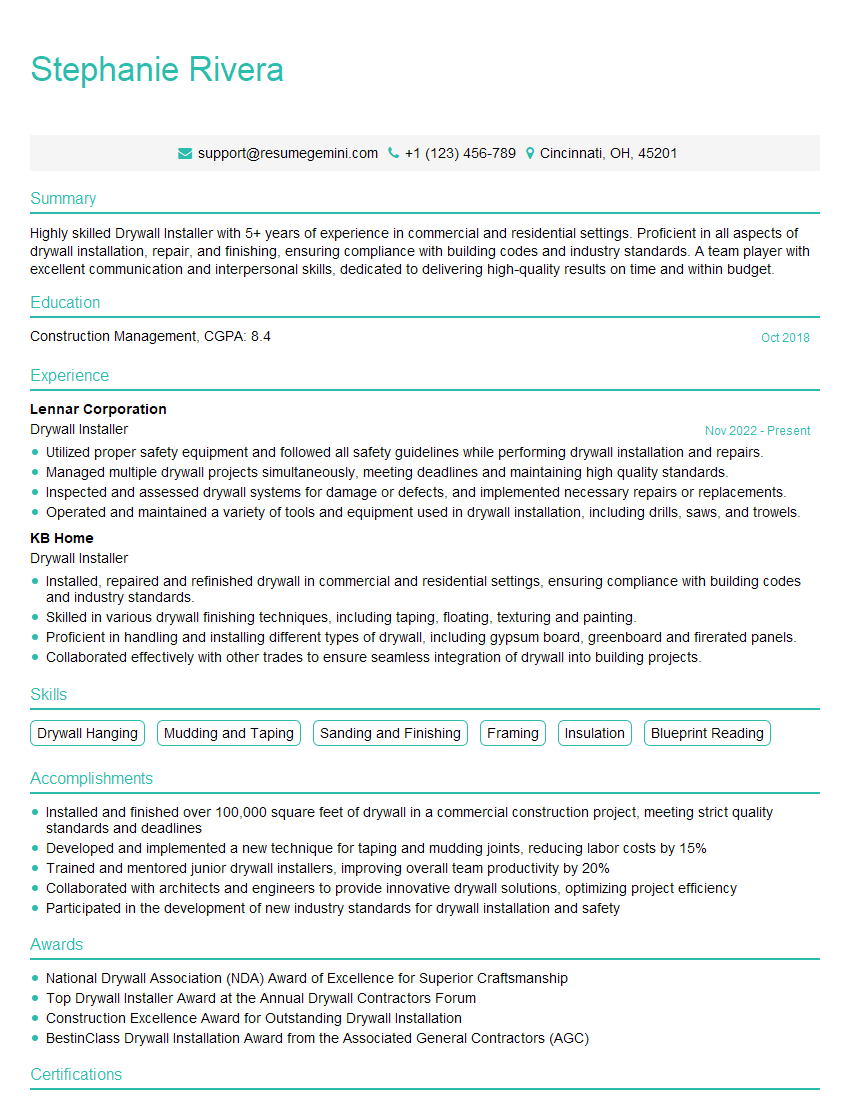
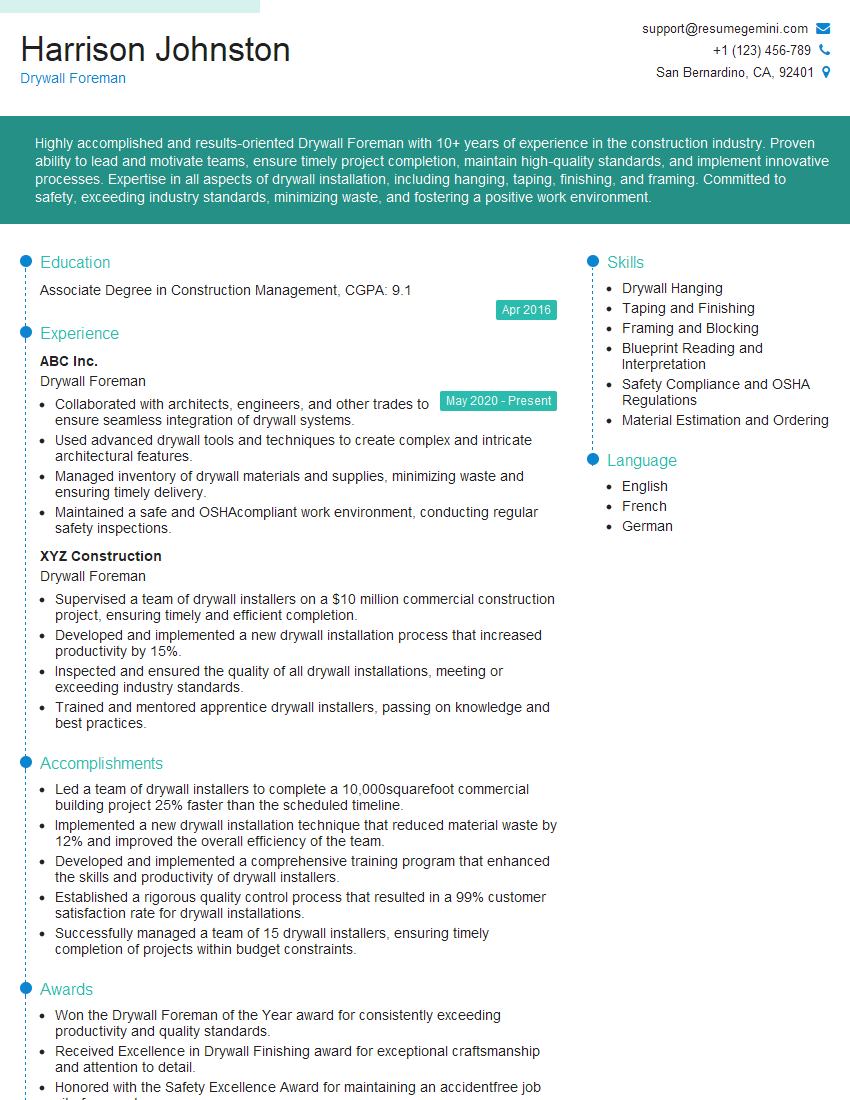
Mastering the skills of installing drywall ceilings and walls opens doors to exciting career opportunities with excellent growth potential. A strong understanding of these techniques is highly valued in the construction industry, leading to higher pay and increased responsibility. To significantly boost your job prospects, it’s crucial to create a professional and ATS-friendly resume that showcases your abilities effectively. ResumeGemini is a trusted resource that can help you build a compelling resume that highlights your expertise. We provide examples of resumes tailored to the specific skills of installing drywall ceilings and walls to help you get started.


Explore more articles
Users Rating of Our Blogs
Share Your Experience
We value your feedback! Please rate our content and share your thoughts (optional).
What Readers Say About Our Blog
To the interviewgemini.com Webmaster.
Very helpful and content specific questions to help prepare me for my interview!
Thank you
To the interviewgemini.com Webmaster.
This was kind of a unique content I found around the specialized skills. Very helpful questions and good detailed answers.
Very Helpful blog, thank you Interviewgemini team.