Feeling uncertain about what to expect in your upcoming interview? We’ve got you covered! This blog highlights the most important Troubleshooting of Cellular Antennas interview questions and provides actionable advice to help you stand out as the ideal candidate. Let’s pave the way for your success.
Questions Asked in Troubleshooting of Cellular Antennas Interview
Q 1. Explain the concept of SWR (Standing Wave Ratio) and its significance in antenna troubleshooting.
Standing Wave Ratio (SWR) is a crucial metric that indicates how well a transmitter’s power is being transferred to an antenna and subsequently radiated. Think of it like a water pipe – if the pipe is perfectly matched to the water flow (transmitter power), the water (power) flows smoothly. If there’s a mismatch, you get reflections and turbulence. A low SWR (ideally close to 1:1) indicates efficient power transfer, while a high SWR means significant power is being reflected back towards the transmitter, leading to reduced signal strength, overheating of equipment, and potential damage.
In antenna troubleshooting, SWR is measured using an SWR meter. A high SWR immediately points to problems in the antenna system, such as a faulty antenna, a damaged coaxial cable, or an impedance mismatch between the antenna and the transmitter. For instance, if we measure an SWR of 3:1, we know there’s a significant mismatch and need to investigate the system thoroughly to identify the source of the reflection.
Q 2. Describe different types of cellular antennas and their applications.
Cellular antennas come in various types, each suited for specific applications:
- Panel Antennas: These are wideband antennas, offering coverage across multiple frequency bands and are commonly used in indoor or outdoor deployments where a wide coverage area is needed but not necessarily high gain.
- Sector Antennas: These are directional antennas, emitting signals in a specific sector (typically 60, 90, or 120 degrees). They’re ideal for cellular base stations where focused signal coverage is desired within a particular area. Think of it like a spotlight, providing concentrated coverage instead of spreading it everywhere like a floodlight.
- Omni-directional Antennas: These antennas radiate signals in all directions, making them useful for applications where coverage in all directions is needed, such as in rural areas with dispersed populations.
- Yagi Antennas (High-gain directional): These are more directional and provide significantly higher gain than sector antennas, making them useful for long-distance transmission or to cover a specific, far-off area.
The choice of antenna depends on factors like the coverage area required, the frequency bands used, the environment (urban vs. rural), and the desired signal strength.
Q 3. How do you troubleshoot a low signal strength issue on a cellular site?
Troubleshooting low signal strength at a cellular site is a systematic process:
- Check the antenna’s physical condition: Look for any signs of damage, corrosion, or loose connections. A physically damaged antenna or corroded connectors can significantly impair performance.
- Measure the SWR: A high SWR indicates a mismatch somewhere in the transmission line. Identify and correct the source of the mismatch.
- Verify cabling: Inspect coaxial cables for damage, cuts, or poor connections. Even minor damage can degrade signal quality and lower the signal strength.
- Analyze signal quality at the base station: Check the received signal strength indicator (RSSI) and signal-to-noise ratio (SNR) to determine the overall quality of the incoming signal from the antenna.
- Perform a site survey: Assess the surrounding environment for obstacles interfering with the signal path, such as buildings, trees, or other antennas.
- Check the antenna alignment: Ensure the antenna is correctly aligned with the base station or the intended coverage area. Minor misalignments can lead to significant signal strength degradation.
- Test the antenna with a signal generator and spectrum analyzer: A detailed analysis can reveal problems not easily found through simple measurements.
Each step allows us to isolate the problem and pinpoint the source of low signal strength.
Q 4. What are the common causes of antenna misalignment, and how do you diagnose them?
Antenna misalignment is a common issue caused by several factors:
- Environmental factors: Strong winds, ice, or other weather conditions can physically move or damage the antenna, leading to misalignment.
- Installation errors: Incorrect initial installation or improper tightening of mounting hardware can result in misalignment over time.
- Tower movement/settling: The tower itself may move or settle slightly, altering the antenna’s alignment.
- Structural damage: Damage to the supporting structure holding the antenna.
Diagnosing misalignment involves:
- Visual inspection: Carefully examine the antenna and its mounting structure for any obvious signs of misalignment or damage.
- Signal strength measurements: Compare received signal strength with expected values. A significant drop can point towards misalignment.
- Azimuth and elevation adjustments: Use test equipment to precisely adjust the antenna’s azimuth (horizontal) and elevation (vertical) angles to optimize signal strength and pattern.
- Using specialized alignment tools: Tools like signal level meters or spectrum analyzers can aid precise alignment. For example, using a compass can give a initial check, but a signal level meter will give a much more accurate indication of the antenna’s pointing direction.
Q 5. Explain the process of performing a site survey for cellular antenna installation.
A site survey for cellular antenna installation is crucial for optimal performance. It involves:
- Identifying the coverage area: Determine the geographical area requiring cellular coverage.
- Analyzing the propagation environment: Assess the terrain, obstacles (buildings, trees, hills), and potential sources of interference.
- Choosing antenna type and location: Select the appropriate antenna type (panel, sector, omni-directional) based on the required coverage pattern and gain. The location will be determined through consideration of signal path obstruction and environmental factors.
- Predictive modeling: Use specialized software to simulate signal propagation and optimize antenna placement for maximum coverage and minimal interference.
- On-site measurements: Use test equipment like signal analyzers to measure signal strength and quality at different locations within the coverage area, allowing for verification of the model.
- Regulatory compliance: Ensure the antenna installation complies with local regulations and zoning laws, this includes considering any potential interference issues with other existing services.
- Safety considerations: Plan for safe access and working conditions during the installation process.
A thorough site survey ensures the antenna is optimally positioned for maximum coverage and efficiency, preventing costly mistakes and future performance issues.
Q 6. How do you identify and resolve issues related to antenna impedance mismatch?
Antenna impedance mismatch occurs when the impedance of the antenna doesn’t match the impedance of the transmission line (usually 50 ohms). This leads to reflections of power back towards the transmitter, causing the issues mentioned in the SWR explanation. Imagine trying to fit a square peg into a round hole – it won’t fit perfectly, and some of the power is wasted.
Identifying and resolving an impedance mismatch involves:
- Measure the SWR: A high SWR value immediately indicates a mismatch.
- Check connectors and cables: Ensure all connectors are securely tightened and that the coaxial cables are in good condition. Damaged connectors or cables are common causes.
- Use an impedance analyzer: This will precisely measure the impedance of the antenna itself to identify if there is an inherent mismatch within the antenna.
- Use impedance matching devices: If the problem lies in the mismatch between the antenna and the transmission line, an impedance matching transformer or balun can help resolve this. They transform the impedance to create a closer match.
- Verify correct antenna installation: If any modifications were done to the antenna, check installation steps to ensure they are in line with manufacturer specifications.
It’s important to note that impedance matching devices may reduce signal strength by a small percentage so it is advisable to test these to measure the signal strength before and after installation to check if it is worth the risk. In most situations though, using impedance matching devices are essential to achieve the signal quality needed.
Q 7. What are the safety precautions you take when working with cellular antennas on towers?
Safety is paramount when working with cellular antennas on towers. The following precautions are essential:
- Proper training and certification: All personnel should have the necessary training and certifications for working at heights and with RF equipment.
- Fall protection: Use appropriate fall arrest systems, harnesses, and safety lines at all times. This is arguably the most important safety aspect.
- Lockout/Tagout procedures: Implement lockout/tagout procedures to prevent accidental energization of equipment.
- RF safety measures: Use RF safety monitoring equipment to ensure exposure levels are within safe limits. Understand RF radiation and its potential health effects. Limit exposure time to radio frequencies to as low as reasonably practical.
- Weather awareness: Postpone work if weather conditions (high winds, lightning, ice) pose a safety risk.
- Proper communication: Establish clear communication procedures among team members.
- Use of appropriate tools and equipment: Ensure that all tools and equipment used for the task are in good condition and are fit for purpose. In addition, make sure the tools and equipment have up-to-date safety checks.
- Emergency preparedness: Have an emergency action plan in place and ensure everyone knows what to do in case of an accident.
Safety should always be the top priority. Neglecting these precautions can result in serious injury or death.
Q 8. Describe your experience with different antenna testing equipment.
My experience with antenna testing equipment spans a wide range of instruments, from basic signal generators and spectrum analyzers to sophisticated network analyzers and antenna pattern measurement systems. I’m proficient in using network analyzers like the Keysight E5071C or Rohde & Schwarz ZNB to measure S-parameters (reflection and transmission coefficients), crucial for evaluating antenna impedance matching and performance. For antenna pattern measurements, I’ve worked extensively with near-field and far-field scanners, such as those from ETS-Lindgren, which provide detailed radiation diagrams. I also have experience with power meters to measure the radiated power from the antenna and signal generators to provide the input signal for testing. Furthermore, I’m familiar with specialized software for analyzing and interpreting the data obtained from these instruments, enabling me to create comprehensive antenna performance reports.
For instance, during a recent project involving a rooftop cellular antenna array, I utilized a network analyzer to identify a mismatch in one of the antenna elements, leading to significant signal reflection and reduced efficiency. This was pinpointed through detailed S-parameter analysis, ultimately resolving the issue with a precise impedance tuner.
Q 9. How do you interpret the results of an antenna pattern analysis?
Antenna pattern analysis reveals how an antenna radiates power in different directions. The results, typically presented as a 3D radiation pattern or 2D polar plots, show gain (signal strength) and beamwidth (the antenna’s directional focus). I interpret these patterns to understand the antenna’s coverage area and identify potential blind spots or areas of signal weakness. For example, a highly directional antenna might have a narrow beamwidth, providing strong signals in a specific direction but weak signals in others.
A typical pattern will show several key metrics: gain (in dBi or dBd), beamwidth (azimuth and elevation), sidelobe levels (unwanted radiation in directions other than the main beam), and front-to-back ratio (the ratio of signal strength in the main direction versus the opposite direction). Interpreting these parameters is vital for optimizing antenna placement and ensuring optimal coverage. For example, low gain would suggest the antenna needs to be replaced, while high sidelobe levels might indicate interference issues. Analyzing the pattern in conjunction with site surveys and propagation models provides a holistic understanding of cellular antenna performance in the deployed environment.
Q 10. What are the different types of connectors used with cellular antennas, and how do you ensure proper connection?
Cellular antennas use a variety of connectors, including N-type, SMA, TNC, and 7/16 DIN. The choice depends on the frequency, power handling capabilities, and environmental factors. N-type connectors are common for high-power applications, while SMA connectors are smaller and often used in test equipment and lower power applications. Ensuring proper connection is critical to avoid signal loss and impedance mismatches, which lead to poor performance.
My approach involves carefully inspecting the connector for damage and ensuring it is securely tightened. I use appropriate torque wrenches to avoid over-tightening and damaging the connector. I also visually inspect for any corrosion or damage to the connector pins, cleaning them if necessary. Testing with a network analyzer confirms proper impedance matching after making connections. Failure to use the correct connectors or to secure them properly can lead to significant signal degradation, so precise handling and quality control is crucial.
Q 11. How do you troubleshoot interference issues affecting cellular antenna performance?
Troubleshooting interference affecting cellular antenna performance involves a systematic approach. It begins with identifying the source and type of interference: Is it co-channel interference (another cellular signal on the same frequency), adjacent channel interference (signals on nearby frequencies), or perhaps interference from other RF sources (radios, microwaves)?
I use spectrum analyzers to pinpoint the frequency and strength of interfering signals. Techniques like site surveys, which involve measuring signal strength at various locations, help identify the source and its impact on the cellular antenna’s performance. Solutions might include adjusting the antenna’s position or orientation to minimize interference, employing interference filters to block unwanted signals, or coordinating with other RF users to resolve frequency conflicts. In some cases, upgrading to a higher-gain antenna or employing diversity techniques (using multiple antennas) can mitigate interference effects. A detailed record of these steps helps in preventative measures and future problem-solving.
Q 12. Explain your experience with different types of antenna polarization.
Antennas utilize two main polarization types: linear (vertical or horizontal) and circular (right-hand or left-hand). Linear polarization means the electric field oscillates in a single plane, while circular polarization has the electric field rotating in a circle. The choice of polarization is crucial for optimizing signal propagation and minimizing interference. For instance, vertical polarization is common in many cellular systems.
My experience includes working with both types of polarization. I understand that mismatched polarization between transmitting and receiving antennas results in signal loss, sometimes significantly impacting performance. I also understand the impact environmental factors, such as reflections from buildings, can have on polarization. Therefore, choosing the right polarization and ensuring proper orientation in the deployment is paramount. For example, during a project in a dense urban environment, employing circular polarization improved signal reception despite numerous multipath reflections, showcasing the importance of polarization considerations in complex scenarios.
Q 13. How do you diagnose and resolve issues related to RF cable damage?
Diagnosing RF cable damage begins with visual inspection for physical damage – kinks, cuts, crushing, or water ingress. I also check connectors for corrosion or damage. The use of a time domain reflectometer (TDR) is critical to pinpoint the exact location of damage within the cable. A TDR sends a signal down the cable and measures the reflections caused by impedance discontinuities, which indicate damage. The time taken for a reflection to return corresponds to the distance from the point of damage.
Once the location of damage is identified, the section of the cable needs replacing. Proper grounding and shielding are essential throughout the repair process. After replacement, I conduct thorough testing with a network analyzer to verify that the signal integrity is restored and the impedance matching is optimal. Ignoring even minor cable damage can significantly reduce signal strength and introduce noise, so it’s crucial to address these problems promptly to ensure reliable performance.
Q 14. What are the factors that affect cellular antenna performance?
Many factors influence cellular antenna performance. These can be broadly categorized as environmental, antenna-related, and signal-related.
- Environmental Factors: Obstructions (buildings, trees, terrain), multipath propagation (signal reflections), weather conditions (rain, snow), and atmospheric conditions all affect signal strength and quality.
- Antenna-Related Factors: Antenna gain, polarization, beamwidth, impedance matching, construction quality, and mounting position influence the antenna’s ability to radiate and receive signals effectively.
- Signal-Related Factors: Signal frequency, modulation scheme, transmitter power, and interference from other RF sources impact the overall performance of the cellular antenna system.
Understanding the interplay of these factors is vital for optimizing antenna placement and maximizing signal strength and quality. For example, a high-gain antenna might be beneficial in an open area but might create unwanted interference in a congested area. Similarly, adverse weather conditions necessitate antennas with specific features to withstand these environmental challenges. A thorough understanding and careful consideration of these factors leads to improved cellular network performance.
Q 15. Describe your experience with remote antenna monitoring systems.
My experience with remote antenna monitoring systems spans several years, encompassing various technologies and deployments. I’ve worked extensively with systems that provide real-time data on key performance indicators (KPIs) such as signal strength, reflection coefficient (SWR), and tilt angle. This data is crucial for proactive maintenance and troubleshooting. For instance, I used a system that alerted us to a significant drop in signal strength from a remote tower during a severe thunderstorm. This early warning allowed us to dispatch a technician before a complete service outage occurred, minimizing downtime and customer disruption. I’m familiar with both proprietary and open-source solutions, and I understand the importance of data security and integrity in these systems. My expertise also includes integrating remote monitoring data with other network management tools for holistic network performance analysis.
Specifically, I’m proficient in analyzing data from systems that utilize various communication protocols, including cellular networks themselves, and dedicated telemetry systems like LoRaWAN for low-power, long-range communication. I am adept at configuring these systems for optimal data acquisition and interpreting trends in the collected data to predict potential issues before they affect service.
Career Expert Tips:
- Ace those interviews! Prepare effectively by reviewing the Top 50 Most Common Interview Questions on ResumeGemini.
- Navigate your job search with confidence! Explore a wide range of Career Tips on ResumeGemini. Learn about common challenges and recommendations to overcome them.
- Craft the perfect resume! Master the Art of Resume Writing with ResumeGemini’s guide. Showcase your unique qualifications and achievements effectively.
- Don’t miss out on holiday savings! Build your dream resume with ResumeGemini’s ATS optimized templates.
Q 16. How do you troubleshoot a problem with a cellular antenna’s grounding system?
Troubleshooting a cellular antenna’s grounding system is critical for both performance and safety. Poor grounding can lead to signal degradation, noise, and even lightning strikes damaging equipment. My approach is systematic. First, I visually inspect all grounding connections, looking for corrosion, loose connections, or broken wires. Think of grounding like the earth itself – it’s a massive conductor that safely dissipates energy. Any break in this path compromises its effectiveness. I use a multimeter to measure the resistance between the antenna ground point and the earth ground. A low resistance (ideally below 1 ohm) indicates a good ground. High resistance suggests a problem. I then trace the grounding path, checking every connection, including the grounding rods (driven into the earth), the grounding wire itself, and the connections to the antenna mast and equipment. If a high resistance is found, I might need to clean corroded connections, replace damaged wire, or even install additional grounding rods to improve the earth connection. Often, a corroded connection can look deceptively intact – a thorough check with a multimeter is essential.
Q 17. What are the common causes of signal fading or shadowing, and how do you mitigate them?
Signal fading and shadowing are common issues in cellular networks. Fading is the fluctuation of signal strength due to multipath propagation (the signal bouncing off multiple surfaces). Shadowing, on the other hand, occurs when obstacles, like buildings or hills, obstruct the direct path between the antenna and the device. Consider a city; tall buildings create ‘shadow zones’ with weak signals. To mitigate these, several strategies can be employed. For fading, techniques like diversity reception (using multiple antennas) and adaptive modulation (adjusting signal characteristics to the channel conditions) help. For shadowing, we might need to strategically place additional antennas in areas with poor coverage, increasing the density of the network or employing more directional antennas.
Sometimes, signal interference from other sources like other wireless devices or electronic equipment can mimic fading and shadowing. A site survey and careful analysis of the frequency spectrum with a spectrum analyzer (explained below) can help isolate and address such interference. Proper antenna placement and careful selection of frequency bands are also vital in minimizing interference. Another crucial strategy is using appropriate antenna gain – a higher gain antenna can help in areas with a weak signal, but can also exacerbate interference.
Q 18. Explain your experience using spectrum analyzers in antenna troubleshooting.
Spectrum analyzers are indispensable tools in antenna troubleshooting. They allow us to visualize the radio frequency (RF) spectrum, identifying signal strengths, frequencies, and potential sources of interference. I’ve extensively used spectrum analyzers to detect interference from adjacent channels, rogue transmitters, or even harmonics (multiple signals at integer multiples of the fundamental frequency) generated by faulty equipment. For instance, I once used a spectrum analyzer to find a source of significant interference in a building; it turned out to be a malfunctioning microwave oven operating on the same frequency as a part of our cellular network. The analyzer allowed us to pinpoint the source and resolve the interference problem. My experience covers various types of analyzers, from portable handheld devices to sophisticated laboratory-grade instruments, each with its specific capabilities and strengths. I understand how to correctly set up and operate these instruments, interpreting the displayed data to identify and resolve RF issues.
Q 19. How do you document your troubleshooting process and findings?
Thorough documentation is essential for effective troubleshooting. My documentation process includes a detailed description of the problem, the steps taken to diagnose it, the tools and equipment used, and the final solution implemented. This is usually done using a combination of methods. For instance, I begin by creating a comprehensive report in a word processor detailing all observations and test results, accompanied by photos or sketches documenting the physical state of equipment and its placement. Test data like signal strength measurements, SWR readings, and spectrum analyzer screenshots are incorporated into the report. I often use specialized software to log and visualize data from remote monitoring systems. This allows me to track trends over time and proactively identify potential issues. The final report is crucial for communication with clients, and also allows for easier problem-solving in the future, should similar issues arise.
Q 20. Describe your experience with different types of antenna mounting hardware.
My experience with antenna mounting hardware encompasses a wide range of types, including tower mounts (guyed towers, self-supporting towers), rooftop mounts, wall mounts, and various mast-mounted solutions. Each type has its own unique challenges and considerations regarding structural integrity, wind load capacity, and ease of installation. I’m familiar with different materials used, such as steel, aluminum, and fiberglass. I also have experience with various clamping mechanisms and securing methods. I understand the importance of selecting the appropriate hardware to match the specific antenna size, weight, wind load requirements, and location. Improperly chosen mounting hardware can lead to antenna failure, damage to equipment, and even personal injury. I would also include experience with grounding hardware for optimal safety and signal integrity.
Q 21. How do you ensure the structural integrity of a cellular antenna installation?
Ensuring the structural integrity of a cellular antenna installation is paramount. I always start with a thorough site survey to assess the location’s environmental conditions, including wind speeds, potential ice loading, and seismic activity. Based on this assessment, I select the appropriate mounting hardware and anchoring methods to withstand the anticipated loads. Detailed calculations are performed to determine the required strength and stability of the structure, considering the weight of the antenna, mast, and mounting hardware. Regular inspections are also crucial for detecting any signs of deterioration or damage, like corrosion or loosening of connections. Safety is paramount; I always adhere to all relevant safety regulations and use appropriate safety equipment during installation and maintenance. Any necessary repairs or reinforcements are documented and carried out promptly to prevent catastrophic failures. Ultimately, a well-engineered and maintained antenna installation ensures long-term reliability, safety, and optimal network performance.
Q 22. What are the regulatory compliance considerations for cellular antenna installations?
Regulatory compliance for cellular antenna installations is crucial for safe and efficient operation, and varies by location. It involves adherence to rules set by governing bodies like the FCC (Federal Communications Commission) in the US, Ofcom in the UK, or similar agencies globally. These regulations cover aspects like:
- Maximum permissible radiation levels: Antennas must operate within specified limits to prevent harmful exposure to electromagnetic radiation. This is usually measured in Specific Absorption Rate (SAR) and involves careful site surveys and power level adjustments.
- Frequency allocation: Each antenna must operate on assigned frequencies to avoid interference with other services. Incorrect frequency usage can lead to significant penalties and service disruptions. This necessitates careful planning and coordination.
- Structural integrity: Antennas must be securely mounted to withstand environmental factors like wind load and ice accumulation. This involves considerations of mounting structures, grounding, and material strength, often requiring engineering certifications.
- Environmental impact: Considerations such as avian impact (birds colliding with antennas) and visual impact (aesthetic concerns) might require special mitigation strategies and permits.
- Height restrictions: Regulations often stipulate maximum antenna heights, impacting signal coverage. Obtaining necessary clearances from aviation authorities is frequently involved for tall structures.
Non-compliance can lead to hefty fines, equipment seizure, and operational shutdowns. Thorough site surveys, meticulous planning, and adherence to all applicable local and national regulations are paramount.
Q 23. How do you handle unexpected issues during an antenna installation or repair?
Unexpected issues during antenna installations or repairs are commonplace. My approach involves a systematic troubleshooting methodology:
- Safety First: Always prioritize safety. Secure the work area, use proper Personal Protective Equipment (PPE), and de-energize equipment when necessary.
- Gather Information: What is the specific problem? What has changed? Document any error messages, visual observations (damaged components), or changes made prior to the problem occurring.
- Visual Inspection: Carefully examine all components for physical damage, loose connections, or corrosion. This often reveals the root cause immediately.
- Testing and Measurement: Use appropriate tools like spectrum analyzers, signal generators, and RF power meters to measure signal strength, SWR (Standing Wave Ratio), and impedance matching. Compare these readings to expected values. This is where experience with specific antenna types is invaluable.
- Isolating the Problem: Systematically check each part of the antenna system (cable, connectors, antenna itself, mounting hardware, etc.). This helps pinpoint the fault quickly.
- Consult Documentation: Refer to the manufacturer’s specifications, installation guides, and troubleshooting manuals. Many issues are addressed within these documents.
- Escalation: If the issue is beyond my expertise, or if safety concerns arise, I always escalate the problem to senior personnel immediately.
- Documentation: Thoroughly document all actions, measurements, and resolutions. This aids future troubleshooting and maintains a professional record.
For example, once, during a high-wind event, an antenna feedline was damaged. A visual inspection quickly identified the damage, allowing us to replace the section and restore service promptly.
Q 24. Explain your experience troubleshooting issues related to antenna diversity.
Antenna diversity is a technique used to improve signal reliability and quality by employing multiple antennas. Troubleshooting issues often involves pinpointing signal path problems.
Common issues with antenna diversity systems include:
- Unequal signal strength between antennas: This can be caused by uneven cable lengths, poor connector quality, or one antenna being poorly positioned. I’d use a spectrum analyzer to measure the signal levels from each antenna individually, and then adjust antenna positioning or cable lengths as needed.
- Improper combining network issues: The combining network (the device that combines the signals from multiple antennas) can fail. I’d inspect the combining network for damaged components or incorrect settings. Replacement might be necessary.
- Interference from other sources: Interference on one antenna path can degrade performance. A spectrum analyzer helps identify the interference source, and solutions could include adjusting antenna orientation, using filters, or changing frequencies.
- Software/controller malfunction: In complex systems, the control software might malfunction. Diagnostics and software updates can resolve this. In one instance, a malfunctioning diversity combiner caused significant signal degradation; a simple software reset resolved this, preventing downtime.
My approach involves a careful examination of each component of the diversity system, verifying signal strength at each point, and using test equipment to identify the source of the problem.
Q 25. What software or tools do you use for antenna modeling and simulation?
Antenna modeling and simulation are essential for predicting antenna performance before installation. I regularly utilize software such as:
- 4NEC2: A free, powerful antenna modeling program that accurately predicts radiation patterns, gain, and impedance. It’s great for designing and optimizing antenna performance.
- CST Studio Suite: A commercially available, high-fidelity electromagnetic simulation software. Its advanced features are useful for complex antenna designs and detailed analyses of signal propagation.
- MATLAB with antenna toolboxes: MATLAB, with its signal processing and antenna toolboxes, allows for customized antenna simulations, ideal for research and development.
These tools allow me to simulate antenna performance in various scenarios, optimize placement for maximum signal strength, and minimize interference. For example, using 4NEC2, I recently optimized the placement of several antennas on a cell tower, improving coverage in a previously shadowed area by nearly 15%.
Q 26. Describe your experience with different types of antenna tuning units.
Antenna Tuning Units (ATUs) are crucial for matching the impedance of an antenna to the transmission line, maximizing power transfer and minimizing signal reflections (SWR). I have experience with various types:
- Manual ATUs: These require manual adjustment of inductors and capacitors for impedance matching. They are simple but less precise and require skill to operate.
- Automatic ATUs: These automatically adjust the impedance matching based on the measured SWR. They provide more accurate matching and are more convenient but can be more complex.
- Solid-state ATUs: These use solid-state components for impedance matching, offering faster switching speeds and increased reliability. This is a newer generation of ATU and offers a compact, efficient solution.
Choosing the appropriate ATU depends on the specific application. For example, in a situation with changing antenna loads, an automatic ATU is a better option than a manual one. I prioritize choosing ATUs that meet the power handling requirements of the antenna and ensure proper impedance matching for optimal performance.
Q 27. How do you prioritize troubleshooting tasks in a high-pressure environment?
In high-pressure environments, prioritizing troubleshooting tasks is paramount. My approach follows a risk-based prioritization system:
- Criticality: Identify the most critical systems first. Are any safety systems affected? Is there significant service disruption to many users? The most impactful issues get top priority.
- Impact: Assess the potential impact of each issue. A small issue with minimal impact can wait longer than a major outage affecting hundreds of customers.
- Urgency: How quickly does the problem need to be resolved? Some issues require immediate attention, while others allow for a more measured response.
- Ease of Resolution: Sometimes, a quick fix can alleviate a significant part of the problem. I tackle these readily solvable issues first to make rapid progress.
- Resource Allocation: Consider the resources needed to resolve each issue. If an issue requires specialized expertise or equipment that is unavailable, it might need to be placed lower in the priority queue.
This risk-based approach, coupled with effective communication with stakeholders, ensures that resources are focused on the most impactful problems first, while still addressing other issues in a timely manner. This approach maintains customer satisfaction and efficiency under pressure.
Key Topics to Learn for Troubleshooting of Cellular Antennas Interview
- Antenna Fundamentals: Understanding antenna types (e.g., panel, omni-directional), gain, beamwidth, polarization, and impedance matching. Practical application: explaining how these parameters affect signal strength and coverage.
- Signal Propagation: Knowledge of factors affecting signal propagation such as path loss, multipath fading, and interference. Practical application: diagnosing weak signal issues by considering environmental factors and identifying potential sources of interference.
- RF Measurement Techniques: Familiarity with tools and techniques for measuring signal strength, SWR (Standing Wave Ratio), and other relevant RF parameters. Practical application: describing the process of troubleshooting a cellular antenna using a spectrum analyzer or signal strength meter.
- Troubleshooting Methodology: A systematic approach to troubleshooting, including identifying the problem, isolating the cause, and implementing a solution. Practical application: outlining a step-by-step process for diagnosing and resolving a cellular antenna issue.
- Cellular Network Technologies: Understanding different cellular technologies (e.g., 4G LTE, 5G NR) and their impact on antenna requirements. Practical application: explaining how antenna design and placement considerations differ between various cellular generations.
- Antenna Installation and Maintenance: Best practices for antenna installation, grounding, and maintenance to ensure optimal performance. Practical application: describing safe and effective procedures for installing and maintaining cellular antennas.
- Troubleshooting Common Issues: Identifying and resolving common antenna problems such as poor connectivity, signal drops, and interference. Practical application: providing solutions for specific scenarios, like dealing with a noisy antenna or a faulty connector.
Next Steps
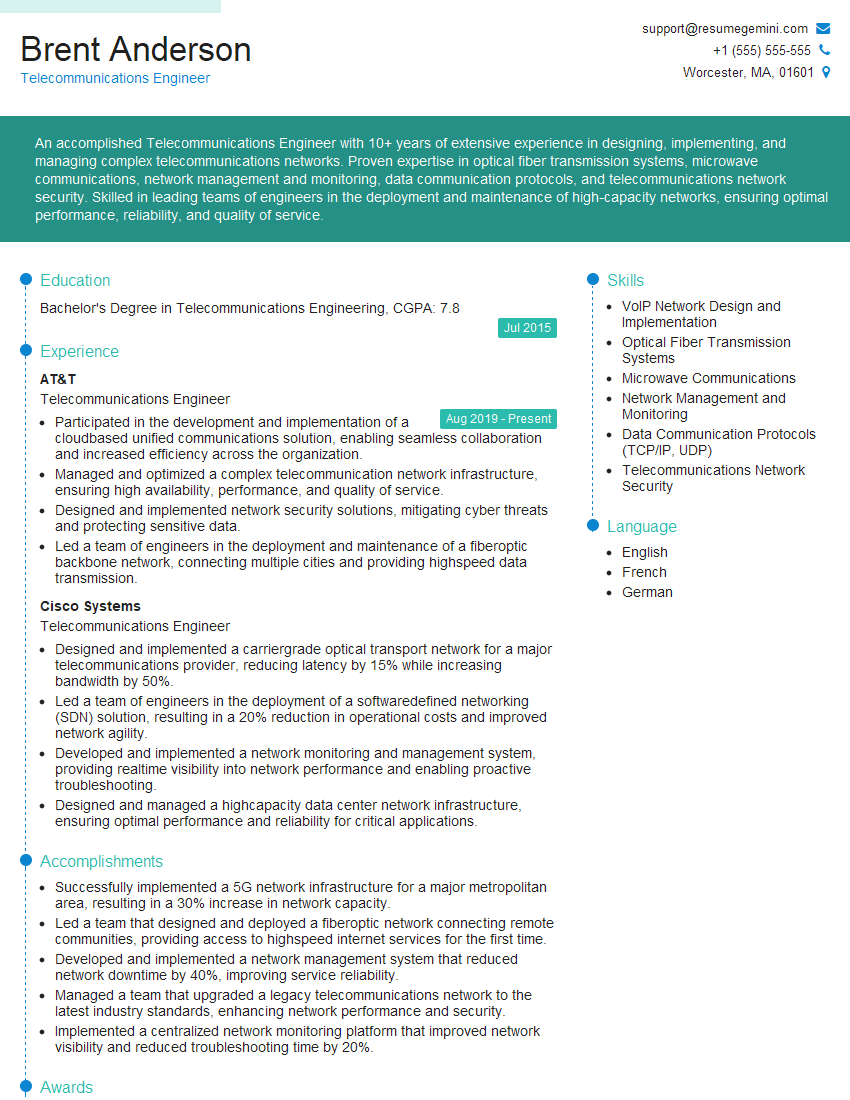
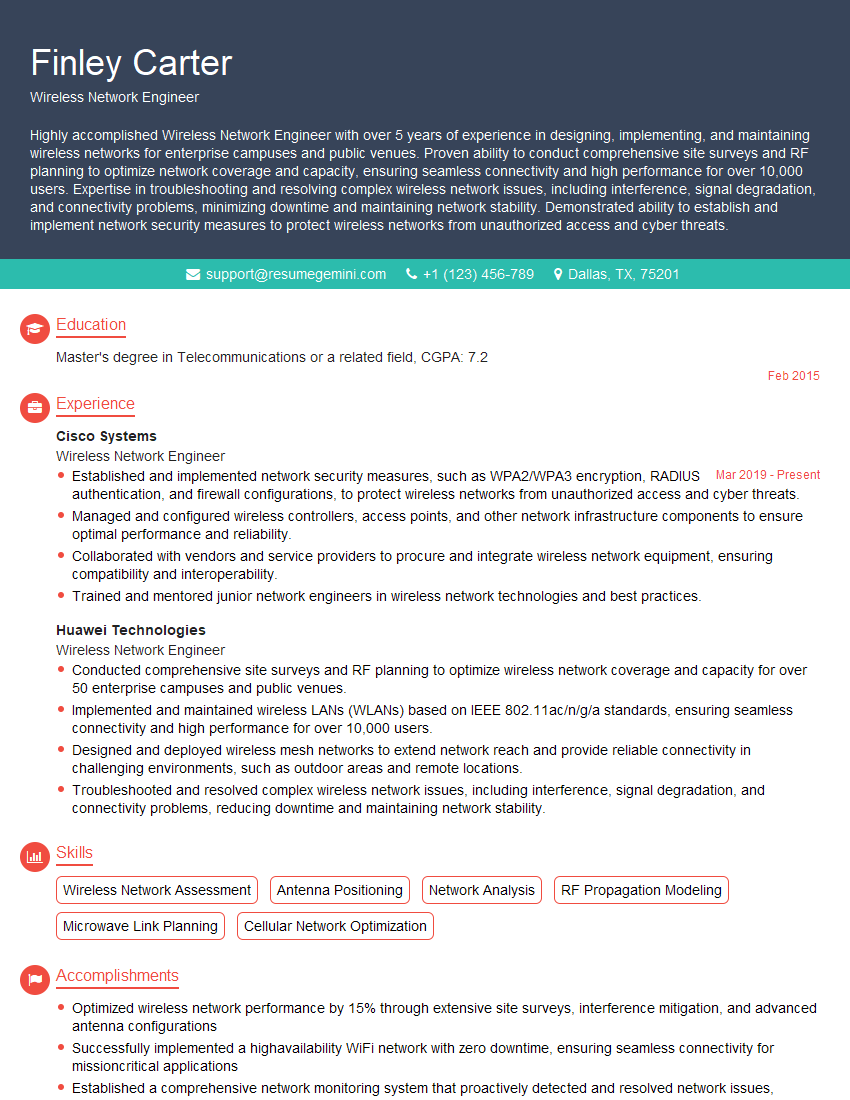
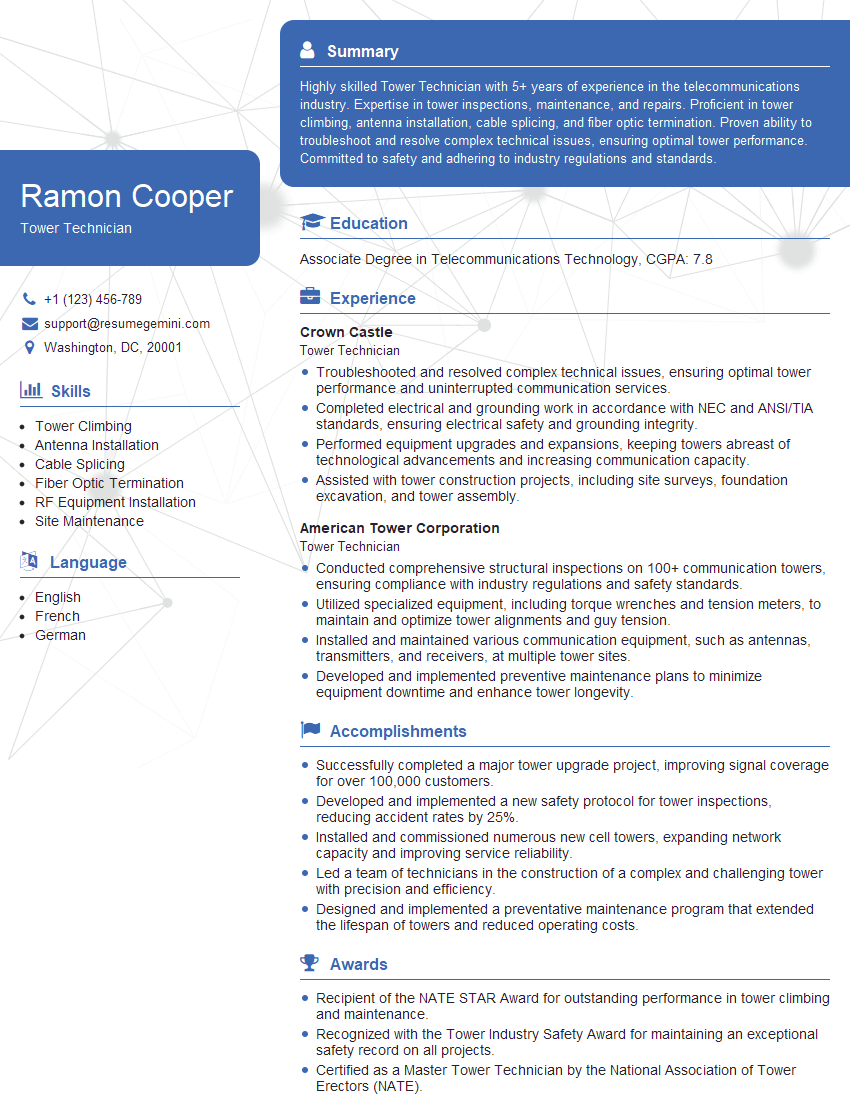
Mastering the troubleshooting of cellular antennas is crucial for career advancement in the telecommunications industry, opening doors to specialized roles and higher earning potential. An ATS-friendly resume is essential for getting your application noticed by recruiters. To create a compelling resume that highlights your skills and experience in this specialized field, we highly recommend using ResumeGemini. ResumeGemini provides the tools and resources to craft a professional and effective resume, and we offer examples of resumes tailored specifically to Troubleshooting of Cellular Antennas to help you get started. Take the next step towards your dream career today!

Explore more articles
Users Rating of Our Blogs
Share Your Experience
We value your feedback! Please rate our content and share your thoughts (optional).
What Readers Say About Our Blog
To the interviewgemini.com Webmaster.
Very helpful and content specific questions to help prepare me for my interview!
Thank you
To the interviewgemini.com Webmaster.
This was kind of a unique content I found around the specialized skills. Very helpful questions and good detailed answers.
Very Helpful blog, thank you Interviewgemini team.