Preparation is the key to success in any interview. In this post, we’ll explore crucial Hadoop, Spark, and Hive interview questions and equip you with strategies to craft impactful answers. Whether you’re a beginner or a pro, these tips will elevate your preparation.
Questions Asked in Hadoop, Spark, and Hive Interview
Q 1. Explain the Hadoop Distributed File System (HDFS) architecture.
HDFS, the Hadoop Distributed File System, is the cornerstone of Hadoop, designed to store and process massive datasets across a cluster of commodity hardware. Imagine a giant library, but instead of books, it holds your data files. This library is distributed across many computers, allowing for parallel processing and high availability.
Its architecture is based on a master-slave model:
- NameNode: This is the ‘librarian,’ managing the file system’s metadata. Think of it as a catalog containing the location of every file and directory in the distributed system. It’s a single point of failure, so high availability configurations are crucial.
- DataNodes: These are the ‘shelves’ where the actual data blocks are stored. Each DataNode reports its status and available storage to the NameNode. Data is replicated across multiple DataNodes for fault tolerance.
When you access a file, the NameNode tells the DataNodes where the relevant data blocks reside, and those DataNodes stream the data to the client. This distributed architecture makes HDFS incredibly scalable and fault-tolerant.
Example: A large company might store petabytes of log data across many DataNodes. If one DataNode fails, the data is still accessible from the replicas stored on other DataNodes.
Q 2. What are the different types of Hadoop clusters?
Hadoop clusters can be categorized based on their deployment and architecture:
- Standalone Cluster: This is a single-node setup, primarily used for testing and development. It lacks the distributed processing capabilities of larger clusters.
- Pseudo-Distributed Cluster: All Hadoop daemons (NameNode, DataNode, etc.) run on a single machine, but they act as if they were on a cluster. Useful for learning and experimentation, but not for production use.
- Fully Distributed Cluster: This is a true distributed system with multiple machines acting as NameNodes, DataNodes, and other Hadoop components. This setup provides high availability and scalability, ideal for handling massive datasets in a production environment.
- Cloud-Based Cluster: These clusters leverage cloud services like AWS EMR, Azure HDInsight, or Google Dataproc. They offer scalability and ease of management, reducing the need for on-premises infrastructure management.
Q 3. Describe the MapReduce programming paradigm.
MapReduce is a programming model that simplifies processing large datasets across a Hadoop cluster. It’s based on two core phases:
- Map Phase: This phase takes the input data and applies a user-defined
mapfunction to each data record. Think of it as transforming raw data into key-value pairs. For instance, if you are counting word occurrences, themapfunction would take each line of text and output key-value pairs where the key is the word and the value is 1. - Reduce Phase: This phase gathers all the key-value pairs produced by the
mapphase with the same key and applies a user-definedreducefunction to them. In the word count example, thereducefunction would sum up all the values associated with each word, giving you the total count for each word.
Example (Python-like pseudocode):
map(line): # Input: line of text for word in line.split(): yield (word, 1) reduce(word, counts): # Input: word, list of counts return (word, sum(counts))MapReduce’s power lies in its ability to distribute the map and reduce operations across multiple machines, allowing for parallel processing and significant speed improvements when handling large datasets.
Q 4. What are the advantages and disadvantages of using Hadoop?
Advantages of Hadoop:
- Scalability: Handles massive datasets effortlessly by distributing processing across many machines.
- Fault Tolerance: Data replication and automatic recovery mechanisms ensure high availability.
- Cost-Effectiveness: Utilizes commodity hardware, reducing infrastructure costs compared to proprietary solutions.
- Flexibility: Supports various data formats and processing frameworks.
Disadvantages of Hadoop:
- Complexity: Setting up and managing a Hadoop cluster can be complex, requiring specialized skills.
- Performance Overhead: Data movement across the network can introduce performance overhead, especially for smaller datasets or tasks with low data locality.
- Limited Real-time Processing: Primarily designed for batch processing; real-time analytics may require additional tools.
- Skill Requirement: Requires specialized expertise for optimal utilization.
Q 5. Explain the concept of data locality in Hadoop.
Data locality in Hadoop refers to the principle of processing data where it resides to minimize data movement and maximize processing efficiency. Imagine you need to build a bookshelf: it’s much more efficient to bring the books (data) to the shelf (processing node) than to move the shelf to each book.
Hadoop strives to achieve high data locality. When a task needs to process a data block, the Hadoop scheduler tries to assign that task to a DataNode that already has that block. This reduces network traffic and significantly speeds up processing. If high data locality isn’t possible, the data needs to be transferred, leading to performance penalties.
Example: If a map task needs to process a data block stored on DataNode A, the ideal scenario is that the task is executed on DataNode A itself. If this is not possible, Hadoop will attempt to schedule it on a node that is relatively close.
Q 6. What are the different types of joins in Hive?
Hive supports various types of joins to combine data from different tables, mirroring SQL’s join functionalities:
- INNER JOIN: Returns rows only when there is a match in both tables. Think of it as finding common ground between two datasets.
- LEFT (OUTER) JOIN: Returns all rows from the left table (the one specified before
LEFT JOIN) and matching rows from the right table. If no match exists in the right table, it will fill inNULLvalues. - RIGHT (OUTER) JOIN: Similar to
LEFT JOIN, but returns all rows from the right table and matching rows from the left table.NULLvalues are added for missing matches in the left table. - FULL (OUTER) JOIN: Returns all rows from both tables. If a match exists, the corresponding rows are combined; otherwise,
NULLvalues are used to fill the missing data. - CROSS JOIN (Cartesian Product): Combines each row from the first table with every row from the second table. This usually leads to a significantly larger result set and should be used cautiously.
Q 7. How does Hive optimize query execution?
Hive optimizes query execution using several strategies:
- Predicate Pushdown: Filters applied to the query (
WHEREclause) are pushed down to the underlying data storage (HDFS) to reduce the amount of data processed. Imagine only fetching the relevant sections of a book, instead of reading the whole thing. - Vectorization: Hive uses vectorized processing to perform operations on multiple rows simultaneously, resulting in improved performance.
- MapReduce Optimization: Hive leverages advanced MapReduce techniques to minimize the number of mappers and reducers needed, reducing execution time and resource consumption.
- Statistics Collection: Hive collects statistics about tables and partitions, such as data size and cardinality, which aid in choosing the most efficient query plan.
- Tez/Spark Execution Engine: Using execution engines such as Tez or Spark replaces the traditional MapReduce engine, resulting in much faster query processing.
- Code Generation: Hive generates efficient execution plans and code, optimizing data processing for performance.
These optimization techniques are crucial for efficient query processing in Hive, enabling efficient handling of massive datasets, even with complex queries.
Q 8. Explain the use of partitioning and bucketing in Hive.
Partitioning and bucketing in Hive are optimization techniques to improve query performance and data management. They both involve dividing your data into smaller, more manageable chunks, but they differ in their approaches and goals.
Partitioning divides a table into disjoint subsets based on a column value (or multiple columns). Think of it like creating folders to organize files – each folder contains files with a similar characteristic. For instance, you might partition a sales table by date (e.g., year=2023, month=10) to quickly access sales data for a specific month. This dramatically improves query speed because Hive only needs to scan the relevant partitions, not the entire table.
Bucketing, on the other hand, distributes data rows evenly across multiple files based on a hash of a column value. This is like creating a library catalog system with specific shelves for each book category. Bucketing enables efficient joins on the bucketed column. If two tables are bucketed on the same column using the same number of buckets, a join operation can be significantly faster because Hive knows exactly which buckets need to be joined.
Example: Imagine a large table of customer transactions. Partitioning by country allows you to quickly query transactions from a specific country. Bucketing by customer ID can speed up joins with a customer information table also bucketed by customer ID.
In summary, partitioning focuses on improving query performance by reducing the amount of data scanned, while bucketing primarily enhances join operations by optimizing data access.
Q 9. What are the different data sources that can be used with Hive?
Hive supports a wide variety of data sources, making it a versatile tool for big data processing. Some of the most common include:
- HDFS (Hadoop Distributed File System): This is the primary data source for Hive. Hive tables are usually stored as files within HDFS.
- Other file systems: Hive can also access data from other file systems like Amazon S3, Azure Blob Storage, and Google Cloud Storage, broadening its applicability to cloud environments.
- ORC (Optimized Row Columnar): This is a highly efficient columnar storage format designed for Hadoop. It significantly reduces the I/O overhead during queries.
- Parquet: Another columnar storage format popular in big data, offering comparable performance to ORC and often better compression.
- Text files (CSV, TSV): These simple formats are easy to work with but might be less efficient than columnar formats for large-scale analytics.
- JSON and Avro: Hive also provides capabilities to interact with these semi-structured data formats.
Choosing the appropriate data source depends on factors like data volume, query patterns, and performance requirements. For example, ORC or Parquet are generally preferred for large analytical datasets due to their high performance. Simple text files are suitable for smaller datasets or situations where you need quick data loading.
Q 10. Describe the architecture of Spark.
Spark’s architecture is centered around a master-slave design, emphasizing distributed computation and fault tolerance. Key components include:
- Driver Program: This is the main program that orchestrates the entire Spark application. It creates the SparkContext, which is the entry point for interacting with the cluster.
- SparkContext: Acts as the connection point between the driver program and the cluster manager (e.g., YARN, Mesos, Standalone).
- Cluster Manager: Manages the resources of the cluster, including allocating executors to tasks.
- Executors: These are worker processes running on individual nodes of the cluster. They execute tasks assigned by the driver.
- Worker Nodes: These are the machines in the cluster where executors reside.
The driver program breaks down the task into smaller units of work (tasks), which are then distributed and executed in parallel across the executors. The results are then aggregated by the driver to produce the final output.
Simplified Analogy: Imagine a chef (driver) preparing a large feast. The chef divides the cooking into tasks (e.g., chopping vegetables, preparing sauce), assigns these tasks to different cooks (executors) in the kitchen (cluster), and then assembles the final dish.
Q 11. Explain the difference between RDDs and DataFrames in Spark.
Both RDDs (Resilient Distributed Datasets) and DataFrames are fundamental data structures in Spark, but they differ significantly in their capabilities and how data is accessed.
RDDs are the original data structure in Spark. They are collections of immutable, distributed data that can be transformed using various operations. RDDs are low-level and require explicit manipulation using functional programming. Think of them as basic building blocks.
DataFrames are higher-level abstractions built on top of RDDs. They provide a tabular structure similar to relational databases, enabling easier manipulation and querying using SQL-like syntax. DataFrames are more user-friendly and better optimized for complex analytical tasks. They handle schema information, making it easier to work with structured data.
Key Differences Summarized:
- Level of Abstraction: RDDs are low-level; DataFrames are high-level.
- Data Structure: RDDs are collections; DataFrames are tables with schema.
- Querying: RDDs use functional transformations; DataFrames support SQL-like queries.
- Optimization: DataFrames offer better optimization for complex operations.
In essence, DataFrames offer a more efficient and user-friendly way to work with structured and semi-structured data compared to the lower-level RDDs. However, RDDs may still be necessary for certain fine-grained control or specialized operations.
Q 12. What are the different types of transformations and actions in Spark?
Spark operations are broadly classified into two categories: Transformations and Actions.
Transformations create a new RDD or DataFrame from an existing one without computing anything immediately. They are lazy operations, meaning the actual computation happens only when an action is triggered. Examples include:
map: Applies a function to each element of an RDD.filter: Selects elements from an RDD that satisfy a given condition.flatMap: Similar tomapbut can produce multiple outputs for each input element.join: Joins two RDDs based on a key.
Actions trigger the actual computation and return a result to the driver program. Examples include:
collect: Returns all the elements in an RDD to the driver.count: Returns the number of elements in an RDD.reduce: Aggregates elements in an RDD using a binary function.saveAsTextFile: Saves an RDD to a text file.
Example (using Python):
 rdd = sc.parallelize([1, 2, 3, 4, 5])
 squaredRDD = rdd.map(lambda x: x * x)  # Transformation
 result = squaredRDD.collect()         # Action
 print(result)                         # Output: [1, 4, 9, 16, 25]
Transformations build the computation plan, while actions initiate the execution and return the final output.
Q 13. How does Spark handle fault tolerance?
Spark’s fault tolerance is built around the concept of lineage – tracking the dependencies between RDDs or DataFrames. If a node or executor fails during computation, Spark can automatically reconstruct the lost partitions by re-executing the necessary transformations starting from the RDD’s lineage. This ensures that the computation is resilient to failures. The core mechanism relies on:
- Lineage Tracking: Spark keeps track of how each RDD was created, allowing it to recover lost partitions.
- Data Replication: Partitions of RDDs are replicated across multiple nodes, so if one node fails, another copy is available.
- Fault-Tolerant Storage: Data is usually stored in a distributed file system like HDFS, which is inherently fault-tolerant.
How it Works: If a partition is lost, Spark will find the transformations that generated that partition and re-execute them on another available node. The lineage information acts like a recipe, guiding Spark on how to reconstruct the lost data. The system’s design minimizes data redundancy and only recreates the necessary parts to recover from the failure, enhancing performance.
Q 14. Explain the concept of Spark Streaming.
Spark Streaming extends Spark’s capabilities to process continuous, real-time data streams. It ingests data from various sources (e.g., Kafka, Flume, Twitter) and allows for stream transformations and computations similar to batch processing but in a continuous manner. Instead of processing entire datasets, Spark Streaming receives data in micro-batches and processes each batch in parallel. This provides a framework for near real-time analytics.
Key Concepts:
- Micro-Batches: Data is divided into small batches of data for processing.
- DStreams: Discretized Streams (DStreams) are the core data structure in Spark Streaming, representing a continuous stream of data.
- Receivers and Direct Approaches: Spark Streaming supports two main methods of receiving data. Receivers are simpler but can be less reliable for very high-volume streams. Direct approaches provide more reliability by reading data directly from the source, without receivers.
Real-World Applications: Spark Streaming is used in various applications requiring real-time analysis, such as:
- Log Monitoring: Analyzing application logs in real-time to identify errors or performance issues.
- Fraud Detection: Identifying fraudulent transactions based on streaming data from financial transactions.
- Social Media Analytics: Monitoring social media trends in real-time.
Spark Streaming offers a robust and scalable solution for building applications that process and analyze continuous data streams, enabling actionable insights from rapidly changing information.
Q 15. What are the different ways to deploy Spark applications?
Deploying Spark applications involves choosing the right execution mode and cluster manager. There are primarily three ways:
- Local Mode: This is ideal for testing and development. Spark runs locally on a single machine, making it easy to debug and experiment. It’s not suitable for large-scale processing.
- Cluster Mode (Standalone, YARN, Mesos): This is for production deployments. You submit your application to a cluster manager:
- Standalone: Spark manages its own cluster resources. Simpler to set up but less flexible than others.
- YARN (Yet Another Resource Negotiator): This is Hadoop’s resource manager. Spark applications run as YARN applications, leveraging Hadoop’s resource management capabilities. Offers excellent resource utilization and integration with Hadoop ecosystem.
- Mesos: A general-purpose cluster manager. Spark can utilize Mesos to run on clusters managed by Mesos, providing flexibility across different frameworks.
- Client Mode (within Cluster Mode): Although not a separate deployment *type*, this refers to the driver program’s location. In client mode, the driver runs on the client machine, which can be problematic for large applications due to network communication overhead. In cluster mode, the driver runs on one of the cluster nodes.
For example, using spark-submit with YARN would look something like this: spark-submit --master yarn --deploy-mode cluster my_spark_app.jar
Career Expert Tips:
- Ace those interviews! Prepare effectively by reviewing the Top 50 Most Common Interview Questions on ResumeGemini.
- Navigate your job search with confidence! Explore a wide range of Career Tips on ResumeGemini. Learn about common challenges and recommendations to overcome them.
- Craft the perfect resume! Master the Art of Resume Writing with ResumeGemini’s guide. Showcase your unique qualifications and achievements effectively.
- Don’t miss out on holiday savings! Build your dream resume with ResumeGemini’s ATS optimized templates.
Q 16. Compare and contrast Hadoop, Spark, and Hive.
Hadoop, Spark, and Hive are all big data technologies, but they serve different purposes and have distinct architectures:
- Hadoop: A distributed storage and processing framework. HDFS (Hadoop Distributed File System) provides robust, fault-tolerant storage, while MapReduce (its original processing engine) handles batch processing. It’s excellent for storing and processing massive datasets but can be slow for iterative processing.
- Spark: A fast, general-purpose cluster computing system. It uses in-memory computation, significantly speeding up iterative algorithms and interactive queries compared to Hadoop’s MapReduce. It also supports various processing styles (batch, streaming, graph, machine learning). Think of it as a more versatile and faster engine than MapReduce.
- Hive: A data warehouse system built on top of Hadoop. It provides a SQL-like interface (HiveQL) to query data stored in HDFS. This makes it easier for SQL-familiar users to access and analyze data without needing to write MapReduce or Spark code. It’s essentially a layer of abstraction over Hadoop for easier data access.
Analogy: Imagine a large library. Hadoop is the building (storage and infrastructure), Spark is a team of highly efficient librarians quickly retrieving and processing specific books (data), and Hive is a helpful catalog that lets you search for books using familiar keywords (SQL queries).
Q 17. What are the common performance bottlenecks in Hadoop?
Hadoop performance bottlenecks often stem from:
- NameNode Bottleneck: The NameNode, responsible for metadata management, can become a single point of failure and a performance bottleneck for large clusters. It’s crucial to consider high availability configurations.
- Network I/O: Data transfer over the network is a significant factor, especially with large datasets. Network bandwidth and latency greatly impact performance. Proper network configuration and data locality optimization are essential.
- Data Skew: Uneven data distribution across nodes leads to some nodes working much harder than others, causing delays. Addressing data skew is vital for balanced processing.
- MapReduce Limitations: MapReduce’s disk-based processing model can be slow for iterative algorithms or interactive queries. Spark is often a better choice for such tasks.
- Resource contention: Insufficient resources (CPU, memory, disk) can significantly hamper performance. Proper resource allocation and cluster sizing are important.
For instance, if a NameNode struggles to manage metadata for a massive dataset, it can cause delays in file access and processing tasks.
Q 18. How do you handle data skew in Hadoop and Spark?
Data skew, where some keys in a dataset have significantly more associated values than others, impacts performance. Strategies to handle it in Hadoop and Spark include:
- Salting: Adding a random number to the key to distribute data more evenly across reducers in MapReduce. This is a common technique in Hadoop.
- Repartitioning: In Spark, using
repartitionto redistribute data based on a different partitioning strategy. This helps to even out the data distribution. Choosing an appropriate number of partitions is critical. - Bucketing/Partitioning: Partitioning data beforehand based on key attributes in Hive or by pre-processing the data before loading into Hadoop/Spark.
- Custom Partitioners: In Spark, developing a custom partitioner to handle data skew more effectively based on specific data characteristics.
- Sampling and Approximation: Using statistical sampling techniques to identify skewed keys and handle them separately.
Example (Spark): If you have a skewed dataset with a few dominant keys, using repartition(200) might not be ideal. You might need to custom partition by using a custom partitioner that handles the skewed keys more effectively.
Q 19. Explain the concept of ACID properties in Hive.
ACID properties (Atomicity, Consistency, Isolation, Durability) in a database guarantee reliable transactions. In Hive, these properties are not fully implemented in the same way as in traditional relational databases due to its reliance on HDFS. Hive’s ACID support depends on features like:
- Atomicity: Transactions are either completely committed or completely rolled back. Hive provides limited atomicity, mostly achievable with transactional tables and specific query types.
- Consistency: Transactions maintain the database’s consistency constraints. Hive ensures consistency through constraints defined in the schema and during transaction management.
- Isolation: Concurrent transactions operate independently without interfering with each other. Hive offers isolation levels (e.g., read committed), but concurrency control is less strict than in fully ACID-compliant databases.
- Durability: Committed transactions persist even in case of failure. Data stored in HDFS benefits from its durability features, but Hive’s ACID support depends on the underlying storage mechanisms.
Essentially, Hive offers a *level* of ACID compliance, but it’s not as robust as traditional relational databases. It’s suitable for situations where the need for full ACID compliance isn’t stringent.
Q 20. How do you troubleshoot performance issues in Hive?
Troubleshooting Hive performance issues involves a systematic approach:
- Analyze Query Execution Plan: Use
EXPLAINto understand the query’s execution plan. Identify bottlenecks such as expensive joins, lack of indexing, or inefficient data access patterns. - Check Hive Logs: Examine the Hive logs for errors, warnings, and performance-related information. This might reveal slow I/O operations or resource exhaustion.
- Monitor Resource Usage: Monitor CPU, memory, and disk I/O usage on the Hive nodes during query execution. Identify resource-intensive operations.
- Optimize Queries: Improve query performance by adding appropriate indexes, rewriting queries (e.g., avoid
SELECT *), using appropriate data types, and optimizing joins (e.g., map joins). - Optimize Table Structure: Consider partitioning and bucketing tables to improve data access efficiency, especially for large tables.
- Upgrade Hive Version: Newer versions of Hive often come with performance enhancements.
- Data Profiling: Understand the characteristics of your data (data skew, data types) to tailor query optimization strategies.
For example, if you find a full table scan in the query execution plan, you might need to add indexes or partition the table to improve performance.
Q 21. What are the security considerations for Hadoop, Spark, and Hive?
Security is paramount for Hadoop, Spark, and Hive. Key considerations include:
- Authentication and Authorization: Implement robust authentication mechanisms (Kerberos) to verify user identities. Use authorization frameworks (Ranger, Sentry) to control access to data and resources. This is crucial to prevent unauthorized access.
- Data Encryption: Encrypt data at rest (in HDFS) and in transit (during data transfer) using encryption tools and protocols (HTTPS, TLS). This protects data from unauthorized access even if security breaches occur.
- Network Security: Secure the network infrastructure to prevent unauthorized access to cluster nodes. Utilize firewalls and network segmentation to limit access.
- Access Control Lists (ACLs): Manage permissions at the file and directory level in HDFS. Control who can read, write, and modify specific data.
- Auditing: Log and track user activity to monitor for suspicious behavior. This helps in detecting and responding to security incidents.
- Regular Security Updates: Keep Hadoop, Spark, and Hive components updated to address known security vulnerabilities.
A comprehensive security strategy involves combining these approaches to create a layered security architecture that protects your data and infrastructure.
Q 22. Describe different methods for data cleaning in Big Data environments.
Data cleaning in Big Data is crucial for ensuring data quality and accuracy. It involves identifying and correcting or removing inaccurate, incomplete, irrelevant, duplicated, or improperly formatted data. This process is often iterative and requires a combination of techniques.
- Data Deduplication: Removing duplicate records. This can be done using techniques like grouping by unique identifiers and selecting the first record, or more sophisticated approaches using fuzzy matching for near-duplicates.
- Handling Missing Values: Addressing missing data points. Strategies include imputation (replacing missing values with estimated values based on other data points, like mean, median, or mode), deletion (removing records with missing values if the proportion is small), or using a special marker to indicate missing data.
- Data Transformation: Converting data into a usable format. This might involve data type conversions (e.g., string to numeric), data normalization (scaling data to a standard range), or feature engineering (creating new features from existing ones).
- Outlier Detection and Treatment: Identifying and handling extreme values that deviate significantly from the norm. Techniques include using box plots, Z-scores, or IQR (Interquartile Range) to identify outliers. Treatment options include removal, capping (replacing outliers with a maximum or minimum value), or transformation (e.g., log transformation).
- Data Consistency Checks: Ensuring data adheres to predefined constraints. This can involve checking for valid ranges, data types, and formats. For example, ensuring dates are within a reasonable range or that a phone number adheres to a specific format.
In a Big Data context, these techniques are often applied using tools like Spark, Hive, or Pig, leveraging their distributed processing capabilities to handle large datasets efficiently.
Q 23. How do you handle large datasets that don’t fit in memory?
Handling datasets too large for memory requires distributed processing. This is where frameworks like Hadoop and Spark shine. Instead of loading the entire dataset into memory, these frameworks divide the data into smaller chunks (partitions) and process each chunk on a separate machine in a cluster.
Hadoop MapReduce: Processes data in a distributed manner across many machines. The ‘map’ phase applies a function to each data chunk individually; the ‘reduce’ phase aggregates results from the map phase. This approach is robust but can be less efficient than Spark for iterative processing.
Spark: Offers in-memory processing capabilities, significantly speeding up iterative tasks. Even with datasets too large for a single machine’s memory, Spark’s distributed architecture ensures efficient processing. Spark uses Resilient Distributed Datasets (RDDs) – fault-tolerant collections of data that are partitioned and stored across multiple machines. When a partition is lost, Spark can automatically reconstruct it.
Example (Conceptual): Imagine a large CSV file containing customer transactions. Instead of loading the entire file, Hadoop or Spark would divide it into smaller files, distributing them to different nodes in a cluster. Each node would then process its assigned chunk of data. The results are then combined to produce the final output.
Q 24. Explain different approaches for data versioning in a Big Data system.
Data versioning in Big Data is essential for managing changes, tracking evolution, and allowing rollback to previous states. Several approaches exist:
- Git for Code and Configuration: Version control systems like Git are ideally suited for managing code related to data pipelines and configurations (e.g., Hive scripts, Spark applications, Hadoop configurations). This allows tracking changes, collaboration, and rollback to earlier versions.
- Time-based Partitioning: Dividing data into partitions based on a timestamp. For example, storing data in directories named by date (e.g.,
/data/year=2023/month=10/day=27). This provides a historical record of data without physically copying the entire dataset. - Data Lakehouse Architectures: These combine the scalability of a data lake with the structure and ACID properties of a data warehouse. Features like metadata management and data lineage tracking inherently provide versioning capabilities. Delta Lake and Iceberg are examples of technologies that support data versioning within the data lakehouse paradigm.
- Database-Specific Versioning: Some databases (like Hive) offer features like transactional tables that provide built-in mechanisms for version control and undo/redo capabilities.
Choosing the right approach depends on the scale, complexity, and specific needs of the project. A hybrid approach, combining Git for code, time-based partitioning for data, and database-level features when necessary, often provides the most robust and efficient solution.
Q 25. Discuss your experience with different Hadoop distributions (Cloudera, Hortonworks, etc.).
I’ve worked extensively with Cloudera Hadoop Distribution (CDH) and Hortonworks Data Platform (HDP), the two major commercial Hadoop distributions. Both provide comprehensive tools and services for building and managing a Hadoop cluster.
Cloudera CDH: Known for its robust management tools (Cloudera Manager), enterprise-grade security features, and excellent integration with other Cloudera ecosystem components (e.g., Cloudera Navigator for data governance). I’ve used CDH in projects involving large-scale data processing and analytics, benefiting from its stability and scalability.
Hortonworks HDP (now part of Cloudera): HDP also offered strong management capabilities (Ambari) and a comprehensive set of tools. Its focus on open-source technologies and community contributions made it a popular choice. I’ve leveraged HDP for projects that required a highly customizable and flexible Hadoop environment.
Key differences often revolved around specific tooling and management interfaces, but both distributions provided the core Hadoop components (HDFS, YARN, MapReduce) and supported various extensions. The choice often depended on organizational preferences and existing infrastructure.
Q 26. Describe your experience with different Spark APIs (Scala, Python, Java).
I have experience with all three major Spark APIs: Scala, Python, and Java. Each has its strengths and weaknesses.
Scala: Being the language Spark is written in, it offers the most concise and often the most performant way to interact with Spark. It’s ideal for complex transformations and creating custom Spark functionalities. However, it has a steeper learning curve compared to Python.
Python: Python’s ease of use and broad adoption make it a popular choice for data scientists and analysts. The PySpark API is highly accessible and integrates well with many popular data science libraries. While it might be slightly less performant than Scala in some cases, its ease of use often outweighs the performance difference.
Java: Offers a robust and mature ecosystem. The Java Spark API is suited for large enterprise projects where scalability and reliability are paramount. However, the verbosity of Java can be less appealing for rapid prototyping compared to Python or Scala.
My project selection often depends on the team’s expertise and project requirements. For performance-critical applications or custom function development, Scala is favored; for rapid prototyping and data exploration, Python is preferred; and for integration with existing Java applications within an organization, Java is the choice.
Q 27. Explain your understanding of Hive UDFs and UDTFs.
Hive UDFs (User-Defined Functions) and UDTFs (User-Defined Table-Generating Functions) extend Hive’s capabilities by allowing users to write custom functions in Java, Python, or other supported languages.
UDFs: Take one or more input values and return a single output value. They’re suitable for tasks like data transformations (e.g., converting a string to uppercase, calculating a value), data cleaning (e.g., handling missing values), or custom aggregations (e.g., calculating a custom statistical measure).
Example UDF (Conceptual): A function to calculate the length of a string: CREATE FUNCTION stringLength AS 'mypackage.StringLengthUDF' USING JAR 'myjar.jar';
UDTFs: Take one or more input values and return multiple output rows. They are used for operations such as splitting a string into multiple words, exploding arrays, or performing cross-joins.
Example UDTF (Conceptual): A function to split a comma-separated string into multiple rows: CREATE TEMPORARY FUNCTION split AS 'mypackage.SplitUDTF' USING JAR 'myjar.jar';
Both UDFs and UDTFs significantly enhance Hive’s functionality by allowing users to implement custom logic tailored to their specific data processing requirements. They add flexibility and extensibility to Hive’s query language.
Q 28. Describe a project where you used Hadoop, Spark, or Hive to solve a specific problem.
In a previous project, we used Spark to analyze a large-scale e-commerce dataset to improve customer segmentation and targeted marketing. The dataset, stored in HDFS, contained millions of customer records with details on their purchase history, browsing behavior, and demographics.
Challenges: The sheer volume of data required a distributed processing framework; real-time processing wasn’t strictly required, but fast processing for iterative model building was critical. Also, generating meaningful customer segments from such a high-dimensional dataset was complex.
Solution: We leveraged Spark’s Machine Learning Library (MLlib) to build a customer segmentation model using K-means clustering. Spark’s distributed nature handled the large dataset efficiently. The process involved data cleaning (handling missing values and outlier treatment), feature engineering (creating new features like purchase frequency and average order value), and model training and evaluation.
Results: The resulting customer segments were significantly more accurate than previous approaches, leading to a measurable improvement in the effectiveness of targeted marketing campaigns. The use of Spark allowed us to iterate quickly on the model, testing different parameters and algorithms to optimize performance.
Key Topics to Learn for Hadoop, Spark, and Hive Interview
- Hadoop:
- HDFS Architecture: Understanding NameNodes, DataNodes, and the file system’s distributed nature.
- MapReduce Paradigm: Grasping the core concepts of map and reduce functions, their execution, and optimization strategies.
- Hadoop Ecosystem Components: Familiarity with YARN, HBase, and other key components and their roles.
- Practical Application: Designing a solution for processing large-scale log data using Hadoop.
- Spark:
- RDDs (Resilient Distributed Datasets): Understanding their immutability, transformations, and actions.
- Spark Execution Model: Knowing how Spark works, including DAG scheduling and optimization.
- Spark SQL and DataFrames: Proficiency in using Spark SQL for data manipulation and analysis.
- Practical Application: Building a real-time data processing pipeline using Spark Streaming.
- Hive:
- HiveQL: Mastering the Hive Query Language and its similarities/differences with SQL.
- Data Warehousing Concepts: Understanding the role of Hive in building data warehouses on top of Hadoop.
- Hive Optimization Techniques: Exploring methods to improve query performance and efficiency.
- Practical Application: Creating a data warehouse using Hive to analyze sales data for business insights.
- Common Interview Areas:
- Data Modeling and Schema Design for Big Data solutions.
- Performance Tuning and Optimization Strategies for Hadoop, Spark, and Hive.
- Troubleshooting common issues and debugging techniques.
Next Steps
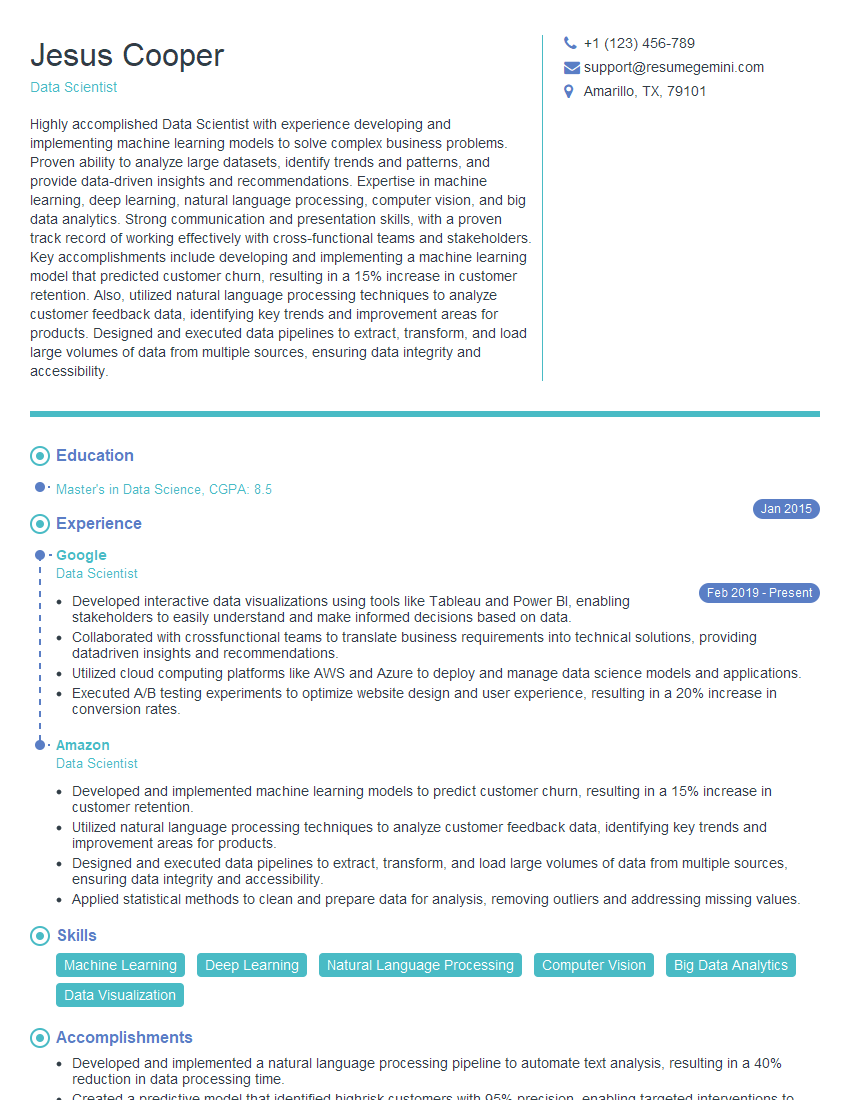
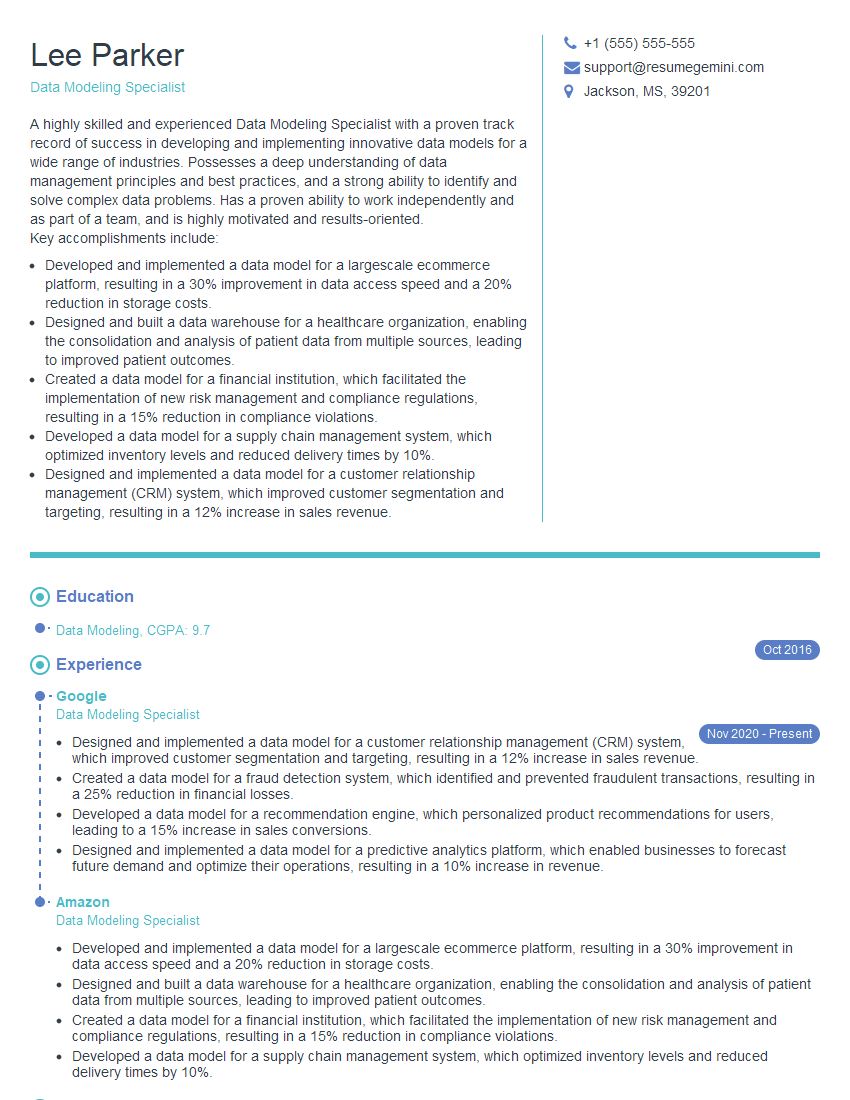
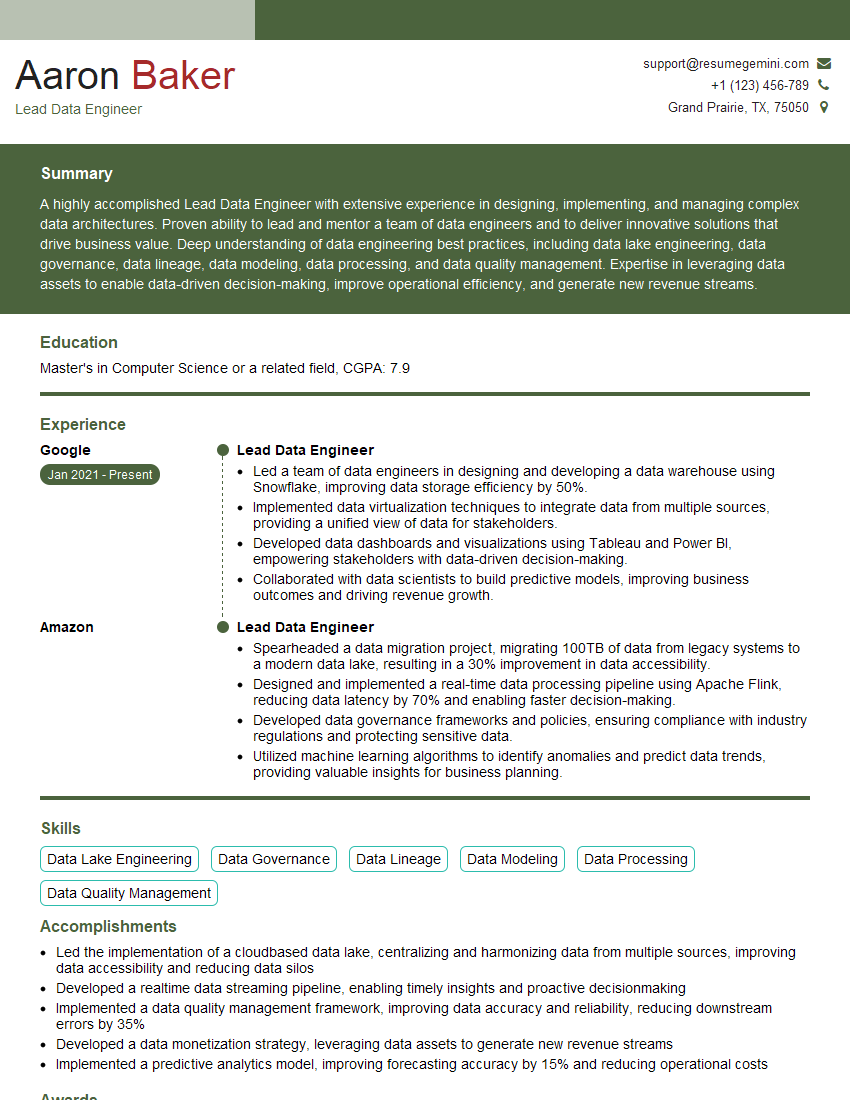
Mastering Hadoop, Spark, and Hive significantly enhances your career prospects in big data engineering and data science. These technologies are highly sought after, opening doors to rewarding and challenging roles. To maximize your chances of landing your dream job, it’s crucial to create a resume that effectively highlights your skills and experience. An ATS-friendly resume is key to getting past applicant tracking systems and into the hands of hiring managers. ResumeGemini is a trusted resource to help you build a professional and impactful resume. We provide examples of resumes tailored specifically to Hadoop, Spark, and Hive roles to give you a head start.

Explore more articles
Users Rating of Our Blogs
Share Your Experience
We value your feedback! Please rate our content and share your thoughts (optional).
What Readers Say About Our Blog
To the interviewgemini.com Webmaster.
Very helpful and content specific questions to help prepare me for my interview!
Thank you
To the interviewgemini.com Webmaster.
This was kind of a unique content I found around the specialized skills. Very helpful questions and good detailed answers.
Very Helpful blog, thank you Interviewgemini team.