Interviews are opportunities to demonstrate your expertise, and this guide is here to help you shine. Explore the essential Experience in sign design and fabrication interview questions that employers frequently ask, paired with strategies for crafting responses that set you apart from the competition.
Questions Asked in Experience in sign design and fabrication Interview
Q 1. What types of sign materials are you familiar with?
My experience encompasses a wide range of sign materials, each chosen based on the project’s specific needs – durability, budget, aesthetic, and location. Let me highlight some key examples:
- Aluminum: A popular choice for its lightweight yet durable nature, ideal for both indoor and outdoor applications. I’ve used it extensively for storefront signs, wayfinding systems, and monument signs, often with powder-coated finishes for enhanced color and weather resistance.
- Acrylic: Excellent for its clarity and vibrant color reproduction. It’s perfect for illuminated signs, channel letters, and dimensional lettering. I’ve used it in projects requiring a sleek, modern look.
- PVC (Polyvinyl Chloride): A cost-effective and versatile material, often used for short-term signage or projects where budget is a primary concern. I’ve incorporated PVC in trade show displays and temporary promotional signage.
- Wood: Offers a natural, rustic aesthetic. I’ve used it for handcrafted signs, particularly those with a vintage or traditional feel, often combining it with other materials like metal for accents.
- Dibond (Aluminum Composite Material): A strong, lightweight material that’s ideal for large format signs and displays. Its flat, smooth surface makes it excellent for high-resolution prints. I’ve frequently used this for building signage and billboards.
Beyond these, I’m familiar with materials like stainless steel, polycarbonate, and various fabrics for banners and flexible signage.
Q 2. Describe your experience with different sign printing methods.
My experience spans several sign printing methods, each offering distinct advantages and limitations. The choice depends greatly on the desired quality, budget, and substrate (the material being printed on):
- Digital Printing: This is a versatile method suitable for a wide range of materials and allows for high-resolution, full-color prints. I frequently use it for banners, vehicle wraps, and signs printed directly onto acrylic or PVC. The speed and cost-effectiveness make it ideal for many projects.
- Screen Printing: Excellent for producing durable, high-volume prints, particularly on flat surfaces like metal or wood. This method excels in producing bold, consistent colors, ideal for logos and repetitive designs on multiple signs. However, it’s less suitable for complex imagery and is more cost-effective for larger runs.
- UV Printing: A direct-to-substrate printing technique known for its vibrant colors and durability, especially suitable for outdoor applications. The ink cures instantly under UV light, minimizing drying time and offering excellent scratch resistance. I’ve utilized this method for many projects requiring long-lasting outdoor signage.
- Vinyl Cutting: Primarily used for creating lettering, logos, and simple graphics from vinyl film. I frequently use this alongside other printing methods – for instance, cutting vinyl lettering to be applied to a digitally printed background on a sign.
Understanding the nuances of each method allows me to recommend the most suitable approach for each client’s project, balancing quality with budget and turnaround time.
Q 3. Explain your experience with sign design software (e.g., Adobe Illustrator, CorelDRAW).
I’m proficient in both Adobe Illustrator and CorelDRAW, two industry-standard software packages for sign design. My expertise lies not only in creating visually appealing designs but also in ensuring they are production-ready. This includes:
- Vector-based design: I create all my designs using vector graphics, ensuring scalability without loss of quality. This is crucial for producing signs in various sizes, from small storefront signs to large billboards.
- Color management: I carefully manage color profiles to ensure accurate color reproduction across different printing methods and materials. This prevents unexpected color variations between the design and the final product.
- File preparation: I meticulously prepare files for print, considering the specific requirements of each printing method and material. This includes proper resolution, color modes (CMYK, RGB), and file formats (AI, EPS, PDF).
- Layout and typography: I pay close attention to typography, ensuring readability at various distances and adherence to brand guidelines. Layout design considers the overall aesthetic and functionality of the sign, optimizing for readability and impact.
I regularly use features like layer management, color palettes, and printing presets within both software packages to maximize efficiency and accuracy.
Q 4. How do you ensure the accuracy of sign designs before production?
Accuracy is paramount in sign design. Before production, I employ several strategies to ensure the final product meets the client’s expectations and specifications:
- Proofing: I provide clients with digital proofs, often in multiple formats (e.g., PDF, JPEG) to allow for thorough review and feedback. This stage is crucial for catching errors in design, typography, and color.
- Scale testing: For larger signs, I create scaled mockups, which helps visualize the sign in its final environment and identify any potential issues with proportions or visibility.
- Template usage: I utilize pre-made templates for standard sign sizes and configurations whenever possible, reducing the chance of errors in measurements and dimensions.
- Collaboration: I communicate with the production team throughout the process, ensuring clarity regarding material choices, printing methods, and any special instructions.
This multi-faceted approach to proofing and verification helps minimize errors and revisions, leading to a smoother production process and a satisfied client.
Q 5. Describe your experience with sign installation techniques.
Sign installation is a crucial stage that demands precision and expertise. My experience encompasses a variety of installation techniques depending on the sign type, location, and substrate:
- Surface Mounting: This involves directly attaching the sign to a surface using screws, rivets, or adhesive. I carefully select the appropriate fasteners and adhesives considering the weight of the sign and the material of the mounting surface.
- Suspended Mounting: This is used for signs suspended from ceilings or structures using wires, cables, or other support systems. Safety is paramount in this method, requiring careful consideration of weight distribution and load-bearing capabilities.
- Post Mounting: Ground-mounted signs, such as monument signs or freestanding structures, demand specialized techniques. This often involves digging post holes, setting concrete foundations, and ensuring the stability of the structure to withstand wind and other environmental factors.
- Channel Letter Installation: Installing channel letters involves precise alignment and spacing, often requiring specialized tools and techniques to ensure a clean, professional finish.
My experience includes working with various heights, surfaces and challenging environments, and I always adhere to industry best practices for safe and efficient installation.
Q 6. What safety precautions do you follow during sign installation?
Safety is my top priority during sign installation. I consistently follow these precautions:
- Proper PPE (Personal Protective Equipment): I always wear appropriate safety gear, including hard hats, safety glasses, gloves, and fall protection equipment depending on the job’s requirements.
- Risk Assessment: Before starting any installation, I conduct a thorough risk assessment to identify potential hazards and develop a safe work plan.
- Proper Lifting Techniques: I utilize appropriate lifting techniques and equipment to avoid injuries when handling heavy signs or materials. Teamwork is essential for larger or heavier signs.
- Fall Protection: For elevated work, I always employ fall protection systems, such as harnesses and safety lines, complying with all relevant safety regulations.
- Traffic Control: If working near roads or pedestrian areas, I implement appropriate traffic control measures to ensure the safety of both the crew and the public.
- Tool Maintenance: All tools and equipment are regularly inspected and maintained to prevent accidents caused by malfunctioning equipment.
Safety training and adherence to regulations are essential for preventing accidents and ensuring the wellbeing of my team.
Q 7. How do you handle unexpected problems during a sign installation?
Unexpected problems during sign installation are common. My approach involves a systematic problem-solving process:
- Assessment: I first calmly assess the situation, identifying the nature and extent of the problem. This might involve checking measurements, inspecting the mounting surface, or evaluating the condition of materials.
- Communication: I communicate clearly with the client and my team, keeping them informed about the situation and any necessary adjustments to the plan.
- Problem Solving: I draw on my experience and knowledge to find a suitable solution, which might involve making adjustments to the installation plan, sourcing replacement materials, or consulting with other experts if needed.
- Documentation: I meticulously document the problem, the solution implemented, and any lessons learned. This helps improve future projects and prevent similar issues from recurring.
- Safety First: If the problem poses a safety risk, I immediately halt work and prioritize rectifying the hazard before resuming the installation.
Adaptability and resourcefulness are key in handling unexpected challenges. I prioritize finding practical, safe solutions that ensure a successful project outcome.
Q 8. What is your experience with vinyl cutting and application?
Vinyl cutting and application is a fundamental skill in sign making. It involves using a vinyl cutter—a computer-controlled machine—to cut adhesive vinyl into various shapes and designs. This process is used for creating decals, lettering, and graphics for a wide range of signage applications, from window graphics to vehicle wraps. My experience encompasses working with various types of vinyl, including self-adhesive vinyl, reflective vinyl, and perforated vinyl, each selected based on the specific application and its requirements. I’m proficient in using software like CorelDRAW and Adobe Illustrator to design and prepare the cut files, ensuring precise and accurate cuts. The application process itself involves weeding (removing the excess vinyl), applying transfer tape, and carefully placing the vinyl onto the substrate. This requires precision and attention to detail to avoid air bubbles and ensure a clean, professional finish. For example, I recently completed a project where we applied complex, multi-layered vinyl designs to the windows of a boutique, resulting in a vibrant and eye-catching display.
Beyond basic application, I’m adept at handling intricate designs requiring precise alignment and layering, as well as techniques for removing air bubbles and ensuring a long-lasting, professional finish. I also understand the importance of proper surface preparation to guarantee adhesion and prevent peeling or lifting.
Q 9. Describe your experience with channel letter fabrication.
Channel letter fabrication is a more advanced sign-making process involving the creation of three-dimensional letters. This involves several steps, starting with creating a template and cutting the face, sides, and return bends from aluminum or other suitable materials. My experience includes working with various metals and materials to achieve different aesthetic effects and durability. Next comes forming and welding the sides to the face, ensuring precise alignment and strong seams. After this, the letters are often powder coated or painted, followed by installation of the face illumination system – this can range from LED modules to neon lighting, depending on the client’s design and budget. Finally, the letters are mounted to a structure using appropriate methods like brackets or raceway systems. For instance, I oversaw the fabrication and installation of a large set of illuminated channel letters for a law firm, paying careful attention to both the visual appeal and structural integrity of the letters to withstand strong winds.
I am experienced with both traditional fabrication techniques and newer methods that prioritize efficiency and precision. I’m comfortable with a variety of materials including aluminum, acrylic, and stainless steel, and possess the ability to handle intricate designs and large-scale projects. My attention to detail ensures each letter is perfectly crafted, regardless of size or complexity.
Q 10. Explain your knowledge of different sign lighting options.
Sign lighting is crucial for enhancing visibility and impact, particularly at night. I have extensive experience with various options, each with unique advantages and drawbacks. These include:
- LED Lighting: Highly energy-efficient, long-lasting, and available in various colors and intensities. This is currently the most popular choice for its versatility and cost-effectiveness.
- Neon Lighting: Offers a classic, distinctive glow, but is less energy-efficient and more fragile than LED. It remains a popular option for specific design aesthetics.
- Fluorescent Lighting: A more traditional option, offering bright illumination but typically less energy-efficient than LED. It’s less common now due to the rise in LED technology.
- Halo Lighting: Creates a soft, even glow around the perimeter of a sign, enhancing its visual appeal. This is often combined with other lighting options.
The selection of lighting depends on factors like budget, aesthetic preferences, the sign’s location, and desired visibility. I guide clients through these choices, helping them make informed decisions based on their individual needs and project specifications.
Q 11. How do you ensure the durability and longevity of fabricated signs?
Durability and longevity are paramount in sign fabrication. To ensure this, I employ several strategies starting from material selection. High-quality materials resistant to weather conditions, like UV-resistant vinyl or powder-coated aluminum are chosen. Proper surface preparation is crucial before applying any coatings or graphics. This includes cleaning the surface thoroughly to remove dirt, grease, or other contaminants that could affect adhesion. I also implement appropriate installation techniques to prevent damage during and after installation. This includes using proper fasteners and ensuring structural integrity, especially for outdoor signage. Regular maintenance, such as cleaning and repair as needed, extends a sign’s lifespan. Finally, using weather-resistant materials and proper sealing techniques are vital in preventing water damage and rusting.
For example, in a recent project involving a coastal location, I specified marine-grade aluminum and UV-resistant coatings to protect the signs from the harsh saltwater environment. This attention to detail ensures the signs will endure the elements for many years.
Q 12. What are your experiences with different types of sign permits and regulations?
Navigating sign permits and regulations is a critical aspect of sign fabrication. My experience covers dealing with various local, state, and sometimes even federal regulations. These regulations often dictate sign size, location, materials, illumination, and even the content of the signage. I’m familiar with the processes involved in obtaining permits, which often include submitting detailed plans, undergoing inspections, and paying applicable fees. Understanding these regulations is crucial to avoid delays, fines, and potential legal issues. For example, I have successfully guided clients through the often complex permitting process in different municipalities, ensuring their signs comply with all applicable codes.
I actively stay updated on evolving regulations, utilizing online resources and participating in industry events to maintain my knowledge base and ensure compliance with current laws.
Q 13. How do you manage a project timeline and budget for sign fabrication?
Effective project timeline and budget management is key to successful sign fabrication. I use project management tools to create detailed timelines that account for every stage, from design and permitting to fabrication and installation. This includes setting realistic deadlines for each task, considering potential delays, and allocating resources effectively. Budgeting involves a detailed breakdown of all costs, including materials, labor, permits, and other expenses. I work closely with clients to establish a clear budget and keep them informed of any potential cost changes throughout the process. Regular progress updates and open communication ensure the project stays on track and within the agreed-upon budget. For complex projects, I use Gantt charts to visualize the timeline and identify potential bottlenecks. This proactive approach minimizes the risk of unexpected delays and cost overruns.
Transparency is paramount— I keep the client informed every step of the way, ensuring they understand the costs involved and the progress of their project.
Q 14. Describe your experience with client communication and project management.
Client communication and project management go hand in hand. I believe in establishing clear communication channels from the outset. This typically includes initial consultations to discuss project requirements, design preferences, and budget constraints. Regular updates are provided throughout the process using emails, phone calls, or project management software, keeping clients informed of progress, any potential challenges, and solutions. Active listening is crucial to understanding the client’s vision and ensuring the final product meets their expectations. I strive to build strong relationships with clients based on trust and transparency. Addressing concerns promptly and proactively is critical in maintaining positive relationships. For instance, in one project, I successfully navigated a design change request midway through the project, adjusting the timeline and budget while maintaining open communication with the client, ultimately resulting in a highly satisfactory outcome.
My goal is to ensure every client feels heard and valued, resulting in a successful project and a strong, lasting business relationship.
Q 15. How do you troubleshoot problems with sign equipment or materials?
Troubleshooting sign equipment and materials requires a systematic approach. I start by identifying the specific problem – is it a malfunctioning machine, a material defect, or an issue with the process? For example, if a printer isn’t feeding vinyl correctly, I’d first check the rollers for debris or misalignment. If a printed graphic is fading prematurely, I’d examine the ink type, the substrate, and the exposure to UV light.
My troubleshooting process typically involves:
- Visual Inspection: Carefully examining the equipment and materials for any obvious defects or damage.
- Testing: Conducting controlled tests to isolate the source of the problem – for instance, testing different inks or substrates with the same print settings.
- Consultation: Referring to manuals, contacting manufacturers for support, or consulting with colleagues for expert advice. Sometimes a simple phone call to the supplier can solve the problem quickly.
- Documentation: Keeping detailed records of the problem, the troubleshooting steps, and the solution. This is crucial for preventing similar issues in the future.
One memorable instance involved a laminator that suddenly stopped heating. After checking the power supply and fuses, I discovered a small piece of debris lodged in the heating element. A simple cleaning solved the problem, highlighting the importance of regular maintenance.
Career Expert Tips:
- Ace those interviews! Prepare effectively by reviewing the Top 50 Most Common Interview Questions on ResumeGemini.
- Navigate your job search with confidence! Explore a wide range of Career Tips on ResumeGemini. Learn about common challenges and recommendations to overcome them.
- Craft the perfect resume! Master the Art of Resume Writing with ResumeGemini’s guide. Showcase your unique qualifications and achievements effectively.
- Don’t miss out on holiday savings! Build your dream resume with ResumeGemini’s ATS optimized templates.
Q 16. What is your experience with large format printing techniques?
I have extensive experience with large format printing techniques, including UV printing, solvent printing, eco-solvent printing, and latex printing. My expertise extends to various substrates like vinyl, corrugated plastic, aluminum composite material (ACM), and fabric banners. I’m proficient in operating and maintaining large-format printers from different manufacturers. I understand color profiles, image resolution, and the impact of different printing technologies on the final product’s durability and appearance.
For instance, I’ve worked on projects requiring high-resolution prints for building wraps, where the image needed to be sharp and vibrant from a distance. In those cases, I carefully selected the appropriate printer, ink, and substrate to ensure the best possible quality. Understanding the properties of different inks is essential – solvent inks are durable but may have a stronger odor, while latex inks are environmentally friendly with less odor.
Q 17. How do you handle design revisions and client feedback?
Handling design revisions and client feedback is crucial for project success. My approach involves clear and open communication. After receiving feedback, I first organize it, clarifying any ambiguous points. I then translate that feedback into actionable design adjustments.
My process is usually as follows:
- Active Listening: Understanding the client’s vision and concerns is paramount. I actively listen and ask clarifying questions.
- Visual Presentation: I present design revisions clearly using mock-ups and annotated versions showing the changes.
- Iteration: I don’t hesitate to make multiple rounds of revisions until the client is completely satisfied. I believe in an iterative design process that evolves through collaboration.
- Documentation: Maintaining a record of all revisions ensures transparency and allows us to track the progress effectively.
I recently worked with a client who wanted a very specific font for their logo. After several attempts, we discovered that the font wasn’t readily scalable for the large sign size. We found an alternative that closely resembled the client’s preference while maintaining print quality. This experience reinforced the value of clear communication and a flexible approach to design revisions.
Q 18. What quality control measures do you employ in sign fabrication?
Quality control is paramount in sign fabrication. My approach involves multiple checks throughout the process, starting from design approval through to final installation. This helps catch errors early and prevent costly mistakes.
My quality control measures include:
- Material Inspection: Verifying the quality of materials upon delivery, ensuring they meet specifications.
- Pre-Print Checks: Reviewing the artwork for color accuracy, resolution, and any potential issues before printing.
- Print Quality Control: Inspecting the printed output for color consistency, sharpness, and any defects.
- Fabrication Inspection: Carefully checking the cut, assembly, and finishing of the sign for accuracy and structural integrity.
- Final Inspection: A thorough inspection of the completed sign before delivery or installation. This includes checking for damage and ensuring all components are securely attached.
For example, before installing a large illuminated sign, I always perform a final check to ensure all wiring is secure, the lighting is functioning correctly, and the structure is robust enough to withstand environmental conditions.
Q 19. How do you stay updated on industry trends and technologies?
Staying updated on industry trends is critical. I achieve this through several methods:
- Trade Publications and Websites: I regularly read industry publications, both online and print, focusing on new materials, technologies, and design trends.
- Industry Events and Trade Shows: Attending trade shows and conferences provides hands-on experience with new equipment and networking opportunities.
- Online Courses and Workshops: I participate in online courses and workshops to stay abreast of advancements in design software and fabrication techniques.
- Professional Associations: Membership in professional associations keeps me connected with industry experts and provides access to resources and training.
Recently, I attended a workshop on sustainable sign materials, which sparked interest in implementing environmentally friendly options in our projects. This helps us meet increasing client demands for eco-conscious products.
Q 20. Describe your experience with working on complex sign projects.
I have considerable experience handling complex sign projects, such as large-scale building wraps, three-dimensional signs with intricate designs, and illuminated signs with integrated electronics. These projects often involve coordinating multiple teams, managing tight deadlines, and working within challenging budgets.
For instance, one project involved designing and fabricating a multi-story building wrap with a complex, photorealistic image. This required careful planning for material selection, printing, installation, and adherence to strict safety regulations. Effective communication and coordination between the design team, printers, installers, and client were crucial to delivering a successful outcome.
Working on complex projects requires meticulous planning, excellent project management skills, and strong problem-solving abilities. But the satisfaction of completing a challenging project and witnessing the final result is immensely rewarding.
Q 21. Explain your process for estimating the cost of a sign project.
Estimating the cost of a sign project requires a detailed breakdown of all involved expenses. My process begins with a thorough understanding of the client’s requirements and specifications.
My cost estimation process involves:
- Design Complexity: Evaluating the design’s intricacy, which affects the time and resources needed.
- Material Costs: Calculating the cost of materials like vinyl, aluminum, lighting components, etc. considering quantity and specifications.
- Labor Costs: Estimating the time needed for design, fabrication, printing, and installation. This includes the hourly rates of all involved personnel.
- Equipment Costs: Considering the cost of using specialized equipment, like printers, cutters, and laminators.
- Installation Costs: Estimating costs associated with installation, including permits, scaffolding, and transportation.
- Contingency: Adding a contingency buffer for unforeseen expenses or delays.
I always provide clients with a detailed breakdown of the estimated costs, allowing for transparency and informed decision-making. This prevents surprises later in the project.
Q 22. How familiar are you with different types of sign substrates?
Selecting the right substrate is crucial for a sign’s durability, aesthetics, and overall effectiveness. My familiarity extends to a wide range, including:
- Aluminum: Durable, lightweight, and available in various finishes (powder coat, brushed, anodized), ideal for exterior signs requiring longevity and resistance to weather.
- Acrylic: Offers excellent clarity, vibrant color reproduction, and a sleek, modern look. Perfect for illuminated signs or applications where a high-quality finish is essential.
- PVC (Polyvinyl Chloride): A cost-effective option offering good durability, suitable for both indoor and outdoor use, though less resistant to extreme temperatures than aluminum or some other materials. Often used for short-term promotional signs.
- Wood: Offers a natural, rustic appeal, commonly used for interior signage and can be customized with various finishes for a bespoke look. Requires proper sealing for outdoor applications.
- Foam Core: Lightweight and inexpensive, ideal for short-term or indoor signs, such as trade show displays. Not suitable for harsh outdoor conditions.
- Dibond (Aluminum Composite Material): Offers a rigid, flat surface, ideal for large format signs and displays. The composite construction combines strength and lightweight properties.
Choosing the substrate depends heavily on the sign’s location, intended lifespan, budget, and desired aesthetic. For example, a temporary event sign might use foam core, while a permanent building sign would necessitate a robust material like aluminum or dibond.
Q 23. How do you maintain and calibrate sign-making equipment?
Maintaining and calibrating sign-making equipment is critical for consistent, high-quality results and equipment longevity. My routine includes:
- Regular Cleaning: Daily cleaning of printers, cutters, and other equipment removes dust and debris that can affect precision and print quality. I use appropriate cleaning solutions for each machine type to avoid damage.
- Blade and Tool Maintenance: Regularly changing cutting plotter blades ensures clean cuts and prevents damage to materials. I inspect all tools for wear and tear and replace as needed.
- Printer Calibration: I perform regular color calibrations using test prints and color charts to ensure accurate color reproduction across different jobs. This may involve adjusting color profiles or using specialized calibration software.
- Software Updates: Keeping software up-to-date ensures optimal functionality and access to the latest features, including bug fixes and performance enhancements.
- Preventive Maintenance: Following manufacturer’s recommendations for routine maintenance schedules, such as lubricating moving parts, helps extend the life of equipment and prevent costly repairs.
For instance, ignoring regular blade changes on a vinyl cutter can lead to inaccurate cuts, wasting materials and causing potential damage to the machine. Proactive maintenance saves time and money in the long run.
Q 24. Describe your problem-solving approach when dealing with sign design challenges.
My problem-solving approach is systematic and involves several key steps:
- Clearly Define the Problem: Begin by thoroughly understanding the challenge. What specific issue needs to be addressed? What are the constraints (budget, timeframe, materials)?
- Gather Information: Research relevant information, consult resources, and discuss the challenge with colleagues.
- Brainstorm Solutions: Explore multiple solutions, considering different materials, techniques, and technologies.
- Evaluate Solutions: Weigh the pros and cons of each option, considering feasibility, cost, and aesthetic appeal.
- Implement the Solution: Execute the chosen solution, meticulously monitoring the process.
- Review and Refine: Evaluate the results and make necessary adjustments to refine the solution if needed.
For example, if a client requests a complex 3D sign with limited budget, I might explore alternative materials or construction methods to achieve a similar aesthetic at a lower cost without compromising quality. I might propose a simpler design or suggest using a less expensive material for the non-visible parts of the sign.
Q 25. How do you ensure the color accuracy of printed signs?
Color accuracy is paramount in sign design. I achieve this through a multi-faceted approach:
- Color Management System (CMS): Utilizing a robust CMS throughout the design and printing process, ensuring consistent color across all stages from design to print. This includes proper profile creation and selection.
- Color Calibration: Regularly calibrating my printers with colorimetric tools and test charts.
- Proofing: Using color-accurate proofs (printed or soft proofs) before final production to verify color matches client expectations.
- Pantone Matching System (PMS): Employing PMS colors for critical applications where precise color matching is paramount. This is especially useful for brand logos and corporate identities.
- Substrate Considerations: Considering the color absorbing properties of the selected substrate when determining print settings. Different substrates interact with ink differently.
A failure to calibrate and verify color can lead to significant rework, client dissatisfaction and financial losses. My rigorous approach minimizes these risks.
Q 26. What is your experience with different types of sign finishes (e.g., laminates, coatings)?
Sign finishes significantly impact durability, aesthetics, and longevity. My experience encompasses:
- Laminates: I use various laminates, including UV-resistant and gloss/matte finishes. Laminates protect the print from scratches, UV damage, and environmental wear, extending the sign’s lifespan, especially for outdoor applications.
- Coatings: I utilize clear coats (UV, acrylic) to protect prints, enhance color vibrancy, and add a level of weather resistance. These vary in thickness and durability, depending on the application.
- Powder Coating (for metal substrates): Offers superior durability and a wide array of colors for metal signs. Powder coatings are resistant to chipping, scratching, and fading.
Choosing the right finish is crucial. For instance, a matte laminate might be preferable for reducing glare on an indoor sign, while a UV-resistant laminate is essential for exterior signs exposed to direct sunlight.
Q 27. Describe your experience with 3D sign design and fabrication.
My experience with 3D sign design and fabrication involves a range of techniques and materials. I am proficient in:
- 3D Modeling Software: I utilize software like Rhino, 3ds Max, or Blender to design complex 3D shapes and structures.
- Material Selection: I choose materials based on the sign’s complexity, desired aesthetic, and budget (e.g., acrylic, foam, wood, metal).
- Fabrication Methods: I use various methods including CNC routing, 3D printing (for prototyping or smaller elements), vacuum forming, and hand-finishing.
- Lighting Integration: Designing and integrating LED lighting within the 3D structures for eye-catching illuminated signs. This can involve custom solutions for complex shapes.
For example, I recently designed and fabricated a 3D logo sign using CNC-routed acrylic and integrated LED backlighting, resulting in a visually stunning and impactful piece.
Q 28. What is your approach to managing multiple sign projects simultaneously?
Managing multiple projects simultaneously requires a structured approach. I utilize:
- Project Management Software: I employ project management tools like Asana or Trello to track deadlines, assign tasks, and monitor progress across all projects.
- Detailed Scheduling: Creating detailed schedules outlining tasks, materials, and deadlines for each project, ensuring efficient workflow and resource allocation.
- Prioritization: Establishing a clear order of priority for projects, based on deadlines and client needs.
- Clear Communication: Maintaining clear and consistent communication with clients and team members, proactively addressing potential issues.
- Regular Review: Regularly reviewing project progress, identifying and addressing potential bottlenecks or delays.
This structured approach allows me to maintain organization and efficiency even when working on multiple projects with different timelines and requirements. Transparency and proactive communication are key to keeping all projects on track and meeting client expectations.
Key Topics to Learn for Experience in Sign Design and Fabrication Interview
- Design Software Proficiency: Mastering design software like Adobe Illustrator, Photoshop, CorelDRAW, and potentially CAD software is crucial. Be prepared to discuss your experience with vector graphics, image manipulation, and technical drawing.
- Material Knowledge: Demonstrate a thorough understanding of various sign materials (acrylic, aluminum, vinyl, wood, etc.), their properties, and appropriate applications. Discuss your experience selecting materials based on project requirements and budget.
- Fabrication Techniques: Showcase your expertise in different fabrication methods, including cutting, routing, printing, welding, and assembling signs. Be ready to explain the processes and challenges involved in each technique.
- Production Workflow: Understanding the entire sign production process, from initial design and client consultation to installation and project completion, is vital. Highlight your experience in managing timelines, resources, and quality control.
- Project Management & Client Communication: Discuss your experience managing projects, communicating effectively with clients, handling revisions, and meeting deadlines. Showcasing your ability to work collaboratively and resolve conflicts is important.
- Safety Regulations & Best Practices: Demonstrate your awareness of relevant safety regulations and best practices in sign fabrication. This includes knowledge of proper equipment handling, material storage, and workplace safety procedures.
- Estimating & Budgeting: Be prepared to discuss your experience in accurately estimating project costs, including materials, labor, and overhead. Understanding profitable pricing strategies is essential.
- Troubleshooting & Problem-solving: Highlight your ability to identify and resolve issues during the design and fabrication process. Provide specific examples of challenges overcome and solutions implemented.
Next Steps
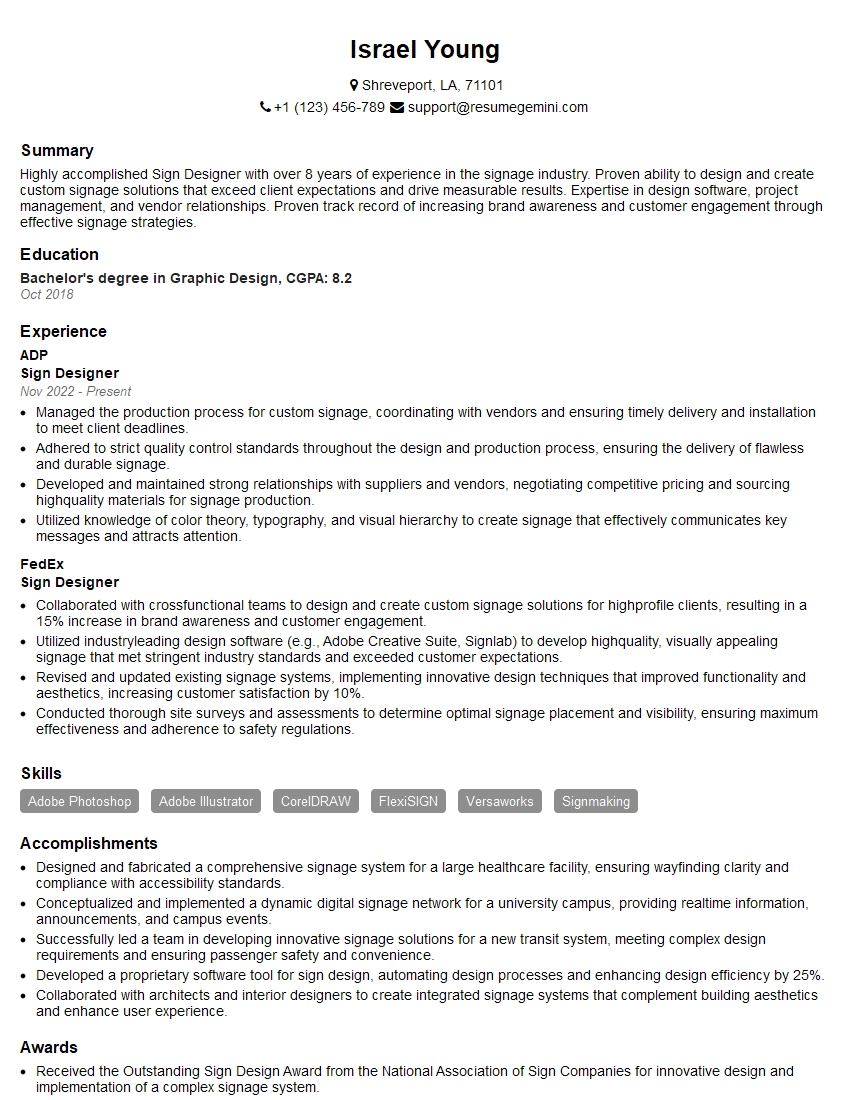
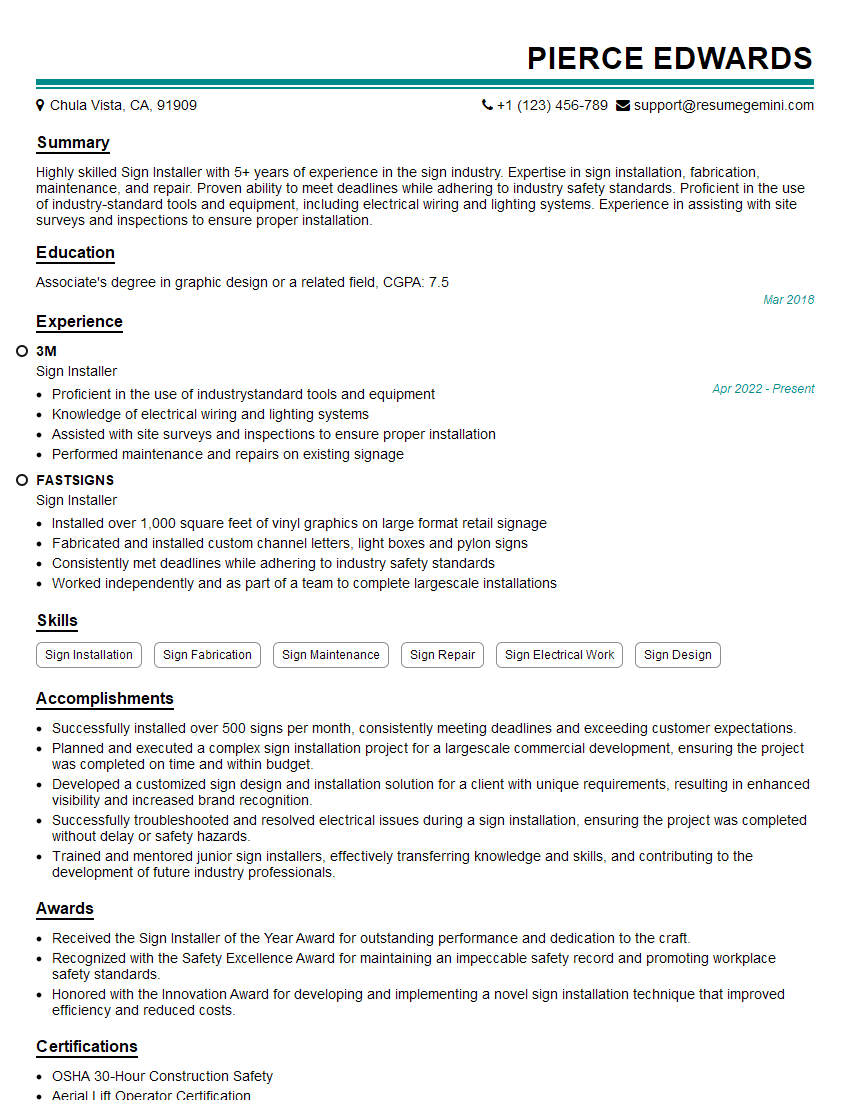
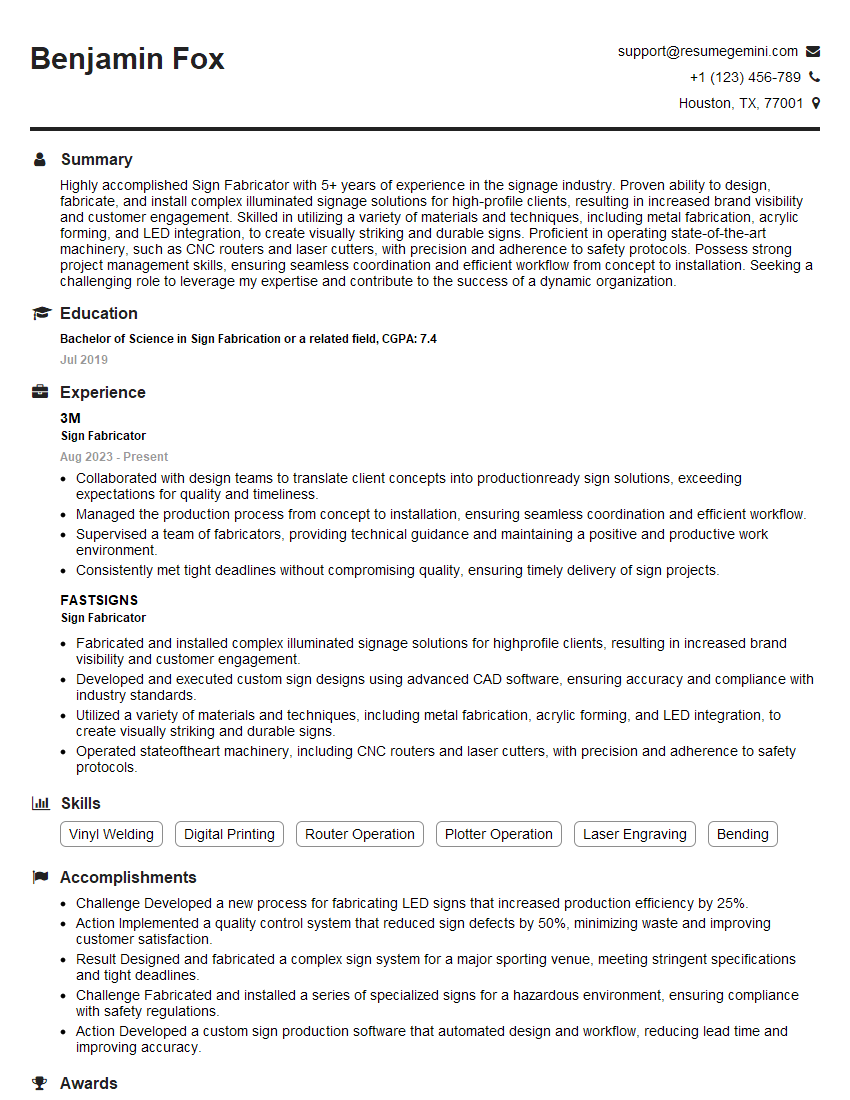
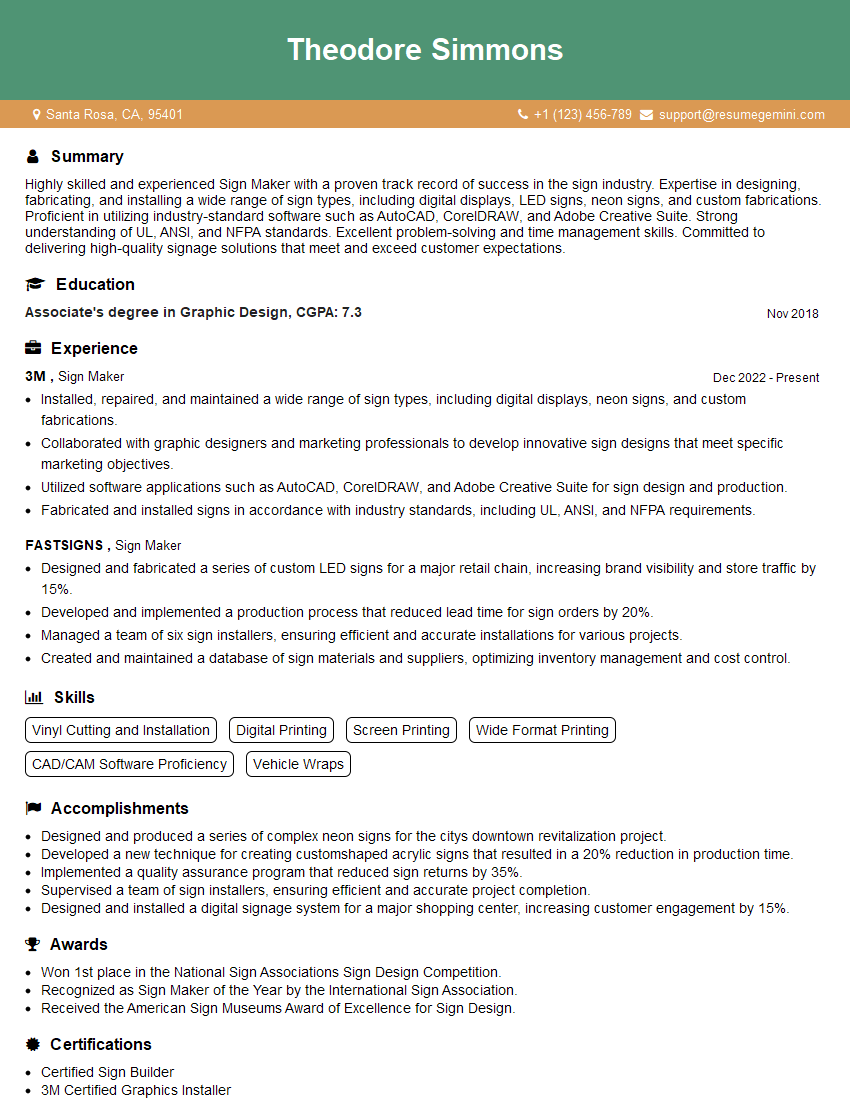
Mastering sign design and fabrication skills opens doors to exciting career opportunities with increasing responsibility and earning potential. To significantly improve your job prospects, create a compelling and ATS-friendly resume that showcases your expertise. ResumeGemini is a trusted resource that can help you build a professional and effective resume, highlighting your unique skills and experience. Examples of resumes tailored to the sign design and fabrication industry are available within ResumeGemini to provide you with inspiration and guidance.
Explore more articles
Users Rating of Our Blogs
Share Your Experience
We value your feedback! Please rate our content and share your thoughts (optional).
What Readers Say About Our Blog
To the interviewgemini.com Webmaster.
Very helpful and content specific questions to help prepare me for my interview!
Thank you
To the interviewgemini.com Webmaster.
This was kind of a unique content I found around the specialized skills. Very helpful questions and good detailed answers.
Very Helpful blog, thank you Interviewgemini team.