Interviews are opportunities to demonstrate your expertise, and this guide is here to help you shine. Explore the essential Robotic Technology interview questions that employers frequently ask, paired with strategies for crafting responses that set you apart from the competition.
Questions Asked in Robotic Technology Interview
Q 1. Explain the difference between a robot manipulator and a robot arm.
While the terms ‘robot manipulator’ and ‘robot arm’ are often used interchangeably, there’s a subtle distinction. A robot arm is a mechanical limb, typically consisting of several segments connected by joints, that can move in a coordinated manner. Think of it as the physical structure. A robot manipulator, on the other hand, is a broader term encompassing the entire system: the arm itself, plus the control system, actuators, sensors, and end-effector. So, a robot arm is a component within a robot manipulator.
Imagine a human arm. The arm itself is analogous to the robot arm. But the complete system – the arm, the brain controlling its movements, the nerves providing feedback, and the hand performing the task – that’s the equivalent of a robot manipulator.
Q 2. Describe different types of robot end-effectors and their applications.
Robot end-effectors are the tools at the end of a robotic arm, enabling it to interact with the environment. There’s a vast variety, tailored to specific tasks. Here are a few examples:
- Grippers: These are perhaps the most common, used for grasping and manipulating objects. They range from simple parallel-jaw grippers to more sophisticated designs like vacuum grippers (for delicate or smooth objects) or multi-fingered hands (for complex manipulation).
- Welding torches: Used for arc welding, these end-effectors precisely control the welding process.
- Spray painting nozzles: Deliver consistent paint application across surfaces.
- Tools for machining operations: These include drills, milling cutters, and grinding wheels, integrating the robot into automated manufacturing processes.
- Sensors: While not always thought of as an end-effector, specialized sensors like cameras or force/torque sensors can be mounted at the end to enhance the robot’s capabilities and situational awareness.
The choice of end-effector depends heavily on the application. A delicate assembly task might require a multi-fingered hand, while a heavy-duty task like palletizing boxes calls for a robust gripper.
Q 3. What are the key components of a robotic system?
A robotic system is more than just a mechanical arm. It’s a complex interplay of several key components:
- Manipulator (or Robot Arm): The physical structure with joints and links.
- Actuators: The ‘muscles’ providing motion, usually electric motors, hydraulic cylinders, or pneumatic actuators.
- Sensors: Provide feedback about the robot’s position, speed, force, and environment (e.g., encoders, accelerometers, force/torque sensors, cameras).
- Control System: The ‘brain’ coordinating actuator movements based on sensor feedback and programmed commands. This includes hardware like microcontrollers and software for motion planning and control.
- End-effector: The tool for interaction with the environment (as discussed above).
- Power Supply: Provides energy to the actuators and other components.
- Programming Interface: Allows users to program the robot’s movements and behaviors.
The seamless integration of these components is crucial for a functioning robotic system.
Q 4. Explain the concept of forward and inverse kinematics.
Forward kinematics solves the problem: ‘Given joint angles, what is the end-effector’s position and orientation?’ It’s a straightforward mathematical transformation, using geometry and trigonometry to calculate the position and orientation of the end-effector from known joint angles.
Inverse kinematics tackles the opposite problem: ‘Given a desired end-effector position and orientation, what joint angles are required?’ This is considerably more complex, often involving iterative numerical solutions, because multiple sets of joint angles might achieve the same end-effector pose.
Consider a robotic arm reaching for a cup. Forward kinematics tells you the cup’s location if you know the arm’s joint angles. Inverse kinematics tells you what joint angles to set to reach the cup.
Q 5. How do you calibrate a robotic arm?
Calibrating a robotic arm is essential for accurate and repeatable movements. The process involves establishing a precise relationship between the robot’s internal joint angles and its actual position and orientation in the workspace. This typically involves these steps:
- Mechanical Inspection: Check for any mechanical issues like looseness in joints or wear and tear.
- Zero-Position Calibration: Determine the ‘home’ or reference position for each joint. This is typically achieved using mechanical stops or sensor readings.
- Joint Angle Calibration: Precisely measure and adjust the relationship between the encoder readings (or other joint position sensors) and the actual joint angles.
- Forward Kinematic Calibration: Verify the accuracy of the forward kinematic model by measuring the end-effector’s position and orientation for various joint angles. Any discrepancies might indicate inaccuracies in link lengths or joint offsets. Adjustments might be made to the robot’s kinematic model.
- Workspace Calibration: This establishes the robot’s reachable workspace. It involves moving the robot arm to various points within the workspace, measuring and comparing actual vs. expected positions.
Calibration methods vary depending on the robotic arm’s complexity and the available sensors. Advanced techniques employ sophisticated algorithms and sensor fusion to achieve high accuracy.
Q 6. Describe different robot control architectures (e.g., joint-space, task-space).
Robot control architectures determine how the robot’s movements are planned and executed. Two common architectures are:
- Joint-Space Control: This focuses on controlling the individual joint angles of the robot. Each joint is treated independently, and the desired trajectory is specified in terms of joint angles over time. It’s simpler to implement but may not be optimal for tasks requiring precise end-effector positioning in Cartesian space.
- Task-Space Control (Cartesian Space Control): This focuses on controlling the end-effector’s position and orientation directly in Cartesian coordinates (X, Y, Z, roll, pitch, yaw). This approach is more intuitive for many applications, as it directly addresses the task goals. It’s more complex to implement because it requires inverse kinematics calculations to translate desired end-effector positions into joint angles.
Other architectures include hybrid approaches combining elements of both joint-space and task-space control, as well as force control, impedance control, and more advanced methods using machine learning for adaptive control.
Q 7. What are the advantages and disadvantages of different robot programming languages?
Several programming languages are used for robotic systems, each with its strengths and weaknesses:
- RAPID (ABB): A proprietary language specific to ABB robots. It’s powerful and well-suited for complex tasks but is not portable to other robot brands.
- KRL (KUKA): Similar to RAPID, KRL is proprietary to KUKA robots. It offers similar capabilities and limitations.
- MATLAB with Robotics Toolboxes: A powerful environment for simulation, control algorithm development, and off-line programming. Its flexibility is offset by the need for additional programming expertise.
- Python with Libraries like ROS (Robot Operating System): A widely used, open-source approach. Python’s versatility and extensive libraries make it highly suitable for robotics applications. ROS provides a standardized framework for building complex robotic systems. This approach promotes interoperability and allows developers to utilize existing modules.
The choice of language depends on factors like the robot’s manufacturer, the complexity of the task, the developer’s expertise, and the need for portability and open-source solutions.
Q 8. Explain the concept of path planning in robotics.
Path planning in robotics is the process of finding a collision-free path for a robot to move from a starting point to a goal point. Imagine it like planning a road trip using a map – you need to find the best route, avoiding obstacles like traffic jams (obstacles in the robot’s environment). This involves sophisticated algorithms that consider the robot’s physical limitations (like turning radius), the environment’s geometry, and potential obstacles.
Common path planning algorithms include A*, Dijkstra’s algorithm, and Rapidly-exploring Random Trees (RRT). A* is particularly popular due to its efficiency in finding optimal paths. These algorithms work by creating a search graph representing the robot’s possible movements and then employing heuristics (educated guesses) to prioritize exploration toward the goal.
In a warehouse setting, for example, a robotic arm needs to plan a path to pick up a package from a shelf, move it across the warehouse, and place it onto a conveyor belt. The path planning algorithm must ensure the arm avoids collisions with other robots, shelves, or people.
Q 9. What are some common sensor technologies used in robotics (e.g., lidar, cameras)?
Robots rely heavily on sensors to perceive their environment. Some common sensor technologies include:
- Lidar (Light Detection and Ranging): Lidar uses lasers to create a 3D point cloud map of the surroundings. Think of it as a robot’s version of eyesight, providing detailed distance information to obstacles. Self-driving cars extensively use lidar for navigation.
- Cameras: Cameras provide visual information, enabling robots to ‘see’ their environment. They can be used for object recognition, navigation, and visual servoing (controlling a robot’s movement based on visual feedback). Modern robots often use multiple cameras for improved depth perception and robustness.
- Ultrasonic Sensors: These sensors emit ultrasonic waves and measure the time it takes for the waves to bounce back. This provides distance measurements, often used for proximity detection and obstacle avoidance. They are simpler and cheaper than lidar but offer less precise measurements.
- Infrared Sensors: These sensors detect infrared radiation, useful for temperature sensing and object detection in low-light conditions. They can be used in applications such as fire detection and robot-assisted surgery.
- IMU (Inertial Measurement Unit): IMUs measure acceleration and angular velocity, helping robots track their own movement and orientation. This is crucial for maintaining stability and accurate positioning.
The choice of sensor depends on the specific application. A robot for navigating a cluttered warehouse might prioritize lidar and cameras, whereas a simpler robot performing a repetitive task might only need ultrasonic sensors.
Q 10. How does computer vision contribute to robotic applications?
Computer vision is the field of artificial intelligence that enables robots to ‘see’ and interpret their environment. It bridges the gap between raw sensor data (like images from cameras) and meaningful information the robot can use for decision-making.
In robotics, computer vision plays a crucial role in tasks such as:
- Object Recognition: Identifying and classifying objects in the robot’s field of view (e.g., recognizing a specific part in a factory assembly line).
- Pose Estimation: Determining the position and orientation of objects (e.g., finding the location of a bolt to be tightened).
- Navigation: Using visual landmarks to guide the robot’s movement (e.g., a robot following a corridor using its camera).
- Visual Servoing: Controlling the robot’s movements based on visual feedback (e.g., guiding a robotic arm to grasp an object by using camera feedback).
For example, a surgical robot uses computer vision to accurately identify the target tissue and guide its instruments during minimally invasive procedures. Similarly, automated inspection systems in manufacturing use computer vision to detect flaws in products.
Q 11. Explain the concept of simultaneous localization and mapping (SLAM).
Simultaneous Localization and Mapping (SLAM) is a crucial technology that allows robots to build a map of an unknown environment while simultaneously determining their location within that map. Imagine exploring a new city without a map – SLAM is like having a robot that creates its own map as it explores and simultaneously figures out where it is on that map.
SLAM involves processing sensor data (often from lidar or cameras) to estimate the robot’s pose (position and orientation) and create a consistent map. This is a challenging problem because the robot’s location is uncertain, and any errors in localization can propagate to the map.
Popular SLAM approaches include Extended Kalman Filter (EKF), Particle Filter, and Graph SLAM. These algorithms use probabilistic methods to handle uncertainties and iteratively refine both the map and the robot’s estimated pose. SLAM is fundamental to autonomous robots operating in dynamic and unstructured environments, such as autonomous vehicles and robotic exploration missions.
Q 12. What are some common challenges in robotic manipulation?
Robotic manipulation, the ability of a robot to interact physically with its environment, presents several challenges:
- Object Variability: Real-world objects are rarely perfectly uniform. Variations in shape, size, and texture make it difficult for robots to reliably grasp and manipulate them.
- Contact Uncertainty: Predicting the exact forces and torques involved in object interaction is challenging. Slippage and unexpected collisions can occur, requiring robust control strategies.
- Dexterity: Replicating human-level dexterity in robots is a major ongoing research area. Fine motor skills, such as manipulating small or delicate objects, require sophisticated control systems and advanced sensors.
- Computational Cost: Real-time manipulation often requires computationally expensive algorithms for planning and control. Finding efficient solutions is crucial for practical applications.
- Sensor Noise and Uncertainty: Sensor data is often noisy and imprecise. Robust algorithms are required to filter out noise and account for uncertainty in sensor readings.
Consider the difficulty of a robot assembling a delicate electronic circuit – the precise placement and handling of tiny components demand high dexterity and sophisticated control, highlighting the challenges in robotic manipulation.
Q 13. Describe different methods for robot obstacle avoidance.
Robots need mechanisms to avoid collisions with obstacles. Common methods include:
- Reactive Obstacle Avoidance: This approach uses sensor data to detect obstacles in real-time and react immediately to avoid collisions. Simple reactive methods might involve stopping or changing direction upon detecting an obstacle. More sophisticated techniques use potential fields or vector fields to guide the robot around obstacles.
- Proactive Obstacle Avoidance (Path Planning): This involves planning a collision-free path before the robot starts moving. Algorithms like A* and RRT are used to find optimal paths that avoid obstacles. This approach is more computationally expensive but can lead to more efficient and safer movements.
- Hybrid Approaches: Many robotic systems use a combination of reactive and proactive methods. A global path may be planned initially, but the robot will react to unexpected obstacles during execution using reactive avoidance strategies.
For example, a cleaning robot might use ultrasonic sensors for reactive obstacle avoidance, stopping or turning when it detects an obstacle. An autonomous car, on the other hand, might use a combination of lidar, cameras, and path planning algorithms for both proactive and reactive obstacle avoidance.
Q 14. Explain how artificial intelligence is used in modern robotics.
Artificial intelligence (AI) is revolutionizing modern robotics, enabling robots to perform complex tasks and adapt to dynamic environments. AI techniques are used in many aspects of robotics:
- Perception: AI algorithms, particularly deep learning, are used for image recognition, object detection, and scene understanding, enabling robots to perceive their environment more effectively.
- Planning and Decision-Making: AI techniques like reinforcement learning allow robots to learn optimal control strategies through trial and error, adapting to changing conditions and learning new tasks without explicit programming.
- Control: AI is used to develop more robust and adaptable control systems, enabling robots to perform complex manipulation tasks and maintain stability in unpredictable situations.
- Human-Robot Interaction: AI enables natural language processing and other communication methods, allowing robots to interact with humans more effectively.
For instance, AI-powered robots are used in manufacturing for complex assembly tasks, in healthcare for surgery and patient care, and in logistics for autonomous warehouse operations. These applications demonstrate the transformative potential of AI in modern robotics.
Q 15. What are the ethical considerations surrounding the use of robots?
The ethical considerations surrounding robots are multifaceted and rapidly evolving as robots become more integrated into our lives. Key concerns include:
- Job displacement: Automation through robotics can lead to significant job losses in various sectors, requiring societal adaptation and retraining initiatives. For example, the rise of automated warehouses has impacted warehouse worker employment.
- Bias and discrimination: AI-powered robots can inherit and amplify biases present in their training data, leading to discriminatory outcomes. Imagine a facial recognition system used in security, trained primarily on one demographic, potentially leading to misidentification of others.
- Privacy and surveillance: Robots equipped with sensors and cameras raise concerns about data privacy and potential misuse of personal information. Consider robotic vacuum cleaners that map your home layout – who owns that data and how is it used?
- Autonomous weapons systems: The development of lethal autonomous weapons systems (LAWS) raises profound ethical dilemmas regarding accountability, the potential for unintended escalation, and the dehumanization of warfare. This is an area of intense debate and international discussion.
- Responsibility and accountability: Determining liability in case of accidents or malfunctioning robots is a complex legal and ethical challenge. Who is responsible if a self-driving car causes an accident?
Addressing these concerns requires a multi-disciplinary approach involving engineers, ethicists, policymakers, and the public to develop responsible guidelines and regulations for robot development and deployment.
Career Expert Tips:
- Ace those interviews! Prepare effectively by reviewing the Top 50 Most Common Interview Questions on ResumeGemini.
- Navigate your job search with confidence! Explore a wide range of Career Tips on ResumeGemini. Learn about common challenges and recommendations to overcome them.
- Craft the perfect resume! Master the Art of Resume Writing with ResumeGemini’s guide. Showcase your unique qualifications and achievements effectively.
- Don’t miss out on holiday savings! Build your dream resume with ResumeGemini’s ATS optimized templates.
Q 16. Describe different types of robot actuators (e.g., hydraulic, pneumatic, electric).
Robot actuators are the ‘muscles’ that enable robots to move and interact with their environment. Three primary types exist:
- Hydraulic actuators: These use pressurized fluid (usually oil) to generate force. They are known for their high power-to-weight ratio and ability to handle heavy loads. Think of the powerful arms of industrial robots used in car manufacturing.
- Pneumatic actuators: These use compressed air or gas to generate force. They are typically simpler and cheaper than hydraulic actuators, but generally less powerful. Examples include the grippers on some automated assembly robots or the control systems of smaller, lighter robots.
- Electric actuators: These use electric motors to generate motion. They are becoming increasingly popular due to their precision, controllability, and cleanliness. Servo motors and stepper motors are commonly used in electric actuators, found in nearly all modern robotic arms, from industrial to surgical systems.
The choice of actuator depends on the specific application requirements, considering factors such as force, speed, precision, cost, and environmental factors (e.g., exposure to flammable materials).
Q 17. How do you ensure the safety of a robotic system?
Ensuring the safety of a robotic system is paramount and involves a multi-layered approach:
- Risk assessment: A thorough risk assessment identifies potential hazards associated with the robot’s operation and environment. This might involve analyzing potential collisions, pinch points, or unexpected movements.
- Safety features: Incorporating safety features like emergency stop buttons, speed limits, safety sensors (e.g., laser scanners, proximity sensors), and interlocks to prevent hazardous situations. These prevent accidental contact and limit damage from malfunctions.
- Redundancy: Designing the system with redundant components to ensure safe operation even if one component fails. This might include backup power systems or duplicate sensors.
- Software safeguards: Programming safety protocols into the robot’s control software, including error detection and recovery mechanisms. These ensure safe shutdowns in case of errors.
- Training and procedures: Providing comprehensive training to operators and maintenance personnel on safe operating procedures and emergency response. This includes both written documentation and hands-on training.
- Regular maintenance and inspection: Routine inspection and maintenance to identify and address potential problems before they lead to accidents. This is crucial for preventing mechanical failures.
A layered safety approach, combining hardware and software safety features with appropriate training and maintenance, is essential for creating a safe robotic environment.
Q 18. What are some common robot safety standards?
Several international and national standards address robot safety. Prominent examples include:
- ISO 10218-1 and ISO 10218-2: These standards specify safety requirements for industrial robots. They cover aspects like risk assessment, safeguarding, and emergency stops.
- ISO/TS 15066: This technical specification provides safety guidelines for collaborative robots (cobots) that work alongside humans.
- ANSI/RIA R15.06-2012: This American standard for industrial robots addresses similar safety concerns as the ISO standards.
- IEC 61508: This standard provides a framework for functional safety of electrical/electronic/programmable electronic safety-related systems, which is relevant to many robotic systems.
Adherence to these standards is crucial for ensuring the safety and reliability of robotic systems in various settings. Compliance is often a regulatory requirement for deploying robots in many industries.
Q 19. Explain the concept of robot workspace.
The robot workspace refers to the three-dimensional volume of space within which a robot can physically operate its end-effector (e.g., gripper, tool). It defines the area accessible to the robot’s manipulator without collisions. Consider it the robot’s ‘reach’.
Factors influencing the robot workspace include:
- Robot’s physical design: The number and configuration of joints, link lengths, and the size and shape of the robot’s body all influence its reachable space.
- Joint limits: The range of motion of each robot joint restricts the overall workspace. Each joint only has a certain angular travel range.
- Obstacles: The presence of obstacles in the robot’s environment can significantly reduce the usable workspace. This is especially important for industrial robots operating in a shared workspace with humans.
Understanding the robot’s workspace is crucial for task planning, collision avoidance, and overall system design. Improper workspace definition can lead to collisions or impossible tasks for the robot.
Q 20. Describe different types of robot grippers.
Robot grippers are end-effectors that enable robots to grasp and manipulate objects. Different gripper types cater to various needs:
- Two-finger grippers: Simple and cost-effective, these are suitable for handling many objects. They mimic a human hand’s pinching action.
- Three-finger grippers: Offer more dexterity than two-finger grippers, enabling more secure grasping and manipulation of complex shapes.
- Multi-finger grippers: Provide the highest dexterity, mimicking the human hand’s ability to grasp and manipulate objects with great precision. These are often complex and expensive.
- Vacuum grippers: Use suction to pick up objects, particularly those with flat or smooth surfaces. These are common in handling applications such as picking up boxes or flat panels.
- Magnetic grippers: Suitable for handling ferromagnetic materials (iron, steel, nickel). These are simple and reliable for specific applications.
- Adaptive grippers: These grippers can adjust their shape to accommodate different object sizes and shapes. This is a growing area of research, aiming to achieve more robust and versatile grasping capabilities.
The selection of a gripper depends on factors such as the size, shape, weight, and material properties of the objects to be handled, as well as the required gripping force and dexterity.
Q 21. How do you troubleshoot common robotic system malfunctions?
Troubleshooting robotic system malfunctions requires a systematic approach:
- Identify the symptom: Precisely describe the problem. Is the robot not moving at all? Is it moving erratically? Is there an error message displayed?
- Gather information: Check error logs, sensor readings, and relevant operational data. Look for patterns or clues.
- Isolate the problem: Systematically test different components of the robot (actuators, sensors, control system) to pinpoint the source of the malfunction. This is often done through visual inspection, testing circuits and components (using a multimeter), reviewing logs, and running specific diagnostic software.
- Diagnose the cause: Based on the isolated problem, determine the root cause. Is it a mechanical failure (broken gear, loose connection), a software bug, or a sensor malfunction?
- Implement a solution: Once the cause is identified, implement the appropriate solution, whether it involves repairing a component, modifying software code, or replacing a faulty sensor.
- Test and verify: After the solution is implemented, thoroughly test the robot to verify that the problem is resolved and that the system is functioning correctly and safely.
- Document findings: Record the problem, diagnosis, and solution for future reference. This helps prevent similar problems and improves future troubleshooting.
Systematic troubleshooting, combined with good documentation and a sound understanding of the robotic system’s architecture, is crucial for efficient problem-solving and maintaining system uptime.
Q 22. What are some common industrial applications of robots?
Industrial robots are revolutionizing manufacturing and logistics. Their applications are vast and constantly expanding, but some common uses include:
- Welding: Robots perform precise and consistent welds, improving quality and speed compared to manual welding. For example, in automotive manufacturing, robots are essential for body assembly.
- Painting: Robotic arms can apply paint evenly and efficiently, minimizing waste and ensuring a uniform finish. This is especially crucial in industries with large-scale painting needs.
- Material Handling: Robots excel at moving materials, picking and placing parts, and palletizing. This reduces manual labor and increases throughput in warehouses and factories. Think of automated guided vehicles (AGVs) in warehouses.
- Assembly: Robots can perform intricate assembly tasks with high precision and repeatability, especially beneficial for electronics assembly or complex mechanical components. This ensures consistent product quality.
- Machine Tending: Robots load and unload parts from machines like CNC milling machines or injection molding presses, allowing for continuous operation and increased efficiency.
The choice of robot type depends on the specific application, with considerations like payload capacity, reach, speed, and precision.
Q 23. Discuss your experience with ROS (Robot Operating System).
ROS, or the Robot Operating System, is the backbone of many modern robotics projects. My experience with ROS spans several years and includes developing both navigation and manipulation capabilities. I’ve used it extensively for:
- Node development: Creating individual software modules (nodes) for tasks like sensor processing, motor control, and path planning. For instance, I developed a node to process data from a LIDAR sensor and create a point cloud map.
- Topic communication: Using ROS topics for efficient data exchange between different nodes. This enables modular design and easier debugging.
- Service calls: Employing ROS services for complex, request-response interactions between nodes. An example would be requesting a trajectory from a path planning node.
- ROS visualization tools: Utilizing tools like RViz for robot visualization and debugging. This is crucial for understanding robot behavior in simulation and real-world environments.
- ROS packages: Leveraging existing ROS packages to accelerate development. I’ve used packages for navigation (navigation stack), control (ros_control), and manipulation (moveit!).
My familiarity extends to both ROS1 and ROS2, understanding their differences and strengths. I’m proficient in writing custom nodes in C++ and Python.
Q 24. Explain your understanding of different robot programming paradigms.
Robot programming paradigms vary widely, each with its strengths and weaknesses:
- Joint-level programming: This involves directly controlling individual joint angles. It’s very precise but requires detailed knowledge of robot kinematics and can be tedious for complex tasks. Think of specifying exact angles for each joint to pick and place an object.
- Cartesian/task-level programming: This focuses on the robot’s end-effector position and orientation in Cartesian space. It’s more intuitive for many tasks as you specify the desired location and orientation, leaving the kinematic calculations to the robot controller.
- Off-line programming (OLP): This involves programming the robot using a computer simulation before deploying it to the real world. This allows for testing and optimization in a safe environment. It’s common for high-risk operations.
- Teach pendant programming: This uses a handheld device to manually guide the robot through a desired path, recording the joint positions for later playback. It’s simple for basic tasks, but less flexible for complex or dynamic environments.
- Behavior-based programming: This involves creating modular behaviors that react to sensor inputs. This approach is particularly useful for autonomous robots operating in unstructured environments.
My experience covers all these paradigms; the best choice depends heavily on the complexity of the task and the robot’s capabilities.
Q 25. Describe a challenging robotics project you worked on and how you overcame the challenges.
A challenging project involved developing a robotic system for autonomous fruit harvesting. The challenge was the variability in fruit size, shape, location, and lighting conditions in an orchard environment.
We tackled these challenges through a multi-faceted approach:
- Robust object detection: We used a combination of deep learning algorithms and classical computer vision techniques to reliably detect ripe fruit despite variations in appearance and lighting. This included training a custom object detection model on a large dataset of orchard images.
- Precise grasping: We designed a compliant robotic gripper that could adapt to different fruit sizes and shapes, reducing the risk of damage during harvesting. This involved numerous simulations and real-world tests.
- Adaptive path planning: We implemented a path planning algorithm that dynamically adjusted to the changing environment and avoided obstacles, such as branches and leaves. This involved using sensor fusion and real-time obstacle avoidance techniques.
- Real-time control: We developed a real-time control system that ensured safe and efficient movement of the robot arm, accurately picking the fruits and avoiding collisions.
Overcoming the challenges required iterative testing, refinement of algorithms, and a close collaboration between computer vision, robotics control, and mechanical engineering teams. The result was a system with significantly improved fruit harvesting rates compared to manual methods.
Q 26. What are your preferred methods for robot simulation and modeling?
My preferred methods for robot simulation and modeling depend on the complexity of the task and the required level of fidelity. Common tools I use include:
- Gazebo: A powerful, open-source simulator that provides realistic physics simulation and sensor modeling. It’s ideal for testing robot control algorithms and sensor integration in a virtual environment.
- ROS-Industrial: This provides a bridge between ROS and industrial robot simulators and controllers, allowing for more accurate simulations of real-world industrial robot behavior.
- MATLAB/Simulink: These provide a robust environment for modeling and simulating complex robotic systems, particularly useful for control system design and analysis.
- SolidWorks/CAD Software: These are essential for creating accurate 3D models of robots and their environments, which can be imported into simulation environments.
Choosing the right toolset often involves considering factors like the level of detail needed, the availability of relevant models, and the required computational resources. For simpler tasks, a less computationally intensive simulator might suffice, while for highly complex tasks, a more detailed and realistic simulation is often necessary.
Q 27. Explain the difference between supervised, unsupervised, and reinforcement learning in robotics.
These three learning paradigms differ significantly in how they train a robot:
- Supervised Learning: The robot is trained on a labeled dataset. For example, images of objects are labeled with their names, and the robot learns to classify objects based on this data. This requires a large, accurately labeled dataset, but it’s effective for tasks with clear input-output relationships.
- Unsupervised Learning: The robot learns from unlabeled data, discovering patterns and structures without explicit guidance. This is useful for tasks like clustering similar objects or discovering hidden relationships in sensor data. It requires less labeled data than supervised learning but can be less accurate or harder to interpret.
- Reinforcement Learning (RL): The robot learns through trial and error, receiving rewards for desirable actions and penalties for undesirable actions. This is ideal for learning complex behaviors in dynamic environments. Think of a robot learning to walk by receiving a reward for taking a step forward and a penalty for falling. RL can be computationally expensive and requires careful design of the reward function.
The choice of learning paradigm depends on the nature of the task, the availability of data, and computational resources. Often, a hybrid approach combining different paradigms can be most effective.
Q 28. Discuss your familiarity with various robotic platforms (e.g., UR, FANUC, KUKA).
I have extensive experience with various robotic platforms, including:
- Universal Robots (UR): I’ve worked with UR’s collaborative robots (cobots) extensively, appreciating their ease of programming and safety features, especially in human-robot collaboration scenarios. I’m familiar with their UR+ ecosystem and various end-effectors.
- FANUC: I’ve programmed and integrated FANUC industrial robots in manufacturing settings, leveraging their robustness and precision for tasks like welding and material handling. I understand their advanced control systems and programming languages.
- KUKA: My experience with KUKA robots includes working with their larger industrial robots, often utilized in heavy-duty applications. I’ve used their KRL programming language and integrated them into various automation systems.
Beyond these, I have working knowledge of other platforms, including ABB and Stäubli robots. My experience encompasses both the hardware and software aspects of these platforms, including integration with various sensors and control systems.
Key Topics to Learn for Your Robotic Technology Interview
- Robotics Fundamentals: Kinematics, dynamics, control systems, and their application in robot manipulation and locomotion.
- Sensors and Perception: Understanding various sensor types (e.g., vision, lidar, force/torque), data processing techniques, and sensor fusion for environmental awareness.
- Programming and Software: Proficiency in relevant programming languages (e.g., Python, C++, ROS) and experience with robotic software frameworks.
- Robot Design and Mechanisms: Knowledge of different robot architectures (e.g., serial, parallel), actuator types, and end-effector design.
- Artificial Intelligence in Robotics: Familiarity with machine learning algorithms, computer vision techniques, and their integration into robotic systems for tasks like path planning and object recognition.
- Safety and Ethical Considerations: Understanding the importance of robot safety protocols, risk assessment, and ethical implications of robotic technologies.
- Practical Applications: Prepare examples from your experience showcasing applications in areas such as industrial automation, healthcare, or autonomous systems.
- Troubleshooting and Problem-Solving: Be ready to discuss approaches to debugging robotic systems, handling unexpected errors, and optimizing performance.
- Specific Robot Platforms: Familiarize yourself with common robot platforms and their capabilities (e.g., UR robots, Kuka robots).
Next Steps
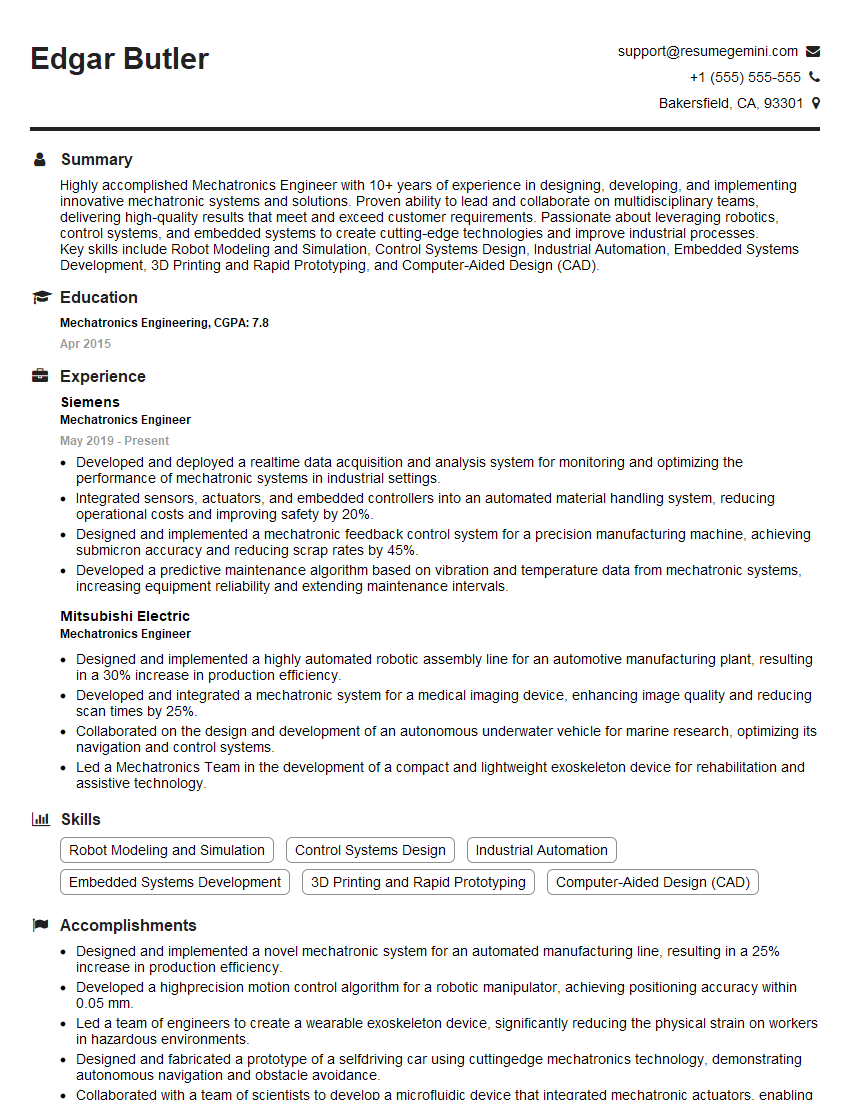
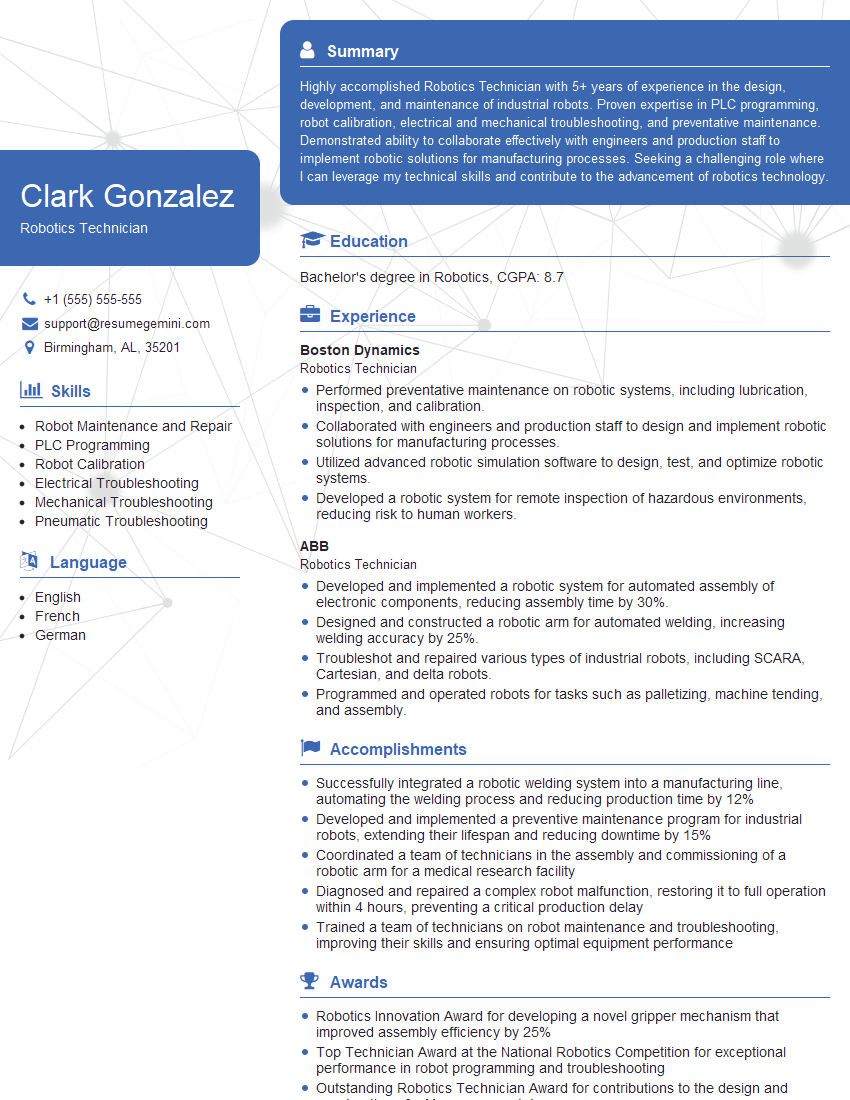
Mastering Robotic Technology opens doors to exciting and innovative career paths with significant growth potential. The demand for skilled professionals in this field is high, making it a rewarding pursuit. To maximize your job prospects, crafting a strong, ATS-friendly resume is crucial. This is where ResumeGemini can help. ResumeGemini provides a powerful and intuitive platform to build a professional resume that highlights your skills and experience effectively. We offer examples of resumes tailored specifically to the Robotic Technology field to help you get started. Take advantage of this resource and create a resume that showcases your expertise and lands you that dream interview!



Explore more articles
Users Rating of Our Blogs
Share Your Experience
We value your feedback! Please rate our content and share your thoughts (optional).
What Readers Say About Our Blog
To the interviewgemini.com Webmaster.
Very helpful and content specific questions to help prepare me for my interview!
Thank you
To the interviewgemini.com Webmaster.
This was kind of a unique content I found around the specialized skills. Very helpful questions and good detailed answers.
Very Helpful blog, thank you Interviewgemini team.