Cracking a skill-specific interview, like one for Experience in working with custom lighting solutions, requires understanding the nuances of the role. In this blog, we present the questions you’re most likely to encounter, along with insights into how to answer them effectively. Let’s ensure you’re ready to make a strong impression.
Questions Asked in Experience in working with custom lighting solutions Interview
Q 1. Explain your experience with different types of custom lighting fixtures.
My experience encompasses a wide range of custom lighting fixtures, from the intricate hand-blown glass pendants of Murano-style designs to the sleek, minimalist profiles of contemporary LED systems. I’ve worked extensively with various materials including metal (brass, steel, aluminum), wood, and acrylic, each demanding a different approach to design and construction. For instance, a project involving a large-scale sculptural chandelier required a detailed understanding of structural integrity and weight distribution, quite different from the precision needed when crafting delicate, bespoke sconces. I am also familiar with integrating various light sources such as incandescent, halogen, fluorescent, and LED technologies, always tailoring the choice to the client’s aesthetic preferences and project needs. For example, I recently completed a project where the client requested a warm, inviting glow using filament LED bulbs to mimic the look of traditional incandescent lighting while still maintaining energy efficiency.
- Metal Fixtures: Experience in working with different metal finishes (powder coating, polishing, plating), ensuring durability and aesthetic appeal.
- Glass Fixtures: Expertise in selecting appropriate glass types and working with glassblowers for custom shapes and textures.
- Integrated LED Systems: Proficiency in designing and integrating custom LED light strips and modules for unique lighting effects.
Q 2. Describe your process for designing a custom lighting scheme for a residential space.
Designing a custom lighting scheme begins with a thorough consultation with the client to understand their lifestyle, preferences, and the overall aesthetic vision for the space. I then conduct a detailed site survey, measuring the room dimensions, assessing existing architectural features, and considering natural light sources. My design process involves a series of iterative steps:
- Needs Assessment: Identifying the functional requirements of each zone (task lighting, ambient lighting, accent lighting).
- Mood Board Creation: Developing a visual representation of the desired atmosphere and style using images, color palettes, and material samples.
- Lighting Plan Development: Creating a detailed lighting plan, indicating fixture placement, type, and specifications.
- 3D Rendering & Simulation: Utilizing specialized software (see below) to visualize the lighting scheme and fine-tune the design based on light levels and shadows.
- Client Review & Refinement: Presenting the design to the client, incorporating their feedback, and making necessary adjustments.
- Fixture Specification & Sourcing: Selecting appropriate fixtures and light sources, considering aesthetics, functionality, and budget.
For instance, in a recent residential project, we transformed a dark, under-lit living room into a bright, inviting space using a combination of recessed lighting, track lighting, and a statement pendant fixture. The layered approach ensured adequate illumination for different activities while creating a warm and welcoming atmosphere.
Q 3. How do you calculate the required lumens for a specific area?
Calculating the required lumens for a specific area is crucial for achieving the desired illumination level. It involves considering several factors:
- Room dimensions (length x width x height): This determines the total volume of the space.
- Room finish reflectivity: Lighter-colored walls and ceilings reflect more light, requiring fewer lumens.
- Desired illuminance (lux): This represents the amount of light falling on a surface. Recommended levels vary depending on the room’s function (e.g., 500 lux for a kitchen work area, 200 lux for a living room). There are established lighting design guides for recommended lux levels.
- Light fixture efficiency (lumens per watt): This indicates how much light is produced per unit of energy consumed.
The basic formula is: Total Lumens = Area (m²) x Desired Illuminance (lux) x Lighting Efficiency Factor. The lighting efficiency factor is a multiplier (typically between 1.0 and 1.5) that accounts for light loss due to absorption and reflection. A professional lighting design software can easily handle this calculation, offering more sophisticated models that factor in multiple light sources and their distribution.
Q 4. What software are you proficient in for lighting design and rendering?
I am proficient in several software applications commonly used for lighting design and rendering. My expertise includes:
- Dialux evo: A powerful tool for calculating illuminance, rendering realistic visualizations, and energy analysis.
- Relux: Similar to Dialux, it provides comprehensive lighting design and simulation capabilities.
- Autodesk Revit: Integrated into BIM (Building Information Modeling) workflows, I utilize Revit for collaborative design and coordination.
- SketchUp with V-Ray: A versatile platform for 3D modeling and high-quality rendering, allowing me to create stunning visualizations for client presentations.
The choice of software depends on the project’s complexity and specific requirements. For instance, I might use Dialux for a straightforward residential project, while Revit would be more suitable for a large-scale commercial project involving multiple disciplines.
Q 5. Explain your understanding of color temperature and its impact on lighting design.
Color temperature, measured in Kelvin (K), describes the perceived warmth or coolness of a light source. Lower color temperatures (2700K-3000K) produce a warm, yellowish light, often associated with comfort and relaxation, ideal for living rooms and bedrooms. Higher color temperatures (5000K-6500K) create a cool, bluish light, commonly used in offices and kitchens, promoting alertness and focus. Color temperature significantly impacts the mood and atmosphere of a space. Imagine a restaurant: warm lighting evokes intimacy and a cozy ambiance, while cool lighting could feel sterile and impersonal. In my designs, I carefully select color temperatures based on the room’s function and desired emotional impact. A balance must be maintained; a space may use warm light in one area (dining) and cooler light in another (kitchen).
Q 6. How do you incorporate energy efficiency considerations into your lighting designs?
Energy efficiency is a paramount consideration in all my lighting designs. I prioritize the use of energy-efficient light sources, such as LEDs, which offer significantly longer lifespans and reduced energy consumption compared to traditional incandescent or fluorescent bulbs. I also employ strategies such as:
- Dimmable Lighting: Allows for precise control of light levels, minimizing energy waste by reducing light output when not needed.
- Occupancy Sensors: Automatically switch lights on and off based on occupancy, eliminating unnecessary energy consumption in unoccupied areas.
- Daylight Harvesting: Designing the lighting scheme to complement and maximize the use of natural light, reducing reliance on artificial lighting.
- Zoning and Task Lighting: Implementing strategically placed lights only where illumination is required, rather than employing general, overall illumination.
For example, I recently incorporated smart lighting controls in a home, allowing the client to adjust the lighting levels and color temperature throughout the house using a smartphone app, leading to a significant decrease in energy usage.
Q 7. Describe your experience with different types of lighting controls systems.
My experience with lighting control systems includes a variety of technologies, ranging from simple dimmer switches to sophisticated, networked systems. I’ve worked with:
- Dimmer Switches: Basic controls allowing for adjustment of light intensity. These are cost-effective for smaller projects.
- Relay Switches: Used for controlling multiple lights from a single point or for integrating with smart home systems.
- 0-10V Dimming Systems: Offer smoother dimming capabilities and greater flexibility compared to dimmer switches.
- DALI (Digital Addressable Lighting Interface): A digital protocol enabling individual control and monitoring of lights within a network. DALI offers advanced features like scene setting and fault detection.
- KNX and other Smart Home Systems: Integration with smart home automation systems allows for centralized control of lighting and other building systems, offering energy savings and enhanced convenience.
The selection of a lighting control system depends on factors like budget, complexity of the lighting scheme, and client requirements. A simple dimmer switch might suffice for a small room, whereas a complex building may benefit from a fully integrated smart home system.
Q 8. What are the key considerations for designing lighting for a commercial space?
Designing lighting for a commercial space requires a multifaceted approach, balancing aesthetics, functionality, energy efficiency, and safety. It’s not just about making the space bright; it’s about creating the right atmosphere to enhance productivity, comfort, and brand image.
- Functionality: Consider the specific tasks performed in each area. A retail store needs bright, even illumination to showcase products, while a restaurant might require softer, more ambient lighting to create a relaxed atmosphere. Different lighting levels (measured in lux) are required for different activities.
- Aesthetics: Lighting contributes significantly to the overall design. The style of fixtures, color temperature (measured in Kelvin), and light distribution should complement the space’s architecture and interior design. Warm white light (around 2700K) is often preferred for residential and hospitality spaces, while cool white (around 5000K) is suitable for offices and industrial settings.
- Energy Efficiency: Utilizing energy-efficient lighting technologies like LEDs is crucial. LEDs offer longer lifespans, lower energy consumption, and reduced maintenance costs compared to traditional lighting options. We would analyze energy usage and potentially incorporate smart lighting controls for optimal energy management.
- Safety: Compliance with relevant building codes and safety regulations is paramount. This includes proper fixture placement to avoid glare, emergency lighting systems, and ensuring compliance with fire safety regulations.
- Budget: Balancing the desired lighting effects with the allocated budget is a critical part of the design process. We explore various options to find the best solution that fits within budget constraints without compromising quality.
For example, in a modern office, we might use a combination of high-efficiency LED panels for general illumination, accent lighting with track spotlights to highlight artwork or architectural features, and task lighting at individual workstations.
Q 9. Explain your familiarity with various lighting technologies (LED, fluorescent, incandescent).
My experience encompasses a wide range of lighting technologies. I have extensive hands-on experience with LEDs, fluorescents, and incandescents, understanding their strengths and weaknesses in various applications.
- LEDs (Light Emitting Diodes): LEDs are the current industry standard due to their high energy efficiency, long lifespan (50,000+ hours), and versatility in terms of color temperature and color rendering index (CRI). They also offer excellent dimming capabilities and are available in a wide array of form factors, making them adaptable to various design needs. I’ve used them in everything from large-scale commercial projects to smaller residential installations.
- Fluorescent Lamps: While less efficient than LEDs, fluorescent lighting remains a viable option, especially in existing installations where retrofitting with LEDs might not be cost-effective. I’m familiar with both T8 and T5 fluorescent lamps and their various ballasts. I understand the importance of properly disposing of fluorescent tubes due to mercury content.
- Incandescent Lamps: Though largely phased out due to inefficiency, incandescent lighting still has its niche applications where warmth and color rendering are paramount, such as in some hospitality settings. However, I would only recommend them where energy efficiency is less of a concern.
My understanding extends to the nuances of each technology, including the different types of LED chips (e.g., COB, SMD), ballast types for fluorescent lamps, and the impact of color temperature on perceived atmosphere.
Q 10. How do you handle lighting challenges in spaces with difficult architectural features?
Challenging architectural features often require creative solutions and a deep understanding of lighting principles. I approach these situations by meticulously analyzing the space and employing a range of strategies.
- Concealed Lighting: For low ceilings or spaces with limited headroom, recessed lighting or cove lighting can be used to maximize space and minimize visual clutter.
- Adaptive Fixture Selection: Specific fixture designs are chosen to manage light distribution effectively. For instance, wall-washers can highlight architectural details on uneven surfaces. Track lighting allows for flexibility in directing light precisely where needed.
- Strategic Layering: Combining various lighting layers (ambient, accent, and task) helps address specific lighting needs. This approach ensures even illumination while mitigating shadows cast by unusual architectural elements.
- Advanced Computational Tools: I utilize lighting design software for photometric analysis to simulate lighting conditions and optimize fixture placement, even in complex spaces. This allows me to predict the performance of the lighting scheme before implementation, minimizing rework.
For example, I once worked on a project with a sloped ceiling. Instead of fighting the architecture, we embraced it by using adjustable track lighting to highlight the angles and create visual interest. We also used uplighting to highlight the structural elements.
Q 11. Describe your experience with lighting calculations and photometric analysis.
Lighting calculations and photometric analysis are integral parts of my design process. I use industry-standard software like DIALux evo and AGi32 to perform detailed calculations and simulations.
This involves:
- Calculating Illuminance Levels: Determining the required light levels (lux) for different areas based on relevant standards and building codes.
- Modeling Light Distribution: Simulating the way light is distributed within a space, accounting for the reflectivity of surfaces and the positions of fixtures. This helps identify areas of potential glare or insufficient illumination.
- Generating Isolux Diagrams: Visualizing the uniformity of illumination across a space to ensure even light distribution.
- Energy Analysis: Estimating energy consumption and identifying opportunities for optimization.
These analyses ensure the design meets client requirements and adheres to industry best practices. The results provide crucial data for selecting the right fixtures, quantities, and placement for optimal lighting performance. For example, in a large retail store, this would allow us to verify sufficient light levels on shelves and minimize energy wastage by tailoring illumination to specific areas.
Q 12. How do you ensure the safety and compliance of your lighting designs with relevant codes?
Safety and compliance are non-negotiable. My designs always adhere to relevant building codes, such as the International Building Code (IBC) and the National Electrical Code (NEC), as well as any local regulations.
I ensure this by:
- Selecting Certified Fixtures: Using only fixtures that meet safety standards and carry appropriate certifications (e.g., UL, ETL).
- Proper Wiring and Installation: Ensuring all wiring and installation practices comply with NEC standards to prevent electrical hazards.
- Emergency Lighting Design: Incorporating emergency lighting systems that meet code requirements for safe egress in case of power failure.
- Glare Control: Employing strategies to minimize glare from lighting fixtures, protecting occupants’ eyesight.
- Regular Updates: Staying informed on the latest codes and regulations to ensure ongoing compliance.
We document all aspects of the design meticulously, including fixture specifications, wiring diagrams, and calculations, to facilitate easy review and verification by relevant authorities.
Q 13. Explain your process for selecting the appropriate lighting fixtures for a given application.
Fixture selection is a critical step that requires careful consideration of many factors. It’s not merely about aesthetics; it’s about finding the right balance between form and function.
My process involves:
- Defining Requirements: Understanding the specific lighting needs of the space, including illuminance levels, color temperature, color rendering, and light distribution patterns.
- Considering Environmental Factors: Evaluating factors like ceiling height, ambient temperature, and potential moisture or dust.
- Analyzing Budgetary Constraints: Exploring options that meet both functional and aesthetic requirements within the allocated budget.
- Evaluating Manufacturer Specifications: Reviewing datasheets and photometric reports to ensure the chosen fixtures meet performance criteria.
- Prototyping and Testing: In complex situations, we might create mockups or conduct small-scale tests to validate the selected fixtures’ performance before full-scale implementation.
For instance, for a high-end retail space, I might opt for high-quality, designer fixtures that provide excellent color rendering to showcase products effectively. For a warehouse, on the other hand, the focus would be on robust, energy-efficient fixtures that can withstand harsh conditions.
Q 14. Describe your experience working with clients to understand their lighting needs and preferences.
Effective client communication is fundamental to a successful lighting project. I strive to understand their vision, needs, and preferences through a collaborative process.
My approach involves:
- Initial Consultation: Meeting with clients to discuss their goals, design preferences, and budgetary constraints. This includes understanding their desired ambiance, functionality needs, and any specific aesthetic preferences.
- Site Visits: Conducting thorough site surveys to assess the space, understand its architectural features, and identify potential challenges.
- Presentation of Design Options: Presenting various design options, including renderings and simulations, to illustrate different lighting approaches and their impact.
- Feedback and Iteration: Actively soliciting and incorporating client feedback throughout the design process to ensure the final design aligns with their expectations.
- Post-Installation Review: Following up with clients after installation to address any concerns and ensure their satisfaction.
I find that actively listening to clients, understanding their preferences, and providing clear, concise explanations of technical aspects builds trust and leads to superior results. One client, a restaurant owner, initially wanted very dim lighting, but after presenting simulations that showed how brighter, strategically placed lighting could enhance the dining experience, they were receptive to a more balanced design that ultimately improved their ambiance and customer satisfaction.
Q 15. How do you manage projects and timelines for custom lighting installations?
Managing projects and timelines for custom lighting installations requires a meticulous approach. It starts with a thorough initial consultation to understand the client’s vision, budget, and desired timeline. This is followed by a detailed design phase, where we create lighting plans, specify fixtures, and prepare detailed documentation. We then develop a comprehensive project schedule, breaking down the work into manageable tasks with assigned deadlines and responsibilities. This schedule, often presented as a Gantt chart, is shared with the client and all stakeholders. Regular progress meetings and transparent communication are critical to keep the project on track. We utilize project management software to track progress, manage resources, and address any potential delays proactively. For instance, in a recent high-end residential project, we used a phased approach, completing the design and procurement of fixtures in phase one, followed by installation and testing in phase two, ensuring a smooth and timely project completion.
We also build in buffer time to account for unforeseen circumstances, such as supply chain delays or unexpected site conditions. This proactive approach minimizes disruptions and ensures the project is delivered on time and within budget. Regular communication with the client keeps them informed of progress and any potential issues.
Career Expert Tips:
- Ace those interviews! Prepare effectively by reviewing the Top 50 Most Common Interview Questions on ResumeGemini.
- Navigate your job search with confidence! Explore a wide range of Career Tips on ResumeGemini. Learn about common challenges and recommendations to overcome them.
- Craft the perfect resume! Master the Art of Resume Writing with ResumeGemini’s guide. Showcase your unique qualifications and achievements effectively.
- Don’t miss out on holiday savings! Build your dream resume with ResumeGemini’s ATS optimized templates.
Q 16. What are some common challenges you face when designing custom lighting solutions?
Designing custom lighting solutions presents unique challenges. One common issue is integrating lighting with existing architectural features. For example, trying to incorporate lighting into a historic building with intricate plasterwork requires careful consideration of the fixture placement and installation methods to avoid damage. Another challenge involves balancing aesthetics and functionality. Clients often have specific design preferences that might conflict with optimal lighting performance. Finding a balance between form and function necessitates creative solutions and strong communication with the client. A third challenge is meeting stringent energy efficiency requirements. While creating a visually appealing space, we need to ensure the design adheres to energy codes and maximizes energy efficiency through the selection of appropriate fixtures and control systems.
Another hurdle can be the coordination of different trades during the installation process. Ensuring that electricians, drywallers, and other tradespeople work seamlessly together to avoid conflicts and delays requires careful planning and proactive communication. Finally, unexpected site conditions, such as incorrect wiring or concealed structural elements, can cause delays and necessitate on-the-spot problem-solving.
Q 17. How do you address budget constraints when designing custom lighting schemes?
Budget constraints are a frequent reality in custom lighting projects. We address this by employing a tiered approach to design, offering various options that meet different budget levels. This begins with a thorough understanding of the client’s budget during the initial consultation. We explore cost-effective solutions without compromising the design’s overall quality or functionality. This might involve selecting fixtures from different manufacturers, exploring alternative materials, or optimizing the number of fixtures needed. For example, using LED technology, known for its energy efficiency, significantly reduces long-term energy costs and can offset the initial investment in higher-quality fixtures. We also prioritize value engineering, where we identify areas to reduce costs without sacrificing functionality or design integrity. This might involve simplifying certain aspects of the design, selecting readily available fixtures, or using less expensive, yet equally effective, materials. Transparent communication with the client throughout the process ensures their understanding and agreement on every decision.
Q 18. Describe your experience with different types of dimming systems.
My experience encompasses various dimming systems, each with its own advantages and disadvantages. I’ve worked extensively with 0-10V dimming, which is a widely used analog system offering reliable performance and cost-effectiveness. However, it’s less precise than digital systems. I’m also proficient with DMX (Digital Multiplex) dimming, a flexible digital system ideal for large-scale projects and complex lighting schemes, allowing for intricate control and programming of individual fixtures. DALI (Digital Addressable Lighting Interface) is another digital system I frequently use; it offers advanced features like individual fixture addressing and feedback, enhancing control and energy efficiency. Finally, I have experience with newer wireless control systems like Bluetooth and Zigbee, providing greater flexibility and ease of installation, especially in retrofit situations. The choice of dimming system depends heavily on the project’s scale, budget, and desired level of control. For instance, a small residential project might benefit from 0-10V, whereas a large commercial space might require the advanced capabilities of DMX or DALI.
Q 19. How do you ensure the longevity and maintainability of your lighting designs?
Ensuring the longevity and maintainability of lighting designs is crucial. We achieve this by specifying high-quality fixtures from reputable manufacturers with a proven track record of reliability. We choose fixtures with easy-to-replace components, readily available spare parts, and clear maintenance instructions. We also design for accessibility, ensuring fixtures are easily reachable for cleaning and maintenance. For instance, recessed fixtures in high-traffic areas are chosen with easily accessible trim rings for cleaning. We document all aspects of the installation, including fixture locations, wiring diagrams, and maintenance procedures. This detailed documentation simplifies troubleshooting and maintenance tasks, extending the life of the lighting system. Furthermore, we encourage the use of durable materials resistant to wear and tear. We might suggest specifying fixtures with corrosion-resistant finishes for environments prone to moisture or humidity. This holistic approach to design, documentation, and material selection contributes significantly to the longevity and maintainability of our lighting solutions.
Q 20. Explain your understanding of light pollution and how to mitigate it.
Light pollution is the excessive or obtrusive artificial light, impacting the environment and human health. Understanding this is crucial for responsible lighting design. My designs aim to minimize light pollution by using appropriate shielding and directing light downwards, preventing upward spill. I specify fixtures with low-glare optics, reducing the amount of light scattered into the night sky. We use controls to limit the amount of light output based on the time of day or occupancy. For example, motion sensors and timers ensure lights are only illuminated when and where needed. The selection of warm-colored light sources (lower color temperatures) also reduces the impact of light pollution as they are less intrusive to the environment and wildlife. For outdoor lighting, using fully shielded fixtures that direct light only where needed is essential, reducing sky glow and impacting the natural environment. In urban environments, optimizing the placement and orientation of lighting fixtures minimizes the impact on nearby residential areas. We also collaborate with astronomers or environmental groups on projects located near observatories or sensitive ecosystems.
Q 21. How do you incorporate sustainable practices into your lighting designs?
Sustainable practices are integral to our lighting designs. We prioritize energy-efficient lighting solutions, primarily using LED technology, which consumes significantly less energy than traditional lighting options. This reduces energy consumption, lowering operational costs and minimizing the carbon footprint. We incorporate daylight harvesting strategies, maximizing natural light to reduce reliance on artificial lighting. This can involve designing architectural features to enhance daylight penetration or using automated lighting controls that dim or switch off artificial lights when sufficient daylight is available. We select fixtures made from recycled or sustainable materials, whenever possible. We also consider the end-of-life disposal of fixtures, choosing products designed for easy disassembly and recycling. Additionally, our design process aims to minimize the environmental impact of the manufacturing, transportation, and installation phases by selecting locally sourced materials and working with suppliers who prioritize sustainable practices. This holistic approach to sustainability ensures our lighting designs are not only energy-efficient but also environmentally responsible throughout their entire lifecycle.
Q 22. Describe your experience with lighting for different applications (e.g., retail, hospitality, healthcare).
My experience spans diverse lighting applications, each demanding a unique approach. In retail, the focus is on enhancing product visibility and creating an inviting atmosphere. I’ve worked on projects using accent lighting to highlight key merchandise, and ambient lighting to create a comfortable shopping experience. For example, a high-end jewelry store required precisely controlled spotlights to showcase diamonds, while a clothing boutique benefited from warmer, softer lighting to create a more relaxed mood.
Hospitality lighting prioritizes mood and ambiance. I’ve designed lighting schemes for restaurants that emphasize intimate dining areas with warmer color temperatures, contrasted by brighter, cooler lighting in bar areas. Hotels often require layered lighting schemes, combining general illumination with task lighting (e.g., bedside lamps) and accent lighting (e.g., artwork spotlights) for a luxurious feel.
In healthcare, the emphasis is on functionality and patient well-being. Proper lighting is crucial for surgical procedures, requiring bright, shadow-free illumination. In patient rooms, a balance of natural and artificial light is needed to promote healing and reduce stress. For instance, I’ve worked on a project incorporating circadian lighting systems to regulate patients’ sleep-wake cycles and improve their overall health.
Q 23. How do you collaborate with other professionals (e.g., architects, engineers) on lighting projects?
Collaboration is paramount in successful lighting projects. I foster strong relationships with architects and engineers from the initial design phase. With architects, we discuss the overall building design, considering factors like window placement and structural elements to determine optimal lighting layouts. We use design review meetings and shared 3D models to visualize and refine the lighting plans collaboratively.
My interaction with engineers involves coordinating technical aspects such as power distribution, fixture selection based on load calculations, and ensuring compliance with building codes and safety regulations. Effective communication, regular meetings, and the use of shared project management software ensure everyone is on the same page and issues are resolved promptly. A successful project relies on understanding the perspectives of everyone involved and finding creative solutions to address any conflicts or challenges.
Q 24. Describe a time you had to troubleshoot a lighting problem. What was the solution?
During a recent restaurant project, we encountered unexpected flickering in the LED downlights. Initially, we suspected faulty fixtures, but after thorough testing, we found the problem wasn’t the lights themselves, but rather inconsistent voltage supply from the building’s electrical system.
The solution involved a multi-step process. First, we used specialized electrical testing equipment to precisely identify the voltage fluctuations. Then, we worked with the electrical engineer to analyze the building’s wiring and discovered a faulty circuit breaker. Replacing the breaker resolved the voltage inconsistency, eliminating the flickering and ensuring consistent, reliable performance of the lighting system. This highlighted the importance of thorough investigation and collaboration with other disciplines to resolve complex lighting issues effectively.
Q 25. What are your preferred methods for presenting lighting designs to clients?
Presenting lighting designs effectively requires a multi-faceted approach. I typically start with a concise overview, explaining the design concept and its alignment with the client’s needs and objectives. Then, I use high-quality visuals, including photorealistic renderings and 3D models, to showcase the lighting design’s impact on the space.
Interactive presentations, where clients can explore different lighting scenarios and adjust parameters (such as color temperature or intensity), can be highly effective in engaging clients and enabling informed decision-making. Finally, I always prepare detailed specifications and cost estimations, ensuring the client understands the project’s scope and budget. Combining these methods provides a comprehensive and impactful presentation that leaves clients confident in the proposed design.
Q 26. How do you stay up-to-date with the latest trends and technologies in lighting design?
Staying current in the dynamic world of lighting design requires a proactive approach. I regularly attend industry conferences and workshops, networking with peers and learning about the latest innovations. I subscribe to industry publications and online resources to keep abreast of new technologies, design trends, and best practices.
Furthermore, I actively participate in online forums and professional organizations, engaging in discussions and sharing knowledge with other lighting designers. Continuous learning is essential; exploring new software and techniques ensures I can provide my clients with cutting-edge, efficient, and sustainable lighting solutions.
Q 27. Describe your experience with lighting simulations and their use in design decisions.
Lighting simulations are an indispensable tool in my design process. Software like DIALux evo and AGi32 allows me to create detailed virtual representations of spaces, experimenting with different fixture types, placement, and lighting controls before physical installation. This helps in predicting light levels, identifying potential issues (e.g., glare or shadows), and optimizing energy efficiency.
For example, using simulation software, I can precisely model the effect of natural light, ensuring that artificial lighting complements it rather than creating harsh contrasts. The ability to visualize different scenarios empowers clients to make informed decisions, minimizing risks and maximizing the aesthetic and functional success of the lighting scheme. The simulations also help demonstrate energy efficiency calculations, showing potential savings through the use of energy-efficient lighting technologies.
Key Topics to Learn for Experience in working with custom lighting solutions Interview
- Understanding Client Needs: Analyzing project briefs, understanding design intent, and translating client vision into technical specifications.
- Lighting Design Principles: Application of principles like ambient, accent, and task lighting; understanding color temperature, CRI, and light distribution.
- Technical Specifications & Calculations: Calculating light levels (lux), selecting appropriate fixtures and lamps based on power consumption, efficiency, and lifespan.
- Fixture Selection & Integration: Choosing suitable luminaires for different applications (e.g., recessed, track, pendant), considering aesthetics, functionality, and compatibility with building systems.
- Control Systems & Automation: Familiarity with various lighting control technologies (e.g., DMX, DALI, 0-10V) and their application in creating dynamic and energy-efficient lighting schemes.
- Budgeting & Cost Estimation: Developing accurate cost estimates for materials, labor, and installation, managing project budgets effectively.
- Problem-Solving & Troubleshooting: Identifying and resolving lighting design issues, managing unexpected challenges during installation and commissioning.
- Collaboration & Communication: Effective communication with architects, engineers, contractors, and clients throughout the project lifecycle.
- Health & Safety Regulations: Understanding relevant safety standards and regulations concerning electrical work and lighting installations.
- Sustainability & Energy Efficiency: Incorporating energy-efficient lighting solutions, understanding LEED and other green building standards.
Next Steps
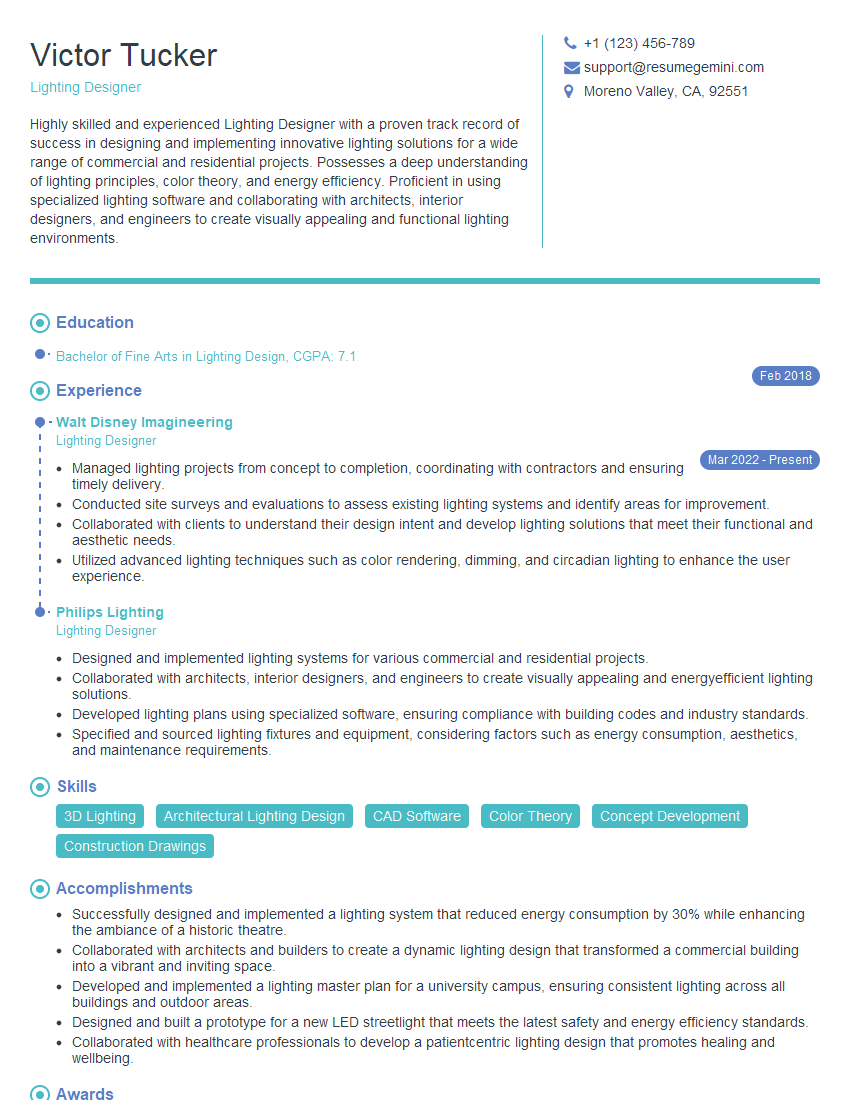
Mastering experience in custom lighting solutions significantly enhances your career prospects, opening doors to exciting roles with greater responsibility and higher earning potential. A well-crafted, ATS-friendly resume is crucial for getting noticed by recruiters. To maximize your chances, leverage the power of ResumeGemini to create a professional and impactful resume that highlights your skills and experience. ResumeGemini provides examples of resumes tailored to Experience in working with custom lighting solutions, helping you showcase your qualifications effectively. Invest in your future – create a winning resume today!
Explore more articles
Users Rating of Our Blogs
Share Your Experience
We value your feedback! Please rate our content and share your thoughts (optional).
What Readers Say About Our Blog
To the interviewgemini.com Webmaster.
Very helpful and content specific questions to help prepare me for my interview!
Thank you
To the interviewgemini.com Webmaster.
This was kind of a unique content I found around the specialized skills. Very helpful questions and good detailed answers.
Very Helpful blog, thank you Interviewgemini team.