Are you ready to stand out in your next interview? Understanding and preparing for Experience in working with theatrical lighting interview questions is a game-changer. In this blog, we’ve compiled key questions and expert advice to help you showcase your skills with confidence and precision. Let’s get started on your journey to acing the interview.
Questions Asked in Experience in working with theatrical lighting Interview
Q 1. Explain the difference between Fresnel and LED lighting fixtures.
Fresnel and LED fixtures are both common in theatrical lighting, but they differ significantly in their light source, optics, and energy efficiency. Fresnels utilize a traditional incandescent or tungsten-halogen lamp, producing a soft-edged, variable beam. The lens, a Fresnel lens, allows for focusing the beam from a wide flood to a narrow spot. LED fixtures, on the other hand, use light-emitting diodes as their light source. This allows for energy efficiency, longer lamp life, and precise color control through RGB or RGBW mixing. Think of it like this: a Fresnel is like an old-fashioned spotlight with a smooth, warm light, while an LED is like a modern, versatile spotlight you can finely tune for color and intensity.
Here’s a table summarizing the key differences:
| Feature | Fresnel | LED |
|---|---|---|
| Light Source | Incandescent or Tungsten-Halogen | LEDs |
| Energy Efficiency | Lower | Higher |
| Heat Output | High | Low |
| Lifespan | Relatively short | Very long |
| Color Control | Limited (gels required for color changes) | Precise color mixing (RGB/RGBW) |
| Beam Control | Variable, soft-edged beam | Variable, can be sharp or soft depending on the fixture |
Q 2. Describe your experience with lighting control consoles (e.g., ETC Ion, MA Lighting grandMA2).
I have extensive experience with both ETC Ion and MA Lighting grandMA2 consoles. My proficiency encompasses programming, patching, cueing, and troubleshooting. With the ETC Ion, I appreciate its user-friendly interface, particularly for smaller productions where speed and simplicity are key. I’ve used it effectively for everything from small plays to corporate events, creating dynamic lighting sequences and smoothly transitioning between scenes. The grandMA2, on the other hand, is a powerhouse, ideal for larger, more complex productions. Its advanced features, like macro programming and sophisticated effects, allow for intricate lighting designs and precise control over numerous fixtures. I’ve used the grandMA2 on several large-scale musicals and concerts, managing complex cue lists and coordinating with other technical departments. I’m comfortable working with both consoles’ networking capabilities and integrating them with other show control systems.
Q 3. How do you calculate light levels using foot-candles or lux?
Calculating light levels involves measuring illuminance, the amount of light falling on a surface. Foot-candles (fc) and lux (lx) are both units of illuminance. One foot-candle equals approximately 10.76 lux. The basic formula is:
Illuminance (fc or lx) = Luminous Intensity (cd) / Distance2
where Luminous Intensity is measured in candelas (cd). In practice, a light meter is typically used to measure illuminance directly. For example, if a light meter reads 500 lux on a stage area, you know that that area is receiving that much light. This is crucial for ensuring even illumination on the stage. Often, we use a light meter to find the actual illuminance level first and then work backwards to determine the ideal fixture placement and intensity needed. For instance, if we’re aiming for 100 lux on a particular actor and find the area is currently receiving 50 lux, we may need to add more fixtures or increase their intensity to achieve our goal.
Q 4. What are the safety procedures for working with high-voltage lighting equipment?
Safety is paramount when working with high-voltage lighting equipment. My safety procedures include:
- Lockout/Tagout: Always lock out and tag out power to fixtures before any maintenance or repair work. This prevents accidental energization.
- Grounding: Ensure all equipment is properly grounded to prevent electrical shocks. This is especially critical in wet or damp environments.
- Personal Protective Equipment (PPE): Wear appropriate PPE, including insulated gloves and safety glasses, when working with high-voltage circuits.
- Proper Training: Only trained and authorized personnel should work with high-voltage equipment.
- Inspection: Regularly inspect cables, connectors, and fixtures for damage and wear.
- Emergency Procedures: Be familiar with emergency procedures in case of electrical shock or fire.
- Awareness of Surroundings: Maintain awareness of your surroundings to avoid tripping hazards or accidental contact with energized equipment.
Following these procedures reduces the risk of electrical shocks, burns, and other injuries.
Q 5. Describe your experience with different types of theatrical gels and their color mixing properties.
I have extensive experience with a wide range of theatrical gels, including Rosco, Lee, and Apollo. Each brand offers slightly different color variations and transmission properties. Gels are essential for shaping the color and quality of light. I understand color mixing principles, including subtractive color mixing with gels. For instance, placing a CTO (color temperature orange) gel over a white light will shift it towards warmer temperatures, while using a CTB (color temperature blue) gel will cool it down. More complex colors are created by layering gels or using combinations of primary colors. I consider factors like the intensity of the light source, the type of gel, and its diffusion properties when selecting gels for a production. Experimentation is key to achieving precise color blends.
For example, I might use a deep red gel to create a dramatic mood, or a pale amber gel for a warm glow. Understanding how different gels interact with each other and with the light source allows for highly nuanced lighting design.
Q 6. Explain the concept of color temperature and its relevance in lighting design.
Color temperature is a measure of the warmth or coolness of a light source, expressed in Kelvin (K). Lower Kelvin values (e.g., 2700K) represent warmer colors like candlelight or incandescent bulbs (think oranges and reds). Higher Kelvin values (e.g., 6500K) represent cooler colors like daylight or fluorescent lights (think blues and whites). In lighting design, consistent color temperature is vital for maintaining a cohesive mood. Inconsistent color temperatures can create a jarring visual experience and distract from the story. Imagine a scene where a warm, intimate lighting scheme is suddenly disrupted by a harshly cool light—it would be jarring and detract from the mood.
Therefore, maintaining a consistent color temperature across fixtures, even when using different types of fixtures (e.g., LEDs and tungsten), is paramount for ensuring a unified and visually pleasing stage design.
Q 7. How do you create a lighting plot?
Creating a lighting plot is a crucial step in the lighting design process. It’s essentially a blueprint that documents the placement, type, and function of all lighting instruments for a given production. My approach includes:
- Initial Consultation: Discussing the director’s vision, script analysis, and set design to understand the overall aesthetic and lighting needs.
- Sketching: Producing a rough sketch of the stage, indicating key areas and potential fixture positions.
- Fixture Selection: Selecting appropriate fixtures based on factors such as beam angle, color mixing capabilities, and intensity.
- Positioning: Precisely plotting the position of each fixture on the sketch, accounting for sightlines and potential obstructions.
- Circuiting: Assigning each fixture to a specific circuit on the lighting console.
- Color and Gel Selection: Identifying the color and gel requirements for each fixture, based on the desired mood and color palette.
- Documentation: Creating a detailed document that includes all the above information. This document often includes a sketch or CAD drawing, a fixture schedule listing each fixture and its position, circuit assignments, and color specifications.
The final lighting plot serves as a guide for the lighting crew during setup, allowing for a coordinated and efficient lighting setup that accurately reflects the designer’s vision.
Q 8. Describe your experience with lighting design software (e.g., WYSIWYG, Vectorworks).
My experience with lighting design software is extensive, encompassing both WYSIWYG and Vectorworks. I’ve used WYSIWYG extensively for large-scale productions, appreciating its powerful 3D visualization capabilities and its ability to accurately represent complex lighting rigs. This allows for pre-visualization of lighting plots, ensuring smooth implementation and minimizing on-site adjustments. For smaller-scale projects and architectural lighting designs, I’ve relied on Vectorworks, which offers a more streamlined workflow while maintaining precision. For instance, on a recent musical theatre production using WYSIWYG, I was able to virtually hang and focus all the lights, significantly reducing setup time during tech rehearsals. In a smaller gallery installation using Vectorworks, I designed lighting schemes that perfectly complemented the artwork, ensuring accurate color temperatures and even illumination.
Beyond the core functionalities, I am proficient in using features such as patch creation, fixture scheduling, and creating lighting cues. I find that the ability to export data in various formats, such as DMX files, is crucial for seamless communication between the design software and the lighting console.
Q 9. How do you troubleshoot common lighting problems during a performance?
Troubleshooting lighting problems during a performance requires a calm, methodical approach. My first step is to isolate the problem. Is it a single fixture, a channel, or a larger system issue? I use a combination of observation, the lighting console, and communication with the stage manager to pinpoint the fault. For example, if a single light is out, I’d check the bulb, the connection, and the circuit breaker. If the problem is a color issue, I’d check the gel, the dimmer, and the console settings. In one instance, during a live opera, a sudden power surge affected some fixtures. Quickly identifying the tripped circuit breaker and rerouting the power using backup circuits ensured minimal disruption to the performance.
If the issue is more complex, I use my knowledge of the lighting system to systematically eliminate potential causes. Documentation is key – clear patching and cue lists are essential for rapid diagnosis. A spare parts kit, containing common consumables like bulbs and gels, is always at the ready.
Q 10. What are your methods for achieving specific lighting effects (e.g., gobo projection, color washes)?
Achieving specific lighting effects relies on understanding the capabilities of different lighting instruments and how they interact. For gobo projection, I select a fixture with a gobo wheel capable of projecting the desired pattern. The size and sharpness of the projection are controlled by the fixture’s focus and distance from the stage. Color washes are created using color-mixing instruments, such as LED pars or profile fixtures, which allow for precise adjustments to hue, saturation, and intensity. I might use a warm amber wash to create a sunset effect or a cool blue wash for a moonlit scene.
For example, to create a dramatic silhouette, I would use a back light with a sharp-edged gobo to cast a strong shadow. If I wanted a more diffused light, I would opt for a soft-edged gobo or use a wash light with a lower intensity. Precise color mixing requires understanding color temperature and color wheels. For example, mixing cyan and magenta will result in blue, while mixing red and green will result in yellow.
Q 11. Explain the importance of safety regulations in theatrical lighting.
Safety regulations are paramount in theatrical lighting. Ignoring them can lead to serious injury or even death. Key aspects include proper rigging techniques to ensure fixtures are securely hung, preventing falls. I meticulously follow weight limits and use appropriate safety chains and shackles. Regular inspection of cables and connectors is crucial to prevent short circuits and electrical hazards. The use of proper safety eyewear to protect against ultraviolet (UV) and infrared (IR) radiation from high-intensity lighting is non-negotiable. Furthermore, I maintain a clear understanding of emergency procedures, including the proper shutdown of the lighting system in case of fire or other emergencies.
In my experience, a well-maintained and rigorously inspected system coupled with a safety-first mentality is the best preventative measure. Strict adherence to local and national regulations, such as those from OSHA or similar bodies, is paramount.
Q 12. Describe your experience working with moving lights and their functionalities.
Moving lights have revolutionized theatrical lighting, offering precise control over position, color, and gobo projection. My experience encompasses various types, from basic movers to high-end units with advanced features. I understand their functionalities, including pan and tilt movements, color mixing capabilities, gobo wheels, and prism effects. For example, I might use a fast-moving head to create a dynamic chase effect across the stage or a slower-moving wash light to highlight a specific actor.
Programming moving lights effectively requires a good understanding of their parameters and the console’s interface. I frequently use pre-programmed looks and macros to speed up my workflow and create consistent effects. I’m also skilled in using the various effects available, such as strobing, color chases, and beam shaping, to enhance the visual spectacle.
Q 13. How do you maintain and repair lighting equipment?
Maintaining and repairing lighting equipment is a crucial part of my role. Regular inspections are essential. This includes checking for loose connections, damaged cables, and burned-out bulbs. I regularly clean lenses and reflectors to maintain optimal light output and prevent overheating. Minor repairs, such as replacing bulbs or gels, are tasks I perform routinely. For more complex repairs, I know when to consult with a qualified technician. A well-maintained inventory of spare parts is essential for quick fixes during performances.
Documentation is crucial here, too. I maintain detailed records of all equipment, including purchase dates, maintenance schedules, and any repairs. This ensures that the equipment is always in optimal working condition and helps to anticipate potential issues.
Q 14. Explain the concept of lighting cues and their sequencing in a show.
Lighting cues are the individual snapshots of a lighting state, each with its specific settings for intensity, color, and position of all the fixtures. Sequencing these cues creates a dynamic lighting plot that follows the narrative of the show. A cue list is a chronological sequence of these cues, programmed into the lighting console. Each cue is given a number for easy reference and often a descriptive label, like ‘Upstage spotlight on lead actor’.
The transition between cues is crucial; this can be a sudden change or a smooth fade, and I carefully consider the tempo and mood of the production when selecting these. For example, a fast transition might be used to emphasize a change in mood, while a slow fade might be used to create a more gradual shift. The sequencing is planned in collaboration with the director and often involves many iterations to find the perfect interplay between the lighting and the action on stage.
Q 15. How do you work collaboratively with other technical departments (e.g., sound, set design)?
Collaboration is key in theatre. Lighting works hand-in-hand with sound, set design, and costume design to create a unified artistic vision. For example, during the production of A Midsummer Night’s Dream, I worked closely with the set designer to ensure my lighting cues highlighted the whimsical forest setting. We discussed placement of trees and other scenic elements so that my lighting could effectively shape the mood and create depth. Similarly, I coordinated with the sound designer to synchronize lighting changes with sound effects and music, ensuring a seamless transition during the fairy scenes. Regular meetings, shared technical drawings, and open communication are crucial in these collaborative efforts. I use shared digital platforms such as Google Drive to share lighting plots and other crucial documentation, ensuring everyone is on the same page.
Career Expert Tips:
- Ace those interviews! Prepare effectively by reviewing the Top 50 Most Common Interview Questions on ResumeGemini.
- Navigate your job search with confidence! Explore a wide range of Career Tips on ResumeGemini. Learn about common challenges and recommendations to overcome them.
- Craft the perfect resume! Master the Art of Resume Writing with ResumeGemini’s guide. Showcase your unique qualifications and achievements effectively.
- Don’t miss out on holiday savings! Build your dream resume with ResumeGemini’s ATS optimized templates.
Q 16. Describe your experience with different types of lighting instruments (e.g., ellipsoidal, PAR cans, cyc lights).
My experience encompasses a wide range of lighting instruments. Ellipsoidals, like the ETC Source Four, offer precise beam control, perfect for highlighting specific actors or creating sharp gobo projections. I’ve used them extensively for focusing individual characters in dramatic plays. PAR cans, while simpler, provide a broad wash of light, useful for backlighting or creating atmospheric effects. I’ve employed PAR cans effectively in concert settings to bathe the stage in vibrant colors. Cyc lights, designed for lighting cycloramas (large curved backdrops), are essential for creating even washes of color or simulating dawn/dusk. In a recent musical production, I used a combination of cyc lights and carefully placed ellipsoidals to transition seamlessly from a bright day scene to a dramatic nighttime cityscape.
Q 17. What is your experience with dimmer board operation and patching?
I’m proficient in operating various dimmer boards and patching consoles. Patching involves connecting lighting instruments to dimmer channels on the board. This requires a detailed understanding of the circuit and ensures each light is controllable individually. I’ve worked with both traditional analog and modern digital consoles, including the ETC Ion and MA Lighting grandMA2. Understanding the console’s features and capabilities is essential for efficient and precise control. For instance, during a complex show requiring multiple scene changes, the ability to quickly recall pre-programmed lighting cues on a digital console is invaluable, ensuring smooth transitions and minimizing potential delays. My experience also includes creating and organizing lighting plots, which are crucial for documenting channel assignments, dimmer levels, and fixture positions.
Q 18. How do you handle unexpected technical issues during a live performance?
Unexpected technical issues are a reality in live performance. My approach involves a calm, systematic response. First, I quickly identify the problem; is it a blown bulb, a faulty dimmer, a power surge? Then I assess the impact on the show. If the issue is minor, such as a single bulb failure, I have a backup bulb ready and make the quick replacement without disrupting the show flow. For more significant issues, I’ll work with the stage manager to implement an immediate workaround, perhaps using alternative lighting instruments or adapting existing cues. Good communication with the rest of the technical crew is vital, especially under pressure. In a past production, a power surge briefly knocked out a section of lights mid-scene. I quickly switched to a backup lighting state, working with the stage manager to alert the cast about the change. The audience was none the wiser.
Q 19. Explain your understanding of lighting design principles (e.g., intensity, color, distribution).
Lighting design is about manipulating intensity, color, and distribution to achieve specific artistic goals. Intensity refers to brightness; you can use it to draw focus, create contrast, or emphasize emotion. Color evokes mood and atmosphere – warm colors for intimacy, cool colors for coldness. Distribution refers to how light is spread across the stage; spot lights highlight individuals while washes flood the scene. For example, in a tense scene, I might use low-intensity, cool-toned spotlights to focus on the key characters, creating a sense of unease. In contrast, a joyous celebration might use high-intensity, warm-colored washes to bathe the entire stage in light.
Q 20. Describe your experience with creating lighting moods and atmospheres.
Creating moods and atmospheres is where the artistry of lighting truly shines. I achieve this by manipulating all three elements: intensity, color, and distribution. For a romantic scene, I might use soft, low-intensity warm light, diffused to create a soft glow. A suspenseful scene might employ sharp, high-intensity beams of cool light, strategically positioned to create shadows and heighten the tension. Understanding how light interacts with the set design and costumes is crucial. For instance, a textured backdrop illuminated by a backlight can create a dramatic effect, highlighting the texture and creating depth. During a recent production of Hamlet, I used a combination of dark, moody lighting and strategically placed spotlights to enhance the play’s atmosphere of suspense and uncertainty.
Q 21. What is your experience with lighting for different types of theatrical productions (e.g., musicals, plays, concerts)?
My experience spans various theatrical productions. In musicals, I’ve emphasized high-energy lighting to enhance the choreography and spectacle, using fast-paced changes and dynamic effects. Plays require a more nuanced approach, focusing on character lighting and creating atmosphere to match the story’s mood. Concerts often call for vibrant, saturated colors and dazzling effects, creating a lively atmosphere. Adaptability is vital – each genre necessitates a different approach and technical strategy. I find working across different genres constantly challenging and rewarding, expanding my creative capabilities and problem-solving skills.
Q 22. How do you create a lighting design that enhances the storytelling of a production?
Creating a lighting design that enhances storytelling is about more than just pretty lights; it’s about using light to sculpt the mood, guide the audience’s eye, and reveal character and plot. It’s a collaborative process, working closely with the director and other designers to understand the emotional arc of the production.
For instance, in a tense scene, I might use sharp, contrasting shadows and cool blues and purples to heighten the drama. Conversely, a romantic scene might benefit from warmer tones like amber and gold, diffused lighting, and soft highlights. I’d consider the use of color temperature – cooler temperatures feeling distant and colder, warmer temperatures feeling more intimate and inviting – as well as intensity and direction to precisely manipulate the emotional impact.
A key element is highlighting key moments. A single spotlight could emphasize a character’s decision, while a wash of color might emphasize a change in location or time of day. Think of the lighting as another character in the play, subtly guiding the audience through the narrative. I’ve found that pre-visualization, sketching light plots alongside the set design, is invaluable in establishing this narrative through light.
Q 23. What are your preferred methods for documenting lighting designs?
My preferred methods for documenting lighting designs are multifaceted, ensuring accuracy and ease of communication with the entire production team. I begin with detailed light plots, typically using a specialized lighting design software like Vectorworks Spotlight or Capture. These plots meticulously chart the position of each lighting fixture, its type, color, and aiming direction. I include notes on the intended effect of each fixture, referencing specific scenes and moments.
Beyond the software, I also create physical paperwork, including a cue sheet (discussed later), and a comprehensive equipment list. This list details every fixture, cable, gel, and accessory. Photographic documentation is crucial; I take detailed photos of the lighting setup during rehearsals and technical rehearsals, serving as a visual record of the design. This allows for quick reference during the run of the show, simplifying troubleshooting and maintaining consistency.
Q 24. How do you ensure the safety and efficiency of lighting equipment setup and operation?
Safety and efficiency are paramount in theatrical lighting. My approach begins with meticulous planning, ensuring all equipment is properly rated for the venue and power supply. I adhere strictly to all relevant safety regulations and guidelines, including regular inspection of cables, connectors, and fixtures for damage or wear. I always use properly grounded equipment and circuit breakers to prevent electrical hazards.
Efficiency is achieved through optimized lighting plots and effective use of control systems. I minimize the number of fixtures required while maximizing their impact. Careful planning means less time spent on setup and troubleshooting. I always ensure that all lighting equipment is appropriately rigged and secured to prevent accidents during operation. Pre-show checks are crucial, as is having backup equipment readily available to mitigate potential issues during the performance.
Q 25. Describe your familiarity with different types of lighting control protocols (e.g., DMX, RDM).
I’m highly proficient in DMX (Digital Multiplex) and RDM (Remote Device Management) protocols, both fundamental to modern lighting control. DMX is the industry standard for transmitting data to lighting fixtures, allowing precise control over attributes such as intensity, color, and gobo (patterns). RDM builds upon DMX, adding the ability to remotely monitor and configure fixtures, enhancing diagnostics and troubleshooting.
Understanding both is critical for efficient design and operation. For example, using RDM, I can remotely check the status of a fixture’s lamp and address issues before a show begins, significantly improving the efficiency and reliability of the lighting system. I’ve worked with various lighting consoles that support these protocols, from smaller consoles used for smaller productions to large-scale consoles for complex shows.
Q 26. How do you manage and organize lighting paperwork and documentation?
Organizing lighting paperwork and documentation is crucial for maintaining a smooth workflow and ensuring consistency. I use a combination of digital and physical organization methods. All electronic files, including light plots, cue sheets, and equipment lists, are meticulously labeled and stored in a clearly organized folder structure on my computer and a cloud-based service for backup. I use a robust naming convention that incorporates project titles, date, and file type to ensure easy retrieval.
For physical documentation, I use binders and labeled folders to keep printed materials organized. I also maintain a detailed inventory of equipment, including serial numbers and maintenance records. This ensures easy access to essential information during any stage of the production and helps in future projects by providing a solid reference.
Q 27. What is your experience with energy-efficient lighting solutions in theatrical productions?
Energy-efficient lighting solutions are increasingly important in theatrical productions. I incorporate LED (Light Emitting Diode) fixtures whenever possible. LEDs offer significant energy savings compared to traditional incandescent or discharge lamps, reducing operational costs and minimizing environmental impact. Moreover, LEDs offer improved color rendering and longer lifespans, reducing maintenance requirements.
Beyond fixture selection, I optimize lighting designs to minimize energy consumption. This involves careful consideration of fixture placement, intensity levels, and dimming curves. I prioritize intelligent lighting fixtures that allow for precise control and reduced energy usage when not at full intensity. For example, using intelligent fixtures allows me to create a dramatic mood with a few fixtures at low intensity rather than numerous lights at higher intensity.
Q 28. Describe your process for creating a lighting cue sheet.
Creating a lighting cue sheet is a crucial step that ensures the smooth execution of the lighting design. It acts as a precise roadmap for the lighting operator during the performance. The process begins by carefully reviewing the script and director’s notes to understand the specific lighting requirements for each scene and cue. I then translate these requirements into a detailed list of cues, each with precise instructions for the lighting operator.
Each cue includes a description of the scene and the intended lighting effect (e.g., “Scene 1: Spotlight on lead actor, uplighting on backdrop”). The cue sheet specifies the exact fixture numbers, their intensity levels, color, and gobo settings. It may also include notes on the timing and transitions between cues. For complex productions, I use a lighting console to pre-program cues. This allows for precise timing and effects, facilitating a smooth and efficient show.
Key Topics to Learn for Theatrical Lighting Interview Success
- Lighting Instruments: Understanding different types of fixtures (e.g., Fresnels, ellipsoidal reflectors, LED pars), their characteristics, and applications. Be prepared to discuss their strengths and weaknesses in various theatrical contexts.
- Color Mixing and Gel Use: Demonstrate knowledge of color theory and how to achieve specific colors using gels and color mixing techniques. Discuss practical experience with different color temperatures and their effect on mood and atmosphere.
- Lighting Design Principles: Explain your understanding of key concepts like intensity, distribution, color, and movement in creating effective lighting designs. Be ready to articulate how these principles contribute to storytelling and overall production.
- Lighting Control Consoles: Describe your experience with different types of lighting consoles (e.g., ETC Ion, MA Lighting grandMA) and their functionalities. Highlight your proficiency in programming cues, patching, and troubleshooting.
- Safety Procedures and Regulations: Showcase your understanding of safety protocols related to electrical equipment, rigging, and working at heights within a theatrical setting. Explain your experience with ensuring safe working practices.
- Problem-solving and Collaboration: Discuss your ability to troubleshoot technical issues, adapt to changing conditions, and collaborate effectively with other crew members (e.g., directors, stage managers, electricians).
- Technical Drawing and Documentation: Explain your ability to read and interpret lighting plots, create your own technical drawings, and maintain clear and accurate documentation of lighting setups.
Next Steps
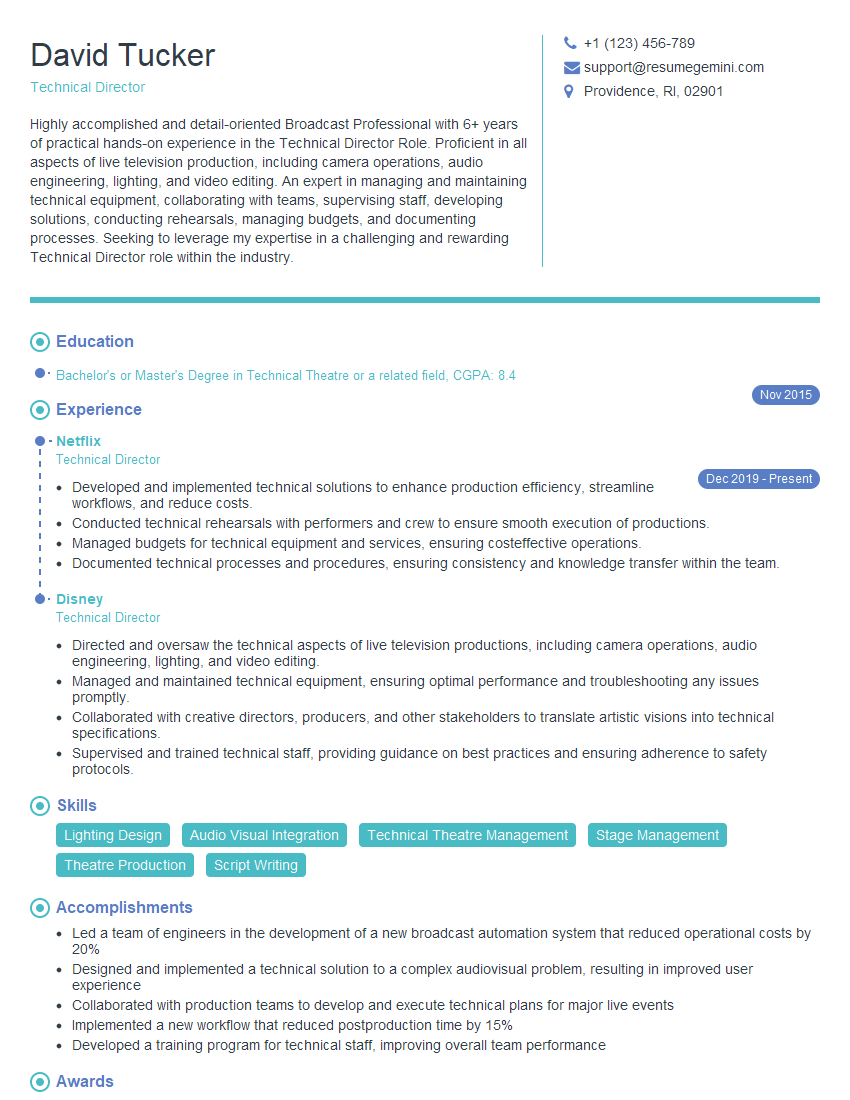
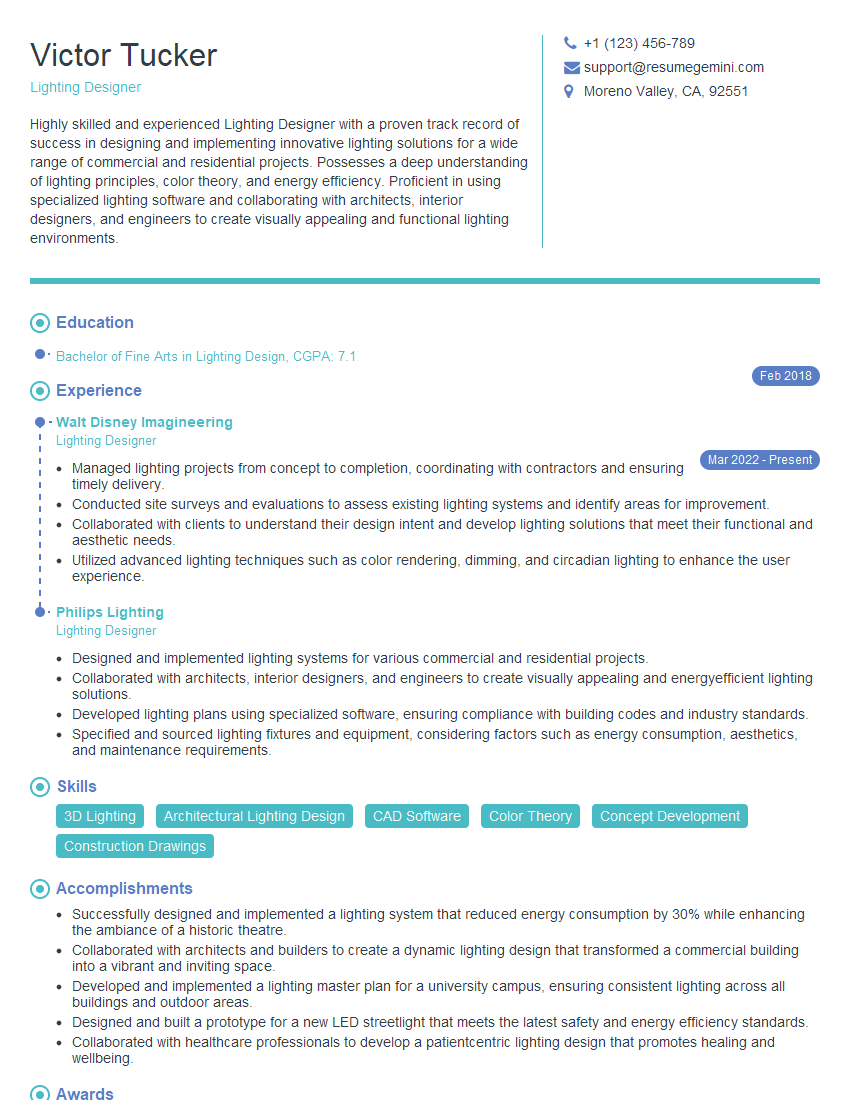
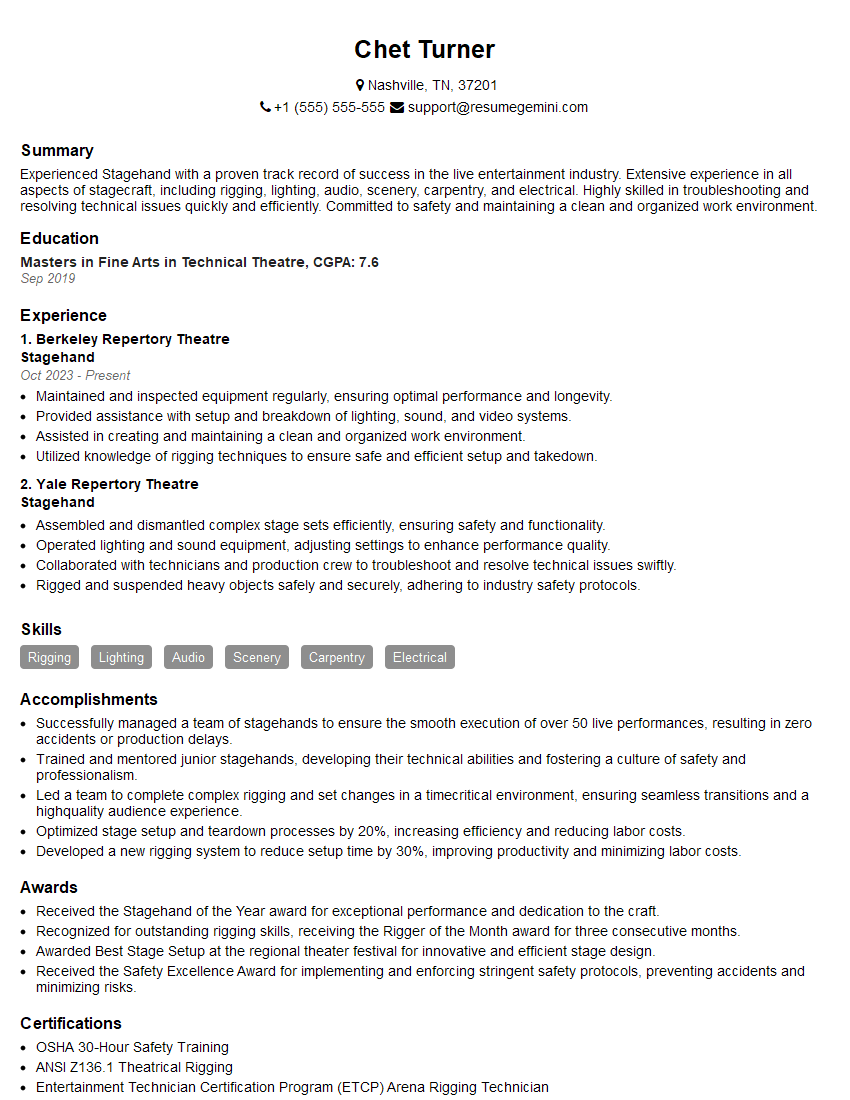
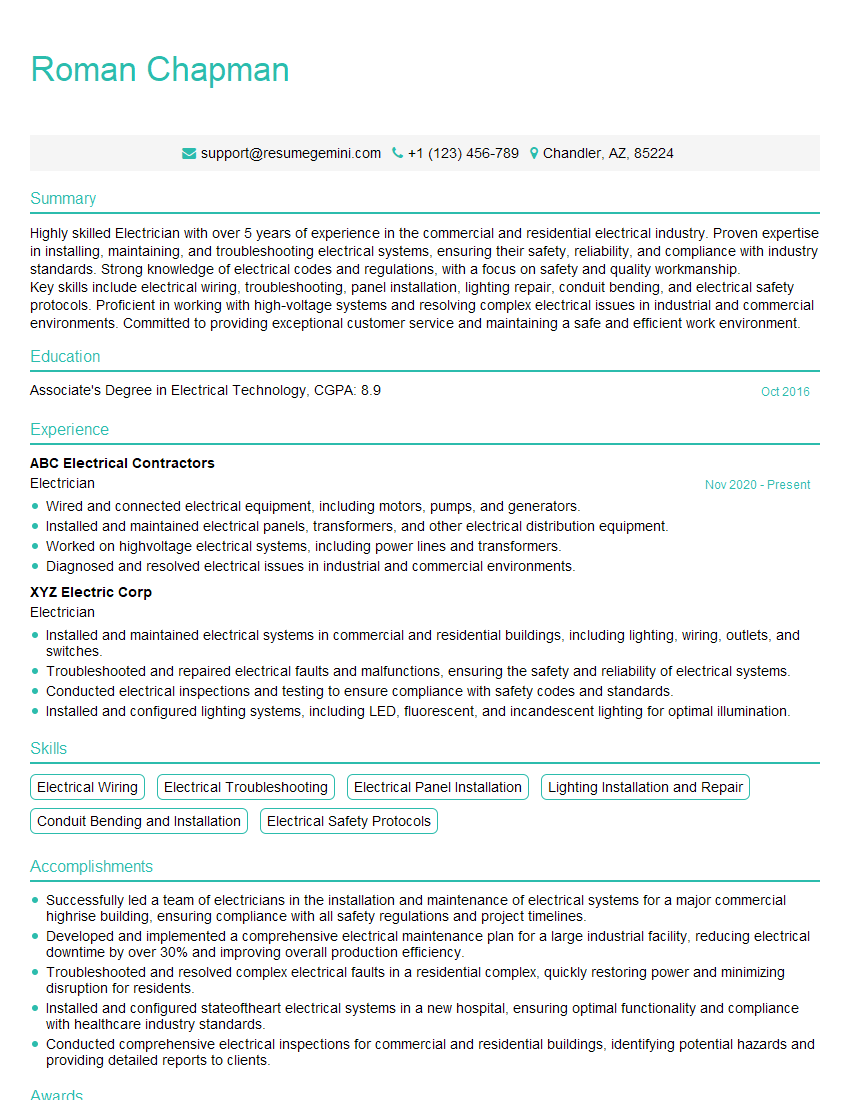
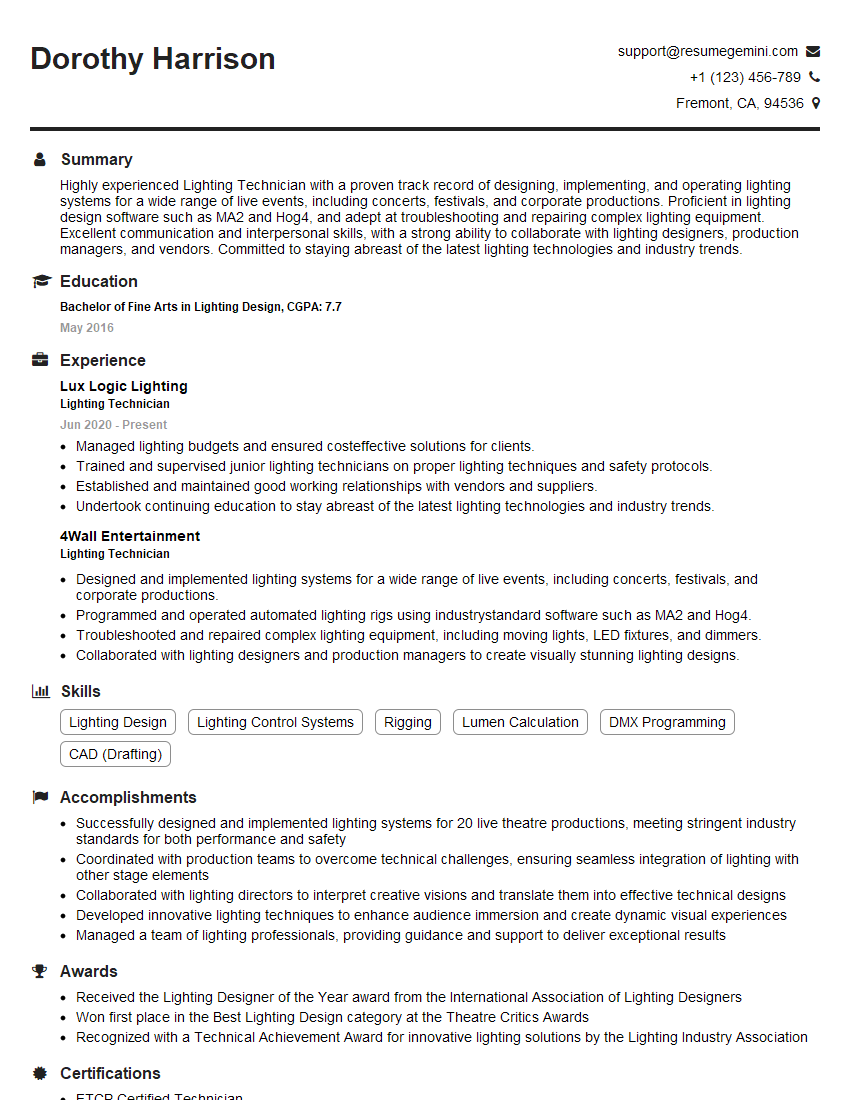
Mastering theatrical lighting techniques is crucial for career advancement in the vibrant world of stage production. A strong understanding of these concepts will significantly improve your interview performance and open doors to exciting opportunities. To maximize your job prospects, crafting an ATS-friendly resume is essential. ResumeGemini is a trusted resource that can help you build a professional and impactful resume, showcasing your skills and experience effectively. Examples of resumes tailored specifically to theatrical lighting experience are available through ResumeGemini, helping you present your qualifications in the best possible light.
Explore more articles
Users Rating of Our Blogs
Share Your Experience
We value your feedback! Please rate our content and share your thoughts (optional).
What Readers Say About Our Blog
To the interviewgemini.com Webmaster.
Very helpful and content specific questions to help prepare me for my interview!
Thank you
To the interviewgemini.com Webmaster.
This was kind of a unique content I found around the specialized skills. Very helpful questions and good detailed answers.
Very Helpful blog, thank you Interviewgemini team.