Interviews are more than just a Q&A session—they’re a chance to prove your worth. This blog dives into essential Substation Maintenance and Management interview questions and expert tips to help you align your answers with what hiring managers are looking for. Start preparing to shine!
Questions Asked in Substation Maintenance and Management Interview
Q 1. Describe your experience with different types of substation transformers.
My experience encompasses a wide range of substation transformers, from the ubiquitous power transformers used for stepping voltage up or down in the transmission and distribution networks, to specialized units like instrument transformers (current and potential transformers) used for measurement and protection. Power transformers are typically large, oil-filled units rated in MVA (Megavolt-amperes), and their design varies depending on application (e.g., generator step-up, transmission line, distribution). I’ve worked with both single-phase and three-phase transformers, and understand the intricacies of their cooling systems (ONAN, ONAF, etc.). Instrument transformers, on the other hand, are smaller and are crucial for relaying and metering. I’ve handled maintenance and troubleshooting on various types, including those with different accuracy classes and insulation systems. For example, I once diagnosed a failing bushing on a 100 MVA power transformer by analyzing oil samples and performing partial discharge testing, preventing a major outage.
I’m also familiar with special transformers like autotransformers, used for voltage regulation and tap changing, and reactor transformers, which are used for limiting fault currents. Understanding the specific characteristics and maintenance needs of each type is crucial for reliable substation operation.
Q 2. Explain the process of preventative maintenance for substation equipment.
Preventative maintenance for substation equipment is a structured, cyclical process aimed at preventing failures and maximizing equipment lifespan. It involves a combination of inspections, testing, and minor repairs performed according to a pre-defined schedule. This schedule typically accounts for the manufacturer’s recommendations and the equipment’s operating history.
- Inspections: Visual inspections are vital, checking for signs of wear, corrosion, loose connections, and overheating. This includes checking for leaks in oil-filled equipment, inspecting insulators for damage, and checking the condition of bushings and connections.
- Testing: Regular testing is critical for assessing the health of equipment. This includes transformer oil analysis (to assess moisture, acidity, and dissolved gas content), dielectric tests (to measure insulation strength), and relay testing (to ensure protection systems are functioning correctly). Circuit breakers undergo contact resistance checks and mechanical operation tests.
- Cleaning: Removing dirt and debris is essential to prevent insulation breakdown and arcing. This might involve cleaning insulators, switching gear, and the substation yard itself.
- Minor Repairs: Addressing minor issues before they escalate into major problems is cost-effective. This includes tightening loose connections, replacing worn parts, and cleaning or repairing damaged components.
The frequency of these tasks depends on the equipment type, operating conditions, and manufacturer recommendations. For instance, transformer oil analysis might be done annually, while relay testing could be quarterly. Maintaining thorough documentation of all maintenance activities is crucial for tracking equipment health and identifying potential problems.
Q 3. How do you troubleshoot a faulty circuit breaker?
Troubleshooting a faulty circuit breaker requires a systematic approach. Safety is paramount – always ensure the breaker is de-energized before starting any work. The process usually begins with gathering information: examining any fault indicators on the breaker itself, checking fault logs from the SCADA system (if available), and reviewing any recent events that might have led to the failure.
- Visual Inspection: Begin with a careful visual inspection, looking for obvious signs of damage like burned contacts, loose connections, or visible arcing.
- Check Control Circuitry: Verify the control circuits are functioning correctly. This may involve testing the trip coils, closing coils, and auxiliary switches. Check for any tripped alarms in the relay panel.
- Check Breaker Mechanism: Examine the mechanical operation of the breaker. Try manually operating the breaker (after ensuring it’s de-energized) to check for any binding or stiffness.
- Contact Resistance Measurement: Measure the resistance across the breaker contacts using a low-resistance ohmmeter. High resistance indicates potential problems.
- Relay Testing: If the issue appears to be related to protection, perform comprehensive relay testing to confirm their proper functioning.
- Insulation Testing: Test the breaker’s insulation resistance to determine the integrity of the insulation.
Depending on the findings, repairs may range from simple tightening of connections to replacing faulty components like contacts or coils. In some cases, it may require the involvement of specialized equipment and technicians.
Q 4. What are the safety precautions you take when working on high-voltage equipment?
Safety is paramount when working on high-voltage equipment. The consequences of a mistake can be fatal. My safety procedures adhere strictly to established safety standards and industry best practices (e.g., OSHA, IEEE). This includes:
- Lockout/Tagout (LOTO): This is the most fundamental safety procedure. Before commencing any work, the equipment must be de-energized and locked out, ensuring no one can accidentally re-energize it. The LOTO process involves multiple authorized personnel.
- Personal Protective Equipment (PPE): Appropriate PPE is crucial, including safety glasses, insulated gloves (tested regularly), arc flash protective clothing, and safety footwear. The PPE requirements are dictated by the voltage level and potential arc flash energy.
- Grounding: All equipment must be thoroughly grounded before work begins, providing a path to earth for any stray currents.
- Permit-to-Work System: A formal permit-to-work system ensures a thorough risk assessment and approval process before starting any work. This documented process tracks personnel, tasks, and safety checks.
- Training and Competency: All personnel must receive thorough training and demonstrate competency in high-voltage safety procedures before working on live equipment. Regular refresher courses are essential.
- Emergency Procedures: Emergency response plans must be in place, including emergency contacts and procedures for handling accidents or emergencies.
I regularly participate in safety briefings and toolbox talks to reinforce safety awareness among colleagues.
Q 5. What are the common causes of substation outages and how are they mitigated?
Substation outages can stem from various causes, many preventable with proper maintenance and design. Common causes include:
- Equipment Failures: Transformer failures (due to insulation breakdown, winding faults, or overloads), circuit breaker malfunctions, and relay malfunctions are significant contributors. Preventive maintenance, regular testing, and prompt repairs mitigate these issues.
- Natural Events: Lightning strikes can cause significant damage to insulators and equipment. Lightning protection systems (surge arresters, grounding) are crucial in mitigating this risk. Severe weather events (storms, floods, etc.) can also lead to outages, and appropriate infrastructure design is critical.
- Human Error: Mistakes during operation or maintenance, such as incorrect switching procedures or faulty connections, can cause outages. Strict adherence to operating procedures and detailed training minimizes this risk.
- Overloads: Excessive demand on the substation can overload equipment, leading to trips and outages. Load management strategies and adequate capacity planning prevent this.
- Animals: Birds and other animals can cause short circuits by making contact with energized equipment. Proper shielding and animal deterrence methods help minimize this risk.
Mitigation strategies involve robust preventative maintenance programs, reliable protection schemes, contingency planning, redundancy in equipment (parallel systems), and investing in robust substation design which takes into account potential threats.
Q 6. Explain your understanding of SCADA systems in substation operations.
Supervisory Control and Data Acquisition (SCADA) systems are essential for the efficient operation and monitoring of substations. SCADA systems provide real-time data on various parameters, including voltage, current, power flow, breaker status, and temperature readings. This data is collected from various sensors and meters located throughout the substation and transmitted to a central control center.
In substation operations, SCADA systems enable operators to:
- Monitor equipment status: View real-time data on equipment health and performance.
- Remotely control equipment: Open and close circuit breakers, tap changers, and other switching devices remotely.
- Detect faults and alarms: Identify faults and anomalies automatically, allowing for quick response.
- Improve operational efficiency: Optimize power flow and ensure system stability.
- Record historical data: Store data for trend analysis and fault diagnosis.
The data is often displayed on graphical user interfaces (GUIs) that provide a clear overview of the substation’s status. SCADA systems improve reliability, reduce operational costs, and allow for better response to outages.
I have extensive experience working with various SCADA systems, including their configuration, troubleshooting and data interpretation. For instance, I once used SCADA data to pinpoint a faulty current transformer that was providing inaccurate readings, preventing a costly investigation.
Q 7. How do you perform a relay test and what are the common relay types?
Relay testing is critical for ensuring the proper functioning of the substation’s protection system. Relays are devices that detect faults and initiate the tripping of circuit breakers to isolate the faulty section of the network. The testing process varies depending on the relay type but generally involves verifying the relay’s response to various fault conditions.
Common relay types include:
- Overcurrent Relays: Detect excessive current flow.
- Differential Relays: Compare currents entering and leaving a protected zone to detect internal faults.
- Distance Relays: Measure the impedance to a fault to determine its distance from the relay.
- Transformer Protection Relays: Designed specifically to protect transformers from internal faults.
- Busbar Protection Relays: Protect the main busbars in the substation.
Relay testing methods include:
- Simulation Testing: Using a relay test set to simulate various fault conditions and observe the relay’s response. This allows for testing without causing a real-world trip.
- In-service Testing: Checking the functionality of relays while the substation is operating, often done using specialized equipment that applies a small test signal.
- Software-based testing: This involves using dedicated software tools to simulate different scenarios and examine the relay’s response. It’s often used during commissioning and during the testing of new digital relays.
Accurate relay testing ensures that the substation’s protection system is functioning as intended, preventing cascading failures and minimizing outage durations.
Q 8. Describe your experience with substation grounding systems.
Substation grounding systems are critical for ensuring personnel safety and equipment protection by providing a low-impedance path for fault currents to flow to the earth. My experience encompasses the design, installation, testing, and maintenance of various grounding systems, including driven rod grounds, counterpoise grids, and grounding mats. I’ve worked with both traditional grounding systems and more advanced designs incorporating ground potential rise (GPR) mitigation strategies. For instance, in one project, we identified a GPR issue near a large transformer which posed a risk to personnel. By strategically adding additional grounding conductors and improving the grid design, we significantly reduced the GPR, enhancing safety. I am also familiar with the use of specialized software for modeling and analyzing grounding system performance, ensuring optimal effectiveness and compliance with relevant safety standards.
I have experience troubleshooting grounding system problems, such as high resistance to earth, which can be caused by corrosion, poor connections, or soil conditions. Addressing these issues involves systematic investigation, including resistance testing using fall-of-potential methods, visual inspection, and potential soil analysis. For example, I once resolved a high-resistance issue by identifying and replacing corroded grounding rods and improving soil conductivity around the affected area. This involved excavating the area, installing new rods, and backfilling with a conductive backfill material.
Q 9. What are the different types of protective relays and their functions?
Protective relays are the nervous system of a substation, instantly detecting faults and initiating appropriate actions to protect equipment and personnel. Different types of relays cater to specific fault conditions. Here are some key examples:
- Differential Relays: These compare the currents entering and leaving a protected zone (e.g., transformer, busbar). Any significant difference indicates an internal fault, triggering a trip.
- Overcurrent Relays: These detect excessive current flow, indicative of short circuits or overloads. They can be time-overcurrent (delayed tripping) or instantaneous (immediate tripping).
- Distance Relays: These measure the impedance to the fault, determining its location along a transmission line. This allows for selective tripping, isolating only the faulted section.
- Buchholz Relays: Specifically designed for transformers, these detect gas accumulation or excessive pressure, indicating internal faults like insulation failure.
- Ground Fault Relays: These sense ground faults, protecting against earth leakage currents which can cause equipment damage or safety hazards.
The choice of relay type depends on the specific equipment being protected and the characteristics of the power system. For example, a large power transformer would require a combination of differential, overcurrent, and Buchholz relays for comprehensive protection.
Q 10. How do you interpret substation protection schemes?
Interpreting substation protection schemes involves understanding the logic and coordination between various protective relays and circuit breakers to ensure selective and rapid fault clearing. This involves reviewing single-line diagrams, relay settings, and protection coordination studies. I approach this by systematically analyzing the protection logic, considering the sequence of events during a fault condition. This includes tracing the fault current path, identifying which relays will operate, and verifying the appropriate circuit breaker tripping actions.
For example, a typical scheme might involve distance relays on transmission lines coordinating with overcurrent relays on substation transformers and busbars. Proper coordination is essential to prevent cascading outages. I use specialized software tools to simulate fault scenarios and verify the correct operation of the protection system. Analyzing the results of these simulations helps to identify potential weaknesses in the protection scheme and propose improvements. This ensures the scheme remains effective against evolving system conditions and potential risks.
Q 11. Explain your experience with transformer oil testing and maintenance.
Transformer oil is crucial for insulation and cooling, requiring regular testing and maintenance. My experience covers various aspects, from routine dielectric strength testing (using a Doble oil testing unit) to assessing dissolved gas analysis (DGA) results to identify potential internal faults. I’m proficient in interpreting DGA results using various methods, including the Duval Triangle and key gas ratios, to diagnose potential problems such as overheating, partial discharges, or arcing. This allows for proactive maintenance, preventing catastrophic transformer failures.
Beyond testing, I’ve performed oil filtration and purification procedures to remove moisture, contaminants, and degradation products, extending the lifespan of the oil. For example, in one instance, DGA revealed an elevated level of acetylene, indicating arcing within the transformer. This led us to conduct a thorough internal inspection, identify and repair the faulty winding, and then replace the oil after thorough filtration. The proactive approach minimized downtime and prevented a significant outage.
Q 12. Describe your experience with substation bussing arrangements.
Substation bussing arrangements refer to the physical configuration of busbars and circuit breakers, determining how equipment is interconnected and power is routed. My experience includes working with various arrangements, including single-bus, double-bus, double-bus-double-breaker (DBDB), and breaker-and-a-half schemes. Each has its advantages and disadvantages regarding reliability, flexibility, and maintenance.
A single-bus system is simple but offers limited redundancy. In contrast, DBDB schemes provide high reliability with dual busbars and breakers, allowing maintenance on one bus without interrupting service. I’ve been involved in the design, upgrade, and maintenance of these systems, ensuring safe and efficient power distribution. Understanding the bussing arrangement is critical for planning maintenance activities, minimizing disruption, and ensuring system reliability. For example, when planning a breaker maintenance, understanding the bussing scheme helps determine which sections of the substation can remain live while the work is performed, minimizing the impact on the electricity supply.
Q 13. How familiar are you with different types of insulators used in substations?
Substations utilize various insulators, each suited for different voltage levels and environmental conditions. I’m familiar with porcelain, glass, polymer, and composite insulators. Porcelain and glass insulators have been traditionally used for their high dielectric strength and resistance to weathering, but they are prone to damage from mechanical stress and electrical flashover under polluted conditions. Polymer insulators offer advantages like improved hydrophobicity and higher resistance to pollution, minimizing the risk of flashover. Composite insulators combine the strengths of different materials, offering good mechanical strength, electrical insulation, and resistance to environmental degradation.
The selection of an insulator type depends on factors like voltage level, environmental conditions (pollution, humidity, temperature), and budget. I’ve been involved in assessing the condition of insulators using visual inspections, partial discharge testing, and other non-destructive testing methods to identify defects such as cracks, damage, and contamination. These inspections are crucial for maintaining safety and preventing outages.
Q 14. What are the key performance indicators (KPIs) you monitor in substation maintenance?
Key Performance Indicators (KPIs) for substation maintenance focus on reliability, safety, and efficiency. These include:
- Equipment Availability: Percentage of time equipment is operational.
- Mean Time Between Failures (MTBF): Average time between equipment failures.
- Mean Time To Repair (MTTR): Average time taken to restore equipment after a failure.
- Safety Incidents: Number of safety incidents or near misses.
- Maintenance Costs: Total cost incurred on maintenance activities.
- Preventive Maintenance Completion Rate: Percentage of scheduled preventive maintenance tasks completed on time.
- Outage Duration: Average duration of power outages.
Monitoring these KPIs allows for proactive identification of problem areas, optimization of maintenance strategies, and improved overall substation performance. Regular review of these KPIs helps to justify maintenance budgets and demonstrate the effectiveness of maintenance programs, ensuring the continuous reliable operation of the substation.
Q 15. Explain your approach to managing substation maintenance budgets.
Managing substation maintenance budgets requires a strategic approach that balances cost-effectiveness with operational reliability. My approach involves a three-step process: Planning, Budgeting, and Monitoring.
Planning: This begins with a comprehensive asset register, meticulously documenting every piece of equipment in the substation, including its age, manufacturer, maintenance history, and predicted lifespan. Using this data, we develop a preventative maintenance schedule, prioritizing critical equipment and factoring in potential risks and future upgrades.
Budgeting: Based on the maintenance plan, we create a detailed budget. This allocates funds for routine maintenance, planned repairs, and potential emergency situations. We use historical data, industry benchmarks, and manufacturer recommendations to estimate costs. We may employ different budgeting techniques like Zero-Based Budgeting (ZBB) or Activity-Based Budgeting (ABB) depending on the context and the size of the project. For example, implementing a new ABB system can help optimize costs by associating maintenance activities with their actual costs.
Monitoring: This crucial step involves tracking actual expenditures against the budgeted amounts. Regular reports highlighting variances and potential overruns allow for proactive adjustments and course correction. This prevents unexpected financial surprises and ensures the budget remains aligned with the maintenance plan.
Example: In a previous role, I successfully implemented a predictive maintenance program utilizing sensor data and machine learning algorithms. This allowed for more precise scheduling of maintenance, resulting in a 15% reduction in overall maintenance costs while improving equipment uptime.
Career Expert Tips:
- Ace those interviews! Prepare effectively by reviewing the Top 50 Most Common Interview Questions on ResumeGemini.
- Navigate your job search with confidence! Explore a wide range of Career Tips on ResumeGemini. Learn about common challenges and recommendations to overcome them.
- Craft the perfect resume! Master the Art of Resume Writing with ResumeGemini’s guide. Showcase your unique qualifications and achievements effectively.
- Don’t miss out on holiday savings! Build your dream resume with ResumeGemini’s ATS optimized templates.
Q 16. How do you ensure compliance with safety regulations in substation maintenance?
Safety is paramount in substation maintenance. My approach is to build a comprehensive safety culture from the ground up, based on a multi-layered framework: Training, Procedures, and Audits.
Training: All personnel involved in substation maintenance undergo rigorous safety training. This includes both classroom instruction and hands-on practical training specific to the equipment and tasks involved. We use regular refresher courses to reinforce safety procedures and incorporate lessons learned from past incidents or near misses. The training covers everything from lock-out/tag-out procedures and arc flash hazards to working at heights and emergency response protocols.
Procedures: We have detailed, documented safety procedures for every maintenance task. These procedures are developed in accordance with industry best practices and regulatory requirements, such as OSHA (in the US) and similar standards elsewhere. These procedures clearly outline safety precautions, permit-to-work systems, and emergency response plans. We use a permit-to-work system that ensures that only authorized personnel with proper training can access live equipment.
Audits: Regular safety audits and inspections are conducted to ensure compliance with established procedures and regulations. This includes both internal audits by our own safety officers and external audits by regulatory bodies. Findings from these audits are reviewed and addressed promptly, leading to continuous improvement in our safety performance. We also maintain detailed records of all safety incidents and near misses, utilizing a root cause analysis methodology to identify and prevent future incidents.
Example: In a past project, we implemented a new safety management system that integrated electronic documentation of permits, safety inspections and task completions, enabling real-time monitoring and proactive risk assessment, and significantly reducing the risk of incidents.
Q 17. Describe your experience with substation automation and control systems.
I have extensive experience with substation automation and control systems, including SCADA (Supervisory Control and Data Acquisition) systems, RTUs (Remote Terminal Units), and various communication protocols such as IEC 61850. My experience encompasses both the design and implementation phases, as well as ongoing maintenance and troubleshooting.
SCADA systems provide centralized monitoring and control of substation equipment, enabling remote operation and improved situational awareness. I am proficient in configuring and maintaining various SCADA platforms, including their HMI (Human-Machine Interface) configurations and alarm management systems. I’ve worked with projects where we integrated new SCADA systems into legacy infrastructure, often requiring careful planning and meticulous execution to avoid disruptions.
RTUs act as the interface between the SCADA system and the field equipment. I have experience in configuring and commissioning RTUs, including the programming of their logic and communication settings. Understanding their functionalities is essential for effective troubleshooting and maintenance.
IEC 61850 is a crucial communication standard for modern substations. I am familiar with its functionalities and have been involved in projects implementing this standard, enhancing interoperability and data exchange between devices within the substation automation system. The improved data exchange provided valuable insights into real-time equipment health and greatly improved predictive maintenance.
Example: I led a project to upgrade an aging SCADA system to a modern, IEC 61850-compliant system. This resulted in improved system reliability, enhanced situational awareness, and reduced maintenance costs. The project was delivered on time and under budget, while minimizing disruption to substation operations. This modernized system allowed for remote diagnostics and streamlined the troubleshooting process.
Q 18. How do you handle emergency repairs in a substation?
Handling emergency repairs requires a rapid and efficient response. My approach prioritizes safety and minimizes downtime, incorporating these key elements: Rapid Assessment, Prioritization, and Safe Execution.
Rapid Assessment: Upon receiving an emergency alert, a swift assessment of the situation is paramount. This involves gathering information about the nature of the fault, its potential impact on the power system, and the available resources. Remote diagnostic tools and experienced personnel are crucial for this initial assessment.
Prioritization: The assessment determines the priority of the repair. If the fault poses a significant risk to safety or power supply, immediate action is required. In such cases, we utilize pre-planned emergency procedures and may involve external support teams to expedite the response.
Safe Execution: All emergency repairs are carried out strictly according to safety protocols. This includes rigorous lock-out/tag-out procedures and the use of appropriate personal protective equipment. We ensure a clear communication channel between the repair team, the control room, and other relevant personnel. Post-repair inspections are vital to ensure the safety and reliability of the restored equipment.
Example: During a severe storm, a lightning strike damaged a critical transformer in a substation. Our emergency response team, using pre-established procedures and emergency protocols, swiftly isolated the faulty equipment, preventing further damage. Temporary measures were implemented to restore power while the damaged transformer was repaired and replaced. We conducted a post-incident review to enhance our preparedness for similar future events.
Q 19. Explain your experience with different types of switchgear.
My experience encompasses a wide range of switchgear, including air-insulated switchgear (AIS), gas-insulated switchgear (GIS), and vacuum circuit breakers. Each type has its own characteristics, advantages, and maintenance requirements.
AIS is characterized by its use of air as the insulating medium. Maintenance involves inspecting insulators, bushings, and contactors for signs of wear, arcing, or damage. Regular cleaning and tightening of connections are important to prevent issues. The advantage of AIS is its relative simplicity and ease of access for maintenance but it is significantly larger and takes up more space.
GIS employs sulfur hexafluoride (SF6) gas as the insulating medium. Maintenance focuses on leak detection and the monitoring of SF6 gas quality. GIS is more compact and offers better protection against environmental factors compared to AIS, however, SF6 gas is a potent greenhouse gas that needs careful handling.
Vacuum circuit breakers are known for their reliable operation and minimal maintenance requirements. They typically need infrequent inspections of the vacuum interrupters and contactors. Their long operational lifespan and low maintenance make them cost effective over time.
Example: I’ve worked on projects involving the maintenance of all three types of switchgear. In one instance, we upgraded an older AIS substation to GIS to reduce its footprint and improve its reliability. This involved careful planning and coordination to minimize downtime and ensure a seamless transition.
Q 20. What are the common causes of equipment failure in substations?
Equipment failure in substations can stem from various causes, often interconnected. The most common include: Environmental Factors, Aging Equipment, and Operational Issues.
Environmental Factors: Extreme weather conditions such as lightning strikes, storms, and high temperatures can damage equipment. Contamination from dust, salt spray, or other pollutants can lead to insulation breakdown and flashover. These require robust protection schemes and regular inspections to mitigate against their effects.
Aging Equipment: As equipment ages, insulation degrades, contacts wear out, and components become more susceptible to failure. Regular preventative maintenance and condition monitoring can help to identify potential issues before they lead to failures. Preventive maintenance can proactively replace aging components thus extending their useful life.
Operational Issues: Overloads, switching surges, and other operational stresses can contribute to equipment failure. Proper operational procedures and the use of protective devices, such as fuses and circuit breakers, are essential to mitigate these risks. Load management strategies and network optimization can prevent equipment overloads and reduce the strain.
Example: In one case, repeated failures of a specific type of bushing were traced to a combination of aging and contamination from airborne pollutants. By implementing a more robust cleaning schedule and upgrading to a more resistant bushing type, we significantly reduced failure rates.
Q 21. How do you prioritize maintenance tasks in a substation?
Prioritizing maintenance tasks requires a systematic approach that balances risk, cost, and operational impact. My approach uses a combination of risk assessment, criticality analysis, and maintenance schedules.
Risk Assessment: Each piece of equipment is assessed for its potential failure impact. A failure of a critical transformer, for instance, has far greater consequences than a minor failure of a control circuit. This assessment considers the likelihood and severity of failure, enabling prioritization based on risk.
Criticality Analysis: This builds on risk assessment by considering the equipment’s importance to the overall power system. Critical equipment is prioritized for maintenance to ensure continuous system operation. A criticality matrix can be created to visually represent and manage this information.
Maintenance Schedules: Preventative maintenance is scheduled based on the risk assessment and criticality analysis. More critical equipment receives more frequent inspections and maintenance. This may include condition-based maintenance where we use data from sensors and diagnostics to determine when maintenance is required.
Example: Using a risk-based prioritization system, we identified that the main power transformer required more frequent oil testing and condition monitoring than other substation components. This led to early detection of a potential problem, preventing a catastrophic failure and associated power outage.
Q 22. Describe your experience with using CMMS (Computerized Maintenance Management Systems).
My experience with CMMS software spans over 10 years, encompassing various systems like SAP PM, IBM Maximo, and Infor EAM. I’ve utilized these systems for work order management, preventive maintenance scheduling, inventory tracking, and generating comprehensive reports on equipment performance and maintenance costs. For instance, in a previous role, I implemented a new CMMS system, migrating data from an outdated system and training technicians on its usage. This resulted in a 15% reduction in maintenance response times and a 10% decrease in unplanned downtime. My proficiency extends to configuring CMMS systems to meet specific substation needs, integrating with other enterprise systems, and optimizing data analysis for informed decision-making. I’m adept at using CMMS data to identify trends, predict potential failures, and optimize maintenance strategies, ensuring cost-effective and efficient substation operations.
Q 23. How do you manage a team of substation maintenance technicians?
Managing a team of substation maintenance technicians requires a blend of technical expertise, leadership skills, and effective communication. I foster a collaborative environment by encouraging open dialogue, active listening, and knowledge sharing among team members. My approach focuses on clear task assignment, regular performance reviews, and providing opportunities for professional development through training and mentorship. For example, I implemented a peer-to-peer training program where senior technicians mentored junior ones, leading to improved skill sets across the team. Safety is paramount; I rigorously enforce safety protocols, conduct regular safety briefings, and actively participate in risk assessments. Effective communication is critical; I utilize various tools like daily briefings, weekly progress meetings, and reporting systems to ensure everyone is aligned and informed. I believe in empowering my team by delegating responsibility and fostering a culture of ownership and accountability.
Q 24. Explain your knowledge of arc flash hazard analysis and mitigation.
Arc flash hazard analysis is critical for substation safety. It involves determining the potential for arc flash incidents and calculating the incident energy levels. This requires using specialized software and considering factors like fault current, equipment configuration, and protective device settings. I’m proficient in conducting arc flash studies using industry-standard software like ETAP and SKM. Mitigation strategies include implementing proper personal protective equipment (PPE) based on the calculated incident energy levels, installing arc flash relays for faster fault clearing, and using equipment with arc flash reduction features. For instance, in a recent project, we implemented a comprehensive arc flash mitigation plan that reduced the incident energy levels significantly, leading to a safer working environment and decreased PPE requirements. This involved detailed analysis, coordination with the operational team, and staff training on the updated safety procedures.
Q 25. How do you ensure the accuracy of substation instrumentation and metering?
Ensuring the accuracy of substation instrumentation and metering is vital for reliable operation and billing. This involves regular calibration and testing of instruments like current transformers (CTs), potential transformers (PTs), and meters using calibrated test equipment. We establish a robust calibration schedule based on manufacturer recommendations and operational needs. Data validation is also key; we use data reconciliation techniques to compare meter readings with expected values and identify discrepancies. Regular audits and inspections of metering equipment are conducted to ensure their proper functioning and prevent inaccuracies. Any identified discrepancies require thorough investigation and corrective actions. For example, we recently discovered a faulty CT during a routine inspection, which prevented significant billing errors and potential safety issues. Implementing a robust calibration and testing program is crucial for maintaining the accuracy and reliability of substation instrumentation and metering.
Q 26. Describe your experience with substation commissioning and testing procedures.
My experience in substation commissioning and testing includes a wide range of activities, from initial inspection and verification of equipment to final testing and handover to operations. I am familiar with industry standards such as IEEE and IEC. This involves rigorous testing procedures for protection relays, circuit breakers, transformers, and other substation equipment. These tests ensure that the equipment is functioning correctly and meets the specified performance requirements. I utilize specialized testing equipment and software to perform these tests and meticulously document the results. A typical commissioning process involves a detailed test plan, execution of tests, documentation of results, and preparation of commissioning reports. For example, I led the commissioning of a new 230kV substation, ensuring all equipment performed as designed before handing it over to the operational team. This involved coordinating with various contractors and vendors, managing schedules, and meticulously documenting all test procedures and results.
Q 27. How do you handle conflicts between maintenance schedules and operational requirements?
Balancing maintenance schedules with operational requirements requires effective communication and collaboration between the maintenance team and the operations team. We utilize a prioritized scheduling system that considers factors like equipment criticality, maintenance urgency, and operational constraints. A clear communication channel is established to discuss any conflicts and reach mutually agreeable solutions. In some cases, we might need to reschedule maintenance activities to minimize disruption to operations. We also leverage predictive maintenance techniques to optimize schedules and reduce the need for unplanned outages. For instance, we successfully coordinated a major transformer maintenance project by working closely with the operational team to schedule it during off-peak hours, minimizing disruption to power supply.
Q 28. Explain your understanding of substation asset management strategies.
Substation asset management involves planning, organizing, and controlling the lifecycle of all assets within a substation. This encompasses the entire spectrum from initial procurement to eventual decommissioning. A key aspect is developing a comprehensive asset register, containing details of each asset, including its age, condition, maintenance history, and replacement cost. This helps in prioritizing maintenance activities and developing long-term investment plans. We utilize risk-based approaches to prioritize assets requiring attention based on their criticality and potential impact on operations. Predictive maintenance strategies are implemented to identify and address potential failures before they occur, reducing downtime and increasing operational efficiency. Life-cycle costing analysis helps in making informed decisions about asset replacement or refurbishment. Data analysis from CMMS plays a vital role in supporting all these aspects of asset management. For example, our team implemented a risk-based asset management strategy which allowed for early detection of potential problems in aging equipment, leading to timely interventions and significant cost savings.
Key Topics to Learn for Substation Maintenance and Management Interview
- Substation Equipment Knowledge: Understanding the operation and maintenance of transformers, circuit breakers, switchgear, relays, and protective devices. This includes knowing their functionalities, typical failure modes, and preventative maintenance schedules.
- Safety Procedures and Regulations: Demonstrate a thorough understanding of safety protocols, lockout/tagout procedures, and relevant industry regulations (e.g., OSHA, NEC). Be prepared to discuss practical examples of how you ensure a safe work environment.
- Preventive and Predictive Maintenance: Explain the difference between preventive and predictive maintenance strategies. Discuss techniques like infrared thermography, oil analysis, and vibration analysis, and how they are used to identify potential problems before they lead to failures.
- Troubleshooting and Diagnostics: Be ready to discuss your approach to troubleshooting substation equipment malfunctions. This includes describing your problem-solving methodology, utilizing diagnostic tools, and effectively communicating findings.
- Substation Automation and SCADA Systems: Familiarize yourself with supervisory control and data acquisition (SCADA) systems and their role in substation monitoring and control. Understanding data interpretation and remote diagnostics is crucial.
- Electrical Power Systems Fundamentals: A strong grasp of fundamental electrical principles, including power system analysis, fault calculations, and protection schemes, is essential for demonstrating a holistic understanding.
- Documentation and Reporting: Discuss your experience with maintaining accurate records, creating detailed reports on maintenance activities, and communicating effectively with supervisors and teams.
- Budgeting and Resource Management: For senior roles, understanding budget allocation, resource optimization, and cost-effective maintenance strategies will be beneficial.
Next Steps
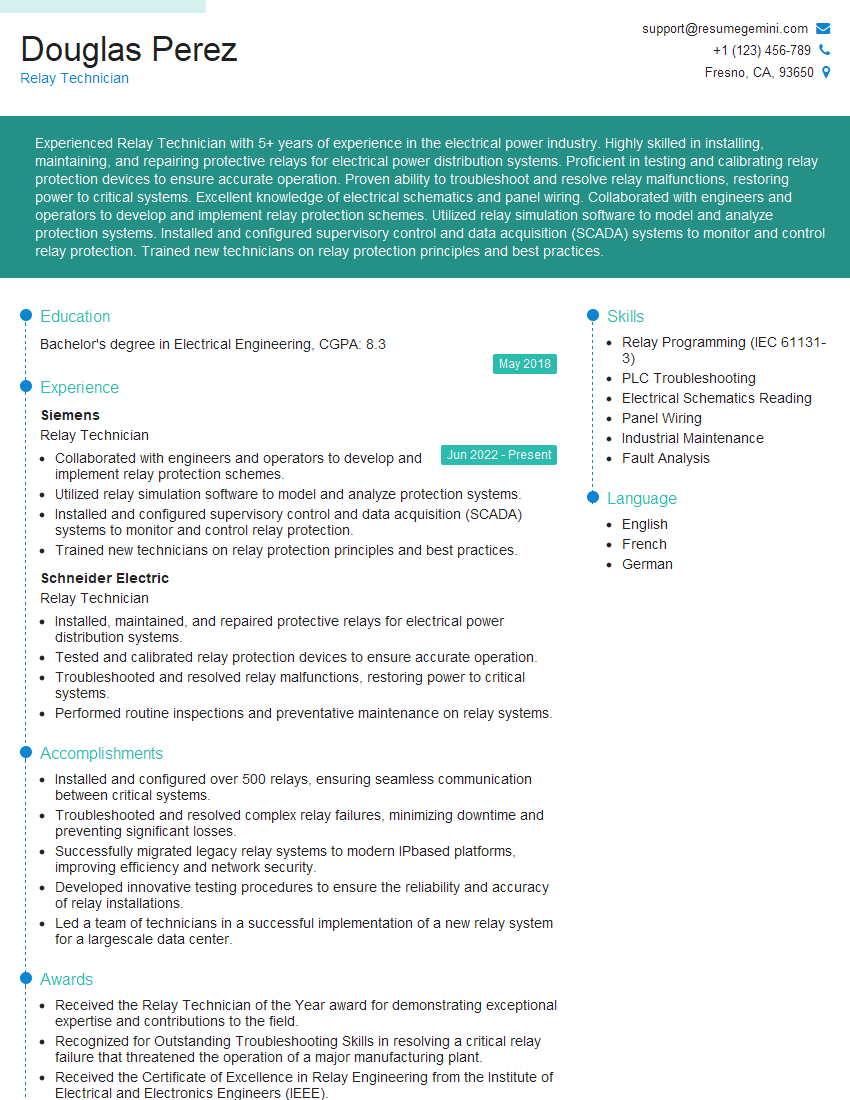
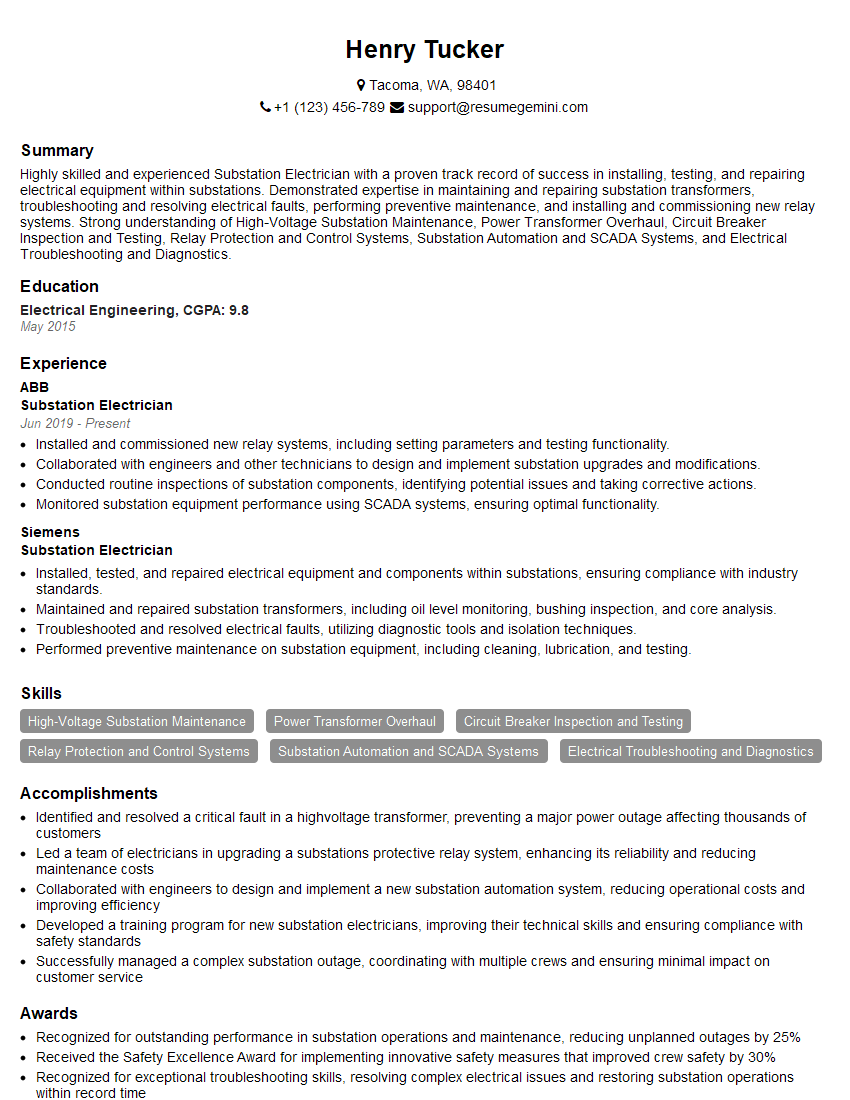
Mastering Substation Maintenance and Management opens doors to rewarding and challenging careers with significant growth potential. This field requires continuous learning and adaptation, making it an intellectually stimulating and valuable asset to the power industry. To maximize your job prospects, crafting a strong, ATS-friendly resume is critical. ResumeGemini is a trusted resource to help you build a professional and impactful resume that highlights your skills and experience effectively. Examples of resumes tailored to Substation Maintenance and Management are available to help guide you.
Explore more articles
Users Rating of Our Blogs
Share Your Experience
We value your feedback! Please rate our content and share your thoughts (optional).
What Readers Say About Our Blog
To the interviewgemini.com Webmaster.
Very helpful and content specific questions to help prepare me for my interview!
Thank you
To the interviewgemini.com Webmaster.
This was kind of a unique content I found around the specialized skills. Very helpful questions and good detailed answers.
Very Helpful blog, thank you Interviewgemini team.