The thought of an interview can be nerve-wracking, but the right preparation can make all the difference. Explore this comprehensive guide to Experience in working with lasers interview questions and gain the confidence you need to showcase your abilities and secure the role.
Questions Asked in Experience in working with lasers Interview
Q 1. Explain the difference between a continuous-wave and pulsed laser.
The key difference between continuous-wave (CW) and pulsed lasers lies in how they emit light. A CW laser emits a continuous beam of light, like a constantly shining lightbulb. The power output remains relatively constant over time. Think of a laser pointer – that’s a CW laser. On the other hand, a pulsed laser emits light in short bursts, or pulses, separated by periods of no emission. Imagine a strobe light; that’s analogous to a pulsed laser. The power is delivered in concentrated bursts, making pulsed lasers significantly more powerful within those short intervals, even if the average power is lower than a CW laser.
This difference has important implications for applications. CW lasers are suitable for applications requiring continuous illumination, like laser scanning or laser cutting of softer materials. Pulsed lasers excel in applications requiring high peak power, such as material processing (cutting hard materials like steel), LIDAR (light detection and ranging), and laser surgery, where precise, high-energy pulses are needed to ablate tissue.
Q 2. Describe the principle of laser operation.
Laser operation relies on the principle of stimulated emission. This involves three key steps: population inversion, spontaneous emission, and stimulated emission. First, we create a population inversion within the laser medium (a material like a gas, crystal, or semiconductor). This means more atoms or molecules are in an excited energy state than in the ground state. This is usually achieved by pumping energy into the medium, using methods such as electrical discharge, optical pumping, or chemical reactions.
Then, spontaneous emission occurs: an excited atom randomly decays to a lower energy level, releasing a photon (a particle of light). This photon enters the laser resonator (a cavity formed by mirrors), triggering stimulated emission. As this photon passes through the laser medium, it interacts with other excited atoms, causing them to release identical photons in phase and direction. This process amplifies the light, resulting in a coherent and highly directional beam. The resonator ensures that the light bounces back and forth, leading to further amplification before exiting the laser.
Think of it like a chain reaction. One photon triggers many more, all identical and moving in the same direction, creating a powerful and focused beam of light.
Q 3. What are the different types of laser resonators and their characteristics?
Laser resonators are crucial for amplifying and shaping the laser beam. Several types exist, each with unique characteristics:
- Fabry-Perot resonator: This is the most common type, consisting of two parallel mirrors. One mirror is highly reflective, while the other has partial reflectivity to allow the beam to exit. It’s simple and effective but can be sensitive to misalignment.
- Unstable resonator: These use mirrors with diverging optics, producing a larger output beam. They’re often used for high-power lasers to prevent damage to the optical elements. The trade-off is a lower beam quality.
- Ring resonator: The light travels in a ring path, allowing for unidirectional emission and potentially higher stability. They’re often used in gyroscopes and other applications requiring high precision.
- Other types: More complex designs incorporate lenses and other elements to improve beam quality or modify the output beam’s shape.
The choice of resonator depends on the specific application and desired laser beam characteristics. For example, a Fabry-Perot resonator might suffice for a laser pointer, while an unstable resonator is better for high-power industrial lasers.
Q 4. How do you measure the power and beam quality of a laser?
Measuring laser power and beam quality are crucial for characterizing laser performance. Power is usually measured using a power meter, a device that absorbs the laser light and converts the absorbed energy into a measurable electrical signal. The units are typically milliwatts (mW) or watts (W). Different types of power meters exist for various wavelengths and power levels.
Beam quality is more complex and typically characterized by the M2 factor (beam propagation ratio). This factor quantifies how closely the laser beam resembles a perfect Gaussian beam (an ideal beam with a specific intensity distribution). An M2 of 1 represents a perfect Gaussian beam, while higher values indicate a less ideal beam profile, often associated with poorer focusability and increased divergence. Beam quality is measured using a beam profiler, which creates a spatial map of the beam’s intensity distribution, allowing calculation of the M2 factor.
Q 5. Explain the concept of laser beam divergence and how it’s affected by beam parameters.
Laser beam divergence refers to the widening of the laser beam as it propagates. This is primarily due to diffraction, the spreading of light waves as they pass through an aperture (like the laser output aperture). The smaller the beam waist (the narrowest point of the beam), the larger the divergence. Furthermore, beam quality (M2 factor) influences divergence; a higher M2 value implies greater divergence.
The divergence angle (usually expressed in milliradians) is inversely proportional to the beam diameter. A smaller beam diameter leads to a larger divergence angle. This is explained by the relationship between the beam’s wavelength, the beam diameter at the output, and the divergence angle. Mathematically, the divergence angle is approximately proportional to the wavelength and inversely proportional to the beam diameter.
In practical terms, a highly collimated (low divergence) laser beam is essential for applications such as long-range laser communication or laser ranging, while a larger divergence might be acceptable or even desirable in some material processing applications where a wider beam spot is needed.
Q 6. What safety precautions must be followed when working with lasers?
Working with lasers, especially high-power lasers, requires strict adherence to safety protocols. These include:
- Eye protection: This is paramount. Appropriate laser safety eyewear must be worn, specifically designed for the laser’s wavelength and power level. Improper eyewear can be worse than no eyewear at all.
- Beam enclosure: Enclose the laser beam to prevent accidental exposure. Use beam stops, enclosures, or other barriers.
- Warning signs: Clearly mark the area with appropriate warning signs indicating the laser’s class and potential hazards.
- Proper training: All personnel should receive comprehensive training on laser safety procedures and emergency response protocols.
- Laser safety officer (LSO): Many organizations designate a LSO to oversee laser safety procedures and ensure compliance with regulations.
- Emergency shutdown procedures: Ensure readily available emergency shutdown mechanisms are in place.
The specific precautions will depend on the laser’s class and power. It’s crucial to consult laser safety standards and regulations for specific guidance.
Q 7. Describe the various laser safety classifications and their implications.
Lasers are classified into different safety classes based on their potential hazard to human eyes and skin. The classes range from Class 1 (safe under reasonable conditions) to Class 4 (extremely hazardous). These classifications provide guidelines for safe handling and use:
- Class 1: These lasers are inherently safe, even with direct exposure to the beam.
- Class 2: Low-power visible lasers. The aversion response (blink reflex) protects the eye from harm.
- Class 3R: Moderate power lasers; direct beam viewing is hazardous.
- Class 3B: Moderate-to-high power lasers; direct or specular reflection viewing can cause serious eye injury.
- Class 4: High-power lasers that can cause eye and skin injury, and may present a fire hazard.
The implications of each class relate directly to the safety precautions required. Class 1 lasers require minimal precautions, while Class 4 lasers require stringent controls, including controlled access areas, specialized safety equipment, and detailed safety procedures. Improper handling of higher-class lasers can lead to severe and permanent injuries.
Q 8. What are the common laser-induced hazards and how can they be mitigated?
Laser systems present several inherent hazards, primarily stemming from the intense, highly focused energy they produce. The most common dangers include:
- Eye damage: Laser light, especially at shorter wavelengths, can cause severe and permanent eye injury, including burns to the retina. This is because the eye’s focusing mechanism concentrates the laser beam onto a tiny spot on the retina, resulting in intense localized heating.
- Skin burns: High-powered lasers can cause burns to the skin, similar to sunburn but potentially far more severe. The severity depends on the laser’s power, wavelength, exposure time, and the skin’s pigmentation.
- Fire hazards: Lasers can ignite flammable materials, posing a significant fire risk, especially in environments with combustible dust or gases.
- Electrical hazards: High-voltage power supplies often associated with lasers create an electrical shock risk. Improper grounding or damaged wiring can lead to serious injury.
Mitigation strategies involve a multi-layered approach focusing on engineering controls, administrative controls, and personal protective equipment (PPE):
- Engineering controls: These aim to eliminate or minimize the hazard at its source. Examples include using laser safety eyewear rated for the specific laser wavelength and power, enclosing the laser beam path in protective housing, and using interlocks to prevent accidental activation.
- Administrative controls: This includes establishing safety procedures, training personnel on safe operating procedures, implementing access control to laser areas, and performing regular equipment inspections.
- Personal Protective Equipment (PPE): This comprises specialized safety eyewear that filters out the specific laser wavelength. Appropriate clothing, gloves, and protective screens should also be considered.
For example, in a laser cutting operation, we’d employ laser safety eyewear with appropriate optical density ratings, properly enclose the cutting area, and implement emergency shut-off switches readily accessible to personnel.
Q 9. Explain the concept of laser beam focusing and its applications.
Laser beam focusing involves concentrating the laser’s energy into a smaller spot size. This is achieved using optical components like lenses, which refract (bend) the light rays to converge at a focal point. The degree of focusing is determined by the lens’s focal length; shorter focal lengths produce tighter focusing.
Mathematically, the relationship between beam diameter (D), focal length (f), and diffraction-limited spot size (d) can be approximated by:
d ≈ (4λf) / πDwhere λ is the wavelength of the laser light. This equation highlights that shorter wavelengths and larger initial beam diameters result in smaller spot sizes.
Applications of laser beam focusing are widespread:
- Laser cutting and engraving: Tight focusing allows for precise material removal with high accuracy.
- Laser surgery: Precise focusing enables surgeons to target specific tissues with minimal collateral damage.
- Laser micromachining: Achieving extremely small spot sizes facilitates the fabrication of miniature components.
- Optical data storage: Focusing the laser beam onto a tiny spot on a disc enables high-density data storage.
Imagine a magnifying glass focusing sunlight. It’s analogous to a lens focusing a laser beam, concentrating the energy into a small, intense spot.
Q 10. What are the different types of laser scanning techniques?
Laser scanning techniques are crucial for various applications requiring precise control over the laser beam’s path. Several techniques exist, each with its advantages and disadvantages:
- Galvanometer scanners: These use small, high-speed mirrors mounted on galvanometers to deflect the laser beam. They provide high speed and precision and are commonly used in laser marking, engraving, and rapid prototyping.
- Rotating polygon scanners: These utilize a multifaceted rotating polygon mirror to deflect the beam. They’re suitable for applications requiring high-speed, line-by-line scanning, like laser printing and barcode scanning.
- Resonant scanners: These utilize a mirror vibrating at its resonant frequency, enabling extremely fast scanning speeds. They are often used in applications demanding high throughput, such as laser cutting and marking on high-speed production lines.
- Acoustical-optical deflectors (AODs): These use acoustic waves to diffract the laser beam, offering non-mechanical deflection. They are characterized by high speed and precision but are generally more expensive.
The choice of scanning technique depends heavily on the specific application’s requirements for speed, precision, and complexity of the scanned pattern. For instance, a galvanometer scanner is ideal for intricate designs while a rotating polygon scanner is better suited for high-speed linear scanning.
Q 11. Describe different types of laser materials (e.g., gas, solid-state, semiconductor).
Lasers are categorized based on the lasing medium used to generate coherent light. Three primary categories exist:
- Gas lasers: These use a gaseous mixture as the lasing medium. Examples include Helium-Neon (HeNe) lasers (commonly used in barcode scanners), Argon ion lasers (used in medical applications and scientific research), and Carbon dioxide (CO2) lasers (employed in material processing due to their high power).
- Solid-state lasers: These use a solid crystalline or glassy material as the lasing medium. Common examples include Neodymium:YAG (Nd:YAG) lasers (widely used in medicine, material processing, and scientific research) and Ruby lasers (historically significant but less common today).
- Semiconductor lasers (also known as diode lasers): These use a semiconductor junction as the lasing medium. They are compact, efficient, and relatively inexpensive. They are prevalent in applications like laser pointers, optical drives, and fiber optic communications.
Each type exhibits unique characteristics in terms of wavelength, output power, efficiency, and beam quality. The selection of a laser material depends critically on the intended application. For example, CO2 lasers are preferred for cutting thick materials due to their high power, while semiconductor lasers are ideal for applications requiring compact size and low power consumption.
Q 12. How do you align and adjust a laser system?
Aligning and adjusting a laser system involves a systematic process to ensure the laser beam follows the intended path and interacts correctly with the target. The steps typically include:
- Optical component alignment: This involves aligning mirrors, lenses, and other optical components to precisely direct the laser beam. This often requires the use of precision adjustment mechanisms and alignment tools, such as HeNe lasers or autocollimators.
- Beam pointing adjustment: This fine-tunes the direction of the laser beam to accurately target the work area. It might involve adjusting mirrors or beam steerers.
- Beam focusing adjustment: This involves adjusting the position of lenses to achieve the desired spot size on the target material. Accurate focusing is crucial for applications like cutting, welding, and marking.
- Power adjustment: This involves adjusting the laser’s output power to the required level for the specific application. This is usually done using electronic controls.
- Beam profiling: This uses a beam profiler to measure the beam’s diameter, shape, and power distribution. This allows for precise optimization of the beam parameters.
The alignment process often requires patience and meticulous attention to detail. It’s frequently iterative, with adjustments made and verified until the desired outcome is achieved. For complex systems, specialized software and automated alignment systems may be used to simplify and improve the accuracy of the alignment process. Incorrect alignment can lead to poor performance, damage to the system, or even safety hazards.
Q 13. Explain the principles of laser-material interaction.
Laser-material interaction describes how laser light interacts with a given material. The process is governed by several factors, including the laser’s wavelength, power density, pulse duration, and the material’s physical and chemical properties.
The primary mechanisms involved include:
- Absorption: The material absorbs the laser energy, leading to an increase in its temperature. This is crucial for processes like laser heating, melting, and vaporization.
- Reflection: A portion of the laser light is reflected from the material’s surface. The reflectivity depends on the material’s surface characteristics and the laser’s wavelength.
- Transmission: Some laser light may pass through the material without being absorbed or reflected. This is more likely with transparent or translucent materials.
- Scattering: The laser light can scatter within the material, reducing the effective energy focused on a specific area.
The dominant interaction mechanism depends on the material’s properties and the laser parameters. For example, a highly absorbent material will primarily undergo heating and melting under laser irradiation, while a highly reflective material will exhibit minimal absorption. Understanding these mechanisms is essential for optimizing laser processing techniques.
Consider a metal being cut by a laser: The laser’s high power density causes rapid heating and melting of the material, eventually leading to vaporization and the formation of a kerf (the cut). The process is governed by the interplay of absorption, reflection, and thermal conduction within the material.
Q 14. What are the different laser processing techniques (e.g., cutting, welding, marking)?
Laser processing encompasses a range of techniques that utilize lasers to modify or process materials. Common techniques include:
- Laser cutting: The laser beam melts and vaporizes material, creating precise cuts in various materials like metals, plastics, and wood. The high precision and speed make it ideal for manufacturing and prototyping.
- Laser welding: The laser’s heat melts the edges of two materials, fusing them together. This technique is used for joining similar or dissimilar materials, offering high strength and precision welds.
- Laser marking: The laser alters the surface properties of the material without removing significant material, creating permanent markings or engravings. This is used for identification, traceability, and decorative purposes.
- Laser drilling: The laser creates small, precise holes in materials, useful for micromachining and creating intricate designs.
- Laser cladding: A coating is deposited onto a substrate using a laser, improving the substrate’s surface properties, such as wear resistance or corrosion resistance.
- Laser ablation: Laser energy removes thin layers of material through vaporization, often used in microfabrication and surface cleaning.
The choice of technique depends on the material, desired outcome, and processing requirements. For instance, laser cutting is suitable for creating intricate shapes, while laser welding excels at joining materials with high precision.
Q 15. Describe your experience with laser diagnostics and troubleshooting.
Laser diagnostics and troubleshooting are crucial for maintaining optimal laser system performance. My experience encompasses a wide range of techniques, from basic power and beam profile measurements to advanced spectroscopic analysis. I’ve worked extensively with various diagnostic tools, including power meters, beam profilers, wave meters, and optical spectrum analyzers.
For instance, in one project involving a high-power Nd:YAG laser used for material processing, I diagnosed a significant drop in output power. Through systematic checks, I identified a misalignment in the laser cavity resulting from thermal expansion. Careful realignment restored the laser to its original power output. Another example involved a fiber laser where I used an optical spectrum analyzer to detect the presence of unwanted stimulated Raman scattering, necessitating adjustments to the fiber length and pump power.
Troubleshooting often involves a methodical approach: I start by reviewing the system’s operational parameters, then move to visual inspection of components for damage or contamination. Using diagnostic tools helps isolate the problem. I meticulously document each step and implement corrective actions based on the findings.
Career Expert Tips:
- Ace those interviews! Prepare effectively by reviewing the Top 50 Most Common Interview Questions on ResumeGemini.
- Navigate your job search with confidence! Explore a wide range of Career Tips on ResumeGemini. Learn about common challenges and recommendations to overcome them.
- Craft the perfect resume! Master the Art of Resume Writing with ResumeGemini’s guide. Showcase your unique qualifications and achievements effectively.
- Don’t miss out on holiday savings! Build your dream resume with ResumeGemini’s ATS optimized templates.
Q 16. What are the common problems encountered with laser systems and how can they be resolved?
Common laser system problems are multifaceted and can range from minor issues to major malfunctions. Some of the most frequent problems include:
- Beam misalignment: Caused by vibrations, thermal drifts, or improper initial setup. Resolved through careful realignment using appropriate tools.
- Power fluctuations: Can arise from issues in the power supply, laser pump source, or cooling system. Troubleshooting involves checking the power supply voltage, laser diode current, and cooling system efficiency.
- Mode instability: Manifests as fluctuations in beam profile and pointing stability. Often requires adjustment of laser cavity parameters or the use of mode-cleaning optics.
- Optical component damage: Can be caused by high power densities, improper handling, or contamination. Requires replacement of damaged components and careful inspection for the root cause.
- Contamination: Dust or debris within the optical path can significantly impact performance. Regular cleaning using appropriate techniques is crucial.
Problem resolution always begins with careful observation and documentation. I use a systematic approach to eliminate potential causes one by one, employing diagnostic tools at each stage to validate my hypotheses. Safety protocols are always paramount.
Q 17. How do you ensure the accuracy and precision of laser measurements?
Ensuring accuracy and precision in laser measurements is vital for reliable results. It involves a multi-pronged approach, including:
- Calibration of instruments: Regular calibration of power meters, beam profilers, and wave meters against traceable standards is crucial.
- Environmental control: Temperature and humidity fluctuations can affect measurement accuracy. Maintaining a stable environment or using temperature-compensated instruments mitigates this.
- Proper measurement techniques: Accurate positioning of detectors and careful alignment of the laser beam are essential.
- Data analysis techniques: Employing statistical analysis to identify and reduce systematic and random errors is critical. Averaging multiple measurements and understanding the error bars associated with measurements enhances precision.
- Uncertainty analysis: Quantifying the uncertainties associated with each measurement step allows for a more realistic assessment of the overall accuracy.
For example, in a precise spectroscopy experiment, I would carefully characterize the uncertainty of each component of the measurement setup (e.g., wavelength accuracy of the laser, detector sensitivity, signal-to-noise ratio) to determine the overall accuracy and reliability of the obtained spectral data.
Q 18. What is the role of optics in a laser system?
Optics play a fundamental role in laser systems, shaping, manipulating, and directing the laser beam. They are essential for:
- Beam shaping: Optical components like lenses and spatial filters are used to modify the laser beam’s spatial profile (e.g., changing a Gaussian beam to a flat-top beam for material processing).
- Beam steering: Mirrors and galvanometers are used to accurately direct the laser beam to the desired target.
- Beam focusing: Lenses are used to concentrate the laser power to a small spot size, increasing the intensity for applications such as laser cutting and micromachining.
- Beam splitting: Beamsplitters are used to divide the laser beam into multiple paths for various applications such as interferometry and optical sensing.
- Wavelength selection: Filters and diffraction gratings are employed to select specific wavelengths from the laser’s output.
The choice of optical components depends on the specific laser system and its application. Careful selection and alignment of these components are crucial for optimal performance and avoiding damage to the optics.
Q 19. Explain different types of optical fibers and their suitability for laser applications.
Optical fibers are essential for delivering laser light efficiently over long distances or into confined spaces. Different types of fibers are suited to specific applications based on their properties.
- Single-mode fibers: These fibers support only one transverse mode of light propagation, resulting in low dispersion and high spatial coherence. Ideal for long-distance communication and applications requiring high beam quality, like laser interferometry.
- Multi-mode fibers: These fibers support multiple modes, leading to higher numerical aperture (ability to accept light from a wider range of angles) but greater dispersion and lower beam quality. They are suitable for shorter-distance applications and high-power delivery where beam quality is less critical.
- Polarization-maintaining fibers: These fibers maintain the polarization state of the light throughout propagation, crucial for applications sensitive to polarization, such as fiber optic sensors and certain types of laser systems.
- Photonic crystal fibers (PCFs): These fibers have a periodic microstructure that allows for unique light guiding properties. They can be designed for various applications such as high-power delivery, supercontinuum generation, and nonlinear optics.
The selection of the right fiber depends on the application’s requirements in terms of power, distance, beam quality, and polarization. Incorrect fiber selection can lead to significant losses and degrade system performance.
Q 20. What is your experience with laser control systems and software?
My experience with laser control systems and software is extensive. I’m proficient in designing, implementing, and troubleshooting control systems for various laser types. This includes familiarity with both hardware and software aspects.
I’ve worked with various control systems ranging from simple analog controls for low-power lasers to sophisticated digital control systems using programmable logic controllers (PLCs) and embedded systems for high-power industrial lasers. In software, I have experience with LabVIEW, MATLAB, and Python, utilizing them for data acquisition, real-time control, and automated process optimization.
For example, I developed a LabVIEW program to control the parameters of a pulsed laser system, including pulse energy, repetition rate, and delay times, allowing for precise control over the laser’s operation. This system automatically logged and processed the experimental data, greatly enhancing efficiency and precision.
Q 21. Describe your experience with different types of laser beam delivery systems.
Different applications require different laser beam delivery systems. My experience encompasses several methods:
- Free-space beam delivery: This involves directing the laser beam through air using mirrors and lenses. Simple but susceptible to atmospheric turbulence and dust.
- Fiber optic delivery: Using optical fibers, which offers excellent flexibility, long-distance capability, and protection from environmental disturbances. The fiber type (single-mode, multi-mode, etc.) is chosen based on specific requirements.
- Scanning systems: These use mirrors or galvanometers to scan the laser beam across a target area, enabling applications like laser marking and laser display.
- Articulated arm delivery: These systems use a series of interconnected segments to deliver the laser beam to hard-to-reach places, ideal for laser welding in confined spaces.
- Integrated beam delivery systems: These systems incorporate a combination of different delivery methods tailored for complex applications requiring precise beam manipulation and control.
The choice of a delivery system is dependent on factors such as beam power, application requirements (e.g., spot size, precision, range), environmental conditions, and cost considerations. Safety is always a primary concern in the design and implementation of any beam delivery system.
Q 22. What experience do you have with laser spectroscopy?
My experience with laser spectroscopy is extensive, encompassing both theoretical understanding and hands-on application. I’ve worked extensively with various spectroscopic techniques, including absorption, emission, and Raman spectroscopy, using lasers across a wide range of wavelengths. For example, in one project, I used tunable diode lasers for high-resolution absorption spectroscopy to analyze trace gas concentrations in atmospheric samples. This involved careful wavelength calibration and signal processing to achieve the necessary sensitivity and accuracy. Another project utilized Raman spectroscopy with a near-infrared laser to characterize the chemical composition of polymer materials. This required selecting an appropriate laser wavelength to optimize Raman scattering and minimize fluorescence interference.
My work has also involved developing and optimizing spectroscopic methods. This includes designing experimental setups, selecting appropriate detectors, and developing data analysis algorithms to extract meaningful information from complex spectroscopic signals. This is a highly analytical field requiring proficiency in statistical analysis and the ability to translate raw data into actionable insights.
Q 23. How do you maintain and calibrate laser systems?
Maintaining and calibrating laser systems requires a meticulous and systematic approach. Regular maintenance involves tasks like cleaning optical components (mirrors, lenses) with appropriate cleaning materials to prevent damage and maintain optical quality. Monitoring power levels, beam alignment, and cooling systems are also critical. A well-maintained logbook is crucial for tracking performance and identifying potential issues proactively.
Calibration involves using calibrated instruments to verify the laser’s output characteristics, such as wavelength, power, and beam profile. For instance, a wavelength meter is used for precise wavelength verification, and a power meter measures the laser’s output power. Regular alignment using precision optical mounts ensures optimal beam quality. Frequency stabilization, if required by the application, may involve complex techniques such as locking the laser to a reference cavity or atomic transition. Calibration procedures vary depending on the laser type and application, but the overarching goal is to ensure reliable, consistent, and accurate performance.
Q 24. Explain the significance of wavelength selection in laser applications.
Wavelength selection is paramount in laser applications as it dictates the laser’s interaction with the target material or system. Different wavelengths interact differently with matter, leading to various effects, such as excitation of specific energy levels in atoms or molecules, selective absorption or scattering, and even photochemical reactions. The choice of wavelength depends heavily on the specific application. For example:
- Medical applications: Near-infrared (NIR) lasers are often used for tissue ablation and coagulation because of their ability to penetrate tissue while minimizing collateral damage, whereas ultraviolet (UV) lasers are utilized in some dermatological treatments.
- Materials processing: Specific wavelengths are chosen to enhance absorption in the target material for cutting, welding, or marking. For example, CO2 lasers (10.6 μm) are frequently used for cutting and engraving non-metallic materials due to their high absorption in these materials.
- Spectroscopy: Precise wavelength selection is crucial to selectively excite or probe specific energy levels within a molecule for detailed chemical analysis.
In essence, correct wavelength selection is crucial for optimizing the efficiency, selectivity, and safety of any laser application.
Q 25. What are the advantages and disadvantages of different types of lasers?
Different laser types offer unique advantages and disadvantages based on their operating principles and characteristics. Here’s a comparison of some common types:
- HeNe Lasers: Advantages include good beam quality and relative simplicity. Disadvantages are limited power and specific wavelengths.
- Diode Lasers: Advantages include compactness, efficiency, and tunability (in some cases). Disadvantages can include lower beam quality compared to some other laser types.
- Solid-State Lasers (e.g., Nd:YAG): Advantages include high power, good beam quality, and versatility in wavelength selection. Disadvantages include higher cost and complexity.
- Gas Lasers (e.g., CO2): Advantages include high power and specific wavelengths suitable for materials processing. Disadvantages include larger size and less portability.
- Fiber Lasers: Advantages include high efficiency, excellent beam quality, and scalability to high power. Disadvantages may include higher initial cost.
The optimal choice depends on the specific requirements of the application, including power needs, wavelength requirements, beam quality, budget, and size constraints.
Q 26. Describe your experience with laser safety protocols and regulations.
Laser safety is paramount in my work. I am thoroughly familiar with ANSI Z136.1 and other relevant laser safety standards and regulations. My experience encompasses risk assessment, implementing appropriate control measures, and training personnel on safe laser operation. This includes using appropriate laser safety eyewear, ensuring proper beam enclosure and shielding, and implementing emergency procedures.
In my previous role, I was responsible for developing and implementing a comprehensive laser safety program that included regular safety inspections, laser safety training, and documentation of all laser operations. We meticulously classified our lasers according to their hazard class, ensuring that appropriate safety measures were in place for each laser system. This proactive approach ensured a safe working environment for all personnel while allowing us to perform our laser-related work efficiently and effectively.
Q 27. Describe a time you had to troubleshoot a complex laser system issue.
In one instance, a high-power Nd:YAG laser system experienced a sudden drop in output power. Initial checks of power supply and cooling systems revealed no anomalies. Through a systematic troubleshooting approach, I investigated the optical path, paying close attention to the alignment of mirrors and lenses. Using a beam profiler, I discovered a misalignment in one of the internal mirrors, leading to significant power loss due to beam wander.
I carefully realigned the mirror using precision adjustment screws and confirmed the power restoration using a power meter. This required patience, precision, and a deep understanding of the laser’s optical design. The experience highlighted the importance of regular maintenance, thorough diagnostics, and a well-documented troubleshooting protocol. A detailed report was subsequently filed, documenting the issue, the troubleshooting process, and the corrective actions taken.
Q 28. What are your future aspirations within the field of laser technology?
My future aspirations in laser technology involve contributing to the advancement of laser-based technologies in biomedical applications. Specifically, I’m interested in exploring the development of novel laser-based diagnostic and therapeutic tools. This includes areas such as minimally invasive surgery, targeted drug delivery, and advanced optical imaging techniques.
I’m eager to contribute to research and development efforts that push the boundaries of laser technology and translate these advancements into practical applications that improve human health and well-being. My long-term goal is to lead a team dedicated to developing innovative laser systems that address unmet clinical needs.
Key Topics to Learn for Experience in working with lasers Interview
- Laser Safety and Regulations: Understanding laser classifications, safety protocols, and relevant regulations (e.g., ANSI, IEC) is crucial for demonstrating responsible and safe work practices.
- Laser Types and Applications: Familiarity with different laser types (e.g., gas, solid-state, diode) and their specific applications in various fields (e.g., manufacturing, medicine, research) will showcase your breadth of knowledge.
- Laser System Operation and Maintenance: Discuss your experience with aligning, calibrating, and troubleshooting laser systems. Highlight any experience with preventative maintenance and repair procedures.
- Optical Components and Principles: Demonstrate understanding of lenses, mirrors, beam splitters, and other optical components used in laser systems. Explain your knowledge of fundamental optical principles like reflection, refraction, and diffraction.
- Laser Beam Characteristics and Control: Discuss your experience in controlling laser beam parameters such as power, wavelength, and beam profile. Explain techniques for beam shaping and manipulation.
- Data Acquisition and Analysis: Showcase your ability to collect and analyze data from laser experiments or processes. This could involve using sensors, software, and statistical methods.
- Problem-solving and Troubleshooting: Be prepared to discuss instances where you identified and resolved issues related to laser systems or experiments. Highlight your analytical and problem-solving skills.
- Laser-material Interactions: Explain your understanding of how lasers interact with different materials, and the resulting effects (e.g., ablation, cutting, welding).
Next Steps
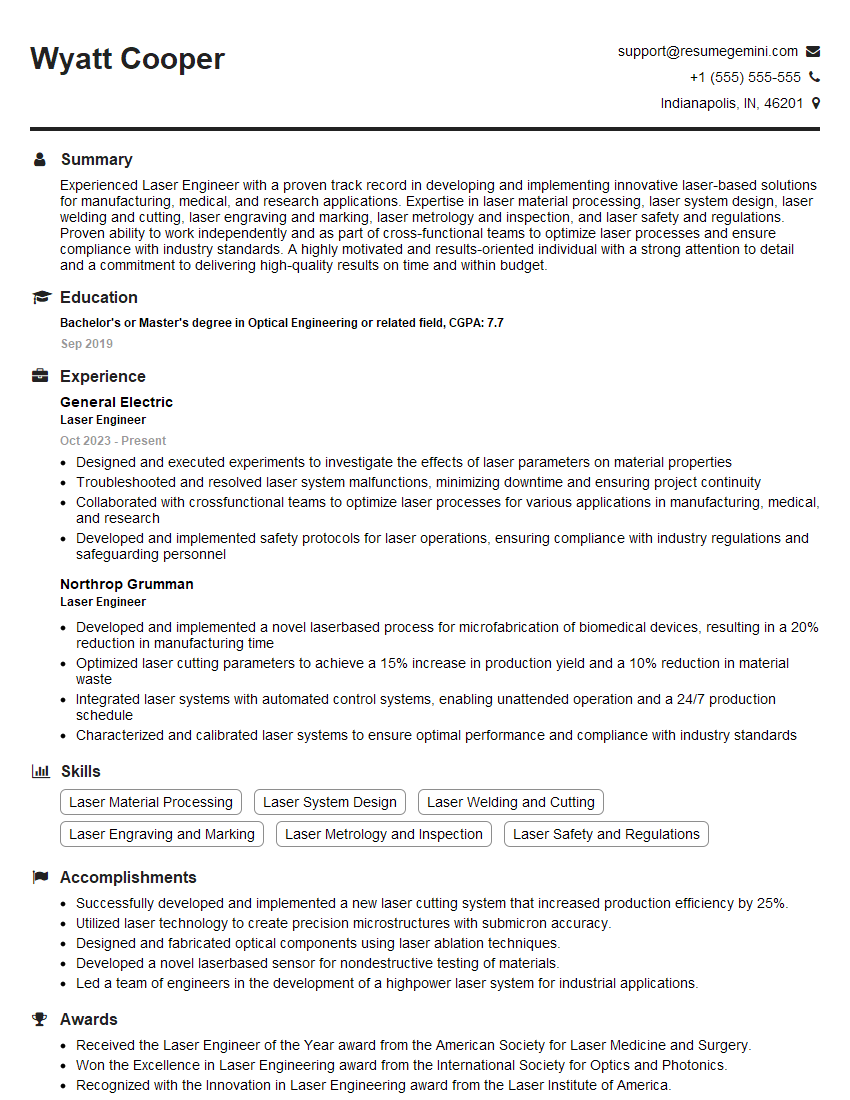
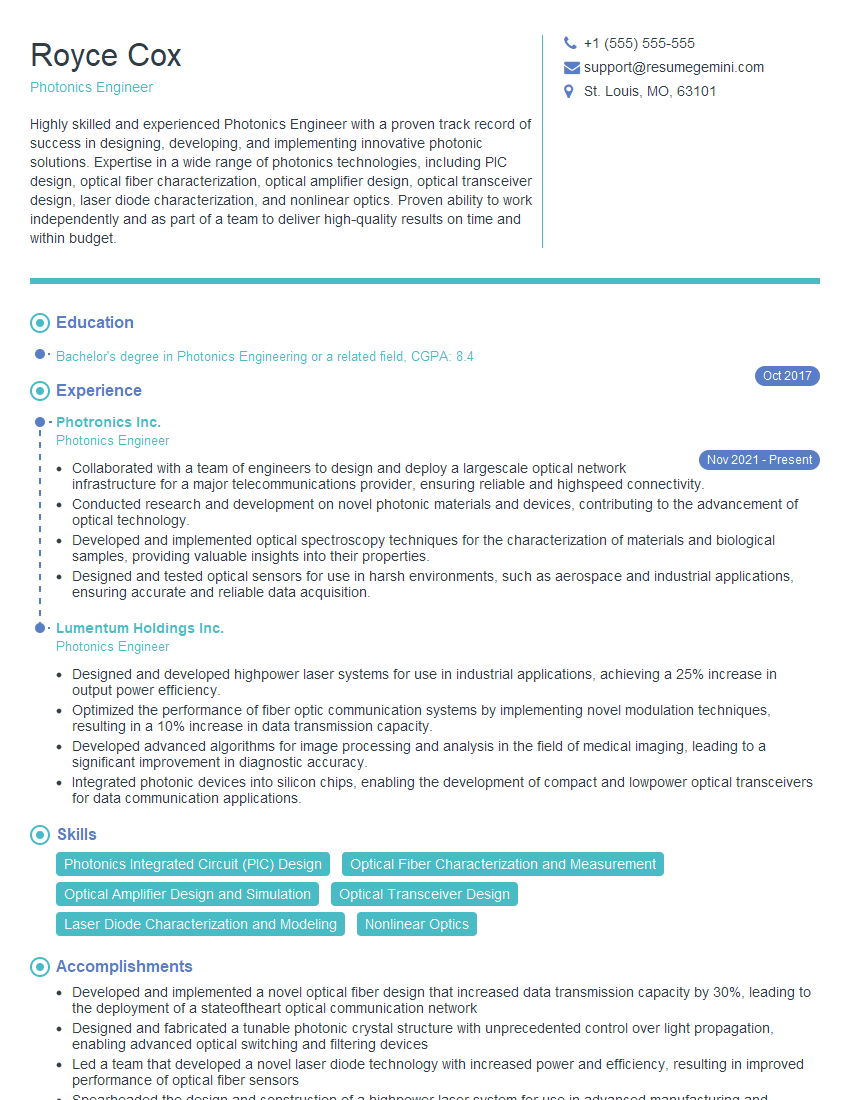
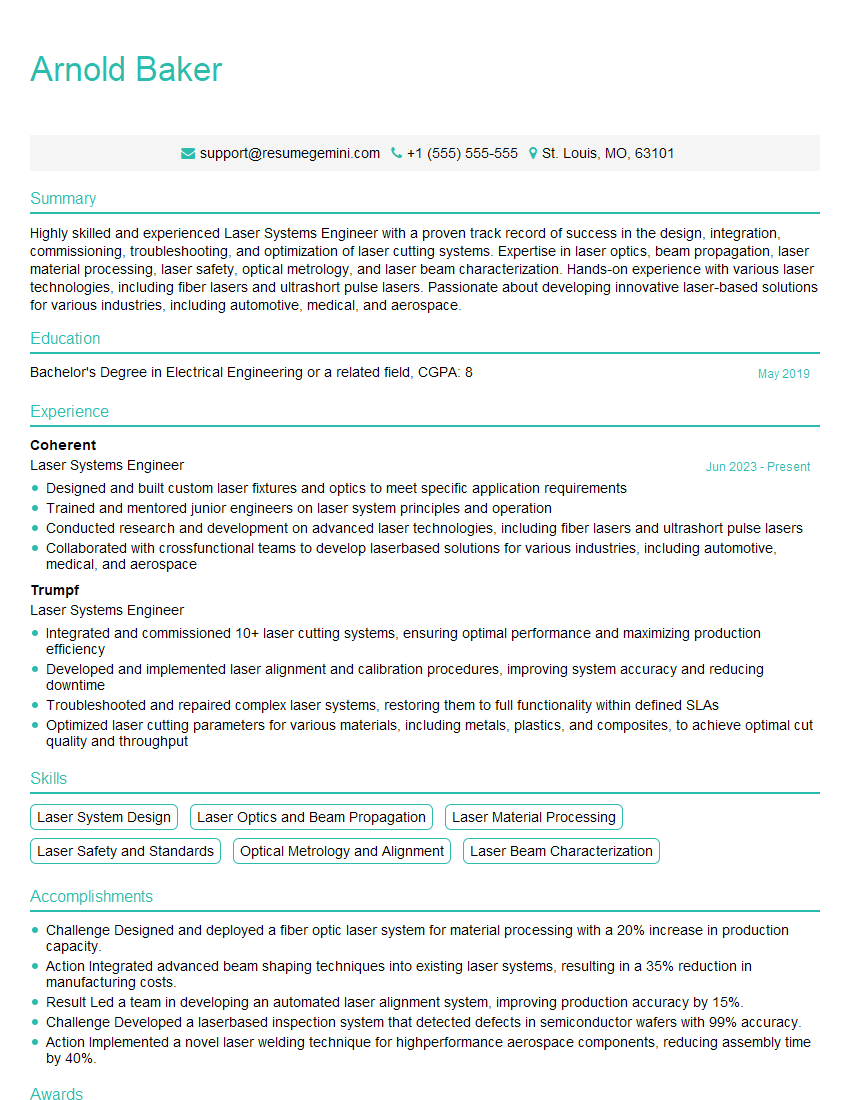
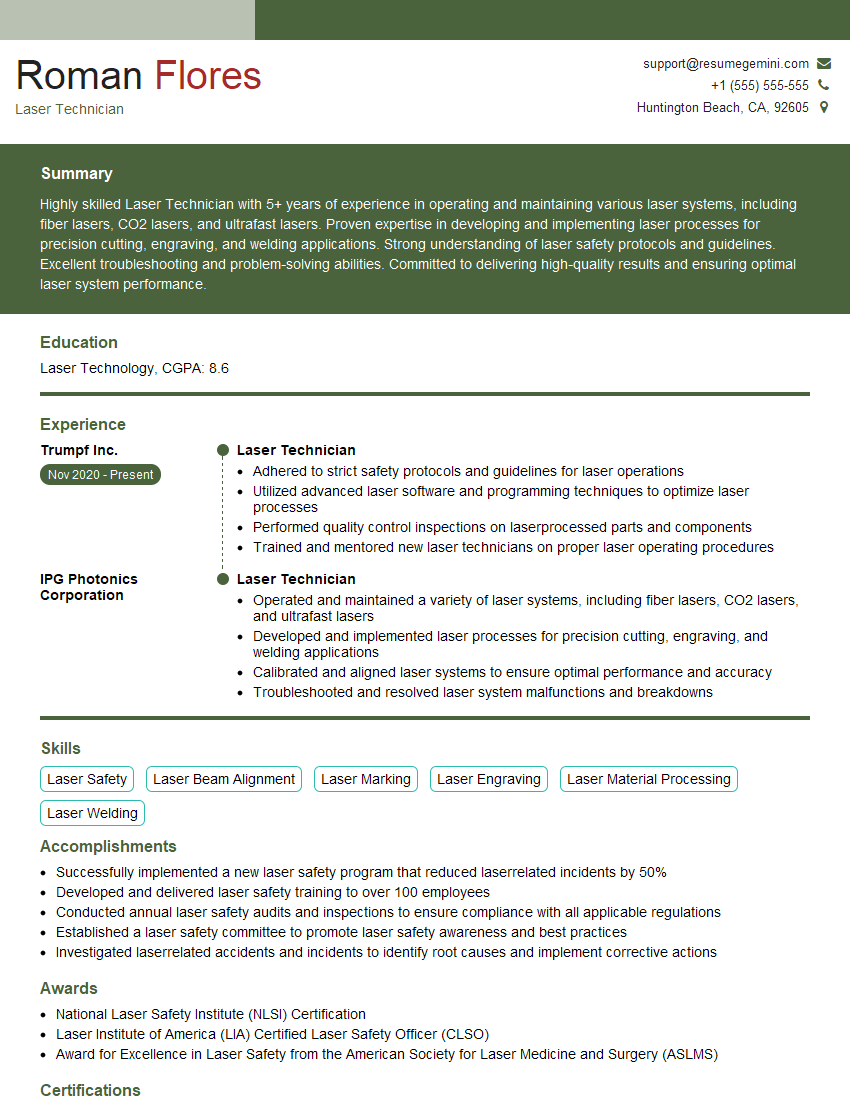
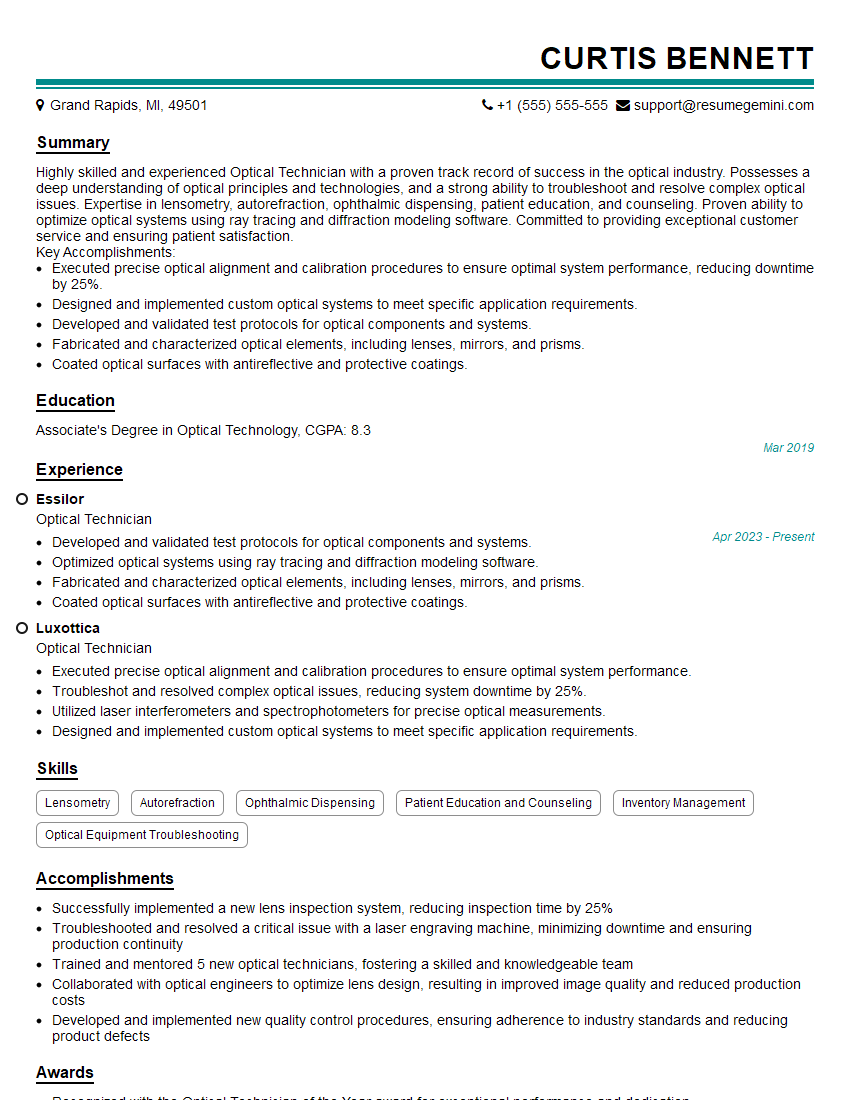
Mastering the intricacies of working with lasers significantly enhances your career prospects in a wide range of high-tech industries. A well-crafted resume is your key to unlocking these opportunities. An ATS-friendly resume, optimized for applicant tracking systems, is crucial for getting your application noticed. ResumeGemini is a trusted resource to help you build a professional and impactful resume that highlights your laser expertise. We offer examples of resumes tailored to experience in working with lasers to help guide you in creating your own compelling application.

Explore more articles
Users Rating of Our Blogs
Share Your Experience
We value your feedback! Please rate our content and share your thoughts (optional).
What Readers Say About Our Blog
To the interviewgemini.com Webmaster.
Very helpful and content specific questions to help prepare me for my interview!
Thank you
To the interviewgemini.com Webmaster.
This was kind of a unique content I found around the specialized skills. Very helpful questions and good detailed answers.
Very Helpful blog, thank you Interviewgemini team.