Cracking a skill-specific interview, like one for Image Segmentation for Remote Sensing, requires understanding the nuances of the role. In this blog, we present the questions you’re most likely to encounter, along with insights into how to answer them effectively. Let’s ensure you’re ready to make a strong impression.
Questions Asked in Image Segmentation for Remote Sensing Interview
Q 1. Explain the difference between supervised and unsupervised image segmentation techniques.
The core difference between supervised and unsupervised image segmentation lies in the availability of labeled data. Supervised segmentation uses a dataset where each pixel (or a group of pixels) is already labeled with its corresponding class (e.g., water, vegetation, buildings). Algorithms like Support Vector Machines (SVM) or Convolutional Neural Networks (CNNs) learn to map image features to these pre-defined classes. Think of it like teaching a child to identify different fruits – you show them examples of apples, oranges, and bananas, labeling each one. The child learns to recognize the features that distinguish each fruit.
Unsupervised segmentation, on the other hand, doesn’t rely on pre-labeled data. It groups pixels based on inherent similarities in their features (color, texture, etc.). Algorithms like k-means clustering or region growing automatically partition the image into segments without prior knowledge of the classes. Imagine letting the child group the fruits based on color alone – they might group red apples and red strawberries together, without knowing their specific names.
In remote sensing, supervised methods are often preferred for tasks requiring high accuracy, like identifying specific crops or mapping urban areas, because accurate labeling ensures the algorithm learns the relevant features. Unsupervised methods can be useful for initial exploration or when labeled data is scarce, perhaps offering a first cut segmentation for refining with supervised approaches. The choice often depends on available resources and the desired level of detail.
Q 2. Describe the process of image pre-processing for remote sensing image segmentation.
Pre-processing for remote sensing image segmentation is crucial for improving the quality and accuracy of the results. It’s like preparing ingredients before cooking – you wouldn’t bake a cake without sifting the flour! The steps typically involve:
- Radiometric Correction: This addresses variations in sensor response and atmospheric effects, ensuring that pixel values accurately reflect ground features. Think of it as calibrating your camera to account for different lighting conditions.
- Geometric Correction: This corrects for geometric distortions caused by sensor perspective, terrain relief, and satellite movement. It’s like straightening a slightly crooked photograph.
- Atmospheric Correction: This removes atmospheric scattering and absorption, improving the clarity of the image and allowing for a more accurate representation of ground reflectance. This step is essential because the atmosphere can scatter light and distort the colors in the image, leading to inaccurate segmentation results.
- Noise Reduction: This reduces random noise in the image, often using filters such as median filters or wavelet transforms. It’s like cleaning up a noisy audio track, making it easier to discern the distinct components.
- Data Enhancement: Techniques such as histogram equalization or contrast stretching improve image contrast, making it easier to distinguish different features. This enhances the visibility of subtle differences between classes.
The specific pre-processing steps will vary depending on the sensor type, image quality, and the segmentation task. For instance, orthorectification, a specialized form of geometric correction, is common for high-resolution imagery to ensure accurate spatial relationships between features.
Q 3. What are some common challenges in remote sensing image segmentation, and how can they be addressed?
Remote sensing image segmentation faces numerous challenges, including:
- High dimensionality: Remote sensing images often have many spectral bands, leading to computationally expensive processing and potential for the ‘curse of dimensionality’.
- Mixed pixels: Pixels often contain multiple land cover types, making accurate classification difficult. Imagine a pixel containing both forest and road – which class should it belong to?
- Spectrally similar classes: Different land cover types can have similar spectral signatures, making it hard to distinguish them. For example, some types of vegetation may be spectrally similar.
- Data heterogeneity: Images may have varying spatial resolutions, atmospheric conditions, and sensor characteristics, making uniform segmentation difficult.
- Computational cost: Processing large high-resolution images can be computationally intensive and time-consuming.
Addressing these challenges requires a multi-pronged approach. We might employ feature extraction techniques to reduce dimensionality and highlight distinguishing features, use advanced algorithms that account for mixed pixels (like Markov Random Fields), select appropriate spectral indices to enhance class separability, and utilize high-performance computing techniques to handle large datasets.
Q 4. Compare and contrast different image segmentation algorithms (e.g., k-means, region growing, watershed, level set methods).
Let’s compare some common image segmentation algorithms:
- k-means clustering: This is a simple, unsupervised algorithm that partitions data into k clusters based on minimizing the distance between data points and their cluster centers. It’s computationally efficient but sensitive to the initial choice of cluster centers and assumes spherical clusters, which might not be realistic in remote sensing data.
- Region growing: This algorithm starts with seed pixels and iteratively adds neighboring pixels based on similarity criteria (e.g., spectral proximity). It’s relatively simple to implement and can handle irregular shapes, but the choice of seed pixels and similarity threshold significantly impact the results.
- Watershed segmentation: This algorithm treats the image as a topographic surface, where pixels represent elevation and segments are defined by catchment basins. It’s effective at segmenting regions with clear boundaries, but prone to over-segmentation, especially in noisy images.
- Level set methods: These are more sophisticated algorithms that evolve curves or surfaces to segment objects. They can handle complex shapes and topologies, but are computationally more expensive than simpler methods.
The choice of algorithm depends on factors like the nature of the data, the desired level of detail, and computational resources. For example, k-means is suitable for quick initial explorations, while level set methods may be preferred for high-accuracy segmentation of complex objects.
Q 5. How do you evaluate the performance of an image segmentation algorithm? What metrics do you use?
Evaluating image segmentation performance requires comparing the segmented image with a ground truth image (a manually labeled reference image). Common metrics include:
- Overall Accuracy (OA): The proportion of correctly classified pixels.
- Producer’s Accuracy (PA): For each class, the proportion of correctly classified pixels relative to the total number of pixels in that class. It shows how well the algorithm identifies pixels of a particular class.
- User’s Accuracy (UA): For each class, the proportion of correctly classified pixels relative to the total number of pixels classified as that class. It shows how reliable the assigned class is for a pixel.
- Kappa coefficient (κ): Measures the agreement between the segmented image and the ground truth, accounting for chance agreement.
- Intersection over Union (IoU) or Jaccard Index: The ratio of the intersection area to the union area between the predicted segmentation and the ground truth for each class. It is commonly used and provides a measure of localization accuracy.
- Dice Coefficient: A similarity metric that measures the overlap between the predicted and ground truth segmentations, often used in medical image segmentation but applicable here as well.
The choice of metrics depends on the application and the importance of different classes. For example, in precision agriculture, high producer’s accuracy for a specific crop might be crucial.
Q 6. Explain the concept of feature extraction in the context of remote sensing image segmentation.
Feature extraction in remote sensing image segmentation involves transforming raw pixel values into a set of features that better represent the underlying land cover types. This is like taking a detailed description of a fruit to highlight only the most important aspects (e.g., color, shape, size) to help easily distinguish it from others. It’s about creating a new representation that simplifies the data, highlights important differences between classes, and might make the problem more manageable for the segmentation algorithm.
The goal is to reduce dimensionality (the number of variables) while retaining or enhancing the information crucial for distinguishing different land cover classes. This can significantly improve the performance and efficiency of segmentation algorithms, especially when dealing with high-dimensional data like hyperspectral imagery.
Q 7. What are some common feature extraction techniques used in remote sensing image segmentation?
Common feature extraction techniques in remote sensing image segmentation include:
- Spectral indices: These are calculated from combinations of spectral bands to highlight specific features. Examples include the Normalized Difference Vegetation Index (NDVI) for vegetation, the Normalized Difference Water Index (NDWI) for water bodies, and the Normalized Difference Built-up Index (NDBI) for urban areas.
- Texture features: These describe the spatial arrangement of pixel values. Common texture features include gray-level co-occurrence matrix (GLCM) statistics (e.g., contrast, homogeneity, energy), Gabor filters, and wavelet transforms. Texture is often very useful in distinguishing between different land covers, especially those with subtle spectral differences.
- Principal Component Analysis (PCA): A dimensionality reduction technique that transforms the original spectral bands into a set of uncorrelated principal components, highlighting the most important variations in the data. PCA is frequently used to reduce the computational load in the segmentation algorithm.
- Object-based image analysis (OBIA): This approach groups pixels into meaningful objects before applying segmentation, using features derived from these objects (size, shape, texture, spectral characteristics) for classification. This is particularly useful for handling heterogeneous images or extracting information at a meaningful scale.
The selection of appropriate feature extraction techniques depends on the specific application, data characteristics, and the desired level of detail. Often, a combination of different features provides the best results.
Q 8. Describe the role of deep learning in remote sensing image segmentation.
Deep learning has revolutionized remote sensing image segmentation by enabling the automated extraction of meaningful information from satellite and aerial imagery. Traditional methods often relied on manual feature engineering and rule-based algorithms, which were time-consuming and lacked the ability to learn complex patterns. Deep learning, particularly Convolutional Neural Networks (CNNs), excels at automatically learning hierarchical features directly from raw pixel data, leading to significantly improved accuracy and efficiency. Think of it like teaching a computer to ‘see’ and understand the nuances in satellite images, much like a human expert, but at a much larger scale and with greater speed.
For instance, a deep learning model can learn to differentiate between different types of vegetation (e.g., healthy crops, diseased crops, or forests) based solely on the spectral and spatial characteristics of the pixels. This surpasses the capabilities of previous techniques, leading to more precise land cover mapping, crop yield prediction, and environmental monitoring.
Q 9. What are Convolutional Neural Networks (CNNs) and how are they applied to remote sensing image segmentation?
Convolutional Neural Networks (CNNs) are a specialized type of artificial neural network designed for processing grid-like data, such as images. They leverage convolutional layers that apply filters (kernels) to the input image to extract local features. These filters detect patterns like edges, corners, textures, and more complex structures. Successive convolutional layers combine these features to learn increasingly abstract representations. Imagine it like a magnifying glass, gradually zooming in on the details of an image to understand its components.
In remote sensing image segmentation, CNNs are used to classify each pixel in an image into predefined classes (e.g., water, buildings, roads, vegetation). Architectures like U-Net, SegNet, and DeepLab are popular choices because they effectively combine feature extraction with precise pixel-level prediction. They often incorporate skip connections that combine features from different layers to retain spatial information, crucial for accurate segmentation boundaries.
For example, a CNN trained on a dataset of labeled satellite imagery can learn to identify flooded areas by recognizing the unique spectral signatures and spatial patterns associated with water. This automation can save significant time and resources compared to manual interpretation.
Q 10. Explain the concept of transfer learning and its application in remote sensing image segmentation.
Transfer learning leverages pre-trained models on large datasets (like ImageNet) to accelerate training and improve performance on smaller, task-specific datasets. Instead of training a CNN from scratch, we can initialize its weights with those learned from a related task. This is particularly beneficial in remote sensing where labeled data can be scarce and expensive to acquire. Think of it as giving your model a head start by teaching it general image understanding before specializing it for remote sensing tasks.
In remote sensing image segmentation, we often use models pre-trained on general image datasets and then fine-tune them on a smaller dataset of remote sensing images. This significantly reduces training time and improves the model’s ability to learn relevant features from limited data. For instance, a model pre-trained on ImageNet can be fine-tuned on a dataset of agricultural images to classify different crop types with better accuracy and fewer training examples compared to training from scratch.
Q 11. How do you handle noisy data or missing data in remote sensing image segmentation?
Remote sensing data is often susceptible to noise (e.g., atmospheric effects, sensor noise) and missing data (e.g., cloud cover). Handling these issues is crucial for accurate segmentation. Several strategies can be employed:
- Pre-processing techniques: These include atmospheric correction to remove atmospheric distortions, noise reduction filters (e.g., median filter), and data imputation methods (e.g., interpolation) to fill in missing data.
- Robust loss functions: Using loss functions less sensitive to outliers, such as Huber loss, can make the model more resilient to noisy data.
- Data augmentation: Creating synthetic noisy versions of existing data can enhance model robustness. This involves adding controlled noise to the training data to make the model more resilient to noisy inputs during testing.
- Generative models: Generative adversarial networks (GANs) can be used to generate realistic data to fill in missing areas or to synthesize data representing different noise levels.
The choice of technique depends on the type and extent of noise and missing data. A combination of these methods is often the most effective approach.
Q 12. Discuss the impact of spatial resolution on the accuracy of image segmentation.
Spatial resolution, the size of the pixels on the ground, significantly impacts segmentation accuracy. Higher spatial resolution (smaller pixels) provides finer details and leads to more precise segmentation boundaries. Imagine comparing a pixelated image to a high-resolution photograph—the high-resolution image allows for much more accurate identification of objects and their boundaries.
With high spatial resolution, subtle differences in land cover become more apparent, allowing for better discrimination between different classes. However, higher resolution also means more data to process, requiring more computational resources and increasing processing time. The choice of spatial resolution depends on the specific application and the trade-off between accuracy and computational cost. For example, identifying individual trees requires much higher spatial resolution than mapping large forest areas.
Q 13. Explain the concept of spectral resolution and its influence on image segmentation.
Spectral resolution refers to the number and width of spectral bands captured by the sensor. Each band represents a specific range of wavelengths in the electromagnetic spectrum. Different materials reflect and absorb light differently across these wavelengths, resulting in unique spectral signatures. Higher spectral resolution (more bands with narrower widths) provides richer information about the materials present, enabling better discrimination between classes.
For instance, high spectral resolution sensors can distinguish between different vegetation types based on subtle variations in their reflectance patterns, which may not be possible with lower spectral resolution sensors. This enhanced spectral information is crucial for precise land cover classification and monitoring vegetation health. However, higher spectral resolution also increases data complexity and requires more sophisticated analysis techniques.
Q 14. What are some common applications of remote sensing image segmentation in different fields (e.g., agriculture, urban planning, environmental monitoring)?
Remote sensing image segmentation has numerous applications across various fields:
- Agriculture: Precision farming, crop yield prediction, disease detection, monitoring irrigation efficiency.
- Urban planning: Building extraction, road network mapping, land use classification, urban growth monitoring.
- Environmental monitoring: Deforestation detection, wetland mapping, glacier monitoring, pollution detection, habitat mapping.
- Disaster management: Flood mapping, earthquake damage assessment, wildfire monitoring.
- Geology: Mineral exploration, landform classification, geological mapping.
In each case, accurate segmentation provides valuable insights that inform decision-making and improve resource management. For example, in agriculture, identifying diseased crops allows for targeted treatment, reducing pesticide use and maximizing yield. In urban planning, accurate building extraction helps optimize infrastructure development and urban design. In environmental monitoring, precise mapping of deforestation allows for timely interventions to protect forests and biodiversity.
Q 15. How do you address the computational cost associated with processing large remote sensing images?
Processing large remote sensing images can be computationally expensive due to their massive size and high resolution. To address this, several strategies are employed. One common approach is tile processing. Instead of loading the entire image into memory at once, we divide it into smaller, manageable tiles. Each tile is processed independently, and the results are then stitched together. This significantly reduces memory requirements.
Another key strategy is leveraging parallel processing. Modern computers and cloud computing platforms offer powerful parallel processing capabilities. We can distribute the processing of individual tiles across multiple cores or even multiple machines, dramatically reducing overall processing time. Libraries like dask in Python are particularly useful for this.
Algorithm optimization plays a crucial role. Choosing efficient algorithms, such as those with lower time complexities, is essential. For instance, using a fast segmentation algorithm like U-Net with appropriate optimizations can make a huge difference.
Finally, data reduction techniques, such as downsampling (reducing image resolution) or using compressed data formats, can significantly reduce the amount of data processed. However, it’s important to balance data reduction with the potential loss of information.
Career Expert Tips:
- Ace those interviews! Prepare effectively by reviewing the Top 50 Most Common Interview Questions on ResumeGemini.
- Navigate your job search with confidence! Explore a wide range of Career Tips on ResumeGemini. Learn about common challenges and recommendations to overcome them.
- Craft the perfect resume! Master the Art of Resume Writing with ResumeGemini’s guide. Showcase your unique qualifications and achievements effectively.
- Don’t miss out on holiday savings! Build your dream resume with ResumeGemini’s ATS optimized templates.
Q 16. Explain the importance of ground truth data in evaluating image segmentation algorithms.
Ground truth data is absolutely critical for evaluating the accuracy of image segmentation algorithms. It provides a benchmark against which our algorithm’s performance can be measured. This data consists of manually labeled images, where each pixel is assigned its correct class label (e.g., water, vegetation, urban area). Think of it like an answer key for our algorithm’s ‘test’.
Without ground truth, we have no way of knowing if our algorithm is accurately segmenting the image. We might get a visually appealing result, but it could be completely inaccurate. Common metrics used to assess the performance against ground truth include:
- Overall Accuracy: The percentage of correctly classified pixels.
- IoU (Intersection over Union): Measures the overlap between the predicted and ground truth segmentation masks.
- Precision and Recall: Assess the algorithm’s ability to correctly identify specific classes.
The quality and quantity of ground truth data directly impact the reliability of our evaluation. More comprehensive ground truth, covering diverse scenarios and classes, leads to more robust and reliable results.
Q 17. Describe your experience with different software packages or tools for remote sensing image processing and segmentation (e.g., ENVI, ArcGIS, QGIS, Python libraries like OpenCV, scikit-image).
My experience spans several software packages and tools. I’ve extensively used ENVI for its powerful functionalities in spectral analysis and image classification. Its user-friendly interface makes it suitable for tasks like band selection and initial image pre-processing. ArcGIS has been invaluable for geospatial analysis, integration with GIS data, and visualization of segmentation results within a geographic context. QGIS offers a similar open-source alternative for those same functionalities.
For more advanced and customized segmentation tasks, I heavily rely on Python with libraries like OpenCV (for basic image manipulation and computer vision tasks) and scikit-image (for image analysis and processing). These libraries provide flexibility and control over the entire segmentation pipeline. I frequently use numpy and pandas for data handling. For deep learning-based segmentation, frameworks like TensorFlow and PyTorch are essential, enabling me to build and train custom models like U-Net or Mask R-CNN.
I find that the choice of software depends heavily on the specific task, available resources, and personal preferences. For instance, if a task involves extensive geospatial analysis, ArcGIS or QGIS are preferred; whereas, deep learning-based segmentation will inevitably lead to using Python libraries and deep learning frameworks.
Q 18. How do you handle the problem of class imbalance in remote sensing image segmentation?
Class imbalance is a common problem in remote sensing, where some classes (e.g., urban areas) might occupy a much smaller area than others (e.g., forests). This can lead to biased models that perform poorly on the minority classes. To handle this, I utilize several techniques:
- Data Augmentation: Artificially increase the number of samples in minority classes by rotating, flipping, or slightly perturbing existing images.
- Resampling Techniques: Oversampling the minority class (e.g., creating synthetic samples) or undersampling the majority class can balance the class distribution. Techniques like SMOTE (Synthetic Minority Over-sampling Technique) are useful here.
- Cost-Sensitive Learning: Assign higher weights to the minority classes during model training. This encourages the model to pay more attention to these less-represented classes.
- Focal Loss: This loss function addresses class imbalance by down-weighting the contribution of easy examples during training.
The optimal technique depends on the severity of the imbalance and the specifics of the data. Experimentation is crucial to determine the most effective strategy.
Q 19. Explain the concept of semantic segmentation and instance segmentation.
Semantic segmentation assigns a class label to every pixel in an image, creating a pixel-wise classification. For example, it would classify each pixel as ‘road’, ‘building’, ‘tree’, etc. It focuses on the *semantic meaning* of each pixel and doesn’t distinguish between individual objects of the same class.
Instance segmentation goes a step further. It not only classifies each pixel but also identifies individual instances of each class. So, it would classify each pixel and also outline and identify each individual car, each individual tree, etc. This requires distinguishing between different objects of the same class.
Imagine a satellite image of a parking lot: semantic segmentation would classify all pixels as ‘car’ or ‘road’; instance segmentation would identify each individual car as a separate instance.
Q 20. What is the difference between pixel-based and object-based image analysis?
Pixel-based image analysis treats each pixel as an independent unit. Classification or segmentation is done pixel by pixel, without considering the spatial context or relationships between neighboring pixels. This approach can be computationally efficient but often lacks the ability to capture contextual information, leading to fragmented or noisy results.
Object-based image analysis (OBIA), on the other hand, groups pixels into meaningful objects or segments based on their spectral and spatial characteristics. It takes into account the relationships between neighboring pixels and considers the overall shape, size, and texture of the objects. This context-aware approach usually produces more accurate and visually appealing results, especially for heterogeneous landscapes. However, OBIA requires additional steps like segmentation and object feature extraction, increasing computational complexity.
Q 21. How do you choose the appropriate segmentation algorithm for a given remote sensing application?
Choosing the right segmentation algorithm depends on several factors:
- Image characteristics: Resolution, spectral bands, noise levels, etc.
- Application requirements: Accuracy needs, computational constraints, desired level of detail (semantic vs. instance segmentation).
- Data characteristics: Class distribution, presence of artifacts, etc.
- Computational resources: Available processing power and memory.
For example, a simple thresholding technique might suffice for images with clear spectral separation between classes, while complex deep learning models are better suited for high-resolution images with subtle variations and many classes. If computational resources are limited, a faster algorithm like k-means clustering might be preferred over a computationally intensive model like U-Net.
Experimentation with different algorithms and parameter tuning is critical to finding the best solution for a specific application. A common strategy is to start with simpler methods and gradually progress to more sophisticated ones if necessary.
Q 22. Explain the concept of scale and its importance in image segmentation.
Scale in image segmentation refers to the relationship between the size of features in the image and their size in the real world. It’s crucial because the appropriate scale dictates the level of detail you need to capture and the methods best suited for segmentation. For example, segmenting individual trees in a forest requires a much finer scale (higher resolution imagery) than segmenting entire forest patches. A low-resolution image might only allow you to distinguish between forest and grassland, while a high-resolution image could identify specific tree species.
Choosing the wrong scale can lead to inaccurate results. If you try to segment small features with low-resolution data, you’ll lack the detail to perform accurate classification. Conversely, using excessively high-resolution data might lead to computational burden and unnecessary complexity without significantly improving the accuracy of segmentation, especially if the features are relatively large.
In practice, scale is often dictated by the application and the spatial resolution of the available imagery. We carefully consider the trade-offs between detail, computational cost, and the desired level of accuracy when selecting the appropriate scale.
Q 23. Describe your experience with different types of remote sensing data (e.g., multispectral, hyperspectral, LiDAR).
My experience encompasses a wide range of remote sensing data types. I’ve worked extensively with multispectral imagery, such as Landsat and Sentinel data, which provides information across multiple spectral bands (e.g., red, green, blue, near-infrared). This data is effective for tasks like land cover classification and vegetation monitoring. I’ve also utilized hyperspectral imagery, which offers a much finer spectral resolution, capturing hundreds of narrow spectral bands. This allows for detailed material identification and discrimination, useful for precision agriculture, mineral exploration, and environmental monitoring. The high dimensionality of hyperspectral data necessitates advanced processing techniques to manage the large datasets.
Furthermore, I have considerable experience with LiDAR (Light Detection and Ranging) data. LiDAR provides precise three-dimensional point cloud information, ideal for creating highly accurate digital elevation models (DEMs) and identifying terrain features. I frequently integrate LiDAR data with multispectral or hyperspectral imagery to improve the accuracy and detail of segmentation results. For example, LiDAR data can provide valuable contextual information to aid in the classification of urban areas by helping distinguish between buildings and trees based on height.
Q 24. How do you handle the challenges of cloud cover in remote sensing image segmentation?
Cloud cover is a significant challenge in remote sensing image segmentation, as clouds obscure the ground features we aim to segment. My approach involves a combination of strategies:
- Cloud masking: Using dedicated cloud masking algorithms and spectral indices (e.g., Normalized Difference Cloud Index – NCI) to identify and remove cloudy regions from the imagery before segmentation. This reduces the impact of clouds on the analysis.
- Temporal compositing: Combining data from multiple images acquired at different times. If a specific area is clouded in one image, it might be clear in another. We can then use the clear images to fill in the gaps in cloudy areas.
- Cloud removal techniques: Employing advanced image processing techniques to reconstruct or fill in cloudy areas. These methods can range from simple interpolation to more complex techniques such as inpainting or deep learning-based cloud removal.
- Data selection: Carefully choosing the acquisition dates to minimize cloud cover. This requires knowledge of the typical weather patterns in the area of interest.
The best approach depends on the specific application, the extent of cloud cover, and the available data. Often, a combination of these strategies is most effective.
Q 25. Describe your experience with using cloud computing platforms (e.g., AWS, Google Cloud, Azure) for processing large remote sensing datasets.
I have extensive experience leveraging cloud computing platforms like AWS, Google Cloud, and Azure for processing large remote sensing datasets. The sheer volume of data generated from remote sensing platforms necessitates the scalability and processing power offered by these platforms. My workflow typically involves:
- Data storage: Utilizing cloud storage services (e.g., S3, Google Cloud Storage) to store and manage terabytes of remote sensing data efficiently.
- Parallel processing: Distributing computationally intensive tasks across multiple virtual machines or using managed services like AWS Batch or Google Cloud Dataproc to accelerate processing times.
- Geospatial processing tools: Employing cloud-based geospatial processing libraries and frameworks (e.g., GDAL, Rasterio) to perform tasks such as image preprocessing, segmentation, and analysis.
- Serverless computing: Leveraging serverless functions for automated data processing pipelines, reducing infrastructure management overhead.
For example, I recently used AWS Batch to process a large hyperspectral dataset for agricultural monitoring. The parallel processing capabilities significantly reduced the processing time compared to using a single local machine.
Q 26. How do you ensure the reproducibility of your image segmentation results?
Reproducibility is paramount in scientific research. To ensure reproducible image segmentation results, I adhere to these practices:
- Version control: Using Git or similar version control systems to track changes to the code, data, and configuration files. This allows me to easily reproduce the exact environment and steps used in previous analyses.
- Detailed documentation: Maintaining comprehensive documentation of the data preprocessing steps, segmentation algorithms used, parameters chosen, and the evaluation metrics employed. This ensures transparency and facilitates the reproduction of results.
- Containerization: Using Docker containers to package the software environment (including libraries, dependencies, and configurations) to ensure consistent execution across different platforms. This eliminates discrepancies arising from different software versions or system configurations.
- Open-source tools: Preferring open-source software packages and tools whenever possible, enhancing transparency and facilitating community scrutiny and verification.
- Metadata management: Maintaining detailed metadata records for all datasets, including acquisition parameters, processing steps, and any relevant contextual information. This ensures clarity and traceability.
Q 27. Explain your approach to debugging and troubleshooting issues encountered during the image segmentation process.
Debugging and troubleshooting in image segmentation often involves systematic investigation. My approach involves:
- Visual inspection: Thoroughly examining the input data and intermediate results through visual inspection to identify any artifacts, inconsistencies, or anomalies. This often helps pinpoint the source of errors.
- Systematic testing: Performing unit and integration tests on individual components of the segmentation pipeline to isolate problems. This helps to diagnose if errors originate from data preprocessing, algorithm parameters, or post-processing steps.
- Parameter tuning: Carefully adjusting algorithm parameters to optimize performance and reduce errors. This might involve experimenting with different thresholds, kernel sizes, or other algorithm-specific settings.
- Data quality assessment: Checking the quality of the input data, as low-quality data can lead to inaccurate segmentation. This includes evaluating factors such as noise levels, spatial resolution, and atmospheric effects.
- Error analysis: Analyzing the type and distribution of segmentation errors to understand the causes and identify potential improvements to the approach.
For example, if I encounter unexpectedly high classification errors, I might use a confusion matrix to identify which classes are most problematic and then investigate whether the issue stems from data quality, algorithm limitations, or improper parameter tuning.
Q 28. Describe a project where you used image segmentation in remote sensing. What challenges did you encounter, and how did you overcome them?
In a recent project, I used image segmentation to map urban sprawl in a rapidly growing coastal city. The goal was to identify built-up areas, vegetation, and water bodies using a combination of high-resolution multispectral imagery and LiDAR data.
Challenges: One major challenge was the high degree of spectral and spatial variability in the urban landscape. Distinguishing between different types of buildings (residential, commercial, industrial), roads, and vegetation proved difficult due to the mixed pixel problem (pixels containing multiple land cover types). Additionally, the presence of shadows and variations in illumination conditions affected segmentation accuracy.
Solutions: To overcome these challenges, I employed a multi-stage segmentation approach. First, I used LiDAR data to create a detailed digital elevation model (DEM) and extract building heights, which were used as features for separating buildings from other land cover classes. Next, I used a deep learning-based segmentation model (U-Net) trained on manually labelled data. I also incorporated spectral indices derived from the multispectral imagery to improve the classification accuracy. Finally, I used post-processing techniques such as morphological operations to refine the segmented boundaries and remove small, isolated regions.
The results significantly improved urban sprawl mapping in the area, providing valuable insights for urban planning and resource management. The integration of LiDAR and multispectral data, coupled with a robust segmentation workflow, proved crucial to successfully overcoming the inherent complexities of urban environments.
Key Topics to Learn for Image Segmentation for Remote Sensing Interview
- Image Preprocessing Techniques: Understanding and applying techniques like noise reduction, atmospheric correction, and geometric correction crucial for accurate segmentation.
- Segmentation Algorithms: Deep dive into various algorithms including thresholding, region-growing, watershed, and deep learning-based methods (e.g., U-Net, Mask R-CNN). Focus on their strengths, weaknesses, and applicability to remote sensing data.
- Feature Extraction and Selection: Explore the importance of extracting meaningful features from remote sensing imagery (spectral, spatial, textural) and selecting the most relevant ones for effective segmentation.
- Evaluation Metrics: Master the use of metrics like accuracy, precision, recall, F1-score, IoU (Intersection over Union) to assess the performance of different segmentation methods. Be prepared to discuss their trade-offs.
- Supervised vs. Unsupervised Segmentation: Understand the differences, advantages, and disadvantages of both approaches and when to apply each in remote sensing contexts.
- Practical Applications: Be ready to discuss real-world applications like land cover classification, urban planning, precision agriculture, deforestation monitoring, and disaster response.
- Challenges and Limitations: Discuss common challenges in remote sensing image segmentation such as cloud cover, shadows, and variations in spectral signatures. Be prepared to discuss potential solutions.
- Deep Learning for Remote Sensing: If focusing on deep learning, demonstrate understanding of convolutional neural networks (CNNs), transfer learning, and data augmentation techniques specific to remote sensing imagery.
Next Steps
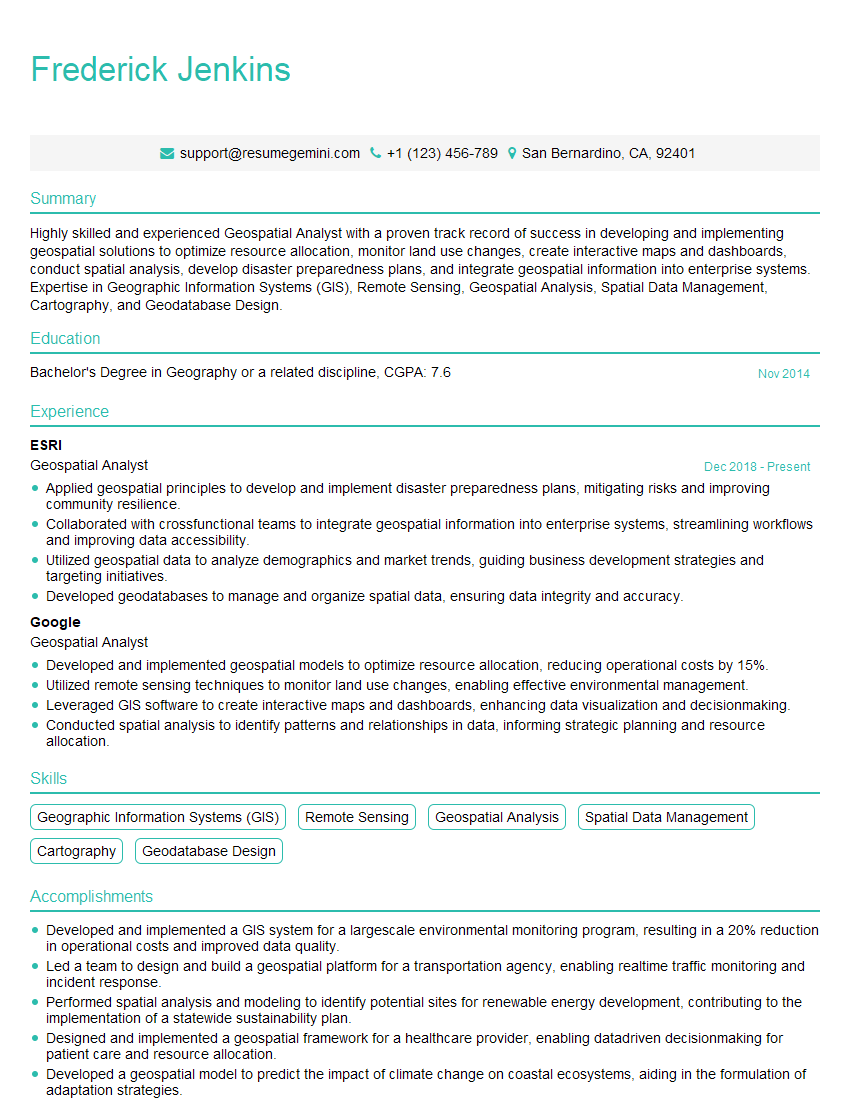
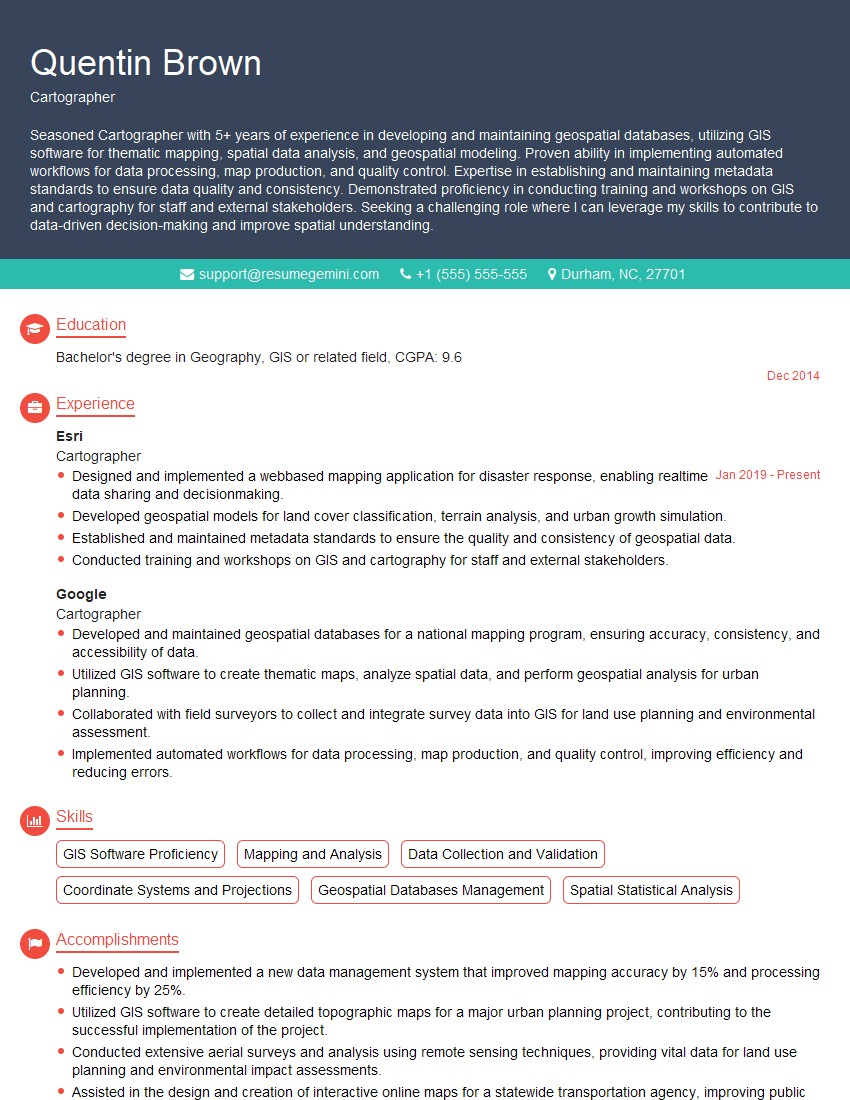
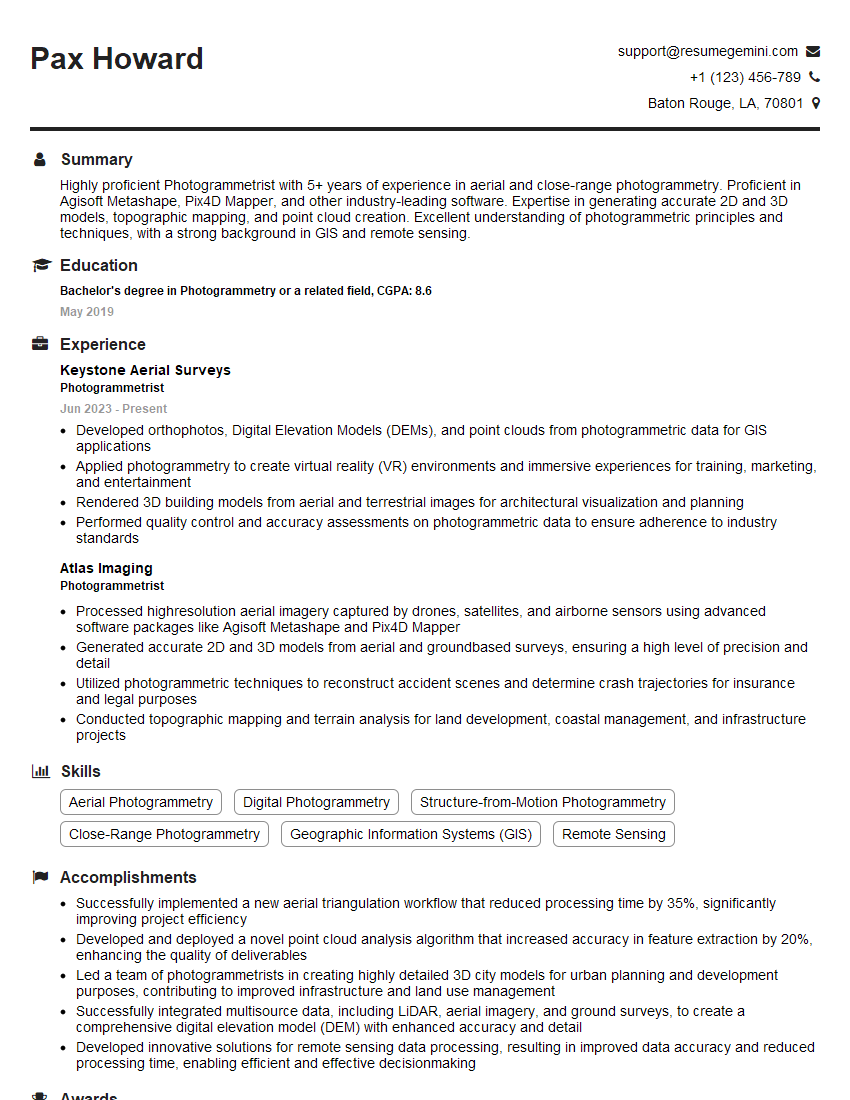
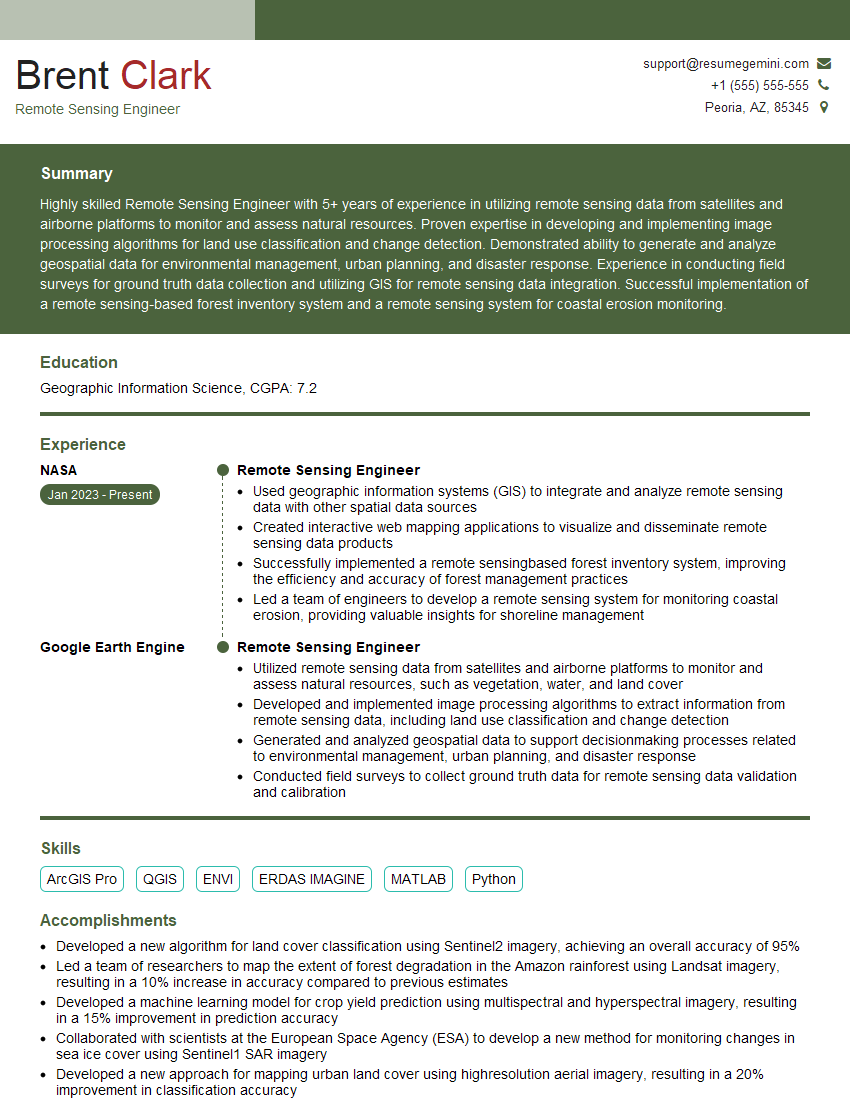
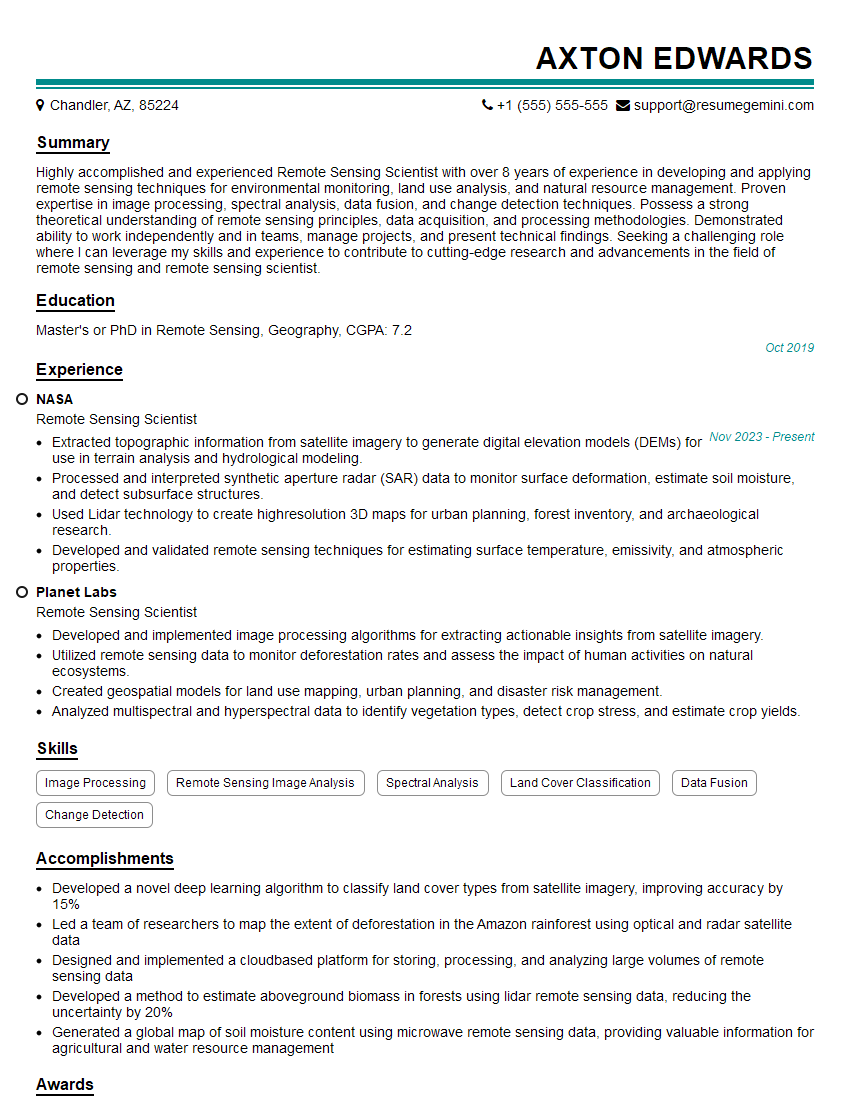
Mastering image segmentation for remote sensing significantly enhances your career prospects in the exciting fields of geospatial analysis, environmental monitoring, and precision agriculture. To stand out, a strong resume is crucial. Creating an ATS-friendly resume is essential for getting your application noticed by recruiters. We highly recommend using ResumeGemini to build a professional and impactful resume tailored to your skills and experience. ResumeGemini provides examples of resumes specifically designed for candidates in Image Segmentation for Remote Sensing to help you craft a compelling application.

Explore more articles
Users Rating of Our Blogs
Share Your Experience
We value your feedback! Please rate our content and share your thoughts (optional).
What Readers Say About Our Blog
To the interviewgemini.com Webmaster.
Very helpful and content specific questions to help prepare me for my interview!
Thank you
To the interviewgemini.com Webmaster.
This was kind of a unique content I found around the specialized skills. Very helpful questions and good detailed answers.
Very Helpful blog, thank you Interviewgemini team.