Feeling uncertain about what to expect in your upcoming interview? We’ve got you covered! This blog highlights the most important Electrical 3D Modeling interview questions and provides actionable advice to help you stand out as the ideal candidate. Let’s pave the way for your success.
Questions Asked in Electrical 3D Modeling Interview
Q 1. Explain your experience with different Electrical 3D modeling software (e.g., AutoCAD Electrical, Revit, EPLAN).
My experience with electrical 3D modeling software spans several leading platforms. I’ve extensively used AutoCAD Electrical for its powerful capabilities in creating detailed schematics and automatically generating panel layouts. Its integration with other Autodesk products streamlines the design process. Revit, on the other hand, excels in building information modeling (BIM), allowing for seamless coordination between different disciplines, including architectural, structural, and MEP (Mechanical, Electrical, Plumbing). I’ve leveraged Revit’s collaborative features on large-scale projects, effectively managing complex electrical systems within a larger building model. Finally, my experience with EPLAN focuses on its strengths in creating comprehensive electrical documentation and managing large component libraries. EPLAN’s structured approach ensures consistency and maintainability across projects, ideal for standardization needs.
For instance, on a recent data center project, AutoCAD Electrical was ideal for rapidly designing the intricate power distribution system, while Revit allowed me to precisely integrate these designs with the overall building model, ensuring no conflicts with other systems like HVAC or fire protection.
Q 2. Describe your process for creating a 3D model of an electrical system.
My process for creating a 3D model of an electrical system is iterative and involves several key steps. First, I begin with a thorough review of the project specifications, architectural drawings, and other relevant documentation to understand the scope and requirements. Then, I develop a detailed electrical schematic using the chosen software (often AutoCAD Electrical or EPLAN). This schematic serves as the foundation for the 3D model.
Next, I import the schematic into the 3D modeling software (Revit or similar). I then place and route the electrical equipment (panels, conduits, cables, etc.) in the 3D space, adhering to relevant codes and standards. I pay close attention to clearances, accessibility, and other critical design considerations. Throughout this process, I utilize the software’s features for clash detection and coordination, addressing any conflicts early in the design phase. The model is reviewed and updated in response to any changes or findings. Finally, I generate detailed drawings and reports from the completed model.
Imagine building with LEGOs. The schematic is like your instructions, and the 3D model is the actual structure. Every piece needs to be in the right place, and connections must be accurate to prevent problems.
Q 3. How do you handle clash detection and coordination in your 3D models?
Clash detection and coordination are critical aspects of my workflow. I employ both automated and manual methods. The software itself (Revit, for example) provides built-in clash detection tools that automatically identify conflicts between different elements within the 3D model – such as a conduit intersecting a structural beam. This often requires careful placement of elements and possibly iterative design changes. Manual checks involve visual inspections of the model to identify potential conflicts the software might miss.
For instance, I recently discovered a clash between a large cable tray and a HVAC ductwork run using Revit’s clash detection tool. This was quickly resolved by adjusting the routing of the cable tray, preventing potential delays and costly rework during construction.
Regular coordination meetings with other disciplines involved in the project, such as architects and structural engineers, are crucial. This collaborative approach helps identify and resolve clashes early in the process before they become major issues.
Q 4. What are your preferred methods for creating and managing electrical schematics?
My preferred methods for creating and managing electrical schematics involve a combination of best practices and software capabilities. I always begin with a well-organized and clearly labeled schematic. This is essential for understanding the design intent. The use of intelligent components within software like AutoCAD Electrical and EPLAN allows for automatic generation of wire lists, bills of materials, and other essential documentation. This automation greatly reduces the risk of errors and accelerates the design process. I adhere to industry standards for schematic design to ensure clarity and consistency.
For example, I use hierarchical schematic organization, breaking down complex systems into manageable smaller sections for better clarity. Each symbol is carefully selected to clearly represent the components, following standards like IEEE or IEC to ensure universal understanding and effective communication with other engineers.
Q 5. Explain your experience with creating and managing electrical symbols and libraries.
Creating and managing electrical symbols and libraries is crucial for consistency and efficiency. I use the built-in libraries provided by the software, customizing them as needed to reflect specific project requirements or vendor-specific components. For instance, using EPLAN’s library management capabilities allows for easy updates and reuse of symbols across multiple projects. I also maintain a robust system for organizing and naming symbols to ensure clear identification and prevent duplication.
In instances where specific symbols aren’t available in the standard libraries, I create them myself, maintaining consistency in style and information content. This meticulous approach ensures that the symbols remain easily identifiable and understandable throughout the project lifecycle. A well-maintained library saves time and improves project quality.
Q 6. How do you ensure accuracy and consistency in your 3D models?
Ensuring accuracy and consistency in 3D models requires a multi-faceted approach. First, meticulous attention to detail during the initial schematic design is paramount. Then, utilizing the software’s features for automatic checks and validations is crucial to identify errors early. Regular quality checks throughout the modeling process, including peer reviews and self-checks, are also essential. Finally, referencing the relevant electrical codes and standards ensures compliance and safety. Any deviations from standards must be documented and justified.
Think of it like building a skyscraper; every detail needs to be perfect. Ignoring standards or rushing through the process can have serious repercussions.
Q 7. Describe your experience with generating reports and documentation from your 3D models.
Generating reports and documentation from 3D models is a vital part of the project delivery process. The software I use provides various tools to generate reports, including wire lists, bills of materials (BOMs), panel schedules, and detailed drawings. These reports are essential for procurement, construction, and maintenance. I customize reports to align precisely with client requirements and project specifications. Additionally, I often export data to other formats (like spreadsheets or PDFs) for easier collaboration and integration with other project management tools.
For example, a comprehensive BOM generated from the Revit model provides a precise list of all electrical components required, reducing the risk of errors and delays in procurement. Similarly, detailed panel schedules ensure efficient panel construction and wiring.
Q 8. How do you collaborate with other disciplines (e.g., mechanical, architectural) during the design process?
Collaboration with other disciplines is paramount in successful building design. It’s not just about coordinating spaces; it’s about ensuring all systems work together seamlessly. I typically start with early, regular coordination meetings involving architects, mechanical engineers, and structural engineers. We use shared models (BIM models, ideally) to identify clashes and potential conflicts early in the design process. For example, if the mechanical ductwork conflicts with my planned conduit runs, we can address it during the design phase, rather than during costly construction. We use model-checking software to detect clashes automatically and use tools like markup software to directly annotate on the 3D model, identifying and resolving conflicts rapidly. This collaborative approach is crucial for avoiding rework and improving project efficiency.
- Regular Meetings: Weekly or bi-weekly meetings are essential to keep everyone on the same page.
- Shared Model Review: Using a central BIM model allows all disciplines to view and review each other’s work in real-time.
- Clash Detection Software: Software can automatically detect and report on potential clashes between different disciplines.
Q 9. What are your preferred methods for managing revisions and changes to your models?
Managing revisions is crucial for maintaining model integrity and clarity. I utilize a version control system within our BIM software, usually integrated with our project management platform. Every change is logged, allowing us to easily track revisions and revert if necessary. A clear naming convention is used for each revision (e.g., ‘Model_RevA’, ‘Model_RevB’), along with detailed revision logs explaining each modification. This ensures transparency and accountability. For more significant changes, we often create separate model versions to avoid conflicts and allow parallel design explorations. This system makes auditing the design process incredibly simple and allows us to easily return to previous iterations.
Think of it like writing a document. You wouldn’t just overwrite the original each time. You create numbered versions (1.0, 1.1, 2.0, etc.) keeping track of all changes made. We treat our 3D models with the same care and diligence.
Q 10. How do you troubleshoot and resolve issues encountered during the modeling process?
Troubleshooting in 3D electrical modeling often involves identifying and resolving clashes, ensuring code compliance, and resolving connectivity issues. The first step is always careful review of error logs and visual inspection of the model, pinpointing the exact location of the problem. For example, if the model indicates a short circuit, I investigate the wiring diagram and the 3D model to identify incorrectly placed conductors or faulty connections. Sometimes, the issue isn’t immediately apparent in the 3D model. In those cases, I use simulation tools to check for voltage drops, current flow, and potential faults. If the issue persists, consulting relevant design documents, specifications, and manufacturers’ data sheets is essential. I always document the troubleshooting process, including the problem, the steps taken, and the solution, to improve future efficiency and assist other team members.
Q 11. Explain your experience with different types of electrical systems (e.g., power distribution, lighting, control systems).
My experience encompasses a wide range of electrical systems. I’ve worked extensively on power distribution systems, designing and modeling everything from low-voltage circuits to high-voltage feeders. This involves meticulous modeling of switchgear, transformers, conduits, and cable trays, ensuring proper sizing and protection. I am also proficient in lighting system design, encompassing both interior and exterior applications. This includes designing lighting layouts, selecting appropriate luminaires, and calculating illumination levels. Additionally, I have substantial experience in control system design. This often involves integrating various systems, such as HVAC, security, and fire protection, and modeling the associated control panels and wiring networks. This multifaceted experience ensures that I can integrate various systems effectively. For instance, I once designed an intricate control system for a smart building that included automated lighting, HVAC adjustments based on occupancy, and integrated security features, all modeled within the same 3D environment.
Q 12. How do you incorporate building codes and standards into your designs?
Incorporating building codes and standards is crucial for safe and compliant designs. I start by identifying the relevant codes and standards applicable to the project, which often varies by location. These could include NEC (National Electrical Code), IEC standards, or local building regulations. I use the codes as a checklist during the design process, ensuring that every aspect of the design complies. This includes things like conduit fill calculations, proper grounding, and appropriate safety clearances. Many BIM software packages have integrated code checking tools which will automatically check the design against a defined code standard to flag potential issues. I also make use of libraries of pre-approved components within the software to ensure compliance. For complex aspects, consultations with code experts might be necessary. This systematic approach ensures that my designs are not only functional but also safe and legal.
Q 13. Describe your experience with using BIM software for electrical design.
I have extensive experience using BIM (Building Information Modeling) software for electrical design, primarily using Revit. I leverage its capabilities for creating detailed 3D models of electrical systems, including conduit runs, cable trays, lighting fixtures, and panels. Beyond just modeling, I utilize Revit’s features for scheduling, quantity take-offs, and clash detection. For instance, I regularly use Revit’s clash detection to identify conflicts between my electrical design and other disciplines’ models. This early identification significantly reduces construction delays and costs. I find Revit’s ability to link to other BIM software incredibly useful for collaborative work. Furthermore, the ability to generate detailed documentation, including drawings and schedules, directly from the model is a significant time saver, making the entire process more efficient.
Q 14. Explain your experience with the use of parametric modeling techniques.
Parametric modeling is a game-changer in electrical design. It allows for creating flexible and adaptable designs where changes to one parameter automatically update other related elements. For example, if I change the diameter of a conduit in the model, all the connected components and cable schedules automatically update, avoiding inconsistencies. This is particularly useful for repetitive elements like lighting layouts or power distribution runs in large buildings. It also allows for easy ‘what-if’ scenario analysis. We can quickly explore different design options by adjusting key parameters and evaluating the impact on other aspects of the design, like cost and space. I utilize families (predefined components) and constraints within the software to establish parametric relationships. This not only saves time but also enhances the accuracy and consistency of the design. Imagine designing a modular office layout; using parametric modeling, changing the number of workstations automatically adjusts the power and lighting requirements, reducing potential errors.
Q 15. How do you handle complex electrical systems and large-scale projects?
Handling complex electrical systems and large-scale projects requires a structured approach. I employ a phased methodology, breaking down the project into manageable modules. This involves a thorough initial assessment to identify critical components, potential challenges, and interdependencies. For instance, in a large manufacturing plant project, I’d start by segmenting the electrical system into areas like power distribution, motor control centers, lighting, and instrumentation. Each area would then be modeled separately, allowing for efficient collaboration among team members. Regular review meetings and rigorous quality checks ensure that all parts integrate seamlessly. Employing parametric modeling techniques further enhances efficiency by allowing for easy modification and adaptation to design changes. For instance, if a client requests a change to the number of outlets in a specific area, a parameter change will automatically update the entire model, minimizing rework.
Furthermore, I leverage BIM (Building Information Modeling) software and collaborative platforms to facilitate efficient information sharing and coordination with other disciplines, such as HVAC and structural engineering. This integrated approach minimizes clashes and errors, accelerating project completion and reducing costs.
Career Expert Tips:
- Ace those interviews! Prepare effectively by reviewing the Top 50 Most Common Interview Questions on ResumeGemini.
- Navigate your job search with confidence! Explore a wide range of Career Tips on ResumeGemini. Learn about common challenges and recommendations to overcome them.
- Craft the perfect resume! Master the Art of Resume Writing with ResumeGemini’s guide. Showcase your unique qualifications and achievements effectively.
- Don’t miss out on holiday savings! Build your dream resume with ResumeGemini’s ATS optimized templates.
Q 16. Describe your workflow for creating detailed electrical drawings and specifications.
My workflow for creating detailed electrical drawings and specifications is highly systematic. It starts with gathering all relevant design documents and specifications from the client. This includes architectural plans, equipment specifications, and any other relevant data. Then, I use this information to create a 3D model using specialized software like AutoCAD Electrical, Revit, or EPLAN. This 3D model allows for a comprehensive visualization of the electrical system, identifying potential clashes and optimizing the layout.
Next, I develop detailed schematics, wiring diagrams, and panel schedules. These are crucial for construction and maintenance purposes. I meticulously annotate the drawings to ensure clarity and compliance with relevant standards (e.g., NEC, IEC). I also create comprehensive specifications outlining materials, equipment, and installation requirements. Throughout the process, I rigorously check for accuracy and compliance. A key element is regular review of the drawings and specifications with the project team, including architects, engineers, and contractors, to ensure everyone is on the same page. The final deliverables include a complete set of drawings and specifications suitable for construction and future maintenance.
Q 17. What is your experience with simulation and analysis of electrical systems?
I have extensive experience with simulation and analysis of electrical systems using software like ETAP, SKM PowerTools, or similar tools. These simulations help predict system performance under various operating conditions and identify potential issues before construction begins. For example, I recently used ETAP to simulate the short-circuit currents in a large commercial building. The simulation helped to size the protective devices correctly, ensuring the safety of the building and its occupants. This prevented potential damage from overcurrents and ensured compliance with safety regulations.
Another critical aspect is the use of these tools for load flow analysis, determining voltage drops along different circuits and verifying the proper sizing of cables and transformers. Harmonic analysis helps in identifying and mitigating harmonic distortion, which is crucial for preventing equipment damage in sensitive systems like data centers or hospitals. The simulation results are meticulously documented and presented to the client, highlighting any potential issues and proposed solutions.
Q 18. How do you manage data and information related to your electrical models?
Data management is a crucial aspect of large-scale electrical projects. I employ a combination of strategies for efficient data organization and retrieval. Firstly, a structured folder system is established for all project-related files. This ensures easy access to any specific document or drawing. We use cloud-based storage solutions like Dropbox or Google Drive for efficient file sharing and collaboration. This promotes accessibility for the entire project team.
Secondly, a central database (often integrated with the 3D modeling software) is used to store information about components, their specifications, and their locations in the model. This ensures consistency and reduces errors. Finally, a meticulous revision control system (described in the next answer) prevents data loss and confusion associated with multiple versions. Regular backups of the entire project data are also performed to ensure data security and prevent loss due to unforeseen circumstances.
Q 19. Describe your experience with using version control systems for your 3D models.
I’m proficient in using version control systems like Git for managing revisions of my 3D models and associated documentation. This practice is essential for collaborative projects, allowing multiple team members to work concurrently without overwriting each other’s work. Each revision is stored with a clear description of the changes made. This detailed history enables easy rollback to previous versions if needed. For instance, if an error is introduced in a later revision, we can easily revert to an earlier, stable version.
In practice, we typically use a branching strategy, allowing parallel development of different features or design alternatives. This reduces conflicts and facilitates efficient merging of different versions. The use of a version control system not only facilitates collaboration but also enhances the overall quality and reliability of the electrical design.
Q 20. What is your understanding of different electrical standards (e.g., NEC, IEC)?
I possess a thorough understanding of various electrical standards, including the National Electrical Code (NEC) in the US and the International Electrotechnical Commission (IEC) standards. The NEC provides specific regulations for electrical installations in the US, covering aspects such as wiring methods, grounding, overcurrent protection, and safety requirements. IEC standards offer a broader international perspective, providing guidelines for various electrical aspects across different countries. The understanding of these standards is paramount in ensuring the safety and compliance of the designs.
My experience includes adapting designs to meet specific regional regulations and understanding the nuances between different standards. For instance, the requirements for grounding systems differ significantly between NEC and IEC, and I am well-versed in navigating these differences. This ensures that the designs are not only functional but also comply with all relevant regulatory requirements.
Q 21. Explain your experience with creating electrical layouts for various building types.
I have extensive experience creating electrical layouts for a wide range of building types, including residential, commercial, industrial, and healthcare facilities. Each building type presents unique challenges and requirements. Residential projects focus on efficient layouts, code compliance, and minimizing costs. Commercial projects require more complex systems, often including sophisticated lighting control systems, power distribution for numerous tenants, and safety systems. Industrial facilities require specialized designs to handle high-power equipment and hazardous areas. Healthcare facilities have stringent safety and reliability requirements, often incorporating redundant systems.
In each case, I tailor my design approach to meet the specific needs of the building. For example, in a hospital, I’d prioritize redundancy in critical systems, ensuring uninterrupted power supply to essential equipment. In an industrial plant, I’d focus on minimizing downtime due to electrical faults, utilizing robust protection and monitoring systems. This adaptability ensures that the electrical systems I design are not only functional but also safe, reliable, and cost-effective.
Q 22. How do you optimize electrical designs for efficiency and cost-effectiveness?
Optimizing electrical designs for efficiency and cost-effectiveness is a crucial aspect of my work. It involves a multi-pronged approach focusing on minimizing material usage, reducing energy consumption, and streamlining installation. This begins with the initial design phase, where I leverage parametric modeling techniques to explore various design options and quickly evaluate their impact on cost and performance.
- Material Selection: I carefully choose components based on their efficiency ratings and lifecycle cost. For example, selecting energy-efficient lighting fixtures and low-loss transformers can significantly reduce operational expenses over the building’s lifespan.
- Load Balancing: Efficient load distribution across the electrical system is key. I utilize 3D modeling software to analyze current flow and identify potential overloading, allowing for proactive adjustments to circuit breaker sizes and conductor sizing, preventing unnecessary upgrades later.
- Short Circuit Analysis: Performing thorough short circuit calculations and ensuring appropriate protective devices are in place are essential for safety and compliance. This helps to avoid over-engineering, leading to cost savings.
- Cable Routing Optimization: Strategic cable routing within the 3D model minimizes cable lengths and material waste, streamlining installation and reducing labor costs. I utilize the built-in cable management tools of my software to achieve optimal routing.
For instance, on a recent hospital project, by strategically placing electrical rooms and employing optimized cable routing, we managed to reduce material costs by 15% and installation time by 10%, demonstrating the impact of a well-planned approach.
Q 23. Describe your experience with integrating electrical models with other building systems.
Integrating electrical models with other building systems is a core competency of mine. This usually involves using a coordinated model, often in a BIM (Building Information Modeling) environment. I have extensive experience working with various disciplines, including architectural, structural, HVAC, and plumbing systems.
- Coordination and Clash Detection: I use the model to identify potential clashes between electrical systems and other building components. For example, I’ll ensure that electrical conduits don’t interfere with ductwork or structural elements. This early detection prevents costly rework during construction.
- Data Exchange: I utilize various file formats (like IFC, Revit, and Navisworks) to seamlessly exchange data between different disciplines. This facilitates collaborative design reviews and ensures consistency across the project.
- System Integration: I’ve integrated electrical models with fire alarm systems, security systems, and lighting control systems, ensuring their proper coordination and functionality within the overall building design.
In one project, integrating the electrical model with the HVAC system allowed us to optimize the placement of lighting and power outlets in relation to air conditioning vents, preventing unnecessary energy loss and improving occupant comfort. This kind of collaboration enhances both the efficiency and functionality of the building.
Q 24. How do you ensure your 3D models meet the client’s requirements?
Meeting client requirements is paramount. My approach involves a close collaboration with the client throughout the entire design process. This starts with a thorough understanding of the project brief, including functional requirements, budget constraints, and any specific code compliance needs.
- Regular Communication: I maintain open and regular communication with the client, providing updates, addressing concerns, and seeking feedback at key milestones. This ensures that the design evolves in alignment with their expectations.
- Design Reviews and Presentations: I conduct regular design reviews with the client, using the 3D model as a visual aid to demonstrate the design’s functionality and aesthetics. This allows for early identification and resolution of any discrepancies.
- Documentation: I provide detailed documentation, including drawings, specifications, and reports, to ensure that the final design meets the client’s requirements and complies with all applicable codes and standards. I always maintain a clear audit trail of all changes and revisions.
For example, on a recent commercial building project, the client had a specific requirement for a particular type of lighting fixture. We incorporated this into the 3D model early in the design phase, minimizing the risk of conflicts and ensuring the final design met their exact specifications.
Q 25. Explain your experience with different types of electrical components and their characteristics.
My experience encompasses a wide range of electrical components, including transformers, circuit breakers, switchgear, lighting fixtures, motors, and various types of conductors. Understanding the characteristics of each component is crucial for designing a safe and efficient system.
- Transformers: I’m proficient in selecting transformers based on their voltage ratings, power capacity, efficiency ratings, and impedance characteristics. I consider factors like cooling requirements and noise levels during selection.
- Circuit Breakers: I have experience with various types of circuit breakers, including molded case, air circuit breakers, and miniature circuit breakers. I select them based on their interrupting capacity, trip characteristics, and compliance with relevant standards.
- Switchgear: I understand the design and application of low-voltage and medium-voltage switchgear, including their protective features and operational requirements.
- Lighting Fixtures: I’m familiar with different types of lighting technologies, including LED, fluorescent, and high-intensity discharge lamps, and select fixtures based on their efficiency, light output, and suitability for the application.
The knowledge of component characteristics allows me to make informed decisions during the design process and optimize the system performance, safety, and longevity. For example, knowing the thermal characteristics of a motor enables me to select appropriate conduit and wire sizing to prevent overheating.
Q 26. What is your approach to dealing with design changes during the project lifecycle?
Design changes are inevitable in any project. My approach is to manage them proactively and efficiently, minimizing their impact on the schedule and budget. This involves a structured process:
- Change Request Management: All design changes are documented through formal change requests, which are reviewed and approved by the relevant stakeholders. This ensures that the impact of changes is thoroughly assessed.
- Model Updates: I utilize the 3D modeling software’s version control features to track all revisions and ensure consistency across the project. Changes are incorporated into the model systematically and thoroughly.
- Impact Analysis: Before implementing any change, I perform an impact analysis to assess its potential effects on other systems and components. This prevents unforeseen issues and helps to maintain the integrity of the overall design.
- Communication: I keep the client and other project stakeholders informed about the progress of change requests and any potential implications.
I once encountered a significant change request on a large-scale industrial facility project. By following this structured approach, we effectively managed the change, minimizing its impact on the overall project schedule and budget, preventing costly delays.
Q 27. Describe your proficiency in using cable management tools within your 3D modeling software.
Proficiency in cable management tools is crucial for creating clean, efficient, and constructible electrical designs. I’m adept at using the cable tray, conduit, and cable routing features within my 3D modeling software (typically Autodesk Revit, or similar).
- Automated Routing: I utilize the automated routing features to quickly and efficiently route cables through the building model, ensuring minimal conflicts with other systems. This saves considerable time and effort compared to manual routing.
- Tray and Conduit Sizing: I accurately size cable trays and conduits based on the number of cables, their sizes, and relevant codes and standards. This ensures proper capacity and prevents overloading.
- Support Structure Design: I’m experienced in designing and placing the necessary support structures for cable trays and conduits, including hangers, brackets, and other support elements.
- Cable Labeling: I utilize the software’s labeling capabilities to generate clear and consistent cable labels, facilitating installation and maintenance.
For example, in a recent data center project, leveraging the automated cable tray routing capabilities of the software significantly reduced the time required for cable management design, allowing for a more detailed and thorough design within the same timeframe.
Q 28. How do you create and manage bill of materials (BOMs) from your 3D models?
Creating and managing BOMs (Bills of Materials) directly from the 3D model is a streamlined process. I leverage the built-in capabilities of my software to automatically generate accurate and detailed BOMs.
- Automated BOM Generation: My software automatically extracts component information from the 3D model, including quantities, sizes, and descriptions. This significantly reduces manual effort and minimizes errors.
- Customization: I can customize the BOM to include additional information, such as part numbers, manufacturer details, and cost data. This provides comprehensive information for procurement.
- Integration with Other Systems: The BOMs can be exported in various formats (like Excel or CSV) for easy integration with procurement and cost estimation software.
- Regular Updates: I regularly update the BOM to reflect any design changes or revisions, ensuring that it remains accurate throughout the project lifecycle.
This integrated approach ensures accuracy and consistency. For instance, on a recent project, a change to a lighting fixture was immediately reflected in the automatically generated BOM, preventing potential procurement issues and ensuring seamless ordering of materials.
Key Topics to Learn for Electrical 3D Modeling Interview
- Software Proficiency: Mastering industry-standard software like AutoCAD Electrical, Revit, or EPLAN. Understand the nuances of each platform’s capabilities and limitations.
- Component Modeling: Demonstrate a thorough understanding of accurately modeling electrical components, including their physical dimensions, properties, and connections. Practice creating detailed models of various electrical equipment.
- Wiring and Cable Routing: Showcase your expertise in efficiently and accurately routing wires and cables within the 3D model, adhering to industry best practices and code compliance.
- Schematic Integration: Explain how to seamlessly integrate 3D models with electrical schematics, ensuring consistency and accuracy between the two representations.
- Clash Detection and Resolution: Highlight your ability to identify and resolve potential clashes between electrical components and other building systems within the 3D model.
- Collaboration and Data Management: Discuss best practices for collaborating on large 3D models using cloud-based platforms and version control systems. Understand data management strategies for efficient workflow.
- Material and Properties Assignment: Explain how to accurately assign materials and electrical properties to components for accurate simulations and analysis.
- Creating and Interpreting Reports: Understand how to generate reports from the 3D model, including bills of materials (BOMs), wire schedules, and other relevant documentation. Practice interpreting these reports.
- Industry Standards and Codes: Demonstrate familiarity with relevant industry standards and building codes related to electrical design and modeling.
- Problem-Solving and Troubleshooting: Be prepared to discuss how you approach troubleshooting issues in 3D models, such as inconsistencies, errors, or unexpected results.
Next Steps
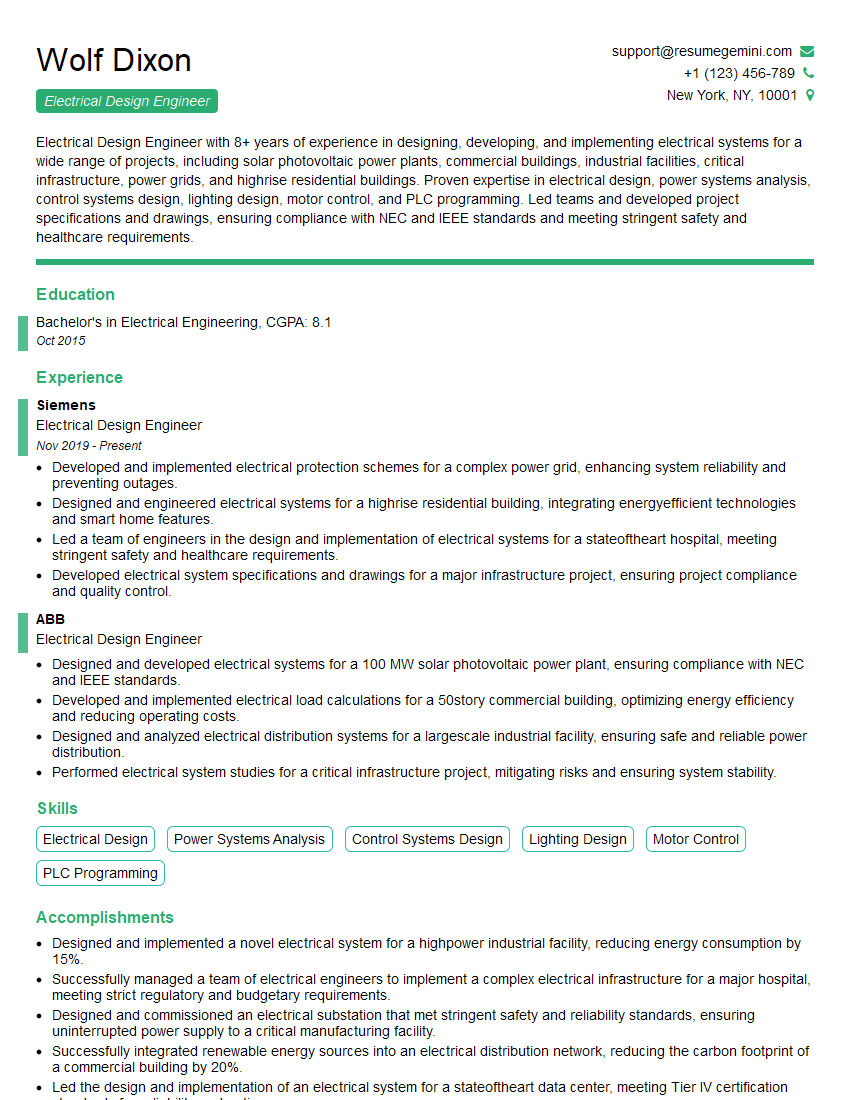
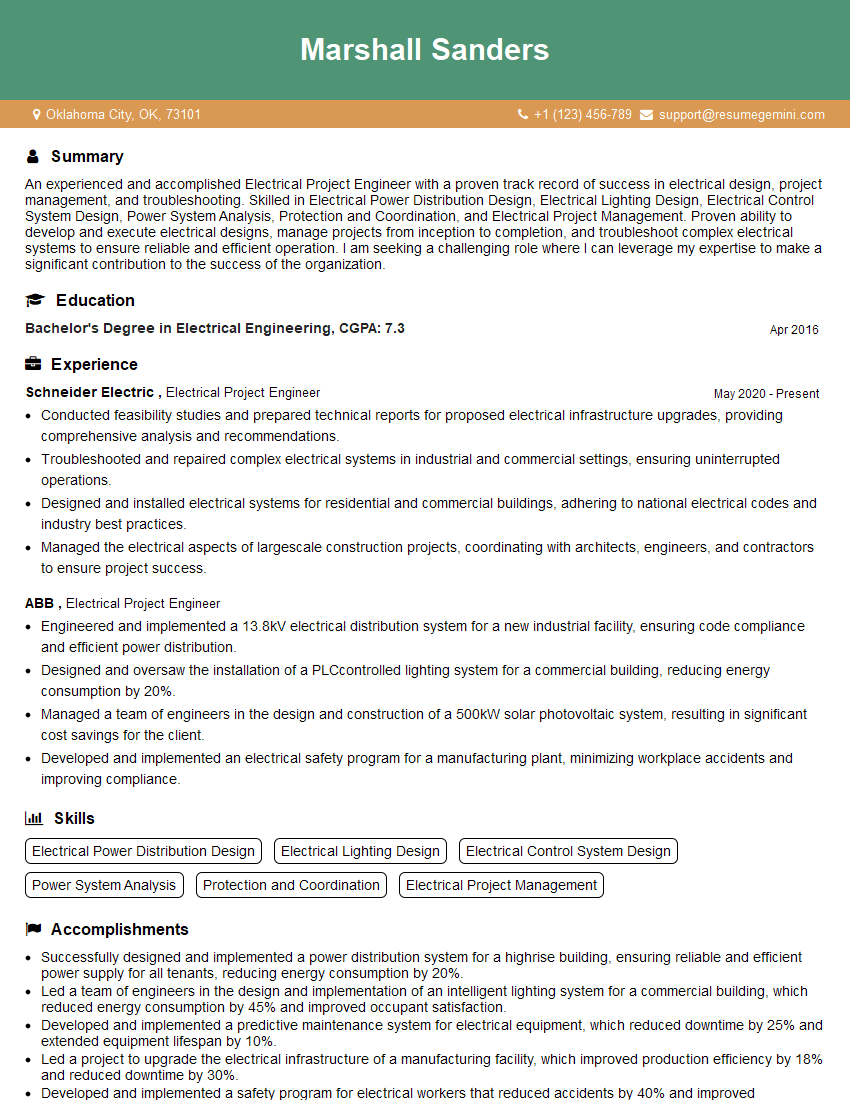
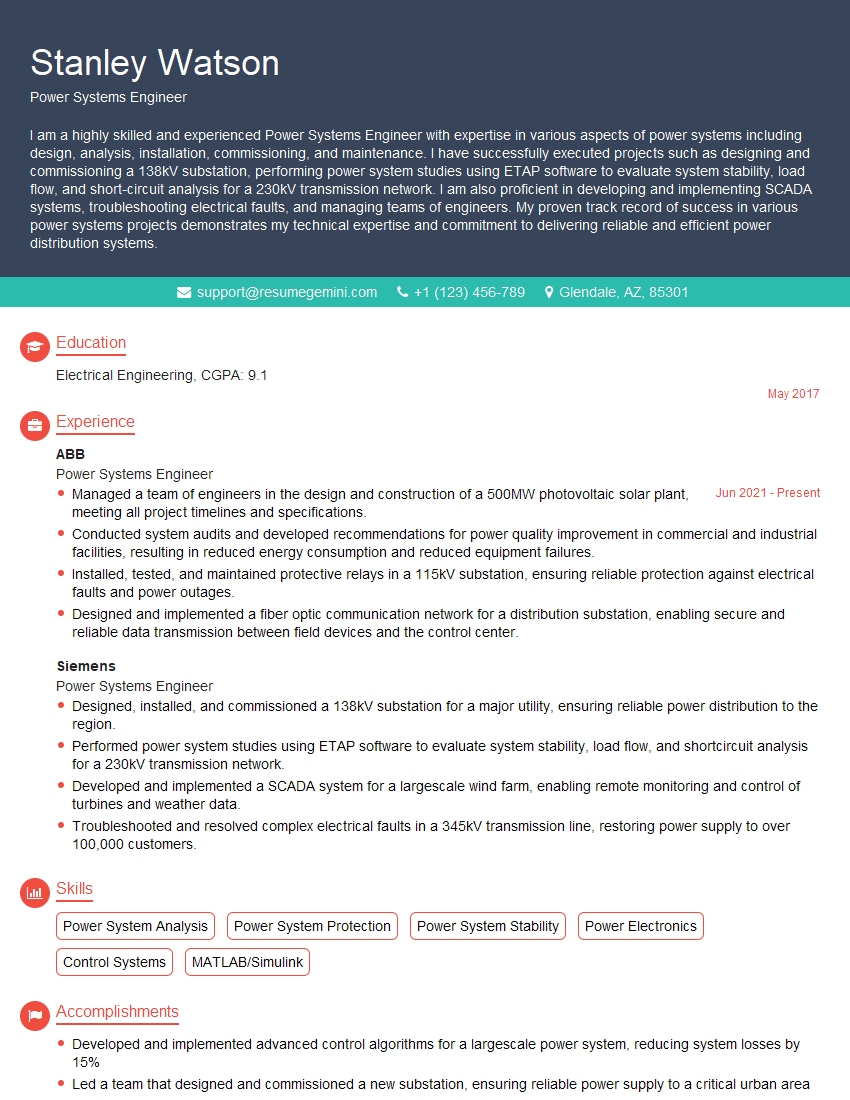
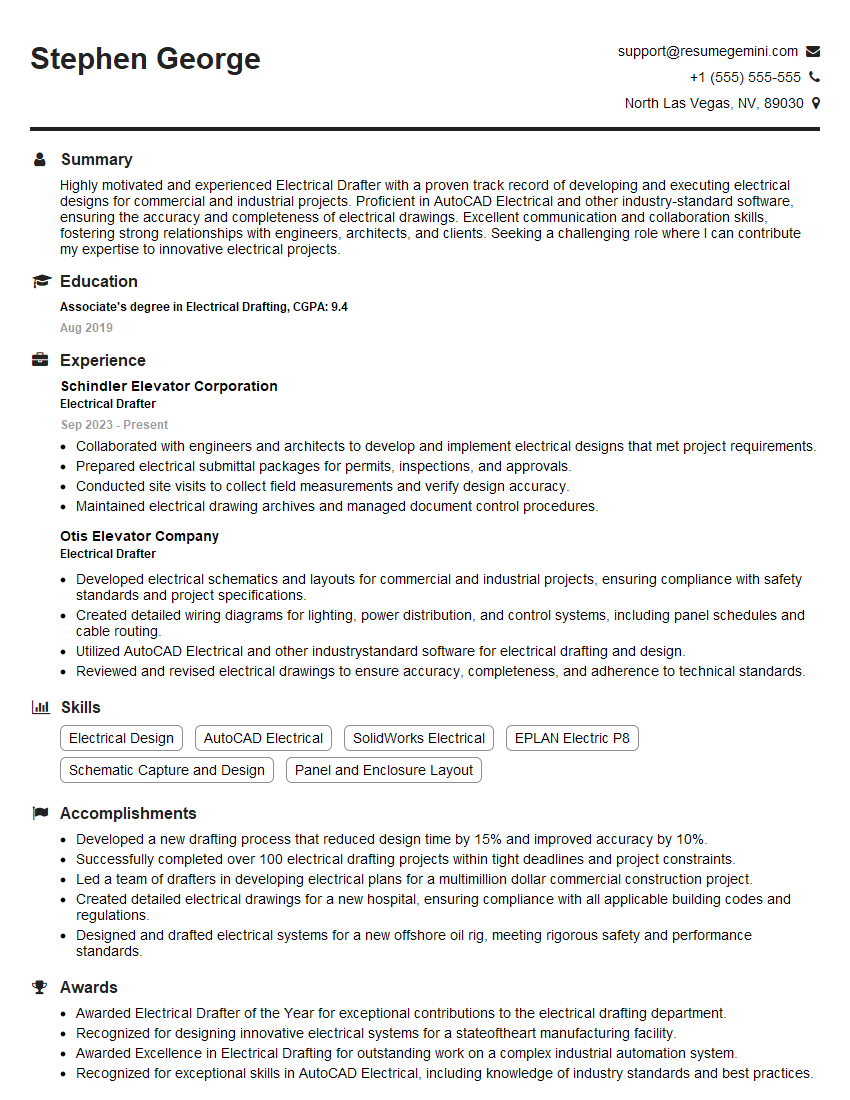
Mastering Electrical 3D Modeling is crucial for career advancement in today’s competitive job market. It opens doors to exciting projects and positions with higher earning potential. To significantly improve your chances of landing your dream job, focus on creating an ATS-friendly resume that showcases your skills and experience effectively. We strongly recommend using ResumeGemini, a trusted resource, to build a compelling and professional resume that highlights your expertise in Electrical 3D Modeling. Examples of resumes tailored specifically to this field are available to help guide you.
Explore more articles
Users Rating of Our Blogs
Share Your Experience
We value your feedback! Please rate our content and share your thoughts (optional).
What Readers Say About Our Blog
To the interviewgemini.com Webmaster.
Very helpful and content specific questions to help prepare me for my interview!
Thank you
To the interviewgemini.com Webmaster.
This was kind of a unique content I found around the specialized skills. Very helpful questions and good detailed answers.
Very Helpful blog, thank you Interviewgemini team.