Unlock your full potential by mastering the most common Atmospheric Radiative Transfer interview questions. This blog offers a deep dive into the critical topics, ensuring you’re not only prepared to answer but to excel. With these insights, you’ll approach your interview with clarity and confidence.
Questions Asked in Atmospheric Radiative Transfer Interview
Q 1. Explain the concept of radiative equilibrium.
Radiative equilibrium describes a state where the net radiative flux at any point within a system is zero. Imagine the Earth: it receives energy from the sun (shortwave radiation) and emits energy back into space (longwave radiation). In radiative equilibrium, the incoming solar energy exactly balances the outgoing terrestrial radiation. This doesn’t mean the temperature is constant everywhere; there are variations due to latitude, altitude, and other factors. However, the system as a whole is in balance, with no net energy gain or loss over time. A simple analogy would be a perfectly insulated cup of coffee – the coffee eventually reaches a stable temperature where heat loss from the coffee is balanced by the heat generated by the coffee itself.
In reality, Earth isn’t perfectly in radiative equilibrium due to factors like changes in atmospheric composition, variations in solar irradiance, and internal processes within the Earth. But the concept of radiative equilibrium provides a fundamental framework for understanding the Earth’s energy budget and climate system.
Q 2. Describe the different types of radiative transfer models.
Radiative transfer models simulate the interaction of radiation with the atmosphere. They range in complexity from simple parameterizations to highly sophisticated numerical models. Here are some key types:
- Plane-parallel models: These assume a horizontally homogeneous atmosphere, simplifying calculations significantly. They are suitable for many applications, particularly when studying the vertical structure of the atmosphere.
- Line-by-line (LBL) models: These models treat the absorption and emission of radiation by atmospheric gases with very high spectral resolution, accurately accounting for the detailed structure of molecular absorption lines. They are computationally intensive but provide the most accurate results.
- Band models: These models group the spectral lines into broader bands, reducing the computational cost compared to LBL models. Different band models use various approximations to represent the absorption within each band.
- Delta-Eddington models: These models approximate scattering effects efficiently, making them suitable for fast calculations in many applications.
- Monte Carlo models: These models simulate the propagation of individual photons through the atmosphere, randomly sampling the absorption, scattering, and emission processes. They can handle complex geometries and scattering accurately but are computationally demanding.
The choice of model depends on the specific application and the required accuracy and computational resources. For simple scenarios, a plane-parallel model might suffice. For highly accurate climate simulations, LBL or Monte Carlo models are often preferred.
Q 3. What are the key differences between shortwave and longwave radiation?
Shortwave (SW) and longwave (LW) radiation differ primarily in their wavelength and source. Shortwave radiation encompasses the ultraviolet (UV), visible, and near-infrared (NIR) parts of the electromagnetic spectrum, primarily emitted by the sun. Longwave radiation, on the other hand, is emitted by the Earth and its atmosphere in the thermal infrared (IR) region.
- Wavelength: SW radiation has shorter wavelengths (0.2 – 4 μm) than LW radiation (4 – 100 μm).
- Source: SW radiation originates from the sun, while LW radiation originates from the Earth and its atmosphere.
- Interaction with atmosphere: SW radiation is mostly absorbed and scattered by atmospheric gases, aerosols, and clouds. LW radiation is primarily absorbed and emitted by greenhouse gases.
- Impact on surface temperature: SW radiation primarily heats the Earth’s surface. LW radiation is responsible for maintaining the surface temperature at a higher level than it would be otherwise.
Think of it like this: the sun is a powerful, hot lightbulb producing shortwave radiation, while the Earth is a warmer object giving off longwave radiation like a heat lamp.
Q 4. Explain the role of atmospheric gases in radiative transfer.
Atmospheric gases play a crucial role in radiative transfer by absorbing and emitting radiation at specific wavelengths. Some gases, like nitrogen (N2) and oxygen (O2), are relatively transparent to most wavelengths. However, others, known as greenhouse gases, strongly absorb and emit longwave radiation. These include water vapor (H2O), carbon dioxide (CO2), methane (CH4), nitrous oxide (N2O), and ozone (O3).
The absorption and emission by greenhouse gases are selective; meaning these gases only interact strongly with particular wavelengths of the longwave spectrum. This selective absorption is what leads to the greenhouse effect. The absorption of LW radiation by greenhouse gases warms the atmosphere. They then re-emit LW radiation in all directions, including towards the surface, contributing to the Earth’s surface temperature. Changes in the concentration of greenhouse gases directly impact the amount of longwave radiation trapped in the atmosphere, altering the Earth’s energy balance and temperature.
Q 5. How does the scattering of radiation affect atmospheric temperature?
Scattering redirects radiation in different directions without changing its wavelength. Atmospheric constituents such as air molecules (Rayleigh scattering) and aerosols (Mie scattering) scatter incoming solar radiation. The effect on atmospheric temperature depends on the type and altitude of the scattering.
Rayleigh scattering, dominant in the upper atmosphere, scatters shortwave radiation more effectively at shorter wavelengths (blue light). This is why the sky appears blue. This scattering redirects some incoming solar radiation away from the surface, reducing the amount of solar energy that reaches the surface and causing a slight cooling effect. However, it also increases the amount of radiation scattered back into space, influencing the overall Earth’s energy budget.
Aerosols, on the other hand, scatter radiation across a wider range of wavelengths. Their effect on temperature can be more complex and depends on the aerosol’s properties (size, composition) and altitude. Some aerosols cause a cooling effect by scattering solar radiation back to space, while others can cause warming by absorbing solar radiation or altering cloud properties.
Q 6. Describe the greenhouse effect and its impact on Earth’s climate.
The greenhouse effect is the warming of the Earth’s surface and lower atmosphere due to the absorption and re-emission of longwave radiation by greenhouse gases. Imagine the Earth as a car parked in the sun with its windows closed. The sun’s shortwave radiation passes through the windows, warming the interior. However, the heat emitted by the car’s interior (longwave radiation) is trapped inside, leading to a temperature increase. Similarly, greenhouse gases in the atmosphere trap longwave radiation emitted by the Earth’s surface, preventing it from escaping directly into space.
The impact on Earth’s climate is significant. The greenhouse effect is crucial for maintaining a habitable temperature on Earth; without it, the average surface temperature would be drastically lower. However, increased concentrations of greenhouse gases due to human activities enhance the greenhouse effect, leading to global warming and climate change. This results in rising global temperatures, changes in precipitation patterns, more frequent and intense extreme weather events, sea-level rise, and other significant impacts on ecosystems and human societies.
Q 7. What are the key parameters involved in radiative transfer calculations?
Several key parameters are involved in radiative transfer calculations. These parameters describe the properties of the atmosphere, the radiation field, and the interaction between them:
- Wavelength (λ): The wavelength of the radiation, which determines how it interacts with atmospheric constituents.
- Absorption coefficient (kλ): A measure of how strongly a gas absorbs radiation at a particular wavelength.
- Scattering coefficient (σλ): A measure of how much radiation is scattered by particles (e.g., aerosols, clouds) at a particular wavelength. This often needs to be described by a phase function, which represents the angular distribution of scattered radiation.
- Extinction coefficient (αλ): The sum of absorption and scattering coefficients (αλ = kλ + σλ).
- Gas concentrations: The abundances of various atmospheric gases (e.g., water vapor, CO2).
- Aerosol properties: Size distribution, composition, and concentration of aerosols.
- Surface albedo: The fraction of incident solar radiation reflected by the Earth’s surface.
- Solar zenith angle: The angle of the sun relative to the vertical.
- Temperature profile: The vertical profile of atmospheric temperature, which affects the emission of longwave radiation.
Accurate radiative transfer calculations require detailed knowledge of these parameters, often obtained from observations or other models. The complexity of the calculations can vary significantly depending on the required accuracy and the complexity of the atmospheric conditions being modeled.
Q 8. How do you account for cloud effects in radiative transfer models?
Clouds significantly impact atmospheric radiative transfer, acting as both reflectors and absorbers of solar radiation and emitters of thermal infrared radiation. Accounting for their effects requires sophisticated techniques within radiative transfer models. We generally represent clouds using various parameterizations, which describe their properties (e.g., optical depth, cloud fraction, effective radius of cloud droplets) based on observational data or meteorological forecasts.
One common approach is to use a two-stream approximation, which simplifies the radiative transfer equations by considering only upward and downward fluxes of radiation within a cloud layer. More advanced methods use Monte Carlo simulations which track individual photons as they interact with cloud particles, offering a high level of accuracy but demanding significant computational resources. Another important aspect is the representation of cloud vertical structure and heterogeneity. Clouds are not uniform; they possess internal variability in their properties. Advanced models account for this by incorporating sub-grid scale cloud variability, often using statistical approaches.
For example, in climate models, accurately simulating cloud feedback (the impact of clouds on climate change) requires advanced cloud parameterizations that effectively capture the interactions between clouds and radiation, as well as their influence on precipitation and other meteorological processes. Misrepresenting cloud effects can lead to significant errors in climate projections.
Q 9. Explain the concept of atmospheric absorption and emission.
Atmospheric absorption and emission are fundamental processes in radiative transfer. Absorption refers to the process where atmospheric gases (like water vapor, carbon dioxide, ozone) absorb incoming solar radiation or outgoing terrestrial radiation. The absorbed energy is then converted into other forms of energy (heat), increasing the temperature of the absorbing gas. The strength of absorption depends on the type and concentration of the gas and the wavelength of the radiation.
Emission, on the other hand, is the process by which atmospheric gases release radiation. All matter emits radiation at wavelengths determined by its temperature; this is described by Planck’s Law. Atmospheric gases emit thermal infrared radiation, which contributes to the Earth’s greenhouse effect. The intensity of emission depends on the temperature and emissivity of the gas. The balance between absorption and emission determines the net radiative heating or cooling of the atmosphere at a particular altitude and wavelength.
A simple analogy is a campfire: the burning wood emits radiation (mostly infrared), and if you place your hand close to the fire, you’ll feel the heat due to the absorption of this radiation. The same basic principle governs the interaction of radiation with gases in the atmosphere, just on a much larger scale.
Q 10. What are the different types of scattering processes in the atmosphere?
Atmospheric scattering involves the redirection of radiation by atmospheric particles such as air molecules, aerosols, and cloud droplets. There are two main types:
- Rayleigh scattering: This occurs when the scattering particles are much smaller than the wavelength of the radiation (e.g., air molecules scattering visible light). Rayleigh scattering is inversely proportional to the fourth power of the wavelength; hence, shorter wavelengths (blue and violet) are scattered more strongly than longer wavelengths (red), leading to the blue color of the sky.
- Mie scattering: This occurs when the scattering particles are comparable in size to or larger than the wavelength of radiation (e.g., aerosols, cloud droplets). Mie scattering is less dependent on wavelength than Rayleigh scattering, and it contributes significantly to the diffuse radiation field in the atmosphere.
Other scattering processes include non-spherical particle scattering, where the shape of the particle affects the scattering pattern, and diffraction, which becomes important when particles are large. These processes are crucial for determining the visibility, brightness, and color of the sky and for modeling the transfer of radiation through clouds and aerosols.
Q 11. Describe the Beer-Lambert law and its application in radiative transfer.
The Beer-Lambert law describes the attenuation of radiation as it passes through a medium. It states that the intensity of radiation decreases exponentially with increasing path length through the absorbing/scattering medium. Mathematically, it’s expressed as:
I = I0 * exp(-τ)where:
Iis the transmitted intensityI0is the initial intensityτis the optical depth, representing the total extinction (absorption plus scattering) along the path.
In radiative transfer, the Beer-Lambert law forms the basis for many calculations. The optical depth (τ) is a crucial parameter, representing the cumulative effect of absorption and scattering along a given path. We can calculate optical depth for different atmospheric constituents (e.g., water vapor, aerosols) and then integrate over all constituents to obtain the total optical depth. The Beer-Lambert law, while a simplified representation, provides a powerful framework for understanding how radiation interacts with the atmosphere and is widely used in various radiative transfer models, from simple analytical solutions to complex numerical simulations.
Q 12. How do you validate a radiative transfer model?
Validating a radiative transfer model is critical to ensure its accuracy and reliability. This process involves comparing model outputs with independent measurements. Several approaches are used:
- Comparison with ground-based measurements: Data from surface-based instruments measuring solar and thermal radiation can be compared with model predictions. This includes direct and diffuse solar irradiance, upwelling and downwelling longwave radiation, etc.
- Comparison with satellite observations: Satellite instruments provide global coverage and measurements at various altitudes, offering valuable data for model validation. Examples include measurements of reflected solar radiation, outgoing longwave radiation, and atmospheric temperature profiles.
- Intercomparison with other models: Comparing results with outputs from other established radiative transfer models can reveal systematic biases and uncertainties.
- Sensitivity studies: Performing sensitivity analyses to assess the impact of input parameters (e.g., aerosol properties, cloud characteristics) on model results provides insights into uncertainties and potential sources of errors.
The validation process typically involves statistical analysis to quantify the agreement between model predictions and observations, considering factors such as spatial and temporal variability and measurement uncertainties. A successful validation demonstrates the model’s ability to accurately reproduce observed radiative fluxes and their variability.
Q 13. What are some common sources of error in radiative transfer calculations?
Several factors can contribute to errors in radiative transfer calculations:
- Inaccurate input data: Errors in atmospheric profiles (temperature, humidity, aerosol concentration, cloud properties) directly propagate to radiative transfer calculations. Using inaccurate or incomplete input data leads to significant uncertainties.
- Model approximations and simplifications: Radiative transfer models often rely on approximations and simplifications to reduce computational complexity. These simplifications can introduce errors, especially when dealing with complex atmospheric scenarios (e.g., inhomogeneous clouds, multiple scattering).
- Treatment of scattering: Accurately modeling multiple scattering (radiation scattered multiple times before reaching the sensor) is computationally challenging. Approximations used in handling multiple scattering can lead to inaccuracies.
- Parameterizations: Parameterizations, which simplify complex physical processes, are often used to represent sub-grid scale variability (e.g., cloud properties within a grid box). The accuracy of these parameterizations significantly influences model results.
- Computational errors: Numerical errors can arise from the discretization of the radiative transfer equations and the numerical methods used to solve them.
Careful consideration of these error sources is crucial for developing and applying radiative transfer models effectively.
Q 14. Explain the concept of radiative forcing.
Radiative forcing is the difference between the incoming solar radiation absorbed by the Earth-atmosphere system and the outgoing terrestrial radiation emitted to space. It quantifies the change in Earth’s energy balance caused by a particular factor (e.g., greenhouse gas increase, aerosol emissions). A positive radiative forcing indicates a warming effect, while a negative forcing indicates a cooling effect. Radiative forcing is usually expressed in Watts per square meter (W/m²).
For example, the increase in atmospheric greenhouse gas concentrations leads to a positive radiative forcing because these gases absorb outgoing longwave radiation, trapping heat and warming the planet. Conversely, aerosols can exert a negative radiative forcing by reflecting incoming solar radiation back to space. Understanding radiative forcing is essential for assessing the impact of various factors on climate change and for developing climate mitigation strategies.
It’s important to note that radiative forcing is a concept related to the changes in the top-of-atmosphere radiative balance. The actual climate response to a given radiative forcing depends on various climate feedback mechanisms, which can amplify or dampen the initial warming or cooling effect.
Q 15. How do you account for the effect of aerosols in radiative transfer?
Aerosols, tiny solid or liquid particles suspended in the atmosphere, significantly impact radiative transfer by scattering and absorbing solar and terrestrial radiation. Accounting for their effect requires detailed knowledge of their size distribution, composition, and concentration. We typically incorporate aerosols into radiative transfer models by representing them as a mixture of different particle types, each with unique optical properties (extinction, scattering, and absorption coefficients). These properties are often wavelength-dependent, meaning the impact of aerosols varies across the electromagnetic spectrum.
For example, sulfate aerosols, often produced by industrial emissions, are highly reflective and can lead to a cooling effect by scattering incoming solar radiation back to space. Conversely, black carbon aerosols (soot) absorb solar radiation, leading to warming. To model this accurately, we utilize aerosol optical depth (AOD), a measure of the extinction of radiation as it passes through the atmospheric column containing aerosols. AOD is typically incorporated into radiative transfer calculations using Mie theory, which provides an analytical solution for scattering and absorption by spherical particles of known size and refractive index. More advanced models also account for non-spherical particles and their complex interactions with light.
Career Expert Tips:
- Ace those interviews! Prepare effectively by reviewing the Top 50 Most Common Interview Questions on ResumeGemini.
- Navigate your job search with confidence! Explore a wide range of Career Tips on ResumeGemini. Learn about common challenges and recommendations to overcome them.
- Craft the perfect resume! Master the Art of Resume Writing with ResumeGemini’s guide. Showcase your unique qualifications and achievements effectively.
- Don’t miss out on holiday savings! Build your dream resume with ResumeGemini’s ATS optimized templates.
Q 16. Describe the role of radiative transfer in climate models.
Radiative transfer is the cornerstone of climate models, forming the engine that simulates the Earth’s energy budget. It determines how solar radiation interacts with the atmosphere, clouds, land, and oceans, and how this energy is subsequently redistributed through absorption, emission, and scattering processes. Climate models use radiative transfer schemes to calculate the amount of solar energy absorbed at the surface and in the atmosphere, and to determine the amount of longwave (infrared) radiation emitted to space and back towards the surface. This energy budget is crucial for determining the Earth’s temperature and its variability.
Discrepancies in the representation of radiative transfer processes, particularly cloud feedbacks and aerosol effects, remain a significant source of uncertainty in climate projections. Improving the accuracy of these schemes is therefore paramount for enhancing the reliability of climate models. For example, accurate representation of cloud radiative effects and their feedbacks on global temperature is essential to reduce uncertainty in projecting future climate change. The intricate interplay of different radiative processes in various atmospheric layers is captured in complex radiative transfer models embedded within broader climate system models. These models are constantly being refined and improved through observation-based validation and new theoretical advances.
Q 17. Explain the difference between direct and diffuse radiation.
Imagine sunlight streaming through a gap in the clouds – that’s direct radiation. It’s radiation that travels in a straight line from the sun to the Earth’s surface without being scattered or absorbed. Diffuse radiation, on the other hand, is the sunlight that has been scattered by atmospheric constituents, such as air molecules, aerosols, and clouds. Think of a cloudy day: you don’t see the sun directly, but the sky is still illuminated because sunlight is being scattered in all directions.
The difference is crucial for many applications. Direct radiation is more intense and can be easily measured using simple instruments pointed directly at the sun. Diffuse radiation is less intense and more challenging to measure, requiring instruments to measure radiation from all angles. Accurately separating direct and diffuse radiation components is fundamental to understanding the total energy reaching the Earth’s surface, which is essential for many environmental applications like agriculture and renewable energy forecasting.
Q 18. What are some common applications of radiative transfer models?
Radiative transfer models have a wide range of applications across numerous scientific disciplines:
- Climate Change Research: Assessing the impact of greenhouse gases, aerosols, and clouds on global temperature and climate patterns.
- Remote Sensing: Retrieving information about atmospheric composition, temperature profiles, and surface properties from satellite and ground-based measurements.
- Weather Forecasting: Improving the accuracy of weather prediction models by accurately representing solar and terrestrial radiation.
- Renewable Energy: Estimating the potential of solar and wind energy resources by assessing solar irradiance and wind profiles.
- Agriculture and Forestry: Modeling the impact of radiation on plant growth, photosynthesis, and crop yields.
- Air Pollution Studies: Analyzing the distribution and effects of pollutants in the atmosphere using radiative transfer modeling.
Essentially, anywhere we need to understand how radiation interacts with the Earth’s atmosphere and surface, radiative transfer modeling plays a crucial role.
Q 19. How do you handle anisotropic scattering in radiative transfer calculations?
Anisotropic scattering, where scattering intensity varies with scattering angle, is a key characteristic of many atmospheric constituents, particularly aerosols and clouds. Ignoring this anisotropy can lead to significant errors in radiative transfer calculations. Handling anisotropic scattering requires using more sophisticated techniques than those employed for isotropic (uniform) scattering. We often use phase functions to describe the angular distribution of scattered radiation.
The phase function, P(θ), represents the probability of scattering light at an angle θ from the incident direction. Several methods can incorporate anisotropic scattering into radiative transfer calculations, including:
- Discrete Ordinates Method (DOM): This method solves the radiative transfer equation by discretizing the angular domain into a set of discrete directions.
- Monte Carlo Method: This method simulates the path of individual photons through the atmosphere, accounting for scattering and absorption events. The efficiency and accuracy of the Monte Carlo method depend on the accuracy of the probability distribution used.
- Adding-doubling method: This is a powerful and efficient technique well-suited to layered media, often used to create lookup tables to expedite calculations.
The choice of method depends on the complexity of the problem, computational resources, and desired accuracy.
Q 20. Explain the concept of multiple scattering.
Multiple scattering refers to the phenomenon where radiation is scattered multiple times by atmospheric particles before either being absorbed or escaping the atmosphere. Imagine a photon entering the atmosphere: it could be scattered by an aerosol, then by a cloud droplet, and then again by another aerosol before finally being absorbed or escaping to space. This contrasts with single scattering, where a photon interacts only once with a particle before continuing on its path. Multiple scattering becomes increasingly important in optically thick media, like dense clouds.
In reality, multiple scattering dominates radiative transfer in many atmospheric scenarios. Accounting for it is critical for obtaining accurate results. Ignoring multiple scattering leads to significant underestimation of diffuse radiation, impacting many applications including remote sensing data interpretation and climate modeling. Advanced radiative transfer models employ sophisticated numerical techniques to deal with this complexity. In simple terms, multiple scattering can be thought of as a ‘cascade’ of scattering events, where the initial scattering event creates secondary sources of radiation that subsequently undergo further scattering events. This complexity requires advanced numerical solutions to accurately solve the radiative transfer equation.
Q 21. What are some advanced techniques used in radiative transfer modeling?
Advanced techniques employed in radiative transfer modeling are constantly evolving. Some notable examples include:
- Vector Radiative Transfer (VRT): This method accounts for the polarization of light, which is crucial for accurate modeling of scattering by non-spherical particles and in situations where polarization effects are significant, such as in studies of cloud properties and remote sensing applications.
- High-Resolution Spectral Models: These models use fine spectral resolution to accurately represent the wavelength-dependent properties of atmospheric gases and aerosols, capturing detailed absorption and scattering features that influence radiative heating and cooling rates.
- Coupled Radiative Transfer Models: These models incorporate radiative transfer schemes within larger, more comprehensive climate models and earth system models to achieve a more holistic representation of the Earth’s energy budget. These models can study the complex interactions between the atmosphere, ocean, land surface, and cryosphere.
- Machine Learning Techniques: Artificial intelligence and machine learning are becoming increasingly important for improving radiative transfer modeling. These approaches can accelerate computations, optimize model parameters, and analyze large datasets, enabling the development of more accurate and efficient models.
The field continues to advance, driven by the need for more accurate and efficient models to address diverse scientific and societal challenges.
Q 22. Describe the use of radiative transfer in remote sensing applications.
Radiative transfer is fundamental to remote sensing because it describes how electromagnetic radiation (EMR) interacts with the atmosphere and the Earth’s surface. Remote sensing instruments measure the EMR reaching the sensor, and radiative transfer models are crucial for interpreting these measurements to obtain information about the atmosphere and surface properties. For instance, we can retrieve temperature profiles, cloud properties, aerosol concentrations, and surface albedo using radiative transfer models to simulate the measured radiance.
Imagine shining a flashlight through a foggy room. The amount of light reaching the far wall is reduced due to scattering and absorption by the fog particles. Similarly, in remote sensing, the signal from the Earth’s surface is attenuated and altered as it travels through the atmosphere. Radiative transfer models account for these interactions – absorption and scattering by atmospheric gases (like water vapor, carbon dioxide, and ozone), aerosols (dust, pollutants), and clouds – allowing us to ‘correct’ the observed signal and infer the properties of the Earth’s surface and the intervening atmosphere. This is essential for applications like monitoring greenhouse gases, estimating vegetation health, and detecting pollution.
Q 23. How do you incorporate surface albedo in radiative transfer models?
Surface albedo, the fraction of incident solar radiation reflected by the surface, is a critical parameter in radiative transfer models. It significantly influences the amount of energy absorbed and emitted by the Earth’s surface, subsequently affecting the atmospheric temperature profile and the overall radiative budget. We incorporate surface albedo into radiative transfer models by specifying its value as a boundary condition.
The albedo is typically represented as a bidirectional reflectance distribution function (BRDF), describing how reflectivity varies with both the solar and viewing angles. Simple models might use a constant albedo value, while more sophisticated models incorporate spectral and angular variations based on surface type (e.g., snow, vegetation, water). For example, a snow-covered surface will have a much higher albedo (reflecting a significant portion of incoming radiation) than a dark forest (absorbing more radiation). Accurate albedo values are essential for accurate simulations of the Earth’s radiation budget and are often derived from satellite observations or ground measurements.
Q 24. Explain the role of radiative transfer in weather forecasting.
Radiative transfer plays a vital role in weather forecasting through its influence on atmospheric temperature and moisture profiles. Weather models incorporate radiative transfer schemes to accurately simulate the heating and cooling of the atmosphere due to solar and terrestrial radiation. This is critical because temperature and moisture gradients drive atmospheric dynamics, influencing the formation and movement of weather systems.
For example, the absorption of solar radiation by the Earth’s surface and atmosphere leads to heating, driving convection and the development of clouds and precipitation. Similarly, the emission of longwave radiation from the Earth’s surface and atmosphere contributes to cooling, influencing the stability of the atmosphere. Accurate modeling of radiative processes is therefore crucial for forecasting temperatures, cloud cover, precipitation, and other weather phenomena. The accuracy of weather predictions significantly improves when including realistic radiative transfer.
Q 25. What are some challenges in simulating radiative transfer in complex atmospheric conditions?
Simulating radiative transfer in complex atmospheric conditions presents several challenges. One major challenge is accurately representing the highly variable nature of clouds. Clouds are highly heterogeneous in their spatial and temporal distribution, composition (liquid water, ice, mixed-phase), and optical properties. Modeling these complexities requires sophisticated techniques and high computational power.
Another significant challenge is dealing with aerosols. Aerosol types, concentrations, and size distributions vary significantly with location and time, influencing their scattering and absorption properties. Accurately modeling the radiative effects of aerosols, especially their interactions with clouds, remains a significant area of research. Furthermore, the accurate representation of complex interactions between radiation, clouds, aerosols, and atmospheric gases requires advanced algorithms and robust validation against observations.
Q 26. Discuss the limitations of current radiative transfer models.
Current radiative transfer models have limitations, primarily stemming from the complexities of the atmosphere and the computational constraints of accurately resolving these complexities. A major limitation is the simplifying assumptions often made to reduce computational burden. These simplifications, such as representing clouds as horizontally homogeneous layers, can lead to inaccuracies in simulations, especially in regions with highly heterogeneous cloud fields.
Another limitation is the incomplete understanding and representation of certain atmospheric processes, such as aerosol-cloud interactions and the detailed microphysics of clouds. Furthermore, the availability and accuracy of input data, such as aerosol properties and cloud parameters, can also influence the accuracy of model simulations. Ongoing research focuses on improving the accuracy and efficiency of radiative transfer models by incorporating more detailed descriptions of atmospheric processes and using more advanced numerical techniques.
Q 27. Explain how you would approach solving a radiative transfer problem using a specific model.
Let’s consider solving a radiative transfer problem using the DISORT (Discrete Ordinate Radiative Transfer) model. DISORT is a widely used model that solves the radiative transfer equation numerically using the discrete ordinate method.
Step 1: Define the problem: Specify the atmospheric conditions (pressure, temperature, gas concentrations, aerosol profiles, cloud properties), the surface albedo, and the solar zenith angle. This often involves creating atmospheric profiles from observation data or using standard atmospheric models.
Step 2: Prepare the input data: This involves creating input files for DISORT that contain the atmospheric profiles, optical properties (extinction, scattering, absorption coefficients), and boundary conditions. This step often requires specialized software to prepare the input data in the correct format.
Step 3: Run DISORT: Run the DISORT model using the prepared input files. This typically involves executing a command-line script or calling DISORT from within a larger modelling framework.
Step 4: Interpret the results: The output from DISORT will contain the simulated radiance at different wavelengths and viewing angles. Analysis of this output will provide information about the radiation field and allow for the retrieval of desired parameters, such as surface temperature or aerosol optical depth.
This process will then be validated against any available measurements to assess the model’s performance. This iterative process of model setup, execution, and validation is a crucial step in the application of radiative transfer models.
Q 28. Compare and contrast different radiative transfer models (e.g., DISORT, MODTRAN).
DISORT and MODTRAN are both widely used radiative transfer models, but they differ in their approaches and applications. DISORT (Discrete Ordinate Radiative Transfer) is a general-purpose model that solves the radiative transfer equation numerically using the discrete ordinate method. It’s computationally efficient and can handle various atmospheric scenarios but requires careful preparation of input data. It’s often used in research and for specialized applications where flexibility and control over model parameters are important.
MODTRAN (Moderate Resolution Transmittance) is a more comprehensive model that incorporates a detailed atmospheric model with pre-defined atmospheric profiles and optical properties. It’s user-friendly and requires less input data preparation but might lack the flexibility of DISORT for highly customized scenarios. It’s frequently used for remote sensing applications where estimates of atmospheric transmittance and radiance are needed without requiring extensive input data configuration. Both models have their strengths and weaknesses, making them suitable for different applications. DISORT excels in flexibility, while MODTRAN shines in ease of use and comprehensive atmospheric data inclusion.
Key Topics to Learn for Atmospheric Radiative Transfer Interview
- Radiation Fundamentals: Understanding electromagnetic spectrum, Planck’s Law, and radiative fluxes. Prepare to discuss the differences between shortwave and longwave radiation.
- Absorption and Emission: Master the concepts of absorption and emission by atmospheric gases (e.g., water vapor, CO2, ozone). Be ready to explain the role of absorption bands and line broadening.
- Scattering: Familiarize yourself with different scattering mechanisms (Rayleigh, Mie) and their impact on radiative transfer. Be able to discuss the angular distribution of scattered radiation.
- Radiative Transfer Equation: Understand the basic radiative transfer equation and its solution methods (e.g., discrete ordinate method, Monte Carlo method). Be prepared to explain the assumptions and limitations of these methods.
- Atmospheric Models: Gain familiarity with common atmospheric models used for radiative transfer calculations (e.g., 1D, 3D models). Understand their strengths and weaknesses.
- Remote Sensing Applications: Prepare to discuss the application of radiative transfer principles in satellite remote sensing, including the retrieval of atmospheric parameters (e.g., temperature, humidity, aerosols).
- Climate Modeling: Understand the role of radiative transfer in climate models and its contribution to climate change predictions. Be ready to discuss the impact of different radiative forcing agents.
- Problem-Solving Techniques: Practice solving radiative transfer problems using both analytical and numerical methods. This will demonstrate your understanding of the underlying principles and your ability to apply them.
Next Steps
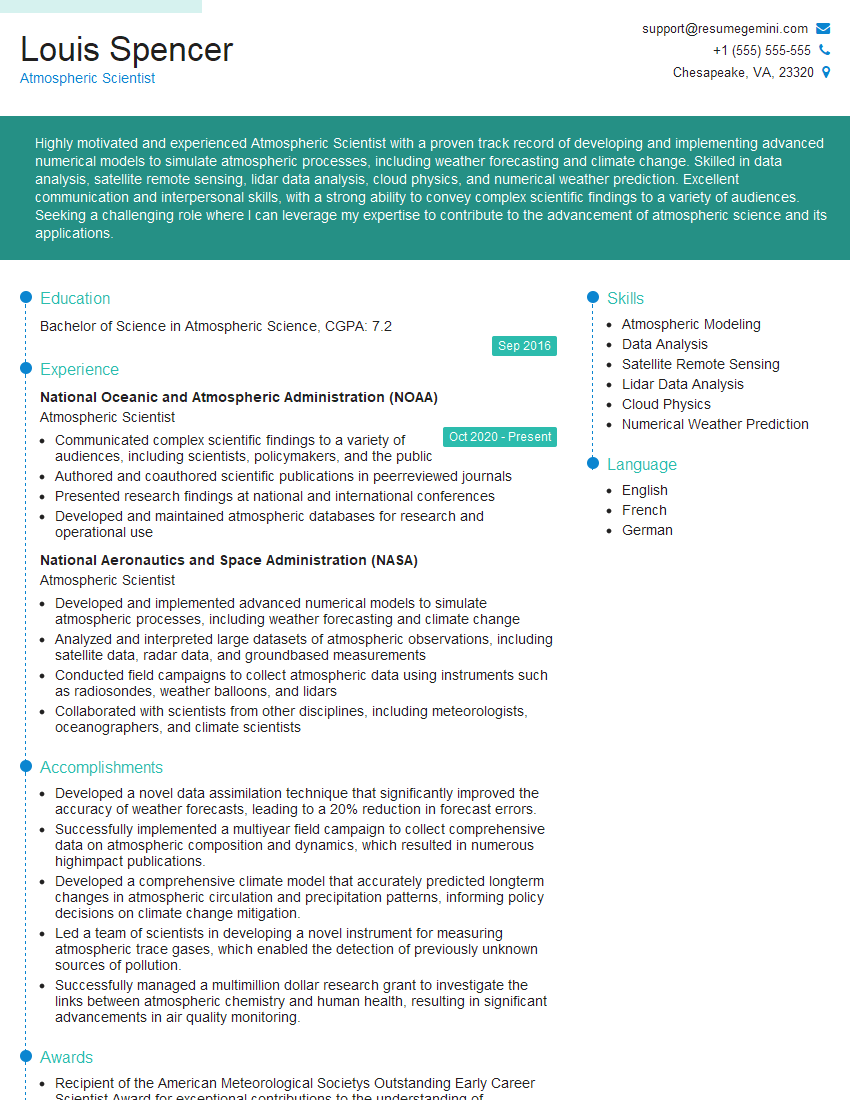
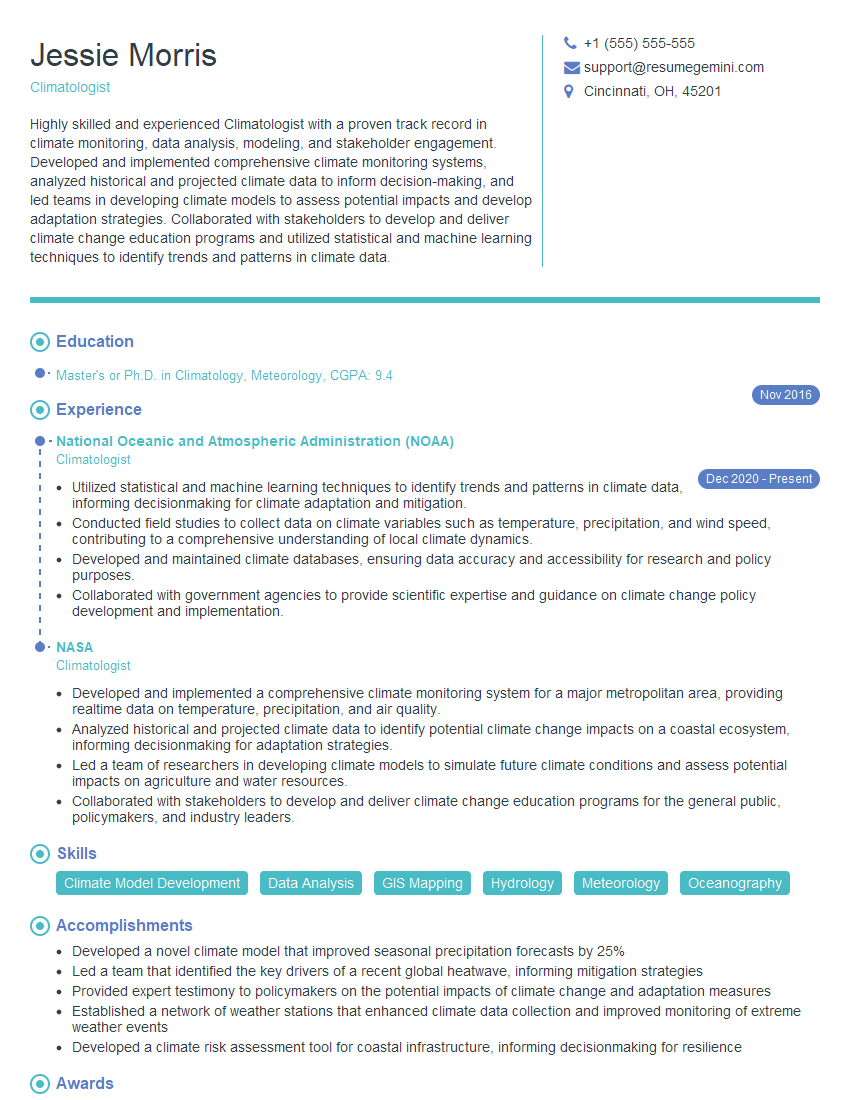
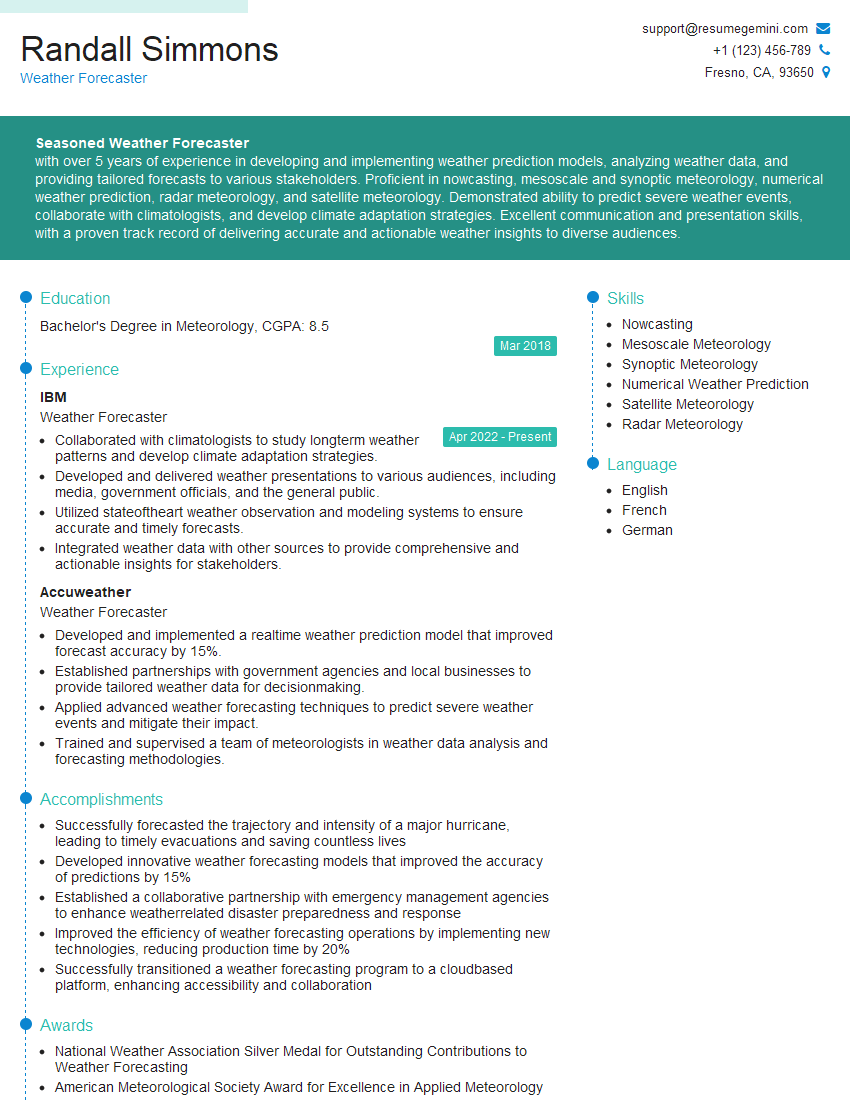
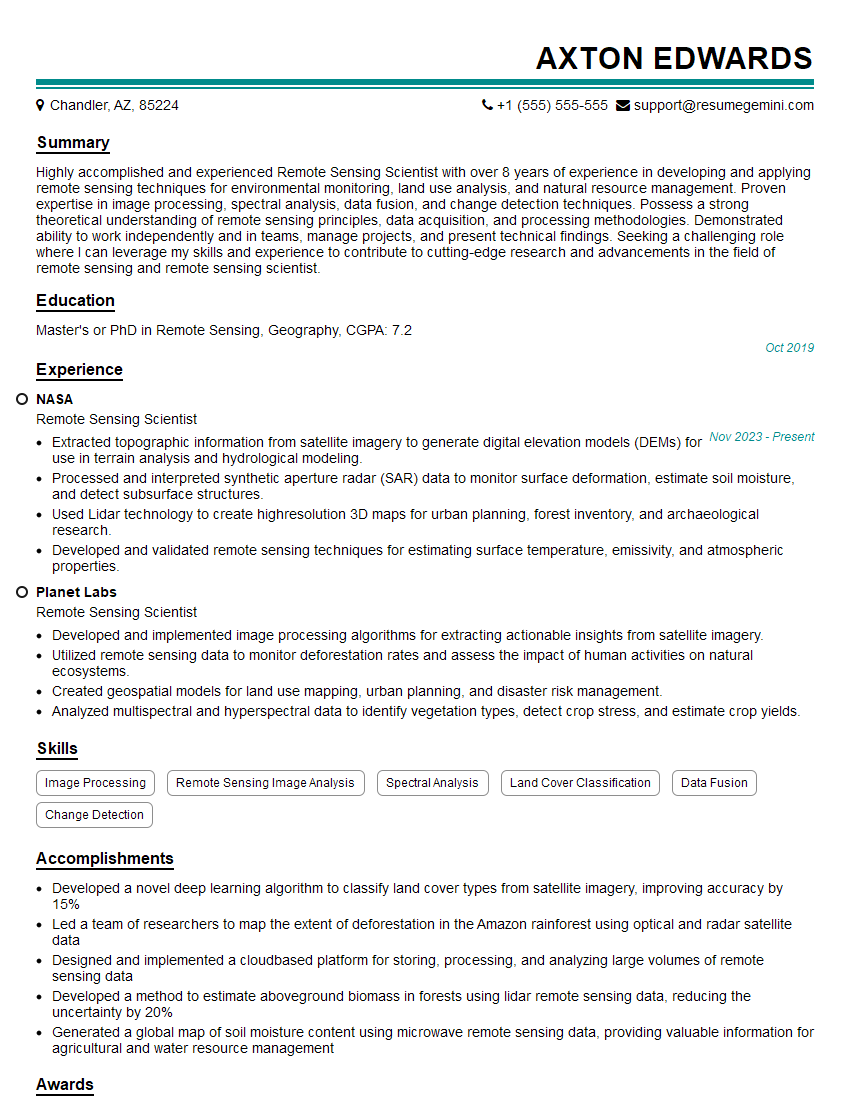
Mastering Atmospheric Radiative Transfer opens doors to exciting careers in research, environmental science, and technology. A strong understanding of these principles is highly valued by employers in these fields. To significantly improve your job prospects, focus on creating a compelling and ATS-friendly resume that highlights your skills and experience. ResumeGemini is a trusted resource that can help you build a professional resume tailored to your specific career goals. We provide examples of resumes specifically tailored for Atmospheric Radiative Transfer professionals to help you get started. Invest time in creating a strong resume – it’s your first impression on potential employers.


Explore more articles
Users Rating of Our Blogs
Share Your Experience
We value your feedback! Please rate our content and share your thoughts (optional).
What Readers Say About Our Blog
To the interviewgemini.com Webmaster.
Very helpful and content specific questions to help prepare me for my interview!
Thank you
To the interviewgemini.com Webmaster.
This was kind of a unique content I found around the specialized skills. Very helpful questions and good detailed answers.
Very Helpful blog, thank you Interviewgemini team.