Unlock your full potential by mastering the most common Glass Etching and Sandblasting interview questions. This blog offers a deep dive into the critical topics, ensuring you’re not only prepared to answer but to excel. With these insights, you’ll approach your interview with clarity and confidence.
Questions Asked in Glass Etching and Sandblasting Interview
Q 1. What are the different types of glass etching techniques?
Glass etching encompasses several techniques, each offering unique aesthetic and practical results. The most common methods include:
- Acid Etching: This involves applying a solution of hydrofluoric acid (HF) to the glass surface. HF reacts with the silica in the glass, dissolving it and creating a frosted or etched effect. The concentration of the acid and the application time determine the depth and intensity of the etch. This is often used for delicate designs and is suitable for smaller projects.
- Sandblasting: A more robust method utilizing compressed air to propel abrasive particles (like silica sand) at high velocity onto the glass surface. This offers more control over depth and can create a wider variety of textures, from fine frosting to deeply etched grooves. Ideal for large-scale projects and sharp, defined designs.
- Cream Etching: A safer alternative to direct acid application, cream etching uses a gel-like acid solution applied with stencils. This technique provides more controlled etching and is popular for hobbyists.
- Laser Etching: A modern technique employing a laser beam to ablate the glass surface, offering high precision and intricate designs. It’s excellent for detailed work but requires specialized and expensive equipment.
The choice of technique depends on factors like the design complexity, desired depth, project scale, safety considerations, and available equipment.
Q 2. Explain the process of sandblasting glass.
Sandblasting glass involves propelling abrasive particles at high velocity against the glass surface using compressed air. It’s a subtractive process, meaning material is removed to create the design. Here’s a step-by-step breakdown:
- Design Preparation: Create a stencil using adhesive vinyl, masking tape, or a similar material to protect areas you want to keep untouched.
- Sandblasting Setup: Connect the sandblasting equipment to a compressed air source, ensuring sufficient pressure (this varies depending on the abrasive and desired depth).
- Abrasive Selection: Choose the appropriate abrasive based on the desired finish (we’ll discuss abrasives further in another question). Load the abrasive into the sandblasting cabinet or gun.
- Sandblasting Process: Carefully direct the stream of abrasive at the exposed glass surface, maintaining a consistent distance and angle to achieve even etching. Test on a scrap piece of glass first to adjust pressure and technique.
- Cleaning: Once finished, remove the stencil and thoroughly clean the glass to remove any residual abrasive.
The pressure of the air, the type of abrasive, and the distance from the nozzle all influence the depth and texture of the etched surface. Practicing on scrap glass is crucial before working on the final piece.
Q 3. What safety precautions are essential when using etching and sandblasting equipment?
Safety is paramount when working with etching and sandblasting equipment. These processes involve hazardous materials and high-pressure equipment. Essential safety precautions include:
- Eye Protection: Always wear safety glasses or a full-face shield to prevent eye injuries from flying debris or chemical splashes.
- Respiratory Protection: Use a respirator with appropriate filters to prevent inhalation of dust particles (especially silica, which can cause silicosis) or acid fumes.
- Skin Protection: Wear gloves and protective clothing to avoid skin contact with acids or abrasive materials. Hydrofluoric acid is particularly dangerous and requires specialized handling.
- Ventilation: Work in a well-ventilated area or use a sandblasting cabinet with efficient dust collection to reduce exposure to harmful particles and fumes. Acid etching should always be done under a fume hood.
- Proper Equipment: Ensure all equipment is in good working order and properly maintained. Check for leaks and damage before each use.
- Emergency Preparedness: Have a readily available eye wash station and emergency first-aid kit in case of accidents.
Always follow the manufacturer’s safety instructions for all equipment and materials. If unsure, consult a safety professional.
Q 4. How do you determine the appropriate pressure and abrasive for sandblasting?
Determining the appropriate pressure and abrasive for sandblasting depends on several factors: the type of glass, the desired depth and texture of the etching, and the type of abrasive being used.
Pressure: Higher pressure generally leads to deeper etching, but excessive pressure can damage the glass or create uneven results. It’s crucial to experiment on scrap glass. Start with lower pressure and gradually increase until you achieve the desired effect. Typical pressure ranges from 40 to 100 PSI, but this can vary considerably.
Abrasive: Different abrasives produce different textures. Finer abrasives (like glass beads) create a softer, smoother etch, while coarser abrasives (like aluminum oxide or silica sand) produce a more aggressive, deeper etch. The hardness of the abrasive also affects the result. A harder abrasive will etch faster but may also damage the glass more easily if the pressure is too high.
Trial and Error: The best way to determine optimal pressure and abrasive is through experimentation on scrap glass. Keep detailed notes of your settings and results to refine your technique over time.
Q 5. Describe your experience with different types of abrasives used in sandblasting.
My experience encompasses a wide range of abrasives for sandblasting, each with its unique properties and applications:
- Silica Sand: A common and relatively inexpensive abrasive, silica sand provides a deep, aggressive etch. However, it produces significant dust, posing significant respiratory hazards. The crystalline silica in sand is particularly dangerous and should be handled with extreme care and proper respiratory protection.
- Aluminum Oxide: A harder, more durable abrasive than silica sand, aluminum oxide produces a finer, more consistent etch with less dust. It’s a better choice for fine detail work and for minimizing respiratory health risks.
- Glass Beads: A softer abrasive, glass beads create a smoother, less aggressive etch, ideal for frosting glass without creating deep grooves. They produce minimal dust.
- Walnut Shells: An eco-friendly alternative to silica sand, walnut shells provide a relatively fine, smooth etch, suitable for more delicate projects. They are also less hazardous to breathe.
The choice of abrasive is driven by the desired outcome. For example, a fine, frosted effect would necessitate glass beads or walnut shells, whereas a deep, textured pattern may call for aluminum oxide or even carefully controlled silica sand usage.
Q 6. How do you ensure consistent etching depth and quality?
Achieving consistent etching depth and quality requires meticulous attention to detail and precise control over various parameters:
- Consistent Air Pressure: Maintain a constant air pressure throughout the sandblasting process using a regulator with a pressure gauge.
- Consistent Distance and Angle: Hold the sandblasting nozzle at a consistent distance and angle from the glass surface to ensure uniform etching.
- High-Quality Stencils: Use durable, precisely cut stencils to ensure clean, sharp lines. Avoid using stencils that are easily damaged or allow abrasive to seep underneath.
- Clean Glass Surface: Ensure the glass is thoroughly cleaned before etching to remove any dirt, grease, or other contaminants that could affect the etch.
- Practice and Refinement: Consistent results come with experience. Practice on scrap glass to develop a feel for the equipment and the effect of different settings on the etched surface.
- Regular Maintenance: Regularly clean and maintain sandblasting equipment to ensure its optimal performance and prevent clogging.
Proper preparation and controlled technique are key to producing high-quality, consistent results in glass etching.
Q 7. What are the common issues encountered in glass etching and how do you troubleshoot them?
Common issues encountered in glass etching include:
- Uneven Etching: This is often caused by inconsistent air pressure, distance from the nozzle, or stencil issues. Troubleshooting involves checking the equipment, adjusting settings, and ensuring the stencil is securely adhered.
- Incomplete Etching: This might result from insufficient pressure, incorrect abrasive, or stencil problems. Examine the equipment settings and ensure the stencil is completely covering the area that should remain unetched.
- Damage to the Glass: Excessive pressure, improper abrasive selection, or abrasive particles striking at an oblique angle can cause chipping or cracking. Careful technique and pressure control are essential.
- Stencil Issues: Stencils that aren’t securely attached or that have imperfections can lead to uneven or incomplete etching. Use high-quality stencils and secure them firmly.
- Dust and Residue: Residue can be challenging to remove from deep etching. A thorough cleaning process with the right solvents (depending on the abrasive used) is necessary.
Addressing these issues often involves systematically checking each step of the process, starting from preparation, and carefully adjusting the technique. Keep detailed records of your settings and outcomes for troubleshooting and future reference. If problems persist, seeking advice from experienced glass etchers or professionals is recommended.
Q 8. How do you prepare glass surfaces for etching and sandblasting?
Preparing glass for etching or sandblasting is crucial for achieving a clean, consistent finish. It’s like preparing a canvas before painting – you wouldn’t start without cleaning it first! The process involves several steps:
- Cleaning: Thoroughly clean the glass surface with a non-abrasive cleaner and warm water. Residue like dust, grease, or fingerprints can interfere with the etching or blasting process, leading to uneven results. I often use a mixture of dish soap and water, followed by a thorough rinse and then a final wipe with isopropyl alcohol to ensure complete dryness.
- Degreasing (Optional but recommended): For precision work, especially with acid etching, a degreasing step is essential. This removes any microscopic oils that may resist the etching solution. I frequently use a commercial degreaser specifically designed for glass.
- Masking (for intricate designs): If you’re not etching the entire surface, carefully mask the areas you want to protect using high-quality masking tape and/or vinyl. This requires precision and patience to avoid bleed-through.
Proper preparation directly impacts the final product’s quality. A poorly cleaned surface will result in an uneven or patchy finish. I’ve learned through experience that taking the time for thorough preparation is always worth the effort.
Q 9. Explain the process of stencil creation for glass etching.
Stencil creation is the art of translating your design onto the glass surface. Think of it as creating a template that guides the etching or blasting process. There are several methods, each with its own advantages:
- Hand-cut stencils: These are created using durable materials like vinyl or stencil film. A precise blade is used to cut out the design, leaving behind the negative space. This method allows for intricate details but requires significant skill and patience.
- Computer-cut stencils: For complex or repetitive designs, computer-cut stencils using a plotter or vinyl cutter are invaluable. You create your design in a vector graphics program, and the machine precisely cuts it from the chosen material. This ensures consistency and speed, especially for large-scale projects.
- Printed stencils: While not as durable as vinyl, printed stencils using a laser printer and stencil paper can work for simpler designs. Remember to seal the printed stencil with a sealant to prevent the ink from bleeding.
Regardless of the method, careful attention to detail is crucial. A poorly made stencil will inevitably lead to a flawed final product. I’ve found that testing the stencil before etching or blasting on a scrap piece of glass is a prudent step.
Q 10. What are the different types of stencils used in glass etching?
The type of stencil used depends heavily on the complexity of the design and the scale of the project:
- Vinyl stencils: These are durable, reusable, and offer clean edges, making them ideal for intricate designs and multiple uses. They are my go-to choice for most projects.
- Paper stencils: These are less durable but quick and easy to create for simple designs. They’re suitable for one-time use and are generally cheaper.
- Silk-screen stencils: For large-scale projects requiring many repetitions of the same design, silk-screen stencils provide excellent consistency and efficiency.
- Mylar stencils: Offering great durability and precision, Mylar stencils are particularly suitable for acid etching where precise lines are essential. They are more expensive but worth the investment for demanding projects.
The choice often comes down to a balance between cost, durability, and the complexity of the design. I’ve experimented with various stencil materials and have developed a preference for vinyl for its versatility and durability.
Q 11. How do you clean and maintain etching and sandblasting equipment?
Cleaning and maintaining etching and sandblasting equipment is paramount for safety and longevity. Neglecting this can lead to equipment damage, inconsistent results, and even health hazards. Here’s my approach:
- Sandblasting equipment: After each use, thoroughly clean the blasting cabinet and remove any residual sand or debris. Inspect the hoses and nozzle for any damage. Regularly lubricate moving parts according to the manufacturer’s instructions.
- Etching equipment: Immediately after etching, rinse all equipment thoroughly with water. For acid etching, neutralize any remaining acid with a base solution (like baking soda and water) before rinsing. Never mix acids and bases forcefully. Store all etching solutions properly, following all safety guidelines.
- General cleaning: Use appropriate cleaning solutions and tools. Avoid abrasive cleaners which could damage the equipment’s surfaces. Proper ventilation is crucial during cleaning, especially when handling etching chemicals.
Regular maintenance not only extends the lifespan of the equipment but also ensures optimal performance and safety. I always prioritize safety and follow all manufacturer’s recommendations meticulously.
Q 12. Describe your experience with different types of etching chemicals.
My experience encompasses several etching chemicals, each with its own characteristics and applications:
- Hydrofluoric acid (HF): This is a powerful and highly corrosive acid used for deep etching. It’s extremely dangerous and requires specialized training and safety precautions. I only use it for very specific projects, adhering strictly to safety regulations.
- Cream etching solutions: These are less aggressive than HF and easier to handle, making them suitable for beginners or less demanding projects. They produce a frosted, opaque finish. I often use these for smaller, detailed work where precise control is needed.
- Phosphoric acid: A versatile acid offering a good balance of etching strength and safety. It provides a more controlled etching process than HF and is suitable for many applications. I find this a good middle ground between aggressive etching and ease of use.
Selecting the right chemical depends entirely on the desired outcome and the user’s experience level. Safety is paramount, and I always prioritize using the least hazardous chemical that can achieve the desired result.
Q 13. How do you dispose of etching chemicals and sandblasting waste safely and responsibly?
Safe disposal of etching chemicals and sandblasting waste is critical for environmental protection and public safety. Improper disposal can lead to serious pollution and health risks. I strictly adhere to local regulations and best practices:
- Etching chemicals: Never pour etching chemicals down the drain. Neutralize acids with a base solution before disposal. Contact your local hazardous waste disposal facility for guidance on proper collection and disposal methods. They often provide specific containers and instructions.
- Sandblasting waste: Sandblasting waste, particularly silica sand, can be a respiratory hazard. Collect the waste in sealed containers and dispose of it according to local regulations. Many recycling centers accept this type of waste.
- Documentation: Maintain detailed records of the chemicals used, quantities disposed of, and the disposal methods employed. This documentation is crucial for compliance and traceability.
Responsible disposal is not just a legal requirement; it’s an ethical obligation. I treat it as a critical aspect of my work, ensuring that all materials are handled and disposed of safely and responsibly.
Q 14. What is the difference between acid etching and cream etching?
The key difference lies in the etching agent and the resulting effect:
- Acid etching: This uses strong acids, such as hydrofluoric acid or phosphoric acid, to deeply etch the glass surface, creating a frosted or opaque effect. This method is best suited for deep etching and creating detailed designs. It requires more expertise and safety precautions.
- Cream etching: This uses a less aggressive, commercially available cream containing hydrofluoric acid in a less concentrated form. It produces a more delicate, less deeply etched frosting effect. It’s easier to handle and generally safer, making it ideal for beginners and simpler projects. It usually produces a less intense frosted effect than acid etching.
Essentially, acid etching offers more control over depth and detail, while cream etching provides a simpler and safer alternative for lighter, less intricate designs. The choice depends on the desired aesthetic and the user’s level of experience and access to materials.
Q 15. What are the limitations of sandblasting on different types of glass?
Sandblasting’s limitations on glass depend heavily on the glass type. Think of it like carving different stones – some are harder to work with than others.
Annealed Glass (standard window glass): This is relatively easy to sandblast, offering a consistent, frosted finish. However, excessive pressure can cause chipping or cracking.
Tempered Glass (safety glass): Much stronger, tempered glass is significantly more difficult and risky to sandblast. The high internal stresses make it prone to shattering under pressure. Specialized techniques and lower pressures are crucial, often requiring a skilled hand and careful control.
Laminated Glass: This type, featuring an interlayer of plastic between glass sheets, presents a unique challenge. Sandblasting might affect only the outer layer, leading to an uneven finish. It requires even more precision and often needs a slightly gentler approach than other methods.
Specialty Glass (e.g., colored, textured): The inherent properties of these glasses—like thickness, color consistency, or existing texture—will influence the outcome of sandblasting. Testing on a sample is almost always necessary before committing to a large project. For example, sandblasting a heavily textured glass could lead to an unpredictable pattern or damage the existing texture.
In summary, understanding the glass type is the first step in successful sandblasting. Each type requires a tailored approach to avoid damage and achieve the desired result.
Career Expert Tips:
- Ace those interviews! Prepare effectively by reviewing the Top 50 Most Common Interview Questions on ResumeGemini.
- Navigate your job search with confidence! Explore a wide range of Career Tips on ResumeGemini. Learn about common challenges and recommendations to overcome them.
- Craft the perfect resume! Master the Art of Resume Writing with ResumeGemini’s guide. Showcase your unique qualifications and achievements effectively.
- Don’t miss out on holiday savings! Build your dream resume with ResumeGemini’s ATS optimized templates.
Q 16. How do you handle intricate designs during etching and sandblasting?
Intricate designs require precision and often a combination of techniques. Imagine sculpting a miniature – you need the right tools and a steady hand.
Stenciling: For detailed designs, we use precision-cut stencils made from durable materials like vinyl or Mylar. This protects areas we don’t want sandblasted, allowing for sharp, clean lines. The stencil’s adhesion and precise cutting are paramount for achieving the finest details.
Hand Sandblasting: This offers the greatest control for intricate areas, particularly with smaller nozzles and lower pressures. It’s a bit like using an airbrush, allowing for fine adjustments and creative freedom. However, it requires significant experience and skill to ensure consistent results.
Specialized Nozzles: We use various nozzle sizes to achieve different levels of detail. Smaller nozzles produce finer lines and sharper details, while larger nozzles are suited for broader areas. Choosing the right nozzle is like picking the right brush for a painting.
Multiple Stencils/Layers: Complex designs often necessitate multiple stencils applied in layers. Each layer might reveal a different part of the design, building up the overall image in a step-by-step process, similar to layering colors in painting.
The key is meticulous preparation and a deep understanding of the capabilities of both the equipment and materials.
Q 17. How do you ensure the accuracy and precision of your work?
Accuracy and precision are paramount. We achieve this through careful planning and execution, much like a surgeon performing a delicate procedure.
Precise Measurements and Design: We start with precise digital designs, ensuring all dimensions are accurate. This is often done using CAD software for complex projects.
High-Quality Stencils: Investing in professionally cut stencils from high-quality materials is crucial for clean lines and consistent results. Poorly cut stencils translate directly into an inaccurate final product.
Controlled Sandblasting Environment: We control factors such as air pressure, distance from nozzle to glass, and the angle of approach. Any deviation from the optimal settings can compromise accuracy.
Regular Equipment Maintenance: Regular maintenance of sandblasting equipment ensures consistent performance and prevents inconsistencies in the blast pattern. This ensures the equipment is always delivering the consistent pressure and abrasive flow needed for precision.
Quality Control Checks: We have a rigorous quality control process, including regular checks throughout the project. We’ll frequently inspect the work in progress to catch any errors early.
These processes, when meticulously followed, help us deliver high-quality results that meet our clients’ expectations.
Q 18. What are the different types of sandblasting equipment you’ve used?
Over my career, I’ve used a variety of sandblasting equipment, each suited for different applications.
Cabinet Sandblasters: These enclosed systems offer better containment of abrasive material and provide a safer environment. They’re ideal for smaller pieces and offer better control over the blasting process, especially for intricate designs.
Open-Air Sandblasters: These are suitable for larger projects, especially when dealing with pieces that are too large to fit into a cabinet. While offering flexibility, they require more stringent safety measures due to the increased risk of abrasive material escaping.
Pressure Feed Systems: These systems use compressed air to propel abrasive media at high velocity. They’re powerful and offer great control for large-scale projects, but require careful handling to avoid damage to delicate pieces.
Suction Feed Systems: These use a vacuum system to draw abrasive media and provide more consistent results, especially with softer abrasives.
The choice of equipment depends entirely on the specific project requirements. We always select the equipment that best fits the job at hand, optimizing both speed and precision.
Q 19. Describe your experience with automated sandblasting systems.
My experience with automated sandblasting systems has been primarily with CNC-controlled systems. These systems offer incredible precision and repeatability for mass production or projects requiring identical replicas.
Think of it as a robotic arm performing sandblasting with unparalleled accuracy. These systems utilize computer-aided design (CAD) files to guide the blasting process, ensuring consistent results across many pieces. The precision is far superior to manual techniques for high-volume projects. We use these systems for large commercial projects where consistency and speed are crucial.
However, these systems are not without limitations. They’re often less flexible than manual techniques for highly customized, one-off designs. The programming and setup can be time-consuming and requires specialized knowledge, but the resulting efficiency for larger projects is worth the investment.
Q 20. How do you calculate the cost of materials for a glass etching or sandblasting project?
Calculating material costs involves a thorough understanding of the project’s scope. It’s like preparing a recipe – you need the right ingredients in the right quantities.
Glass Type and Size: Different glass types have different costs per square foot. Larger projects naturally require more glass.
Abrasive Media: The type and quantity of abrasive media (e.g., silica sand, glass beads, etc.) directly impacts the cost. Finer abrasives are often more expensive.
Stencils/Masks: Custom-made stencils can be a significant expense, especially for intricate designs. The cost depends on complexity and materials.
Labor Costs: Labor is a significant factor, especially for intricate designs or large projects. Automated systems can reduce labor costs, but the initial investment is substantial.
Overhead: Additional costs include utilities, equipment maintenance, and safety equipment.
To provide an accurate estimate, we thoroughly assess the design, glass type, quantity, and chosen techniques. We create a detailed breakdown of costs for the client, ensuring transparency and avoiding any hidden expenses.
Q 21. What are the health risks associated with glass etching and sandblasting?
Glass etching and sandblasting present several health risks if proper safety precautions aren’t taken. It’s essential to treat this as a hazardous work environment.
Silica Dust Inhalation: Silica sand is a significant hazard. Inhaling silica dust can lead to silicosis, a serious and potentially fatal lung disease. Therefore, respirators with HEPA filters are mandatory.
Eye Injuries: Flying abrasive particles can cause severe eye injuries. Safety goggles are essential and must be worn at all times.
Skin Irritation: Abrasive materials can irritate the skin. Protective clothing, including gloves, long sleeves, and eye protection, is necessary.
Noise Exposure: Sandblasting equipment is loud. Hearing protection is crucial to avoid hearing damage.
Chemical Exposure (for etching): Some etching techniques utilize chemicals that can be harmful if not handled properly. Always follow manufacturer’s instructions and use proper ventilation.
We rigorously adhere to all safety regulations and provide thorough training to our employees. We emphasize a proactive safety approach, including regular equipment inspections and maintenance, proper disposal of waste materials, and ensuring a well-ventilated workspace.
Q 22. How do you protect yourself and others from these risks?
Safety is paramount in glass etching and sandblasting. We employ a multi-layered approach to mitigate risks. This starts with personal protective equipment (PPE): This includes respirators (specifically designed for silica dust in sandblasting), safety glasses with side shields offering protection against flying particles, heavy-duty gloves to prevent cuts and chemical burns, and long-sleeved protective clothing to cover exposed skin. We also utilize engineered controls to minimize exposure. This means working in well-ventilated areas or using enclosed blasting cabinets with efficient dust collection systems. For chemical etching, we work in fume hoods and use appropriate chemical handling protocols.
Beyond individual protection, we maintain a safe work environment. This includes regular equipment inspections, proper storage of chemicals and abrasive materials, and comprehensive safety training for all personnel. We conduct regular safety briefings to reinforce best practices and address any emerging concerns. A clean and organized workspace is also vital to prevent accidents. Finally, we have clearly defined emergency procedures in place and ensure everyone is aware of them. Think of it like this: we treat every project as if it were being done in a laboratory setting, with strict attention to detail and safety measures.
Q 23. Describe your experience with various glass types and their suitability for etching/sandblasting.
My experience spans a wide range of glass types, each presenting unique challenges and opportunities for etching and sandblasting. Annealed glass, the most common type, is relatively easy to work with for both techniques. However, float glass, known for its superior clarity, yields stunning results, especially with intricate etching designs. Borosilicate glass, due to its higher resistance to thermal shock and chemical attack, is ideal for applications requiring durability and chemical resistance. Its harder surface might require more aggressive blasting techniques.
Lead crystal glass offers a beautiful, lustrous surface for etching, but its lead content necessitates extra caution regarding dust inhalation. The choice of glass depends on the desired aesthetic outcome, budget, and intended application. For example, a delicate etched design on a wine glass might necessitate float glass for its clarity, whereas a durable sandblasted sign might call for tempered glass or borosilicate.
Q 24. Have you worked with specialized glasses, such as tempered or laminated glass?
Yes, I have extensive experience working with tempered and laminated glass. These glasses require a specialized approach due to their enhanced strength and layered structure. Tempered glass is significantly stronger than annealed glass, making it more challenging to etch or sandblast. The process often requires more aggressive techniques and increased attention to prevent chipping or cracking. The heat treatment process used in tempering can sometimes affect the etch or blast depth and uniformity.
Laminated glass presents another set of considerations. Its layered construction, typically with a polyvinyl butyral (PVB) interlayer, can impede the penetration of abrasive materials and etching chemicals. Depending on the design and depth needed, special techniques might be required to achieve the desired effect without compromising the integrity of the lamination. For instance, lighter etching or sandblasting techniques focusing on the outer layer are often employed.
Q 25. How do you ensure the longevity and durability of your etched or sandblasted designs?
Ensuring longevity and durability is critical. For sandblasted designs, the depth of the blasting is key. A deeper blast creates a more permanent and resistant design. The choice of abrasive material also impacts durability. Silicon carbide, for instance, is preferred for its hardness and consistent results. For etched designs, the choice of etching cream or acid, along with the etching time, impacts the design’s permanence. The post-processing is also vital.
After etching or sandblasting, it’s important to thoroughly clean the glass to remove any residual chemicals or abrasive particles. For some applications, a protective sealant or coating can be applied to further enhance durability and resist wear and tear. This is especially relevant for items that will be handled frequently or exposed to harsh environments. Just like sealing a painting to protect it from damage, the final sealant protects our hard work.
Q 26. Explain your experience with quality control procedures in glass finishing.
Quality control is integrated into every stage of the process, from initial design approval to final inspection. We start with meticulous design reviews to ensure the artwork is suitable for the chosen glass type and technique. During production, we continuously monitor the etching or blasting process to ensure consistent depth, sharpness, and uniformity. We utilize calibrated equipment and regularly check for inconsistencies. After the glass is processed, a rigorous quality check is performed, evaluating the finished piece against the original design specifications.
This inspection includes checking for imperfections, such as uneven etching, scratches, or blemishes. We utilize digital imaging and magnification tools for a thorough assessment. Documentation at each stage, including photographs and measurements, ensures traceability and allows us to identify any potential issues. Our goal is to deliver flawless pieces that meet the highest quality standards, ensuring client satisfaction.
Q 27. Describe a situation where you had to troubleshoot a problem during a glass etching or sandblasting project. What was the problem, and how did you solve it?
Once, I was working on a large-scale sandblasted logo for a storefront window using a newly acquired sandblasting machine. The logo wasn’t etching evenly; one section was significantly lighter than the rest, even with consistent pressure and air flow. Initially, I suspected a problem with the stencil, but a thorough inspection ruled that out.
After careful analysis, I discovered that the air nozzle on the machine had a slight blockage. This was causing inconsistent airflow, resulting in an uneven blast. The solution was simple: I cleaned the nozzle thoroughly, ensuring no obstructions remained. After this, the sandblasting produced a uniform logo. The situation highlighted the importance of regular equipment maintenance and thorough troubleshooting, focusing on the obvious before the obscure to find quick solutions.
Q 28. How do you stay updated on new techniques and technologies in glass etching and sandblasting?
Staying updated is crucial in this ever-evolving field. I actively participate in industry conferences and trade shows, networking with other professionals and learning about the latest techniques and technologies. I subscribe to industry publications and journals, which offer insights into new materials, equipment, and design approaches. Online forums and communities are also valuable sources of information and allow for collaborative problem-solving.
Furthermore, I regularly attend workshops and training sessions offered by equipment manufacturers and material suppliers. This hands-on experience ensures I am proficient with the latest equipment and techniques. Continuous learning is not just a good habit but a necessity to maintain a high level of expertise and offer clients the best possible service and results. Think of it like a chef constantly refining their techniques based on new ingredients and culinary trends.
Key Topics to Learn for Your Glass Etching and Sandblasting Interview
- Safety Procedures and Regulations: Understanding and adhering to all relevant safety protocols for handling chemicals, equipment, and materials. This includes PPE, waste disposal, and emergency procedures.
- Etching Techniques: Mastering various etching methods, including acid etching, cream etching, and their applications for different glass types and desired effects. Consider the differences in depth and clarity achieved by each method.
- Sandblasting Techniques: Proficiency in operating sandblasting equipment, including different nozzle sizes and pressures for achieving varied surface textures and designs. Explore techniques for controlling depth and detail.
- Design and Layout: Understanding the principles of design as they apply to glass etching and sandblasting. This includes translating designs from digital formats to physical application, mask creation and application.
- Material Selection: Knowledge of different types of glass, their properties, and suitability for etching and sandblasting. Understanding how different glasses react to different techniques is crucial.
- Maintenance and Troubleshooting: Familiarity with the maintenance requirements of etching and sandblasting equipment, including cleaning, repair, and troubleshooting common issues.
- Project Management: Ability to manage projects effectively, from initial design to final product delivery, including time management and resource allocation.
- Quality Control: Understanding quality control measures to ensure consistently high-quality results. This includes inspecting work for imperfections and implementing corrective actions.
Next Steps
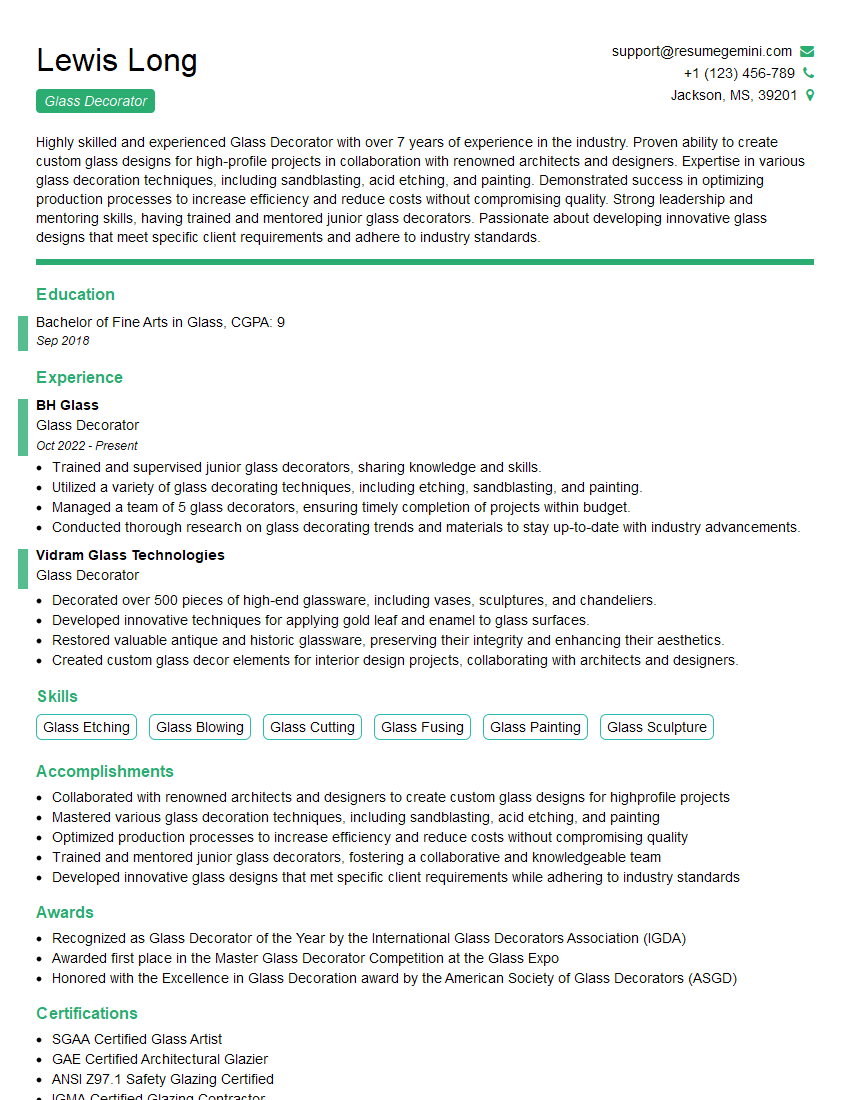
Mastering glass etching and sandblasting opens doors to diverse and rewarding career opportunities in various industries. Your expertise in these techniques will be highly valued by employers seeking skilled artisans and technicians. To significantly boost your job prospects, creating a strong, ATS-friendly resume is essential. ResumeGemini is a trusted resource that can help you craft a professional resume that highlights your skills and experience effectively. ResumeGemini provides examples of resumes tailored to the Glass Etching and Sandblasting industry, guiding you in presenting your qualifications in the best possible light. Take the next step towards your dream career – build a compelling resume with ResumeGemini today.
Explore more articles
Users Rating of Our Blogs
Share Your Experience
We value your feedback! Please rate our content and share your thoughts (optional).
What Readers Say About Our Blog
To the interviewgemini.com Webmaster.
Very helpful and content specific questions to help prepare me for my interview!
Thank you
To the interviewgemini.com Webmaster.
This was kind of a unique content I found around the specialized skills. Very helpful questions and good detailed answers.
Very Helpful blog, thank you Interviewgemini team.