Are you ready to stand out in your next interview? Understanding and preparing for Glass Cutting, Polishing, and Edging interview questions is a game-changer. In this blog, we’ve compiled key questions and expert advice to help you showcase your skills with confidence and precision. Let’s get started on your journey to acing the interview.
Questions Asked in Glass Cutting, Polishing, and Edging Interview
Q 1. Explain the different types of glass cutting techniques.
Glass cutting techniques vary depending on the type of glass, desired cut, and available tools. The most common methods are:
- Manual Scoring and Snapping: This involves scoring the glass with a glass cutter (a hardened steel wheel or a carbide tip) and then applying controlled pressure to snap the glass along the score line. This is ideal for straight cuts on thinner glass. Think of it like creating a controlled crack.
Example: Cutting a piece of window glass to fit a frame. - Automated Cutting: Industrial settings often use automated glass cutters, including CNC (Computer Numerical Control) machines. These use diamond-tipped wheels or lasers to cut complex shapes and patterns with high precision and speed. These machines can handle thicker and larger pieces of glass.
Example: Mass production of glass for automotive windshields or architectural facades. - Waterjet Cutting: A high-pressure stream of water mixed with abrasive particles cuts through the glass, offering a very clean and precise cut, even on complex shapes. It’s suitable for various glass types and thicknesses.
Example: Cutting intricate shapes in tempered or laminated glass for artistic purposes.
The choice of technique depends heavily on factors such as the volume of work, the complexity of the design, the thickness and type of glass, and the desired level of precision.
Q 2. What safety precautions are essential when operating glass cutting equipment?
Safety is paramount in glass cutting. Here are some essential precautions:
- Eye Protection: Always wear safety glasses or a face shield to protect your eyes from flying glass fragments.
- Gloves: Wear cut-resistant gloves to protect your hands from cuts and abrasions.
- Proper Handling: Support the glass firmly to prevent breakage or slippage during cutting.
- Sharp Tools: Use sharp, well-maintained cutting tools to ensure a clean cut and minimize the risk of chipping.
- Machine Guards: Ensure all safety guards on automated equipment are in place and functioning correctly.
- Clean Workspace: Keep the work area clean and free of debris to avoid tripping hazards and prevent accidental glass breakage.
- Emergency Procedures: Be aware of emergency procedures and have a first-aid kit readily available.
Ignoring these precautions can lead to serious injuries like cuts, eye damage, or even blindness.
Q 3. Describe the process of polishing glass to achieve a high-gloss finish.
Polishing glass to a high-gloss finish involves a multi-stage process that progressively refines the surface. It typically involves:
- Initial Grinding: This removes any major scratches or imperfections from the cut edges using progressively finer abrasives. Think of it like sanding wood – you start rough and get progressively finer.
- Fine Grinding: This uses finer abrasives to further smooth the surface, reducing the scratches left by the coarser abrasives.
- Polishing: This uses polishing compounds (often cerium oxide) and polishing pads to create a highly reflective, mirror-like finish. This step is crucial for achieving that showroom shine.
- Final Buffing (Optional): A final buffing stage with a soft cloth or felt wheel can further enhance the gloss and remove any minor imperfections.
Throughout the process, plenty of water is used as a coolant and lubricant. The entire process requires precision and patience to achieve a flawless finish.
Q 4. What are the different types of glass edges and their applications?
Different glass edges serve various purposes and aesthetics:
- Penetration Edged: This creates a sharp, clean edge for use in safety glass laminates. It interlocks for strength.
- Beveled Edge: An angled edge that creates a sleek, decorative look. Commonly seen in mirrors and decorative glasswork.
- Polished Edge: A smooth, highly polished edge; ideal for mirrors and high-end applications where a refined look is desired.
- Seamed Edge: Two pieces of glass are fused together at their edges, producing a strong and visually interesting join.
- Arris Edge: A slightly rounded edge offering durability and mitigating sharp corners. This is a good general-purpose edge for safety.
- Ogee Edge: A decorative edge that has a curve and is frequently used in decorative glasswork.
The choice of edge depends on the application, safety considerations, and aesthetic requirements. For example, a polished edge would be inappropriate for an application where strength is prioritized over appearance.
Q 5. How do you choose the appropriate abrasive for glass polishing?
Abrasive selection for glass polishing is crucial for achieving the desired finish. The choice depends on the stage of polishing and the desired level of smoothness. Generally:
- Coarser Abrasives (e.g., silicon carbide): Used in initial grinding stages to remove larger scratches and imperfections.
- Medium Abrasives: Used in fine grinding to further smooth the surface.
- Fine Abrasives (e.g., cerium oxide, diamond slurries): Used in the polishing stage to create a high-gloss finish.
The progression is key—starting with coarser abrasives and gradually moving to finer ones. Using too coarse an abrasive at the polishing stage would scratch the glass, while using a fine abrasive at the beginning would be inefficient.
Q 6. Explain the importance of maintaining glass cutting tools.
Maintaining glass cutting tools is essential for safety, efficiency, and the quality of the finished product. Regular maintenance includes:
- Cleaning: Removing dust, debris, and polishing residue after each use.
- Sharpening: Regularly sharpening or replacing worn-out cutting wheels or blades ensures clean, precise cuts. Dull tools increase the chance of chipping and breakage.
- Storage: Storing tools properly (e.g., in protective cases) prevents damage and accidental injury.
- Lubrication (for some tools): Applying the correct lubricant to moving parts ensures smooth operation and extends the lifespan of the tools.
Neglecting tool maintenance leads to poor cuts, increased safety risks, and reduced lifespan of the equipment. It’s like keeping your car in good condition – regular servicing prevents bigger problems down the road.
Q 7. What are the common causes of glass chipping during cutting?
Glass chipping during cutting can stem from several issues:
- Dull cutting tools: A dull cutter can cause the glass to shatter instead of cleanly scoring, leading to chipping.
- Improper scoring: Applying uneven pressure or not scoring deeply enough can result in a jagged cut and chipping.
- Underlying stresses in the glass: Internal stresses within the glass sheet can cause it to chip during cutting.
- Incorrect snapping technique: Applying force at the wrong point during snapping can also lead to chipping.
- Improper support: Inadequate support of the glass during cutting can cause it to crack or chip.
- Using the wrong type of glass cutter: Using the incorrect cutter for the glass type and thickness.
Addressing these issues through proper technique, tool maintenance, and careful selection of materials will minimize chipping and breakage, ensuring superior results.
Q 8. How do you handle different glass thicknesses during processing?
Handling different glass thicknesses requires adjusting the cutting and processing parameters on our machinery. Think of it like baking a cake – you wouldn’t use the same recipe for a single-layer cake as you would for a multi-tiered one. For thinner glasses, we use lighter scoring pressure and slower cutting speeds to prevent chipping or breakage. For thicker glasses, we increase the cutting force and potentially adjust the blade or wheel accordingly. We also adjust the polishing and edging processes, ensuring sufficient time and pressure for optimal results. For example, a 6mm glass might require a specific feed rate on the polishing machine, while a 12mm glass needs a slower, more deliberate approach to prevent uneven polishing or burning. This often involves changing the abrasive compounds and polishing pads to accommodate the differing thickness and potential stress points introduced during the cutting process.
Q 9. Describe your experience with various glass types (e.g., tempered, laminated).
My experience encompasses a wide range of glass types, including annealed, tempered, laminated, and even specialty glasses like low-iron or patterned glass. Tempered glass, known for its strength, requires careful handling throughout the entire process, as any damage during cutting or edging can lead to shattering. Laminated glass, which comprises two or more layers bonded together, needs precise cutting to avoid delamination. Each type demands a different approach; for instance, the scoring depth for tempered glass requires more precision than annealed glass due to the risk of stress fractures. I’ve worked extensively with low-iron glass, which requires particular attention during polishing to prevent scratches and maintain the clarity. Understanding the specific properties of each glass type is critical for optimizing the cutting, polishing, and edging processes and ensuring a high-quality finished product.
Q 10. What are the signs of a poorly polished glass surface?
A poorly polished glass surface exhibits several tell-tale signs. The most common are scratches, which can range from fine hairlines to deep gouges. Another indicator is unevenness; the surface might appear wavy or have areas of different gloss levels. A hazy or cloudy appearance indicates that the polishing process hasn’t removed all the imperfections left by previous steps. Also, you might observe inconsistent reflectivity – areas reflecting light differently than others. Imagine a mirror: a poorly polished one will have distortions or unclear reflections, compared to a perfectly smooth surface offering a sharp, clear image. We use various tools like optical microscopes and laser profilometers to detect minor imperfections, ensuring quality control at every stage.
Q 11. How do you ensure consistent edge quality during high-volume production?
Consistent edge quality in high-volume production relies heavily on precise machine calibration, regular maintenance, and diligent quality control. We employ automated edging machines that are programmed for specific edge profiles and thicknesses. Regular checks of the cutting and grinding wheels are critical; worn or damaged wheels compromise precision. Statistical Process Control (SPC) charts are used to monitor critical parameters like edge thickness and straightness, allowing for early detection of any deviations. For example, if the edge thickness consistently falls outside a pre-defined tolerance, we immediately investigate and adjust machine settings or replace worn parts. Operator training is also paramount; well-trained staff recognize and correct subtle variations quickly, minimizing defects. Consistent quality control throughout the whole process ensures the final product meets the highest standards.
Q 12. What are your troubleshooting skills regarding glass cutting machine malfunctions?
Troubleshooting glass cutting machine malfunctions requires a systematic approach. I begin by carefully observing the problem; for example, is the cut inconsistent, is the machine making unusual noises, or are there visible signs of damage? Then, I refer to the machine’s operation manual and diagnostic codes to identify potential issues. Common problems include issues with the blade, worn guides, problems with the lubrication systems, or malfunctions in the servo motors or control systems. A methodical process of elimination, checking each component, typically leads to the solution. For example, if the cut is uneven, I would first inspect the blade for wear or damage, then check the guide rails for alignment, and then examine the machine’s lubrication system. If a component needs replacing, I ensure I’m using manufacturer-approved parts to maintain the machine’s performance and warranty. Documentation of each issue and its solution is key to continual improvement and preventing similar incidents.
Q 13. Explain the importance of proper edge sealing techniques.
Proper edge sealing is crucial for several reasons. First, it prevents moisture from entering the glass, protecting against corrosion and potential damage. Think of it as sealing a window frame to prevent drafts and water infiltration. Second, it enhances the aesthetic appeal of the glass, providing a smooth, finished look. Third, for safety-critical applications, proper sealing is essential; it prevents chipping or fragmentation of the edge. We use a variety of sealing techniques depending on the glass type and application, from simple epoxy sealants to specialized silicone-based sealants that provide superior durability and water resistance. In high-volume applications, automated sealant application systems ensure consistent and efficient sealing.
Q 14. How do you measure the accuracy of a cut or polished edge?
Measuring the accuracy of a cut or polished edge utilizes a combination of tools and techniques. For straightness and dimensional accuracy, we employ precision calipers, digital micrometers, and optical comparators. These tools allow for extremely precise measurements of edge thickness, length, and straightness, ensuring they meet the tolerances outlined in the project specifications. For surface quality, we use profilometers and optical microscopes to assess surface roughness and detect any scratches or imperfections. Measuring angles is accomplished with precise goniometers or optical techniques. The data collected feeds into our quality control system allowing us to track performance, identify potential areas for improvement and ensure consistently accurate results across all projects.
Q 15. Describe your experience with automated glass processing equipment.
My experience with automated glass processing equipment spans over 10 years, encompassing a wide range of machinery including CNC cutting tables, automatic edging machines, and robotic polishing systems. I’m proficient in operating and maintaining various brands, such as Bottero, Intermac, and Bavelloni. For instance, I’ve extensively used Bottero’s automatic edging machines, mastering their programming for complex bevels and intricate edge designs. My expertise extends beyond basic operation; I can troubleshoot malfunctions, perform preventative maintenance, and optimize machine parameters for efficiency and superior output. I’m also familiar with the various software programs used to control and monitor these machines, ensuring accurate and consistent processing. In one project, I identified a recurring issue with a CNC cutting table’s laser alignment, leading to inconsistent cuts. Through meticulous calibration and adjustments, I was able to eliminate the issue, dramatically improving production quality and reducing waste.
Career Expert Tips:
- Ace those interviews! Prepare effectively by reviewing the Top 50 Most Common Interview Questions on ResumeGemini.
- Navigate your job search with confidence! Explore a wide range of Career Tips on ResumeGemini. Learn about common challenges and recommendations to overcome them.
- Craft the perfect resume! Master the Art of Resume Writing with ResumeGemini’s guide. Showcase your unique qualifications and achievements effectively.
- Don’t miss out on holiday savings! Build your dream resume with ResumeGemini’s ATS optimized templates.
Q 16. What are the common defects found in glass processing, and how do you address them?
Common defects in glass processing include chipping, scratching, waviness, haze, and stress fractures. Addressing these depends heavily on the stage of processing and the type of glass. Chipping and scratching often occur during cutting and handling. We mitigate this through careful handling practices, proper machine maintenance (e.g., ensuring sharp cutting wheels and avoiding collisions), and the use of protective films. Waviness, or unevenness in the surface, can be due to issues with the annealing process or improper support during grinding. Solutions involve adjusting annealing parameters or optimizing the supporting structures during the grinding process. Haze, a cloudy appearance, often results from improper polishing, and the correct polishing compound and process parameters must be used to remedy this. Finally, stress fractures are often caused by thermal shock or internal stresses in the glass itself. Careful control of temperature during processing and the selection of appropriate glass types are key to prevention.
Q 17. How do you ensure quality control throughout the glass processing workflow?
Quality control is paramount. We implement a multi-stage approach, starting with incoming inspection of the raw glass for defects. Each processing step (cutting, grinding, polishing, edging) involves in-process checks using calibrated measuring tools and visual inspection. For example, we regularly check the thickness and flatness of the glass using digital calipers and straight edges after cutting and grinding. After polishing, we assess the surface finish using a high-intensity light source to detect any haze or scratches. Finally, a rigorous final inspection ensures all pieces meet specifications before packaging. Statistical Process Control (SPC) techniques are employed to monitor process stability and identify potential issues proactively. This data-driven approach helps maintain consistency and prevent defects from becoming widespread.
Q 18. What is your experience with different types of polishing compounds?
My experience encompasses a broad range of polishing compounds, including cerium oxide, diamond slurries, and various proprietary blends. Cerium oxide is a cost-effective option often used for achieving a high-gloss finish on many glass types. Diamond slurries, however, provide superior scratch removal capabilities, especially on heavily damaged glass. The selection of the compound depends on factors like the type of glass, the desired level of finish, and the severity of pre-existing defects. I understand the different particle sizes and their effect on the final polish. For instance, using a coarser diamond slurry initially to remove deeper scratches, followed by a finer slurry for a high-gloss finish. Furthermore, I’m familiar with the preparation and maintenance of these compounds to ensure optimal performance and longevity. Improper use or storage can lead to ineffective polishing or even damage to the glass.
Q 19. How do you maintain the cleanliness of your work area and equipment?
Maintaining a clean work area and equipment is crucial for both safety and quality. We follow strict protocols, including regular cleaning of all machinery after each use. This involves removing glass fragments, polishing compound residue, and any other debris. Dedicated cleaning agents appropriate for the specific materials are employed. The work area is kept organized and free of clutter to prevent accidents. We use vacuum systems to collect dust and glass particles and regularly clean the air filtration systems in our machinery to prevent the spread of fine particles. A systematic cleaning schedule is maintained and meticulously documented to ensure consistency and prevent contamination.
Q 20. Describe your experience with handling hazardous materials in glass processing.
Handling hazardous materials is an integral part of glass processing. We work with various chemicals, including polishing compounds that may contain potentially harmful substances. Therefore, we always adhere to strict safety procedures. This includes the use of appropriate Personal Protective Equipment (PPE), such as safety glasses, gloves, and respirators. All chemicals are properly labeled and stored according to safety data sheets. Furthermore, we have designated areas for handling and disposing of hazardous waste and strictly follow established protocols for proper disposal. Regular training and refresher courses are provided to staff to ensure they’re aware of all risks and safety measures. In the event of a spill or accident, we have well-defined emergency procedures in place to promptly and safely handle the situation.
Q 21. Explain your understanding of health and safety regulations in glass processing.
My understanding of health and safety regulations in glass processing is extensive. I’m well-versed in OSHA guidelines and other relevant local and national regulations concerning the handling of machinery, hazardous materials, and personal safety. This encompasses machine guarding requirements, lock-out/tag-out procedures, proper ventilation, and waste disposal. I ensure all safety procedures are followed meticulously, conducting regular safety inspections and actively participating in safety training programs. Compliance is not merely a formality; it’s integral to our operational culture. A proactive approach to safety, incorporating regular training and risk assessments, is key to preventing accidents and ensuring a safe work environment for everyone.
Q 22. How do you adapt your techniques to handle different customer specifications?
Adapting to customer specifications is crucial in glass processing. It’s about understanding their needs – be it the type of glass, desired thickness, edge finish, size, and any special treatments (like coatings or laminations). I begin by carefully reviewing the specifications, clarifying any ambiguities with the customer. Then, I select the appropriate tools, materials, and processes. For example, if a customer requires a very precise cut on a delicate piece of float glass, I’d opt for a precision wet saw over a score-and-snap method. If the project involves intricate beveling, I’d program the CNC edging machine accordingly. This methodical approach ensures the final product perfectly matches the customer’s vision.
I always maintain detailed records of each project’s specifications, including any special instructions, to maintain quality and consistency across all jobs.
Q 23. Describe your experience with different types of glass cutting tools (e.g., score and snap, wet saw).
My experience encompasses a wide range of glass cutting tools. The ‘score and snap’ method, using a glass cutter and pliers, is ideal for straightforward cuts on thinner glass and prototyping, although precision can be challenging on thicker pieces. I am proficient with various types of wet saws, including those with diamond blades for intricate cuts and those using abrasive wheels for tougher materials. I’ve worked with both manual and automated wet saws; the latter allowing for greater precision and higher throughput. I understand the importance of using the correct blade type – diamond for precise cuts in glass, silicon carbide for certain types of ceramic glass – dependent on the material’s properties and the desired outcome.
For example, using a wet saw with a worn diamond blade on tempered glass could lead to chipping and cracking, highlighting the need for regular blade maintenance and tool selection appropriate for the task.
Q 24. How do you determine the appropriate speed and feed rate for glass cutting machinery?
Determining the optimal speed and feed rate for glass cutting machinery is critical for preventing damage and achieving a quality finish. It’s a balance between speed (productivity) and precision (quality). Factors influencing these settings include the type of glass (thickness, hardness, type), the cutting tool (blade type, condition), and the desired cut quality.
Too fast a feed rate can lead to chipping, cracking, or uneven cuts, while too slow a rate reduces productivity. I typically begin with the manufacturer’s recommended settings as a starting point, then fine-tune them based on my experience and the specific material. For instance, thicker tempered glass requires a slower feed rate and potentially a higher water flow for the wet saw to manage the heat and stress generated during the cutting process. I constantly monitor the cutting process and adjust the settings as necessary, ensuring consistency and minimizing waste.
Q 25. What are your strategies for optimizing the efficiency of glass processing operations?
Optimizing efficiency in glass processing involves several strategies. Firstly, I prioritize proper planning and scheduling to minimize downtime and maximize machine utilization. This includes efficient workflow design, minimizing material handling, and proper storage of materials and finished goods.
- Preventive Maintenance: Regularly maintaining machinery (cleaning, lubrication, blade changes) prevents unexpected breakdowns.
- Lean Manufacturing Principles: Applying lean principles like 5S (Sort, Set in Order, Shine, Standardize, Sustain) to keep the workplace organized and improve workflow.
- Process Improvement: Continuously analyzing processes to identify bottlenecks and areas for improvement. This can include using data analysis to track cutting times, waste, and defects, allowing for targeted process refinements.
- Automation: Leveraging automation wherever possible, such as CNC edging machines, reduces manual labor and improves consistency.
For example, implementing a Kanban system for inventory management helps prevent overstocking of materials while ensuring sufficient stock to meet production demands. A well-organized workstation significantly reduces the time spent searching for materials and tools.
Q 26. How do you handle customer complaints or defects in the final product?
Handling customer complaints and defects is a critical aspect of the job. I always approach such situations with empathy and professionalism. The first step involves carefully examining the defect to understand its root cause – was it a material flaw, a processing error, or a problem with the specifications?
Once the cause is identified, I determine the best course of action, which may involve replacing the damaged piece, reworking it, or offering a partial refund, depending on the severity and nature of the defect. Open communication with the customer throughout the process is key. I explain the problem, the solution, and the timeline for resolution. Thorough documentation of the issue, the investigation, and the resolution is crucial for preventing similar problems in the future. This helps in identifying recurring issues and improving overall quality control.
Q 27. Describe a time you had to resolve a challenging problem in glass processing.
One challenging project involved cutting and polishing a large, unusually shaped piece of laminated glass for a high-profile art installation. The curvature of the glass and the need for a flawless, polished edge presented significant challenges. The initial attempt using the standard wet saw resulted in chipping and uneven edges. I had to develop a modified cutting jig to support the glass during the cutting process, while also carefully adjusting the speed and feed rate of the wet saw and the subsequent polishing process. I collaborated with the engineering team to design a custom jig that firmly held the glass in place during the multiple cuts required. This multi-step approach eventually resulted in a perfectly cut and polished piece that met the client’s exacting standards.
Q 28. Explain your experience with different types of edging machines.
My experience includes operating various types of edging machines. I’m proficient with both manual and automated machines. Manual edging machines, such as those with grinding wheels, require skill and precision and are suitable for smaller projects and specialized shapes. However, CNC (Computer Numerical Control) edging machines offer significantly higher precision, speed, and repeatability, particularly crucial for large-scale projects requiring consistent edge profiles. I am familiar with machines capable of creating various edge profiles, such as flat, beveled, eased, ogee, and pencil polishing.
For instance, an automated CNC machine allows for programmable edge designs, ensuring consistency and reducing human error, especially important for complex shapes or large-volume projects. My expertise extends to setting up, maintaining, and troubleshooting these machines.
Key Topics to Learn for Glass Cutting, Polishing, and Edging Interview
- Glass Cutting Techniques: Understanding various cutting methods (e.g., scoring, snapping, wet cutting), choosing the right tools for different glass types and thicknesses, and ensuring precision cuts to minimize waste.
- Safety Procedures: Detailed knowledge of safety protocols for handling glass, using cutting and polishing equipment, and proper disposal of waste materials. Understanding and application of relevant safety regulations.
- Polishing Techniques: Mastering different polishing methods (e.g., hand polishing, machine polishing), selecting appropriate polishing compounds and pads for various glass types, and achieving a high-quality, scratch-free finish.
- Edging Techniques: Proficiency in various edging techniques (e.g., straight edging, beveling, curving), understanding the impact of different edging styles on the final product, and ensuring precise and consistent results.
- Glass Properties and Types: In-depth knowledge of different types of glass (e.g., annealed, tempered, laminated), their properties, and how these properties influence cutting, polishing, and edging processes. Understanding the limitations and potential challenges of each type.
- Troubleshooting and Problem-Solving: Ability to identify and resolve common issues encountered during cutting, polishing, and edging, such as chipping, scratching, and inconsistencies in finish. Demonstrating practical problem-solving skills and quick thinking.
- Equipment Maintenance and Operation: Understanding the proper operation and maintenance of cutting, polishing, and edging machines. Knowledge of preventative maintenance procedures to minimize downtime and ensure optimal performance.
- Quality Control and Inspection: Familiarity with quality control procedures to ensure the final product meets specifications. Understanding how to inspect for defects and ensure consistent quality throughout the process.
Next Steps
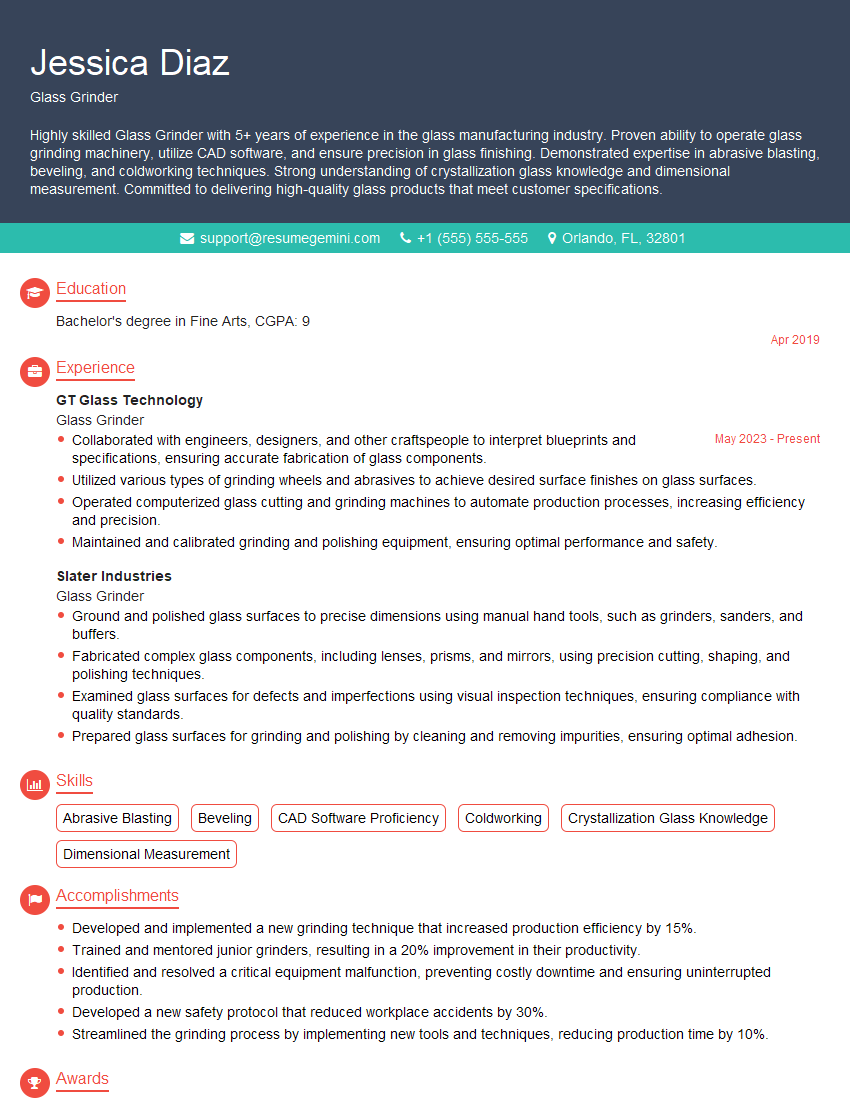
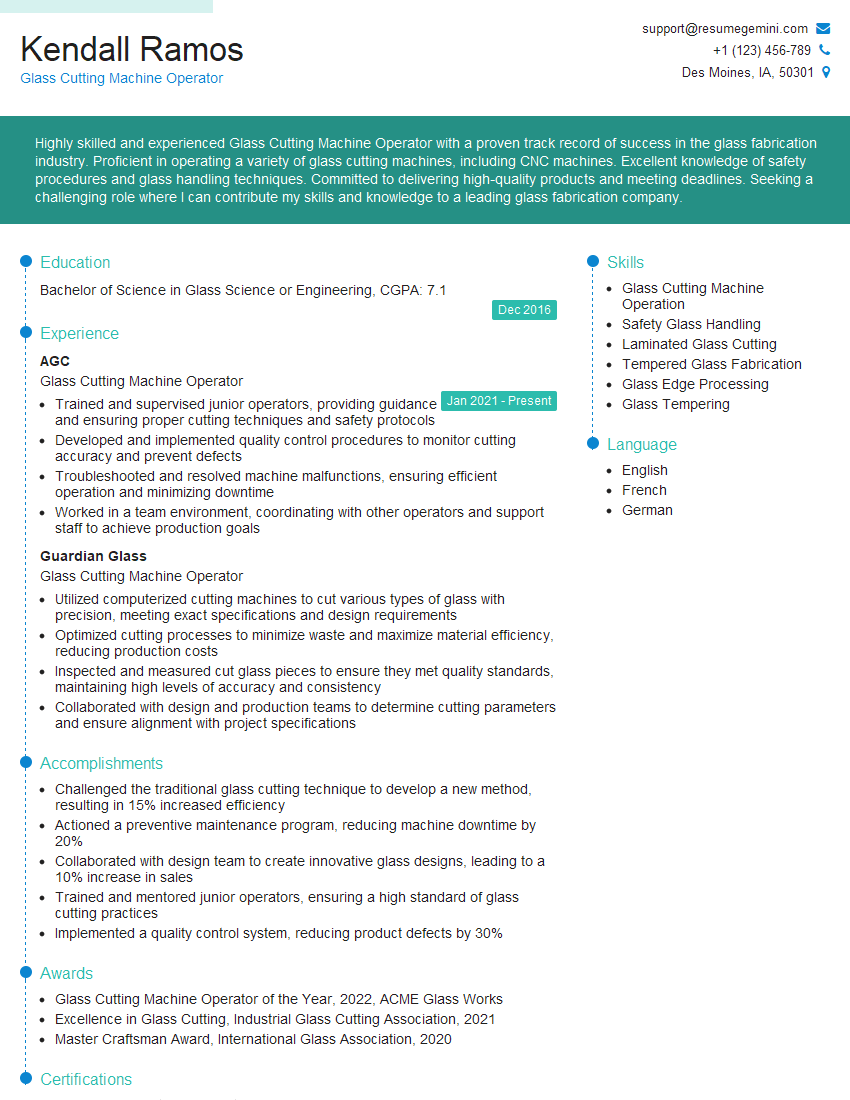
Mastering Glass Cutting, Polishing, and Edging opens doors to a rewarding career with excellent growth potential. Your expertise in these areas is highly sought after in various industries. To maximize your job prospects, create an ATS-friendly resume that highlights your skills and experience effectively. ResumeGemini is a trusted resource that can help you build a professional and impactful resume. We provide examples of resumes tailored to Glass Cutting, Polishing, and Edging to guide you in creating a document that showcases your abilities and gets you noticed by potential employers.


Explore more articles
Users Rating of Our Blogs
Share Your Experience
We value your feedback! Please rate our content and share your thoughts (optional).
What Readers Say About Our Blog
To the interviewgemini.com Webmaster.
Very helpful and content specific questions to help prepare me for my interview!
Thank you
To the interviewgemini.com Webmaster.
This was kind of a unique content I found around the specialized skills. Very helpful questions and good detailed answers.
Very Helpful blog, thank you Interviewgemini team.