Interviews are opportunities to demonstrate your expertise, and this guide is here to help you shine. Explore the essential Glass Repair and Restoration Techniques interview questions that employers frequently ask, paired with strategies for crafting responses that set you apart from the competition.
Questions Asked in Glass Repair and Restoration Techniques Interview
Q 1. Describe your experience with different types of glass (e.g., tempered, laminated, annealed).
My experience encompasses all major glass types used in automotive and architectural applications. Annealed glass, also known as float glass, is the most common type – think of your standard window pane. It’s relatively inexpensive and easily cut, but shatters into sharp shards when broken. Tempered glass, on the other hand, is significantly stronger due to a heat-treating process. When it breaks, it crumbles into small, relatively harmless pieces, making it ideal for car windshields and shower doors. This is crucial for safety. Finally, laminated glass consists of two or more layers of annealed glass bonded together with a layer of polyvinyl butyral (PVB) interlayer. This interlayer holds the glass fragments together even when broken, preventing penetration and reducing the risk of injury – a common feature in car windshields. I’ve worked extensively with all three, repairing minor damage in annealed and laminated glass and understanding the limitations and repair possibilities for tempered glass (which is generally replaced rather than repaired).
For example, I’ve successfully repaired minor chips and cracks in annealed glass using resin injection, while recognizing that large cracks or star breaks in tempered glass often necessitate replacement due to safety concerns. Understanding the distinct properties of each glass type is fundamental to determining the best repair approach, ensuring both safety and cost-effectiveness.
Q 2. Explain the process of repairing a chipped windshield.
Repairing a chipped windshield involves precision and specialized tools. First, the area surrounding the chip is thoroughly cleaned to remove any dirt, debris, or existing sealant. Next, a specialized resin is carefully injected into the chip using a syringe-like tool. This resin is formulated to match the refractive index of the glass, making the repair virtually invisible. Once injected, the resin is cured using UV light, solidifying it and filling the chip completely. Any excess resin is then carefully removed, and the area is polished to restore the smoothness of the glass surface. The entire process requires a steady hand and attention to detail to ensure a seamless and durable repair.
For example, a small bullseye chip—a relatively simple repair—requires less time and resin than a larger crack that extends across multiple layers. If there are structural compromises the client needs to be made aware that full windshield replacement may be necessary, particularly in instances where the crack threatens the structural integrity of the glass.
Q 3. How do you assess the repairability of a cracked window?
Assessing repairability depends on several factors. The size and type of crack are crucial. Small chips or cracks, especially those that don’t penetrate multiple layers of laminated glass, are usually repairable. Cracks that are larger than approximately one inch, spider-webbing cracks, or those that extend into the driver’s direct line of sight generally aren’t. The location of the damage also matters; damage in the driver’s field of vision usually warrants replacement. Finally, the severity of damage influences the decision. A severely damaged windshield that compromises structural integrity demands replacement.
I always inspect the damage carefully. If there is any doubt about repairability, I recommend a full replacement to ensure safety. Imagine a long, deep crack in the windshield — the risk of it propagating is simply too high to justify a repair. Safety is always my paramount concern.
Q 4. What are the safety precautions you take when working with broken glass?
Safety is paramount when handling broken glass. I always wear heavy-duty gloves to prevent cuts. Eye protection, such as safety glasses, is essential to guard against flying fragments. A dust mask reduces the inhalation of tiny glass particles. Furthermore, I work in a well-ventilated area to prevent the buildup of resin fumes. Before starting any repair I take the time to thoroughly clean the damaged area removing any potential hazards. I carefully collect all broken glass fragments, using a brush and dustpan, and dispose of them properly in sealed containers. A full safety brief is given to clients before any repair commences, including information on how to minimize the risk of injury while waiting for repair to commence.
Q 5. Describe your experience with different glass repair resins and adhesives.
My experience includes a wide range of glass repair resins and adhesives. I use UV-curable resins for most windshield repairs. These resins are designed to fill chips and cracks, matching the refractive index of the glass. The formulation I choose depends on the specific needs of the job, the type of glass and the severity of the damage. Certain resins offer increased strength or UV resistance, particularly important for repairs exposed to harsh sunlight. Adhesives, on the other hand, are used for bonding glass panels together during replacement or in the repair of minor cracks, ensuring a secure fit. The selection of the appropriate resin is based on a combination of factors: the type and size of damage, the specific type of glass, and environmental conditions.
For instance, a high-strength resin might be necessary for a repair in a high-impact area of a vehicle, while a different resin might be better suited to more aesthetically-sensitive areas. Selection of materials plays a major role in the longevity and structural integrity of the repair.
Q 6. How do you determine the appropriate type of sealant for a particular glass repair job?
Choosing the right sealant is crucial for a long-lasting repair. The type of sealant depends on the application and the materials being joined. For example, polyurethane sealants are commonly used in automotive applications due to their flexibility and ability to withstand vibration and temperature fluctuations. Silicone sealants are suitable for some architectural applications, offering excellent adhesion and water resistance. However, silicone can be more difficult to clean up and isn’t always compatible with all glass or other materials. I always assess the specific requirements of the job, considering factors such as the type of glass, the environmental conditions, and the required level of adhesion and durability.
Imagine repairing a cracked window in a bathroom versus a car window. In the bathroom, a sealant that is resistant to moisture and high humidity is required, unlike the application in a car where resistance to vibrations and extreme temperature differences is more important.
Q 7. What tools and equipment are essential for effective glass repair and restoration?
Effective glass repair and restoration requires specialized tools and equipment. A UV curing light is essential for hardening the resin used in chip repairs. Various syringes and applicators allow for precise resin injection into cracks and chips. A range of resin formulations caters to different needs. A high-quality vacuum system removes air bubbles during the resin injection process. Finally, polishing tools and compounds are needed to achieve a smooth, seamless finish. The use of specific tools varies with the nature of the repair and the type of glass being worked on. For example, a tempered glass replacement requires different tools than a simple chip repair in annealed glass.
Having the right tools greatly influences the speed and quality of the repair work. For instance, using a low-quality UV light might result in incomplete curing, compromising the integrity of the repair.
Q 8. How do you handle different types of glass damage (e.g., scratches, chips, cracks)?
Handling different types of glass damage requires a tailored approach. The severity and type of damage dictate the repair strategy.
- Scratches: Minor scratches on non-critical surfaces might only need polishing with specialized compounds. Deeper scratches on highly visible areas may require more intensive polishing or, in extreme cases, replacement. Think of it like sanding out a scratch on a car – the depth determines the necessary level of intervention.
- Chips: Small chips can sometimes be filled with specialized glass fillers, carefully matched to the glass color. This is a good solution for minor chips on less-visible areas. Larger chips frequently need more significant intervention, potentially involving replacement of the entire glass pane.
- Cracks: Cracks are the most complex to manage. Small cracks in non-structural glass might be stabilized using resin injection techniques, filling the crack and preventing further propagation. This is like mending a broken bone with a cast; it stabilizes the damage but doesn’t completely restore it. Larger or complex cracks usually necessitate glass replacement for structural integrity and safety.
The choice of repair method always prioritizes safety and the aesthetic outcome, balancing cost-effectiveness with the desired result.
Q 9. Explain your experience with glass restoration techniques for antique or historical glass.
Restoring antique or historical glass demands meticulous care and specialized techniques. It’s not just about fixing the damage; it’s about preserving the historical integrity of the piece.
I’ve worked on several projects involving stained glass windows and antique mirrors, each requiring different approaches. For instance, stained glass restoration often involves lead repair, cleaning the glass surface without damaging the paint or patina, and potentially the careful replacement of broken pieces using historically accurate techniques and materials. With antique mirrors, the focus is often on preserving the delicate silvering on the back of the glass, using specialized cleaning solutions and repair methods. I always research the history and manufacturing method of the piece to inform my restoration process.
The most important aspect is using the least invasive methods. Replacement is a last resort, and often conservation and stabilisation are prioritised over full restoration. Documenting the process is also crucial for historical accuracy and future restoration attempts.
Q 10. Describe your process for cleaning and preparing glass surfaces before repair.
Proper cleaning and preparation are fundamental to successful glass repair. A clean surface ensures optimal adhesion of any filler or adhesive materials.
- Initial Cleaning: I begin with a thorough cleaning using soft cloths, distilled water, and a mild, non-abrasive detergent. Avoid any harsh chemicals that could damage the glass or its coatings.
- Degreasing: Next, I carefully degrease the surface using isopropyl alcohol. This removes any remaining oils or residues that might compromise the bond. This is crucial for achieving a long-lasting repair.
- Drying: The surface must be completely dry before proceeding. I use lint-free cloths or compressed air to ensure no debris remains.
- Inspection: A final visual inspection ensures the surface is clean, dry, and ready for the repair process. Any remaining dirt or imperfections will compromise the quality of the final repair.
This process is essential regardless of the type of damage or repair method. A clean surface is the foundation of a lasting repair.
Q 11. How do you ensure the structural integrity of a repaired glass unit?
Ensuring the structural integrity of a repaired glass unit depends on several factors, primarily the type of damage and the repair method. For simple repairs like filling minor chips, the structural integrity is generally not significantly affected. However, with cracks or larger damages, the structural integrity requires careful attention.
- Crack Repair: When repairing cracks, the use of high-quality resin and proper injection techniques is crucial. The resin must fully penetrate the crack, bonding the broken pieces and restoring strength. This is analogous to using epoxy to join two pieces of wood; proper curing time and even distribution of the resin are crucial.
- Laminated Glass: In the case of laminated glass, the interlayer helps maintain structural integrity even with significant damage. Repair often focuses on the cosmetic aspects rather than fundamental structural reinforcement.
- Replacement: For extensive damage, complete replacement is the safest option to guarantee structural integrity.
Regular inspections after repair are also crucial to ensure the repair holds up under stress and environmental conditions.
Q 12. What are your troubleshooting strategies for common glass repair issues?
Troubleshooting in glass repair requires a methodical approach. Common issues include poor adhesion, incomplete crack filling, or discoloration of the repair material.
- Poor Adhesion: This usually results from insufficient cleaning or the presence of contaminants on the glass surface. The solution is to carefully clean the area again, ensuring complete removal of oils, dirt, and residues before re-attempting the repair.
- Incomplete Crack Filling: This may occur if the resin injection technique isn’t properly executed or if the crack is too complex. Re-injecting resin with an improved technique might resolve this. In some cases, additional support structures or a different repair strategy might be needed.
- Discoloration: Discoloration can stem from using an inappropriate resin or allowing insufficient curing time. Using a correct resin that matches the glass color and allowing the sufficient drying time are vital.
Careful observation, understanding the cause of the issue, and applying the correct corrective action are paramount.
Q 13. Explain your understanding of Insulated Glass Units (IGUs) and their repair.
Insulated Glass Units (IGUs) are sealed units containing two or more panes of glass separated by a spacer filled with a desiccant and an inert gas like argon. Repairing IGUs is tricky as they are sealed units.
Repairing a damaged IGU usually requires replacing the entire unit. It is rarely cost-effective to repair a broken seal, because replacing the gas and desiccant, which is essential for maintaining the insulating properties and preventing moisture buildup, is almost impossible. The process of disassembly, cleaning, refilling and re-sealing is very complex and generally not economical.
The exception is a minor damage that only affects the outer pane. In that case, replacing only the damaged outer pane is possible, keeping the remaining parts of the IGU intact.
Q 14. How do you handle customer complaints or unexpected issues during a job?
Handling customer complaints or unexpected issues is crucial for maintaining professionalism and client satisfaction. My approach emphasizes open communication, transparency, and a focus on finding solutions.
- Listen and Acknowledge: I begin by actively listening to the customer’s concerns and acknowledging their frustration. Empathy is key.
- Assess the Situation: I thoroughly assess the situation to understand the root cause of the problem. This might involve revisiting the site or reviewing my work process.
- Propose Solutions: Based on my assessment, I propose a solution that addresses the customer’s concerns and minimizes further disruption. This might involve rework, adjustments to the original plan, or a partial refund.
- Follow Up: Once the issue is resolved, I follow up with the customer to ensure their satisfaction. This demonstrates accountability and builds trust.
Treating each customer with respect and focusing on solutions, even unexpected ones, is paramount to maintaining a positive professional reputation.
Q 15. Describe your experience with different types of glass cutting and shaping techniques.
Glass cutting and shaping is a precise art, requiring a blend of skill and the right tools. My experience encompasses various techniques, from the traditional to the more advanced. For example, I’m proficient in using a glass cutter, a tool that requires a steady hand and precise scoring to create clean breaks. This is ideal for simpler cuts on flat glass. For more intricate shapes and curved pieces, I utilize a wet saw, which uses a diamond blade and water coolant for smoother cuts and prevents chipping. This is particularly useful when working with thicker glass or creating custom shapes for projects like stained-glass windows. Furthermore, I’ve extensively worked with CNC glass cutting machines for high-volume, precision work, guaranteeing consistency and accuracy in complex designs. I’m also skilled in using a grinding wheel for refining edges and smoothing out imperfections after cutting. Finally, specialized techniques like flame polishing are utilized for improving the aesthetic quality and durability of the glass edges, particularly vital in high-end restoration projects.
- Glass Cutter: Ideal for straight cuts on flat glass.
- Wet Saw: Best for curved or intricate shapes, thicker glass.
- CNC Cutting: High-volume, precise cutting for complex designs.
- Grinding Wheel: Refining edges and removing imperfections.
- Flame Polishing: Improves aesthetics and durability of glass edges.
Career Expert Tips:
- Ace those interviews! Prepare effectively by reviewing the Top 50 Most Common Interview Questions on ResumeGemini.
- Navigate your job search with confidence! Explore a wide range of Career Tips on ResumeGemini. Learn about common challenges and recommendations to overcome them.
- Craft the perfect resume! Master the Art of Resume Writing with ResumeGemini’s guide. Showcase your unique qualifications and achievements effectively.
- Don’t miss out on holiday savings! Build your dream resume with ResumeGemini’s ATS optimized templates.
Q 16. What are the common causes of glass breakage, and how can they be prevented?
Glass breakage often stems from a combination of factors. Thermal stress is a major culprit; rapid temperature changes, like a sudden blast of cold air on a heated pane, can cause cracking. Impact damage, from accidental collisions or even small objects, is another common cause. Improper installation is a frequent oversight; inadequate support, incorrect fastening, or sealant failure can leave glass vulnerable. Finally, inherent flaws within the glass itself, such as internal stresses during manufacturing, can predispose it to breaking under relatively minor stress. Prevention hinges on addressing these root causes. Careful temperature regulation, using protective films or laminates to increase impact resistance, and meticulous installation practices with appropriate supports and sealants are crucial steps. Regular inspections to catch potential issues early are also essential.
- Thermal Stress: Avoid rapid temperature fluctuations.
- Impact Damage: Use protective films or tempered glass.
- Improper Installation: Ensure proper support and sealant.
- Inherent Flaws: Inspect glass carefully for defects.
Q 17. Explain your experience with the installation and repair of different types of glass.
My experience with glass installation and repair spans a wide range of applications, from simple window replacements to complex architectural projects. I’ve worked with various types of glass, including annealed glass (standard window glass), tempered glass (safety glass used in automotive and shower enclosures), laminated glass (two sheets bonded with a plastic interlayer for enhanced safety and impact resistance), and insulated glass units (IGUs), also known as double or triple-pane windows, designed for better insulation. The installation process varies depending on the glass type and the application. For example, IGUs require careful handling to avoid damage to the seal and precision in aligning the unit within its frame. Tempered glass needs special attention due to its safety aspects. Repair techniques vary depending on the nature of the damage. Minor chips can sometimes be repaired using specialized resins. However, extensive damage usually requires full glass replacement to maintain safety and structural integrity. For example, a cracked car windshield will generally require complete replacement, rather than repair.
Q 18. How do you maintain your tools and equipment?
Maintaining my tools and equipment is paramount to ensuring both safety and the quality of my work. Glass cutters need regular cleaning to remove debris and prevent scoring inaccuracies. Wet saw blades require periodic replacement to maintain sharpness and prevent uneven cuts. I regularly clean and lubricate my grinding wheels, and ensure that all electrical tools are checked for proper grounding and insulation. I also store all my tools properly to prevent damage or accidental injury. This includes storing blades in protective cases and keeping smaller tools organized in designated compartments. Regular maintenance schedules are followed, and any damaged or worn-out tools are replaced promptly. This proactive approach prevents costly repairs in the long run and avoids potential errors that could compromise a project.
Q 19. What are your knowledge of relevant safety regulations and building codes concerning glass?
I’m intimately familiar with relevant safety regulations and building codes concerning glass, specifically those related to safety glass requirements in various applications. These vary depending on the location and type of construction. For instance, tempered glass is often mandated for shower enclosures and exterior doors due to its enhanced strength and safety characteristics. Laminated glass is frequently required for applications where safety is paramount, such as vehicle windshields. I always adhere to strict safety protocols during handling and installation. I’m up to date on the latest safety standards and regularly review code updates to remain compliant and ensure my work always meets the highest standards of safety and performance.
Q 20. How do you estimate the time and cost required for a glass repair job?
Estimating the time and cost for a glass repair job involves a systematic approach. First, a thorough assessment of the damage is essential to determine the scope of work required. This includes identifying the type of glass, the size of the damaged area, and the complexity of the repair or replacement. Then, I factor in the time needed for tasks like cutting, shaping, installing, and cleaning. Material costs, including the price of glass and sealants, are crucial components. Labor costs, based on my hourly rate and the estimated time, are then calculated. Additional factors like the accessibility of the work site and any special equipment needs might influence the overall cost. I always provide detailed, transparent estimates to my clients, allowing them to make informed decisions. For example, a simple window pane replacement will have a considerably lower estimate than a complex, custom-shaped glass installation.
Q 21. What is your experience with different types of glass sealants and their applications?
My experience includes a wide variety of glass sealants, each suited to specific applications and glass types. Silicone sealants are versatile and commonly used for general glazing, providing excellent adhesion and flexibility. They are often preferred for exterior applications due to their weather resistance. Polyurethane sealants are another popular choice, known for their superior strength and durability, making them suitable for structural glazing. Butyls are used for creating airtight seals in IGUs (insulated glass units). The choice of sealant depends heavily on the project’s specific requirements. For instance, a high-performance building might require a sealant with enhanced thermal properties, while a historic restoration could necessitate a sealant that matches the original material’s aesthetic. I always ensure proper surface preparation before application to ensure a strong, long-lasting bond. Incorrect sealant selection or application can lead to leaks and premature failure, so careful consideration is vital.
Q 22. Describe your understanding of glass properties and their impact on repair techniques.
Understanding glass properties is fundamental to successful repair. Different types of glass – annealed, tempered, laminated, etc. – possess varying strengths, fracture patterns, and responses to repair techniques. Annealed glass, for example, shatters into sharp shards upon impact, making repair often impractical; replacement is usually necessary. Tempered glass, on the other hand, fragments into small, relatively harmless cubes, offering potential for repair in certain situations using resin injection. Laminated glass, with its interlayer of plastic, holds together even when cracked, providing ample opportunity for repair by filling the cracks with resin.
The thickness of the glass also plays a crucial role. Thicker glass requires more robust repair methods, while thinner glass might be more susceptible to further damage during the repair process. Finally, the type of damage—a simple crack, a large shatter, or a chip—dictates the appropriate repair approach. For instance, a small chip in a car windshield might be easily repaired with resin, while a large crack might necessitate replacement.
Q 23. What is your experience with working at heights or using specialized equipment?
Safety is paramount in my work. I’m experienced and certified in working at heights, utilizing harnesses, safety lines, and scaffolding as needed. I’ve completed numerous projects involving high-rise buildings and challenging access points. This includes working on stained glass windows in cathedrals and repairing skylights on multi-story structures. My experience with specialized equipment encompasses the safe and proficient use of cherry pickers, aerial work platforms, and vacuum lifters for handling large glass panels.
I’m also proficient with various power tools used in glass repair and replacement, always adhering to stringent safety protocols. This includes proper ventilation when working with certain sealants and the use of appropriate personal protective equipment (PPE) such as safety glasses, gloves, and respirators.
Q 24. Describe your experience with repairing stained glass windows.
Repairing stained glass windows demands meticulous attention to detail and specialized skills. My experience includes restoring antique windows, where the preservation of historical integrity is crucial. This involves careful assessment of the damage, identifying the type of glass (often lead-based), and selecting appropriate repair techniques. Often, I employ traditional methods such as lead soldering and glass cutting to replace damaged pieces, ensuring a seamless integration with the existing structure.
For more minor damage, I use specialized glass cements and epoxy resins designed for stained glass. Color matching is critical in these situations, requiring a keen eye for detail and the ability to mix and blend pigments accurately. I have extensive experience working with various lead came designs and understanding the structural integrity of the window to ensure longevity after the repair.
Q 25. Explain the process of replacing a damaged car windshield.
Replacing a car windshield involves several steps. First, the old windshield is carefully removed. This involves cutting the old sealant around the perimeter using a specialized tool, often a wire tool, and then gently separating the glass from the frame. Next, the area is thoroughly cleaned to remove any remaining sealant and debris. The new windshield is then positioned carefully into the frame, ensuring proper alignment.
A new bead of automotive-grade urethane sealant is applied around the perimeter of the windshield. The windshield is held in place until the sealant cures, typically using clamps or suction cups. After the sealant has cured (usually a few hours), the clamps are removed and any excess sealant is cleaned away. Finally, a thorough inspection is performed to ensure a secure and leak-proof fit. This process requires precision and attention to detail to maintain the structural integrity and safety of the vehicle.
Q 26. What are the different methods of removing old sealant from glass?
Removing old sealant is a crucial step in many glass repair and replacement projects. The method used depends on the type of sealant. For older, brittle sealants, a sharp utility knife or specialized sealant removal tool can be used carefully to scrape away the material. This requires precision to avoid damaging the surrounding glass or frame. For more resilient sealants, chemical removers might be necessary. These solvents must be carefully selected and used according to the manufacturer’s instructions, as they can be corrosive and should always be used in a well-ventilated area.
Mechanical methods, such as using a heat gun to soften the sealant before removal, are also effective in some cases. However, this must be done with caution to prevent damage to the glass or frame. After removal, the area needs thorough cleaning to ensure a clean surface for new sealant application.
Q 27. Explain your experience with using specialized glass repair equipment (e.g., resin injectors, UV lamps).
I’m proficient in using various specialized glass repair equipment. Resin injectors allow for the precise application of resin into cracks, filling them and restoring structural integrity. Different types of resin are available, each suited to particular glass types and damage severities. UV lamps are then used to cure the resin, hardening it and completing the repair process. The intensity and duration of UV exposure need careful control to avoid damaging surrounding materials or causing discoloration.
Beyond resin injectors and UV lamps, I also have experience with glass grinding and polishing tools for smoothing out rough edges or minor imperfections after repairs. I understand the importance of using the correct equipment for the task, ensuring consistent results and longevity of repair work. Proper maintenance of this equipment ensures consistent and reliable performance.
Q 28. Describe your understanding of the environmental impact of glass repair and disposal practices.
Environmental responsibility is a significant concern in glass repair and disposal. The improper disposal of glass can lead to environmental damage. Therefore, I always prioritize recycling whenever possible. Many glass types are recyclable, and I ensure proper sorting and disposal procedures are followed. Using environmentally friendly sealants and resins reduces the potential environmental impact of the repair process. These products minimize volatile organic compounds (VOCs) and other harmful substances.
Furthermore, responsible waste management, including the proper disposal of solvents and other hazardous materials, is critical. I am well-versed in local regulations and best practices for safe and responsible disposal. Promoting the repair of glass rather than immediate replacement reduces the demand for new glass production, significantly lessening the environmental burden associated with manufacturing and transportation.
Key Topics to Learn for Glass Repair and Restoration Techniques Interview
- Types of Glass Damage: Understanding various glass defects (cracks, chips, scratches, pitting) and their causes is fundamental. This includes recognizing differences in glass types (e.g., annealed, tempered, laminated).
- Repair Techniques: Mastering techniques like resin injection, chip repair, scratch removal, and the use of specialized tools and equipment. Consider the practical application of these techniques on different glass surfaces (e.g., automotive, architectural).
- Restoration Methods: Explore advanced restoration methods such as polishing, buffing, and the use of specialized coatings to improve clarity and durability. Be prepared to discuss the pros and cons of different restoration approaches.
- Material Science: A solid understanding of glass composition, properties, and behavior under stress is crucial. This includes knowledge of different glass treatments and their impact on durability and repairability.
- Safety Procedures: Demonstrate familiarity with safe handling of glass, appropriate personal protective equipment (PPE), and waste disposal procedures. This is a critical aspect of the profession.
- Troubleshooting and Problem-Solving: Be prepared to discuss your approach to diagnosing complex glass damage, selecting the appropriate repair or restoration method, and overcoming unforeseen challenges.
- Industry Standards and Best Practices: Familiarity with relevant industry standards, codes, and best practices is crucial for demonstrating professionalism and competence.
Next Steps
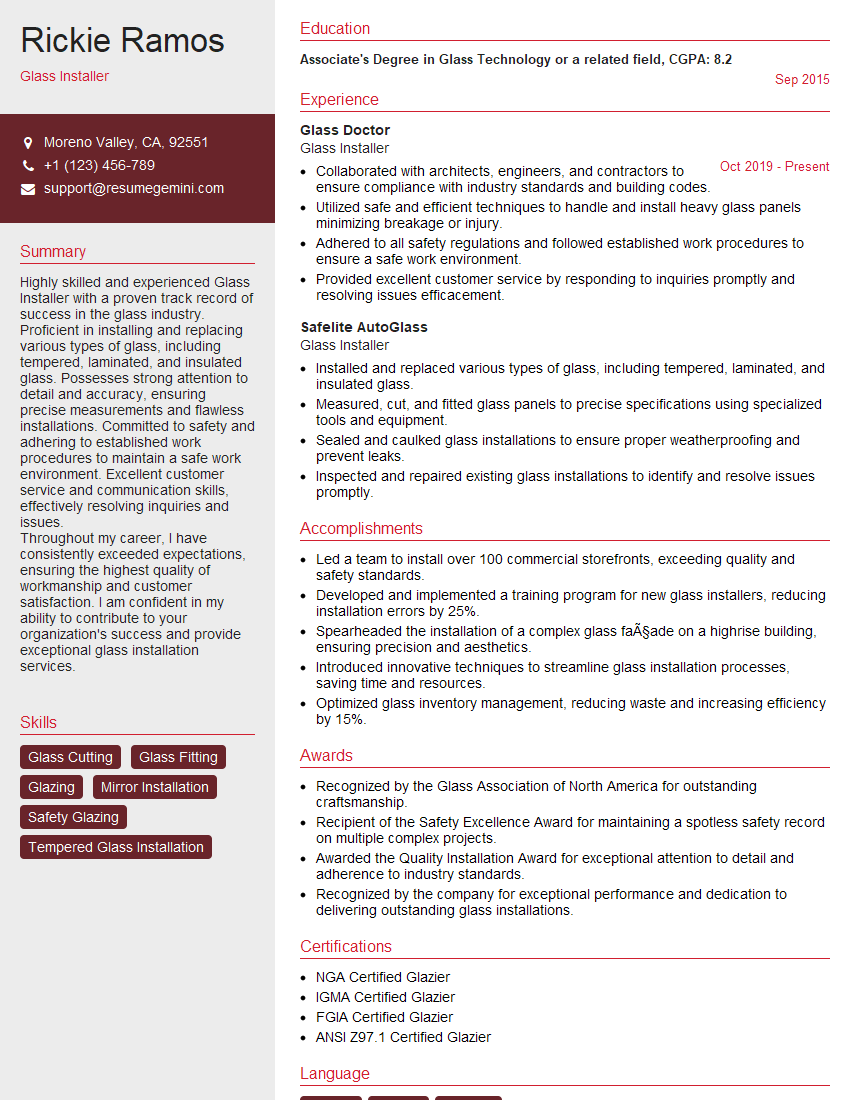
Mastering Glass Repair and Restoration Techniques opens doors to a rewarding career with diverse opportunities for growth and specialization. To maximize your job prospects, a strong, ATS-friendly resume is essential. ResumeGemini is a trusted resource to help you create a professional and impactful resume that highlights your skills and experience effectively. Examples of resumes tailored to Glass Repair and Restoration Techniques are available to guide your resume building process. Invest time in crafting a compelling resume – it’s your first impression on potential employers.


Explore more articles
Users Rating of Our Blogs
Share Your Experience
We value your feedback! Please rate our content and share your thoughts (optional).
What Readers Say About Our Blog
To the interviewgemini.com Webmaster.
Very helpful and content specific questions to help prepare me for my interview!
Thank you
To the interviewgemini.com Webmaster.
This was kind of a unique content I found around the specialized skills. Very helpful questions and good detailed answers.
Very Helpful blog, thank you Interviewgemini team.