Cracking a skill-specific interview, like one for Leaded Glass Etching, requires understanding the nuances of the role. In this blog, we present the questions you’re most likely to encounter, along with insights into how to answer them effectively. Let’s ensure you’re ready to make a strong impression.
Questions Asked in Leaded Glass Etching Interview
Q 1. Explain the process of cutting leaded glass.
Cutting leaded glass, specifically the glass pieces themselves, is done using a glass cutter. Think of it like cutting a pizza, but with significantly more precision required! It’s crucial to use a good quality oil-fed glass cutter to ensure a clean, straight cut. The process begins with scoring the glass with the cutter, applying even pressure along a straight edge. This creates a tiny fracture along the scored line. Then, carefully snap the glass along the scored line using a pair of pliers or a glass breaking tool. It’s important to support the glass properly to avoid chipping or shattering. Practice is key; you’ll develop a feel for the right amount of pressure and technique to achieve perfect cuts.
For more complex shapes, you might use a glass grinder to refine the edges or create curves. Imagine shaping a stained-glass flower petal – you wouldn’t be able to achieve that precise curve with just a cutter.
Remember, always wear safety glasses when cutting glass to protect your eyes from flying fragments.
Q 2. Describe different types of lead came used in leaded glass.
Lead came, the metal framework that holds the glass pieces together, comes in various types, each offering different properties and aesthetic qualities. The most common types include:
- H-Came: This is the classic ‘H’ shaped came, offering strength and a readily available, relatively inexpensive option.
- Zinc Came: A more modern alternative, zinc came is stronger and less prone to lead poisoning concerns. However, it can be more challenging to solder.
- Antique Came: This often refers to reclaimed lead came, which adds character and a vintage feel to the project. Finding consistent quality can be a challenge.
- Different Lead Weights: Lead came is also available in varying weights, with thicker came suitable for larger projects or areas requiring more structural support. A thinner came might be ideal for a smaller, delicate piece.
The choice of came depends on your project’s needs, aesthetic preferences, and budget. Consider the size and weight of your glass, the complexity of the design, and your own comfort level with soldering different types of came.
Q 3. How do you select the appropriate solder for a leaded glass project?
Selecting the right solder is paramount for a strong and beautiful leaded glass piece. The wrong solder can lead to weak joints, discoloration, or even project failure. The key factor is the solder’s melting point. You’ll typically use a lead-based solder or a lead-free alternative.
Lead-based solder: Traditionally used, offering excellent flow and strength. However, be aware of the health and environmental concerns associated with lead. Always work in a well-ventilated area and use appropriate safety equipment.
Lead-free solder: A safer alternative, utilizing tin and other metals. While it’s generally a bit more challenging to work with (requiring higher temperatures and potentially more flux), the environmental and health benefits are significant. The specific type of lead-free solder you choose might depend on the type of came used.
Regardless of the choice, ensure the solder is compatible with your came. The solder should melt at a temperature that allows it to flow easily into the joint without damaging the glass or came. Check manufacturer’s recommendations for both the came and solder to ensure compatibility.
Q 4. What are the safety precautions when working with leaded glass?
Safety is paramount when working with leaded glass. Lead dust and fumes are hazardous, so always work in a well-ventilated area. Wear a dust mask rated for lead particles to prevent inhalation of lead dust during cutting, grinding, and soldering. Gloves are essential to protect your hands from cuts and chemicals.
Safety glasses are a must-have to protect your eyes from flying glass fragments during cutting and soldering. Consider a face shield for additional protection. Use a soldering iron with a temperature control to prevent overheating and burns. Finally, always dispose of lead waste properly according to your local regulations – don’t just throw it in the trash.
Remember that lead poisoning can cause serious health issues, therefore taking these precautions isn’t just recommended – it’s essential.
Q 5. Explain the process of foiling glass pieces for leaded glass.
Foiling glass pieces is a crucial step in creating a professional-looking leaded glass project, especially for those pieces without a pre-applied copper foil. It involves applying a thin copper foil tape to the edges of your glass pieces before soldering. This tape acts as a barrier between the glass and the solder, ensuring a clean and uniform finish. You need a copper foil tape specifically designed for stained glass. It comes in various widths. Choose one slightly wider than the came you’ll be using.
The process involves carefully applying the foil tape around the perimeter of the glass, pressing it firmly to ensure good adhesion. You then use a specialized glass foil tool to burnish the foil, creating a tight seal and removing any air bubbles. This creates a clean, smooth edge that will result in a professional-looking solder line.
Imagine painting the edge of your glass with a thin metallic ribbon – this is the effect you’re going for. It’s a delicate process, requiring patience and attention to detail. Proper foiling makes the difference between a high quality piece and a less professional looking one.
Q 6. Describe different methods for cleaning leaded glass.
Cleaning leaded glass depends on the type of dirt or grime you’re dealing with. For light dusting, a soft, dry cloth or a feather duster will suffice. For more stubborn dirt, use a damp cloth with a mild dish soap solution. Avoid harsh chemicals or abrasive cleaners that could scratch the glass or dull the lead.
For more thorough cleaning, you can use a soft-bristled brush to gently remove dirt from the grooves of the lead came. Always rinse thoroughly with clean water and dry with a soft cloth to prevent water spotting.
Never use harsh chemicals or abrasive cleaners, especially on antique leaded glass. It’s best to err on the side of caution and use gentle methods to preserve the integrity and beauty of your piece. For difficult cleaning problems, consider consulting a professional stained glass conservator.
Q 7. How do you repair cracked or broken leaded glass?
Repairing cracked or broken leaded glass can be challenging and often requires a good deal of skill. Small cracks can sometimes be stabilized with clear epoxy resin, applied carefully to fill the crack without affecting the overall appearance. For more significant damage, replacing the broken pieces is usually necessary.
The repair process requires careful removal of the damaged sections. You might need specialized tools to separate the glass and came without causing further damage. The broken glass pieces need to be replaced with identical pieces (or the closest match possible). Then, you’ll have to carefully re-solder the connections and clean the repaired area.
For major repairs or especially valuable pieces, you should consult a professional stained glass restorer. They possess the expertise and tools necessary to perform a restoration that preserves the integrity and aesthetic value of the piece. Attempting a complex repair without the necessary skills can cause more harm than good.
Q 8. What are common problems encountered during leaded glass construction?
Common problems in leaded glass construction often stem from the intricate nature of the work. One major issue is lead came breakage, usually caused by mishandling, excessive pressure during assembly, or poor-quality came. Another significant challenge is glass breakage, particularly with older or more brittle glass types. Improper cutting or scoring can lead to cracks and shattering. Soldering issues are also prevalent; insufficient heat, improper flux application, or contaminated solder can result in weak or uneven joints. Finally, design flaws, such as inconsistent lead line spacing or improper sizing of glass pieces, can cause significant problems during assembly and ultimately affect the structural integrity and aesthetic appeal of the finished panel. Addressing these challenges requires careful planning, precision cutting, and a firm understanding of materials and techniques.
Q 9. Explain the process of patination in leaded glass.
Patination in leaded glass refers to the process of artificially aging the lead came to create a desired aesthetic. Traditionally, this involves applying a chemical solution, often a mixture of acids and sulfides, to the lead to oxidize its surface. This oxidation creates a darker, more aged appearance, often ranging from a subtle darkening to a rich, almost black patina. The process can be controlled to achieve varying shades and levels of antiquing. For example, a shorter exposure time will yield a lighter patina, while longer exposure will result in a deeper, more dramatic effect. It’s crucial to protect the glass during patination to prevent etching or damage from the chemical solutions. Safety precautions, such as wearing gloves, eye protection, and working in a well-ventilated area, are paramount during this process. Different patinas can be achieved by varying the chemical solution’s concentration and exposure time, allowing for great artistic control.
Q 10. How do you design a leaded glass panel?
Designing a leaded glass panel is a multi-step process that begins with understanding the client’s needs and the intended location. I usually start by sketching initial ideas, exploring various patterns and styles. This is followed by creating a full-scale drawing, often using specialized software (more on that later). This drawing determines the size and shape of the panel, the placement of individual glass pieces, and the flow of the lead lines. Careful attention is paid to the balance and harmony of colors and textures. Next, I create a detailed cutting plan, specifying the dimensions and shape of each individual glass piece. This step requires precise measurements to ensure a perfect fit. Finally, I often create a small-scale mock-up or prototype using less expensive materials to test the design and make necessary adjustments before proceeding with the final piece. This ensures the design works perfectly before investing significant time and materials in the final product.
Q 11. Describe different glass types suitable for leaded glass work.
Many glass types are suitable for leaded glass work, each offering unique properties. Antique glass, with its inherent imperfections and subtle variations in color and texture, adds a sense of age and charm. Cathedral glass, known for its textured surface and diffused light, creates a beautiful, soft glow. Streaky glass provides a dynamic, flowing effect with its swirled colors and patterns. Clear float glass offers a clean, modern look and excellent clarity, while colored float glass allows for precise color control and consistency. The choice of glass depends heavily on the desired aesthetic and the overall design. In some cases, I might even combine several types to create a richer and more complex effect. The important consideration is the glass’s thickness and stability to ensure it can withstand the stresses of the lead came and maintain its structural integrity.
Q 12. How do you estimate the cost of a leaded glass project?
Estimating the cost of a leaded glass project involves several factors. First, the size and complexity of the design significantly impact the time and materials required. Larger, more intricate designs will naturally cost more. The type of glass used also plays a role; antique or specialty glass is often more expensive than standard float glass. The cost of the lead came itself, as well as any additional materials like solder, flux, and patination solutions, must be considered. Finally, labor costs are a significant component; highly skilled artisans command higher rates. I usually provide detailed estimates based on a combination of these factors. I break down the cost into materials and labor, offering transparent pricing to my clients. It is important to note that unforeseen complications could arise, which can be addressed through a well-defined contract. This often involves discussing potential cost escalations up front to minimize any surprises later.
Q 13. What software or tools do you use for leaded glass design?
While traditional methods of drawing and drafting are still invaluable, I often employ digital design software for leaded glass projects. Programs like Adobe Illustrator or CorelDRAW are excellent for creating precise vector drawings of the panel layout, allowing for accurate scaling and detailed planning. These tools facilitate easy manipulation and modification of the design, making it easier to experiment with different patterns and arrangements. Furthermore, these programs often have functionalities for generating cutting plans and calculating materials. Although not specifically designed for leaded glass, the flexibility and precision they offer makes them indispensable for creating complex designs efficiently.
Q 14. Describe your experience with different glass etching techniques.
My experience with glass etching techniques is extensive, encompassing both traditional and modern methods. I’m proficient in acid etching, which uses chemical solutions to create frosted or etched designs. This is a versatile technique allowing for fine detail and varying levels of depth. I also use abrasive blasting, a method involving pressurized air and abrasive media to create textured effects on the glass. This is particularly effective for creating bold, dramatic designs. Finally, I utilize sand carving to create intricate patterns and designs. The control and level of detail achievable through this technique is remarkable. Each method offers unique aesthetic qualities and is applied according to the desired outcome and artistic vision of the project. The choice depends on the desired texture, depth, and overall artistic effect needed. Often, I combine techniques to achieve a more nuanced and layered effect. For example, I may use acid etching for finer details and abrasive blasting for larger areas requiring a textured finish.
Q 15. How do you ensure the structural integrity of a leaded glass piece?
Ensuring the structural integrity of a leaded glass piece is paramount. It’s all about creating a strong, stable framework that will withstand time and potential stress. This begins with the careful selection and cutting of the glass itself. Using high-quality glass that’s appropriately thick for the project’s size and design is crucial. Think of it like building a house – you wouldn’t use flimsy plywood for the foundation!
Next, the lead came (the lead strips used to join the glass pieces) must be properly sized and applied. Each piece of glass needs to fit snugly within the came to minimize movement and potential cracking. I always ensure the came is properly cleaned before soldering to ensure a strong bond. The solder itself acts as a crucial reinforcement, creating a robust network holding the whole piece together. Finally, the entire piece is thoroughly inspected for any loose or improperly seated glass pieces before the final solder is applied.
For instance, on a large window project, I might use thicker glass and reinforce critical areas with additional came and solder for added support. This meticulous approach prevents sagging or breakage over time, preserving the beauty and integrity of the artwork.
Career Expert Tips:
- Ace those interviews! Prepare effectively by reviewing the Top 50 Most Common Interview Questions on ResumeGemini.
- Navigate your job search with confidence! Explore a wide range of Career Tips on ResumeGemini. Learn about common challenges and recommendations to overcome them.
- Craft the perfect resume! Master the Art of Resume Writing with ResumeGemini’s guide. Showcase your unique qualifications and achievements effectively.
- Don’t miss out on holiday savings! Build your dream resume with ResumeGemini’s ATS optimized templates.
Q 16. Explain your process for creating a pattern for a leaded glass project.
Creating a pattern for leaded glass is a meticulous process that involves several key steps. First, I conceptualize the design, often sketching multiple iterations until I achieve the desired aesthetic. I then choose the glass pieces, selecting colors and textures to complement the design and create a visually appealing composition. This stage is crucial because it directly influences the final look.
Next, I create a full-scale drawing of the design on grid paper, marking the precise size and shape of each individual glass piece. This is like creating a blueprint. This drawing acts as a template for cutting the glass. I carefully mark the glass pieces based on this pattern. This precision is crucial for a seamless final product. The precise measurements are then transferred to the glass itself.
Once cut, I meticulously arrange the glass pieces according to the pattern to test the fit and ensure the accuracy of the design before soldering. Any adjustments are made during this crucial testing phase. It’s akin to a dress rehearsal before the final performance – far better to fix any issues early on.
Q 17. What are the challenges of working with antique leaded glass?
Working with antique leaded glass presents unique challenges. The glass itself is often brittle and more susceptible to damage due to age and weathering. The lead came may be corroded or weakened, requiring careful cleaning and repair before any work can begin. It’s a delicate balancing act between preservation and restoration.
Another major challenge is identifying the type of lead used and the solder composition. Older techniques used different materials, and improperly chosen replacement materials can lead to further damage or incompatible reactions. Additionally, antique pieces often have a unique patina and character that must be preserved. Restoring such pieces requires extensive experience and patience. It’s a careful process requiring a deep respect for the history and craftsmanship of the piece.
For example, I once worked on a Victorian window where the lead was incredibly fragile. I had to meticulously clean it using specialized solutions, taking extreme care to avoid breakage. The restoration process was incredibly slow, but the final result beautifully preserved the original craftsmanship.
Q 18. How do you handle irregular or curved glass pieces in leaded glass work?
Handling irregular or curved glass pieces requires advanced techniques. It starts with accurately creating a pattern that mirrors the curve. Then, I use specialized glass cutting tools— including scoring wheels and pliers— to create pieces that closely conform to the design. This requires extra precision and often involves multiple, smaller pieces to achieve the desired shape.
The lead came must also be carefully manipulated to fit these curved pieces accurately. I often use more flexible lead or even specialized techniques involving shaping the lead came itself with specialized pliers and bending tools. It’s a bit like sculpting with lead and glass, and requires a high level of skill and artistry.
For example, I once created a leaded glass lampshade with a flowing, organic shape. Achieving the smooth curves required careful shaping of the glass and the lead came, with many small adjustments to create a beautiful, flowing shape that successfully complemented the overall design.
Q 19. Describe your experience with different soldering techniques.
My experience encompasses several soldering techniques, each with specific applications. The most common is traditional tin-lead solder, a classic technique prized for its strength and relatively low melting point. However, due to the toxicity concerns surrounding lead, I also utilize lead-free solders, which offer a more environmentally responsible approach without compromising too much on quality. The choice of solder depends on the project’s requirements and personal preferences.
I employ different soldering techniques based on the project’s requirements, using a torch for larger pieces and smaller, handheld irons for finer detail work. The skill lies in controlling the heat precisely to create clean, strong solder joints without overheating or damaging the surrounding glass or lead came. Each technique requires a steady hand and careful attention to detail to ensure clean, professional results. For instance, when working with antique pieces, I often employ a more gentle approach, utilizing lower temperatures to minimize any risk of damaging delicate lead came.
Q 20. How do you maintain the quality and longevity of a leaded glass piece?
Maintaining the quality and longevity of a leaded glass piece relies on both proper construction and ongoing care. The quality of materials—from the glass to the lead and solder—directly affects its lifespan. Proper soldering techniques, as previously mentioned, are crucial in preventing leaks or weaknesses.
Once completed, a regular cleaning is essential. Avoid abrasive cleaners or harsh chemicals, as these can damage the lead or the glass’s surface. A gentle solution of warm water and mild soap is usually sufficient. Avoid direct sunlight or extreme temperature changes which can cause stress and cracking over time. For larger pieces, it may be advisable to carefully reinforce lead lines over time should any signs of weakening appear.
In summary, proper craftsmanship coupled with responsible care ensures that a leaded glass piece remains a cherished object for generations. Many of my pieces from years ago remain in perfect condition, a testament to the combined efforts of quality materials and conscientious care.
Q 21. What are the different types of glass etching tools and their applications?
Glass etching tools offer diverse applications, each designed for specific effects. The most common is the handheld rotary tool, equipped with various bits for carving intricate patterns or creating textured surfaces. These bits can range from fine abrasive points for delicate detail work to coarser bits for more aggressive etching.
Acid etching utilizes strong chemicals to eat away at the glass surface, often creating frosted or matte effects. This technique is ideal for larger areas or smoother transitions. For more controlled designs, stencils and masking techniques are used in conjunction with acid etching to protect desired areas of the glass. Sandblasting is another powerful method, providing a precise and controlled way to create intricate designs. However, due to safety concerns, specialized equipment and knowledge are needed.
Finally, newer techniques include laser etching, offering remarkable precision and the ability to create extremely detailed designs. It’s more costly, but offers great precision and scalability.
Q 22. How do you achieve different levels of opacity in etched glass?
Achieving different levels of opacity in etched glass is all about controlling the depth and intensity of the etching process. Think of it like carving into stone – a light touch creates a subtle effect, while a deeper carve produces a more opaque result.
We control opacity primarily through the duration of the etching process. A shorter etch time with a weaker etching cream results in a frosted, translucent effect. Longer etch times and stronger creams create deeper, more opaque areas. The type of etching cream also plays a role. Some creams are formulated to produce more aggressive etching, leading to quicker opacity.
For example, to create a design with both translucent and opaque elements, I might use stencils. I’d apply a stencil to protect areas I want to remain clear, then etch the exposed areas for a short period to achieve translucence. After removing the stencil, I could then reapply it selectively to protect the translucent areas while I deeply etch other parts for a completely opaque finish. This allows for great control over the final look and feel of the piece.
Q 23. Explain the process of creating a textured surface on etched glass.
Creating a textured surface on etched glass involves techniques beyond simple acid etching. We can add texture through a number of methods, each resulting in a unique aesthetic.
- Sandblasting: This is a common method for creating a variety of textures, from fine frosting to deeply etched patterns. The pressure and grain size of the sand determine the final texture.
- Using textured stencils: Instead of a flat stencil, we can use stencils with textured surfaces. When etching through these stencils, the texture of the stencil is transferred to the glass.
- Applying textured mediums before etching: We can apply materials like textured paints or pastes before etching. These materials will resist the acid, leaving behind a textured surface once the etching is complete. Think of using a textured mask, almost like sculpting with the etching cream.
- Multiple etching stages: By employing multiple etching stages, each with slightly different techniques, we can build complex textures, layering different depths and patterns.
Imagine creating a piece with a flowing, wave-like texture. This could be achieved by using a sandblasting technique with varying pressure, creating subtle shifts in texture that mimic the motion of water. Or, you might use a layered approach, etching a fine texture initially and then adding deeper grooves in a second stage to accentuate certain areas.
Q 24. How do you protect etched glass from damage?
Protecting etched glass is crucial to preserve its beauty and longevity. Once the etching is complete, the glass is more susceptible to damage compared to untreated glass.
- Proper Handling: Always handle etched glass carefully, avoiding sharp impacts and sudden temperature changes. Gloves are always recommended.
- Protective Coatings: Applying a clear sealant or protective coating is highly recommended. These coatings help to increase durability and resistance to scratches and abrasion. There are several types available – some are specifically designed for glass etching.
- Proper Storage: Store etched glass in a clean, dry environment away from dust and potential impact hazards. Consider soft padding or wrapping the pieces for additional protection.
- Regular Cleaning: Clean etched glass with a soft cloth and a mild, non-abrasive cleaner. Avoid harsh chemicals or abrasive cleaners that could damage the etched surface.
For example, a client might have an etched glass panel incorporated into a door. We’d strongly recommend a high-quality sealant to protect it from daily wear and tear, ensuring it retains its beauty for years to come.
Q 25. How do you troubleshoot common issues during the glass etching process?
Troubleshooting is a key part of the process. Several common issues can arise, but usually they are resolvable.
- Uneven Etching: This often results from inconsistencies in the application of the etching cream or stenciling. Solution: Ensure even cream application, using proper stencil techniques and checking for air bubbles under the stencil.
- Blurry lines: This can happen if the stencil isn’t securely adhered or if the etching cream bleeds under the stencil. Solution: Use a strong adhesive and ensure a perfect seal around the stencil edges.
- Weak Etching: This can result from using an old or weak etching cream, insufficient etching time, or improper cream concentration. Solution: Use fresh cream, increase etch time, and use a stronger concentration.
- Damage to Glass: This might be due to improper handling or aggressive cleaning. Solution: Prevent this by using careful handling techniques and non-abrasive cleaning materials.
I recently encountered a project where the etching was uneven. Through careful examination, I realized there were small air pockets trapped beneath the stencil. By addressing this air pocket issue and ensuring a firm stencil adhesion, I was able to successfully complete the project with an even, crisp etching.
Q 26. What are the safety precautions you take when etching glass?
Safety is paramount when working with etching chemicals. Always treat etching creams with the respect they deserve.
- Protective Gear: Always wear appropriate personal protective equipment (PPE), including gloves, eye protection, and a respirator to prevent inhalation of fumes.
- Well-Ventilated Area: Work in a well-ventilated area to minimize exposure to fumes. Ideally, work outdoors or in a space with a strong exhaust system.
- Proper Disposal: Dispose of etching chemicals according to local regulations. Never pour them down the drain.
- First Aid Knowledge: Be familiar with the first aid procedures in case of accidental exposure. Have a neutralizing agent on hand for acid spills.
Remember that etching cream is corrosive. Even a small spill can cause significant damage to skin and eyes. Safety precautions aren’t just best practice, they’re essential for your well-being.
Q 27. What are some common design considerations for leaded glass projects?
Design considerations for leaded glass projects are many and varied, balancing aesthetics with structural integrity.
- Light Source: The way light interacts with the glass is crucial. The design should consider how light will pass through the etched glass, creating patterns and shadows. A stained-glass window, for instance, relies on light to bring the colors to life.
- Overall Theme or Style: The design should complement the overall theme of the project, whether it’s a traditional Victorian style or a modern minimalist design. The etching style must be cohesive with the overall concept.
- Scale and Proportion: The size and proportion of the design elements are important, ensuring visual balance and harmony.
- Color Palette: If using color in the design, a thoughtful color palette is crucial to creating a visually appealing and balanced piece.
- Structural Integrity: The design must take into consideration the structural integrity of the leaded glass piece, ensuring it’s strong and durable.
For a project involving a large window, the design would need to be carefully planned to ensure the light passes through effectively, highlighting the etched details. Smaller designs might focus more on intricate details that only become apparent upon close inspection.
Q 28. Describe your experience with different styles of leaded glass, such as Tiffany or Art Nouveau.
I have extensive experience working with various styles of leaded glass, including Tiffany and Art Nouveau.
Tiffany Style: This style is characterized by its vibrant colors, intricate designs, and use of small, individually cut pieces of glass. My work often involves meticulously etching details onto these small pieces, adding subtle textures and highlights that enhance the overall design. The challenge lies in the precision required when etching such small areas, ensuring consistency across all the pieces.
Art Nouveau Style: Art Nouveau typically features flowing lines, organic shapes, and a strong emphasis on nature. My etching work in this style often involves creating flowing, organic patterns on the glass, mimicking natural forms like leaves, vines, or flowers. The techniques I employ here might involve multiple etching stages or the use of textured stencils to achieve the characteristic flowing textures of this design style.
In both styles, the etching serves to enhance and complement the overall design, adding depth, texture, and visual interest to the final piece. The subtle details brought out by etching are what really bring these styles to life.
Key Topics to Learn for Leaded Glass Etching Interview
- Design & Pattern Transfer: Understanding the process of transferring designs onto glass, including techniques like hand-drawing, projecting images, and using stencils. Consider the impact of different design styles on the etching process.
- Etching Techniques: Mastering various etching methods, including acid etching, abrasive blasting, and their respective strengths and weaknesses. Be prepared to discuss the safety precautions and environmental considerations associated with each.
- Lead Came & Soldering: Knowledge of different types of lead came, proper soldering techniques, and the importance of creating strong, leak-proof joints. This includes understanding the nuances of different solder alloys and their melting points.
- Glass Selection & Properties: Familiarity with various types of glass suitable for etching and their specific properties (e.g., thickness, transparency, durability). Discuss how glass choice impacts the final product and the etching process.
- Finishing & Polishing: Understanding the techniques used to achieve a professional finish, including cleaning, polishing, and potentially adding protective coatings. Discuss the importance of these steps in preserving the artwork’s integrity.
- Troubleshooting & Problem Solving: Be ready to discuss common challenges encountered during the etching process, such as uneven etching, cracks, or lead came issues. Outline your approach to identifying and resolving these problems.
- Safety Procedures & Regulations: Demonstrate a thorough understanding of safety protocols related to handling acids, lead, and other materials used in leaded glass etching. This includes proper ventilation, personal protective equipment (PPE), and waste disposal.
Next Steps
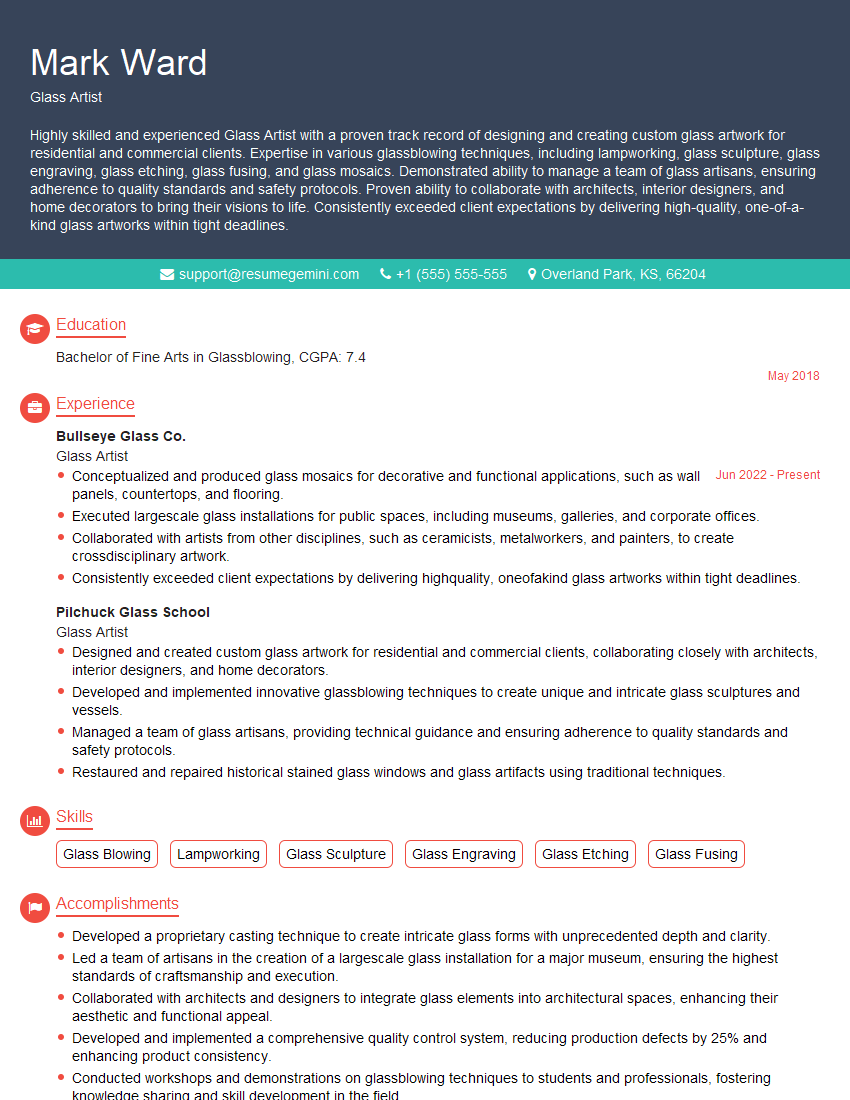
Mastering leaded glass etching opens doors to exciting career opportunities in art restoration, stained-glass studios, and custom design projects. To maximize your job prospects, creating a strong, ATS-friendly resume is crucial. ResumeGemini is a trusted resource to help you build a professional and impactful resume that showcases your skills and experience effectively. Examples of resumes tailored to the leaded glass etching field are available to guide you. Invest time in crafting a compelling resume—it’s your first impression on potential employers.
Explore more articles
Users Rating of Our Blogs
Share Your Experience
We value your feedback! Please rate our content and share your thoughts (optional).
What Readers Say About Our Blog
To the interviewgemini.com Webmaster.
Very helpful and content specific questions to help prepare me for my interview!
Thank you
To the interviewgemini.com Webmaster.
This was kind of a unique content I found around the specialized skills. Very helpful questions and good detailed answers.
Very Helpful blog, thank you Interviewgemini team.