Interviews are opportunities to demonstrate your expertise, and this guide is here to help you shine. Explore the essential Legal Terminology and Procedures interview questions that employers frequently ask, paired with strategies for crafting responses that set you apart from the competition.
Questions Asked in Legal Terminology and Procedures Interview
Q 1. Define ‘voir dire’.
Voir dire is the process of questioning potential jurors to determine their suitability to serve on a jury. It’s a crucial part of ensuring a fair and impartial trial. Think of it as a screening process where both the prosecution and defense get to assess potential jurors’ biases, knowledge of the case, or any pre-existing opinions that could affect their ability to be objective.
During voir dire, attorneys may ask questions about the juror’s background, employment, relationships, experiences, and even their opinions on relevant legal issues. The goal is to identify and remove jurors who might be prejudiced or unable to fairly consider the evidence presented. For example, if a case involves domestic violence, an attorney might want to remove jurors who have experienced domestic abuse themselves, as their personal experiences might cloud their judgment. The judge ultimately decides whether a potential juror will be dismissed or allowed to serve.
Q 2. Explain the difference between a statute and a regulation.
The difference between a statute and a regulation lies primarily in their origin and scope. A statute is a law passed by a legislative body – think of Congress at the federal level or a state legislature. Statutes are broad in scope and address general principles. For example, a statute might define the crime of theft or establish the rules for forming a corporation.
A regulation, on the other hand, is a rule created by an administrative agency to implement and enforce a statute. These agencies are given the authority to create more detailed rules to clarify how a statute works in practice. For example, the Environmental Protection Agency (EPA) might create regulations specifying acceptable levels of pollutants under a broader environmental protection statute. Regulations are usually more specific and targeted than statutes.
Imagine a statute as a blueprint for a house, providing the general framework and specifications. Regulations are then the detailed instructions for each step of construction, ensuring that the final product complies with the blueprint.
Q 3. What is the significance of a ‘plea bargain’?
A plea bargain is an agreement between a defendant and the prosecution in a criminal case where the defendant pleads guilty to a lesser charge or pleads guilty to some of the charges in exchange for a reduced sentence or other concessions. It’s essentially a negotiation to avoid a trial.
The significance of a plea bargain is immense. It saves the court time and resources, avoids the uncertainties of a trial, and can offer a less severe punishment for the defendant. However, it also means the defendant forfeits their right to a trial and potentially a chance to prove their innocence. For example, a defendant charged with multiple felonies might plead guilty to one lesser offense in exchange for the other charges being dropped. This benefits both sides: the prosecution secures a conviction and avoids the costs and risks of a trial, while the defendant receives a lighter sentence than they might have received after a conviction on all charges.
Q 4. Describe the process of serving legal documents.
Serving legal documents is the formal process of delivering a legal document, such as a summons, complaint, or subpoena, to the intended recipient. Proper service is crucial because it ensures the individual is officially notified of the legal action against them and has the opportunity to respond. Failure to properly serve documents can lead to serious consequences, including dismissal of the case.
The method of service depends on the type of document and jurisdiction. Common methods include:
- Personal Service: Directly handing the documents to the individual.
- Substituted Service: Leaving the documents at the individual’s residence or place of business with a responsible adult.
- Service by Publication: Publishing notice of the legal action in a newspaper, typically used when the individual’s location is unknown.
- Service by Mail: While not always sufficient for initiating a lawsuit, certified mail with return receipt requested can be used for specific purposes.
The specific rules governing service are outlined in the rules of civil procedure for the relevant jurisdiction. Often, an independent process server or sheriff is hired to ensure proper service.
Q 5. What is a ‘motion to dismiss’ and when is it used?
A motion to dismiss is a request to a court to dismiss a case because there is a fundamental legal flaw. It essentially argues that even if all the facts presented are true, the plaintiff (in a civil case) or the prosecution (in a criminal case) still hasn’t presented a valid legal claim.
It is used in various situations, including:
- Lack of Jurisdiction: The court lacks the authority to hear the case.
- Failure to State a Claim: The complaint doesn’t allege facts that, if proven true, would entitle the plaintiff to relief.
- Improper Venue: The case is filed in the wrong court location.
- Statute of Limitations: The case was filed after the deadline for filing.
Imagine a scenario where someone sues a corporation for breach of contract but fails to properly establish the existence of a valid contract in their complaint. The corporation could file a motion to dismiss, arguing that even if all the plaintiff’s facts are true, no valid contract existed, therefore no breach occurred. The court would then decide if the motion should be granted, essentially ending the case at that stage.
Q 6. Explain the difference between civil and criminal law.
Civil law and criminal law are distinct branches of the legal system that address different types of wrongs and have different goals. Criminal law deals with actions that are considered harmful to society as a whole. The government prosecutes these cases, and the goal is to punish the offender through fines, imprisonment, or other penalties. Examples include murder, theft, and assault. The burden of proof is beyond a reasonable doubt – a very high standard.
Civil law concerns disputes between private individuals or organizations. The goal is typically to compensate the injured party for their losses or to enforce a contract. Examples include breach of contract, negligence (e.g., a car accident), and property disputes. The burden of proof is lower, often the preponderance of the evidence.
Think of it this way: criminal law is about punishing wrongdoers for actions that harm society, while civil law is about resolving disputes between individuals and making things right.
Q 7. What are the key elements of a legally binding contract?
A legally binding contract requires several key elements:
- Offer: A clear and definite proposal made by one party to another.
- Acceptance: Unconditional agreement to the terms of the offer.
- Consideration: Something of value exchanged by each party. This could be money, goods, services, or a promise to do or not do something.
- Mutual Assent (Meeting of the Minds): Both parties must understand and agree to the terms of the contract.
- Capacity: Both parties must be legally competent to enter into a contract (e.g., of legal age and sound mind).
- Legality: The subject matter of the contract must be legal.
For instance, a contract for the sale of a car requires an offer by the seller to sell the car for a specific price, acceptance by the buyer, consideration (the exchange of money for the car), mutual assent (both parties agree on the terms), capacity (both parties are legally able to enter a contract), and legality (the sale of cars is legal). Absence of any of these elements could render the contract unenforceable.
Q 8. Define ‘jurisdiction’ and its importance in legal proceedings.
Jurisdiction refers to the authority of a court or other government entity to hear and decide a case. It’s the foundation of any legal proceeding; without it, a court’s actions are void. Think of it as the court’s legal ‘power’ over a specific person, subject matter, or geographic area.
The importance of jurisdiction is paramount. If a court lacks jurisdiction, any judgment it renders is unenforceable. This means that even if a court finds in your favor, the other party can simply ignore the ruling. Jurisdiction is determined by various factors, including the location of the defendant (in personam jurisdiction), the location of the property in dispute (in rem jurisdiction), and the subject matter of the case (subject matter jurisdiction). For example, a California court generally cannot force a resident of New York to appear before it unless that New York resident has sufficient contacts with California.
Q 9. What is the difference between mediation and arbitration?
Mediation and arbitration are both alternative dispute resolution (ADR) methods that help parties resolve conflicts outside of traditional court litigation, but they differ significantly in their processes and outcomes.
- Mediation: A neutral third party, the mediator, facilitates communication and negotiation between the disputing parties. The mediator doesn’t decide the outcome; instead, they guide the parties toward a mutually agreeable solution. Mediation emphasizes compromise and collaboration. Think of the mediator as a skilled facilitator, helping the parties find common ground. The outcome is a settlement agreement, which is contractually binding.
- Arbitration: A neutral third party, the arbitrator, acts as a judge, hearing evidence and arguments from both sides and then issuing a binding decision (award). Arbitration is more formal than mediation, often following established procedural rules. The arbitrator’s decision is typically final and enforceable like a court judgment. It is akin to a mini-trial, with a decision rendered by the arbitrator rather than a judge or jury.
Imagine a landlord-tenant dispute over unpaid rent. Mediation might lead to a payment plan agreed upon by both parties. Arbitration, on the other hand, could result in the arbitrator ordering the tenant to pay the full amount plus late fees.
Q 10. Explain the concept of ‘discovery’ in litigation.
Discovery is the pre-trial phase in litigation where both sides exchange information relevant to the case. Its purpose is to ensure a fair trial by allowing each party to understand the strengths and weaknesses of the other side’s case before trial. This prevents trial by ambush, where one party unexpectedly presents evidence the other side is unprepared to address.
Discovery methods include:
- Interrogatories: Written questions sent to the opposing party that must be answered under oath.
- Requests for Production of Documents: Demands for the opposing party to provide relevant documents and other tangible evidence.
- Depositions: Oral examinations of witnesses under oath, recorded by a court reporter.
- Requests for Admissions: Requests for the opposing party to admit or deny specific facts.
For instance, in a car accident case, discovery might involve exchanging police reports, medical records, photographs of the damaged vehicles, and depositions from the drivers and witnesses.
Q 11. What are the various types of legal evidence?
Legal evidence is anything presented to a court to prove or disprove a fact in issue. There are numerous types, broadly categorized as:
- Testimonial Evidence: Oral or written statements made by witnesses under oath. This includes witness testimony and depositions.
- Documentary Evidence: Written documents such as contracts, emails, photographs, and medical records.
- Real Evidence: Physical objects such as weapons, clothing, or the actual property in dispute.
- Demonstrative Evidence: Tangible items used to illustrate a point, such as maps, diagrams, or models.
- Circumstantial Evidence: Indirect evidence that suggests a fact but doesn’t directly prove it. For example, finding a defendant’s fingerprints at a crime scene is circumstantial evidence of their presence.
The admissibility of evidence is governed by rules of evidence, ensuring its relevance and reliability.
Q 12. Describe the process of appellate review.
Appellate review is the process of challenging a lower court’s decision in a higher court. The appellant (the party appealing) argues that the lower court made an error of law or fact. The appellee (the party who won in the lower court) defends the lower court’s decision.
The appellate court doesn’t retry the case; it reviews the record from the lower court, focusing on legal issues, not factual findings. The appellate court may affirm (uphold) the lower court’s decision, reverse it, or remand (send it back) to the lower court for further proceedings. Imagine it like a review of a referee’s call in a sporting event – the appellate court examines whether the original decision was based on a misapplication of the rules, not whether the original call was ‘right’ or ‘wrong’ based on what each judge might see differently.
For example, if a trial court improperly admitted evidence, the appellate court could reverse the decision and order a new trial.
Q 13. Explain the difference between ‘in rem’ and ‘in personam’ jurisdiction.
These terms describe different types of court jurisdiction related to the power of a court over a person or property.
- In Personam Jurisdiction: This refers to the court’s power over a specific individual or entity. A court has in personam jurisdiction over a defendant who resides within its geographic area, or who has sufficient contacts with that area (such as doing business there or causing harm there). Think of it as the court’s power over a person.
- In Rem Jurisdiction: This refers to the court’s power over a specific piece of property located within its geographic boundaries, regardless of where the parties involved reside. A court can, for instance, rule on the ownership of a particular house located within its geographic territory, irrespective of the owners’ location. Think of it as the court’s power over a thing.
For example, a court in California might have in personam jurisdiction over a California resident sued for breach of contract and in rem jurisdiction over a dispute over a piece of land located in California, even if the parties involved are from another state.
Q 14. What is the difference between a felony and a misdemeanor?
Felonies and misdemeanors are classifications of crimes based on their severity and potential punishment. The distinction is crucial as it impacts sentencing, the defendant’s rights, and the overall legal process.
- Felony: A serious crime typically punishable by imprisonment for more than one year, often in a state or federal prison. Examples include murder, robbery, and grand theft. Felonies generally carry more serious consequences, including extensive criminal records and potential loss of civil rights.
- Misdemeanor: A less serious crime, typically punishable by a fine, short jail sentence (usually less than one year), or community service. Examples include petty theft, simple assault, and traffic violations. Misdemeanors generally have less severe long-term consequences than felonies.
The difference can be significant. A felony conviction will have far-reaching consequences, including impacting employment opportunities, housing options, and the ability to vote or own firearms, while a misdemeanor conviction typically has less of an impact.
Q 15. What is a ‘writ of certiorari’?
A writ of certiorari is a discretionary writ issued by a higher court, typically a Supreme Court, to a lower court, ordering the lower court to deliver its records in a case so that the higher court can review it. Think of it as a request for a higher court to examine a decision made by a lower court. It’s not automatic; the higher court chooses which cases it will hear through certiorari. The Supreme Court of the United States, for instance, receives thousands of certiorari petitions annually, but only grants a small percentage, usually those presenting significant legal questions or conflicting lower court rulings.
Essentially, it’s a mechanism for higher courts to exercise appellate jurisdiction over specific cases they deem worthy of review. The granting of a writ signifies the court’s acceptance of the case for further consideration. This process ensures that the higher court can address important legal issues and harmonize differing interpretations across lower courts.
Career Expert Tips:
- Ace those interviews! Prepare effectively by reviewing the Top 50 Most Common Interview Questions on ResumeGemini.
- Navigate your job search with confidence! Explore a wide range of Career Tips on ResumeGemini. Learn about common challenges and recommendations to overcome them.
- Craft the perfect resume! Master the Art of Resume Writing with ResumeGemini’s guide. Showcase your unique qualifications and achievements effectively.
- Don’t miss out on holiday savings! Build your dream resume with ResumeGemini’s ATS optimized templates.
Q 16. Explain the concept of ‘stare decisis’.
Stare decisis, Latin for “to stand by things decided,” is a fundamental legal doctrine that compels courts to follow precedents set by prior decisions when deciding similar cases. Imagine building with Lego bricks; each brick represents a legal precedent. New structures (case rulings) are built upon these pre-existing bricks, ensuring consistency and predictability in the legal system. This principle promotes fairness, stability, and the efficient administration of justice.
There are two main aspects: vertical stare decisis, where lower courts must follow precedents set by higher courts within the same jurisdiction, and horizontal stare decisis, where courts at the same level generally follow their own previous rulings. However, stare decisis isn’t absolute; courts can overturn prior precedents if they are deemed incorrect, outdated, or no longer applicable to modern circumstances.
For example, Brown v. Board of Education overturned the precedent set in Plessy v. Ferguson, demonstrating that even established precedents can be reconsidered and changed based on societal evolution and evolving legal understanding.
Q 17. Define ‘res judicata’.
Res judicata, meaning “a matter judged,” prevents the same parties from relitigating the same issue in subsequent lawsuits. Once a court has rendered a final judgment on the merits of a case, that judgment is conclusive and binding between the parties involved. This prevents endless re-litigation of identical claims. It’s a cornerstone of legal efficiency, ensuring that disputes are resolved definitively and that parties cannot endlessly rehash already decided matters.
Imagine a civil case where a car accident is litigated. If the court finds the defendant liable and awards damages, the plaintiff cannot later file another lawsuit against the defendant for the same accident and the same damages. This principle applies only to the specific issues and parties involved in the original lawsuit.
Q 18. What is a ‘summary judgment’ and under what circumstances is it granted?
A summary judgment is a court order that resolves a lawsuit without a trial. It’s granted when there’s no genuine issue of material fact and the moving party is entitled to judgment as a matter of law. This means the evidence is so one-sided that a reasonable jury could only reach one verdict.
It’s often used in cases where one party believes the other party lacks sufficient evidence to support their claim, or if the case hinges on a clear interpretation of the law rather than disputed facts. For instance, if a contract is unambiguous and clearly breached, a summary judgment might be granted to the non-breaching party. The court reviews the evidence submitted by both sides (typically affidavits, depositions, and exhibits) to determine if a trial is necessary.
A crucial difference from a dismissal is that a summary judgment addresses the merits of the case based on the existing evidence, whereas a dismissal often focuses on procedural issues, such as lack of jurisdiction or failure to properly file documents.
Q 19. Explain the purpose of legal precedents.
Legal precedents, also known as case law, serve several crucial purposes. Primarily, they provide consistency and predictability in the application of the law. By referencing past rulings, courts create a framework for future decisions. It promotes fairness by ensuring similar cases are treated similarly, enhancing public trust and confidence in the judicial system.
Secondly, they guide legal reasoning and interpretation of statutes. When statutes are ambiguous or unclear, courts often look to prior cases for guidance on their meaning and application. Finally, precedents help shape and develop the law, allowing it to evolve and adapt to changing societal values and circumstances. They essentially provide a roadmap for resolving legal disputes, creating continuity and reducing the need for constant reinterpretation of fundamental principles.
Q 20. What are the key differences between breach of contract and tort?
Breach of contract and tort are both types of civil wrongs, but they differ significantly in their origin and the nature of the harm involved. A breach of contract arises from the violation of a legally binding agreement between two or more parties. It involves a failure to perform a contractual duty, causing harm to the other party. For example, failure to deliver goods as specified in a sales contract would constitute a breach of contract.
A tort, on the other hand, is a civil wrong that arises from a violation of a duty imposed by law, rather than a contractual agreement. Torts encompass a wide range of actions, such as negligence (causing harm through carelessness), defamation (damaging someone’s reputation), trespass (unlawfully entering someone’s property), and intentional infliction of emotional distress. The key difference lies in the source of the duty: contract for breach of contract, and law for tort.
Imagine someone slipping on a wet floor in a store due to the store’s negligence. This would be a tort (negligence) and not a breach of contract, as there was no prior contractual relationship between the injured party and the store. In contrast, if the store fails to deliver ordered goods as promised in a written agreement, this would be a breach of contract.
Q 21. Describe the process of filing a lawsuit.
Filing a lawsuit involves a multi-step process. First, the plaintiff (the person initiating the lawsuit) must draft a complaint, a formal document outlining the legal claims against the defendant (the person being sued). This complaint details the factual background, legal basis for the suit, and the relief sought (e.g., damages, injunction).
The complaint is then filed with the appropriate court, along with a filing fee. The court will then issue a summons, notifying the defendant of the lawsuit. The defendant must respond to the complaint within a specific timeframe, either by filing an answer (agreeing or denying the allegations), or by filing a motion to dismiss (arguing the case should be thrown out).
Following the defendant’s response, the parties engage in discovery, a process of exchanging information and evidence. This might involve depositions (oral testimony under oath), interrogatories (written questions), requests for documents, and requests for admissions (statements of fact that the other party must admit or deny). The goal is to uncover all relevant facts before trial.
After discovery, the case may proceed to trial, mediation, arbitration, or settlement. If the case proceeds to trial, evidence is presented to a judge or jury, who will render a verdict. The entire process can be complex and vary significantly based on the jurisdiction, the type of lawsuit, and the specific circumstances of the case. Legal representation is often crucial in navigating this process effectively.
Q 22. What is a ‘deposition’ and what is its purpose?
A deposition is a pre-trial discovery tool where a witness gives sworn testimony under oath, outside of court. It’s essentially a formal interview, recorded by a court reporter, where the witness answers questions posed by attorneys from both sides of the case.
Its purpose is multifaceted. It allows lawyers to learn about the witness’s knowledge of the facts relevant to the case, assess their credibility, preserve their testimony for trial (in case they become unavailable later), and potentially uncover inconsistencies in their statements. Imagine it as a detailed reconnaissance mission before the main battle in court.
For example, in a car accident case, a deposition might involve questioning the other driver about the circumstances of the accident, their version of events, and any injuries sustained. The plaintiff’s doctor might also be deposed to provide expert medical testimony regarding the extent of the injuries and treatment.
Q 23. What are the different types of legal opinions?
Legal opinions fall into various categories, depending on the context and the attorney’s role. Some common types include:
- Formal Opinion Letters: These are detailed written opinions issued by an attorney to a client, often addressing a specific legal question. They thoroughly analyze the relevant law, facts, and potential risks.
- Memoranda of Law (Memos): Internal documents written by attorneys for their own firm or for a client, summarizing research and legal analysis on a particular issue. These are less formal than opinion letters but still contain detailed legal arguments.
- Expert Witness Reports: Written reports prepared by legal experts who provide opinions on specialized subjects relevant to the case. These often involve scientific, technical, or other specialized knowledge.
- Court Opinions: Issued by judges, these are official rulings on legal issues presented in a case. They set precedent and guide future legal decisions.
The choice of opinion type depends on the client’s needs and the purpose of the opinion. A formal opinion letter might be required for a significant business transaction, while a memo might suffice for internal analysis during early stages of litigation.
Q 24. Explain the concept of ‘burden of proof’.
The burden of proof is the obligation on a party in a legal case to prove the facts necessary to win the case. This obligation varies depending on the type of case and the specific element being proven. In criminal cases, the prosecution bears the burden of proving the defendant’s guilt ‘beyond a reasonable doubt,’ a very high standard. This means there must be no reasonable explanation for the evidence other than the defendant’s guilt.
In civil cases, the burden of proof is generally ‘by a preponderance of the evidence,’ meaning the party with the burden must show that it’s more likely than not that their version of the facts is correct. This is a lower standard than ‘beyond a reasonable doubt’. For instance, if someone sues for breach of contract, they have the burden of showing that a contract existed, it was breached, and they suffered damages as a result. The level of evidence required changes the outcome drastically.
Q 25. What is ‘estoppel’?
Estoppel is a legal principle that prevents someone from arguing something contrary to what they previously said or did, if that action caused someone else to rely on it to their detriment. It essentially stops a party from going back on their word or actions if it would unfairly harm another party who reasonably relied on them.
Imagine a landlord telling a tenant that they won’t enforce a clause in their lease. If the tenant then acts in reliance on that promise (e.g., makes improvements to the property), the landlord would likely be estopped from later enforcing that clause because the tenant relied on their representation. The tenant suffered a detriment – acted in reliance of the landlord’s assurance. This is a form of equitable estoppel, where fairness prevents the assertion of a right.
Q 26. What is the significance of ‘due process’?
Due process is a fundamental principle of fairness enshrined in the U.S. Constitution and other legal systems. It ensures that individuals are treated fairly and equitably by the government and its legal processes. This encompasses several aspects:
- Notice: Individuals must be given proper notice of any legal proceedings that affect them.
- Opportunity to be Heard: Individuals have the right to present their case and challenge the evidence against them.
- Impartial Tribunal: Decisions must be made by an unbiased and neutral body.
- Right to Counsel: In many cases, individuals have the right to be represented by a lawyer.
Due process is crucial to prevent arbitrary or unfair government actions and safeguard individual rights. For instance, due process requires a fair trial, access to legal representation, and the right to appeal unjust decisions. The principle is deeply rooted in fairness and to ensure nobody is treated arbitrarily.
Q 27. Explain the difference between ‘obiter dicta’ and ‘ratio decidendi’.
Both ratio decidendi and obiter dicta are parts of a judicial opinion, but they hold different legal weight.
Ratio decidendi (reason for deciding) is the core legal principle or rule upon which the court based its decision. It forms the binding precedent for future cases with similar facts. It’s the essential holding that sets legal authority.
Obiter dicta (things said by the way) are statements made by a judge that are not essential to the decision of the case. While they can be persuasive and influential, they are not binding precedent. They are essentially observations or comments made in passing.
Think of it like this: the ratio decidendi is the recipe, the essential instructions that must be followed to achieve the desired result (the court’s decision). Obiter dicta are the chef’s tips or suggestions, helpful but not strictly necessary for the successful outcome.
Q 28. What is a ‘class action lawsuit’?
A class action lawsuit is a type of lawsuit where one or more individuals (the named plaintiffs) represent a larger group of people (the class) who have all suffered similar harm as a result of the same wrongful act or omission. This allows multiple individuals with similar claims to join together to pursue a single lawsuit, rather than filing numerous individual actions.
This is particularly helpful when individual claims are too small to make pursuing a lawsuit alone worthwhile. Imagine hundreds of customers harmed by a defective product; each suing individually is inefficient and costly. A class action allows them to pool resources and pursue justice collectively. However, there are strict requirements to qualify for class action status, including demonstrating that the members of the class share common legal issues and that the named plaintiffs adequately represent their interests.
Key Topics to Learn for Legal Terminology and Procedures Interview
- Civil Procedure Fundamentals: Understand the stages of litigation, from pleadings to trial, including key concepts like jurisdiction, venue, and service of process. Practical application: Analyze a hypothetical case scenario and identify potential procedural issues.
- Criminal Procedure Basics: Familiarize yourself with the differences between civil and criminal procedures, focusing on arrest, arraignment, plea bargaining, and trial processes. Practical application: Explain the Miranda rights and their significance in a criminal investigation.
- Legal Research & Citation: Master the art of legal research using online databases and legal texts. Understand proper legal citation methods (e.g., Bluebook). Practical application: Demonstrate your ability to locate relevant case law and statutes to support a legal argument.
- Common Legal Terminology: Develop a strong understanding of frequently used legal terms such as “voir dire,” “deposition,” “summary judgment,” “habeas corpus,” and “stare decisis.” Practical application: Define and explain the practical implications of these terms within specific legal contexts.
- Evidence and Discovery: Understand the rules of evidence and the discovery process, including depositions, interrogatories, and document requests. Practical application: Explain the admissibility of different types of evidence in court.
- Ethical Considerations: Be prepared to discuss ethical rules and responsibilities governing legal professionals, focusing on attorney-client privilege and conflicts of interest. Practical application: Analyze a hypothetical ethical dilemma faced by a legal professional.
Next Steps
Mastering Legal Terminology and Procedures is crucial for a successful career in the legal field. A strong grasp of these concepts will significantly improve your analytical skills, problem-solving abilities, and overall effectiveness as a legal professional. To enhance your job prospects, creating a compelling and ATS-friendly resume is essential. ResumeGemini is a trusted resource that can help you build a professional and impactful resume tailored to your skills and experience. We provide examples of resumes specifically designed for candidates with expertise in Legal Terminology and Procedures to help you craft the perfect application. Take the next step towards your dream career today!
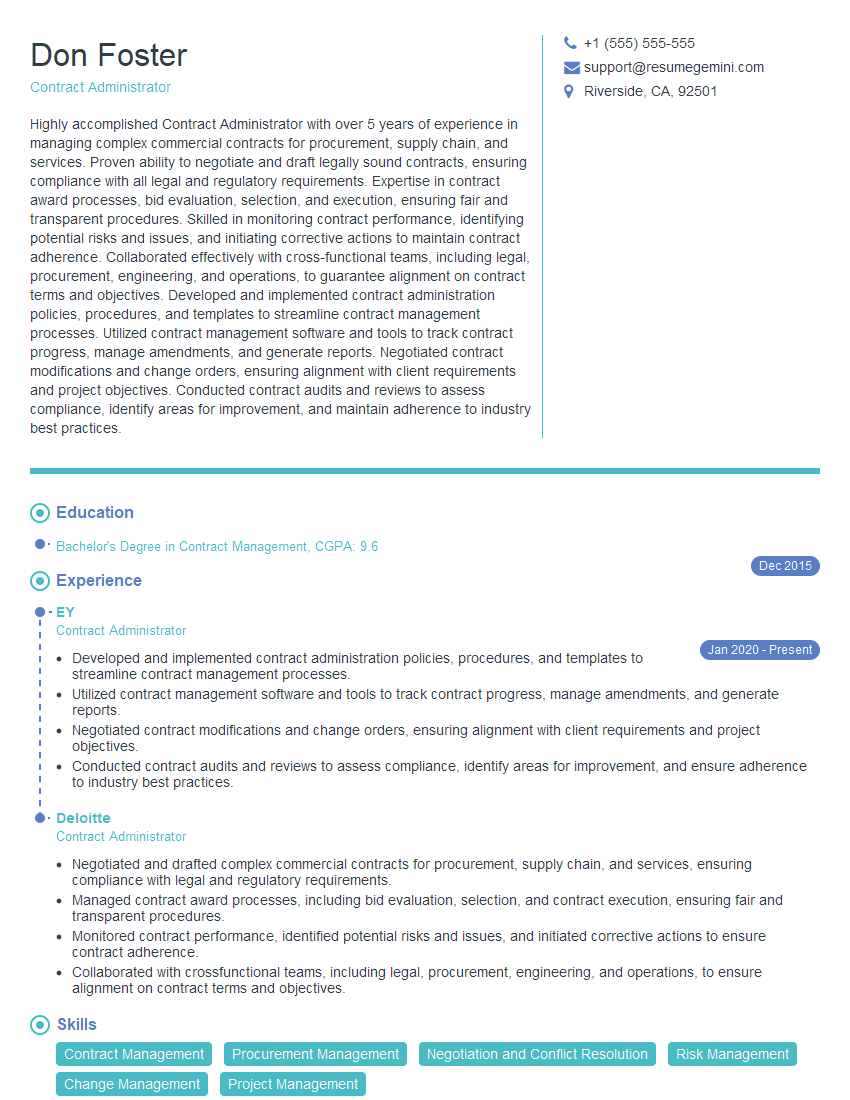
Contract Administrator Resume Sample
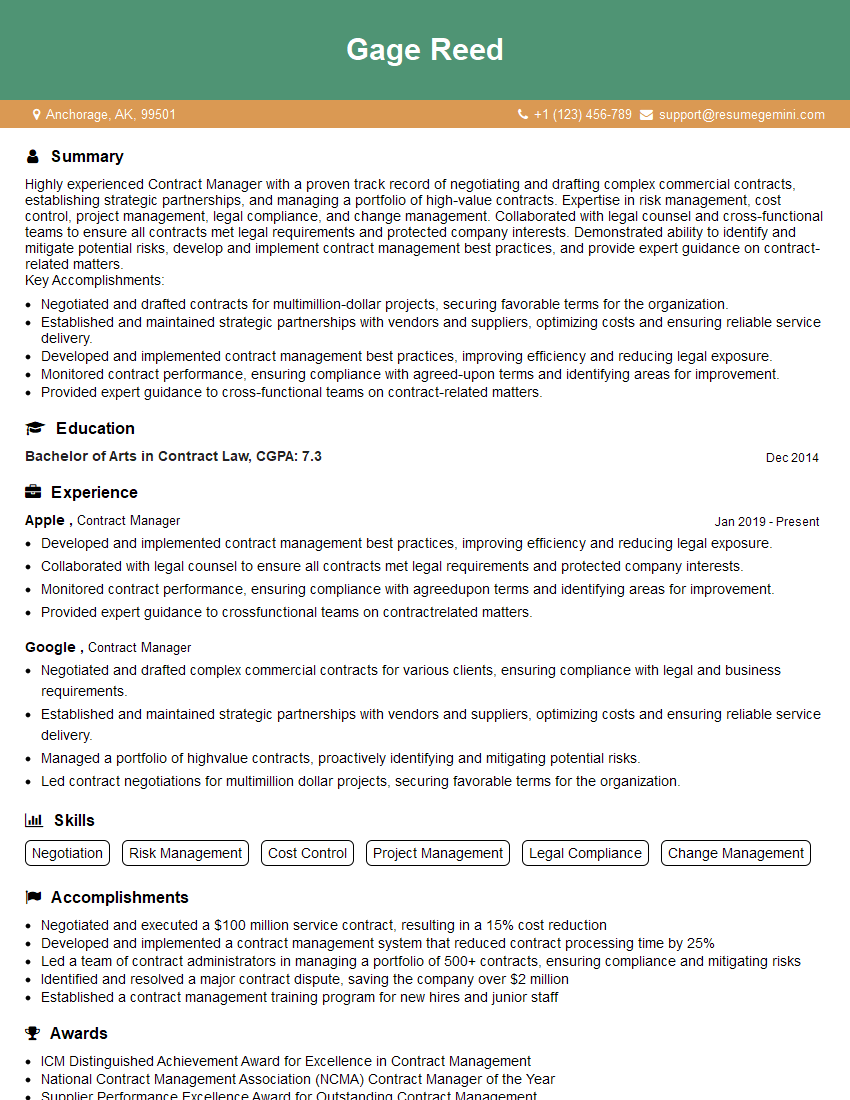
Contract Manager Resume Sample
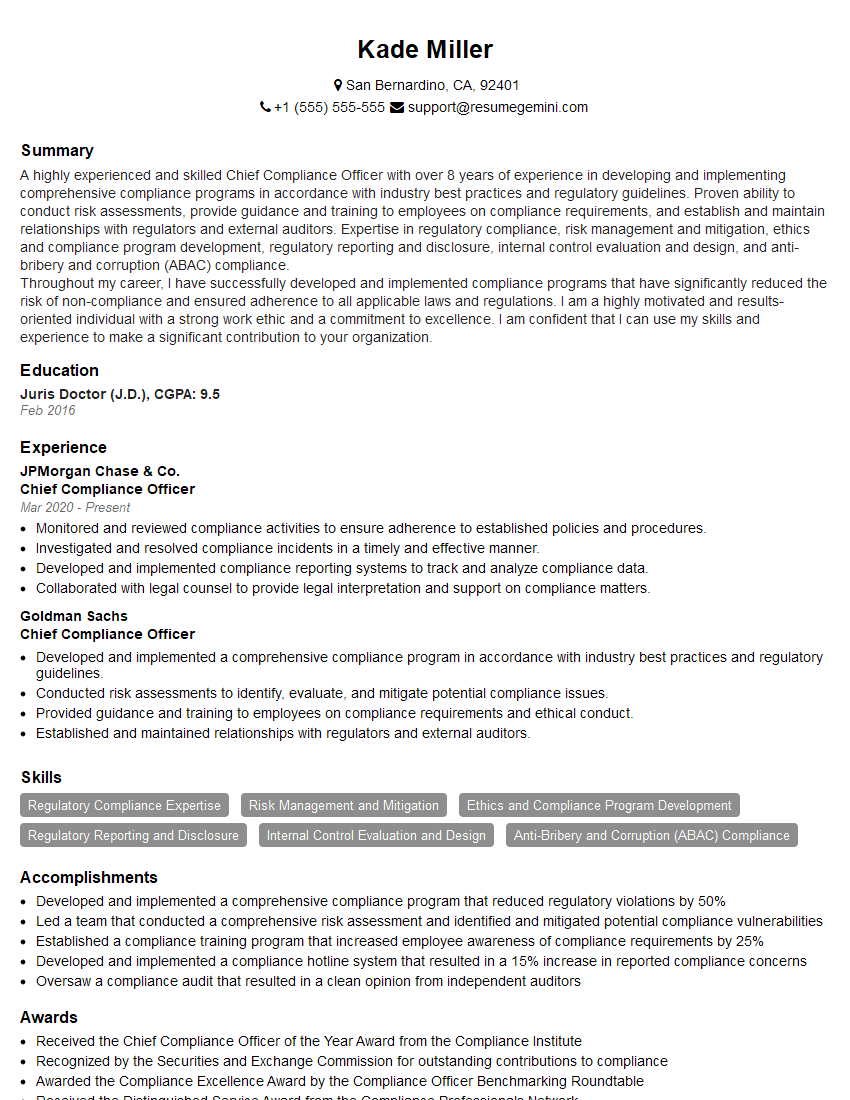
Chief Compliance Officer Resume Sample
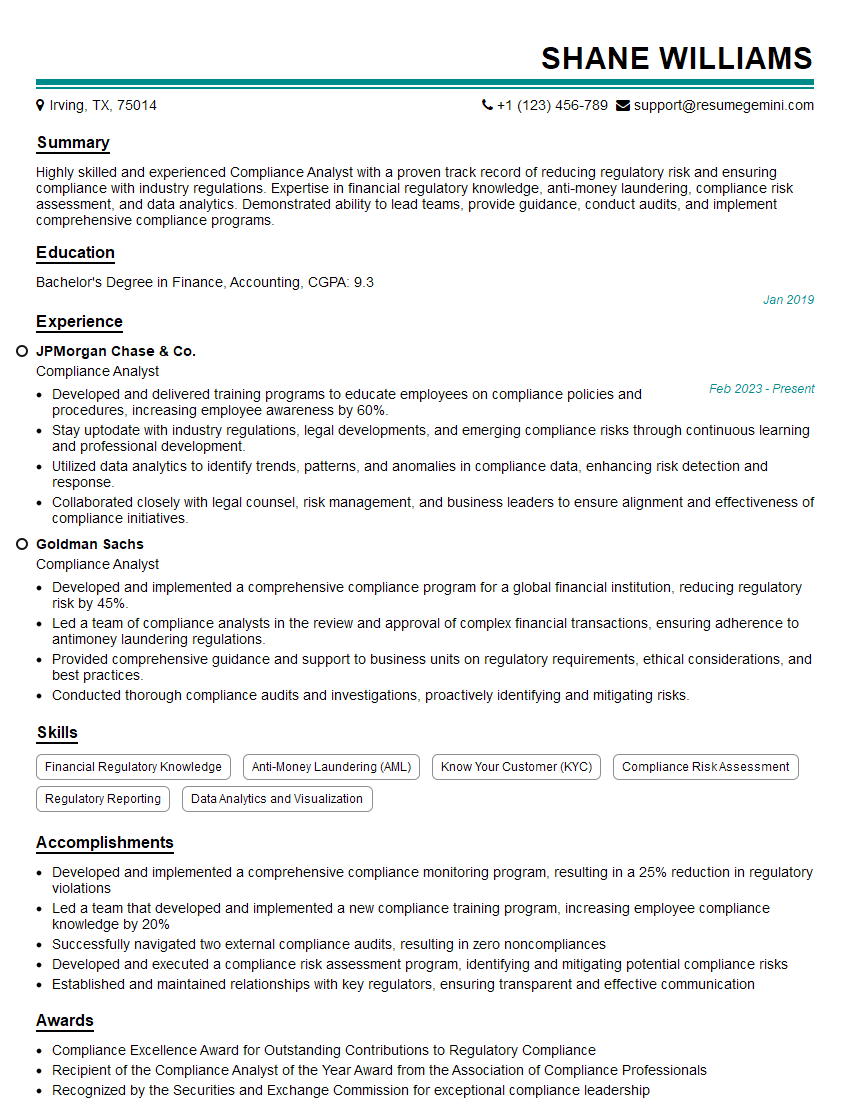
Compliance Analyst Resume Sample
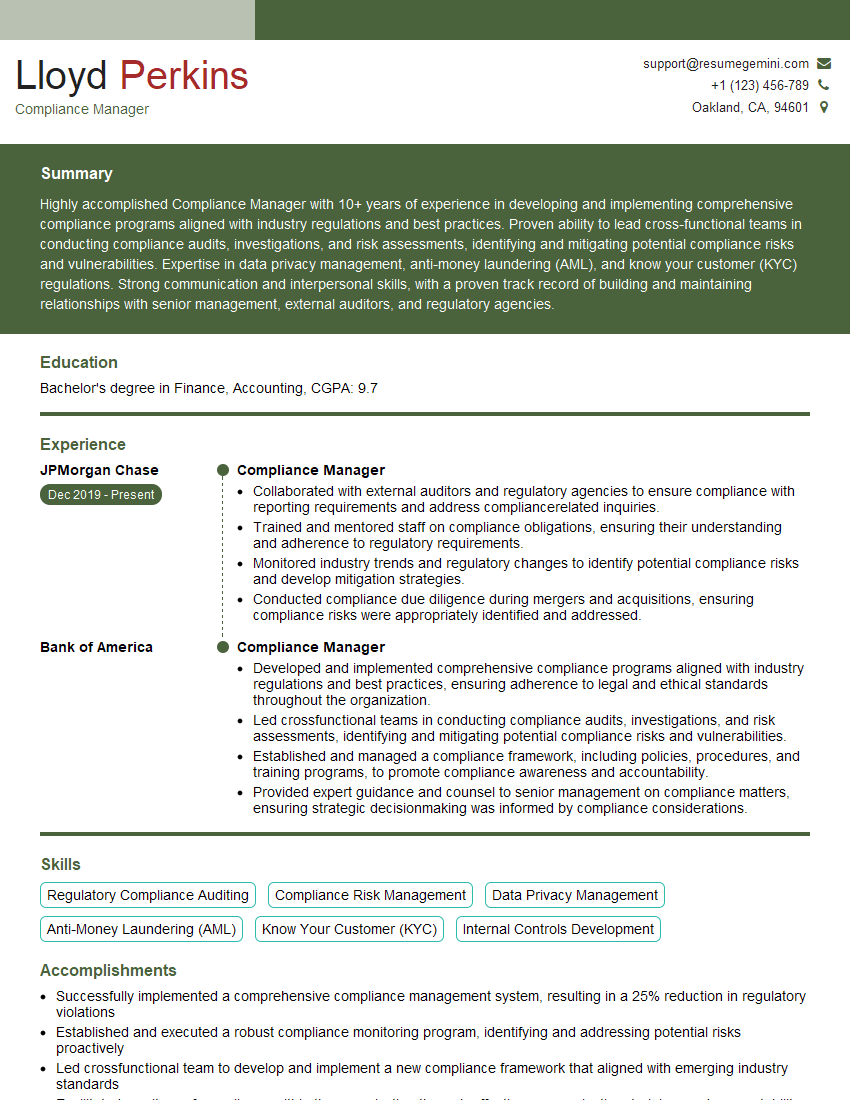
Compliance Manager Resume Sample
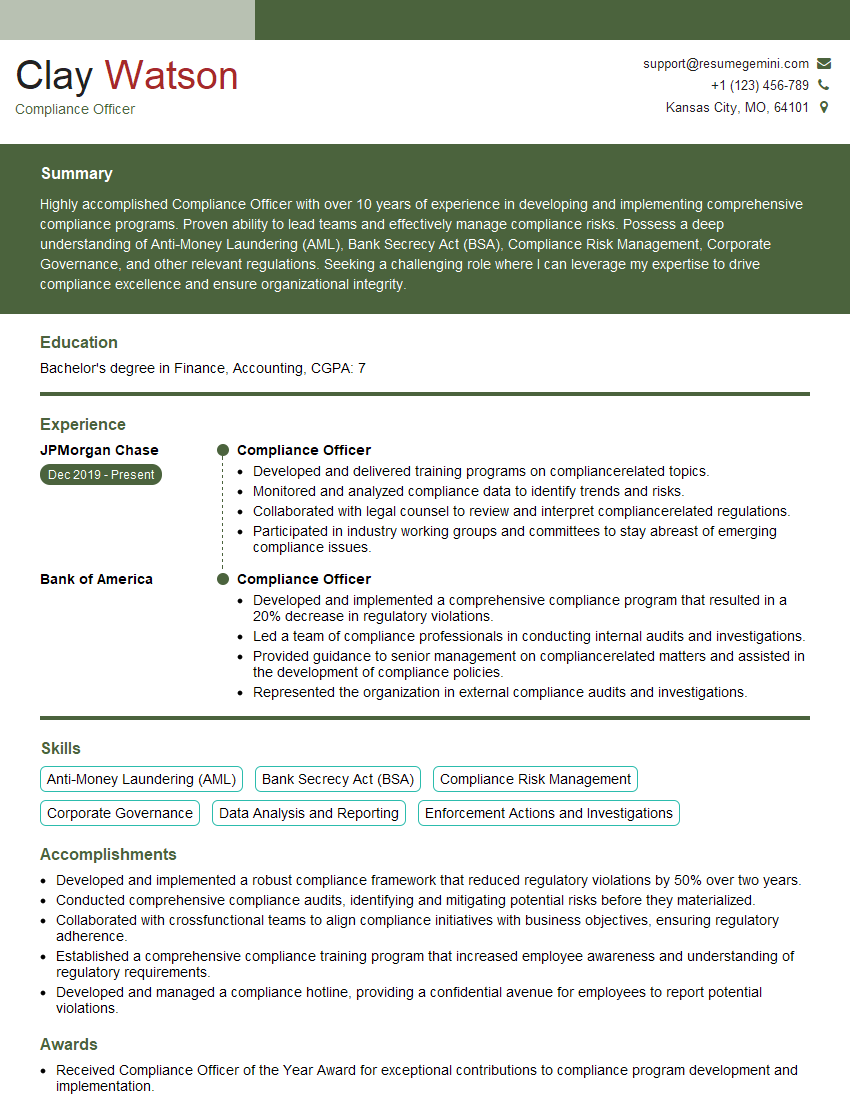
Compliance Officer Resume Sample
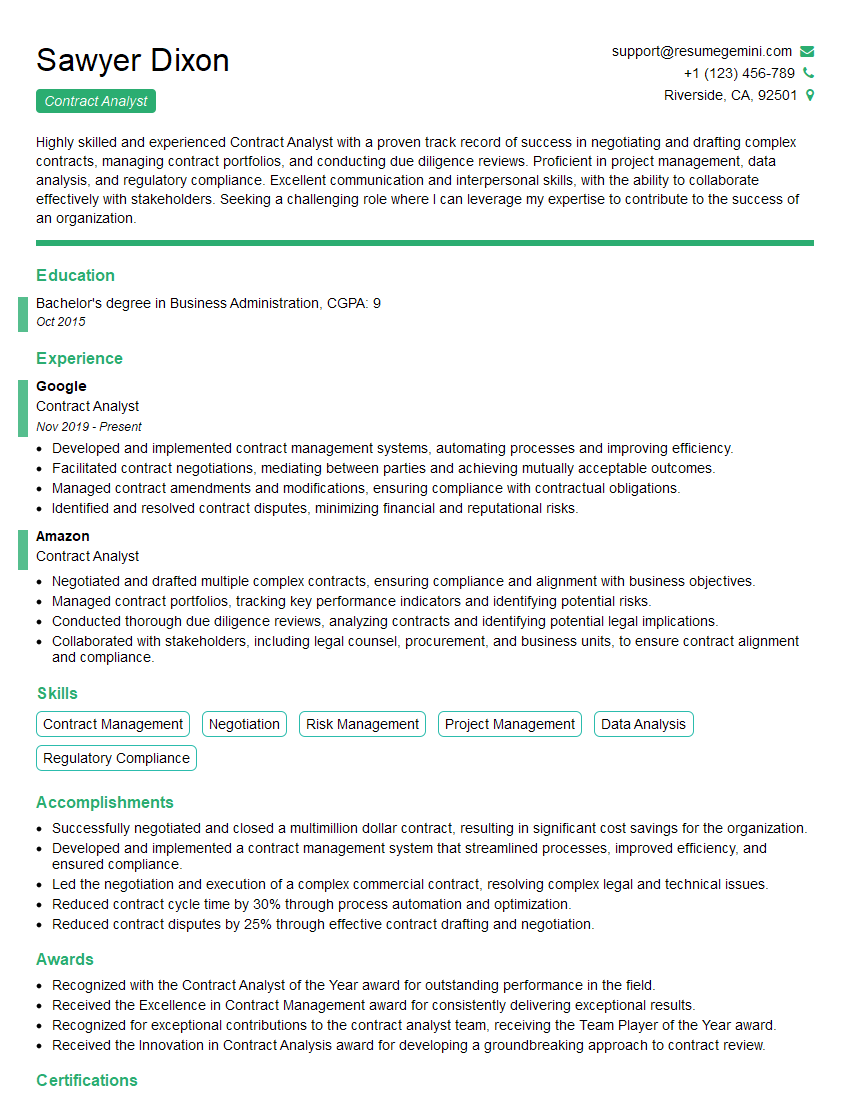
Contract Analyst Resume Sample
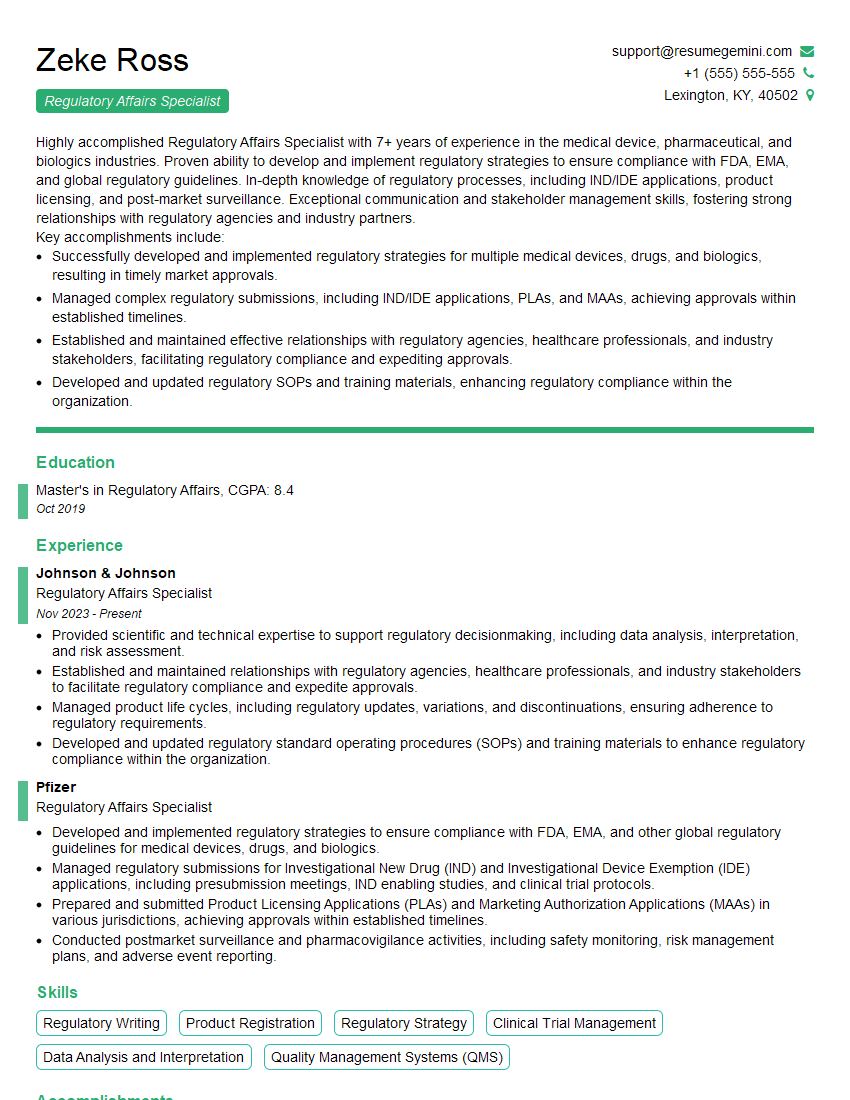
Regulatory Affairs Specialist Resume Sample
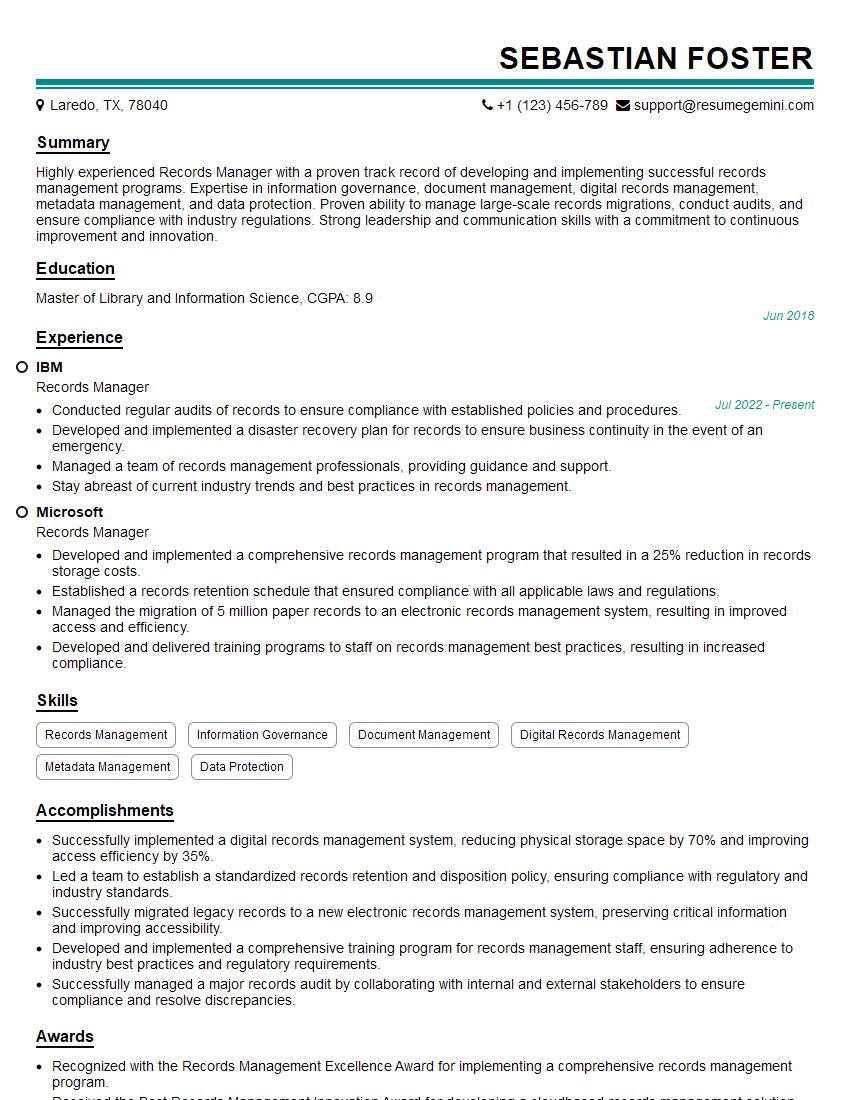
Records Manager Resume Sample
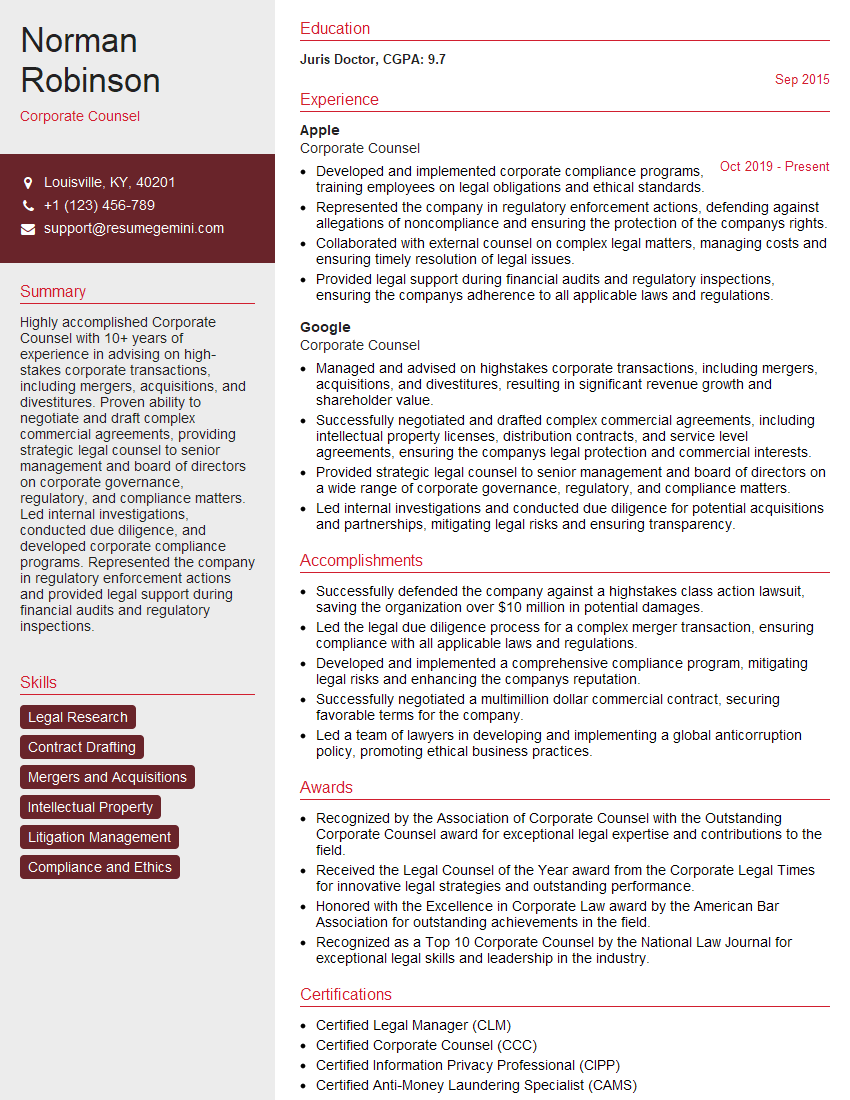
Corporate Counsel Resume Sample
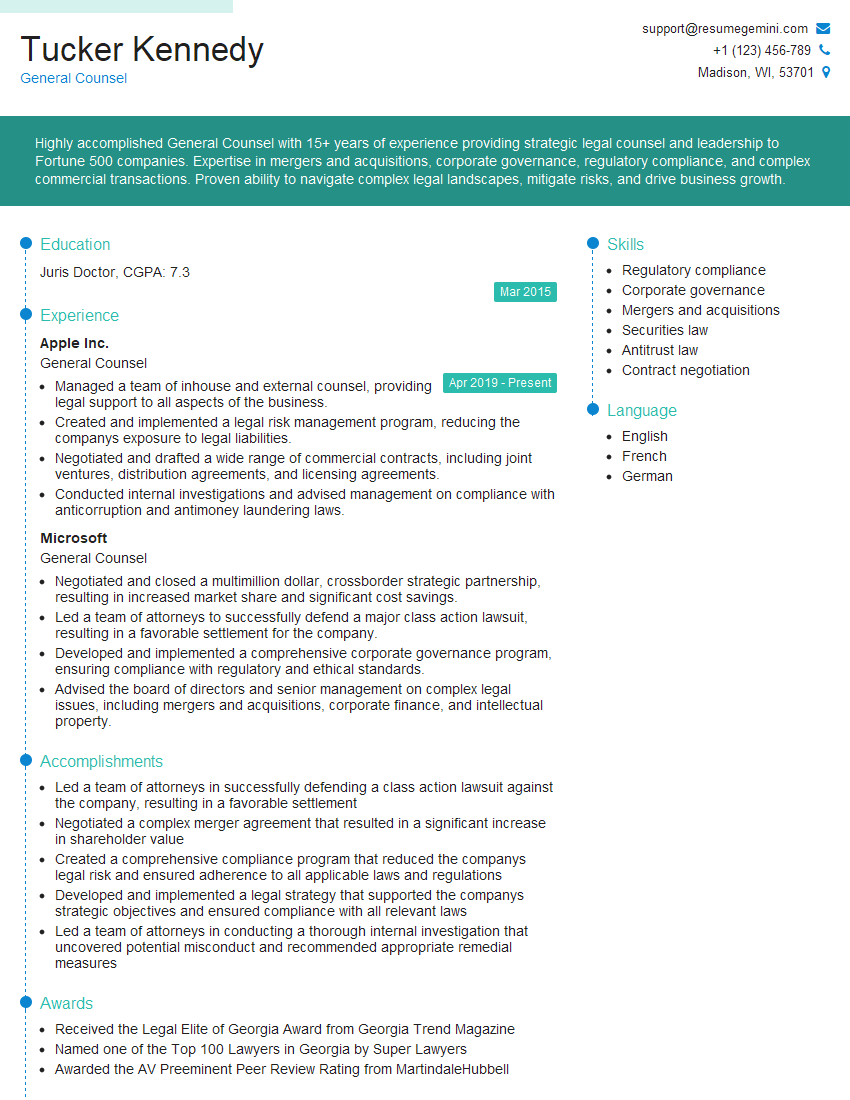
General Counsel Resume Sample
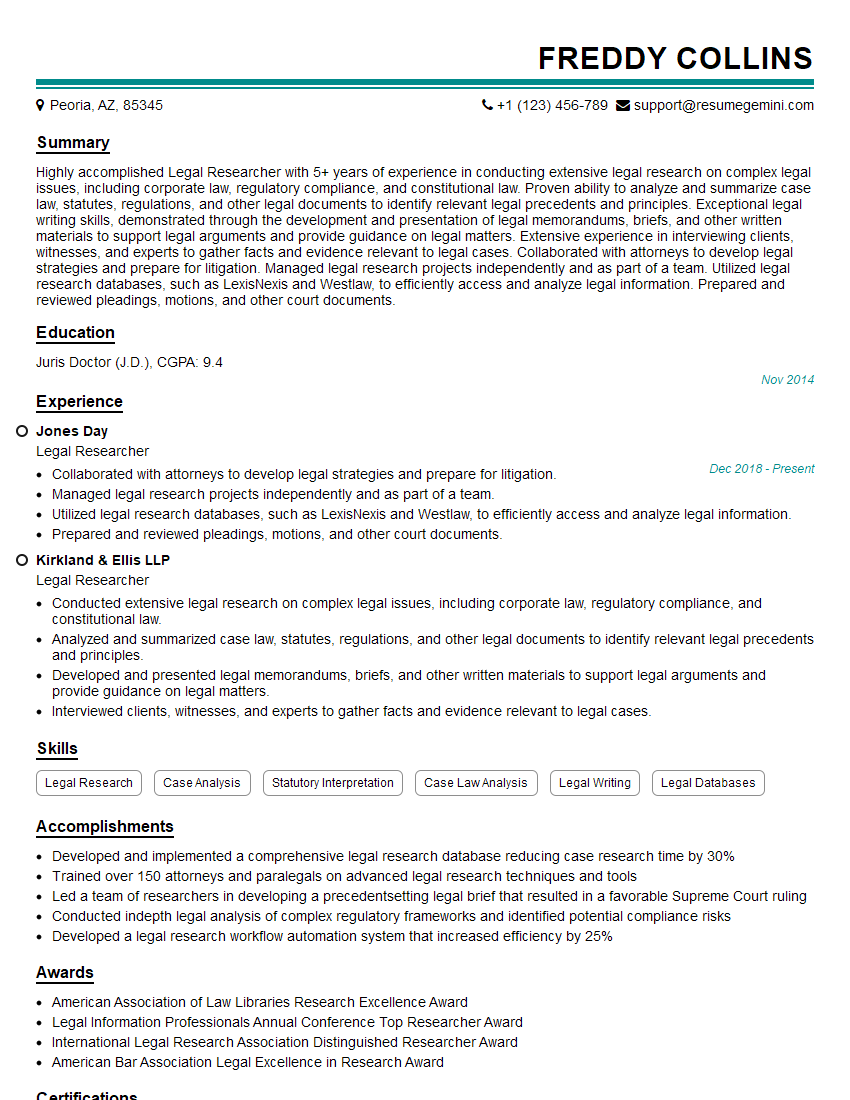
Legal Researcher Resume Sample
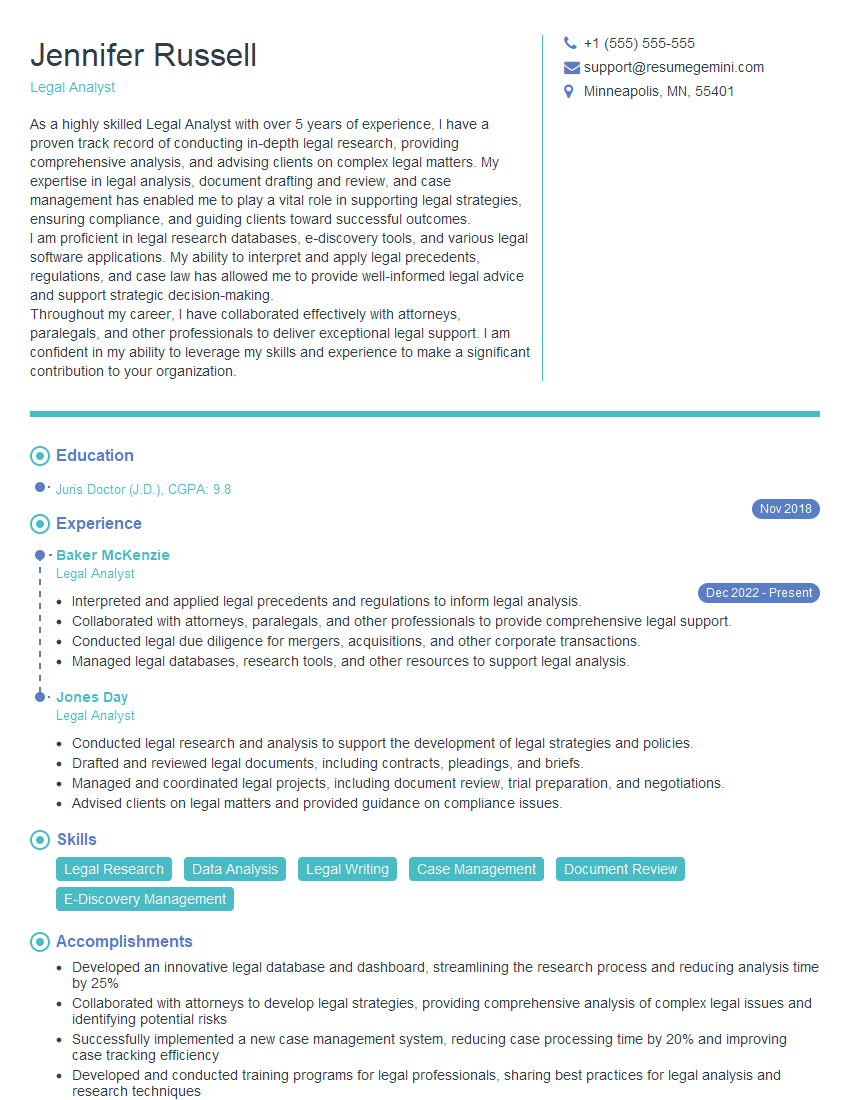
Legal Analyst Resume Sample
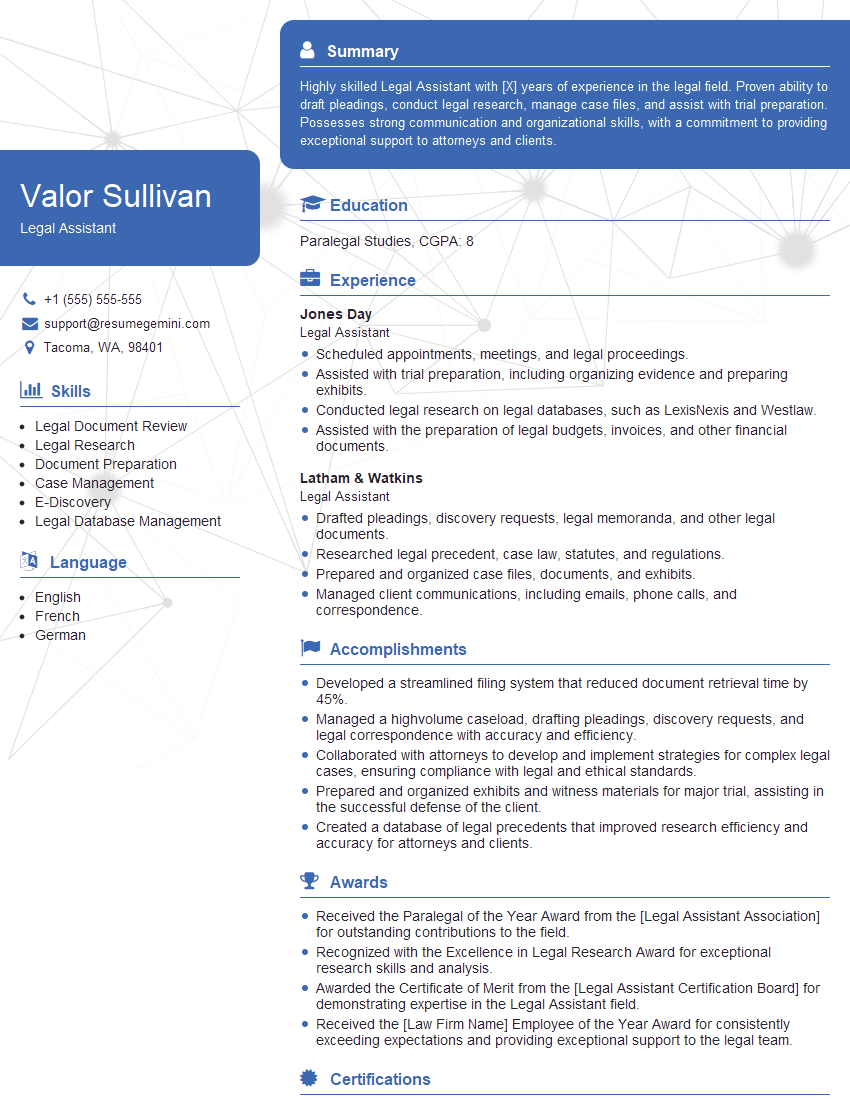
Legal Assistant Resume Sample
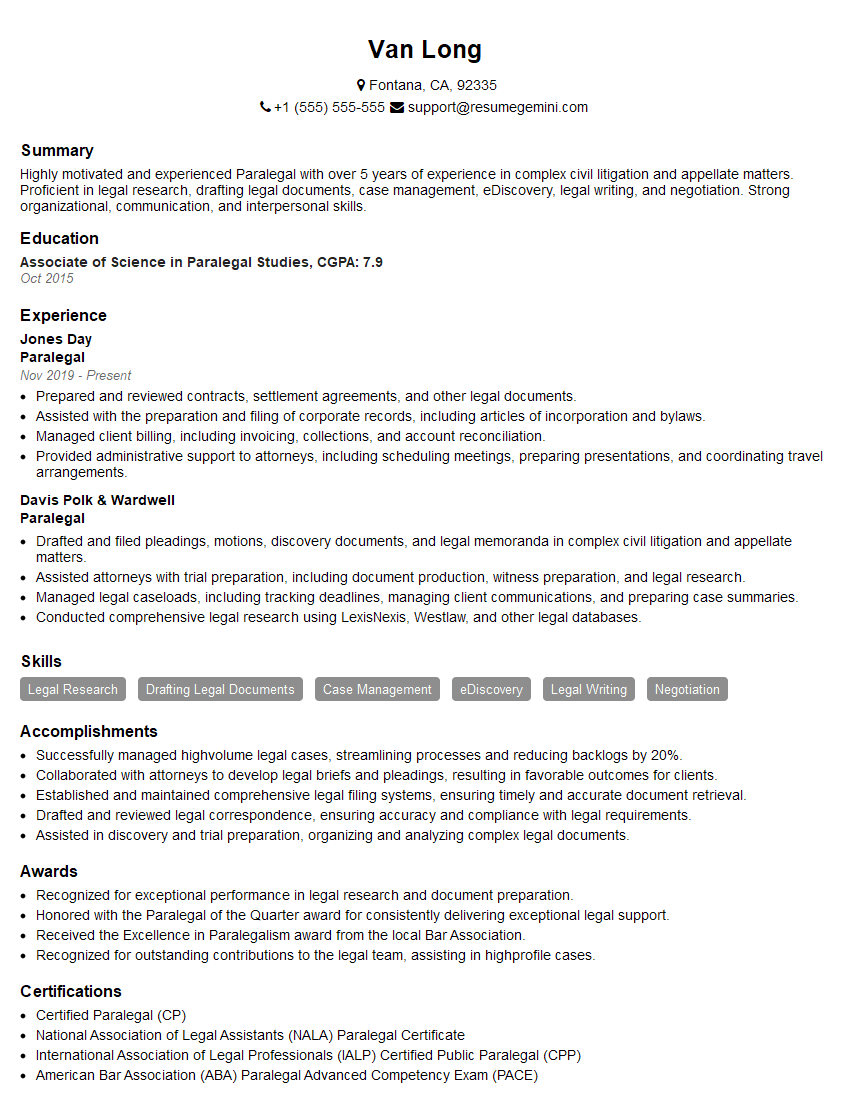
Paralegal Resume Sample
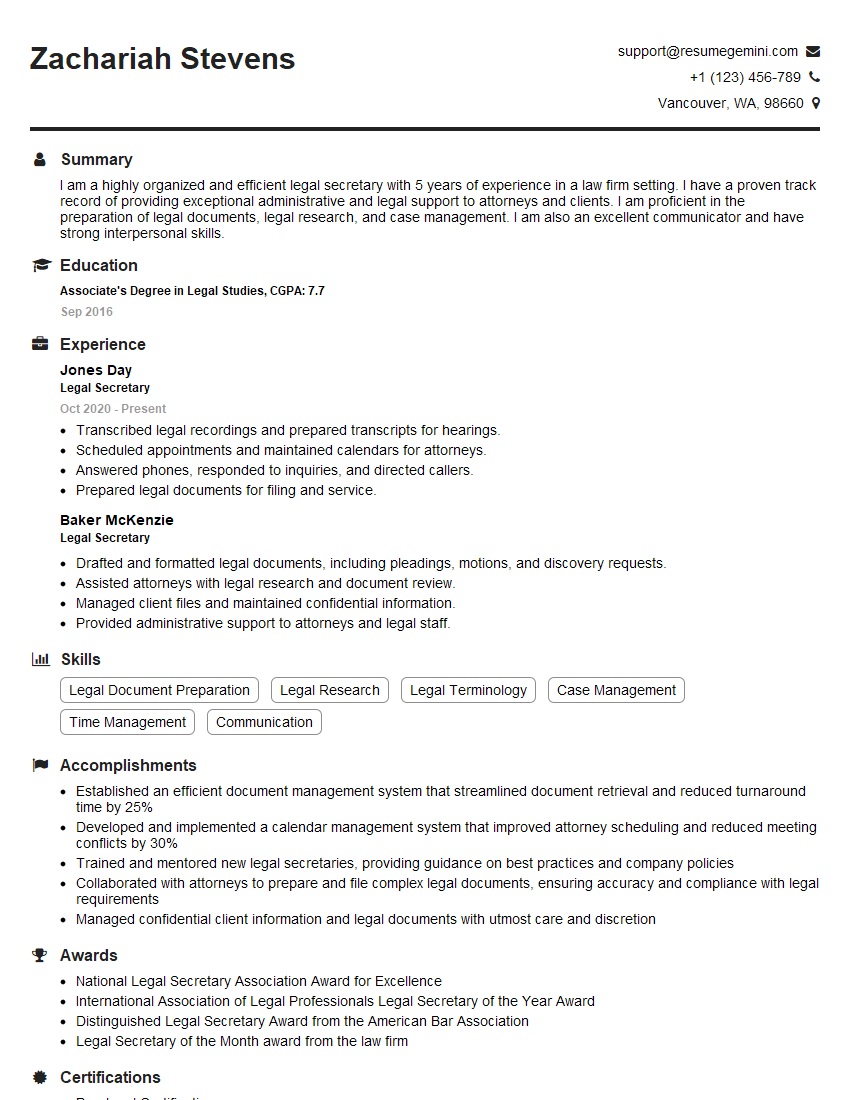
Legal Secretary Resume Sample
Explore more articles
Users Rating of Our Blogs
Share Your Experience
We value your feedback! Please rate our content and share your thoughts (optional).
What Readers Say About Our Blog
To the interviewgemini.com Webmaster.
Very helpful and content specific questions to help prepare me for my interview!
Thank you
To the interviewgemini.com Webmaster.
This was kind of a unique content I found around the specialized skills. Very helpful questions and good detailed answers.
Very Helpful blog, thank you Interviewgemini team.