Every successful interview starts with knowing what to expect. In this blog, we’ll take you through the top Leaded glass assembly interview questions, breaking them down with expert tips to help you deliver impactful answers. Step into your next interview fully prepared and ready to succeed.
Questions Asked in Leaded glass assembly Interview
Q 1. Describe your experience with different types of leaded glass (e.g., Tiffany, Frank Lloyd Wright styles).
My experience with leaded glass encompasses a wide range of styles, including the iconic Tiffany and Frank Lloyd Wright techniques. Tiffany glass, known for its vibrant colors and intricate designs, often utilizes small, irregularly shaped pieces of glass, meticulously arranged to create stunning mosaics. The lead came is relatively thin, resulting in a more delicate, yet equally strong, final piece. Frank Lloyd Wright’s style, on the other hand, tends towards geometric patterns and a more subdued color palette. His designs often incorporate larger glass pieces and may use thicker lead came for a bolder, more architectural feel. I’ve worked extensively with both styles, appreciating the unique challenges and rewards each presents. For example, a recent Tiffany-style project involved hundreds of tiny glass pieces depicting a blooming flower, requiring exceptional precision and patience, while a Frank Lloyd Wright-inspired window incorporated geometric panels with beveled glass, demanding careful calculation of angles and precise cutting.
Q 2. What are the common challenges encountered in leaded glass assembly, and how do you overcome them?
Leaded glass assembly presents several challenges. One common issue is the fragility of the glass itself. Careful handling throughout the process is paramount to avoid breakage. Another challenge lies in achieving perfectly aligned seams between the glass pieces. Even slight misalignments can compromise the aesthetic appeal and structural integrity. Finally, ensuring a strong and watertight seal is crucial to prevent leaks or damage. To overcome these challenges, I utilize precision cutting tools, meticulous planning and design, and careful soldering techniques. For instance, I always use appropriate glass supports during the construction process to minimize stress and potential breakage. I also employ a magnifying glass for precise alignment of the glass pieces and consistently use high-quality solder for a robust seal. Experience teaches patience and attention to detail, making all the difference in achieving a flawless, durable product.
Q 3. Explain your process for cutting and shaping glass for leaded glass projects.
My glass cutting process begins with careful planning. I create a full-scale pattern of the design, which I then transfer to the glass. I use a specialized glass cutter to score the glass along the marked lines, applying even pressure for a clean cut. Then, using running pliers, I carefully snap the glass along the score line, minimizing chipping or breakage. For intricate shapes, I employ a wet saw with a diamond blade for greater precision. I always wear safety glasses during this process. Once cut, I use grinding tools to smooth any rough edges before assembling the pieces. Imagine it like a delicate jigsaw puzzle, but instead of wood, it’s beautiful glass. Precision is key at each stage, from the initial score to the final smoothing.
Q 4. Describe the different types of solder used in leaded glass work and their applications.
Several types of solder are used in leaded glass work, each with specific applications. Lead solder, a traditional choice, is known for its strength and relatively low melting point. However, due to lead’s toxicity, lead-free solders are gaining popularity. These are typically tin-based alloys with varying proportions of other metals like silver or copper, which may impact their melting point and strength. I select solder based on project requirements and my client’s preference, always considering factors like the glass type, desired strength, and aesthetic finish. Lead solder creates a darker patina over time, while lead-free options may offer a brighter finish. The choice is a balance of functionality and environmental responsibility. For example, in a delicate Tiffany-style lamp, I might prefer lead-free solder to minimize potential health risks.
Q 5. How do you ensure the structural integrity of a leaded glass panel?
Ensuring the structural integrity of a leaded glass panel is crucial. This is achieved through several key steps. First, the careful selection of strong, high-quality lead came (the metal framework holding the glass) is critical. Second, meticulous soldering techniques are paramount. Each solder joint must be strong and secure. Third, the use of appropriate supporting structures (e.g. armatures) during assembly helps prevent warping or breakage during construction. Finally, a strong, well-sealed back-support, such as a painted plywood backing, adds significant strength and stability to the final piece. Think of the lead came as the skeleton, the soldering as the ligaments, and the backing as the muscle, all working together to create a robust and beautiful final result. Quality in each stage is key.
Q 6. What safety precautions do you observe while working with leaded glass and soldering equipment?
Safety is paramount in leaded glass work. I always wear safety glasses to protect my eyes from flying glass fragments during cutting. When soldering, I use a well-ventilated area and a respirator to avoid inhaling fumes. Lead solder requires particular caution, as lead dust is highly toxic. I also work in a clean and organized workspace to prevent accidents. Proper disposal of lead waste is essential. Finally, protective gloves and clothing help prevent burns and other injuries. My approach always prioritize safety alongside quality craftsmanship, viewing these as equally important aspects of the craft.
Q 7. Explain your experience with different types of glass and their suitability for leaded glass projects.
My experience includes working with a variety of glass types suited for leaded glass projects, each with its own unique properties. These include clear, colored, textured, and opalescent glass. Clear glass provides a clean backdrop, allowing colors to shine. Colored glass offers vibrant hues, while textured glass adds depth and dimension. Opalescent glass creates a luminous effect, ideal for capturing light. The choice of glass is determined by the design intent and the overall aesthetic of the project. For instance, a stained-glass window might utilize clear glass for the background and various colored glass for the design, whereas a Tiffany lamp might employ a variety of opalescent glass to achieve a shimmering effect. The selection process always involves considering the light transmission, color saturation, and overall texture to achieve the desired artistic outcome.
Q 8. How do you handle the cleaning and maintenance of leaded glass panels?
Cleaning and maintaining leaded glass panels requires a gentle touch and the right tools. Think of it like caring for a delicate antique – you wouldn’t want to scratch the surface! Regular dusting with a soft cloth or a feather duster is essential to remove surface dust and prevent buildup. For more stubborn dirt, I use a slightly dampened microfiber cloth, ensuring it’s not overly wet to avoid damaging the lead came or the glass itself. Avoid abrasive cleaners or harsh chemicals, as these can etch the glass or corrode the lead. For more significant cleaning, a specialist glass cleaner, applied sparingly and carefully wiped, can be used. Protecting the panels from extreme temperature fluctuations and direct sunlight is also vital to prevent cracking or fading of the glass.
For example, on a large church window commission, we established a quarterly cleaning schedule using a dedicated team trained in delicate cleaning techniques. This ensured the longevity and beauty of the intricate leaded glass for years to come.
Q 9. Describe your experience with designing and executing complex leaded glass patterns.
Designing and executing complex leaded glass patterns is a rewarding but challenging process. It starts with a thorough understanding of the client’s vision, translating their ideas into a detailed design plan. This often involves sketching initial concepts, then refining the design digitally. I’m experienced in creating intricate patterns involving various glass types, colors, and textures, ensuring seamless transitions and balanced visual appeal. Consider a recent project where the client requested a window depicting a fantastical forest scene. The design involved hundreds of individual glass pieces, each carefully selected and cut to precise dimensions. The execution requires meticulous attention to detail during the cutting, assembly, and soldering phases. It’s a blend of artistic vision and technical precision. I carefully consider the structural integrity of the piece throughout the design process, ensuring it will be both aesthetically pleasing and robust.
Q 10. How do you manage your time effectively on large-scale leaded glass projects?
Managing time effectively on large-scale leaded glass projects involves a structured approach. I begin with a detailed project schedule, breaking down the entire process into smaller, manageable tasks. This includes material procurement, design refinement, glass cutting, lead came preparation, assembly, and final finishing. Critical Path Method (CPM) scheduling helps identify tasks that are crucial to the project’s timeline and allows for efficient resource allocation. Regular progress meetings with the team and client keep everyone informed and aligned. Furthermore, I prioritize tasks based on their urgency and importance, using tools like Gantt charts to visualize the project timeline and potential bottlenecks. Flexibility is also key. Unexpected delays are common, so having contingency plans allows for adjustments without significantly impacting the overall timeline.
For instance, on a recent cathedral window restoration, we used a detailed Gantt chart to track progress. This allowed us to proactively address potential delays caused by material shortages by ordering supplies in advance and adjusting the timeline.
Q 11. What software or tools are you proficient in for leaded glass design?
While traditional sketching and pattern-making remain crucial, I also utilize digital tools to enhance efficiency and precision. I’m proficient in Adobe Illustrator for creating detailed vector-based designs, which allows for precise scaling and manipulation of patterns. This software is particularly helpful for complex designs requiring intricate details and multiple glass pieces. I also use CAD software for creating detailed three-dimensional models, especially useful for larger projects. Furthermore, I’m familiar with various digital image editing software for manipulating and selecting glass textures and colors to ensure an accurate visual representation of the final product. This allows clients to visualize the final result effectively and enables me to make informed decisions during the design process.
Q 12. How do you troubleshoot common issues during leaded glass assembly?
Troubleshooting in leaded glass assembly often involves identifying and rectifying issues related to lead came, glass, or the soldering process. For example, if a lead came line is uneven, it might be due to inconsistent lead application or improper shaping. I address this by checking the lead came for kinks or irregularities, ensuring the glass pieces are properly aligned, and using appropriate tools to adjust the lead came as needed. Glass breakage during cutting or assembly can happen; careful handling and the use of appropriate cutting tools minimizes this risk. If soldering issues arise, such as weak joints or uneven solder flow, I carefully examine my soldering technique, temperature control, and the cleanliness of the lead came surfaces. Sometimes, replacing faulty sections is necessary to ensure the structural integrity and aesthetic quality of the panel.
A systematic approach, involving careful examination, and understanding the cause of the issue, rather than just addressing symptoms, is key to successful troubleshooting. Experience allows for quick identification of common problems and effective solutions.
Q 13. Explain your understanding of different glazing techniques.
My understanding of glazing techniques encompasses various methods for securing and sealing glass pieces within a framework. Traditional leaded glass uses lead came, creating strong and intricate patterns. Copper foil is another method where thin copper strips are wrapped around the edges of glass pieces before soldering, resulting in a clean and elegant finish. Zinc came offers a similar aesthetic to lead but with greater strength and resistance to corrosion, making it a preferable choice in some applications. Finally, I’m also familiar with more modern techniques like silicon glazing, which offers a flexible and durable alternative, particularly suitable for curved or irregular surfaces.
Choosing the right glazing technique depends on factors like the style of the piece, its intended location, and desired aesthetic. For instance, lead came is perfect for traditional stained glass windows, while copper foil lends itself to more contemporary designs. Zinc came would be a suitable alternative where enhanced durability is needed.
Q 14. How do you create a strong and secure lead came line?
Creating a strong and secure lead came line is fundamental to the structural integrity and longevity of a leaded glass panel. It involves precision in cutting, shaping, and joining the lead came. The lead came should be correctly sized and shaped to fit snugly around the glass pieces. The use of high-quality lead came free of impurities is crucial for ensuring strong solder joints. Cleanliness is vital; both the lead came and glass surfaces must be free from dirt or other contaminants to ensure proper soldering. The soldering process itself requires careful control of temperature and flux application to create strong and consistent joints. Using a quality soldering iron, with appropriate temperature settings, ensures that the solder flows correctly, creating strong, visually appealing seams.
Think of it like building a brick wall – each brick (glass piece) needs to be precisely fitted and strongly mortared (soldered) to ensure the structure’s stability. Over time, regular inspections can reveal potential issues that can be addressed before they become significant problems.
Q 15. What is your experience with repairing damaged leaded glass panels?
Repairing damaged leaded glass panels requires meticulous attention to detail and a steady hand. My approach begins with a thorough assessment of the damage. This includes identifying the extent of the breakage – whether it’s a single cracked piece, multiple broken pieces, or damage to the lead came itself.
For minor cracks, I might carefully clean the area and use a specialized epoxy resin designed for stained glass to stabilize the crack and prevent further damage. More extensive damage often necessitates replacing broken pieces. This involves carefully removing the damaged sections, finding matching replacement glass (or sourcing similar glass if an exact match is unavailable), and then precisely cutting and fitting the replacements. Re-leading the panel requires careful soldering to ensure a strong, watertight seal and a seamless aesthetic.
I’ve worked on everything from small, intricate panels in antique windows to larger, more complex designs in church windows. One memorable project involved repairing a 100-year-old family heirloom where I painstakingly matched the original glass and replicated the aged patina of the lead came to ensure a historically accurate restoration.
Career Expert Tips:
- Ace those interviews! Prepare effectively by reviewing the Top 50 Most Common Interview Questions on ResumeGemini.
- Navigate your job search with confidence! Explore a wide range of Career Tips on ResumeGemini. Learn about common challenges and recommendations to overcome them.
- Craft the perfect resume! Master the Art of Resume Writing with ResumeGemini’s guide. Showcase your unique qualifications and achievements effectively.
- Don’t miss out on holiday savings! Build your dream resume with ResumeGemini’s ATS optimized templates.
Q 16. What are your preferred methods for creating curved or irregular shapes in leaded glass?
Creating curved or irregular shapes in leaded glass presents unique challenges but allows for stunning artistic expression. My preferred methods involve careful planning and precise cutting. For gentle curves, I often use flexible lead came, which allows for bending and conforming to the desired shape. For more dramatic curves, I may cut the glass into smaller, more manageable pieces, each carefully shaped to fit the curve. This often requires employing a glass grinder to achieve the perfect fit.
Another technique I frequently use is the ‘wet-saw’ method, which provides much greater control over cuts when dealing with complex shapes. The precision involved in this technique is crucial to prevent chipping or cracking, particularly in thinner glass. The entire process of constructing a curved piece requires a strong understanding of how glass behaves under pressure and the limits of the materials involved. Think of it like building with a very delicate, beautiful puzzle—requiring both artistic vision and technical skill.
Q 17. How familiar are you with various lead came profiles and their applications?
Familiarity with various lead came profiles is fundamental to successful leaded glass work. Different profiles offer distinct aesthetic qualities and structural capabilities. For instance, ‘H’ profiles are common and provide good strength and stability, while ‘U’ profiles are more decorative. I’m proficient with a wide range of profiles, including:
- ‘H’ profile: Offers excellent structural integrity and is versatile for various projects.
- ‘U’ profile: Provides a more decorative look, often used for intricate designs and borders.
- ‘V’ profile: Typically used for more modern or minimalist designs.
- ‘Z’ profile: Offers increased strength and stability, often utilized in larger panels or areas under stress.
My selection depends heavily on the project’s design, size, and intended functionality. For a delicate antique restoration, I might prioritize a historically accurate profile, while a contemporary art piece might call for a more modern and minimalist design using a different profile altogether.
Q 18. Explain your experience with foiling techniques in stained glass assembly.
Foiling techniques provide an alternative to traditional leaded glass, offering a cleaner, more modern aesthetic. My experience with foiling involves using copper foil tape applied to the edges of the glass pieces. This tape is then soldered, creating a strong, seamless bond without the visible lead came.
The process involves carefully applying the foil tape, ensuring complete coverage to prevent leaks and maintaining consistent pressure. Then, I carefully solder the foil, using a low-temperature solder to prevent cracking the glass. Proper cleaning is critical to ensure the solder flows smoothly and forms a robust seal. The resulting piece has a distinct look, ideal for modern designs where the lead lines might be considered too prominent. I often combine foiling with other techniques, such as painting or etching, to add further artistic elements.
Q 19. Describe your process for patina application and its purpose.
Patina application is a crucial step in enhancing the aesthetic appeal and longevity of leaded glass. Patina is a chemical treatment that changes the color and texture of the lead came, often giving it an aged or antique look. My process typically involves applying a patina solution, either by brushing or immersion, depending on the desired effect. I closely monitor the application to ensure even coverage and prevent uneven discoloration.
After application, I thoroughly rinse the piece and then use a sealant to protect the patina and enhance its durability. The purpose of patina application goes beyond aesthetics—it adds a layer of protection to the lead came, slowing down oxidation and maintaining its integrity over time. Different patina solutions produce varying colors and effects—from a subtle aged appearance to a deep, rich black, allowing for artistic customization.
Q 20. How do you choose the right type of solder for a specific project?
Solder selection is critical for successful leaded glass assembly. The type of solder I choose depends on several factors, including the type of glass, the design’s complexity, and the desired aesthetic. Generally, I opt for a lead-free solder for health and environmental reasons, but some historical restorations might require the use of traditional lead solder for authenticity.
Low-temperature solders are favored for delicate work with thinner glass, minimizing the risk of cracking. Higher-temperature solders are better suited for thicker glass or larger, more robust projects. It is crucial to match the solder’s melting point to the glass’s heat resistance to avoid damage. For example, when working with antique glass, I’ll always favor a lower-temperature solder to prevent any risk of thermal shock.
Q 21. What methods do you use to prevent solder from flowing onto the glass surface?
Preventing solder from flowing onto the glass surface is essential for maintaining a clean and professional finish. My techniques include:
- Careful flux application: Applying flux only to the lead came and avoiding contact with the glass surface is crucial. Flux helps the solder flow smoothly but can leave unsightly marks if it comes into contact with the glass.
- Proper heat control: Using a well-controlled soldering iron with an appropriate temperature prevents excessive solder flow. Overheating is a common cause of solder spills onto the glass.
- Protective masking: In intricate designs, I often use masking tape or other materials to protect areas I don’t want solder to reach. This is especially helpful when working with delicate designs or when multiple colors need to be kept separated.
- Quick, controlled movements: Smooth and quick soldering movements minimize the risk of solder build-up or spills.
After soldering, any excess solder can be carefully cleaned using a suitable solder remover, though preventing spills in the first place is always the most efficient approach.
Q 22. Describe your experience working with different types of cement or epoxy used in leaded glass.
My experience with cements and epoxies in leaded glass work is extensive. The choice depends heavily on the project’s specifics – the size of the panel, the type of glass, and the desired aesthetic. Traditional leaded glass often uses a lead-based cement, which provides a strong, durable bond and a characteristic patina over time. However, lead-free cements and epoxies are increasingly popular due to safety concerns. These offer similar strength but without the environmental hazards. I’ve worked with various epoxy brands, each offering slightly different working times and flexibility. For instance, some epoxies are better suited for intricate designs due to their thinner consistency, while others are chosen for their superior impact resistance in larger panels. The selection process is often a balance between cost, performance, and the project’s requirements.
For example, on a recent church window restoration, we opted for a slow-setting, lead-free epoxy to ensure precise placement of the many small pieces of antique glass. The longer working time allowed for meticulous adjustment, crucial for preserving the historical integrity of the design. Conversely, for a modern, larger-scale installation in a commercial setting, we utilized a faster-setting epoxy that provided increased durability and quicker project completion.
Q 23. How do you prepare the glass surface before applying lead came?
Preparing the glass surface is critical for a successful leaded glass project. Any dust, grease, or debris will compromise the bond between the glass and the lead came. My process begins with a thorough cleaning using a non-abrasive cleaner and soft cloths. I avoid harsh chemicals that could damage the glass surface. After cleaning, I inspect the glass carefully, paying close attention to edges for any chips or imperfections which could affect the structural integrity of the finished panel. Sometimes a very fine polishing may be necessary to remove minor imperfections. The goal is to create a perfectly clean and smooth surface for optimal adhesion.
Q 24. How do you ensure consistent spacing between the lead lines?
Maintaining consistent spacing between lead lines is crucial for achieving a visually appealing and structurally sound panel. I use several techniques to ensure accuracy. Firstly, I carefully plan the design, often creating a full-scale template beforehand. Secondly, I use standardized lead came of consistent dimensions. Thirdly, during the assembly process, I use spacing tools such as small metal or plastic spacers that are removed once the cement is set. This allows for perfect alignment and even lead lines across the entire panel. Regular checks with a ruler throughout the process are essential to catch and correct any inconsistencies early on.
Think of it like building with bricks – consistent mortar spacing is essential for a strong and visually appealing wall. The same principle applies to leaded glass; consistent spacing between the lead lines creates a balanced and professional-looking final product.
Q 25. What are your preferred methods for cleaning up excess solder?
Cleaning up excess solder is a crucial step in the leaded glass process. I prefer using a combination of methods for optimal results. While the solder is still molten, I use a damp sponge or cloth to carefully wipe away excess material. Once the solder cools, I use a specialized solder removal tool to delicately scrape away any remaining residue. For intricate areas, I employ fine-tipped wire brushes. Finally, I use a brass wire brush to remove any minor remaining imperfections and to restore the sheen of the lead lines. The entire cleaning process is slow and deliberate, ensuring that the lead lines remain pristine and undamaged. It’s a bit like sculpting; we’re refining the piece to reveal its final beauty.
Q 26. Explain your process for preparing a leaded glass panel for installation.
Preparing a leaded glass panel for installation involves several key steps. First, I carefully inspect the completed panel for any structural weaknesses or loose connections. Then, I apply a protective backing to the panel, such as a thin layer of felt or foam, to safeguard it during installation. This backing helps to cushion the panel and prevent any damage to the glass or lead lines during transportation or handling. I also mark any designated mounting points or attachment areas on the back of the panel to ensure precise positioning during installation. Finally, I will often add protective corner pieces to further protect the finished work. This preparation is essential to guarantee the panel arrives safely and is installed correctly.
Q 27. What is your experience with working at heights or using ladders for installation?
Safety is paramount in my work. I possess extensive experience working at heights, always adhering to stringent safety protocols. I am proficient in using various types of ladders and scaffolding, always ensuring they are properly secured and inspected before use. I always use appropriate safety harnesses and fall protection equipment when working at heights above a certain level. Furthermore, I am fully aware of the relevant safety regulations and best practices for working at heights, and I make sure that all my work is done with the highest standards of safety, both for myself and for others.
Q 28. Describe your familiarity with different types of glazing putty and their use in leaded glass installation.
My familiarity with glazing putty extends beyond its use in traditional window glazing. In leaded glass work, glazing putty plays a crucial role in sealing the panel for weatherproofing and preventing drafts. I’ve worked with several types of putty, including oil-based, water-based, and silicone-based options. Oil-based putties offer excellent durability and water resistance, making them ideal for exterior installations. Water-based putties are easier to clean up, but their durability may be slightly lower depending on the formulation. Silicone-based putties provide a strong, flexible seal that can accommodate some movement, which can be beneficial in areas prone to expansion and contraction. The choice of putty depends significantly on the location and environmental conditions of the installation. For instance, in a humid environment, a high-quality oil-based putty would be preferred for its water-resistance.
Key Topics to Learn for Leaded Glass Assembly Interview
- Soldering Techniques: Understanding different solder types, flux application, and proper heating techniques for creating strong, aesthetically pleasing joints. This includes recognizing and addressing common soldering flaws.
- Glass Cutting and Shaping: Mastering safe and precise glass cutting methods, including scoring, snapping, and grinding. Understanding how to shape glass to fit specific designs and accurately measure dimensions.
- Lead Came Preparation: Learning how to properly prepare and shape lead came to create the structural framework for the leaded glass piece, ensuring consistent and accurate sizing.
- Pattern Design and Interpretation: Understanding how to interpret and follow complex patterns, including translating designs into practical assembly steps. This involves understanding scale, symmetry, and the nuances of different artistic styles.
- Glass Selection and Properties: Knowledge of various types of glass, their properties (e.g., thickness, color, texture), and suitability for different projects. This includes understanding how to select glass that complements design and creates a cohesive look.
- Safety Procedures and Best Practices: Understanding and adhering to safety regulations related to handling glass, lead, and soldering equipment. This includes proper use of personal protective equipment (PPE) and safe disposal of materials.
- Troubleshooting and Quality Control: Ability to identify and resolve common problems encountered during the assembly process. Understanding quality control measures to ensure the finished product meets high standards of craftsmanship.
- Project Management and Time Management: Understanding how to plan and manage projects effectively, including estimating time required for completion and managing resources efficiently.
Next Steps
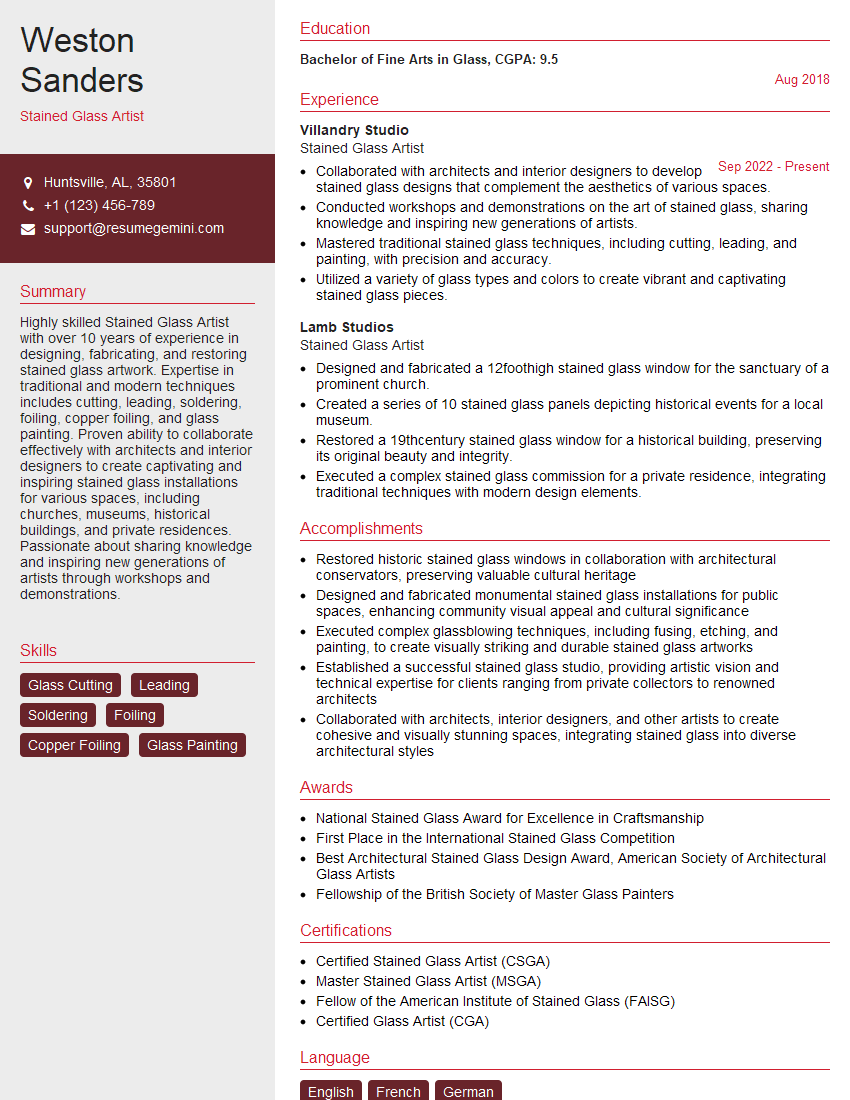
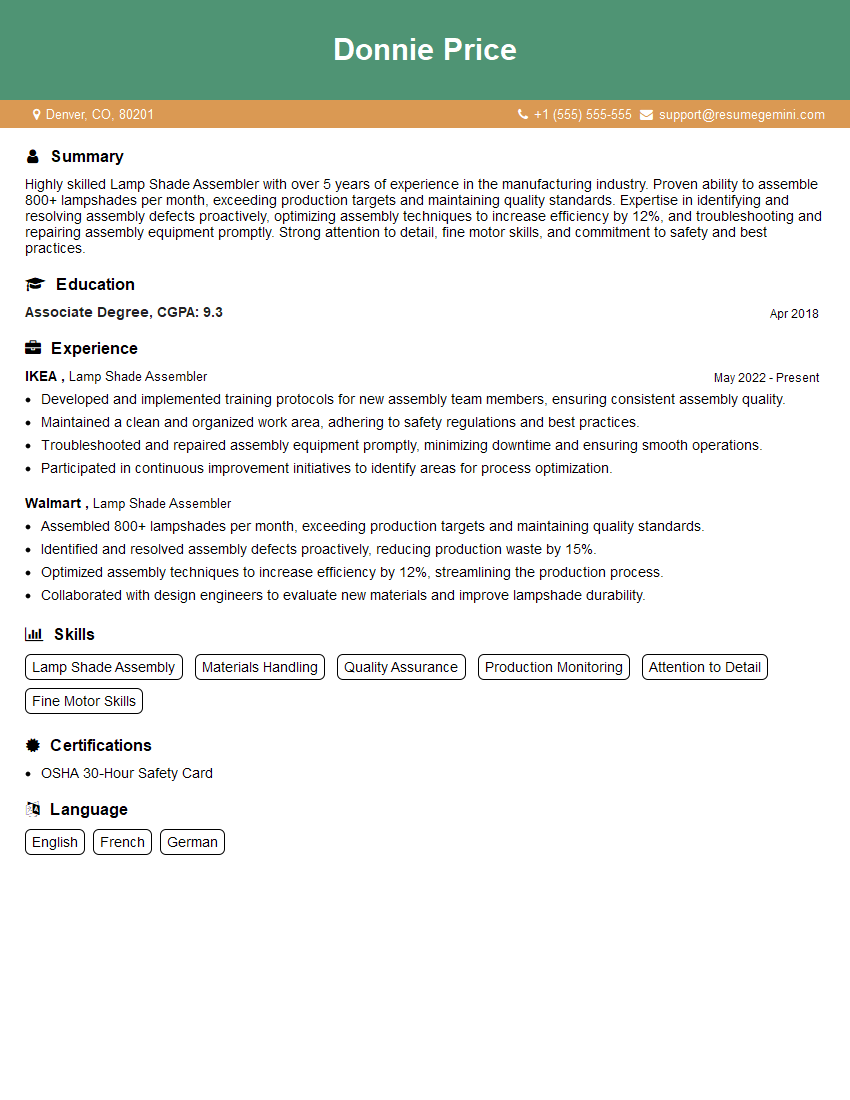
Mastering leaded glass assembly opens doors to exciting career opportunities in stained glass studios, restoration projects, and even artistic collaborations. A strong understanding of these techniques showcases your skill and dedication, making you a highly sought-after candidate. To further enhance your job prospects, creating an ATS-friendly resume is crucial. ResumeGemini is a trusted resource that can help you build a professional resume designed to highlight your skills and experience effectively. Examples of resumes tailored to the leaded glass assembly field are available to guide you through the process.
Explore more articles
Users Rating of Our Blogs
Share Your Experience
We value your feedback! Please rate our content and share your thoughts (optional).
What Readers Say About Our Blog
To the interviewgemini.com Webmaster.
Very helpful and content specific questions to help prepare me for my interview!
Thank you
To the interviewgemini.com Webmaster.
This was kind of a unique content I found around the specialized skills. Very helpful questions and good detailed answers.
Very Helpful blog, thank you Interviewgemini team.