Interviews are more than just a Q&A session—they’re a chance to prove your worth. This blog dives into essential ArcGIS Mapping and Analysis interview questions and expert tips to help you align your answers with what hiring managers are looking for. Start preparing to shine!
Questions Asked in ArcGIS Mapping and Analysis Interview
Q 1. Explain the difference between vector and raster data.
Vector and raster data are two fundamental ways of representing geographic information in GIS. Think of it like this: vector data is like drawing a map with precise lines and points, while raster data is like a photograph of the same area.
Vector Data: Represents geographic features as points, lines, and polygons. Each feature has precise coordinates and can store attributes (e.g., name, address, population). Think of a city boundary defined by a polygon, a road as a line, and a fire hydrant as a point. Vector data is ideal for representing discrete features and is highly accurate for spatial analysis involving precise locations.
Raster Data: Represents geographic features as a grid of cells or pixels, each containing a value. This value could be elevation, land cover type, or temperature. Think of a satellite image showing land use or a digital elevation model (DEM) showing elevation variations. Raster data is great for continuous phenomena and is easily integrated with remotely sensed data. However, it can be less precise than vector data in representing features with sharp boundaries.
The choice between vector and raster depends heavily on the application. For example, a cadastral map showing land parcels would use vector data, while a land cover map derived from satellite imagery would be raster.
Q 2. Describe your experience with geoprocessing tools in ArcGIS.
I have extensive experience using ArcGIS geoprocessing tools for a wide range of tasks. I frequently use ModelBuilder for automating complex workflows, saving time and ensuring reproducibility. For example, I once built a model to automate the process of extracting building footprints from high-resolution aerial imagery, including steps for orthorectification, image classification, and feature extraction. This significantly reduced the manual effort and ensured consistency across multiple datasets.
Beyond ModelBuilder, I’m proficient in using tools for spatial analysis (like overlay analysis, proximity analysis, and buffering), data conversion (such as converting between different coordinate systems and data formats), and data management (e.g., merging, appending, and dissolving features). I’ve also used Python scripting within ArcGIS Pro to customize geoprocessing tasks and create more efficient workflows. For instance, I wrote a script to automate the generation of reports summarizing spatial statistics for various regions of interest.
My experience also includes using tools for hydrological modeling, network analysis, and 3D analysis within ArcGIS, tailoring my approach to the specific needs of each project.
Q 3. How do you handle spatial data errors and inconsistencies?
Handling spatial data errors and inconsistencies is crucial for accurate analysis. My approach involves several key steps:
Data Validation: Before analysis, I thoroughly check the data for errors like missing attributes, overlapping geometries, or incorrect coordinate systems. ArcGIS provides tools for this purpose, such as the ‘Check Geometry’ tool.
Data Cleaning: I employ various techniques to clean the data, including resolving topological errors (e.g., using the ‘Eliminate’ tool to remove sliver polygons), fixing geometric errors, and using attribute queries to identify and correct inconsistencies.
Data Transformation: I use projections and coordinate system transformations to ensure data compatibility. Understanding the implications of different datums is crucial to avoid errors in spatial analysis.
Spatial Accuracy Assessment: I assess the accuracy of the data using appropriate techniques, such as comparing the data to reference datasets or performing root mean square error (RMSE) analysis.
Metadata Management: Maintaining detailed metadata, including information about data sources, processing steps, and limitations, is important for transparency and reproducibility.
For instance, in a recent project involving land use classification, I identified several overlapping polygons. Using the ‘Erase’ geoprocessing tool, I successfully eliminated these errors before proceeding with further analysis, ensuring the accuracy of the final output.
Q 4. What are the different types of map projections and when would you use each?
Map projections are essential for representing the Earth’s 3D surface on a 2D map, inevitably leading to some level of distortion. The type of projection you choose depends on the area you are mapping and what aspects you want to preserve (e.g., area, shape, distance).
Equidistant Projections: Preserve distance from a central point or along certain lines. Useful for navigation or mapping areas along a meridian or parallel.
Conformal Projections: Preserve angles and shapes, ideal for navigational charts and mapping small areas where shape accuracy is critical. Mercator is a well-known example but exaggerates areas at higher latitudes.
Equal-Area Projections: Preserve area, critical when calculating area measurements, often used for thematic mapping showing proportions of various land use categories.
Compromise Projections: Balance distortion across properties, like the Robinson projection, often used for world maps attempting to minimize overall distortion.
Choosing the right projection depends on the application. For instance, a map of a small city where shape accuracy is crucial would benefit from a conformal projection like Transverse Mercator, while a world map depicting population density would be better suited to an equal-area projection.
Q 5. Explain your understanding of coordinate systems and datum.
Coordinate systems and datums are fundamental to understanding spatial location. A coordinate system defines how geographic coordinates (latitude and longitude) are expressed on a map, while a datum defines the reference surface used for these coordinates. Think of it like this: the datum is the base, and the coordinate system is how we measure location on that base.
Coordinate System: Specifies the units and method used to define location (e.g., geographic coordinates in degrees, minutes, seconds, or projected coordinates in meters). Popular coordinate systems include UTM (Universal Transverse Mercator), State Plane, and geographic coordinates.
Datum: A reference surface (ellipsoid) approximating the Earth’s shape and provides a framework for measuring locations. Different datums represent the Earth’s shape differently. Examples include NAD83 (North American Datum of 1983) and WGS84 (World Geodetic System of 1984). Inaccurate datum selection can lead to significant errors in spatial analysis, particularly across larger areas.
For example, using a different datum when overlaying datasets can lead to features appearing misaligned. Accurate alignment requires consistency in both coordinate systems and datums.
Q 6. How do you perform spatial analysis using ArcGIS?
ArcGIS offers a wide array of tools for spatial analysis. These tools allow us to answer complex questions about geographic data, such as proximity analysis, overlay analysis, and spatial statistics. The choice of method depends entirely on the questions that need to be answered.
Overlay Analysis: Combining multiple layers to explore spatial relationships. For example, overlaying a land use layer with a soil type layer can help identify areas suitable for a particular type of development.
Proximity Analysis: Measuring distances and areas around features. For example, creating buffers around schools to assess their service area.
Spatial Statistics: Analyzing the spatial distribution of features. For example, using spatial autocorrelation to identify clusters of crime incidents.
Network Analysis: Analyzing paths and routes on networks such as roads or utilities. For example, finding the shortest route between two points or optimizing delivery routes.
In a real-world example, I recently used spatial analysis to identify optimal locations for new wind turbines, incorporating factors like wind speed, proximity to power lines, and land use regulations. This involved overlay analysis, proximity analysis, and suitability modeling to find the most suitable sites.
Q 7. Describe your experience with creating and managing geodatabases.
I possess significant experience in creating and managing geodatabases in ArcGIS. Geodatabases provide a structured way to organize and manage spatial data, improving data integrity and efficiency. I’m familiar with both file geodatabases and enterprise geodatabases.
My experience includes:
Designing geodatabase schemas: Creating feature classes, tables, and relationships that effectively represent the data model for a project. This includes defining appropriate data types, domains, and subtypes for attributes.
Data import and export: Importing data from various sources (shapefiles, CAD files, spreadsheets, etc.) and exporting data to different formats.
Data management: Implementing data validation rules, enforcing data integrity, and performing data maintenance tasks such as archiving and backups.
Versioning and Replication: Using geodatabase versioning to manage concurrent edits and data updates, particularly important in collaborative projects. This also includes replication for managing geodatabases across multiple locations.
Performance Optimization: Implementing techniques to enhance geodatabase performance, including spatial indexing and data compression. For example, I improved the performance of a large-scale urban planning database by creating spatial indexes on key feature classes.
For example, I once designed and implemented a geodatabase for a large-scale environmental monitoring project, integrating data from various sensors, environmental models, and field surveys. The well-structured geodatabase allowed for seamless data management and analysis.
Q 8. How do you perform data quality control in ArcGIS?
Data quality control (QC) in ArcGIS is crucial for ensuring the accuracy, completeness, and reliability of your spatial data. It’s like proofreading a document before publication – you wouldn’t want to rely on inaccurate information! My approach involves a multi-step process.
- Data Validation: I utilize ArcGIS’s built-in tools to check for attribute errors, such as inconsistencies in data types or ranges. For example, I’d check if a field specifying population has negative values, which is impossible. I also use tools to identify spatial errors, such as overlaps or gaps in polygon features. Imagine checking for overlapping property boundaries – that could lead to serious legal issues!
- Topology Checks: I regularly employ topology rules to enforce geometric relationships between features. For example, I’d ensure that polygon boundaries are closed and that lines don’t overlap or have gaps. This is akin to ensuring that the pieces of a jigsaw puzzle fit perfectly together.
- Data Cleaning: This involves rectifying identified errors. I might use editing tools to fix geometric inconsistencies, update attribute values, or identify and remove duplicate features. This is the ‘corrective’ step, directly addressing the problems found during validation.
- Data Auditing: After cleaning, I perform audits to verify the corrections. This includes comparing the data before and after the cleaning process. This might involve using a database comparison tool to confirm that no information was unintentionally lost or modified during the cleaning process.
- Metadata Management: Maintaining complete and accurate metadata is paramount. I meticulously document the data’s origin, processing steps, and any known limitations. This is like providing a thorough description and history of the data, making it transparent and reliable for future users.
For instance, in a project involving land parcels, identifying and correcting overlaps in property boundaries would be critical for accurate land assessments and prevent potential disputes.
Q 9. Explain your experience with different types of spatial queries.
Spatial queries are the bread and butter of GIS analysis. They allow us to extract information based on spatial relationships. My experience encompasses several types:
- Spatial Selection: This involves selecting features based on their location relative to other features or a defined area. For example, selecting all buildings within a 1-kilometer radius of a school using a buffer analysis. This is very useful for proximity analysis in areas like emergency response planning, where we need to identify the closest facilities to incidents.
- Attribute Queries: These are queries based on the attribute values of features. For example, selecting all parcels with a land use code of ‘Residential’ and a value exceeding $1 million. This is often combined with spatial selection. Imagine identifying all residential properties above a certain tax bracket within a specific district.
- Spatial Joins: This integrates attributes from one feature class into another based on spatial relationships. Imagine joining street centerline data with census block data to attach demographic information to street segments. This is particularly useful when you have related data split across different layers.
- Overlay Analysis: This involves combining two or more spatial layers to create a new layer containing information from both. Examples include intersect (finding the common area between two layers) and union (combining features based on boundaries). This could be used for land suitability analysis, merging soil type information with topographic data to identify ideal sites for planting.
Each query type has its applications. The choice depends on the specific analytical goals. I always strive to choose the most efficient and accurate method based on the problem being solved.
Q 10. How would you address data scalability challenges in a large GIS project?
Scalability in large GIS projects is paramount. A poorly planned project can grind to a halt when processing enormous datasets. My strategies include:
- Data Partitioning: Dividing large datasets into smaller, manageable chunks is crucial. This allows for parallel processing, significantly reducing processing times. Think of it like dividing a large workload among a team – it gets done much faster.
- Geodatabases: Using geodatabases, especially enterprise geodatabases, is essential. These databases provide robust data management capabilities and improved performance compared to shapefiles, especially for large datasets.
- Database Optimization: This includes creating appropriate spatial indexes, optimizing data structures, and using efficient query techniques. It’s like organizing a library effectively; it’s far easier to find a specific book in an organized system.
- Cloud Computing: Leveraging cloud platforms like ArcGIS Online or Amazon Web Services (AWS) provides scalable computing resources to handle massive datasets. This allows for processing tasks that are too large for local machines. This is the digital equivalent of having access to a supercomputer to handle your analysis.
- Data Compression and Generalization: Simplifying complex datasets while retaining relevant information is vital. This includes reducing the number of vertices in polygon features or using generalized representations of features. This balances accuracy and performance.
For example, analyzing statewide land cover data requires careful consideration of data partitioning and cloud computing to manage the immense amount of information involved.
Q 11. Describe your experience with scripting or automation in ArcGIS (Python, ModelBuilder).
Automation is a game-changer in GIS. I’m proficient in both Python scripting and ModelBuilder.
- Python Scripting: I use Python to automate repetitive tasks, such as data preprocessing, batch geoprocessing, and custom analyses. For example, I’ve written scripts to automatically convert data from various formats to a common standard, ensuring consistency across multiple datasets. This saves substantial time and effort compared to manual processing.
- ModelBuilder: This is perfect for visualizing and managing complex geoprocessing workflows. I use it to build models that chain together various geoprocessing tools, allowing me to perform complex analyses reproducibly. I can build custom tools that simplify workflows for others.
For example, I built a ModelBuilder model that automatically performs a series of overlay, buffer, and selection analyses to identify suitable locations for new wind farms. It automatically handles the steps, ensuring consistency and reducing errors.
Here’s a snippet of Python code for creating a buffer:
import arcpy
arcpy.Buffer_analysis("input_features", "output_features", "100 Meters")
This code creates a 100-meter buffer around the input features and saves the result to the output features.
Q 12. How do you symbolize and classify data for effective map communication?
Effective map symbolization and classification are critical for communicating information clearly and concisely. It’s about guiding the reader’s eye to the key aspects of the data.
- Choosing Appropriate Symbols: The type of symbol used depends heavily on the data. Points might be represented by markers, lines by different line weights and styles, and polygons by fill patterns or colors. The choice should be intuitive and easily interpretable. Using a different color for each residential zoning category is far more intuitive than using various line patterns.
- Classification Methods: Data classification schemes determine how data values are grouped and visually represented. Common methods include equal interval, quantile, natural breaks (Jenks), and standard deviation. The best method depends on the data distribution and the message being communicated. For a dataset with a skewed distribution, using equal intervals would not be a good approach as many classes would have a very small number of features.
- Color Schemes: Color choice is paramount. I use perceptually uniform color ramps to avoid misinterpretations and ensure accessibility. I avoid using colors that may have cultural connotations and ensure sufficient color contrast for readers with visual impairments. A color blind-friendly palette is essential.
- Cartographic Principles: I adhere to established cartographic principles, such as map scale, legend design, and labeling. These principles help create maps that are visually appealing and informative.
For example, in mapping population density, I’d likely use a graduated color scheme based on natural breaks to highlight areas of high and low population concentration. A good map tells a story effectively.
Q 13. Explain your experience with integrating GIS data with other data sources.
Integrating GIS data with other data sources is essential for comprehensive analysis. My experience involves several methods:
- Database Joins and Relates: I frequently use database joins and relates to link GIS data with tabular data from spreadsheets, databases, or other sources. For example, I can join census data to a map of census tracts to create a more informative map.
- APIs (Application Programming Interfaces): I utilize APIs to access and integrate data from online services, such as weather data or real-time traffic information. This allows me to create dynamic and interactive maps.
- File Geodatabases: These are very useful to combine multiple datasets of varying formats.
For example, in a project analyzing air quality, I might integrate GIS data (locations of pollution sources) with sensor data (real-time pollutant concentrations) and weather data to create a comprehensive analysis of air quality patterns. This requires careful data transformation and management, however, as different datasets may have varying formats and standards.
Q 14. How do you create and manage layers and feature classes in ArcGIS Pro?
Managing layers and feature classes in ArcGIS Pro is fundamental. It involves understanding the data structure and utilizing the software’s tools effectively.
- Creating Feature Classes: I create new feature classes using the Create Feature Class geoprocessing tool, specifying the geometry type (point, line, or polygon), spatial reference, and attribute fields as needed. This is the foundation for building a new dataset.
- Importing Data: I import data from various formats (shapefiles, CAD files, etc.) using the Add Data or Import Features tools. This is how external datasets are integrated into a project.
- Managing Layers: In ArcGIS Pro, layers represent the visual representation of data. I use the Contents pane to manage layers, control their visibility, symbology, and other properties. This is crucial for visualizing different aspects of the data selectively.
- Data Organization: I organize data into geodatabases or folders to maintain a logical structure, making it easier to find and manage the datasets. A well-organized data structure is essential for efficient work and project manageability.
- Feature Class Editing: I use the editing tools to modify existing feature classes, adding, deleting, or modifying features. This may involve correcting errors or updating information.
Proper management is essential for a well-organized and efficient GIS project. The goal is to have a structured and easily navigable workspace, enabling efficient analysis.
Q 15. Describe your experience with map layout design and cartographic principles.
Map layout design is the art and science of arranging map elements – features, text, legends, scale bars – to create a visually appealing and informative map. Cartographic principles guide this process, ensuring clarity, accuracy, and effectiveness. My experience encompasses a wide range of map types, from simple thematic maps to complex atlases. I leverage my knowledge of visual hierarchy (using size, color, and placement to emphasize key information), visual balance (achieving symmetry or asymmetry deliberately), and figure-ground relationships (ensuring features stand out against the background). For instance, I recently designed a map showing population density in a large city. I used graduated colors to represent density, ensuring the legend was easily understood and placed strategically. I carefully considered font sizes and styles for readability and added a clear title and north arrow for orientation. I always strive to make maps accessible and understandable to a wide audience, regardless of their GIS expertise.
I also have extensive experience with ArcGIS Pro’s layout capabilities, utilizing map elements like callouts, text boxes, and graphics to enhance the narrative. I have worked with various projection systems, ensuring accuracy and consistency throughout the mapping process. I am proficient in creating both print-ready and web-ready map layouts, adapting the design to the target medium.
Career Expert Tips:
- Ace those interviews! Prepare effectively by reviewing the Top 50 Most Common Interview Questions on ResumeGemini.
- Navigate your job search with confidence! Explore a wide range of Career Tips on ResumeGemini. Learn about common challenges and recommendations to overcome them.
- Craft the perfect resume! Master the Art of Resume Writing with ResumeGemini’s guide. Showcase your unique qualifications and achievements effectively.
- Don’t miss out on holiday savings! Build your dream resume with ResumeGemini’s ATS optimized templates.
Q 16. How do you use spatial interpolation techniques in ArcGIS?
Spatial interpolation is the process of estimating values at unsampled locations based on known values at sampled locations. In ArcGIS, I commonly use several methods depending on the data and desired outcome. Inverse Distance Weighting (IDW) is a straightforward technique that assigns weights inversely proportional to the distance from known points. This is useful for smoothly interpolating surfaces but can be sensitive to outliers. Kriging, a geostatistical method, considers both spatial autocorrelation and the variability of data, producing more accurate and reliable surfaces by incorporating uncertainty. It’s especially valuable when dealing with spatially autocorrelated data like soil properties or rainfall measurements. For example, I used Kriging to model air pollution levels across a city, taking into account the spatial correlation between monitoring stations.
I also utilize other techniques like Spline and Natural Neighbor. The choice depends on the data distribution and the specific application. Before interpolation, I always carefully assess data quality, handling outliers and selecting the appropriate method for the data characteristics and the research question.
Q 17. What are the advantages and disadvantages of using different spatial analysis methods?
Various spatial analysis methods offer different strengths and weaknesses. For example, Buffer analysis is simple and efficient for identifying areas within a specified distance of a feature, but it doesn’t consider the characteristics of the features being buffered. Overlays, like intersection and union, combine multiple layers, providing insights into spatial relationships, but can be computationally intensive with large datasets. Network analysis offers route optimization and service area analysis, incredibly valuable for logistics or emergency services, but requires a well-defined network dataset.
- Advantages of Buffer Analysis: Simple, intuitive, fast processing.
- Disadvantages of Buffer Analysis: Doesn’t account for feature characteristics; limited analytical depth.
- Advantages of Overlays: Comprehensive spatial relationships; detailed analysis.
- Disadvantages of Overlays: Computationally intensive; potential for data loss or ambiguity.
- Advantages of Network Analysis: Real-world applications; optimized solutions.
- Disadvantages of Network Analysis: Requires specific data structure; potentially complex to set up.
The optimal method depends on the specific problem and data. I always carefully evaluate the trade-offs before selecting a method, considering data characteristics, computational resources, and the desired outcome.
Q 18. Describe your experience with working with large datasets in ArcGIS.
Working with large datasets in ArcGIS requires strategic planning and efficient techniques. I regularly handle datasets exceeding several gigabytes, employing techniques like data tiling, geoprocessing tools with parallel processing capabilities, and data compression. For example, I used data tiling to process a massive LiDAR dataset, breaking it into smaller, manageable chunks for analysis and visualization. This significantly reduced processing time and memory requirements. I also leverage ArcGIS’s geodatabase capabilities, optimizing data storage and facilitating efficient querying and analysis. To handle large raster datasets, I have experience with using image pyramids and employing appropriate data formats and compression techniques.
Furthermore, I am adept at using tools like the ArcGIS Geoprocessing framework to automate and streamline tasks, ensuring efficient handling of large volumes of data. My experience also includes leveraging cloud-based GIS solutions for large-scale data storage and processing, increasing scalability and flexibility.
Q 19. How do you ensure the accuracy and reliability of your GIS data?
Data accuracy and reliability are paramount in GIS. My approach involves a multi-faceted strategy starting with data source evaluation. I meticulously assess the source’s credibility, accuracy, and completeness. I then conduct thorough data validation and cleaning steps, addressing inconsistencies, errors, and outliers. This may involve using ArcGIS tools like the Data Reviewer extension to identify and rectify spatial and attribute errors. For instance, I once discovered discrepancies in address points using spatial checks against a road network, leading to corrections and improvements in data integrity.
I also utilize metadata management diligently, documenting data sources, processing steps, and limitations. Regular data audits and quality control checks are essential to maintain accuracy. Depending on the project, I might implement data versioning or establish robust data governance procedures to ensure ongoing data quality and reliability.
Q 20. Explain your familiarity with different data formats (shapefiles, geodatabases, rasters).
I am proficient with various data formats, understanding their strengths and limitations. Shapefiles, though widely used, are limited to a single feature class and lack advanced data management capabilities. Geodatabases, on the other hand, are robust, offering multiple feature classes, complex relationships, and superior data management tools. They are particularly useful for large and complex projects. Raster data formats, like TIFF and GeoTIFF, are suitable for imagery and continuous data such as elevation models. My experience encompasses working with various raster formats and performing operations such as raster reclassification and mosaicking.
The selection of the appropriate data format is crucial and depends on project requirements. For example, shapefiles are suitable for simple visualizations, while geodatabases are more appropriate for complex data management needs. Raster data is essential when handling remotely sensed data such as satellite imagery.
Q 21. How do you perform spatial joins and overlays in ArcGIS?
Spatial joins and overlays are fundamental spatial analysis techniques. Spatial joins link attributes from one feature class to another based on spatial relationships; for example, joining census data to polygons representing neighborhoods. In ArcGIS, I use the ‘Spatial Join’ tool, specifying the join operation (e.g., one-to-one, many-to-one) and the spatial relationship (e.g., intersects, contains).
Overlays integrate the geometries and attributes of multiple layers. Common overlay operations include ‘Intersect’ (identifying the common areas), ‘Union’ (combining all areas), ‘Erase’ (removing one layer from another), and ‘Clip’ (extracting a portion of a layer). I use the appropriate overlay tool in ArcGIS’s geoprocessing environment, selecting the input layers and specifying the output parameters. For example, I’ve used ‘Intersect’ to determine the area of wetlands overlapping with a proposed development zone. I often visualize the results using thematic maps, highlighting the spatial patterns resulting from the analysis.
Q 22. Explain your understanding of topology and its importance in GIS.
Topology in GIS refers to the spatial relationships between geographic features. It’s like defining the rules of how features connect and interact. For example, it ensures that lines in a road network don’t overlap or have gaps, that polygons representing parcels share common boundaries without slivers, and that points representing addresses fall correctly within their corresponding polygons.
Its importance lies in maintaining data integrity and accuracy. Without enforced topology, your GIS data can become messy and unreliable, leading to inaccurate analyses and misleading visualizations. Imagine trying to calculate the area of parcels if their boundaries don’t properly connect – you’ll get wildly inaccurate results. Topology rules ensure data quality, leading to more efficient analysis and improved decision-making.
- Example: In a water distribution network, topology is crucial to model the flow of water. It ensures that pipes connect properly and that valves are correctly positioned, allowing for accurate simulation of water pressure and flow.
- Example: In land parcel mapping, topology ensures that adjacent parcels share a common boundary, preventing overlaps or gaps, thus ensuring accurate area calculations and property analysis.
Q 23. How do you use different spatial referencing systems (SRS)?
Spatial referencing systems (SRS), also known as coordinate systems or projections, define how geographic data is located on the Earth’s surface. Choosing the right SRS is crucial for accurate spatial analysis and map creation. Different SRSs use different datums, projections, and units (meters, feet, degrees), each appropriate for specific geographic areas and applications.
My experience encompasses working with both geographic coordinate systems (GCS) like WGS 1984 (used in GPS) and projected coordinate systems (PCS) like UTM (Universal Transverse Mercator) or State Plane. I select the appropriate SRS based on the project’s geographic extent, required accuracy, and the type of analysis to be performed. For example, a large-scale national project might use a UTM zone covering the specific region, while a local-scale project might benefit from a state plane coordinate system. I often use the ArcGIS ‘Project’ tool to transform data from one SRS to another, ensuring compatibility between datasets.
Understanding datum transformations is also essential. A datum is a reference surface used for measuring locations. Transforming data between datums (e.g., NAD83 to NAD27) requires careful consideration, as significant discrepancies can arise, especially over large areas. I often utilize the appropriate datum transformation parameters to minimize errors during the projection process.
Q 24. Describe your experience with creating and using custom tools or models in ArcGIS.
I have extensive experience creating and using custom tools and models in ArcGIS, primarily using ModelBuilder and Python scripting. ModelBuilder allows me to automate complex workflows by visually connecting geoprocessing tools, while Python scripting provides more flexibility and control. This is incredibly helpful for repetitive tasks or complex analysis.
For example, I once developed a ModelBuilder model to automate the process of creating buffer zones around schools, intersecting those buffers with road data, and then generating reports on the number of intersections. This saved significant time compared to manual processing. In another project, I used Python scripting to automate the classification of remotely sensed imagery and generate custom reports based on the results.
Here’s a simple example of Python code that uses the arcpy module to buffer features:
import arcpy
arcpy.env.workspace = "C:/path/to/your/geodatabase"
arcpy.Buffer_analysis("input_features", "output_features", "1000 Meters")
This demonstrates my ability to combine visual workflow automation with powerful programmatic control for increased efficiency and consistency. This allows me to solve more complex tasks more effectively.
Q 25. How do you handle conflicts between different data sources or projections?
Conflicts between data sources often arise due to differences in projections, datums, or attribute schemas. To resolve these, I employ a systematic approach. First, I identify the nature of the conflict, then choose the best resolution strategy based on the context.
Projection Differences: I use the ArcGIS ‘Project’ tool to transform data into a common projection. Choosing the appropriate target projection is key and often involves trade-offs – minimizing distortion might require sacrificing a simple projection. I carefully consider the extent of the data and the types of analysis to be performed when selecting the best projection.
Datum Differences: Similarly, if different datums are used, I apply appropriate datum transformations using the ArcGIS ‘Project’ tool. These transformations account for the differences between different reference surfaces used by each datum.
Attribute Schema Discrepancies: If data sources have different attribute structures (different field names, data types, etc.), I use ArcGIS’s data management tools to reconcile them. This might involve adding new fields, renaming fields, or converting data types to maintain consistency. I document all changes meticulously to maintain data provenance.
In short, the key is understanding the source of the conflict and implementing the most suitable data transformation or management technique. Careful planning and meticulous documentation are paramount.
Q 26. Explain your experience with ArcGIS Online or ArcGIS Enterprise.
I have significant experience with both ArcGIS Online and ArcGIS Enterprise. ArcGIS Online is a cloud-based platform that offers collaborative mapping and data sharing capabilities. I’ve used it extensively for sharing maps and data with stakeholders, creating web maps for public access, and leveraging its various online services such as geocoding and spatial analysis tools. Its ease of collaboration and web-based nature are ideal for sharing results and engaging with a wider audience.
ArcGIS Enterprise is a more powerful on-premise solution, offering greater control and customization. I’ve used this in projects requiring enhanced security and management of organizational data. I’ve configured and managed ArcGIS Server, published geoprocessing services, and created custom web applications using ArcGIS API for JavaScript. It’s the ideal solution when greater control, security, and integration with existing IT infrastructure are essential.
Both platforms are valuable and choosing between them depends on the project needs and constraints, such as security requirements, data volume, and budget. I’m proficient in using both to fit the project’s requirements.
Q 27. Describe a challenging GIS project you’ve worked on and how you overcame the challenges.
One challenging project involved creating a flood risk assessment for a coastal city. The challenge wasn’t just the technical complexity but also the diverse data sources and stakeholder expectations. We had to integrate LiDAR data for elevation modeling, hydrodynamic models for flood simulation, building footprints, and socio-economic data to assess vulnerability.
The primary challenges included:
- Data Integration: The datasets were in various formats, projections, and levels of accuracy. A significant effort was dedicated to cleaning, projecting, and validating all data to ensure consistency and accuracy.
- Model Calibration and Validation: The hydrodynamic model required careful calibration and validation to ensure accurate flood simulations. This involved comparing model outputs with historical flood events and expert feedback.
- Stakeholder Engagement: Communicating complex technical information to diverse stakeholders (government officials, residents, etc.) required careful planning and effective visualization techniques. We used interactive maps and clear reports to present findings.
To overcome these, we used a phased approach:
- Data Preprocessing: Thoroughly cleaned and projected the data to a common coordinate system.
- Model Development and Calibration: Used industry-standard software to simulate floods, validating results against historical data and expert opinion.
- Visualization and Communication: Created interactive maps and reports to communicate findings effectively to stakeholders, using clear language tailored to different audiences.
The project successfully delivered a comprehensive flood risk assessment, informing emergency planning and infrastructure investment. It highlighted the importance of a well-structured approach, meticulous data handling, and effective communication in complex GIS projects.
Key Topics to Learn for ArcGIS Mapping and Analysis Interview
- Spatial Data Fundamentals: Understanding different data types (vector, raster), coordinate systems (geographic, projected), and data projections. Practical application: Explain how choosing the correct projection impacts analysis accuracy.
- Data Management and Manipulation: Importing, exporting, and managing geospatial data in ArcGIS Pro. Practical application: Describe your experience with geodatabase design and data cleaning techniques.
- Geoprocessing Tools and Techniques: Familiarity with common geoprocessing tools like buffer analysis, overlay analysis (intersect, union), spatial joins, and proximity analysis. Practical application: Explain how you would use these tools to solve a real-world problem, such as identifying areas at risk from a wildfire.
- Cartography and Map Design: Creating clear, informative, and visually appealing maps using ArcGIS Pro. Practical application: Discuss principles of map design and your experience creating effective thematic maps.
- Spatial Analysis Techniques: Understanding and applying various spatial analysis techniques such as density analysis, interpolation, and network analysis. Practical application: Describe a project where you used spatial analysis to draw meaningful conclusions.
- ArcGIS Online and Collaboration: Sharing and collaborating on maps and geospatial data using ArcGIS Online. Practical application: Discuss your experience with sharing map services and working collaboratively on GIS projects.
- Scripting and Automation (Python): Understanding the basics of scripting in Python within the ArcGIS environment to automate tasks and improve efficiency. Practical application: Explain how you’ve used scripting to streamline your workflow.
- Data Visualization and Interpretation: Effectively communicating spatial information through various visualizations and interpreting analysis results. Practical application: Discuss how you present and interpret your findings from a GIS project to a non-technical audience.
Next Steps
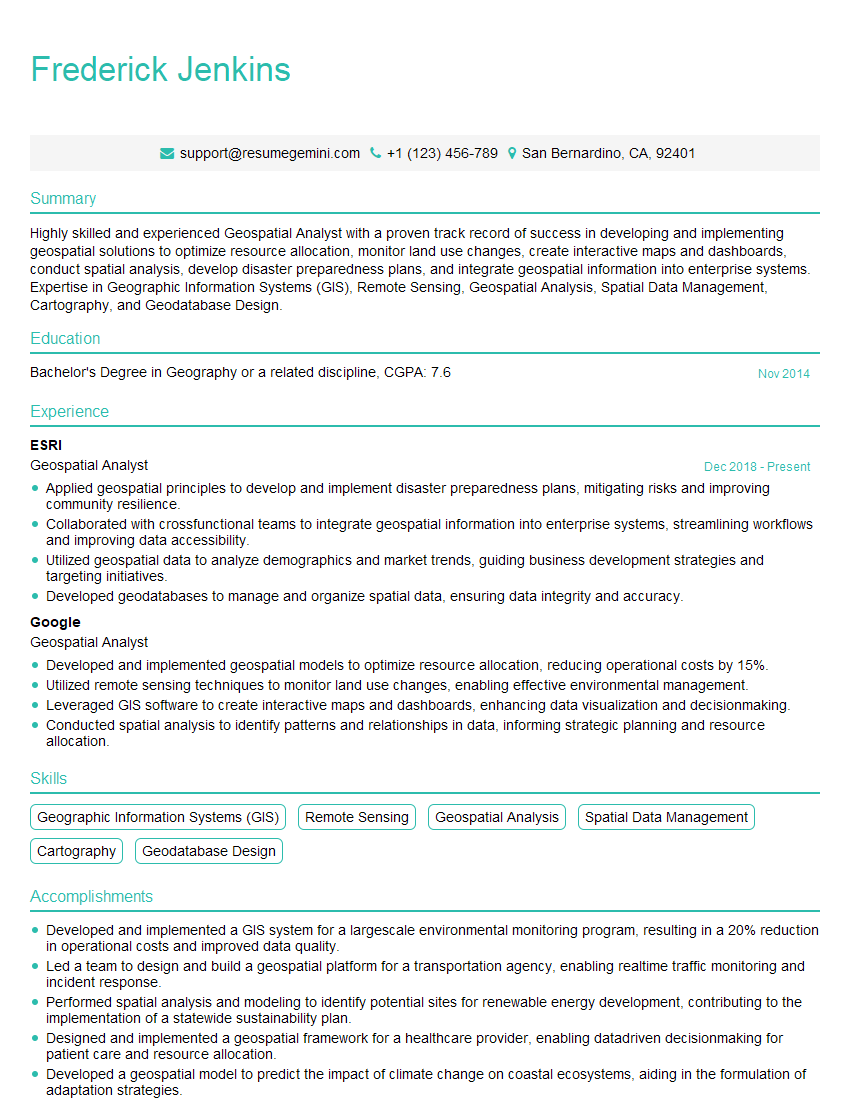
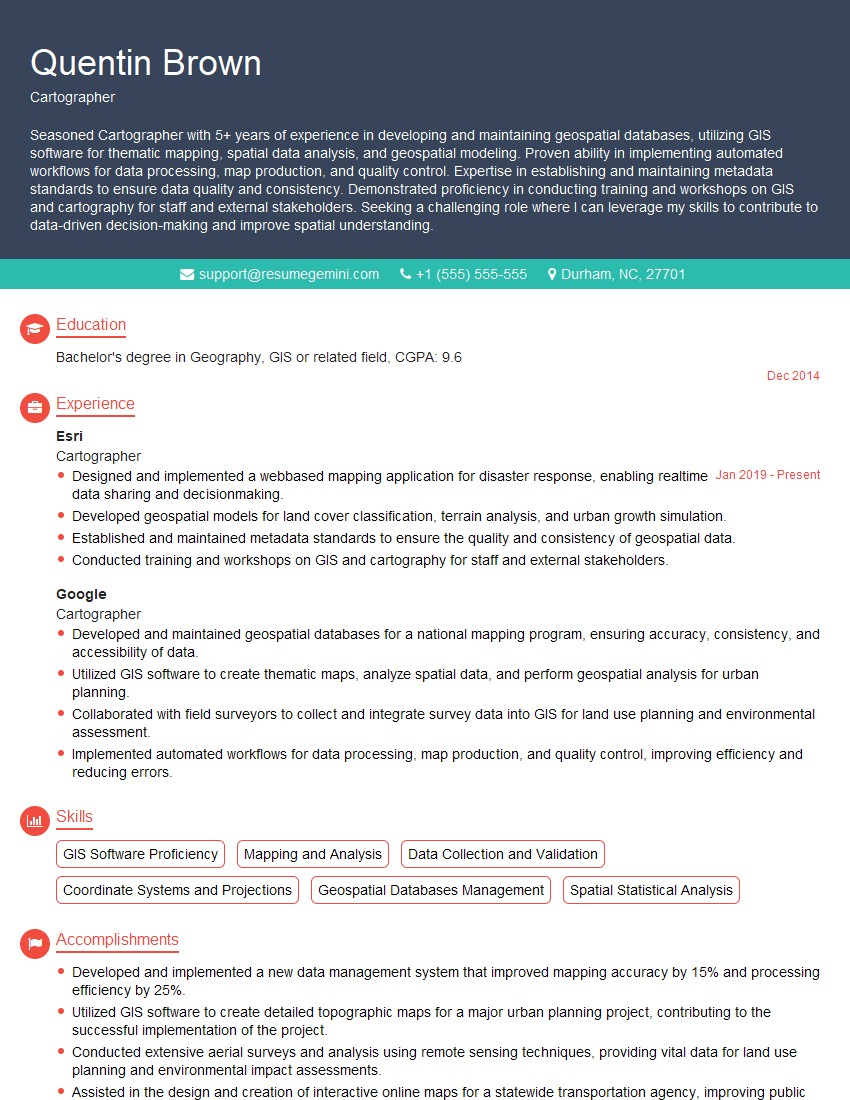
Mastering ArcGIS Mapping and Analysis significantly enhances your career prospects in diverse fields like urban planning, environmental science, and public health. A strong understanding of these skills showcases your ability to solve complex spatial problems and visualize data effectively. To maximize your job search success, focus on creating an ATS-friendly resume that highlights your key skills and accomplishments. ResumeGemini is a trusted resource that can help you build a professional and impactful resume. They provide examples of resumes tailored to ArcGIS Mapping and Analysis, ensuring your application stands out.
Explore more articles
Users Rating of Our Blogs
Share Your Experience
We value your feedback! Please rate our content and share your thoughts (optional).
What Readers Say About Our Blog
To the interviewgemini.com Webmaster.
Very helpful and content specific questions to help prepare me for my interview!
Thank you
To the interviewgemini.com Webmaster.
This was kind of a unique content I found around the specialized skills. Very helpful questions and good detailed answers.
Very Helpful blog, thank you Interviewgemini team.