Unlock your full potential by mastering the most common Wastewater System Modeling and Simulation interview questions. This blog offers a deep dive into the critical topics, ensuring you’re not only prepared to answer but to excel. With these insights, you’ll approach your interview with clarity and confidence.
Questions Asked in Wastewater System Modeling and Simulation Interview
Q 1. Explain the difference between steady-state and dynamic wastewater models.
Steady-state and dynamic models are two fundamental approaches in wastewater system modeling. A steady-state model simplifies the system by assuming that the flow and water quality parameters remain constant over time. Think of it like taking a snapshot of the system at a particular moment. This simplifies calculations significantly, making it suitable for initial assessments or preliminary designs. However, it ignores the transient nature of wastewater flows and pollutant concentrations, which can significantly vary throughout the day or year.
In contrast, a dynamic model simulates the system’s behavior over time, capturing the variations in flow and water quality. It’s like recording a movie of the system’s operation, showing how conditions change. This approach provides a more realistic representation of the system’s response to varying influent conditions, rainfall events, and operational changes. Dynamic modeling is essential for assessing the impact of these variations on treatment performance and for optimizing operational strategies.
Example: A steady-state model might predict the average daily BOD (Biochemical Oxygen Demand) removal efficiency of a treatment plant. A dynamic model, however, could simulate the hourly BOD removal efficiency, accounting for diurnal variations in influent flow and composition, providing a more accurate picture of treatment plant performance.
Q 2. What are the limitations of using a simplified model versus a complex model?
The choice between a simplified and a complex model involves a trade-off between accuracy and computational effort. Simplified models, often using lumped parameter approaches, are computationally efficient and require less data. However, they sacrifice detail and may not accurately capture complex system interactions. They’re suitable for initial screening analyses or when data is limited.
Complex models, on the other hand, incorporate detailed representation of the system’s components and processes. They offer higher accuracy and can simulate a broader range of scenarios. However, they are computationally intensive, require substantial data input, and necessitate expertise in model calibration and validation. They are ideal for detailed design, optimization, and impact assessment studies.
Limitations of simplified models: They may overlook critical interactions, leading to inaccurate predictions, especially under dynamic conditions or during extreme events. For example, a simplified model might not adequately capture the impact of a major rainfall event on the sewer network’s capacity.
Limitations of complex models: High data requirements can be a significant hurdle. Calibration and validation can be time-consuming and challenging. Overly complex models can become computationally expensive and difficult to manage.
Q 3. Describe your experience with various wastewater modeling software (e.g., SWMM, MIKE URBAN, InfoWorks WS Pro).
I have extensive experience using various wastewater modeling software packages, including SWMM (Storm Water Management Model), MIKE URBAN, and InfoWorks WS Pro. My experience spans from developing and calibrating models for individual components of wastewater systems to creating integrated models encompassing the entire system, from collection networks to treatment plants.
SWMM is particularly powerful for simulating combined sewer overflows (CSOs) and stormwater runoff impacts on wastewater treatment plants. I’ve used it extensively to model hydraulic and water quality aspects of sewer networks, including the effects of pump station failures and pipe blockages.
MIKE URBAN offers strengths in hydrodynamic and water quality modeling of urban drainage systems. I have employed it to assess the impact of urban development on receiving water quality and to design sustainable drainage systems (SuDS).
InfoWorks WS Pro is a robust tool for large-scale wastewater network modeling and optimization. I’ve utilized it in projects involving the design and optimization of large-scale wastewater collection systems, including pump station placement and pipe sizing optimization.
My proficiency in these software packages extends to data preprocessing, model calibration and validation, scenario analysis, and report generation. I’m adept at interpreting model results to support informed decision-making.
Q 4. How do you calibrate and validate a wastewater model?
Calibration and validation are critical steps in ensuring the reliability of a wastewater model. Calibration involves adjusting model parameters to minimize the discrepancy between simulated and observed data. This is an iterative process involving comparing model outputs (e.g., flow, pollutant concentrations) with field measurements collected at various locations within the system. This often involves employing optimization algorithms to find the best-fit parameters.
Validation, on the other hand, uses independent data sets (not used in calibration) to evaluate the model’s predictive capability. It assesses whether the calibrated model accurately simulates the system’s behavior under different conditions than those used during calibration. A well-validated model should show acceptable agreement between predicted and observed values for the validation dataset.
Example: In calibrating a SWMM model of a sewer network, I might adjust parameters such as Manning’s roughness coefficient for different pipe segments to match observed flow depths and velocities at various manholes. Validation would then involve comparing the model’s predictions for a separate period (perhaps during a major rainfall event) against observed data from that period to ensure the model performs reliably under different conditions.
Q 5. What are the key parameters used in wastewater modeling, and how do they affect model outputs?
Numerous parameters influence wastewater model outputs. Key parameters can be broadly categorized into hydraulic and water quality parameters.
Hydraulic parameters include:
- Manning’s roughness coefficient: Describes the friction within pipes and channels, affecting flow velocity and head loss.
- Pipe diameter and slope: Determine the flow capacity of the network.
- Infiltration/Inflow (I/I): Represents extraneous water entering the sewer system, significantly impacting flow rates.
- Pump characteristics (head-capacity curves): Define the performance of pump stations.
Water quality parameters include:
- BOD (Biochemical Oxygen Demand): Measures the amount of oxygen consumed by microorganisms decomposing organic matter.
- COD (Chemical Oxygen Demand): Represents the total amount of oxygen required to oxidize organic and inorganic matter.
- TSS (Total Suspended Solids): Indicates the amount of solid particles suspended in the water.
- Ammonia (NH3): A crucial indicator of nitrogen pollution.
- Decay and reaction rate constants: Determine the rate of degradation of pollutants.
Changes in these parameters directly affect model outputs, such as flow rates, water levels, pollutant concentrations at various points in the system, and treatment plant performance indicators.
Q 6. Explain the concept of hydraulic modeling in wastewater systems.
Hydraulic modeling in wastewater systems focuses on simulating the flow of wastewater through the network. It involves representing the physical components of the system (pipes, pumps, manholes, etc.) mathematically, and solving the equations governing fluid flow to predict flow rates, water depths, and pressures at various points in the network. The goal is to ensure the system has sufficient capacity to handle design flows and to identify potential bottlenecks or areas of surcharge.
Hydraulic models utilize fundamental principles of fluid mechanics (e.g., Bernoulli’s equation, continuity equation) to simulate the movement of water. They’re crucial for designing and managing wastewater collection systems, addressing issues such as sewer overflows, pump station design, and pressure management.
Example: Hydraulic modeling might be used to assess the impact of a new housing development on an existing sewer network, determining if the existing infrastructure has sufficient capacity to handle the increased flow. Or it might be used to optimize pump station operation to minimize energy consumption while maintaining appropriate pressure levels.
Q 7. How do you handle uncertainty in wastewater modeling inputs?
Uncertainty is inherent in wastewater modeling inputs, stemming from measurement errors, data limitations, and the complexity of the system. Several methods are employed to handle this uncertainty:
- Sensitivity analysis: Identifying the parameters that have the most significant influence on model outputs. This helps prioritize data collection efforts and focus on reducing uncertainty in the most critical parameters.
- Probabilistic modeling: Instead of using single values for parameters, probability distributions are assigned, reflecting the uncertainty in their values. This allows for the generation of a range of possible outcomes, providing a measure of the uncertainty in the model’s predictions.
- Monte Carlo simulations: A technique where the model is run repeatedly with different parameter values sampled from their probability distributions. This generates a distribution of model outputs, providing insights into the range of possible outcomes and the probability of exceeding certain thresholds.
- Ensemble modeling: Employing multiple models with different structures or parameterizations to capture different aspects of the system’s behavior. The results from these models are combined to provide a more robust and less uncertain prediction.
By incorporating uncertainty analysis into the modeling process, we obtain a more realistic assessment of the system’s behavior and the confidence we can place in the model’s predictions.
Q 8. Describe your experience with water quality modeling (e.g., BOD, COD, nutrients).
Water quality modeling in wastewater systems focuses on predicting the concentrations of various pollutants over time and space. I have extensive experience modeling Biochemical Oxygen Demand (BOD), Chemical Oxygen Demand (COD), and various nutrients like nitrogen (nitrate, nitrite, ammonia) and phosphorus. This involves using mathematical models that simulate the biological and chemical processes affecting these parameters. For example, BOD models typically use reaction kinetics (like first-order decay) to simulate the rate at which organic matter is consumed by microorganisms. Nutrient models often incorporate more complex processes like nitrification (conversion of ammonia to nitrate) and denitrification (conversion of nitrate to nitrogen gas). In my work, I’ve used software packages like MIKE 11, SWMM, and EPA’s Water Quality Analysis Simulation Program (WASP) to build and calibrate these models, often integrating them with hydrodynamic models to simulate pollutant transport.
For instance, in one project, we used a BOD model to assess the impact of a new industrial discharge on a receiving stream. The model helped predict downstream BOD concentrations, allowing us to design appropriate mitigation strategies and meet water quality standards.
Q 9. How do you incorporate rainfall data into a wastewater model?
Rainfall data is crucial in wastewater modeling because it directly impacts the inflow to the system. Incorporating rainfall involves using rainfall intensity and duration data as input to the model. This data is typically obtained from weather stations or rainfall gauges. There are several ways to integrate this data:
- Direct Inflow: Rainfall directly contributes to the wastewater flow, especially in combined sewer systems where stormwater and wastewater flow in the same pipes. The model uses the rainfall data to calculate the additional flow entering the system.
- Infiltration/Inflow (I&I): Rainfall can lead to infiltration of groundwater into the sewer system and inflow from sources like roof drains connected to the sewer network. This is often modeled using empirical relationships that relate rainfall intensity to I&I volume.
- Time-Series Analysis: Rainfall data can be incorporated as a time series directly into the model. The model then uses this time series to calculate the varying inflow rates over time.
For example, we might use a simple regression model to estimate I&I based on past rainfall data. A more sophisticated approach might involve using a hydrological model to simulate the runoff generation process before it reaches the sewer system, leading to a more accurate prediction of rainfall’s effect.
Q 10. Explain the concept of infiltration and inflow (I&I) in wastewater systems and how it’s modeled.
Infiltration and Inflow (I&I) represent the non-sanitary flows entering the wastewater collection system. Infiltration refers to groundwater seeping into the pipes, while inflow encompasses other extraneous sources such as roof drains, foundation drains, and illegal connections. I&I significantly impacts the design, operation, and cost-effectiveness of wastewater treatment plants. Excessive I&I can overload the system, causing backups, overflows, and environmental pollution.
Modeling I&I is a complex task. Several techniques exist:
- Statistical Methods: Simple regressions or more complex statistical models can be developed by correlating I&I with rainfall data. This requires historical data on flow and rainfall.
- Water Balance Approach: This approach involves calculating the inflow based on the measured outflow and the known storage in the sewer system. It often relies on pressure and flow data from manholes or pumping stations.
- Hydraulic Modeling: Advanced hydraulic models like SWMM (Storm Water Management Model) can be used to simulate the flow within the sewer system. These models incorporate physical parameters such as pipe diameters, slopes, and manhole configurations to estimate I&I.
Determining the contribution of infiltration versus inflow is crucial. Infiltration is usually addressed through pipe rehabilitation projects, while inflow often requires tracking down and sealing the illegal connections.
Q 11. How do you model the impact of climate change on wastewater systems?
Climate change significantly impacts wastewater systems. Increased rainfall intensity and frequency can overload the system, while rising temperatures can alter biological processes in wastewater treatment plants. Modeling the impact involves incorporating climate change projections into the model:
- Altered Rainfall Patterns: Climate models provide future projections of rainfall, including intensity, frequency, and duration. This data can be used to drive the model and simulate the increased I&I associated with more intense and frequent rainfall events.
- Temperature Changes: Higher temperatures affect biological processes in treatment plants. Models need to account for the impacts of temperature on microbial activity in the treatment processes, potentially changing the efficiency of nutrient removal.
- Sea Level Rise: For coastal wastewater systems, sea level rise will impact the outfall capacity, causing issues with discharge and affecting water quality.
For instance, a model might project increased overflows and treatment plant failures in a given area under various future climate scenarios. This can inform adaptation strategies, such as investing in improved infrastructure or upgrading existing treatment facilities to handle increased inflow and altered operational conditions.
Q 12. What are the different types of wastewater treatment processes, and how are they modeled?
Wastewater treatment involves a series of processes to remove pollutants and make the water safe for discharge or reuse. The modeling of these processes varies depending on the specific treatment technology:
- Activated Sludge Process: This is a common biological treatment process. Models use kinetic equations to describe the growth and decay of microorganisms consuming BOD and nutrients. The model parameters reflect the microbial activity and the effectiveness of oxygen transfer.
- Membrane Bioreactors (MBRs): MBRs combine biological treatment with membrane filtration. Models need to account for both the biological reactions and the membrane filtration process, including membrane fouling and permeate flux.
- Anaerobic Digestion: Anaerobic digestion breaks down organic matter in the absence of oxygen. Models focus on the kinetics of the different microbial communities involved and the production of biogas.
- Nutrient Removal Processes: Nitrification and denitrification processes are often modeled using kinetic equations that describe the transformation of different nitrogen forms. Phosphorus removal can be modeled based on chemical precipitation or biological uptake.
Software packages like GPS-X and Aspen Plus are specialized in modeling specific treatment processes. The choice of model depends on the complexity of the treatment process and the required level of detail.
Q 13. Describe your experience with data analysis and visualization techniques used in wastewater modeling.
Data analysis and visualization are fundamental to wastewater modeling. I have experience with a range of techniques:
- Statistical Analysis: Analyzing flow and quality data to identify trends, outliers, and correlations. Techniques like regression analysis are used to calibrate models and determine relationships between variables.
- Time Series Analysis: Analyzing time-series data to identify patterns and forecast future conditions. Techniques such as ARIMA models are helpful in predicting flow and pollutant concentrations.
- Data Visualization: Creating charts and graphs to visualize data and model results. Tools like R, Python (with libraries like Matplotlib and Seaborn), and GIS software are essential for presenting the findings clearly and effectively.
For instance, in one project, we used time-series analysis to identify seasonal patterns in flow and used this information to optimize the operation of a wastewater treatment plant. We also created interactive maps showing predicted pollutant concentrations to communicate the impact of a planned infrastructure upgrade to stakeholders.
Q 14. How do you assess the accuracy and reliability of a wastewater model?
Assessing the accuracy and reliability of a wastewater model is crucial. This involves several steps:
- Calibration: Adjusting the model parameters to match historical data. This involves comparing model predictions with observed flow and quality data.
- Validation: Testing the model’s ability to predict conditions not used in the calibration process. This confirms the model’s generalizability and predictive capability.
- Sensitivity Analysis: Determining the impact of variations in model parameters on the model’s output. This helps to understand the uncertainty associated with the model’s predictions.
- Uncertainty Analysis: Quantifying the uncertainty associated with model predictions, considering uncertainties in input data and model parameters. This involves methods such as Monte Carlo simulation.
- Goodness-of-Fit Statistics: Using statistical measures like R-squared, RMSE (Root Mean Square Error), and NSE (Nash-Sutcliffe Efficiency) to assess the goodness-of-fit between the model and observed data.
A well-calibrated and validated model with low uncertainty levels increases confidence in the model’s predictions. The choice of metrics and validation techniques will depend on the specific objectives of the model and the available data.
Q 15. What are the common challenges in wastewater modeling and simulation?
Wastewater modeling, while powerful, faces several significant challenges. One major hurdle is the inherent complexity of wastewater systems. These systems are dynamic, encompassing diverse components like sewer networks, treatment plants, and receiving waters, each with its own intricate processes and interactions. Accurate representation of these complexities in a model requires extensive data and sophisticated mathematical formulations.
Another challenge lies in data scarcity and quality. Obtaining reliable, comprehensive data on wastewater flow, composition, and infrastructure characteristics can be difficult and expensive. Incomplete or inconsistent data directly impacts the accuracy and reliability of the model. Furthermore, the calibration and validation of models are often time-consuming and require significant expertise. Ensuring the model accurately represents the real-world system necessitates careful parameter estimation and rigorous testing. Finally, the computational demands of simulating large and complex wastewater systems can be substantial, requiring powerful computing resources and efficient algorithms. For instance, simulating a large city’s sewer network for a long period can be computationally expensive.
Career Expert Tips:
- Ace those interviews! Prepare effectively by reviewing the Top 50 Most Common Interview Questions on ResumeGemini.
- Navigate your job search with confidence! Explore a wide range of Career Tips on ResumeGemini. Learn about common challenges and recommendations to overcome them.
- Craft the perfect resume! Master the Art of Resume Writing with ResumeGemini’s guide. Showcase your unique qualifications and achievements effectively.
- Don’t miss out on holiday savings! Build your dream resume with ResumeGemini’s ATS optimized templates.
Q 16. How do you handle data gaps in wastewater modeling?
Data gaps are a common reality in wastewater modeling. We employ several strategies to address this. Firstly, we utilize data imputation techniques. This involves using statistical methods to estimate missing values based on available data patterns and correlations. For example, if we have rainfall data but some flow measurements are missing, we can use statistical models to estimate the missing flow data based on the rainfall data and known relationships between rainfall and flow. Secondly, we might leverage spatial interpolation. If data is sparse geographically, we can use techniques like kriging to estimate values at unsampled locations based on neighboring data points. Thirdly, we might consult expert judgment. When data is completely unavailable, relying on the knowledge and experience of wastewater engineers can provide reasonable estimates for certain parameters. Finally, we can use sensitivity analysis to identify parameters where data gaps have the least impact on model output. This allows us to prioritize data collection efforts on the most critical parameters.
Q 17. Describe your experience with sensitivity analysis in wastewater models.
Sensitivity analysis is crucial in wastewater modeling. It helps us understand how changes in input parameters affect model outputs. I’ve extensively used various sensitivity analysis techniques, including local methods like the derivative-based approach and global methods like Monte Carlo simulations. For instance, in a project modeling a wastewater treatment plant, I used a Monte Carlo simulation to analyze the impact of uncertainty in influent flow and pollutant concentrations on the effluent quality. This helped us identify the most influential parameters, guiding future data collection and model refinement. The results showed that influent flow rate had a more significant impact than the concentration of a specific pollutant, informing our resource allocation for data improvement.
We also use sensitivity analysis to assess model robustness. If the model output is highly sensitive to small changes in a specific parameter, this might indicate either a problem with the data for that parameter or a limitation in the model’s structure. This provides valuable insights for model improvement and helps us make better informed decisions about how to manage uncertainty.
Q 18. How do you choose the appropriate model for a specific wastewater system?
Choosing the right model depends on several factors, including the specific goals of the modeling effort, the available data, the complexity of the system, and the computational resources. For instance, a simple steady-state model might suffice for assessing the capacity of a single sewer pipe, while a complex dynamic model is necessary to simulate the entire wastewater system of a large city considering diurnal variations in flow and pollution loads.
We often start by defining the objectives of the study. This informs the selection of appropriate modeling tools and techniques. A simple model, like a mass balance model, is often sufficient for basic assessments, whereas more complex models, like hydrodynamic models (SWMM, MIKE 11), are needed for detailed simulations of flow and water quality. The quality and quantity of available data also play a crucial role. A highly detailed model requires significantly more input data. Finally, the computational resources and time constraints should be considered. Complex models require more powerful computing resources and longer simulation times.
Q 19. Explain the concept of model uncertainty and how to address it.
Model uncertainty is inherent in any modeling exercise. It arises from various sources, including data uncertainty (measurement errors, missing data), model structural uncertainty (simplifications and assumptions made in developing the model), and parameter uncertainty (difficulty in accurately estimating parameter values). Addressing model uncertainty is critical for reliable results. We employ several approaches, including Monte Carlo simulations to quantify parameter uncertainty, and scenario analysis to explore the impacts of different assumptions.
For example, if we’re modeling the impact of a new development on a wastewater treatment plant’s capacity, we might run Monte Carlo simulations with various inflow scenarios and plant operational parameters to determine the probability of exceeding the plant’s capacity. This approach provides a range of possible outcomes, rather than a single deterministic prediction, offering a more realistic and reliable assessment. We also use techniques like Bayesian inference to combine prior knowledge with observed data for a more robust estimation of model parameters.
Q 20. How do you communicate complex modeling results to non-technical audiences?
Communicating complex modeling results to non-technical audiences requires clear and concise visualization and storytelling. I avoid technical jargon and use simple language and analogies. For example, instead of saying “the model predicts a 15% increase in BOD concentration,” I might say “the model shows that the amount of pollution in the river will increase by about one-sixth.”
I rely heavily on visual aids such as graphs, charts, and maps to convey key findings effectively. I also structure my presentations using a clear narrative, starting with the problem, explaining the modeling approach, presenting the key results, and summarizing the implications. Interactive dashboards can be exceptionally effective; they empower the audience to explore the results at their own pace.
Q 21. What is your experience with using GIS in wastewater modeling?
Geographic Information Systems (GIS) are invaluable in wastewater modeling. I have extensive experience integrating GIS data with my modeling work. GIS provides a powerful platform for visualizing and analyzing spatial data related to wastewater infrastructure, such as sewer networks, treatment plants, and manholes. This allows us to integrate spatial data directly into the model, enabling more accurate representation of the system’s geometry and hydraulic characteristics. For example, I used ArcGIS to integrate sewer network data with hydrodynamic models, allowing for detailed simulations of flow and water quality throughout a complex sewer network. The GIS data also facilitates the visualization of model results geographically, providing intuitive maps showcasing predictions for flow velocity, water level, or pollution concentration.
Beyond spatial data input, GIS aids in analyzing the spatial distribution of water quality parameters and identifying areas of concern. I’ve used GIS to overlay model results with sensitive environmental features, allowing for a more holistic assessment of potential environmental impacts. For example, after simulating a spill scenario in a sewer network, the GIS allowed us to map the potential pollution pathway and assess its impact on nearby water bodies.
Q 22. Describe your experience with integrating wastewater models with other systems (e.g., SCADA).
Integrating wastewater models with Supervisory Control and Data Acquisition (SCADA) systems is crucial for real-time monitoring and control of wastewater treatment plants. This integration allows for the dynamic adjustment of treatment processes based on actual plant performance data. My experience involves using various methods, including:
- Data exchange protocols: Utilizing protocols like OPC UA (Unified Architecture) or Modbus to seamlessly transfer data between the model and the SCADA system. This involves configuring data points for input (e.g., influent flow, effluent quality parameters) and output (e.g., set points for aeration blowers, chemical dosing).
- Real-time model calibration and validation: Using SCADA data to regularly calibrate and validate the model’s parameters and performance predictions. Discrepancies highlight areas needing attention, ensuring accuracy and relevance. For instance, comparing predicted effluent BOD (Biochemical Oxygen Demand) against the actual SCADA readings helps fine-tune model parameters.
- Closed-loop control implementation: Designing and implementing closed-loop control strategies where the model predicts optimal operating conditions, and the SCADA system automatically adjusts the plant’s operational parameters accordingly. A simple example is adjusting the aeration rate based on the model’s prediction of dissolved oxygen levels.
In one project, I successfully integrated a dynamic model of an activated sludge process with a SCADA system, leading to a 15% reduction in energy consumption by optimizing aeration strategies based on real-time model predictions.
Q 23. Explain the role of unit processes in wastewater treatment modeling.
Unit processes are the individual treatment steps within a wastewater treatment plant (WWTP). Modeling them accurately is essential for simulating the overall plant performance. Each unit process, like primary sedimentation, activated sludge, or disinfection, is represented mathematically by equations describing its key mechanisms. For example:
- Primary sedimentation: Modeled using settling velocity equations to predict the removal of suspended solids.
- Activated sludge: Often described by the Activated Sludge Model (ASM) series of models, which account for biological growth, substrate utilization, and oxygen transfer.
- Disinfection: Modeled using inactivation kinetics (e.g., Chick-Watson model) to predict pathogen removal.
These individual unit process models are linked together to form a comprehensive WWTP model, enabling simulation of the entire treatment process. The accuracy of the overall model relies heavily on the accuracy and detail of the individual unit process models. Ignoring certain details can lead to inaccurate overall predictions, like underestimating nutrient removal or misrepresenting effluent quality.
Q 24. How do you model the effects of different control strategies on wastewater systems?
Modeling the impact of control strategies involves modifying the model to incorporate the chosen control actions. This is often done by adding control algorithms or logic within the model’s structure. Examples include:
- Setpoint adjustments: Simulating changes in setpoints for operational parameters (e.g., aeration rate, chemical dosage) based on the control strategy.
- Feedback control loops: Implementing feedback mechanisms within the model to simulate the response of the system to deviations from desired conditions. This often requires using differential equations and control theory concepts.
- Advanced control algorithms: Incorporating sophisticated control strategies like Model Predictive Control (MPC), which uses model predictions to optimize the system’s performance over time.
For instance, to assess the impact of a new control strategy aimed at reducing energy consumption, we might simulate the WWTP model with and without the new strategy implemented. Comparing the results, such as energy usage and effluent quality, allows for a quantitative evaluation of the strategy’s effectiveness.
Q 25. What are the ethical considerations in wastewater modeling and simulation?
Ethical considerations in wastewater modeling are paramount, focusing on the responsible use of models and their impact on society. Key aspects include:
- Data privacy: Protecting the confidentiality of data used in model development and validation, particularly sensitive information about wastewater constituents.
- Model transparency: Ensuring the model’s structure, parameters, and assumptions are clearly documented and understandable to others. This promotes reproducibility and scrutiny.
- Bias mitigation: Recognizing potential biases in data collection and model development that could lead to unfair or inaccurate predictions, particularly in the context of environmental justice.
- Responsible use of results: Using model results responsibly and avoiding overinterpretation or misrepresentation of findings, ensuring they don’t lead to inaccurate policy decisions or harm communities.
For example, if a model predicts a disproportionate impact of a wastewater policy on a vulnerable community, ethical considerations would demand further investigation and mitigation of potential negative consequences.
Q 26. Describe a time when you encountered a problem during wastewater modeling; how did you solve it?
During a project modeling a large WWTP, I encountered unexpected oscillations in the simulated dissolved oxygen levels in the activated sludge basin. This wasn’t matching the observed plant data. My troubleshooting steps involved:
- Data review: I first carefully reviewed the input data, checking for errors or inconsistencies. This identified a problem with a sensor reporting inaccurate influent flow data.
- Parameter sensitivity analysis: To pinpoint the source of the oscillations, I performed a sensitivity analysis, systematically varying model parameters to assess their effect on the simulated dissolved oxygen. This revealed that the model was overly sensitive to the aeration rate coefficient.
- Model refinement: Based on the findings, I refined the model by incorporating more realistic representations of the aeration process, using more robust parameter estimation techniques and incorporating additional data points for the aeration rate, which revealed an error in the sensor reading.
- Validation: After refining the model, I performed a rigorous validation against observed plant data, which resulted in a much better fit, resolving the oscillations and improving model accuracy.
This experience emphasized the importance of rigorous data checking, thorough sensitivity analysis, and iterative model refinement to ensure the accuracy and reliability of wastewater models.
Q 27. Explain your understanding of different numerical methods used in wastewater modeling.
Various numerical methods are used to solve the differential equations that describe wastewater treatment processes. Common methods include:
- Euler methods: Simple but potentially less accurate methods for solving ordinary differential equations (ODEs), particularly for stiff systems which are common in biological processes. They approximate the solution by taking small steps along the tangent line.
- Runge-Kutta methods: More sophisticated ODE solvers offering improved accuracy and stability compared to Euler methods. They utilize weighted averages of slopes at different points within a step.
- Finite difference methods: Used to solve partial differential equations (PDEs), commonly encountered in modeling hydrodynamic processes or transport phenomena in treatment units. These methods discretize the spatial and temporal domains, approximating derivatives using finite differences.
- Finite element methods: Another powerful technique for solving PDEs, often preferred for complex geometries or heterogeneous systems. They divide the domain into elements and approximate the solution within each element using basis functions.
The choice of numerical method depends on factors such as model complexity, accuracy requirements, and computational resources. For example, simple models might utilize Euler methods, while complex, multi-dimensional models might require the use of finite element methods.
Q 28. How do you ensure the sustainability and long-term viability of your wastewater models?
Ensuring the sustainability and long-term viability of wastewater models requires proactive strategies including:
- Modular design: Developing the model in a modular fashion, allowing easy updates and modifications to individual unit processes or components as new data becomes available or treatment processes change.
- Data management: Implementing a robust data management system to ensure easy access to and updating of historical and current plant data for ongoing model calibration and validation.
- Version control: Utilizing version control systems (like Git) to track changes to the model code and ensure reproducibility of results. This allows tracking changes over time and reverting if necessary.
- Documentation: Maintaining comprehensive documentation of the model, its assumptions, parameters, and limitations, ensuring future users can understand and maintain the model. This includes a clear description of the model’s assumptions and limitations.
- Regular review and update: Regularly reviewing and updating the model based on new research, technological advancements, and operational data. This ensures the model remains relevant and accurate over time.
Without these strategies, models can quickly become outdated and unreliable, rendering them unsuitable for decision-making. Think of it like maintaining a piece of software: regular updates and patches are vital to prevent bugs and ensure it continues to function properly.
Key Topics to Learn for Wastewater System Modeling and Simulation Interview
- Hydraulic Modeling: Understanding flow dynamics within wastewater systems, including pipe networks, pumps, and treatment units. Consider exploring different modeling approaches (e.g., steady-state vs. dynamic).
- Water Quality Modeling: Analyzing the fate and transport of pollutants (BOD, COD, nutrients, etc.) throughout the system. Practice applying various reaction kinetics and transport mechanisms.
- Software Proficiency: Demonstrate familiarity with industry-standard simulation software (e.g., SWMM, InfoWorks ICM, MIKE 11). Be prepared to discuss your experience with model calibration and validation techniques.
- Scenario Analysis and Optimization: Explain your ability to use models to evaluate the impact of different design alternatives, operational strategies, and infrastructure upgrades. Highlight experience with optimization algorithms.
- Data Analysis and Interpretation: Showcase your skills in handling and interpreting large datasets, identifying trends, and drawing meaningful conclusions from model outputs. Emphasize statistical analysis techniques.
- Model Limitations and Uncertainties: Discuss the inherent uncertainties in modeling and how you account for them in your analysis. Be prepared to address potential limitations of different modeling approaches.
- Process Understanding: A strong grasp of wastewater treatment processes (primary, secondary, tertiary) is crucial for effective model development and interpretation.
Next Steps
Mastering Wastewater System Modeling and Simulation opens doors to exciting career opportunities in environmental engineering, offering specialization in a high-demand field. A strong understanding of these modeling techniques significantly enhances your value to prospective employers. To secure your dream role, a well-crafted resume is essential. Creating an ATS-friendly resume maximizes your chances of getting noticed by recruiters. ResumeGemini is a trusted resource to help you build a compelling and effective resume. We offer examples of resumes tailored specifically to Wastewater System Modeling and Simulation professionals to guide you. Take the next step towards your successful career journey today.
Environmental Scientist Resume Sample
Process Engineer Resume Sample
Process Control Engineer Resume Sample
Environmental Engineer Resume Sample
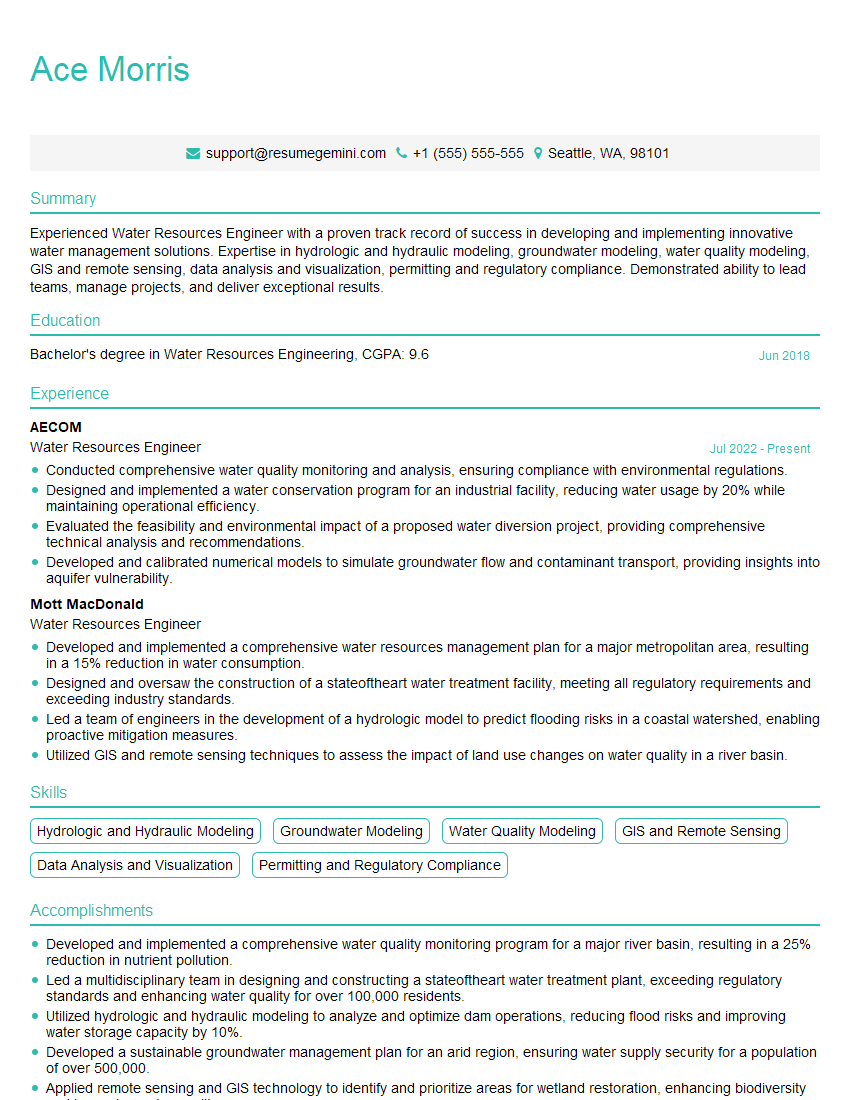
Water Resources Engineer Resume Sample
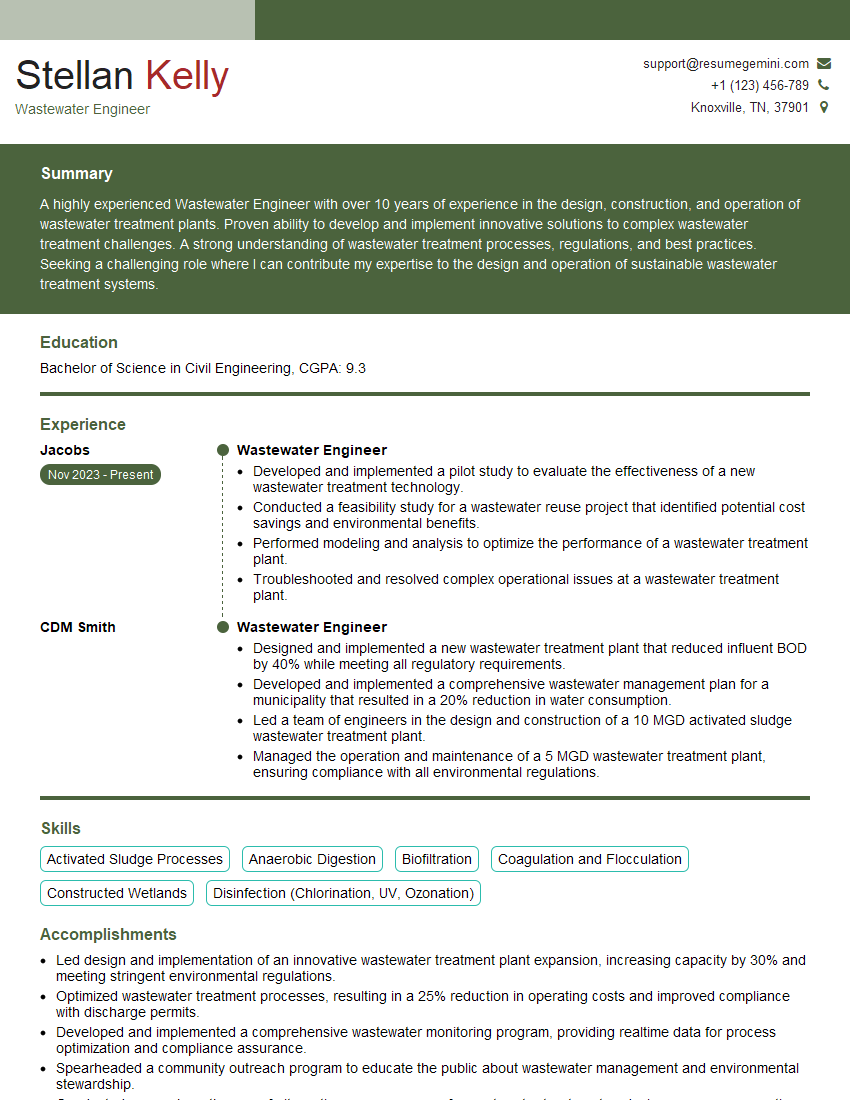
Wastewater Engineer Resume Sample
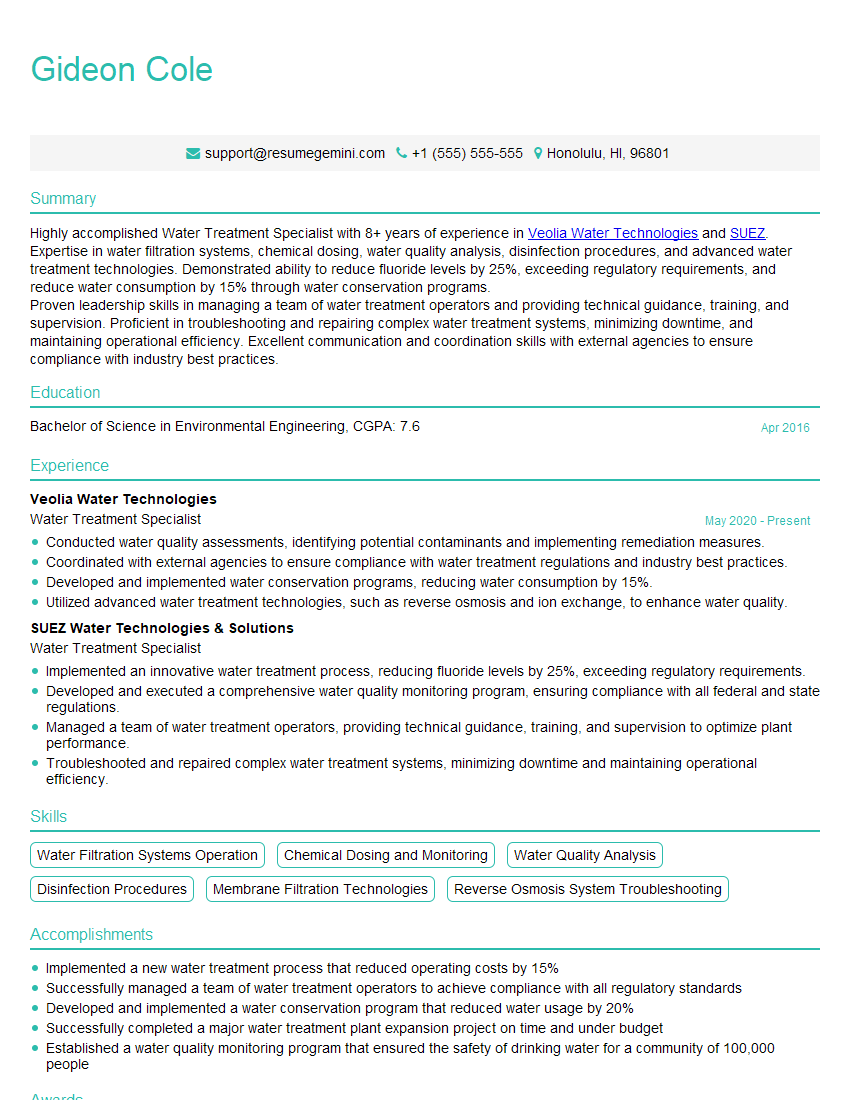
Water Treatment Specialist Resume Sample
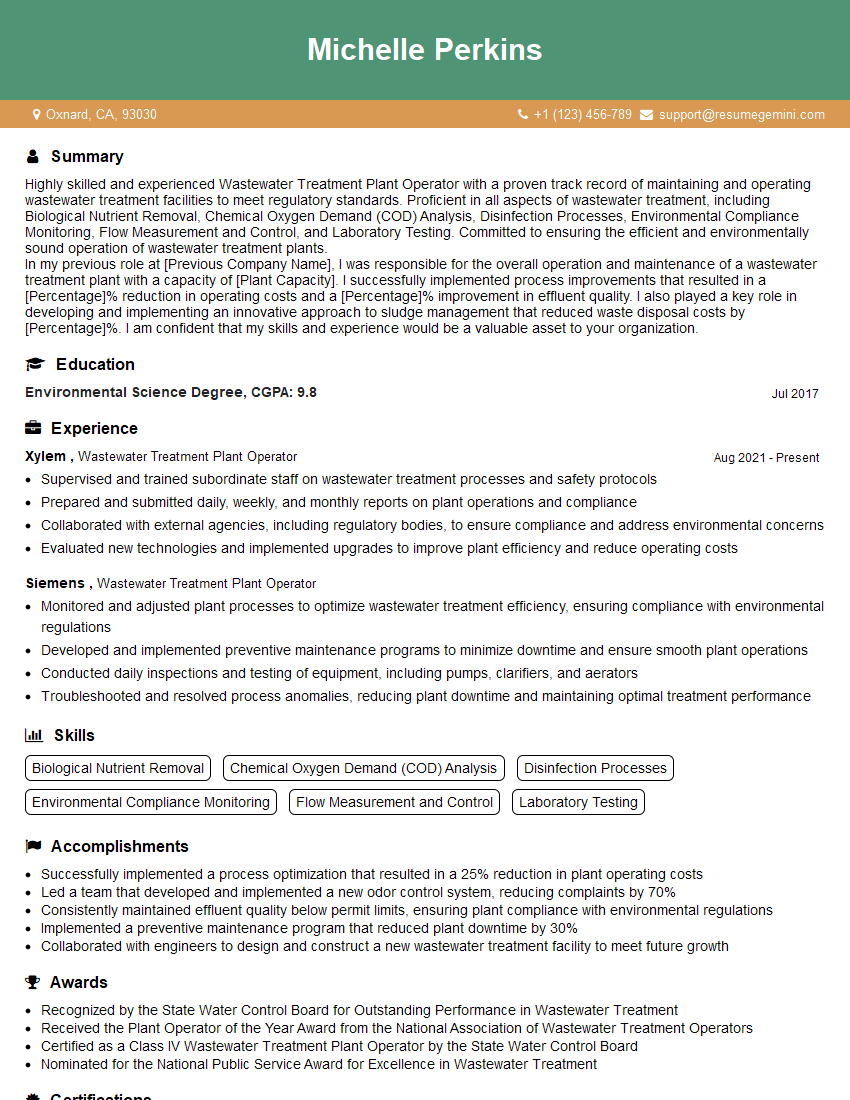
Wastewater Treatment Plant Operator Resume Sample
Explore more articles
Users Rating of Our Blogs
Share Your Experience
We value your feedback! Please rate our content and share your thoughts (optional).
What Readers Say About Our Blog
To the interviewgemini.com Webmaster.
Very helpful and content specific questions to help prepare me for my interview!
Thank you
To the interviewgemini.com Webmaster.
This was kind of a unique content I found around the specialized skills. Very helpful questions and good detailed answers.
Very Helpful blog, thank you Interviewgemini team.