Interviews are opportunities to demonstrate your expertise, and this guide is here to help you shine. Explore the essential Pump and Meter Maintenance interview questions that employers frequently ask, paired with strategies for crafting responses that set you apart from the competition.
Questions Asked in Pump and Meter Maintenance Interview
Q 1. Explain the different types of pumps and their applications.
Pumps are broadly classified based on their operating principle. Let’s explore some key types:
- Centrifugal Pumps: These are the most common type, using a rotating impeller to increase fluid velocity and pressure. They’re ideal for high-flow, low-pressure applications like water supply systems and irrigation. Imagine a spinning fan – it accelerates air, much like a centrifugal pump accelerates liquid.
- Positive Displacement Pumps: These pumps trap a fixed volume of fluid and move it through the system. Sub-types include rotary (gear, lobe, vane) and reciprocating (piston, diaphragm) pumps. Rotary pumps are great for viscous fluids like oil, while reciprocating pumps handle high-pressure applications such as hydraulic systems. Think of a syringe – it precisely displaces a fixed volume with each stroke.
- Axial Flow Pumps: These pumps use an impeller to accelerate the fluid in a direction parallel to the pump’s axis. They are excellent for high-flow, low-head applications such as drainage and irrigation systems. Picture a propeller pushing water.
- Submersible Pumps: As the name suggests, these pumps are submerged in the fluid they are pumping. This is especially useful for deep well applications or when pumping contaminated water.
The choice of pump depends heavily on the fluid properties (viscosity, abrasiveness), required flow rate, pressure head, and the overall application.
Q 2. Describe the principle of operation of a centrifugal pump.
A centrifugal pump operates on the principle of converting rotational energy into fluid energy. The impeller, a spinning disk with curved blades, accelerates the fluid. This increase in velocity translates to an increase in pressure. As the fluid is accelerated outward by the impeller, it flows into the volute (a spiral casing) which gradually increases in area, converting velocity into pressure. The pressurized fluid then exits the pump through the discharge port. Think of a spinning wheel throwing water outwards; the outward force becomes the pressure head.
Q 3. How do you troubleshoot a pump that is not delivering sufficient flow?
Troubleshooting insufficient flow requires a systematic approach:
- Check the suction side: Ensure there’s sufficient net positive suction head (NPSH). Low NPSH causes cavitation (discussed later). Verify the suction line is free from blockages or leaks, and that the suction strainer is clean. A partially clogged strainer is a very common culprit.
- Inspect the pump itself: Look for wear and tear on the impeller, seals, and bearings. A worn impeller reduces efficiency. Check the pump’s alignment and coupling for any misalignment which can create vibrations and reduce flow.
- Examine the discharge side: Check for blockages in the discharge piping or valves. A partially closed valve will dramatically reduce flow. Ensure the correct pipe size is used to prevent excessive pressure drops.
- Verify motor operation: Confirm the motor is running at its rated speed and power. A motor issue could be preventing the pump from operating correctly. Check the motor’s current draw – unusually high current may indicate a problem.
- Check system pressure: Higher-than-normal system pressure could be restricting the flow.
By methodically investigating these areas, you’ll pinpoint the cause and implement the necessary correction. Often, a simple cleaning or adjustment can resolve the problem.
Q 4. What are the common causes of pump cavitation and how can they be prevented?
Cavitation is the formation and collapse of vapor bubbles in a liquid due to low pressure. These collapsing bubbles can damage pump components. It sounds like tiny explosions inside the pump.
- Common Causes: Low NPSH (Net Positive Suction Head), high pump speed, excessive system pressure, high liquid temperature, partially clogged suction line.
- Prevention: Ensure adequate NPSH by checking suction pressure, reducing pump speed if necessary, optimizing suction pipe size and length to minimize frictional losses, checking for air leaks in the suction line, ensuring the fluid’s temperature is within the pump’s operating range. Regularly check and clean the suction strainer.
Cavitation is detrimental to pump performance and longevity; preventing it is crucial for efficient and reliable operation.
Q 5. Explain the different types of flow meters and their working principles.
Flow meters measure the volumetric flow rate of a fluid. Several types exist:
- Differential Pressure Flow Meters (e.g., orifice plate, venturi meter): These meters create a pressure drop across a restriction in the pipe. The pressure difference is proportional to the flow rate. They are relatively simple and inexpensive but can cause pressure losses.
- Positive Displacement Flow Meters: These meters measure flow by trapping and counting discrete volumes of fluid. They are very accurate but can be more expensive and less suitable for high viscosity fluids.
- Velocity Flow Meters (e.g., turbine, ultrasonic, electromagnetic): These meters measure the velocity of the fluid and calculate flow rate based on the pipe’s cross-sectional area. Turbine meters are rugged and reliable, while ultrasonic and electromagnetic meters are non-invasive and suitable for various fluids.
- Area Flow Meters (e.g., rotameter): These meters use a variable area to maintain a constant pressure drop while the flow rate varies.
The choice depends on accuracy requirements, fluid properties, cost constraints, and pressure drop considerations.
Q 6. How do you calibrate a flow meter?
Flow meter calibration involves comparing its readings to a known standard. The process typically involves:
- Establish a reference standard: This could be a precision flow meter or a volumetric tank and stopwatch method.
- Prepare the flow meter: Clean the meter and its associated components.
- Set up the calibration system: Create a system to allow for controlled and measured flow through the meter.
- Run a series of tests: Vary the flow rate through a wide range, recording both the meter reading and the reference standard’s reading.
- Analyze the results: Compare the meter readings against the reference readings to determine any deviations. This analysis will generate a calibration curve or correction factors.
- Adjust or replace the meter: If the deviations are beyond acceptable limits, the meter may need adjustment or replacement.
Calibration frequency depends on the meter type, application, and regulatory requirements. Regular calibration ensures accurate measurements.
Q 7. What are the common maintenance procedures for pumps?
Pump maintenance is crucial for reliability and efficiency. Common procedures include:
- Regular Inspections: Check for leaks, vibration, unusual noises, and proper lubrication.
- Lubrication: Follow the manufacturer’s recommendations for bearing lubrication. Insufficient or incorrect lubrication leads to premature wear.
- Seal Replacement: Pump seals wear out over time and require periodic replacement to prevent leaks. Regular inspections can catch a failing seal before it becomes a major problem.
- Bearing Replacement: Bearings are subject to wear and require replacement as needed. Excessive vibration or noise often indicates bearing wear.
- Impeller Inspection and Repair: Inspect the impeller for wear or damage. Worn impellers reduce efficiency and can require replacement or repair.
- Cleaning: Regularly clean the suction strainer and pump casing to prevent blockages and maintain performance. This applies to both the suction and discharge sides.
Preventive maintenance is far more cost-effective than emergency repairs. Developing a regular maintenance schedule based on the pump’s operating conditions and manufacturer’s recommendations is essential.
Q 8. How do you perform a pump vibration analysis?
Pump vibration analysis is crucial for preventative maintenance, allowing us to identify potential problems before they lead to costly breakdowns. We use specialized instruments like accelerometers and vibration analyzers to measure the vibrations produced by the pump. These measurements are then analyzed to identify the frequency, amplitude, and overall pattern of the vibrations. Different vibration patterns correspond to different issues, such as imbalance, misalignment, bearing wear, cavitation, or resonance.
For example, a high-amplitude vibration at a specific frequency might indicate an imbalance in the rotating components. This could be due to worn bearings, a damaged impeller, or simply an uneven distribution of weight. Analyzing the vibration data helps us pinpoint the root cause and recommend the appropriate corrective actions. Sophisticated software can even help predict potential failures by analyzing trends in vibration data over time.
The process typically involves:
- Selecting appropriate measurement points on the pump and motor.
- Attaching accelerometers to these points.
- Collecting vibration data across various operating conditions.
- Analyzing the data using specialized software to identify frequency and amplitude patterns.
- Interpreting the results to diagnose the problem.
Q 9. What are the safety precautions to be followed while working with pumps and meters?
Safety is paramount when working with pumps and meters. This involves following strict protocols and using appropriate personal protective equipment (PPE). Always remember that we’re dealing with potentially hazardous materials and high pressures.
- Lockout/Tagout Procedures: Before performing any maintenance, the pump must be completely isolated from the system using lockout/tagout procedures to prevent unexpected start-ups. This is crucial to prevent serious injury.
- Personal Protective Equipment (PPE): This includes safety glasses, gloves (chemical-resistant if handling potentially harmful fluids), steel-toe boots, and hearing protection (especially for noisy pumps). A hard hat is also recommended in many environments.
- Confined Space Entry: If working inside a pump casing or meter pit, confined space entry procedures must be strictly followed. This may involve atmospheric testing for oxygen levels, hazardous gases, and other potential dangers.
- Emergency Shutdown Procedures: Be familiar with the emergency shutdown procedures for the specific pump and system. Know where the emergency stop buttons are located and how to quickly shut down the equipment in case of an emergency.
- Hot Work Permits: If any welding, cutting, or other hot work is required, a hot work permit must be obtained and all necessary safety precautions must be followed.
Remember, a well-defined safety plan and thorough training are essential to minimize risks. Safety should always be the top priority.
Q 10. Explain the importance of lubrication in pump maintenance.
Lubrication is absolutely vital for the longevity and efficient operation of pumps. Proper lubrication reduces friction between moving parts, preventing wear and tear, reducing heat generation, and extending the lifespan of the pump. Without proper lubrication, components will wear out quickly leading to increased maintenance costs, potential failures, and downtime.
Think of it like this: imagine trying to move heavy furniture across a rough floor versus a polished, well-lubricated surface. The difference in effort and wear and tear is dramatic. Similarly, the lubricants in pumps minimize friction, reducing the energy required to operate the pump, and lessening the risk of damage to the internal components.
Different pump types require different types of lubricants, and the correct lubricant must be chosen based on factors such as the pump’s operating temperature and the fluid being pumped. Regular lubrication schedules, coupled with visual inspections for leaks or signs of contamination, are crucial for maintaining pump health.
Q 11. Describe the process of replacing a pump seal.
Replacing a pump seal is a common maintenance task that requires precision and care. The exact procedure will depend on the pump design, but the general steps are similar. Incorrect installation can lead to leaks and further damage.
- Isolate and Drain: Completely isolate the pump from the system using lockout/tagout procedures and drain the fluid from the pump casing. This is crucial to avoid spillage and ensure a clean working environment.
- Disassemble: Carefully disassemble the pump casing to access the pump seal. Take photos or make detailed notes to aid in reassembly.
- Remove Old Seal: Carefully remove the old seal, taking care not to damage the seal housing. Note the orientation and any special markings on the old seal.
- Clean and Inspect: Thoroughly clean the seal housing and ensure there is no damage to the shaft or housing that could impact the new seal’s performance.
- Install New Seal: Carefully install the new seal, ensuring it’s properly seated and oriented according to the manufacturer’s instructions. Avoid using excessive force, as this could damage the seal.
- Reassemble: Reassemble the pump casing, ensuring all components are correctly aligned and tightened to the manufacturer’s specifications.
- Test and Inspect: After reassembly, carefully test the pump for leaks. A small leak may indicate incorrect installation.
It is vital to refer to the pump’s specific maintenance manual for detailed instructions and component specifications. Using the wrong seal or improper installation techniques can result in premature seal failure and costly repairs.
Q 12. How do you diagnose and repair a leaking pump?
Diagnosing a leaking pump involves systematically checking potential sources of the leak. It’s a process of elimination.
- Identify the Leak Location: Pinpoint the exact location of the leak. This helps determine the likely cause – packing gland, seal, casing joint, etc.
- Check Packing Gland: If the leak originates from the packing gland, it might be due to worn packing, improper adjustment of the gland nuts, or a damaged shaft. Adjusting the gland or replacing the packing may solve this.
- Inspect Pump Seals: If the leak is coming from the seal area, the seal might be worn or damaged. It’s crucial to identify whether it’s a mechanical seal or a soft packing seal as replacement and repair techniques will vary considerably.
- Examine the Pump Casing: Inspect for cracks or damage in the pump casing. Small cracks can allow fluid to escape. Welding or replacement may be necessary in severe cases.
- Check Connections: Verify all pipe connections and fittings for leaks. Tightening loose connections or replacing damaged parts often resolves this issue.
Repair methods will vary based on the source of the leak. It may involve replacing a seal, packing, tightening bolts, or more extensive repair of the pump casing. Always remember to follow safety protocols before attempting any repairs.
Q 13. What are the common problems associated with positive displacement pumps?
Positive displacement pumps, unlike centrifugal pumps, move a fixed volume of fluid per rotation. This inherent characteristic leads to specific common problems:
- Internal Wear: Due to the close tolerances and direct contact of moving parts, wear and tear is a significant concern. This can lead to reduced efficiency, leakage, and eventual failure of internal components like gears, vanes, or lobes.
- Cavitation: If the inlet pressure is too low, cavitation (the formation of vapor bubbles) can occur. These bubbles can implode, causing significant damage to internal components, leading to noise, vibration, and reduced pump lifespan.
- Excessive Pressure: Because they displace a fixed volume, positive displacement pumps can generate very high pressures if the outlet is restricted. This can lead to damage to the pump or the piping system. Pressure relief valves are often used to prevent this.
- Lubrication Issues: Many positive displacement pumps require adequate lubrication to minimize wear and friction. Insufficient lubrication can result in rapid wear, seizing, and failure of the pump’s internal mechanisms.
- Fluid Viscosity: The viscosity of the pumped fluid can also significantly affect the pump’s performance. If the fluid is too viscous, it can lead to high pressures and increased wear. Conversely, low viscosity may lead to leakage or ineffective pumping.
Regular maintenance, including inspection of internal components, lubrication checks, and pressure monitoring, is critical to extend the lifespan and maintain the efficiency of positive displacement pumps.
Q 14. How do you troubleshoot a malfunctioning pressure gauge?
Troubleshooting a malfunctioning pressure gauge often involves a systematic approach.
- Visual Inspection: Begin with a visual inspection of the gauge itself. Check for any obvious damage, such as cracks in the glass, loose connections, or physical obstructions.
- Check Zero Point: Isolate the gauge and check if the needle points to zero when there is no pressure. If not, the gauge might need recalibration or repair.
- Compare to Other Gauges: If possible, compare the reading with other pressure gauges installed in the system. Discrepancies could point to a fault in the gauge itself.
- Verify Pressure Source: Ensure that the system itself is functioning correctly. A faulty pressure switch or other components in the system can give false pressure readings. Use a known good source of pressure to test the pressure gauge if possible.
- Inspect Tubing and Connections: Check the tubing and connections for leaks, kinks, blockages, or any other issues that might affect the pressure reading. Air bubbles in the line can also affect readings.
If the issue persists after these checks, it might be necessary to replace the pressure gauge with a calibrated one. Always follow safety procedures when working with pressurized systems.
Q 15. Explain the different types of pump bearings and their maintenance.
Pump bearings are crucial for smooth operation and longevity. Different bearing types suit various applications and operating conditions. The most common types are sleeve bearings, ball bearings, and roller bearings.
Sleeve Bearings: These are simple, cost-effective bearings consisting of a cylindrical sleeve of a bearing material (like bronze or babbitt) surrounding a rotating shaft. They’re suitable for low-speed, heavy-load applications. Maintenance involves regular lubrication checks and potential replacement of the sleeve if wear is excessive. Think of it like a well-oiled hinge on a heavy door – consistent lubrication is key.
Ball Bearings: These utilize steel balls to reduce friction between the shaft and the housing. They are excellent for high-speed applications but may require more frequent lubrication than sleeve bearings. Maintenance involves inspecting for wear and tear, and regular relubrication according to manufacturer’s recommendations. Think of a bicycle wheel – the balls allow for smooth rotation.
Roller Bearings: Similar to ball bearings, but use cylindrical rollers instead of balls, providing higher load capacity. They’re ideal for heavy-duty, high-load applications. Maintenance is similar to ball bearings – regular inspection, lubrication, and replacement as needed. Imagine the rollers on a conveyor belt – each roller handles a larger portion of the load.
Regardless of bearing type, regular vibration analysis and temperature monitoring are crucial. Excessive vibration or high temperatures indicate potential bearing failure and necessitate prompt maintenance.
Career Expert Tips:
- Ace those interviews! Prepare effectively by reviewing the Top 50 Most Common Interview Questions on ResumeGemini.
- Navigate your job search with confidence! Explore a wide range of Career Tips on ResumeGemini. Learn about common challenges and recommendations to overcome them.
- Craft the perfect resume! Master the Art of Resume Writing with ResumeGemini’s guide. Showcase your unique qualifications and achievements effectively.
- Don’t miss out on holiday savings! Build your dream resume with ResumeGemini’s ATS optimized templates.
Q 16. What is the significance of Net Positive Suction Head (NPSH)?
Net Positive Suction Head (NPSH) is the difference between the absolute pressure at the pump suction and the vapor pressure of the liquid being pumped. It’s vital because it ensures the liquid doesn’t cavitate. Cavitation occurs when the liquid pressure drops below its vapor pressure, forming vapor bubbles that implode, causing damage to the pump internals and reducing efficiency. Think of it like trying to suck liquid through a straw that’s too long – the liquid won’t reach your mouth because the pressure is insufficient.
Sufficient NPSH is essential for smooth pump operation. Insufficient NPSH leads to cavitation, which sounds like a rattling or growling noise. This damage can manifest as pitting on impeller blades or reduced pump efficiency. Ensuring adequate NPSH involves careful system design, considering factors like pipe diameter, elevation differences, and liquid properties. Proper sizing of the suction line and ensuring there are no blockages are critical.
Q 17. How do you calculate the pump efficiency?
Pump efficiency is the ratio of hydraulic power output to the power input. It reflects how well the pump converts input power into useful fluid power. It’s typically expressed as a percentage.
The calculation is:
Efficiency (%) = (Hydraulic Power Output / Power Input) x 100Hydraulic Power Output is calculated as: Pout = ρghQ where:
ρis the fluid densitygis the acceleration due to gravityhis the head developed by the pumpQis the volumetric flow rate
Power Input is measured directly from the pump’s power source (e.g., motor). A high efficiency percentage indicates an effective pump with minimal energy loss. Lower efficiency means more energy is wasted, usually as heat.
For example, if a pump has a hydraulic power output of 10 kW and a power input of 12 kW, its efficiency would be (10/12) x 100 = 83.33%. Regular maintenance and optimization of the pump system can help to improve the efficiency.
Q 18. What is the difference between a positive displacement meter and a differential pressure meter?
Positive displacement meters and differential pressure meters operate on different principles to measure fluid flow.
Positive Displacement Meters: These meters measure flow by precisely trapping a known volume of fluid and counting the number of times this volume is displaced. They are highly accurate for a wide range of flow rates but can be more expensive than other types. Imagine a measuring cup – each fill represents a known volume. Examples include nutating disk, oval gear, and rotary vane meters.
Differential Pressure Meters: These meters measure the pressure drop across a restriction (like an orifice plate or venturi tube) in the flow path. This pressure drop is proportional to the square of the flow rate. They are less accurate than positive displacement meters, especially at low flow rates, but they are generally more cost-effective. Imagine a garden hose with a partially closed nozzle – the reduced diameter increases the water velocity and pressure drop.
The choice between these meters depends on factors like accuracy requirements, flow rate range, fluid properties, and budget. For high-accuracy applications requiring precise volume measurements, positive displacement meters are preferred. For less critical applications where cost is a significant factor, differential pressure meters may be sufficient.
Q 19. How do you handle a pump that is overheating?
Pump overheating is a serious issue that can lead to damage and failure. Immediate action is crucial. The first step is to shut down the pump immediately to prevent further damage. Next, identify the cause of overheating. Common causes include:
- Insufficient lubrication
- Air in the system (leading to cavitation)
- Blocked filters or strainers
- Overloading the pump
- Mechanical issues within the pump itself
Once the cause is identified, address it. This might involve replenishing or changing the lubricant, purging air from the system, cleaning filters, reducing the pump’s load, or performing necessary repairs. After addressing the root cause, inspect the pump for any damage and replace parts as necessary. Before restarting, carefully check all connections and parameters. Consider adding additional cooling systems, such as an external heat exchanger, if overheating is a recurring problem.
Q 20. Explain the importance of regular pump inspections.
Regular pump inspections are paramount for preventing costly repairs and ensuring reliable operation. Preventive maintenance is far cheaper and more effective than emergency repairs. Inspections should include:
- Visual inspection: Check for leaks, corrosion, loose connections, and any signs of damage.
- Lubrication check: Verify the lubrication levels and condition of lubricants.
- Vibration analysis: Monitor vibration levels to detect imbalances or bearing wear.
- Temperature monitoring: Track operating temperatures to identify potential overheating issues.
- Performance checks: Measure flow rate, pressure, and power consumption to identify any deviations from optimal performance.
The frequency of inspections depends on the pump’s criticality and operating conditions. Critical pumps in high-demand operations might require daily inspections, while less critical pumps may require weekly or monthly checks. A well-documented inspection schedule and logbook are crucial for tracking maintenance activities and identifying trends.
Q 21. What are the different types of pump couplings and their applications?
Pump couplings connect the pump shaft to the driver (e.g., motor). Different coupling types are chosen based on the application’s specific needs. Some common types include:
Rigid Couplings: These provide a direct, rigid connection between the pump and motor shafts. They are simple, inexpensive, and suitable for applications where precise alignment is maintained and misalignment is minimal. However, they don’t accommodate any shaft misalignment.
Flexible Couplings: These accommodate some degree of misalignment between the pump and motor shafts, reducing stress and vibration. Types include elastomeric couplings (using rubber or similar materials to absorb vibrations) and jaw couplings (using metal components to allow for limited angular and parallel misalignment). They offer better protection against shock loads compared to rigid couplings.
Fluid Couplings: These use a fluid medium to transmit torque. They provide smooth starts, protect against shock loads, and dampen vibrations. However, they can be less efficient than other types.
Magnetic Couplings: These transmit torque magnetically, eliminating the need for direct mechanical contact between the pump and motor shafts. They are ideal for applications requiring hermetic sealing or where there is a need to isolate the pump and motor.
The selection of a coupling depends on factors such as the required torque transmission, acceptable misalignment, operating speed, and environmental conditions. Careful consideration of these factors is essential for ensuring optimal pump performance and preventing premature failure.
Q 22. Describe the process of aligning a pump.
Pump alignment is crucial for efficient operation and preventing premature wear. Misalignment can lead to increased vibration, reduced performance, and even catastrophic failure. The process typically involves ensuring the pump shaft is perfectly aligned with the driver shaft (e.g., motor or engine). This is usually done using a combination of methods such as:
- Laser alignment: A highly accurate method using lasers to project a straight line through the shafts. This provides precise measurements and is widely used in industrial settings.
- Dial indicator alignment: A more traditional method using dial indicators to measure shaft misalignment. It’s less precise than laser alignment but still effective for many applications. This method requires careful setup and measurement at multiple points.
- Reverse dial indicator method: This method reduces errors caused by shaft deflection by rotating the coupling and measuring at several points. It’s more involved but more precise for some applications.
The process generally involves:
- Preparation: Ensure the pump and driver are securely mounted and accessible.
- Measurement: Using the chosen method (laser or dial indicator), measure the shaft alignment at several points along the coupling.
- Adjustment: Adjust the pump’s feet or base to correct any misalignment. This may involve shims or other adjustment mechanisms.
- Re-measurement: Re-measure the alignment after adjustments to verify that it’s within acceptable tolerances.
- Documentation: Record the alignment measurements and any adjustments made. This creates a maintenance record that tracks alignment history.
For example, imagine a large centrifugal pump in a water treatment plant. Improper alignment could lead to excessive vibration, causing damage to the pump bearings and seals, resulting in costly repairs and downtime.
Q 23. How do you interpret pump performance curves?
Pump performance curves are graphical representations showing the relationship between a pump’s flow rate, head (pressure), and efficiency at various operating points. Understanding these curves is critical for selecting and operating pumps effectively. The curves typically show:
- Head-Capacity Curve: This plots the total dynamic head (TDH) the pump can generate against the flow rate. It shows the pump’s ability to deliver fluid at different flow rates under specific conditions.
- Efficiency Curve: Shows the pump’s efficiency (percentage of input power converted to useful fluid energy) at various flow rates. The point of maximum efficiency is crucial for optimizing pump operation.
- Power Curve: Plots the power required by the pump at different flow rates.
Interpreting these curves involves identifying the system’s operating point – the intersection of the pump’s head-capacity curve and the system’s head-capacity curve (representing the resistance of the piping system). This point shows the actual flow rate and head the pump will deliver in the system. Operating near the best efficiency point (BEP) is crucial to minimize energy consumption and maximize pump life.
For example, if the system curve intersects the pump curve at a low efficiency point, it might indicate the need for a more appropriately sized pump or system modifications to improve efficiency.
Q 24. What are the different types of meter accuracy classes?
Meter accuracy classes define the allowable error range for a flow meter. These classes are standardized to ensure consistent measurement quality across different manufacturers and applications. The classification often depends on the type of meter but generally follows standards like:
- Grade R: Represents reference-grade meters with extremely high accuracy, typically used for calibration purposes.
- Grade 1, 2, and 3: These grades are commonly used for general purposes. Grade 1 has the highest accuracy, while Grade 3 has the lowest.
- Other Classifications: Different meter types might have their specific accuracy classifications, often determined by the standards applicable to that kind of meter (e.g., IEC, ISO).
For example, a high-precision application like pharmaceutical manufacturing would require a Grade 1 or even a reference-grade meter. On the other hand, a less critical application like irrigation might be able to use a Grade 3 meter where a wider tolerance range is permissible.
Q 25. How do you select the appropriate pump for a specific application?
Selecting the right pump requires a thorough understanding of the application’s requirements. This process typically involves:
- Defining the Fluid Properties: Identify the fluid’s viscosity, density, temperature, and any corrosive or abrasive characteristics.
- Determining the System Requirements: Calculate the required flow rate (volume per unit of time) and total dynamic head (TDH) needed to overcome the system’s resistance (friction, elevation changes, etc.).
- Choosing the Pump Type: Select an appropriate pump type based on the fluid properties and system requirements. Different pump types (centrifugal, positive displacement, etc.) have different strengths and weaknesses. For instance, centrifugal pumps are suited for high flow rates with relatively low pressures, while positive displacement pumps excel at handling viscous fluids or maintaining precise flow rates.
- Reviewing Pump Performance Curves: Compare the pump performance curves to the system requirements to ensure the pump can meet the desired flow rate and head at an acceptable efficiency.
- Considering Materials of Construction: Choose materials compatible with the fluid’s characteristics to prevent corrosion or other damage.
- Evaluating Additional Factors: Assess factors like space constraints, noise levels, maintenance requirements, and cost.
For instance, a chemical processing plant handling a corrosive fluid will require a pump made of corrosion-resistant materials like stainless steel or special alloys. In contrast, a water pumping system might use a more standard cast iron pump.
Q 26. Explain the concept of hydraulic head.
Hydraulic head refers to the total mechanical energy of a fluid per unit weight. It represents the ability of the fluid to do work, encompassing various forms of energy:
- Elevation Head: The potential energy due to the fluid’s height above a reference point. Think of water stored in a tank; the higher the tank, the greater the elevation head.
- Pressure Head: The energy due to the fluid pressure. Higher pressure means greater pressure head.
- Velocity Head: The kinetic energy associated with the fluid’s velocity. Faster-moving fluid possesses greater velocity head.
The total dynamic head (TDH) is the sum of these three components. It’s a critical parameter in pump selection and system design because it represents the total energy the pump must provide to move the fluid through the system. Imagine a water pump lifting water from a well and delivering it to a house. The TDH would include the height of the water column (elevation), the pressure needed to overcome friction in pipes (pressure), and the velocity of water flow (velocity).
Q 27. How do you troubleshoot a flow meter that is giving inaccurate readings?
Troubleshooting an inaccurate flow meter involves a systematic approach:
- Verify Calibration: Check if the meter is properly calibrated. Calibration ensures the meter measures correctly within its specified accuracy range. If out of calibration, recalibrate or replace the meter.
- Inspect for Obstructions: Look for any obstructions in the flow path that could interfere with accurate measurement. This could include debris, sediment, or scale buildup. Clean the flow meter if necessary.
- Check for Leaks: Leaks upstream or downstream of the meter can cause inaccurate readings. Repair any leaks.
- Examine the Meter’s Condition: Inspect the meter for physical damage or wear and tear, including cracks, corrosion, or damaged seals. Repair or replace if needed.
- Verify Installation: Ensure the meter is installed correctly according to manufacturer specifications. Improper installation is a frequent source of errors.
- Check for External Influences: External factors like vibration, magnetic fields, or temperature fluctuations can affect flow meter readings. Determine whether external factors are interfering.
- Compare to a Reference Meter: If possible, use a known accurate meter to verify readings.
For instance, a positive displacement meter might show an inaccuracy due to wear on its internal components leading to leakage. A flow meter installed in a location with excessive vibration might provide erratic readings.
Q 28. What are the common causes of meter drift?
Meter drift refers to a gradual change in a flow meter’s reading over time, even when the actual flow rate remains constant. Several factors can cause this:
- Wear and Tear: Mechanical wear on internal components (e.g., bearings, seals) can affect the accuracy over time.
- Temperature Effects: Changes in temperature can affect the meter’s sensitivity and lead to drift.
- Corrosion: Corrosion of internal parts can alter the flow path, affecting the reading.
- Scale Build-up: Scale buildup inside the meter can restrict flow and change the meter’s reading.
- Component Degradation: Aging and degradation of electronic components (in electronic flow meters) can affect the readings.
Regular calibration and maintenance are essential to minimize meter drift and ensure accuracy. For example, in a water metering application, mineral buildup inside the meter can lead to a gradual under-reporting of the actual water flow over time.
Key Topics to Learn for Pump and Meter Maintenance Interview
- Pump Fundamentals: Understanding different pump types (centrifugal, positive displacement, etc.), their operating principles, and applications. Consider the practical implications of choosing the right pump for a specific task.
- Metering Technologies: Familiarize yourself with various metering methods (positive displacement, turbine, ultrasonic, etc.) and their accuracy, limitations, and maintenance requirements. Think about troubleshooting scenarios involving inaccurate readings.
- Preventive Maintenance: Mastering scheduled maintenance procedures, including lubrication, inspection, and component replacement. Practice explaining how preventive maintenance minimizes downtime and extends equipment lifespan.
- Troubleshooting and Repair: Develop your skills in diagnosing pump and meter malfunctions, identifying common problems (e.g., leaks, vibrations, low flow), and implementing effective repair strategies. Consider case studies of successful troubleshooting.
- Safety Procedures: Understand and apply relevant safety regulations and best practices for working with pumps and meters, including lockout/tagout procedures and hazard identification. Demonstrate your commitment to a safe work environment.
- Instrumentation and Control Systems: Gain familiarity with the instrumentation used to monitor pump and meter performance (pressure gauges, flow meters, etc.) and basic control systems. Consider how these systems work together to optimize performance.
- Hydraulics and Fluid Mechanics: A strong grasp of fundamental hydraulic principles (pressure, flow, head) is essential for understanding pump and meter operation and troubleshooting. Be prepared to discuss these concepts in practical terms.
Next Steps
Mastering Pump and Meter Maintenance opens doors to rewarding and stable careers in various industries. A strong foundation in this field demonstrates valuable technical skills and problem-solving abilities, leading to increased job opportunities and career advancement. To maximize your chances of landing your dream job, create an ATS-friendly resume that highlights your skills and experience effectively. ResumeGemini is a trusted resource that can help you build a professional and impactful resume, ensuring your qualifications shine. Examples of resumes tailored to Pump and Meter Maintenance are available to guide you through the process.

Calibration Technician Resume Sample

Process Technician Resume Sample

Hydraulic Technician Resume Sample

Operations Technician Resume Sample

Facility Technician Resume Sample

Plant Technician Resume Sample

Control Systems Technician Resume Sample
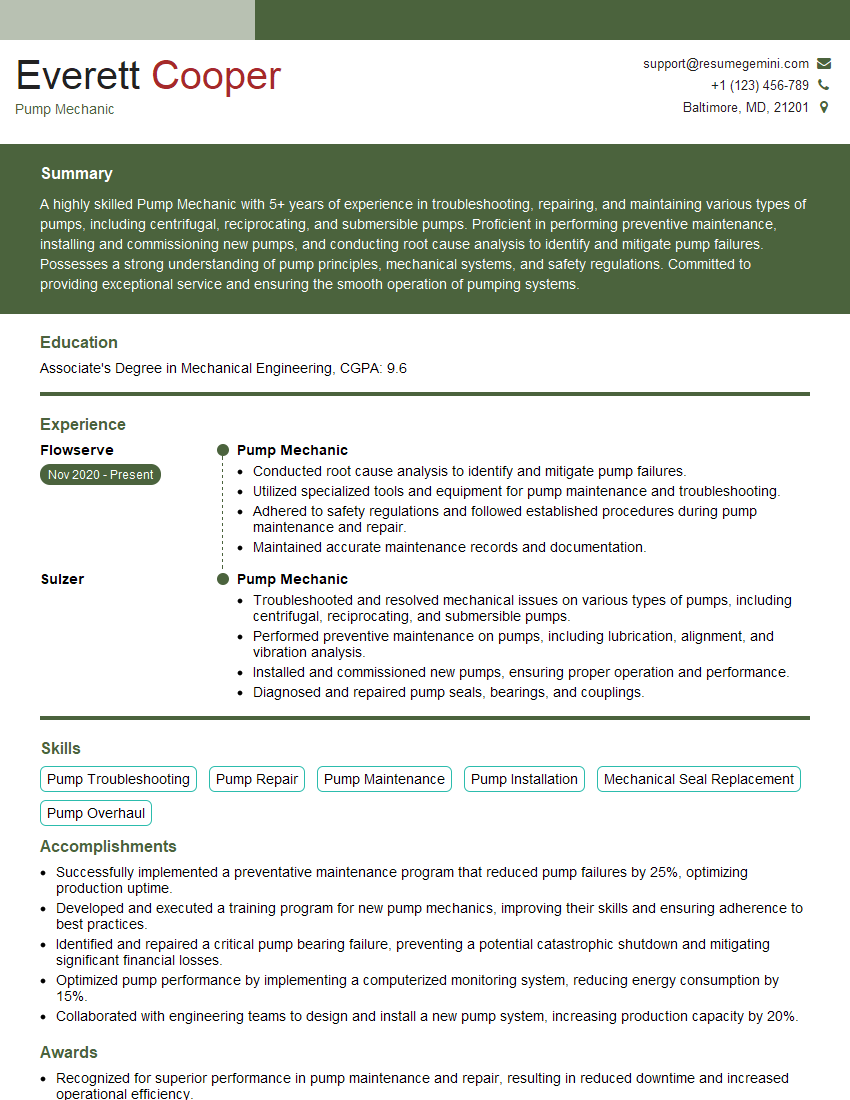
Pump Mechanic Resume Sample

Industrial Maintenance Technician Resume Sample

Instrumentation and Controls Technician Resume Sample
Explore more articles
Users Rating of Our Blogs
Share Your Experience
We value your feedback! Please rate our content and share your thoughts (optional).
What Readers Say About Our Blog
To the interviewgemini.com Webmaster.
Very helpful and content specific questions to help prepare me for my interview!
Thank you
To the interviewgemini.com Webmaster.
This was kind of a unique content I found around the specialized skills. Very helpful questions and good detailed answers.
Very Helpful blog, thank you Interviewgemini team.