Interviews are more than just a Q&A session—they’re a chance to prove your worth. This blog dives into essential Control and monitor gas flow and pressure interview questions and expert tips to help you align your answers with what hiring managers are looking for. Start preparing to shine!
Questions Asked in Control and monitor gas flow and pressure Interview
Q 1. Explain the principle of a pressure reducing valve.
A pressure reducing valve (PRV) is a crucial component in gas systems designed to lower the pressure of a gas stream to a safe and usable level. It achieves this by using a diaphragm or piston mechanism that responds to downstream pressure changes. Imagine a water balloon; the PRV acts like a valve controlling the water flow, ensuring a consistent, lower pressure despite fluctuations in the input pressure.
Here’s how it works: High-pressure gas enters the PRV. The pressure acts on a diaphragm or piston, pushing against a spring. This spring provides a setpoint pressure. When the downstream pressure is lower than the setpoint, the valve opens, allowing gas to flow. As the downstream pressure increases, the diaphragm or piston is pushed back, closing the valve and regulating the flow to maintain the setpoint pressure. Different types of PRVs exist, including pilot-operated and self-operated valves, each with its specific design and application.
For example, in a natural gas distribution network, PRVs are essential for reducing the high pressure from the pipeline to the safe operating pressure required for residential use. Without them, the risk of leaks and explosions is significantly increased.
Q 2. Describe different types of gas flow meters and their applications.
Several types of gas flow meters exist, each suited to specific applications depending on factors like gas type, pressure, flow rate, and accuracy requirements. Think of them like different tools for measuring different things – a ruler for precise small measurements and a tape measure for larger ones.
- Rotameter: A simple and visual flow meter. It uses a float within a tapered tube; the higher the flow rate, the higher the float rises. These are suitable for low-pressure applications and provide a good visual indication of flow.
- Orifice Plate: This meter uses a restriction (the orifice plate) to create a pressure drop. The pressure difference across the plate is proportional to the square of the flow rate. They are accurate and widely used but require careful installation and calibration. Suitable for higher-pressure applications.
- Turbine Meter: A spinning turbine inside the gas stream is directly proportional to the flow rate. These are robust, accurate and suitable for a wide range of flow rates and pressures. They are commonly used in industrial settings.
- Ultrasonic Meter: These meters use sound waves to measure the flow rate without needing any intrusive elements in the gas stream. They’re very accurate and ideal for applications where minimal pressure drop is required.
- Coriolis Meter: These measure mass flow rate directly by detecting the Coriolis force generated by the flowing gas. This type offers high accuracy and is suitable for various gas types.
The choice of meter depends on the specific application. For example, a rotameter might be suitable for a small laboratory experiment, while a turbine meter would be preferred for a large industrial gas pipeline.
Q 3. How do you troubleshoot a gas leak?
Troubleshooting a gas leak requires a systematic approach prioritizing safety. Never attempt to repair a gas leak yourself without proper training and equipment. Always call a qualified gas technician immediately if you suspect a leak.
The first step is to safely evacuate the area and ventilate. Then, you need to locate the leak. This often involves using a gas leak detector, which detects flammable gases by measuring changes in conductivity or using infrared sensors. A soapy water solution applied to suspected joints can also be used; bubbles will form at the point of a leak. Visual inspection is also essential for identifying damaged pipes or fittings.
Once the leak is located, isolate the gas supply – usually by turning off the relevant valve. After confirming that the gas is shut off, the leak can then be repaired by a qualified professional. It’s crucial to remember to purge the system completely of any remaining gas before attempting any repair.
Throughout this process, safety is paramount. Avoid sparks or open flames, ensure good ventilation, and remember that some gases are toxic.
Q 4. What safety precautions are essential when working with high-pressure gas systems?
Working with high-pressure gas systems demands strict adherence to safety protocols. It’s not just about following rules; it’s about protecting lives and preventing catastrophic events. The key principles include:
- Proper Training and Certification: Only trained and certified personnel should handle high-pressure gas systems.
- Personal Protective Equipment (PPE): This includes safety glasses, gloves, appropriate clothing, and respiratory protection, depending on the gas.
- Regular Inspections and Maintenance: Equipment should be regularly inspected for wear and tear, leaks, and proper functionality. Scheduled maintenance is crucial.
- Emergency Procedures: Everyone involved should know and understand emergency procedures for leak detection, containment, and evacuation.
- Lockout/Tagout Procedures: These procedures ensure that equipment is properly isolated before maintenance or repair work.
- Pressure Relief Devices: Pressure relief valves and rupture disks are crucial safety features that prevent over-pressurization.
- Appropriate Signage and Warning Labels: Clear signage warns of potential hazards.
- Proper Ventilation: Adequate ventilation is crucial to prevent gas buildup.
A failure to follow these precautions can lead to serious accidents, including explosions, fires, and asphyxiation.
Q 5. Explain the concept of gas flow rate and its measurement units.
Gas flow rate refers to the volume of gas passing a specific point in a given amount of time. Think of it like the speed of water flowing through a pipe – a faster flow rate means more water passes through in the same time. It’s a fundamental parameter in many gas handling processes.
Common units for gas flow rate include:
- Cubic meters per hour (m³/h): A common unit for volumetric flow rate.
- Cubic feet per minute (cfm): Another common unit for volumetric flow rate, frequently used in the US.
- Standard cubic meters per hour (Sm³/h) or Standard cubic feet per minute (scfm): These account for variations in temperature and pressure, providing a standardized measure.
- Kilograms per hour (kg/h) or pounds per hour (lb/h): These represent mass flow rate, which is particularly important when dealing with gas mixtures or gas density changes.
The choice of unit depends on the specific application and the desired accuracy. In some applications, standard volume flow rates are preferable to ensure consistency across varying environmental conditions.
Q 6. Describe your experience with SCADA systems in gas flow control.
I have extensive experience integrating and managing SCADA (Supervisory Control and Data Acquisition) systems for gas flow control in large-scale industrial applications. SCADA systems provide real-time monitoring and control of gas flow, pressure, and other parameters across geographically dispersed locations. This allows for remote monitoring and efficient management.
My experience involves configuring SCADA systems to interface with various field instruments, including flow meters, pressure transmitters, and gas analyzers. I’ve worked with different SCADA platforms, developing custom applications for data visualization, alarm management, and reporting. I’ve also been involved in designing and implementing control strategies to optimize gas flow, minimizing energy consumption and ensuring safe operation.
For example, I was part of a project where we implemented a SCADA system to monitor a vast natural gas pipeline network. This system provided real-time data on pressure and flow at various points along the pipeline, allowing for immediate detection and response to any anomalies. The system included automated control mechanisms to regulate pressure and flow, optimizing efficiency and safety.
Q 7. How do you calibrate gas flow meters?
Calibrating gas flow meters is essential for maintaining accuracy and ensuring reliable operation. The calibration procedure depends on the type of flow meter, but the general principles are similar: comparing the meter’s reading to a known standard.
The process typically involves using a calibration standard, such as a calibrated flow prover or a traceable reference flow meter. The gas flow meter is connected to the standard, and a known flow rate is established. The meter’s reading is then compared to the standard. Any deviations are noted, and adjustments are made to the meter, if possible, or correction factors are applied. This process is often repeated across a range of flow rates to create a calibration curve.
For example, to calibrate an orifice plate flow meter, you might use a bell prover – a large, precisely calibrated vessel used to measure gas volume. By measuring the time it takes to fill the bell prover with a known gas flow, the exact flow rate can be determined and compared to the meter’s reading.
Accurate calibration ensures that the flow meter provides accurate and reliable readings, crucial for safety, process control, and billing accuracy in gas distribution and industrial applications. Regular calibration is essential, with the frequency determined by factors like gas type, flow rate, and operational conditions. Proper documentation of the calibration process is also vital.
Q 8. What are the common causes of gas pressure fluctuations in a pipeline?
Gas pressure fluctuations in pipelines are a common challenge stemming from a variety of sources. Think of it like a water pipe – changes in flow can cause pressure changes. In gas pipelines, these changes can be caused by several factors:
- Changes in Demand: Increased consumption at peak times (like evenings in residential areas) can draw more gas from the pipeline, causing a pressure drop downstream. Conversely, reduced demand leads to increased pressure.
- Compressor Station Operation: Compressors boost gas pressure to overcome friction losses during long-distance transport. Malfunctioning compressors or fluctuations in their operation can directly impact downstream pressure.
- Pipeline Leaks: Leaks, even small ones, lead to pressure drops. The size and location of the leak will determine the severity of the pressure fluctuation.
- Temperature Variations: Gas expands with increasing temperature and contracts with decreasing temperature. This thermal expansion/contraction significantly impacts pipeline pressure, especially over long distances.
- Blockages or Restrictions: Anything obstructing the pipeline, such as debris, ice, or even corrosion buildup, will create pressure buildup upstream and reduction downstream.
- Altitude Changes: Elevational changes along the pipeline influence pressure; gas pressure tends to be lower at higher elevations.
Understanding these causes allows for better pipeline design, control system implementation, and predictive maintenance strategies.
Q 9. Explain the role of pressure regulators in gas distribution systems.
Pressure regulators are crucial components in gas distribution systems, acting as valves that automatically maintain a constant downstream pressure regardless of upstream pressure fluctuations. Think of them as carefully controlled valves that prevent a surge of water pressure from damaging your house plumbing.
Their role is to:
- Maintain Consistent Pressure: They reduce high-pressure gas from transmission pipelines to lower pressures suitable for residential, commercial, or industrial applications. This ensures safe and efficient gas delivery.
- Prevent Over-Pressurization: They protect downstream equipment and infrastructure from damage caused by excessive pressure.
- Protect against Under-Pressurization: They ensure sufficient pressure for appliances and processes to function correctly, even when upstream pressure drops.
- Improve Safety: Maintaining a consistent pressure helps prevent leaks and minimizes the risk of gas explosions.
Different types of pressure regulators exist, including pilot-operated, diaphragm-operated, and electronic regulators, each suited for specific applications depending on pressure ranges and control requirements.
Q 10. How do you handle emergency situations related to gas leaks or pressure surges?
Emergency situations like gas leaks or pressure surges require immediate and decisive action. Safety is paramount. My approach follows a structured procedure:
- Isolate the Affected Area: Immediately shut down the gas flow to the affected section of the pipeline using appropriate isolation valves. Safety protocols dictate that the area must be immediately evacuated.
- Emergency Response Team Notification: Immediately contact the emergency response team (fire department, gas company emergency services) and report the situation, providing exact location and details.
- Leak Detection and Repair: Once the area is secure, begin leak detection using specialized equipment such as leak detectors and ultrasonic sensors. Repairs should only be undertaken by trained personnel following safety procedures.
- Pressure Restoration: After the leak is repaired and safety is confirmed, the gas flow is slowly restored, carefully monitoring pressure and flow rates. Gradual restoration minimizes the chances of further issues.
- Root Cause Analysis: A thorough investigation is conducted to determine the root cause of the incident to implement preventive measures and prevent future occurrences. This may include pipeline inspections, equipment maintenance checks, and procedure reviews.
Effective emergency response relies on well-defined procedures, regular training, and readily available emergency equipment. Simulations and drills are essential in preparing for such events.
Q 11. What are the different types of gas compressors used in the industry?
Gas compressors are vital for long-distance gas transportation, boosting pressure to overcome frictional losses in the pipeline. Several types exist:
- Centrifugal Compressors: These use rotating impellers to accelerate the gas, increasing its pressure. They’re suitable for high-volume, low-pressure applications. Think of a fan, but much more powerful and designed for gas.
- Reciprocating Compressors: These use pistons to compress gas in a series of strokes. They are better suited for high-pressure applications but can be less efficient than centrifugal compressors for large volumes. This is similar to the piston in your car engine, but adapted for gas compression.
- Rotary Screw Compressors: These utilize intermeshing helical screws to compress gas, offering a balance between efficiency and pressure capabilities. They provide a smoother operation compared to reciprocating compressors.
- Axial Compressors: These use a series of rotating blades to compress gas, offering high efficiency at high flow rates. They are typically used in larger pipeline systems.
The choice of compressor depends on factors like gas type, required pressure increase, flow rate, and cost considerations. In many applications, a combination of compressor types may be used for optimal efficiency.
Q 12. Describe your experience with PLC programming in gas flow control applications.
I have extensive experience in PLC programming for gas flow control applications, using various platforms such as Siemens TIA Portal, Rockwell Automation Studio 5000, and Schneider Electric PL7. My experience encompasses:
- Supervisory Control and Data Acquisition (SCADA) Integration: I’ve programmed PLCs to interface with SCADA systems, allowing for real-time monitoring and control of gas flow parameters. This allows operators to see everything happening in the pipeline and adjust settings as needed.
- Flow Measurement and Control: I’ve developed PLC programs to read data from flow meters, analyze it, and manipulate control valves to maintain the desired flow rates. For example, a PID (Proportional-Integral-Derivative) control algorithm is commonly used for this.
// Example PID control loop (pseudocode): error = setpoint - measured_flow; output = Kp*error + Ki*integral(error) + Kd*derivative(error); - Pressure Regulation and Control: I’ve programmed PLCs to manage pressure regulators, ensuring the gas pressure remains within the specified range. This often involves reading pressure sensors and adjusting valve positions.
- Alarm and Safety Systems: I’ve incorporated safety features such as high/low pressure alarms, leak detection systems, and emergency shutdown procedures into my PLC programs. Ensuring system safety is paramount.
- Data Logging and Reporting: I’ve developed PLC programs that store operational data for analysis and reporting. This is crucial for maintenance scheduling, performance tracking, and regulatory compliance.
My expertise in PLC programming allows for the efficient and safe control of gas flow and pressure, ensuring optimized operation and minimizing risks.
Q 13. How do you ensure the accuracy of gas flow measurements?
Ensuring accurate gas flow measurement is critical for efficient operation and billing. Accuracy depends on several factors:
- Proper Meter Selection: Choosing the right type of flow meter (e.g., orifice plate, turbine meter, ultrasonic meter) is crucial, depending on the gas properties, flow rate, and pressure. Each meter type has its own strengths and limitations.
- Regular Calibration and Maintenance: Flow meters need regular calibration to ensure accuracy. Scheduled maintenance and cleaning are also essential to prevent wear and tear affecting readings. Think of it like getting your car’s speedometer checked and making sure it’s in good condition.
- Temperature and Pressure Compensation: Gas flow is affected by temperature and pressure. Therefore, accurate measurement requires compensation for these factors. This means applying correction factors to the raw meter readings based on temperature and pressure sensors.
- Data Validation and Verification: Regular checks on the meter readings are required using independent measurements or cross-checking with other data. Consistency across various readings is important.
- Environmental Factors Consideration: Environmental conditions like humidity or vibration can influence readings. Proper installation and shielding can mitigate these effects.
Accurate flow measurement involves a combination of proper instrumentation, regular maintenance, and data validation techniques, guaranteeing reliable and trustworthy data for operational and commercial purposes.
Q 14. Explain the importance of gas quality control in the transmission process.
Gas quality control is paramount during transmission, impacting pipeline integrity, safety, and the quality of the gas delivered to end-users. Maintaining gas quality involves:
- Moisture Removal: Water in natural gas can cause corrosion and hydrate formation, leading to pipeline blockages. Dehydration processes ensure minimal moisture content.
- Impurity Removal: Impurities like sulfur compounds, carbon dioxide, and other contaminants can corrode pipelines, damage equipment, and affect gas quality. Various cleaning techniques are employed.
- Odorization: Natural gas is odorless, making leaks difficult to detect. Adding an odorant like mercaptan allows for easier detection of leaks, enhancing safety.
- Monitoring Gas Composition: Regular analysis of gas composition ensures it meets specified standards for heating value and other properties. Chromatography is a common technique used here.
- Pipeline Integrity Management: Regular inspections and maintenance of the pipeline infrastructure are crucial in preventing leaks and ensuring gas quality.
Strict adherence to gas quality standards is essential for ensuring safe and reliable gas transmission. It’s a crucial aspect of managing risk and meeting regulatory requirements.
Q 15. What are the environmental regulations related to gas handling and emissions?
Environmental regulations governing gas handling and emissions are stringent and vary depending on location and the type of gas. They primarily focus on minimizing air pollution, preventing water contamination, and protecting public health and the environment. Key regulations often address:
- Greenhouse gas emissions: Regulations like the Clean Air Act (in the US) and similar international agreements aim to reduce emissions of methane and carbon dioxide, potent greenhouse gases often associated with gas production and transportation. This involves leak detection and repair programs, optimizing equipment efficiency, and potentially utilizing carbon capture and storage technologies.
- Air quality: Limits are placed on the emission of volatile organic compounds (VOCs), nitrogen oxides (NOx), and sulfur oxides (SOx), which contribute to smog, acid rain, and other environmental problems. This necessitates the use of emission control equipment like flares, catalytic converters, and scrubbers.
- Water pollution: Regulations prevent the discharge of gas-related pollutants into waterways. This includes managing produced water (water extracted along with gas) and preventing spills of gas or other hazardous materials.
- Waste management: Regulations govern the proper disposal or recycling of materials associated with gas handling, including spent catalysts and other waste streams.
Compliance requires meticulous record-keeping, regular monitoring, and potentially costly upgrades to equipment and processes. Failure to comply can result in significant fines and legal repercussions.
Career Expert Tips:
- Ace those interviews! Prepare effectively by reviewing the Top 50 Most Common Interview Questions on ResumeGemini.
- Navigate your job search with confidence! Explore a wide range of Career Tips on ResumeGemini. Learn about common challenges and recommendations to overcome them.
- Craft the perfect resume! Master the Art of Resume Writing with ResumeGemini’s guide. Showcase your unique qualifications and achievements effectively.
- Don’t miss out on holiday savings! Build your dream resume with ResumeGemini’s ATS optimized templates.
Q 16. Describe different methods used for controlling gas pressure in a pipeline.
Controlling gas pressure in a pipeline is critical for safety and efficient operation. Several methods are employed:
- Pipeline valves: These are the most basic method, allowing for the on/off control and throttling of gas flow to regulate pressure. They can be manually operated or automated through control systems.
- Compressor stations: These strategically placed facilities increase gas pressure along the pipeline, overcoming pressure losses due to friction and elevation changes. They are essential for long-distance transportation and maintaining consistent pressure.
- Pressure regulating stations (PRSs): These stations automatically maintain a consistent downstream pressure by reducing the pressure from the upstream pipeline. They employ pressure-reducing valves and often include bypass systems for safety and maintenance.
- Control valves: These precision valves, often controlled by automated systems, precisely adjust gas flow to maintain the desired pressure. They are commonly used in conjunction with PRSs and compressor stations for fine-tuning pressure control.
The choice of method depends on the specific pipeline parameters, distance, and required pressure levels. Complex pipelines may utilize a combination of these methods for optimal control.
Q 17. How do you maintain and repair gas flow control equipment?
Maintenance and repair of gas flow control equipment is crucial for ensuring safe and reliable operation. It typically involves:
- Regular inspections: Visual inspections, leak detection, and performance checks are conducted routinely, often following a pre-defined schedule. This helps identify potential problems early.
- Preventive maintenance: Scheduled maintenance includes cleaning, lubrication, and replacement of worn parts. This extends the lifespan of equipment and minimizes unexpected failures.
- Calibration: Regular calibration ensures that instrumentation and control systems are providing accurate measurements. This is vital for maintaining proper pressure and flow control.
- Repair and replacement: When issues are detected, repairs are carried out following safety protocols and using appropriate tools and parts. Damaged or worn-out components may need replacement.
- Documentation: Meticulous record-keeping is essential, documenting all maintenance and repair activities. This aids in troubleshooting and helps to identify trends or potential issues.
Safety is paramount during all maintenance activities. Lockout/tagout procedures are strictly followed to prevent accidental gas releases or equipment activation.
Q 18. What are the potential hazards associated with gas compression stations?
Gas compression stations present several potential hazards:
- High-pressure gas: The primary hazard is the high-pressure gas itself. Leaks can lead to explosions, fires, and asphyxiation.
- Flammable gas: Many gases are flammable, making fire and explosion a significant risk. Ignition sources, such as electrical sparks or hot surfaces, must be meticulously controlled.
- Toxic gases: Some gases are toxic, posing health risks to workers and the surrounding community. Proper ventilation and personal protective equipment are crucial.
- Equipment failure: Failure of compressors, valves, or other equipment can lead to uncontrolled gas releases, creating dangerous situations.
- Electrical hazards: High-voltage electrical systems are present in compression stations, posing risks of electrocution.
Mitigation involves robust safety systems, regular inspections, emergency response plans, and comprehensive employee training. Redundant systems and fail-safes are often incorporated to minimize the impact of equipment failures.
Q 19. Describe your experience with gas pipeline safety regulations.
My experience with gas pipeline safety regulations is extensive. I’ve been involved in projects encompassing compliance with regulations such as the federal Pipeline Safety regulations (in the US) and equivalent international standards. This includes:
- Risk assessment: Conducting thorough risk assessments to identify potential hazards and implement appropriate mitigation strategies.
- Integrity management: Implementing integrity management programs, involving regular pipeline inspections, leak detection, and maintenance to ensure the safe operation of the pipeline.
- Emergency response planning: Developing and practicing emergency response plans to handle gas leaks, explosions, or other incidents. This includes establishing clear communication protocols and evacuation procedures.
- Compliance audits: Conducting regular audits to ensure compliance with all applicable regulations and industry best practices.
- Incident investigation: Investigating incidents to identify root causes and implement corrective actions to prevent recurrence.
I’m thoroughly familiar with the documentation and reporting requirements associated with these regulations and have a strong track record of ensuring compliance.
Q 20. Explain the role of instrumentation and control systems in gas pipeline monitoring.
Instrumentation and control systems (ICS) are the backbone of gas pipeline monitoring. They provide real-time data on pressure, flow, temperature, and other critical parameters, allowing for efficient operation and safety. Key components include:
- Sensors: These devices measure various parameters, such as pressure transducers, flow meters, and temperature sensors. Data from these sensors is relayed to the control system.
- Control valves: These automated valves regulate gas flow and pressure based on setpoints or control algorithms.
- SCADA (Supervisory Control and Data Acquisition) systems: These systems collect data from sensors, process it, and provide a centralized view of the pipeline’s status. Operators can monitor the entire system and intervene as needed.
- PLC (Programmable Logic Controllers): PLCs perform automated control functions based on pre-programmed logic. They often interface directly with control valves and other field equipment.
- Data historians: These systems store historical data, allowing for trend analysis, performance monitoring, and troubleshooting.
The ICS provides early warning of potential problems, allowing for timely intervention to prevent accidents and ensure efficient operation. Data analysis can also help optimize pipeline performance and reduce costs.
Q 21. How do you interpret gas flow and pressure data from SCADA systems?
Interpreting gas flow and pressure data from SCADA systems requires a thorough understanding of pipeline dynamics and operational parameters. I typically approach this by:
- Visual inspection: First, I visually inspect the data trends displayed on the SCADA screens, looking for unusual patterns or anomalies. This might include sudden pressure drops, unexpected flow increases, or deviations from the expected behavior.
- Data analysis: I use analytical tools within the SCADA system to perform more detailed analysis, potentially comparing current data to historical trends or applying statistical methods to identify patterns.
- Correlation with other data: I correlate flow and pressure data with other parameters such as temperature and compressor performance to understand the underlying causes of any deviations.
- Alarm management: I assess alarm conditions reported by the SCADA system, prioritizing those that indicate potential safety hazards.
- Root cause analysis: When issues are identified, I conduct a root cause analysis to determine the underlying causes and implement appropriate corrective actions.
For example, a sudden pressure drop might indicate a leak, while a gradual pressure decrease could be due to increased demand or a problem with a compressor station. Understanding the context of the data is crucial for accurate interpretation and effective problem-solving.
Q 22. How do you troubleshoot common problems with gas flow control valves?
Troubleshooting gas flow control valves involves a systematic approach. First, I’d check for obvious issues like a closed valve or a clogged line. Then, I move to more advanced diagnostics. For example, if the valve isn’t opening or closing properly, I’d check the actuator – is it receiving the correct signal? Is there a power supply problem? I would also check the valve’s internal components for wear and tear or damage. Is the valve stem stuck? Are there any leaks? I’d use pressure gauges and flow meters to measure pressure drops across the valve and flow rates to pinpoint the problem. Instrumentation is key here. Finally, I’d consult the valve’s technical documentation for specific troubleshooting steps and consider contacting the manufacturer for support if needed.
For instance, I once worked on a gas pipeline where a control valve was failing intermittently. After checking the electrical connections and confirming proper actuator function, I found a small particle lodged within the valve seat, restricting flow. Removing the particle restored normal operation.
Q 23. Describe your experience with different types of gas flow control algorithms.
I’ve worked extensively with various gas flow control algorithms, including PID (Proportional-Integral-Derivative) control, which is very common for its ability to handle disturbances and maintain setpoints. PID controllers adjust the valve position based on the error between the desired flow rate and the actual flow rate. I’ve also used more advanced algorithms like model predictive control (MPC), which takes into account future predictions to optimize control and prevent oscillations. MPC is particularly useful in complex systems with multiple interacting variables. Another algorithm is cascade control where a master controller regulates the main flow and a secondary controller adjusts a smaller flow variable. Finally, I’m familiar with fuzzy logic controllers which are excellent for handling non-linear systems and systems where precise models are unavailable. The choice of algorithm depends heavily on the specific application and its complexity. For instance, simple on/off control is sometimes suitable for low-accuracy applications.
Q 24. What are the key performance indicators (KPIs) for gas flow control systems?
Key Performance Indicators (KPIs) for gas flow control systems focus on safety, efficiency, and reliability. They include:
- Accuracy: How closely the actual flow rate matches the setpoint. Deviation from the setpoint is critical.
- Response Time: How quickly the system reacts to changes in demand or disturbances.
- Stability: The system’s ability to maintain consistent flow without oscillations.
- Safety: Number of incidents, alarms and near misses related to pressure and flow issues.
- Efficiency: Minimizing gas consumption or wastage.
- Reliability: Uptime and mean time between failures (MTBF) of the control system and equipment.
- Maintainability: Ease and cost of maintenance and repairs.
Monitoring these KPIs through a SCADA (Supervisory Control and Data Acquisition) system is crucial for ensuring optimal performance and identifying potential problems early on.
Q 25. Explain how to calculate gas flow rate using orifice plate flow meters.
Calculating gas flow rate using an orifice plate flow meter involves applying the following equation, which is a form of Bernoulli’s equation:
Q = Cd * A * √(2ΔP/ρ)
Where:
Qis the volumetric flow rate (e.g., m³/s)Cdis the discharge coefficient (dimensionless), a factor accounting for losses due to friction and flow profile.Ais the area of the orifice opening (m²)ΔPis the pressure difference across the orifice plate (Pa)ρis the density of the gas (kg/m³)
The discharge coefficient (Cd) is empirically determined and depends on factors like the Reynolds number and the orifice plate’s geometry. Manufacturers’ data sheets usually provide this value or equations to determine it. Accurate measurement of pressure drop (ΔP) is crucial; it’s typically done using pressure taps located upstream and downstream of the orifice plate. The gas density (ρ) is a function of pressure and temperature, which must also be measured accurately. One must also account for non-ideal gas behavior at high pressure conditions using the appropriate compressibility factor.
Q 26. How do you ensure compliance with safety standards and regulations?
Ensuring compliance with safety standards and regulations is paramount in gas flow control. This involves adhering to industry codes and standards (e.g., API, ASME, OSHA) for equipment design, installation, operation, and maintenance. We meticulously document all procedures and regularly inspect equipment for leaks, corrosion, and other potential hazards. Safety systems, like pressure relief valves, emergency shutdown systems, and gas detection systems, are regularly tested and maintained. All personnel receive appropriate safety training and are required to follow established safety protocols. Comprehensive risk assessments are conducted to identify and mitigate potential hazards. Regular audits are performed to ensure continuous compliance. In my experience, proactive safety measures and consistent adherence to standards are vital to preventing accidents.
Q 27. Describe your experience with predictive maintenance for gas control equipment.
Predictive maintenance plays a crucial role in minimizing downtime and improving the reliability of gas flow control equipment. We utilize data analytics and machine learning techniques to analyze sensor data from various components, such as valves, actuators, and pressure gauges. This allows us to identify patterns and predict potential failures before they occur. For example, an increase in vibration or a gradual decline in actuator response time could be indicative of impending failure. Based on these predictions, we schedule preventive maintenance activities, such as replacing worn-out parts or performing lubrication, thereby avoiding costly emergency repairs and potentially hazardous situations. We use techniques like vibration analysis, infrared thermography, and oil analysis to monitor equipment health. This proactive approach significantly enhances the safety and efficiency of the gas flow control system.
Q 28. What are your strategies for managing complex gas flow control scenarios?
Managing complex gas flow control scenarios requires a multi-faceted approach. Firstly, a thorough understanding of the system dynamics is crucial. This means developing accurate models of the various components and their interactions. Secondly, advanced control strategies, such as model predictive control (MPC), are essential for optimizing performance in the face of multiple interacting variables and constraints. Thirdly, robust instrumentation and real-time monitoring are vital for ensuring effective control and early detection of anomalies. This involves using advanced sensors, data acquisition systems, and SCADA software. Finally, a strong team of experienced engineers is needed to design, implement, and maintain the system. For example, in a large refinery with numerous interconnected gas streams, I would use a distributed control system (DCS) to coordinate the flow control of multiple gas streams to maintain optimal process conditions, always prioritizing safety and efficiency. Simulation plays a big part in testing different strategies and optimizing system performance before actual implementation.
Key Topics to Learn for Control and Monitor Gas Flow and Pressure Interview
- Gas Flow Measurement Techniques: Understanding different flow meters (e.g., orifice plates, rotameters, ultrasonic flow meters), their principles of operation, limitations, and selection criteria for specific applications.
- Pressure Measurement and Control: Familiarity with various pressure sensors (e.g., pressure transducers, manometers), pressure control valves, and their applications in regulating gas pressure within specified limits. Understanding pressure units and conversions.
- Gas Properties and Behavior: Knowledge of ideal gas law, compressibility factors, and the impact of temperature and pressure on gas flow and density. Understanding the behavior of different gas types.
- Safety and Regulatory Compliance: Familiarity with relevant safety regulations and procedures for handling gases, including leak detection and prevention methods, emergency response protocols, and personal protective equipment (PPE).
- Control Systems and Instrumentation: Understanding basic control loop principles (e.g., PID control), process control instrumentation (e.g., transmitters, controllers, actuators), and data acquisition systems used in gas flow and pressure control.
- Troubleshooting and Problem-Solving: Ability to diagnose and resolve common issues related to gas flow and pressure control, such as pressure drops, leaks, and malfunctioning equipment. Experience with root cause analysis techniques.
- SCADA Systems (Supervisory Control and Data Acquisition): Understanding the role of SCADA systems in monitoring and controlling gas flow and pressure in large-scale applications. Familiarity with common SCADA interfaces and data visualization techniques.
- Automation and Programmable Logic Controllers (PLCs): Experience with PLC programming and its application in automated gas flow and pressure control systems. Understanding ladder logic or other programming languages.
Next Steps
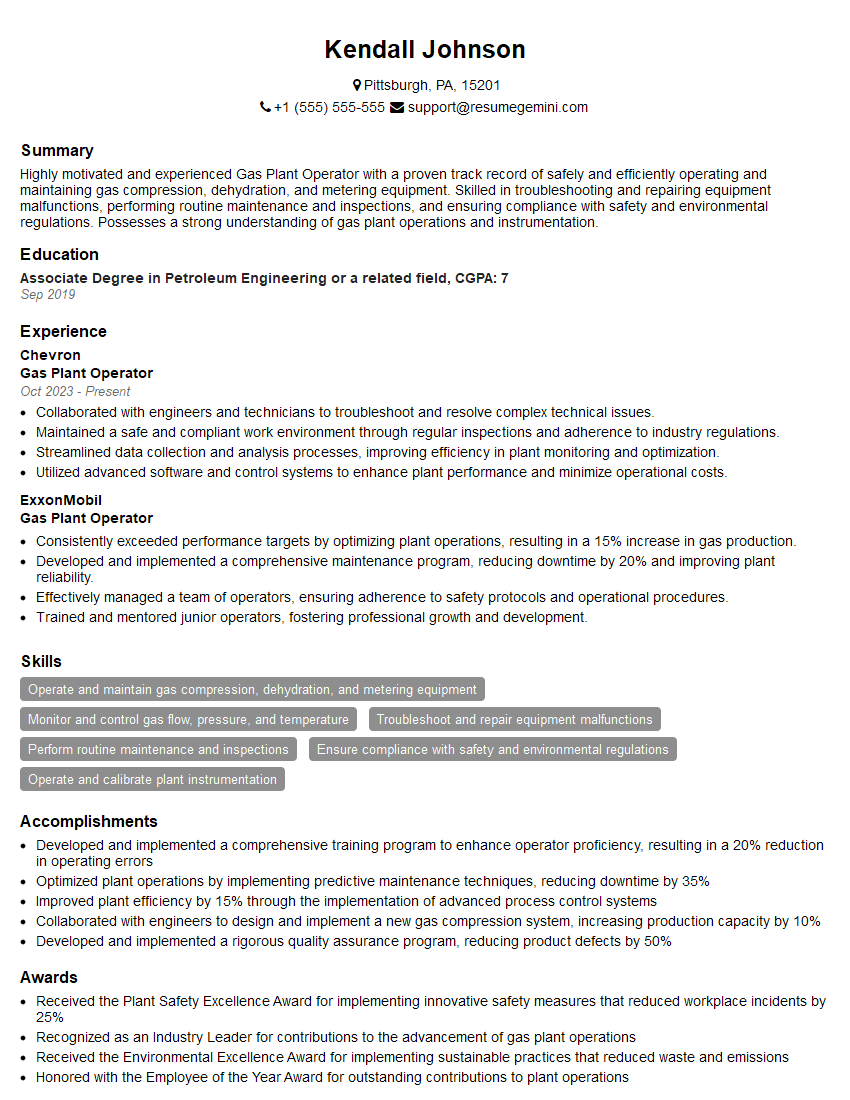
Mastering the control and monitoring of gas flow and pressure opens doors to exciting career opportunities in various industries. A strong understanding of these principles demonstrates your technical expertise and commitment to safety. To significantly enhance your job prospects, create an ATS-friendly resume that highlights your skills and experience effectively. ResumeGemini is a trusted resource to help you build a professional and impactful resume. They provide examples of resumes tailored specifically to roles involving Control and monitor gas flow and pressure, helping you present yourself as the ideal candidate.
Explore more articles
Users Rating of Our Blogs
Share Your Experience
We value your feedback! Please rate our content and share your thoughts (optional).
What Readers Say About Our Blog
To the interviewgemini.com Webmaster.
Very helpful and content specific questions to help prepare me for my interview!
Thank you
To the interviewgemini.com Webmaster.
This was kind of a unique content I found around the specialized skills. Very helpful questions and good detailed answers.
Very Helpful blog, thank you Interviewgemini team.